
Epilator Market Share, Growth & Forecast by 2034
Coverage: By Type (Tweezer, Spring, Wet-Use, Rotating Disc Epilator); Distribution Channel (Online, Offline), and Geography (North America, Europe, Asia Pacific, and South and Central America)
- Status : Data Released
- Report Code : TIPRE00016008
- Category : Electronics and Semiconductor
- No. of Pages : 150
- Available Report Formats :


- Last update date : August 25, 2026


2025 Market Size
US$ 477.93 Mn
Base year value
2034 Forecast
US$ 790.31 Mn
Projected by 2034
CAGR 2026-2034
5.75 %
Growth rate
Addressable Market
US$ 5,748.09 Mn
(2026-2034)
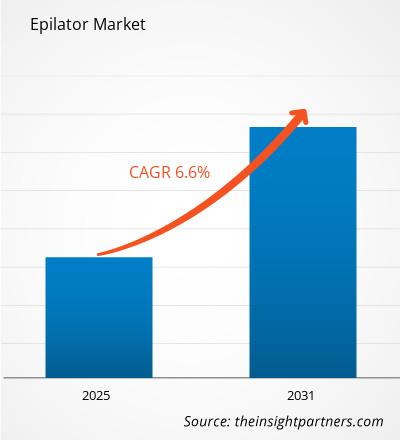
The Epilator Market size awas valued at US$ 477.93 Million in 2025 and is projected to reach US$ 790.31 Million by 2034, registering a CAGR of 5.75% from 2026 to 2034. Expansion is supported by increasing preference for at-home grooming, product improvements focused on comfort and precision, and broader availability through digital retail. The category continues shifting from basic hair removal toward multifunctional personal-care devices combining convenience, portability, and skin-comfort features.
North America remains an established demand center, with the Epilator Market supported by high household penetration of personal-care appliances, premium beauty-device purchasing, and strong omnichannel distribution. The region is estimated to expand at a 5.1–5.6% CAGR during 2026–2034. Product differentiation around cordless operation, wet-use capability, ergonomic handling, and precision illumination is expected to sustain replacement and upgrade demand.
Epilator Market Assessment and Insights
- North America: North America is estimated to hold a 31–35% Epilator Market share in 2025 and grow at a 5.1–5.6% CAGR between 2026–2034, supported by premiumization, established grooming routines, and broad retail availability.
- US: The US accounts for 78–82% of North American demand in 2025 and is projected to grow at a 5.0–5.5% CAGR between 2026–2034, led by premium cordless devices.
- Europe: Europe represents a 28–32% share in 2025 and is expected to expand at a 5.0–5.5% CAGR between 2026–2034, with Germany, the UK, France, Italy, and Spain supporting demand through mature personal-care consumption.
- Asia Pacific: Asia Pacific holds a 23–27% share in 2025 and is projected to grow at a 6.5–7.2% CAGR between 2026–2034, with China, Japan, India, South Korea, and Australia leading adoption.
- Largest Segment: Tweezer epilators hold a 46–50% market share in 2025 and are expected to grow at a 5.2–5.7% CAGR during 2026–2034, reflecting broad consumer familiarity.
- High Growth Segment: Online distribution represents a 38–42% market share in 2025 and is projected to grow at a 7.0–7.8% CAGR during 2026–2034, benefiting from digital discovery.
- Key companies analyzed in detail: Koninklijke Philips N.V., The Procter & Gamble Company, Panasonic Holdings Corporation, Conair Corporation, Spectrum Brands Holdings, Inc., Beurer GmbH, Emjoi, Inc., Epilady USA Inc., Wahl Clipper Corporation, Andis Company.
Source: The Insight Partners' analysis based on proprietary research, government publications, company annual reports, investor presentations, industry databases, and expert interviews.
The Epilator Market growth is influenced by a value chain which starts from precise parts suppliers and motor manufacturers and goes through product assemblers, beauty firms, distributors, marketplaces, and specialty retailers. Consumer interest is driven by a preference for lasting substitutes for shaving and maintaining the convenience of at-home treatment. The competitive landscape favors the integration of more grooming functions into single devices.
The flexibility of supply is preserved owing to the use of components common in the consumer electronics industry by epilators, allowing for the release of new versions by established personal care firms and contractors without having to redesign their production lines. Quality control, battery life, water resistance, durability, and compatibility with attachments are still important factors in procurement. Pricing is influenced by sourcing costs, availability of parts, and exchange rates.
Epilator Market Report Scope
| Report Attribute | Details |
|---|---|
| Market size in 2025 | US$ 477.93 Million |
| Market Size by 2034 | US$ 790.31 Million |
| Global CAGR (2026 - 2034) | 5.75% |
| Historical Data | 2021-2024 |
| Forecast period | 2026-2034 |
Epilator Market Analysis
The Epilator Market report indicates that growth is influenced by a value chain which starts from precise parts suppliers and motor manufacturers and goes through product assemblers, beauty firms, distributors, marketplaces, and specialty retailers. Consumer interest is driven by a preference for lasting substitutes for shaving and maintaining the convenience of at-home treatment. The competitive landscape favors the integration of more grooming functions into single devices.
The flexibility of supply is preserved owing to the use of components common in the consumer electronics industry by epilators, allowing for the release of new versions by established personal care firms and contractors without having to redesign their production lines. Quality control, battery life, water resistance, durability, and compatibility with attachments are still important factors in procurement. Pricing is influenced by sourcing costs, availability of parts, and exchange rates.
Product differentiation is becoming more and more dependent on technology, brand reputation, sales channels, and post-sale service. The company Koninklijke Philips N.V. relies on ceramic tweezers, dual wet-and-dry usage, illumination, and multifunctional beauty system; The Procter & Gamble Company offers Braun products with such qualities as precision, ergonomics, and high-quality hair removal. Panasonic Holdings Corporation specializes in compact precision instruments and personal care engineering.
As for The Epilator Market analysis, it shows that the importance of digital marketing strategies including merchandise, reviews, influencer marketing, and consumer education is becoming higher. As for positioning, the companies Conair Corporation and Spectrum Brands Holdings, Inc. remain easy to understand, and Beurer GmbH, Epilady USA Inc., Emjoi, Inc., Wahl Clipper Corporation, Andis Company become new competitors. The direction of investment in the future will be the development of rechargeable systems, modularity, and portability of the products.
● REPORT CUSTOMIZATION
Tailor This Report To Align With Your Specific Business Requirements
This report can be customized to align precisely with your business objectives, scope, and target markets. Customization options include tailored segmentation, geography, competitive analysis, and strategic insights to support informed decision-making.
Customize This Report →WHAT YOU CAN ADJUST
- ● Segmentations
- ● Geography
- ● Competitive Analysis
- ● Language Preferences
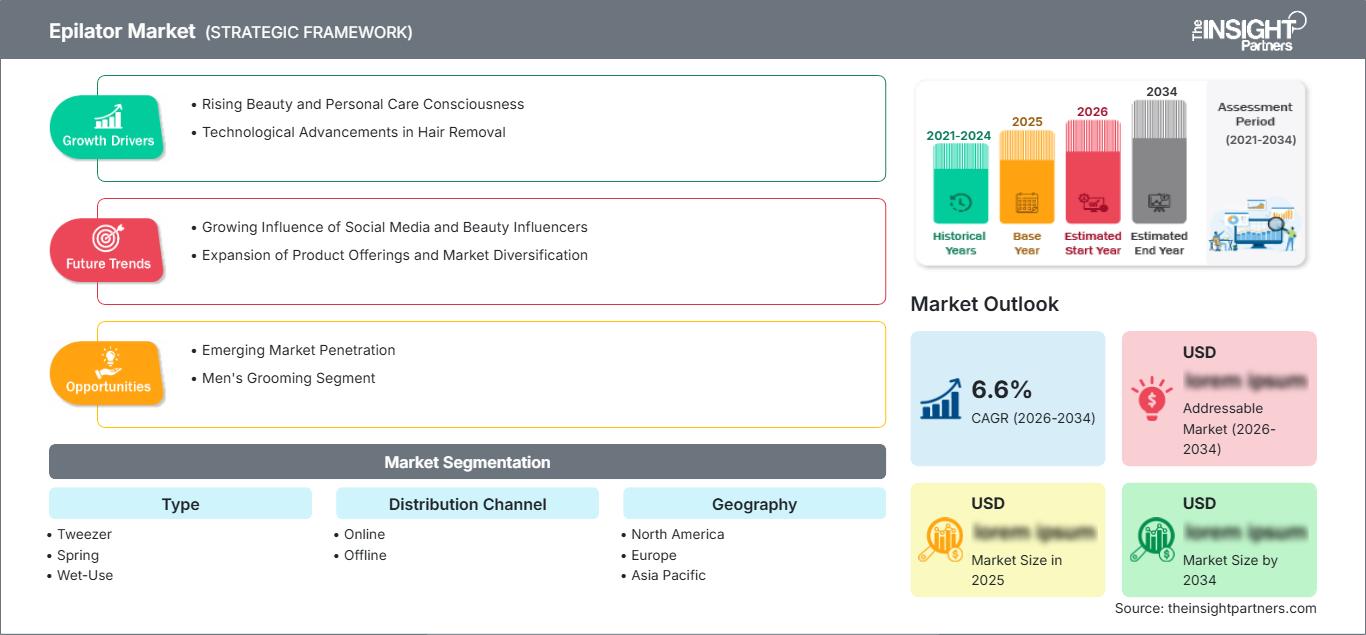
Epilator Market: Strategic Insights
Regional Insights
North America Epilator Market
It is expected that North America will have a share of 31–35% of the world's demand and will grow at a 5.1–5.6% CAGR till 2034. The US forms the leading market in this region while Canada contributes to it via existing personal-care retail infrastructure and acceptance of premium appliances. Buyers express high interest in cordless tools, wet operation, numerous attachments, and special light.
The presence of mature retail allows for buying both replacements and premium appliances. They can be purchased in department stores, beauty retailers, pharmacies, marketplaces, and branded web sites while comparisons of product specifications become more common in purchase decisions. The competitive situation in this region favors mature brands with extensive service infrastructure and established grooming range. Increased purchasing power of households enables manufacturers to release premium tools with advanced ergonomic design, ceramic construction, and numerous attachments without being price-oriented only.
U.S. Epilator Market Market
The US constitutes 78-82% of North American demand in 2025 and is expected to grow at a 5.0-5.5% CAGR till 2034. Favorable factors in the market include established personal-grooming habits, good marketplace penetration, and wide availability of high-end as well as mid-tier products. The brands such as Koninklijke Philips N.V., The Procter & Gamble Company, Conair Corporation, and Spectrum Brands Holdings, Inc. enjoy significant recognition in all types of hair removal.
Consumption patterns include full-body grooming, facial hair trimming, bikini hair trimming, and multi-purpose beauty regimens. Cordless devices are especially useful for convenience, and wet-use feature helps position the product in a comfort-oriented manner. Comparison of accessories, battery performance, speeds, illumination, and ease of cleaning becomes increasingly important for consumers before purchase. Thus, educating the consumer about the product becomes an important competitive factor, especially for new customers comparing epilation with shaving, waxing, etc.
Europe Epilator Market Market
Europe is expected to account for 28-32% of the global market in 2025 and register a CAGR of 5.0-5.5% till 2034, with Germany being one of the major markets. The UK and Germany have already developed an established market of beauty devices' purchase, while France, Italy, and Spain have contributed by having a strong tradition of grooming and development of online sales.
The UK has well-established omnichannel strategies where online shopping can help compare products and provide a higher selection of premium products. Germany has already developed the habit of appliance use with the purchasing decision being based on engineering principles of reliability and accuracy. France, Italy, and Spain offer additional demand due to beauty-conscious consumers and specialty retail network.
APAC Epilator Market Market
APAC occupies 23-27% market share in 2025 and will experience 6.5-7.2% CAGR until 2034. China, Japan, South Korea, India, and Australia represent the top five markets in the region. The growing rate of urbanization, as well as the increased availability of digital retail channels, leads to an increase in exposure to personal-care devices.
China and South Korea feature developed eco-systems for beauty devices, while Japan focuses on precision and small size. The market in India provides great opportunities for further development due to the adoption of personal grooming products by urban residents and improved access through online stores. Australia serves as a developed market with high acceptance of premium products.
Middle East & Africa Epilator Market Market
Demand in Middle East and Africa region comes from a smaller base as well, but it will be growing at a CAGR of 5.8-6.5% up until 2034. The leading markets here include Saudi Arabia, United Arab Emirates, South Africa and other Gulf and African countries. Growing urban consumer demand will shift towards convenient personal care solutions that will be available through pharmacies, beauty product stores, department stores, and online retailers.
Saudi Arabia and United Arab Emirates are characterized by the presence of a developed beauty industry as well as developed retail infrastructure while South Africa has a developed market for personal care appliances. The Rest of MEA is more price sensitive market which offers the opportunity to target it with compact entry-level products and cordless appliances.
Segmentation Analysis
Type
Type is projected to grow at a 5.4–5.9% CAGR during 2026–2034. The segment is shaped by differences in extraction mechanism, comfort perception, device price, and intended body area. Tweezer technology remains broadly recognized, while wet-use and rotating-disc configurations provide differentiation through comfort, precision, and versatility. The Epilator Market scope increasingly favors devices that combine reliable extraction with ergonomic handling and multiple grooming attachments.
- Tweezer: Tweezer systems maintain broad consumer familiarity because their extraction mechanism is easy to understand and widely incorporated into mainstream devices. Their strategic importance supports product upgrades around speed, comfort, illumination, and precision.
- Spring: Spring-based systems occupy a specialized position, appealing to consumers seeking straightforward mechanical operation. Demand is more concentrated in compact and entry-oriented products where simplicity, portability, and affordability influence purchasing decisions.
- Wet-Use: Wet-use models benefit from consumers prioritizing comfort and flexible grooming routines. Water resistance also supports shower-based usage, easier cleaning, and premium positioning, making this configuration strategically relevant to manufacturers seeking feature-led differentiation.
- Rotating Disc Epilator: Rotating-disc designs emphasize continuous hair capture and efficient coverage. They are positioned toward users seeking broader-area treatment and can support premium differentiation through ceramic surfaces, higher rotation efficiency, ergonomic heads, and advanced comfort features.
Distribution Channel
Distribution Channel is expected to register a 6.8–7.4% CAGR during 2026–2034. Online retail is gaining strategic weight because consumers can compare technical specifications, reviews, prices, accessories, and warranties before purchasing. Offline channels remain important for tactile evaluation, immediate availability, retailer assistance, and premium beauty-device merchandising. The Epilator Market trends therefore favor an integrated approach rather than complete substitution of physical retail.
- Online: Online channels benefit from broad assortment, price transparency, consumer reviews, targeted advertising, and rapid marketplace expansion. They are strategically important for reaching younger consumers, emerging markets, niche device configurations, and digitally informed premium buyers.
- Offline: Offline retail remains relevant where consumers prefer physical product inspection, retailer guidance, and immediate purchase. Specialty beauty stores, department stores, pharmacies, and electronics retailers continue supporting premium presentation and brand credibility.
Opportunity Snapshot
| Distribution Channel | Revenue Contribution | Trend Tag | Adoption Stage |
|---|---|---|---|
| Online | Medium | Social Commerce | Scaling |
| Offline | High | Store Experience | Mature |
Epilator Market Growth Drivers and Impact Analysis
Expansion of At-Home Personal Grooming Routines
Professional grooming at home is becoming a common practice among consumers, thus driving the requirement for products that provide consistent results without the need to visit the salon regularly. Such a trend is beneficial for the demand for epilators since owning the device transforms hair removal expenditure into the cost of a product used repeatedly. The effect is more pronounced in urban families since the aspect of time-saving is considered here. For manufacturers, such a requirement can be satisfied by the inclusion of epilation with shaving, exfoliation, trimming, and other body care options. This multifunctionality would increase the usefulness of the device and justify premium prices. The retailers are also in favor since it allows merchandising of products as beauty/personal care devices.
Product Engineering Focused on Comfort and Precision
Technological improvements in ceramic tweezing surfaces, lighting, flexible heads, control over speed, ergonomic handles, and wet use are removing the practical limitations that have plagued the use of epilation by traditional means. Such innovations speak directly to issues like pain, missed hair, hygiene, and hard-to-reach spots. On the market front, these will lead to a greater cycle of upgrading, especially among existing customers interested in replacing their rudimentary equipment with something more advanced. Precise lighting and better hair extraction may also make the process less tedious, requiring fewer passes for hair removal. Those producers who succeed in combining comfortable design with efficient hair removal will be able to compete beyond mere cost.
Digital Retail Expanding Product Discovery
Digital commerce is reshaping how consumers evaluate beauty appliances by making specifications, reviews, demonstrations, and competing prices immediately accessible. This reduces information barriers for first-time buyers and expands reach beyond physical retail footprints. For manufacturers, online channels create measurable opportunities to test product positioning, monitor consumer feedback, adjust assortment, and introduce niche configurations without requiring extensive store placement. The impact extends into emerging economies where marketplace infrastructure can reach consumers beyond major cities. Digital merchandising also increases the importance of content quality, warranty information, replacement-part availability, and credible performance communication. As online purchasing becomes more routine, brands with strong digital visibility can build demand for premium devices while maintaining entry-level offerings that introduce new users to epilation.
Epilator Market Future Trends
Multifunctional Beauty Platforms Will Broaden Product Value
Future product architectures are likely to combine epilation with trimming, shaving, exfoliation, cleansing, and targeted facial-care functions. Instead of treating hair removal as a standalone appliance, manufacturers are increasingly positioning devices as modular beauty platforms with interchangeable heads. This approach can increase consumer utility while reducing the number of separate devices required in a household. It also creates opportunities for accessory sales, replacement heads, and differentiated premium packages. Design priorities will increasingly include compact storage, simplified attachment changes, battery longevity, and ergonomic control across multiple applications. Brands that develop coherent ecosystems rather than isolated products may achieve stronger retention because consumers become familiar with one platform and can expand its capabilities through additional attachments.
Precision Personalization Will Shape Premium Devices
The next stage of product development is likely to emphasize personalization around body area, hair characteristics, sensitivity, and user experience. Adjustable speed, targeted heads, pressure-aware handling, illumination, and guided positioning can help consumers achieve more consistent results. Manufacturers may increasingly use consumer feedback and usage research to refine ergonomics rather than relying only on mechanical performance. Premium models could therefore compete through measurable convenience and user guidance instead of simply increasing motor power or accessory counts. This trend may also encourage specialized facial and precision products alongside full-body devices. As consumers become more informed through digital demonstrations and reviews, transparent explanation of how specific features affect comfort, accuracy, and maintenance will become an increasingly important part of product strategy.
Epilator Market Opportunities
Localized Product Portfolios for Emerging Markets
Manufacturers can expand addressable demand by tailoring product configurations to local purchasing power, grooming preferences, climate conditions, and retail infrastructure. Emerging markets do not require identical premium assortments to mature economies. Compact battery-operated devices, durable entry models, simplified attachment packages, and localized instructions can improve accessibility while preserving brand differentiation. India and Southeast Asia present opportunities for marketplace-led distribution combined with selective physical retail, while Middle Eastern markets can support premium assortments tied to beauty-specialty channels. Strategic partnerships with regional distributors can reduce market-entry friction and improve after-sales support. Companies should also evaluate localized packaging, language requirements, warranty structures, and replacement-part availability because these factors can influence adoption as strongly as headline product specifications.
Omnichannel Expansion Through Data-Led Merchandising
Retailers and manufacturers can use omnichannel data to identify differences between online discovery and offline conversion, enabling more precise inventory and promotion decisions. Online search behavior can reveal interest in specific device types, price points, attachments, and body-area applications, while physical-store performance can indicate where consumers require demonstrations or product assistance. Integrating these signals can improve assortment planning and reduce overreliance on broad promotional discounting. The Epilator Market Forecasts can therefore create opportunities for companies that build flexible channel strategies rather than treating digital and physical retail independently. Investment in product education, comparison tools, user-generated content, and service support can strengthen conversion while improving consumer confidence in higher-priced devices.
Recent Developments
- September 2025: Panasonic launched its EY Epilator Series with the “Double Disk. Single Stroke. Zero Fuss.” campaign, promoting its double-disc technology designed to remove more hair in a single stroke. Initially launched in Europe and later rolled out globally, the campaign was supported across Panasonic’s website, Amazon and social media, strengthening the company’s positioning in the electric hair-removal and epilator market.
- February 2026: Italy’s competition authority launched an investigation into Procter & Gamble over allegedly misleading advertising for its Braun Skin i-Expert IPL hair removal device, particularly claims that the product could keep users “hair-free for two years.” The regulator said the claims may overstate the device’s effectiveness and may not be sufficiently supported by evidence, highlighting increased scrutiny of performance claims in the hair-removal and epilator market
Frequently Asked Questions

- Comprehensive Market Sizing and Forecast Analysis
- Detailed Segmentation Analysis
- In-Depth Market Dynamics Assessment
- Regional and Country-Level Insights
- Competitive Landscape and Company Benchmarking
- Strategic Business Intelligence
Recent Reports
Testimonials

The Insight Partners' SCADA System Market report is comprehensive, with valuable insights on current trends and future forecasts. The team was highly professional, responsive, and supportive throughout. We are very satisfied and highly recommend their services.
RAN KEDEM Partner, Reali Technologies LTDs
I requested a report on a very specific software market and the team produced the report in a few days. The information was very relevant and well presented. I then requested some changes and additions to the report. The team was again very responsive and I got the final report in less than a week.
JEAN-HERVE JENN Chairman, Future Analytica
We worked with The Insight Partners for an important market study and forecast. They gave us clear insights into opportunities and risks, which helped shape our plans. Their research was easy to use and based on solid data. It helped us make smart, confident decisions. We highly recommend them.
PIYUSH NAGPAL Sr. Vice President, High Beam Global
The Insight Partners delivered insightful, well-structured market research with strong domain expertise. Their team was professional and responsive throughout. The user-friendly website made accessing industry reports seamless. We highly recommend them for reliable, high-quality research services
YUKIHIKO ADACHI CEO, Deep Blue, LLC.
This is the first time I have purchased a market report from The Insight Partners.While I was unsure at first, I visited their web site and felt more comfortable to take the risk and purchase a market report.I am completely satisfied with the quality of the report and customer service. I had several questions and comments with the initial report, but after a couple of dialogs over email with their analyst I believe I have a report that I can use as input to our strategic planning process.Thank you so much for taking the extra time and making this a positive experience.I will definitely recommend your service to others and you will be my first call when we need further market data.
JOHN SUZUKI President and Chief Executive Officer, Board Director, BK Technologies
I wish to appreciate your support and the professionalism you displayed in the course of attending to my request for information regarding to infectious disease IVD market in Nigeria. I appreciate your patience, your guidance, and the fact that you were willing to offer a discount, which eventually made it possible for us to close a deal. I look forward to engaging The Insight Partners in the future, all thanks to the impression you have created in me as a result of this first encounter.
DR CHIJIOKE ONYIA MANAGING DIRECTOR, PineCrest Healthcare Ltd.Reason to Buy
- Informed Decision-Making
- Understanding Market Dynamics
- Competitive Analysis
- Identifying Emerging Markets
- Customer Insights
- Market Forecasts
- Risk Mitigation
- Boosting Operational Efficiency
- Strategic Planning
- Investment Justification
- Tracking Industry Innovations
- Aligning with Regulatory Trends





 Get Free Sample for