
Europe Fiber to the x Market Analysis and Forecast by Size, Share, Growth, Trends 2034
Coverage: By Architecture (Fiber to the Premises or Home or Building (FTTp or FTTh or FTTb), Fiber to the Node or Curb or Kerb or Closet or Cabinet (FTTn or FTTc or FTTk), and Fiber to the Office (FTTo)), Fiber To The Premises Or Home Or Building (fttp Or Ftth Or Fttb) (Fiber to the Desktop (FTTd) and Fiber to the Office (FTTo)), Distribution Network (Passive Optical Network and Active Optical Network), Product (Optical Line Terminal, Optical Network Terminal or Unit, Optical Splitter, and Others), and Vertical (Industrial, Commercial, and Residential)
- Status : Published
- Report Code : TIPRE00044011
- Category : Electronics and Semiconductor
- No. of Pages : 227
- Available Report Formats :


- Last update date : August 04, 2026


2025 Market Size
US$ 3,627.5 Mn
Base year value
2034 Forecast
US$ 7,221.6 Mn
Projected by 2034
CAGR 2026-2034
8.0 %
Growth rate
Addressable Market
US$ 48,922.51 Mn
(2026-2034)
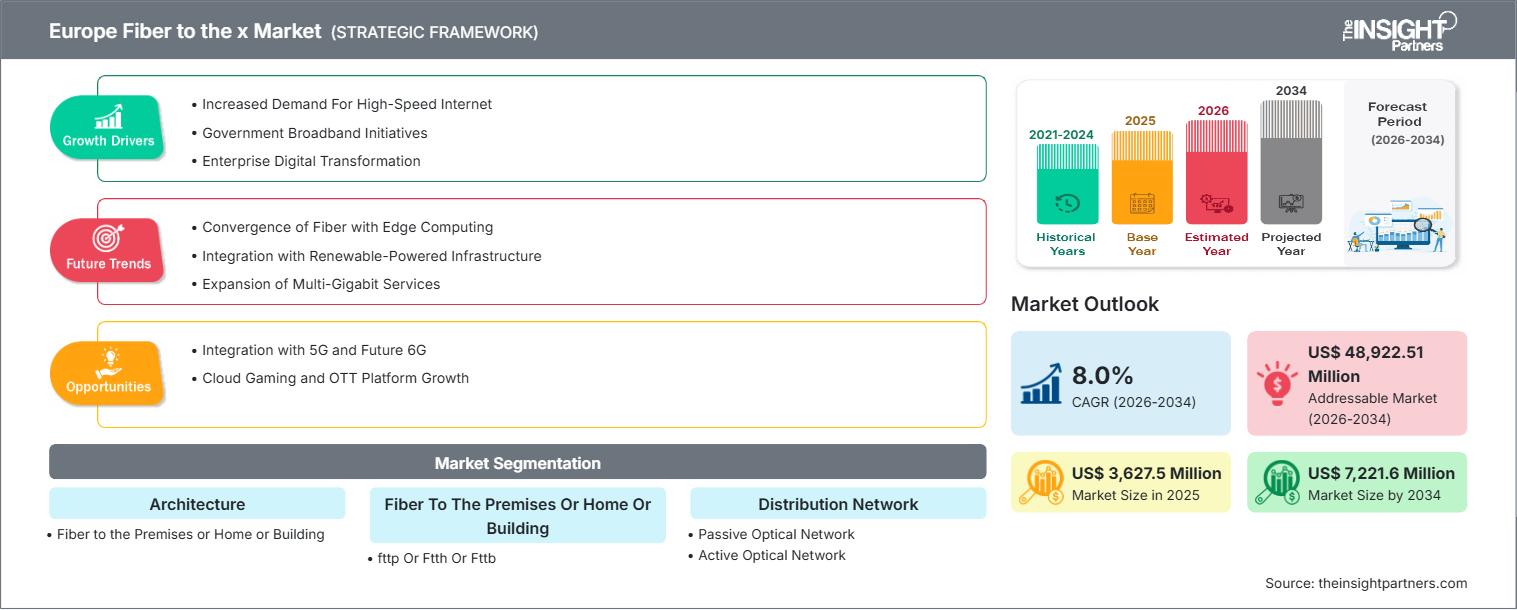
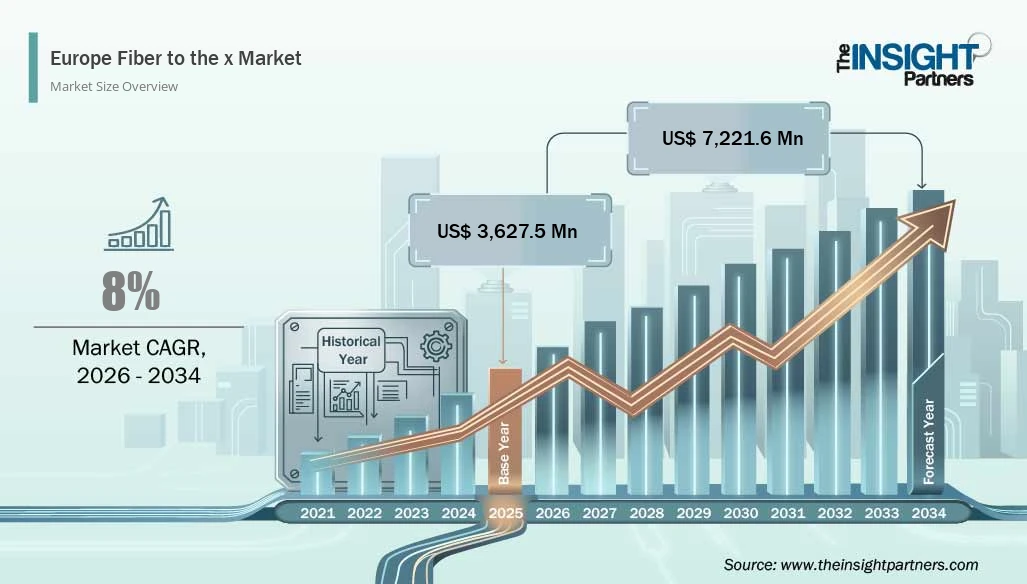
The Europe Fiber to the x Market size is expected to reach US$ 7,221.6 Million by 2034 from US$ 3,627.5 Million in 2025. The market is estimated to record a CAGR of 8.0% from 2026 to 2034.
Executive Summary and Europe Fiber to the x Market Analysis:
The fiber to the x (FTTx) market in Europe is experiencing robust expansion, driven by significant infrastructure investments and strong policy support for digital connectivity. Across the region, both urban and rural areas are witnessing upgrades from legacy copper and coaxial networks to fiber-based technologies, which deliver higher speeds, greater reliability, and enhanced capacity. This transition is essential to support the escalating demand for high-bandwidth applications-such as cloud services, streaming, teleworking, and IoT deployments-fueling a broader digital transformation across industries and households. Several national broadband plans and public-private strategies continued to push fiber expansion in 2024. For instance, EU member states aligned their broadband strategies with EU Digital Decade objectives that target 2030 universal high-capacity connectivity.
A key factor propelling the FTTx market in Europe is favorable regulatory frameworks and public funding. Many European countries have adopted national broadband plans that prioritize fiber deployment as a strategic objective, often with financial incentives or co-investment mechanisms to encourage private sector participation. This factor has helped mitigate the high upfront costs associated with fiber rollout, especially in less densely populated and economically challenging regions. Additionally, EU-level initiatives and cohesion funds have been instrumental in aligning cross-border goals, promoting competition, and fostering infrastructure sharing among operators to accelerate buildouts. The Gigabit Infrastructure Act was approved in April 2024 and laid the groundwork in 2023 for harmonized rules that simplify and reduce the cost of deploying gigabit-capable networks (including fiber) across member states.
Technological advancements also influence market growth. Enhanced deployment techniques-such as microtrenching and aerial fiber solutions, alongside improvements in passive optical network (PON) technologies-have reduced installation complexity and costs. Furthermore, business demand for ultra-fast connectivity-especially from data centers, enterprise campuses, and industrial hubs-is stimulating more fiber deployments beyond residential access, contributing to a broader ecosystem of digital services. Overall, the market is on a steady growth trajectory, shaped by strategic policy support, collaborative investment models, and strong end-user demand for next-generation connectivity.
● REPORT CUSTOMIZATION
Tailor This Report To Align With Your Specific Business Requirements
This report can be customized to align precisely with your business objectives, scope, and target markets. Customization options include tailored segmentation, geography, competitive analysis, and strategic insights to support informed decision-making.
Customize This Report →WHAT YOU CAN ADJUST
- ● Segmentations
- ● Geography
- ● Competitive Analysis
- ● Language Preferences
Europe Fiber to the x Market: Strategic Insights
-
Get Top Key Market Trends of this report.This FREE sample will include data analysis, ranging from market trends to estimates and forecasts.
Europe Fiber to the x Market Segmentation Analysis:
- By Architecture, the Europe Fiber to the x Market is segmented into Fiber to the Premises or Home or Building (FTTp or FTTh or FTTb), Fiber to the Node or Curb or Kerb or Closet or Cabinet (FTTn or FTTc or FTTk), and Fiber to the Office (FTTo). The Fiber to the Premises or Home or Building (FTTp or FTTh or FTTb) segment dominated the market in 2025.
- By Fiber To The Premises Or Home Or Building (fttp Or Ftth Or Fttb), the Europe Fiber to the x Market is segmented into Fiber to the Desktop (FTTd) and Fiber to the Office (FTTo). The Fiber to the Office (FTTo) segment dominated the market in 2025.
- By Distribution Network, the Europe Fiber to the x Market is segmented into Passive Optical Network and Active Optical Network. The Passive Optical Network segment dominated the market in 2025.
- By Product, the Europe Fiber to the x Market is segmented into Optical Line Terminal, Optical Network Terminal or Unit, Optical Splitter, and Others. The Optical Network Terminal or Unit segment dominated the market in 2025.
- By Vertical, the Europe Fiber to the x Market is segmented into Industrial, Commercial, and Residential. The Residential segment dominated the market in 2025.
Europe Fiber to the x Market Report Scope
| Report Attribute | Details |
|---|---|
| Market size in 2025 | US$ 3,627.5 Million |
| Market Size by 2034 | US$ 7,221.6 Million |
| CAGR (2026 - 2034) | 8.0% |
| Historical Data | 2021-2024 |
| Forecast period | 2026-2034 |
| Segments Covered |
By Architecture
|
| Regions and Countries Covered |
Europe
|
| Market leaders and key company profiles |
|
Europe Fiber to the x Market Players Density: Understanding Its Impact on Business Dynamics
The Europe Fiber to the x Market is growing rapidly, driven by increasing end-user demand due to factors such as evolving consumer preferences, technological advancements, and greater awareness of the product's benefits. As demand rises, businesses are expanding their offerings, innovating to meet consumer needs, and capitalizing on emerging trends, which further fuels market growth.
Europe Fiber to the x Market Outlook
Government broadband initiatives catalyze infrastructure investment, expanding coverage into underserved regions and reducing deployment risk for private players. Policymakers across regions increasingly recognize broadband as essential infrastructure for economic development, digital inclusion, and competitiveness in the digital economy. National strategies and public funding often act as a springboard for fiber deployments, enabling network buildouts that might otherwise be too costly or slow to deliver if left solely to commercial incentives.
Public broadband programs typically provide direct subsidies, create policy frameworks that encourage investment, and streamline regulatory processes for network construction. Beyond infrastructure funding, governments often address non-economic barriers by simplifying permitting, allocating public rights-of-way, and integrating broadband targets into broader development plans. These regulatory actions lower the barriers to fiber deployment and help harmonize objectives across stakeholders. In markets where state involvement is high, these strategies have translated into faster deployment timelines and deeper penetration into rural and remote areas, reinforcing the market growth by aligning public interest with private investment.
Europe Fiber to the x Market Country Insights
By country, the Europe Fiber to the x Market is segmented into Germany, France, Italy, the United Kingdom, Russia, and the Rest of Europe. Germany held the largest share in 2025.
The FTTx market in Germany is advancing rapidly as digital infrastructure becomes a cornerstone of economic competitiveness. The push toward full fiber connectivity is driven by strong government commitment and sustained public investment aimed at expanding broadband access nationwide. Municipalities and regional operators are actively deploying fiber networks, supported by policy frameworks that unlock funding for underserved areas. Demand from private enterprises, cloud-based services, and consumer appetites for ultra-high-definition streaming and remote work capabilities are fueling uptake. Germany's industrial sector-with its emphasis on automation and 5G synergy-also encourages fiber expansion, as high bandwidth and low latency become critical. In November 2025, several fiber operators-including Deutsche GigaNetz and GlasfaserPlus-signed new partnerships to expand fiber reach through open access collaborations, helping accelerate backbone buildouts and shared fiber access. Collaboration between large incumbent providers and local carriers is expanding the reach of fiber deeper into suburban and rural regions. The confluence of regulatory support, investment incentives, and growing end-user demand positions Germany's FTTx market for sustained expansion.
Europe Fiber to the x Market Company Profiles
Some of the key players operating in the market include Verizon Communications Inc, CommScope Holding Co Inc, Molex LLC, ZTE Corp, Vodafone Group Plc, Corning Inc, Ofs Fitel LLC, AT&T Inc., Fujikura Ltd., and Huawei Technologies Co., Ltd.
These players are adopting various strategies such as expansion, product innovation, and mergers and acquisitions to provide innovative products to their consumers and increase their market share.
Europe Fiber to the x Market Research Methodology
The following methodology has been followed for the collection and analysis of data presented in this report:
Secondary Research
The research process begins with comprehensive secondary research, utilizing internal and external sources to gather qualitative and quantitative data for each market. Commonly referenced secondary research sources include, but are not limited to:
-
- Company websites, annual reports, financial statements, broker analyses, and investor presentations
-
- Industry trade journals and other relevant publications
-
- Government documents, statistical databases, and market reports
-
- News articles, press releases, and webcasts specific to companies operating in the market
-
Note:
All financial data included in the Company Profiles section has been standardized to US$. For companies reporting in other currencies, figures have been converted to US$ using the relevant exchange rates for the corresponding year.Primary Research
The Insight Partners conducts a significant number of primary interviews each year with industry stakeholders and experts to validate its data analysis and gain valuable insights. These research interviews are designed to:
-
- Validate and refine findings from secondary research
-
- Enhance the expertise and market understanding of the analysis team
-
- Gain insights into market size, trends, growth patterns, competitive dynamics, and future prospects
-
Primary research is conducted via email interactions and telephone interviews, encompassing various markets, categories, segments, and sub-segments across different regions. Participants typically include:
-
- Industry stakeholders: Vice Presidents, Business Development Managers, Market Intelligence Managers, and National Sales Managers
-
- External experts: Valuation specialists, research analysts, and key opinion leaders with industry-specific expertise
-

- Comprehensive Market Sizing and Forecast Analysis
- Detailed Segmentation Analysis
- In-Depth Market Dynamics Assessment
- Regional and Country-Level Insights
- Competitive Landscape and Company Benchmarking
- Strategic Business Intelligence
Recent Reports
Testimonials

The Insight Partners provided valuable market intelligence that supported our global go-to-market strategy. Their team was professional, responsive, and attentive to our feedback, providing thoughtful analysis and helpful methodological clarifications throughout the project.
Junmo Kim Chief Financial Officer (CFO), Enertech Co., Ltd.
The Insight Partners' SCADA System Market report is comprehensive, with valuable insights on current trends and future forecasts. The team was highly professional, responsive, and supportive throughout. We are very satisfied and highly recommend their services.
RAN KEDEM Partner, Reali Technologies LTDs
I requested a report on a very specific software market and the team produced the report in a few days. The information was very relevant and well presented. I then requested some changes and additions to the report. The team was again very responsive and I got the final report in less than a week.
JEAN-HERVE JENN Chairman, Future Analytica
We worked with The Insight Partners for an important market study and forecast. They gave us clear insights into opportunities and risks, which helped shape our plans. Their research was easy to use and based on solid data. It helped us make smart, confident decisions. We highly recommend them.
PIYUSH NAGPAL Sr. Vice President, High Beam Global
The Insight Partners delivered insightful, well-structured market research with strong domain expertise. Their team was professional and responsive throughout. The user-friendly website made accessing industry reports seamless. We highly recommend them for reliable, high-quality research services
YUKIHIKO ADACHI CEO, Deep Blue, LLC.
This is the first time I have purchased a market report from The Insight Partners.While I was unsure at first, I visited their web site and felt more comfortable to take the risk and purchase a market report.I am completely satisfied with the quality of the report and customer service. I had several questions and comments with the initial report, but after a couple of dialogs over email with their analyst I believe I have a report that I can use as input to our strategic planning process.Thank you so much for taking the extra time and making this a positive experience.I will definitely recommend your service to others and you will be my first call when we need further market data.
JOHN SUZUKI President and Chief Executive Officer, Board Director, BK Technologies
I wish to appreciate your support and the professionalism you displayed in the course of attending to my request for information regarding to infectious disease IVD market in Nigeria. I appreciate your patience, your guidance, and the fact that you were willing to offer a discount, which eventually made it possible for us to close a deal. I look forward to engaging The Insight Partners in the future, all thanks to the impression you have created in me as a result of this first encounter.
DR CHIJIOKE ONYIA MANAGING DIRECTOR, PineCrest Healthcare Ltd.Reason to Buy
- Informed Decision-Making
- Understanding Market Dynamics
- Competitive Analysis
- Identifying Emerging Markets
- Customer Insights
- Market Forecasts
- Risk Mitigation
- Boosting Operational Efficiency
- Strategic Planning
- Investment Justification
- Tracking Industry Innovations
- Aligning with Regulatory Trends





 Get Free Sample for