
Evaporative Cooling Market Growth, Trends & Demand by 2034
Coverage: By Type of Cooling (Direct Evaporative Cooling, Indirect Evaporative Cooling, Two-stage Evaporative Cooling); Application (Residential, Commercial, Industrial, Confinement Farming) , and Geography (North America, Europe, Asia Pacific, and South and Central America)
- Status : Data Released
- Report Code : TIPRE00025981
- Category : Electronics and Semiconductor
- No. of Pages : 150
- Available Report Formats :


- Last update date : August 26, 2026


2025 Market Size
US$ 8.91 Bn
Base year value
2034 Forecast
US$ 20.61 Bn
Projected by 2034
CAGR 2026-2034
9.77 %
Growth rate
Addressable Market
US$ 131.54 Bn
(2026-2034)
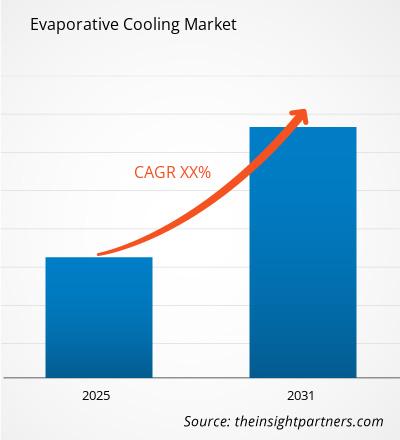
The Evaporative Cooling market was valued at US$ 8.91 billion in 2025 and is expected to reach US$ 20.61 billion by 2034; it is estimated to record a CAGR of 9.77% during 2026-2034.
Evaporative Cooling Market Assessment and Insights
- North America: North America accounted for a 36–40% Evaporative Cooling Market share in 2025 and is estimated to expand at a 9.0–10.0% CAGR between 2026–2034, supported by data centers, industrial facilities, and energy-conscious HVAC investment.
- US: The US represented 78–80% of North America's 2025 demand and is projected to grow at a 9.1–10.1% CAGR between 2026–2034, led by commercial and industrial cooling.
- Europe: Europe held a 15–18% share in 2025 and is expected to register a 9.5–10.5% CAGR, with Germany, the UK, France, Italy, and Spain supporting industrial and commercial adoption.
- Asia Pacific: Asia Pacific represented a 38–41% share in 2025 and is forecast to grow at a 12.0–13.0% CAGR, led by China, India, Japan, and South Korea.
- Largest Segment: Residential applications represented a 58–62% market share in 2025 and are projected to grow at a 9.2–9.8% CAGR between 2026–2034.
- High Growth Segment: Industrial applications represented a 20–24% market share in 2025 and are estimated to advance at a 12.4–13.1% CAGR between 2026–2034.
- Key companies analyzed in detail: Bonaire, Celsius Design Limited, CFW Evapcool, Colt Group Limited, Condair Group AG, Delta Cooling Towers Inc., ENEXIO Water Technologies GmbH, Munters Group AB, Phoenix Manufacturing Inc., and SPX Cooling Technologies.
Source: The Insight Partners' analysis based on proprietary research, government publications, company annual reports, investor presentations, industry databases, and expert interviews.
In the case of the Evaporative Cooling market, there has been an evolution from simple air-cooling solutions to complex systems with higher efficiency media, variable speed fans, water control devices, sensors, and hybrid systems. Industrial and commercial buyers consider not only cost of the equipment but also its lifecycle energy consumption. Two-stage designs will help increase the applicability of this method where humidity makes direct systems unusable, and adiabatic methods will be used in the rejection of heat and process cooling.
According to the Evaporative Cooling Market report, future growth will come in the form of development in emerging industrial locations, large-scale agricultural operations, and dense digital infrastructures. Building efficiency regulations, decarbonization goals of companies, water management considerations, and electrification will be shaping technology choices. Asia Pacific will continue to be a major demand center, whereas North America and Europe will focus on high efficiency systems, controls, and hybrids.
Evaporative Cooling Market Report Scope
| Report Attribute | Details |
|---|---|
| Market size in 2025 | US$ 8.91 Billion |
| Market Size by 2034 | US$ 20.61 Billion |
| Global CAGR (2026 - 2034) | 9.77% |
| Historical Data | 2021-2024 |
| Forecast period | 2026-2034 |
Evaporative Cooling Market Analysis
Factors fueling growth in Evaporative Cooling Market include the demand for efficient heating reduction without excessive electricity use in favorable climate conditions. The supply chain operates on a wide ecosystem that consists of equipment makers, cooling media manufacturers, pumps, fans, control solutions providers, engineering companies, contractors, and facility operators. The residential market focuses on cost-effective solutions and ease of use, whereas the industrial segment requires engineering of air flow, water treatment, and integration into HVAC systems.
The Evaporative Cooling Market becomes increasingly application-specific due to the need for custom airflow capacity, media design, durability, water quality solutions, and automation. Continuous operation capability in harsh conditions is another factor that is relevant for industrial and agricultural markets. Availability of replacement parts also plays a crucial role in life-cycle expenses. That's why distribution and service become critical competitive factors.
The Evaporative Cooling Market Analysis shows a highly fragmented industry landscape covering specialist makers of evaporative equipment, cooling tower makers, air treatment companies, and HVAC engineering companies. Condair Group AG and Munters Group AB cater to industrial and commercial climate control needs, and SPX Cooling Technologies and Delta Cooling Towers Inc. have a stronghold on engineered heat rejection systems. Phoenix Manufacturing Inc. offers products for evaporative cooling equipment in residential and commercial applications.
Growing investments are being made into water conservation solutions, efficient fans, hybrid systems, improved controls, and data centers applications. Celsius Design Limited and Colt Group Limited add project-based competence to the market, whereas ENEXIO Water Technologies GmbH focuses on engineered water and heat rejection systems. Bonaire and CFW Evapcool augment the specialist products segment. Effective differentiation will be based on application expertise, quick service response, lifecycle economy, and integration of evaporative equipment with cooling systems.
● REPORT CUSTOMIZATION
Tailor This Report To Align With Your Specific Business Requirements
This report can be customized to align precisely with your business objectives, scope, and target markets. Customization options include tailored segmentation, geography, competitive analysis, and strategic insights to support informed decision-making.
Customize This Report →WHAT YOU CAN ADJUST
- ● Segmentations
- ● Geography
- ● Competitive Analysis
- ● Language Preferences
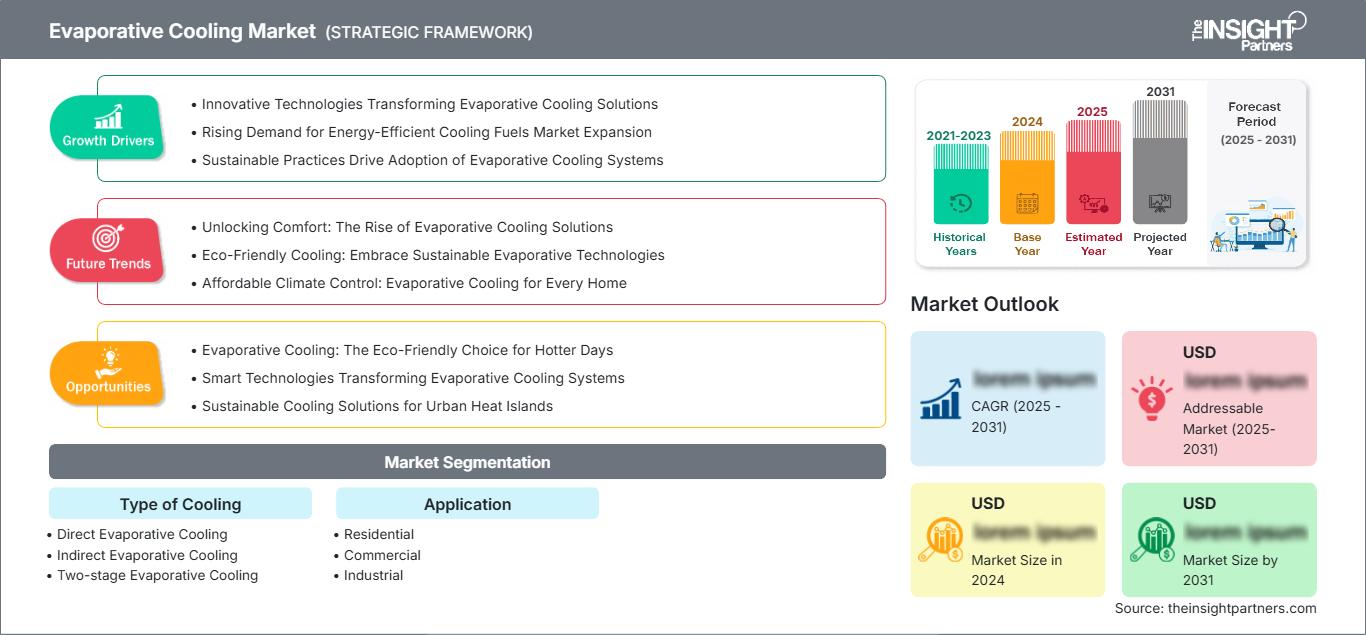
Evaporative Cooling Market: Strategic Insights
Regional Insights
North America Evaporative Cooling Market
North America held a 36–40% share of the global market in 2025 and is projected to expand at a 9.0–10.0% CAGR through 2034. The US has strong domination in regional demand owing to huge commercial and industrial buildings, agriculture, data centers, and cooling infrastructures. States with arid climatic conditions offer favorable conditions for the use of direct systems, but indirect and hybrid technology offers more applications in humid environments.
Regional demand is greatly driven by electricity cost, facility sustainability, availability of water, and other sustainability initiatives. Developers of data centers are considering the use of evaporative and adiabatic systems to minimize mechanical refrigeration needs. The industrial users are equally seeking for reduced operating costs without compromising air flow and thermal stability. Companies such as Phoenix Manufacturing Inc., Condair Group AG, and SPX Cooling Technologies among others have good distribution network within the region.
U.S. Evaporative Cooling Market Market
The US represented 78–80% of North America's 2025 market and is forecast to grow at a 9.1–10.1% CAGR through 2034. Demand is concentrated in the Southwest and other dry-climate states, where residential, commercial, agricultural, and industrial users can obtain strong cooling performance from evaporative technologies. Phoenix Manufacturing Inc. maintains a broad equipment portfolio, while SPX Cooling Technologies serves large engineered cooling requirements.
Commercial facilities, warehouses, manufacturing plants, greenhouses, and data centers are expanding the addressable application base. Industrial users increasingly assess water consumption, maintenance requirements, and seasonal operating profiles when selecting systems. Two-stage and indirect configurations can extend deployment into locations with more challenging humidity conditions. Regulatory attention to building efficiency and corporate energy targets further encourages solutions that lower cooling electricity consumption without requiring extensive refrigeration capacity.
Europe Evaporative Cooling Market
Europe accounted for a 15–18% share in 2025 and is expected to grow at a 9.5–10.5% CAGR through 2034. Germany takes the lead, backed by industrial manufacturing, logistics, automotive manufacturing, and energy efficiency. UK is also significant in terms of commercial and data center use, whereas France, Italy, and Spain offer further opportunities within industrial facilities, agriculture, hospitality, and commercial buildings.
UK is becoming more relevant with regards to data centers, warehouses, and commercial buildings that need efficient cooling that uses less energy. Celsius Design Limited has designed evaporative solutions for use in data centers and industrial settings, underscoring the significance of engineered solutions. Demand is also driven by performance criteria of buildings and the need for summer cooling without using conventional mechanical cooling systems.
Germany combines industrial cooling requirements with a strong engineering base and emphasis on energy-efficient equipment. France supports demand through commercial infrastructure, industrial facilities, and data-center development. Italy and Spain provide favorable opportunities in manufacturing, agriculture, and hospitality, particularly where hot summers and suitable humidity conditions support evaporative operation. Colt Group Limited and Condair Group AG contribute to Europe's specialized cooling ecosystem.
APAC Evaporative Cooling Market
APAC represented a 38–41% share in 2025 and is projected to grow at a 12.0–13.0% CAGR through 2034. China dominates, with India, Japan, and South Korea next in line. Australia is still crucial for domestic and commercial uses, especially when it comes to arid regions. Industrial development, urban growth, and increased demand for cooling contribute to continual investments.
China and India offer many possibilities via manufacturing, transportation, farming, and commercial construction. Japanese and Korean businesses are more interested in efficient industrial and commercial systems, whereas the needs of Australia are still related to climate conditions. The focus of governments on energy efficiency, industrial development, and building quality leads to wider usage of low energy cooling technology.
Middle East & Africa Evaporative Cooling Market Market
Middle East and Africa demand is developing around hot climates, industrial infrastructure, agriculture, hospitality, and large-scale commercial projects. Saudi Arabia is the leading regional market, followed by the UAE and South Africa. The regional CAGR is estimated at 8.0–9.0% through 2034 as infrastructure development creates additional cooling requirements.
Saudi Arabia and the UAE offer opportunities in commercial developments, industrial facilities, logistics, and outdoor cooling. Water availability remains an important design consideration, encouraging interest in efficient controls and optimized water management. South Africa provides applications across industrial and agricultural facilities, while the rest of MEA remains more dependent on imported equipment, engineering partnerships, and project-based procurement.
Segmentation Analysis
Type of Cooling
Type of Cooling is projected to expand at a 10.0–11.5% CAGR during 2026–2034. Direct systems retain broad adoption because of straightforward construction and favorable economics, while indirect and two-stage technologies are gaining relevance where humidity control, comfort requirements, or higher cooling efficiency justify additional system complexity. Selection depends strongly on climate, application load, water availability, and desired temperature control.
- Direct Evaporative Cooling: Direct systems maintain a strong market position because they offer straightforward operation and economical cooling. Demand remains concentrated in dry climates, warehouses, residential buildings, and open industrial environments.
- Indirect Evaporative Cooling: Indirect systems are strategically important where operators require sensible cooling without adding moisture to supply air. Adoption is supported by commercial buildings, data centers, and controlled industrial environments.
- Two-stage Evaporative Cooling: Two-stage systems address humidity limitations through staged heat and moisture transfer. Their importance is increasing where users require improved comfort, greater temperature control, and broader climatic applicability.
Application
Application is expected to register a 10.5–12.0% CAGR through 2034. Residential demand provides a large installed base, while commercial and industrial applications are gaining strategic importance because of larger cooling loads and energy-management objectives. Confinement farming also requires reliable environmental control for animal welfare and productivity, supporting demand for airflow and temperature-management systems.
- Residential: Residential applications provide the broadest installed base, particularly in hot and dry regions. Demand is shaped by household affordability, electricity costs, installation simplicity, and replacement of older cooling equipment.
- Commercial: Commercial demand is supported by retail, hospitality, offices, warehouses, and institutional buildings. Buyers increasingly prioritize low operating costs, fresh-air delivery, controllability, and compatibility with existing ventilation infrastructure.
- Industrial: Industrial applications are strategically important for factories, logistics facilities, workshops, and process environments with substantial heat loads. Demand emphasizes durability, high airflow, automation, maintenance access, and continuous operation.
- Confinement Farming: Confinement farming relies on controlled temperature and ventilation to support animal productivity. Evaporative systems provide scalable cooling for poultry, dairy, and livestock facilities where airflow and climate management are essential.
Opportunity Snapshot
| Application | Revenue Contribution (High/Medium/Low) | Trend Tag | Adoption Stage |
| Residential | High | Home Cooling | Mature |
| Commercial | Medium | Building Efficiency | Scaling |
| Industrial | High | Process Cooling | Scaling |
| Confinement Farming | Medium | Livestock Climate | Scaling |
Evaporative Cooling Market Growth Drivers and Impact Analysis
Rising cooling loads in hot and expanding built environments
Increasing temperatures, urbanization, industrial development, and expanding floor areas are raising cooling requirements across multiple end-use environments. The International Energy Agency consistently highlights space cooling as one of the factors driving electricity consumption. Therefore, efficiency in cooling systems still stands out as very important. An evaporative system can help meet part of this need in areas where evaporation still works. The business case is evident in places where there are large establishments running for long hours, which means that there are high costs due to mechanical refrigeration. Large warehouses, manufacturing plants, agriculture and commercial buildings could install an evaporative system to mitigate the peak cooling demands or complement other cooling systems.
Data-center expansion is broadening demand for low-energy heat rejection
The rapid build-out of data centers has led to the emergence of opportunities for evaporative and adiabatic cooling designs since IT facilities need to reject heat constantly. Increasing electrical energy needs due to data centers and AI has been brought up by the International Energy Agency. The technology of evaporative cooling allows reducing mechanical cooling when outdoor climate is beneficial and can be incorporated in hybrid systems where direct use is limited. There arises a need for high capacity equipment, advanced control, redundancy, water management systems, and monitoring. Impact of market goes beyond specialized cooling equipment since developers think about rejecting heat in the initial stages of building the facilities instead of choosing the equipment at later stages. Companies that can incorporate cooling, ventilation, control, and water treatment in their offerings can take part in bigger infrastructure projects with complicated technical requirements.
Industrial energy-efficiency programs are encouraging alternative cooling designs
Industrial facilities are under growing pressure to improve energy performance while maintaining stable operating conditions. The International Energy Agency's broader energy-efficiency agenda emphasizes reducing energy intensity across buildings and industrial systems, supporting technologies that deliver required thermal performance with lower electricity consumption. Evaporative cooling can become attractive in facilities with high sensible heat loads, substantial ventilation requirements, or dry operating climates. Manufacturing plants, logistics centers, workshops, and agricultural facilities can use large-airflow systems where conventional refrigeration would impose higher operating costs. The commercial impact includes opportunities for retrofit projects, system upgrades, controls modernization, and replacement of inefficient equipment. Suppliers can strengthen their positions by demonstrating measured performance, simplifying maintenance, optimizing water consumption, and designing systems that integrate with existing ventilation or mechanical cooling infrastructure.
Evaporative Cooling Market Future Trends
Digital controls will enable climate-responsive cooling optimization
Evaporative Cooling Market trends are moving toward connected controls that continuously adjust airflow, water delivery, fan speed, and operating schedules according to outdoor and indoor conditions. Future systems will increasingly combine temperature, humidity, pressure, occupancy, and equipment-performance data to determine when evaporative operation provides the best efficiency. Predictive algorithms can identify declining media performance, pump issues, abnormal water use, or airflow restrictions before they create major service interruptions. Integration with building-management systems should also allow operators to coordinate evaporative equipment with mechanical chillers, ventilation, and demand-response strategies. This evolution will make control architecture a more important purchasing criterion. Suppliers that provide interoperable platforms, remote diagnostics, automated fault detection, and detailed energy reporting should be better positioned as commercial and industrial customers seek measurable operating improvements rather than standalone equipment functionality.
Hybrid cooling architectures will expand beyond climate-limited applications
The next stage of adoption will involve greater use of hybrid configurations that combine evaporative cooling with mechanical refrigeration, dry cooling, or heat-exchange technologies. Such architectures can operate evaporatively during favorable weather and transition to alternative cooling modes when humidity or temperature conditions reduce effectiveness. This approach improves annual operating flexibility and can reduce dependence on a single cooling technology. Data centers, industrial plants, commercial buildings, and large agricultural facilities are potential beneficiaries because their cooling requirements vary across seasons and operating conditions. Hybrid systems also provide a practical route for organizations that want energy savings without accepting the climate limitations of fully direct evaporative cooling. Equipment manufacturers are therefore likely to focus on integrated controls, modular heat-rejection components, automatic mode switching, and system designs that simplify installation alongside existing HVAC infrastructure.
Evaporative Cooling Market Opportunities
Water-efficient systems for water-stressed industrial regions
Evaporative Cooling Market Forecasts point to opportunities for equipment designed around tighter water-management requirements in regions facing increasing resource constraints. Industrial customers increasingly need to balance cooling efficiency with water availability, making optimized bleed-off, filtration, monitoring, variable water flow, and hybrid dry-wet operation commercially relevant. Investors and manufacturers can prioritize technologies that reduce unnecessary water consumption without sacrificing heat-rejection performance. Retrofit programs also provide an addressable opportunity because existing towers and evaporative units can be upgraded with controls, filtration, improved media, sensors, and water-management equipment. Projects in the Middle East, Western United States, Australia, and industrial parts of Asia may particularly benefit from these solutions. Commercial success will depend on demonstrating total lifecycle savings rather than evaluating water use or electricity consumption independently.
Regional service networks for emerging cooling markets
A further opportunity lies in developing regional service capabilities alongside equipment distribution. Emerging markets often have expanding cooling requirements but limited local expertise for system selection, commissioning, water treatment, preventive maintenance, and performance optimization. Manufacturers can establish application centers, certified contractor networks, spare-parts hubs, and remote-monitoring services to reduce installation risk and shorten maintenance response times. Partnerships with local engineering companies can also improve access to large infrastructure projects where specifications are developed before equipment procurement. This approach is particularly relevant to India, Southeast Asia, the Middle East, and selected African markets. Service-led expansion can improve customer retention because evaporative systems require periodic media inspection, pump maintenance, water-quality management, and airflow verification. The opportunity therefore extends across the equipment lifecycle rather than being limited to initial system sales.
Recent Developments
- August 2026: I2Cool launched I2Coating CorroCool, combining electricity-free evaporative cooling with industrial-grade corrosion protection. The coating is designed for applications exposed to heat, humidity, and corrosive environments, providing passive temperature reduction while protecting equipment surfaces. The development supports lower-energy thermal management for industrial facilities seeking to reduce mechanical cooling requirements and maintenance associated with corrosion.
- September 2025: Vertiv launched a new free-cooling evaporative solution with low global-warming-potential refrigerant, targeting high-density data-center environments. The system combines evaporative cooling with indirect heat exchange to support efficient thermal management while reducing reliance on conventional mechanical cooling. Its lower-GWP design aligns data-center infrastructure with increasingly stringent environmental requirements and rising demand for energy-efficient cooling technologies.
- March 2025: EVAPCO launched the eco-Air Titan air-cooled heat exchanger for large-scale heat rejection applications, targeting battery plants, data centers, industrial processing, and power generation. Designed for natural refrigerant systems using ammonia and CO2, the unit uses fans up to 20 feet wide to cool circulating water or glycol. EVAPCO also expanded production in the US, Belgium, and China in response to strong demand.
Frequently Asked Questions

- Comprehensive Market Sizing and Forecast Analysis
- Detailed Segmentation Analysis
- In-Depth Market Dynamics Assessment
- Regional and Country-Level Insights
- Competitive Landscape and Company Benchmarking
- Strategic Business Intelligence
Recent Reports
Testimonials

The Insight Partners provided valuable market intelligence that supported our global go-to-market strategy. Their team was professional, responsive, and attentive to our feedback, providing thoughtful analysis and helpful methodological clarifications throughout the project.
Junmo Kim Chief Financial Officer (CFO), Enertech Co., Ltd.
The Insight Partners' SCADA System Market report is comprehensive, with valuable insights on current trends and future forecasts. The team was highly professional, responsive, and supportive throughout. We are very satisfied and highly recommend their services.
RAN KEDEM Partner, Reali Technologies LTDs
I requested a report on a very specific software market and the team produced the report in a few days. The information was very relevant and well presented. I then requested some changes and additions to the report. The team was again very responsive and I got the final report in less than a week.
JEAN-HERVE JENN Chairman, Future Analytica
We worked with The Insight Partners for an important market study and forecast. They gave us clear insights into opportunities and risks, which helped shape our plans. Their research was easy to use and based on solid data. It helped us make smart, confident decisions. We highly recommend them.
PIYUSH NAGPAL Sr. Vice President, High Beam Global
The Insight Partners delivered insightful, well-structured market research with strong domain expertise. Their team was professional and responsive throughout. The user-friendly website made accessing industry reports seamless. We highly recommend them for reliable, high-quality research services
YUKIHIKO ADACHI CEO, Deep Blue, LLC.
This is the first time I have purchased a market report from The Insight Partners.While I was unsure at first, I visited their web site and felt more comfortable to take the risk and purchase a market report.I am completely satisfied with the quality of the report and customer service. I had several questions and comments with the initial report, but after a couple of dialogs over email with their analyst I believe I have a report that I can use as input to our strategic planning process.Thank you so much for taking the extra time and making this a positive experience.I will definitely recommend your service to others and you will be my first call when we need further market data.
JOHN SUZUKI President and Chief Executive Officer, Board Director, BK Technologies
I wish to appreciate your support and the professionalism you displayed in the course of attending to my request for information regarding to infectious disease IVD market in Nigeria. I appreciate your patience, your guidance, and the fact that you were willing to offer a discount, which eventually made it possible for us to close a deal. I look forward to engaging The Insight Partners in the future, all thanks to the impression you have created in me as a result of this first encounter.
DR CHIJIOKE ONYIA MANAGING DIRECTOR, PineCrest Healthcare Ltd.Reason to Buy
- Informed Decision-Making
- Understanding Market Dynamics
- Competitive Analysis
- Identifying Emerging Markets
- Customer Insights
- Market Forecasts
- Risk Mitigation
- Boosting Operational Efficiency
- Strategic Planning
- Investment Justification
- Tracking Industry Innovations
- Aligning with Regulatory Trends





 Get Free Sample for