
EVOH Resins for Food Application Market Size, Share & Trends by 2034
Coverage: By Application (Films, Tray, Bottles, Bag-in-box, and Others) and End-Use (Bakery and Confectionery, Beverages, Sauces and Dressings, Meat Poultry and Seafood, RTE Foods and Meals, and Others)
- Status : Data Released
- Report Code : TIPRE00029537
- Category : Chemicals and Materials
- No. of Pages : 150
- Available Report Formats :


- Last update date : March 18, 2026


2025 Market Size
US$ 679.24 Mn
Base year value
2034 Forecast
US$ 983.63 Mn
Projected by 2034
CAGR 2026-2034
4.2 %
Growth rate
Addressable Market
US$ 7,551.82 Mn
(2026-2034)
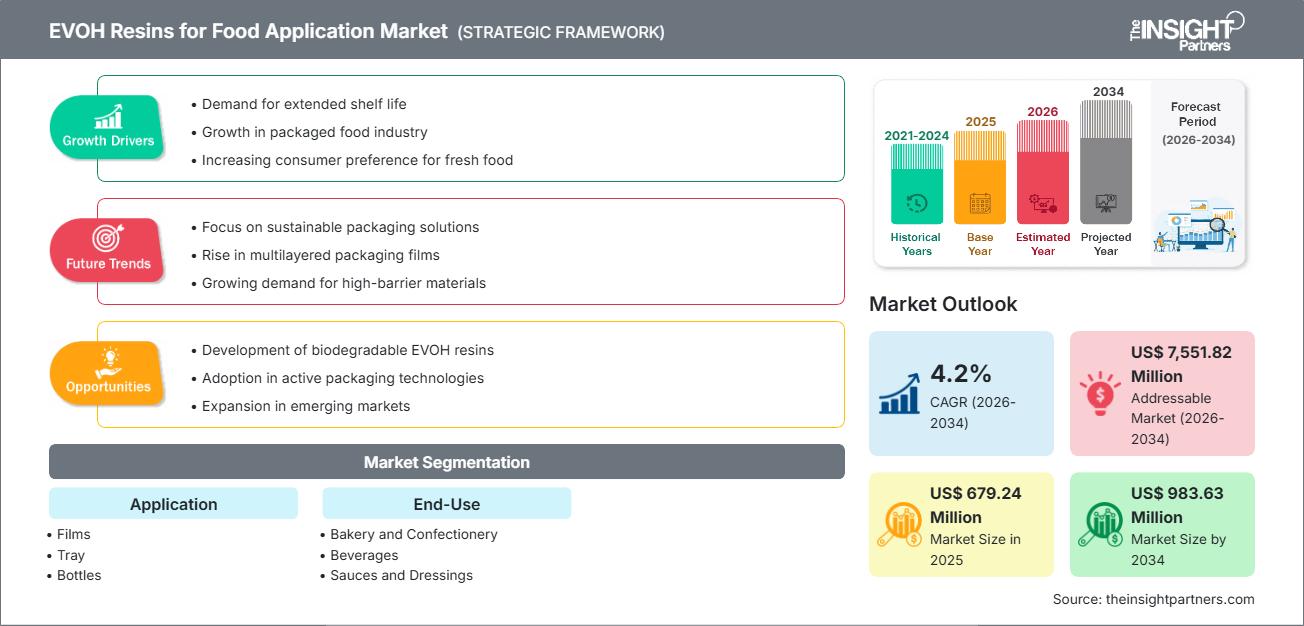
The global EVOH Resins Market for Food Application size is projected to reach US$ 983.63 million by 2034 from US$ 679.24 million in 2025. The market is anticipated to register a CAGR of 4.2% during the forecast period 2026–2034.
Key market dynamics include a heightening global focus on food waste reduction through extended shelf-life solutions, rising consumer awareness regarding the efficacy of high-barrier materials in preserving nutritional integrity, and a significant shift toward flexible, lightweight packaging formats. Additionally, the market is expected to benefit from the growing popularity of ready-to-eat (RTE) meals, expansion in organized retail channels across emerging economies, and the increasing inclusion of EVOH in high-value specialty segments like organic baby foods and premium condiments.
EVOH Resins Market for Food Application Analysis
The EVOH resins market analysis shows a shift toward high-performance barrier solutions as manufacturers prioritize the elimination of chemical preservatives in favor of advanced physical protection. Procurement trends indicate the market is moving toward high-ethylene-content grades that offer a balance of processability and barrier performance for complex co-extrusion lines. Strategic opportunities are emerging in the development of recyclable-ready multilayer structures, where EVOH is combined with compatible tie layers to meet tightening circular economy mandates without compromising food safety. The analysis also notes that market expansion depends on the integration of EVOH with biopolymers and the scaling of chemical recycling infrastructure to manage multilayer waste. Competitive differentiation now stands out depending on technical support services, such as barrier modeling and shelf-life simulation, which help food brands optimize material usage and reduce cost-to-market.
EVOH Resins Market for Food Application Overview
The EVOH resins for food applications are shifting from a specialty technical additive to a mainstream packaging standard for perishable goods. While historically focused on processed meats and shelf-stable sauces, EVOH is expanding into value-added products like functional beverages, plant-based dairy alternatives, and aseptic portion-controlled snacks. Both global chemical giants and specialized film converters are part of this market, leveraging the superior oxygen-blocking capabilities of ethylene-vinyl alcohol copolymers. More health-conscious consumers in Europe and North America are demanding clean-label products, which has helped EVOH gain popularity as a critical enabler of preservative-free food distribution. Asia-Pacific is rapidly becoming a production and consumption powerhouse, driven by the modernization of food supply chains in China and India. For instance, the market in the US represents a mature yet innovative landscape for EVOH resins, driven by a high domestic demand for convenience-oriented and long-life food products. The market is characterized by a strong integration of high-barrier films in retail meat and dairy industries, alongside a growing shift toward sustainable, lightweight pouch formats that replace traditional rigid glass or metal containers.
Market Assessment and Insights
- Global market for EVOH Resins for Food Application was valued at US$ 679.24 Million in 2025
- Annual market size is expected to reach US$ 983.63 Million by 2034
- Total addressable market (TAM) during 2026-2034 is projected to reach approximately US$ 7,551.82 Million
- Market is anticipated to register a CAGR of 4.2% during the forecast period
- The United States represents a key market, supported by Demand for extended shelf life, Growth in packaged food industry, Increasing consumer preference for fresh food, as well as evolving industry dynamics
- Market analysis covers North America, Europe, Asia-Pacific, South and Central America, Middle East and Africa, with growth evaluated across the forecast period
- Market opportunities such as Development of biodegradable EVOH resins, Adoption in active packaging technologies, Expansion in emerging markets are expected to influence market dynamics and addressable market
- Report profiles industry participants, including Kuraray Co., Ltd., Nippon Gohsei (UK) Limited, Kureha Europe B.V., Chang Chun Group, Eval Europe NV, Soarus L.L.C. (Mitsubishi Chemical Europe GmbH), Schur Flexibles GmbH, Arkema, Solvay S.A., Gantrade Corporation, while analyzing competitive strategies and innovation developments
-
Source: The Insight Partners' analysis based on proprietary research, government publications, company annual reports, investor presentations, industry databases, and expert interviews.
● REPORT CUSTOMIZATION
Tailor This Report To Align With Your Specific Business Requirements
This report can be customized to align precisely with your business objectives, scope, and target markets. Customization options include tailored segmentation, geography, competitive analysis, and strategic insights to support informed decision-making.
Customize This Report →WHAT YOU CAN ADJUST
- ● Segmentations
- ● Geography
- ● Competitive Analysis
- ● Language Preferences
EVOH Resins for Food Application Market: Strategic Insights
-
Get Top Key Market Trends of this report.This FREE sample will include data analysis, ranging from market trends to estimates and forecasts.
EVOH Resins Market for Food Application Drivers and Opportunities
Market Drivers:
- Superior Gas Barrier Performance and Preservation: EVOH offers an exceptional barrier against oxygen, carbon dioxide, and aromas, which is critical for preventing lipid oxidation and maintaining the sensory profile of sensitive food products without the need for artificial additives.
- Mainstreaming of Flexible Packaging Formats: The global transition from rigid to flexible packaging, such as stand-up pouches and vacuum skin packs, has sustained high demand for EVOH as a thin, effective barrier layer that reduces overall package weight and transportation costs.
- Rising Regulatory Pressure on Food Safety: Stringent international standards for food contamination and hygiene have propelled the adoption of EVOH-based multilayers, which provide a robust functional barrier against external contaminants and moisture ingress.
Market Opportunities:
- Expansion into Recyclable Multilayer Solutions: Developing EVOH grades that are compatible with polyolefin recycling streams offers significant opportunities to capture the growing market for eco-designed packaging in regions with strict plastic waste regulations.
- Growth in Aseptic and Retort Applications: Beyond standard refrigeration, there is a substantial opportunity to integrate EVOH into high-performance retort pouches for ready meals, providing a durable alternative to aluminum foil that allows for microwaveability and transparency.
- Diversification into Smart and Active Packaging: Incorporating EVOH as a substrate for oxygen scavengers or freshness indicators presents a growing opportunity to serve premium food segments where real-time quality monitoring is a key consumer value.
EVOH Resins Market for Food Application Report Segmentation Analysis
The EVOH Resins Market for Food Application share is analyzed across various segments to provide a clearer understanding of its structure, growth potential, and emerging trends. Below is the standard segmentation approach used in most industry reports:
By Application:
- Films: The largest segment by volume, utilized extensively in lamination and co-extrusion for flexible pouches, wrap films, and lidding materials to ensure maximum product freshness.
- Tray: A dominant format for protein-based products, where EVOH-lined rigid and semi-rigid trays are essential for modified atmosphere packaging (MAP) of fresh meat and poultry.
- Bottles: Increasingly preferred for oxygen-sensitive liquids like juices and condiments, offering a lightweight and shatterproof alternative to glass with equivalent barrier properties.
- Bag-in-box: Offers a specialized solution for bulk liquid food and beverage distribution, protecting products like wine and edible oils from oxidation during dispensing.
- Others: Includes tubes and specialty containers for niche food applications requiring high-precision barrier protection.
By End-Use:
- Bakery and Confectionery: A growing segment focusing on moisture and aroma protection to extend the shelf life of snacks and delicate pastry products.
- Beverages: Utilized primarily in aseptic juice packaging and multilayer plastic bottles to prevent oxygen-induced degradation of flavors and vitamins.
- Sauces and Dressings: A core segment where EVOH prevents the oil oxidation and color changes typically associated with condiments and emulsified sauces.
- Meat, Poultry, and Seafood: The highest-value segment, relying on vacuum and gas-flush packaging to maintain the color and safety of fresh animal proteins.
- RTE Foods and Meals: A fast-rising segment driven by urban lifestyles requiring shelf-stable, microwave-friendly, and high-quality prepared meals.
- Others: Encompasses baby food, dairy products, and organic produce, where nutrient preservation is paramount.
By Geography:
- North America
- Europe
- Asia Pacific
- South & Central America
- Middle East & Africa
EVOH Resins for Food Application Market Report Scope
| Report Attribute | Details |
|---|---|
| Market size in 2025 | US$ 679.24 Million |
| Market Size by 2034 | US$ 983.63 Million |
| Global CAGR (2026 - 2034) | 4.2% |
| Historical Data | 2021-2024 |
| Forecast period | 2026-2034 |
| Segments Covered |
By Application
|
| Regions and Countries Covered |
North America
|
| Market leaders and key company profiles |
|
EVOH Resins for Food Application Market Players Density: Understanding Its Impact on Business Dynamics
The EVOH Resins for Food Application Market is growing rapidly, driven by increasing end-user demand due to factors such as evolving consumer preferences, technological advancements, and greater awareness of the product's benefits. As demand rises, businesses are expanding their offerings, innovating to meet consumer needs, and capitalizing on emerging trends, which further fuels market growth.
EVOH Resins Market for Food Application Share Analysis by Geography
Asia-Pacific is expected to grow fastest in the coming years due to massive urbanization and the expansion of the cold-chain infrastructure. Emerging markets in South & Central America and the Middle East also present significant untapped opportunities as domestic food processors upgrade to high-barrier packaging to meet export standards.
The EVOH resins market for food applications is undergoing a significant transformation, moving from a niche technical solution to a fundamental component of the global food security and sustainability strategy. Growth is driven by the surge in demand for preservative-free foods and the widespread adoption of advanced barrier films in retail. Below is a summary of market trends by region:
North America
- Market Share: Holds a substantial share driven by a highly organized retail market and a strong preference for convenient, long-life packaged foods.
- Key Drivers:
- Widespread adoption of Modified Atmosphere Packaging (MAP) for case-ready meats.
- Expansion of the e-commerce grocery channel requires durable, high-barrier transit packaging.
- Shift toward clean-label food products that necessitate physical rather than chemical preservation.
- Trends: Integration of EVOH in smart packaging with freshness sensors and the rapid scaling of thin-wall lidding films for dairy and snack portions.
Europe
- Market Share: A leading region in technical innovation and regulatory-driven adoption of sustainable barrier materials.
- Key Drivers:
- Stringent EU regulations on plastic recyclability and food waste reduction.
- High consumer demand for organic and minimally processed foods with short supply chains.
- Strong presence of global packaging leaders focusing on R&D for recyclable multilayers.
- Trends: Strategic shift toward mono-material-ready EVOH structures and a significant increase in the use of EVOH for high-barrier paper-based laminates.
Asia-Pacific
- Market Share: The fastest-growing region, with China and Japan acting as the primary drivers for both production and consumption.
- Key Drivers:
- Rapid expansion of the middle class with increasing disposable income for premium packaged foods.
- Government-led initiatives in India and China to reduce post-harvest food losses through better packaging.
- Growth of the regional ready-to-eat (RTE) and instant noodle markets.
- Trends: Heavy investment in new co-extrusion capacity and a rising focus on EVOH-based high-barrier pouches for the food service and hospitality industries.
South and Central America
- Market Share: An emerging market with a growing export-oriented food sector in countries like Brazil and Argentina.
- Key Drivers:
- Modernization of the meat processing industry to meet international export quality standards.
- Increasing urban demand for western-style snacks and convenient dairy products.
- Rising interest in high-performance packaging to overcome long domestic logistics distances.
- Trends: Adoption of EVOH-based vacuum skin packaging (VSP) for premium beef exports and the introduction of high-barrier coffee packaging.
Middle East and Africa
- Market Share: A developing market focusing on food security and the formalization of local food processing hubs.
- Key Drivers:
- Need for high-performance barrier packaging to withstand extreme temperatures and arid climates.
- Strategic investments in domestic food production to reduce reliance on imports.
- Rising consumption of UHT milk and fruit juices in multilayer containers.
- Trends: Implementation of shelf-stable packaging for pediatric nutrition and the expansion of high-barrier flexible films in urban retail centers.
High Market Density and Competition
Competition is intensifying due to the presence of established chemical leaders such as Kuraray Co., Ltd., Mitsubishi Chemical Group, and Chang Chun Petrochemical. Regional technical experts and specialized resin compounders like SK Functional Polymer and Nippon Gohsei also contribute to a highly competitive landscape.
This competitive environment pushes vendors to differentiate through:
- Sustainable Resin Innovation: Developing Circular-Ready EVOH grades that can be recycled within existing Polyethylene (PE) or Polypropylene (PP) streams without causing gels or contamination.
- Downstream Technical Collaboration: Partnering with film converters to optimize layer thickness, reducing the cost of high-barrier films while maintaining performance.
- Regional Capacity Expansion: Investing in localized production facilities in Asia and North America to ensure supply chain resilience and reduce logistics-related lead times.
- Functional Grade Customization: Offering specialty grades with enhanced thermoformability or moisture resistance to cater to high-stress applications like retort and deep-draw trays.
Opportunities and Strategic Moves
- Partner with major food retailers to develop private-label packaging solutions that prioritize food waste reduction and recyclability, aligning with corporate ESG targets.
- Incorporate bio-based feedstock in EVOH production to appeal to environmentally conscious brands seeking to lower the carbon footprint of their high-barrier packaging.
Major Companies operating in the EVOH Resins Market for Food Application are:
- Kuraray Co., Ltd.
- Nippon Gohsei (UK) Limited
- Kureha Europe B.V.
- Chang Chun Group
- Eval Europe NV
- Soarus L.L.C. (Mitsubishi Chemical Europe GmbH)
- Schur Flexibles GmbH
- Arkema
- Solvay S.A.
- Gantrade Corporation
Disclaimer: The companies listed above are not ranked in any particular order.
EVOH Resins Market for Food Application News and Recent Developments
- In June 2025 2025, Kuraray rolled out its 100% biomass-based ethylene vinyl alcohol copolymer (EVOH) under the brand name Circular Eval. Produced at its Antwerp-based EVAL Europe facility, the launch of this innovative material represented a major step in the company's transition toward renewable materials and established a new benchmark for EVOH Resins for Food Application.
- In May 2025, the Mitsubishi Chemical Group's (MCG) SoarnoL™ EVOH resins were officially recognized by the Association of Plastic Recyclers (APR) and pre-qualified as store drop-off recyclable by How2Recycle®. The APR confirmed that these ethylene-vinyl alcohol copolymer (EVOH) resins, featuring an ethylene content, proved to be recyclable within multilayer PE films. This achievement, which met the APR's Critical Guidance Protocol for PE Film and Flexible Packaging, significantly enhanced the sustainability profile of EVOH Resins for Food Application by demonstrating their technical compatibility with existing recycling streams.
EVOH Resins Market for Food Application Report Coverage and Deliverables
The EVOH Resins Market for Food Application Size and Forecast (2021–2034) report provides a detailed analysis of the market covering below areas:
- EVOH Resins Market for Food Application size and forecast at global, regional, and country levels for all the key market segments covered under the scope
- EVOH Resins Market for Food Application trends, as well as market dynamics such as drivers, restraints, and key opportunities
- Detailed PEST and SWOT analysis
- EVOH Resins Market for Food Application analysis covering key market trends, global and regional framework, major players, regulations, and recent market developments
- Industry landscape and competition analysis covering market concentration, heat map analysis, prominent players, and recent developments in the EVOH Resins Market for Food Application.
- Detailed company profiles
Frequently Asked Questions

- Comprehensive Market Sizing and Forecast Analysis
- Detailed Segmentation Analysis
- In-Depth Market Dynamics Assessment
- Regional and Country-Level Insights
- Competitive Landscape and Company Benchmarking
- Strategic Business Intelligence
Recent Reports
Testimonials

The Insight Partners' SCADA System Market report is comprehensive, with valuable insights on current trends and future forecasts. The team was highly professional, responsive, and supportive throughout. We are very satisfied and highly recommend their services.
RAN KEDEM Partner, Reali Technologies LTDs
I requested a report on a very specific software market and the team produced the report in a few days. The information was very relevant and well presented. I then requested some changes and additions to the report. The team was again very responsive and I got the final report in less than a week.
JEAN-HERVE JENN Chairman, Future Analytica
We worked with The Insight Partners for an important market study and forecast. They gave us clear insights into opportunities and risks, which helped shape our plans. Their research was easy to use and based on solid data. It helped us make smart, confident decisions. We highly recommend them.
PIYUSH NAGPAL Sr. Vice President, High Beam Global
The Insight Partners delivered insightful, well-structured market research with strong domain expertise. Their team was professional and responsive throughout. The user-friendly website made accessing industry reports seamless. We highly recommend them for reliable, high-quality research services
YUKIHIKO ADACHI CEO, Deep Blue, LLC.
This is the first time I have purchased a market report from The Insight Partners.While I was unsure at first, I visited their web site and felt more comfortable to take the risk and purchase a market report.I am completely satisfied with the quality of the report and customer service. I had several questions and comments with the initial report, but after a couple of dialogs over email with their analyst I believe I have a report that I can use as input to our strategic planning process.Thank you so much for taking the extra time and making this a positive experience.I will definitely recommend your service to others and you will be my first call when we need further market data.
JOHN SUZUKI President and Chief Executive Officer, Board Director, BK Technologies
I wish to appreciate your support and the professionalism you displayed in the course of attending to my request for information regarding to infectious disease IVD market in Nigeria. I appreciate your patience, your guidance, and the fact that you were willing to offer a discount, which eventually made it possible for us to close a deal. I look forward to engaging The Insight Partners in the future, all thanks to the impression you have created in me as a result of this first encounter.
DR CHIJIOKE ONYIA MANAGING DIRECTOR, PineCrest Healthcare Ltd.Reason to Buy
- Informed Decision-Making
- Understanding Market Dynamics
- Competitive Analysis
- Identifying Emerging Markets
- Customer Insights
- Market Forecasts
- Risk Mitigation
- Boosting Operational Efficiency
- Strategic Planning
- Investment Justification
- Tracking Industry Innovations
- Aligning with Regulatory Trends





 Get Free Sample for