
Bio Based Resins Market Share, Size & Demand by 2034
Coverage: By Type (Biodegradable Starch Blends, Polylactic Acid (PLA), Bio-polyethylene Terephthalate (Bio-PET), Polyhydroxyalkanoate (PHA), Bio-polyethylene (Bio-PE), Others); Application (Packaging, Automotive, Construction, Others), and Geography (North America, Europe, Asia Pacific, and South and Central America)
- Status : Data Released
- Report Code : TIPRE00013630
- Category : Chemicals and Materials
- No. of Pages : 150
- Available Report Formats :


- Last update date : August 27, 2026


2025 Market Size
US$ 7.33 Bn
Base year value
2034 Forecast
US$ 17.07 Bn
Projected by 2034
CAGR 2026-2034
9.85 %
Growth rate
Addressable Market
US$ 108.65 Bn
(2026-2034)
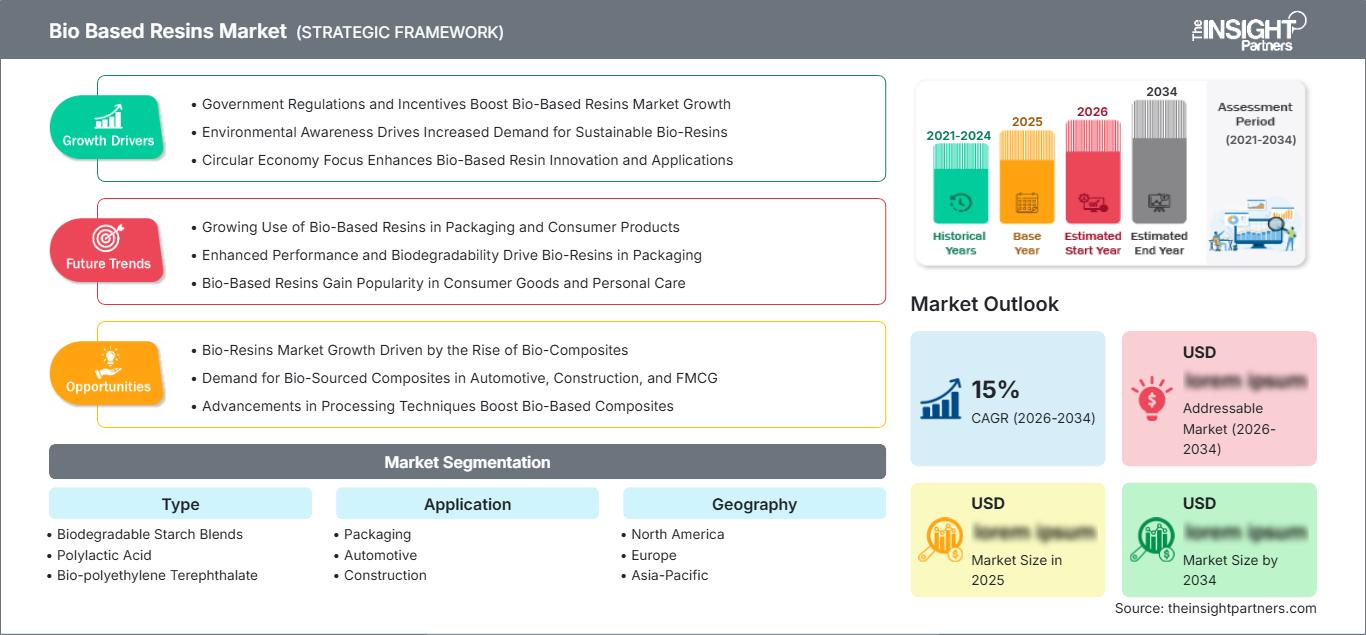
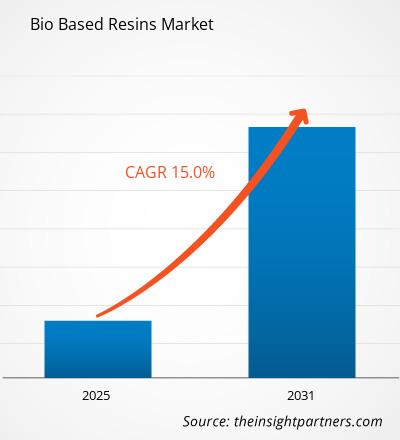
The Bio-Based Resins market size was valued at US$ 7.33 Billion in 2025 and is projected to reach US$ 17.07 Billion by 2034, registering a CAGR of 9.85% during 2026–2034. The market encompasses renewable and bio-derived polymer systems used across packaging, automotive, and construction applications. Growth reflects substitution of fossil-based feedstocks, advances in polymer processing, increasing demand for lower-carbon materials, and broader commercial availability of bio-based alternatives.
North America is positioned for sustained expansion as packaging producers, automotive manufacturers, and construction-material companies increase renewable-content procurement. The Bio-Based Resins Market size is supported by established polymer-processing infrastructure, corporate decarbonization commitments, and growing availability of certified bio-based feedstocks. Regional adoption is also influenced by demand for drop-in materials that can operate within existing converting and manufacturing systems without extensive process modifications.
Bio Based Resins Market Assessment and Insights
- North America: North America is estimated to hold a 17–21% share in 2025 and is projected to expand at an 8.7–9.8% CAGR during 2026–2034, supported by packaging sustainability programs, automotive material substitution, and established resin-processing infrastructure.
- U.S.: The U.S. accounts for approximately 78–84% of North America's 2025 market value and is expected to expand at an 8.8–9.9% CAGR during 2026–2034, led by packaging and automotive applications.
- Europe: Europe represents an estimated 27–31% share in 2025 and is projected to grow at a 9.2–10.1% CAGR through 2034. Germany, France, Italy, Spain, and the UK support demand through circular-economy policies, sustainable packaging requirements, and advanced polymer manufacturing.
- Asia Pacific: Asia Pacific holds an estimated 35–40% share in 2025 and is expected to register a 10.1–11.2% CAGR during 2026–2034. China, Japan, South Korea, India, and Australia benefit from large converting industries, renewable-feedstock availability, and expanding biopolymer production.
- Largest Segment: Packaging is the leading application, accounting for an estimated 48–53% share in 2025 and expanding at a 9.6–10.5% CAGR, driven by the substitution of conventional packaging polymers.
- High Growth Segment: Automotive is the fastest-growing application, representing approximately 18–22% share in 2025 and advancing at a 10.4–11.5% CAGR as manufacturers seek lightweight, lower-carbon materials.
- Key companies analyzed in detail: Arkema S.A., BASF SE, Bio-Tec Environmental, LLC, Braskem S.A., Corbion N.V., Danimer Scientific, Inc., Minima Technology Co., Ltd., NatureWorks LLC, Trinseo PLC, and Covestro AG.
Source: The Insight Partners' analysis based on proprietary research, government publications, company annual reports, investor presentations, industry databases, and expert interviews.
Biopolymers have evolved from being limited to niche applications based on their sustainability to becoming high-performance engineered polymers that can meet growing performance and processing demands. Development of better technologies for feedstock production, improved homogeneity, barrier properties, thermal stability, and compatibility with existing machinery is contributing towards increasing the commercial potential of biopolymers. Well-known polymer classes like PLA, bio-PE, bio-PET and PHA find wider use in packaging and other industries, while specialty bio-based resins help expand application range into high-performance segments of automotive and construction markets.
Market growth in the Bio-Based Resins Market continues to be influenced by feedstock availability, fermentation efficiency, polymerization technologies, and production scale. Asia continues to be the major center of production capacity of bioplastics globally, whereas Europe and North America continue dominating in terms of technology and application development. In the future, focusing on circular economy principles and lowering carbon footprints is likely to drive adoption. Favorable policies, especially those developed in Europe, alongside the development of renewable feedstock sources, mass balance concepts, and recyclable drop-ins, will help enhance competitiveness.
Bio Based Resins Market Report Scope
| Report Attribute | Details |
|---|---|
| Market size in 2025 | US$ 7.33 Billion |
| Market Size by 2034 | US$ 17.07 Billion |
| Global CAGR (2026 - 2034) | 9.85% |
| Historical Data | 2021-2024 |
| Forecast period | 2026-2034 |
Bio Based Resins Market Analysis
Demand is being shaped by packaging converters, brand owners, automotive manufacturers, and construction-material producers seeking alternatives to fossil-derived polymers. The Bio-Based Resins Market growth trajectory depends on the interaction between renewable feedstock supply, polymer manufacturing capacity, conversion economics, and end-user sustainability requirements. Packaging remains particularly important because resin selection directly affects material footprint, recyclability, barrier performance, and compliance with evolving packaging policies.
The value chain starts with agricultural feedstocks, biological wastes, or renewable intermediates and goes all the way through fermentation, chemical transformation, polymerization, compounding, distribution of resins, and finishing of the end products. Supply conditions are very different for each polymer. The bio-PE process uses the already existing facilities that are used for the processing of polyethylene, whereas PLA and PHA need to use special manufacturing techniques.
The Bio-Based Resins Market analysis indicates a fragmented competitive structure, with companies differentiating through renewable feedstock integration, polymer performance, production scalability, and application-specific formulations for packaging, automotive, and construction markets. Competitive positioning increasingly combines scale with differentiated material technology. Arkema S.A. emphasizes bio-derived polymers and specialty materials, while BASF SE integrates renewable feedstocks and mass-balance approaches across its polymer portfolio. Braskem S.A. maintains a strong position in bio-based polyethylene, whereas NatureWorks LLC focuses on PLA. Corbion N.V. and Danimer Scientific, Inc. emphasize biodegradable polymer technologies, while Covestro AG develops bio-attributed and circular material systems.
Investment in the Bio-Based Resins Market is moving toward commercial-scale production, process optimization, and partnerships across the value chain. Companies are attempting to reduce the cost premium associated with renewable materials while improving product consistency and application breadth. Arkema's 2025 activities demonstrate this direction through bio-based resins, certified mass-balance solutions, and recyclable composite technologies. Strategic differentiation increasingly depends on securing renewable feedstocks and demonstrating measurable lifecycle benefits.
● REPORT CUSTOMIZATION
Tailor This Report To Align With Your Specific Business Requirements
This report can be customized to align precisely with your business objectives, scope, and target markets. Customization options include tailored segmentation, geography, competitive analysis, and strategic insights to support informed decision-making.
Customize This Report →WHAT YOU CAN ADJUST
- ● Segmentations
- ● Geography
- ● Competitive Analysis
- ● Language Preferences
Bio Based Resins Market: Strategic Insights
Regional Insights
North America Bio Based Resins Market
North America is estimated to represent 17–21% of the Bio-Based Resins market share in 2025, with an expected CAGR of 8.7–9.8% through 2034. The area enjoys good polymer processing facilities, experienced packaging converters, and high engagement by automotive and consumer goods companies. The renewable content targets and company-wide CO2 reduction initiatives have made resin consumers consider the possibility of using bio-based polymers along with recycled polymers.
About 78–84% of the North American region's value is contributed by the U.S. in 2025. The key drivers of demand in this area include packaging, automotive parts, and specialty industrial materials, where drop-in capability makes conversion easier. Canada brings sustainability of packaging and advanced materials applications into the game, whereas Mexico brings manufacturing through its automotive and packaging supply chains.
U.S. Bio Based Resins Market
The U.S. represents approximately 78–84% of North America's 2025 Bio-Based Resins Market share and is projected to grow at an 8.8–9.9% CAGR through 2034. Demand comes from packaging producers, automotive suppliers, and manufacturers seeking renewable-content materials without major changes to established processing equipment. Federal and state-level sustainability initiatives also influence procurement decisions.
Materials suppliers such as BASF SE, Braskem S.A., NatureWorks LLC, Covestro AG, and others have a commercially or technologically significant presence in U.S. applications. Packaging is still one of the major markets, whereas automotive uses are starting to consider renewable polymer use in interiors and structural parts. Applications in construction are still picky due to cost issues and certification requirements.
Europe Bio Based Resins Market
In the Bio-Based Resins Market, Europe accounts for an estimated 27–31% share in 2025 and is expected to register a 9.2–10.1% CAGR through 2034. Germany leads regional demand, supported by advanced polymer manufacturing and automotive production. The UK, France, Italy, and Spain can contribute via packaging conversion, construction materials, and sustainable industrial procurement.
The UK is developing demand for packaging redesign and corporate carbon reduction, as well as renewables-based materials. Germany boasts a large-scale automotive and chemicals industry, along with polymer processing expertise. There are good prospects in France for packaging and industrial materials, whereas Italy has packaging conversion expertise. Spain is creating prospects for renewables-based manufacturing processes. European legislation remains a strong catalyst for demand as producers adapt to circular economy principles.
APAC Bio Based Resins Market
The Bio-Based Resins Market represents an estimated 35–40% share in APAC in 2025 and is projected to grow at a 10.1–11.2% CAGR. China leads regional production and consumption, followed by Japan, South Korea, India, and Australia. The region benefits from extensive packaging manufacturing, export-oriented polymer conversion, and growing domestic sustainability requirements.
China uses large-scale plastic manufacturing together with developing biopolymer capacity, while Japan and South Korea focus on high-performance materials. India provides substantial market potential for packaging and auto applications backed by increased manufacturing capacity. Australia is still smaller but has relevance in sustainable packaging and bio feedstock. Available production capacity data shows that Asia leads the world in biobased plastics manufacturing.
Middle East & Africa Bio Based Resins Market
The Middle East & Africa represent emerging regions in the Bio-Based Resins Market, supported by petrochemical diversification, growing packaging demand, and sustainability initiatives. Saudi Arabia and the UAE provide strong industrial infrastructure and investment capabilities, while South Africa contributes through packaging and manufacturing demand. The region is expected to record an 8.1–9.1% CAGR through 2034.
Saudi Arabia and the UAE can leverage existing polymer infrastructure while diversifying toward renewable and circular materials. South Africa remains the principal Sub-Saharan demand center, supported by packaging and industrial applications. The rest of MEA offers smaller but developing opportunities where sustainable packaging, imported bio-based materials, and circular-economy programs influence resin purchasing.
Segmentation Analysis
Type
The Bio-Based Resins Market scope by type includes biodegradable starch blends, polylactic acid, bio-polyethylene terephthalate, polyhydroxyalkanoate, and bio-polyethylene. The type segment is expected to expand at a 9.4–10.3% CAGR during 2026–2034. Selection depends on biodegradability, mechanical performance, barrier properties, feedstock availability, processing compatibility, and end-of-life requirements.
- Biodegradable Starch Blends: These materials address applications requiring renewable content and biodegradability. Their comparatively accessible feedstocks support use in flexible packaging and disposable products where moisture sensitivity and mechanical performance can be managed.
- Polylactic Acid: PLA benefits from established commercial production, broad processing compatibility, and applications in packaging, food-service products, fibers, and formed components. Its combination of renewable feedstock and established conversion technology supports continued adoption.
- Bio-polyethylene Terephthalate: Bio-PET offers familiar PET processing characteristics while replacing part of fossil-derived feedstock. Its compatibility with existing bottle and packaging systems makes it strategically important for companies seeking renewable content without major conversion changes.
- Polyhydroxyalkanoate: PHA attracts demand where biodegradability and renewable production pathways are important. Technology improvements are focused on fermentation efficiency, feedstock flexibility, polymer consistency, and reducing production costs relative to conventional polymers.
- Bio-polyethylene: Bio-PE provides renewable content while retaining the processing and performance characteristics of conventional polyethylene. This makes it attractive for packaging, films, closures, and molded products where drop-in compatibility is strategically important.
Application
In the Bio-Based Resins Market, application demand is projected to increase at a 9.6–10.5% CAGR during 2026–2034. Packaging remains the largest demand center because converters can incorporate established bio-based polymers into existing product formats. Automotive represents a faster-growing opportunity as manufacturers investigate lower-carbon materials for interiors, lightweight components, and selected structural applications.
- Packaging: Packaging remains the principal application because brands and converters seek renewable-content materials for bottles, films, trays, flexible formats, and specialty packaging. Performance requirements increasingly include barrier properties, recyclability, and verified feedstock sourcing.
- Automotive: Automotive applications are expanding as manufacturers evaluate lightweight materials with lower embedded carbon. Interior components, electrical parts, under-the-hood applications, and composites provide opportunities where thermal, mechanical, and durability specifications can be met.
- Construction: Construction demand centers on durable materials, coatings, composites, insulation-related components, and specialty polymer systems. Adoption depends strongly on service life, certification, moisture resistance, fire performance, and total installed cost.
Opportunity Snapshot
| Application | Revenue Contribution | Trend Tag | Adoption Stage |
| Packaging | High | Renewable Packaging | Scaling |
| Automotive | Medium | Lightweight Materials | Scaling |
| Construction | Low | Green Materials | Emerging |
Bio Based Resins Market Growth Drivers and Impact Analysis
Expansion of sustainable packaging requirements
Packaging remains the strongest structural demand catalyst in the Bio-Based Resins Market because brand owners increasingly evaluate renewable content alongside recyclability, recycled content, and material efficiency. The information provided on the global bioplastics production capacity indicates that 41.3% of the global bioplastics production capacity is in the packaging sector in 2025. This is indicative of the significance of packaging as an application sector. Regulatory issues are pushing things forward in this direction, especially in Europe, as the Packaging and Packaging Waste Regulation in Europe focuses on bio-based feedstocks and packaging sustainability. This opens up opportunities for the resin producers to produce resins that are compatible with the existing converting technologies. It also makes certification and life cycle data important, as there is a need for differentiation between real and environmental claims.
Growth of renewable feedstock and polymer technologies
Enhancements in fermentation, catalytic processes, polymerization, and feedstock processing have increased the number of viable resins that are bio-based. PLA, PHA, bio-PE, and bio-PET are now used in applications that were traditionally served by conventional polymers. Geographical expansion in capacity also takes place, with Asia being the largest region in terms of bioplastics capacity and Europe and North America retaining their technology and conversion capacities. The influence of technological improvements in the industry includes a reduction in dependency on feedstock pathways as well as an increase in customization of resins according to applications. As capacity increases, purchasing will no longer be based on pilot sustainability initiatives but on standard purchase agreements.
Corporate decarbonization and lifecycle-performance requirements
Sustainability programs from companies are taking steps from general environmental pledges towards actual carbon reductions from products. Consumers are becoming increasingly interested in the share of renewable raw materials, their certification, carbon footprint, efficiency of the manufacturing process, and end-of-life options. These developments incentivize resin manufacturers to develop mass balance systems, segregated renewable raw materials, LCA processes, and traceability platforms. For instance, Arkema stated that solutions based on more than 25% of bio-based products account for around 10% of its sales in 2024, while its certification program now includes all its coating plants. Such trends show that sustainability requirements are incorporated into business processes and product development. This demand goes further than packaging to the automotive and building materials industries.
Bio Based Resins Market Future Trends
Expansion of drop-in and mass-balance resin systems
Future Bio-Based Resins Market trends are likely to emphasize materials that can enter established production systems without extensive equipment changes. With drop-in polymers and mass-balance materials, companies get an easy solution for introducing renewable or bio-attributed carbon while still retaining the same processing environment. Such an option would help to boost the uptake of sustainable polymers in automotive, electronic, packaging, coating, and industrial applications, where the qualification process is expensive. Certification is going to be very necessary because customers want to have a chain-of-custody certification. Systems like ISCC PLUS and its equivalents can be used to trace the origin while still allowing existing manufacturing facilities to use alternative raw materials. Covestro's bio-circular attributed polycarbonate range is one of those examples of a solution that integrates mass balance raw materials into regular processing and performance.
Greater integration of circularity with bio-based materials
Bio-based content evaluation is becoming more and more common, together with recycling and re-use, rather than as an individual property of sustainability. Thus, producers have to create resin formulations that incorporate renewable feedstocks as well as recycling/re-used content opportunities. This will impact the development, certification, and funding since more and more consumers want products that minimize fossil fuel dependence without placing new burdens on the end-of-life stage. The packaging industry is going to be one of the main testing grounds for such innovations; however, applications within the automotive field will significantly speed up the process via lightweighting and part reformulation. In addition, regulations will drive more specific environmental claims and lifecycle assessments. Thus, future products will need to compete on the matrix of renewable content, carbon footprint, recyclability, durability, and processing efficiency. The companies capable of integrating all these features into one material platform will have better access to procurement needs than the bio-based materials producers.
Bio Based Resins Market Opportunities
Scaling renewable resin production near feedstock hubs
The Bio-Based Resins Market Forecasts indicate an opportunity to expand production near reliable agricultural, biological-waste, and renewable-intermediate supply centers. Feedstock proximity can reduce logistics exposure while improving traceability and supporting long-term supply agreements. Producers can prioritize regions with established sugar, corn, cellulose, agricultural-residue, or waste-oil value chains and connect these resources with polymerization or fermentation assets. Strategic partnerships with converters can further reduce commercialization risk by securing offtake before capacity expansion. Investment in modular production technologies may also allow manufacturers to respond to regional demand without committing immediately to very large facilities. The strongest opportunities should involve applications where customers accept renewable-content premiums because sustainability requirements, brand commitments, or regulatory obligations create sufficient value to offset higher material costs. Such projects can also diversify feedstock exposure and reduce dependence on a single renewable input.
Developing high-performance bio-based materials for automotive
Automotive represents an attractive opportunity because material selection increasingly incorporates lightweighting, carbon footprint, durability, and circularity. Resin producers can target interior components, electrical systems, composite structures, and specialty parts where renewable-content materials can satisfy stringent technical requirements. Development should focus on thermal stability, impact resistance, dimensional consistency, flame performance, and long-term durability rather than sustainability attributes alone. Partnerships with automotive OEMs, tier suppliers, and compounders can shorten qualification cycles and provide direct feedback on formulation requirements. The opportunity also extends to bio-based reinforcement systems and hybrid composites that combine renewable polymers with natural fibers or recycled materials. Successful commercialization would increase resin volumes beyond packaging and diversify demand across industrial applications. Automotive adoption could therefore provide a higher-value route for producers seeking to expand bio-based polymers into technically demanding markets.
Recent Developments
- January 2026: Arkema S.A. — Arkema announced that it would showcase 100% bio-based and recyclable resin technologies at JEC World 2026, expanding its sustainable composite materials portfolio. The company highlighted new resin solutions designed to combine renewable content with recyclability for demanding composite applications, supporting the shift toward lower-impact materials in transportation, energy, and industrial applications.
- November 2025: Michelin — Michelin and China's Yangtze River Delta Carbon Fiber and Composite Materials Technology Innovation Center signed a strategic cooperation agreement covering the joint research, development, and industrialization of bio-based, non-toxic, high-performance resin systems. The collaboration targets sustainable composite materials and supports technological development within China's composites industry.
- April 2025: Verde Bioresins, Inc. — Verde Bioresins announced new biodegradable PolyEarthylene film grades for packaging applications. The company stated that its FDA-approved resins combine plant-based content, recyclability, and landfill biodegradability while remaining compatible with conventional plastic-processing equipment. The development expands bio-based resin applications in flexible films and packaging formats.
Frequently Asked Questions

- Comprehensive Market Sizing and Forecast Analysis
- Detailed Segmentation Analysis
- In-Depth Market Dynamics Assessment
- Regional and Country-Level Insights
- Competitive Landscape and Company Benchmarking
- Strategic Business Intelligence
Recent Reports
Testimonials

The Insight Partners' SCADA System Market report is comprehensive, with valuable insights on current trends and future forecasts. The team was highly professional, responsive, and supportive throughout. We are very satisfied and highly recommend their services.
RAN KEDEM Partner, Reali Technologies LTDs
I requested a report on a very specific software market and the team produced the report in a few days. The information was very relevant and well presented. I then requested some changes and additions to the report. The team was again very responsive and I got the final report in less than a week.
JEAN-HERVE JENN Chairman, Future Analytica
We worked with The Insight Partners for an important market study and forecast. They gave us clear insights into opportunities and risks, which helped shape our plans. Their research was easy to use and based on solid data. It helped us make smart, confident decisions. We highly recommend them.
PIYUSH NAGPAL Sr. Vice President, High Beam Global
The Insight Partners delivered insightful, well-structured market research with strong domain expertise. Their team was professional and responsive throughout. The user-friendly website made accessing industry reports seamless. We highly recommend them for reliable, high-quality research services
YUKIHIKO ADACHI CEO, Deep Blue, LLC.
This is the first time I have purchased a market report from The Insight Partners.While I was unsure at first, I visited their web site and felt more comfortable to take the risk and purchase a market report.I am completely satisfied with the quality of the report and customer service. I had several questions and comments with the initial report, but after a couple of dialogs over email with their analyst I believe I have a report that I can use as input to our strategic planning process.Thank you so much for taking the extra time and making this a positive experience.I will definitely recommend your service to others and you will be my first call when we need further market data.
JOHN SUZUKI President and Chief Executive Officer, Board Director, BK Technologies
I wish to appreciate your support and the professionalism you displayed in the course of attending to my request for information regarding to infectious disease IVD market in Nigeria. I appreciate your patience, your guidance, and the fact that you were willing to offer a discount, which eventually made it possible for us to close a deal. I look forward to engaging The Insight Partners in the future, all thanks to the impression you have created in me as a result of this first encounter.
DR CHIJIOKE ONYIA MANAGING DIRECTOR, PineCrest Healthcare Ltd.Reason to Buy
- Informed Decision-Making
- Understanding Market Dynamics
- Competitive Analysis
- Identifying Emerging Markets
- Customer Insights
- Market Forecasts
- Risk Mitigation
- Boosting Operational Efficiency
- Strategic Planning
- Investment Justification
- Tracking Industry Innovations
- Aligning with Regulatory Trends





 Get Free Sample for