
Explosive trace Detection Market Growth, Size & Forecast by 2034
Coverage: by PProduct (Handheld, Portable/ Movable, Fixed Point/ Standalone); Technology (Chemiluminescence, Ion Mobility Spectrometry, Mass Spectrometry, Thermo-Redox, Surface Acoustic Wave, Chemical Reagents and Ultraviolet Fluorescence); Application (Commercial Airports, Railways, Retail Markets, Ports, Cargo & Vehicles, BFSI, Others); and Geography (North America, Europe, Asia Pacific, and South and Central America)
- Status : Data Released
- Report Code : TIPRE00004347
- Category : Electronics and Semiconductor
- No. of Pages : 150
- Available Report Formats :


- Last update date : September 09, 2026


2025 Market Size
US$ 1.44 Bn
Base year value
2034 Forecast
US$ 3.23 Bn
Projected by 2034
CAGR 2026-2034
9.39 %
Growth rate
Addressable Market
US$ 20.85 Bn
(2026-2034)
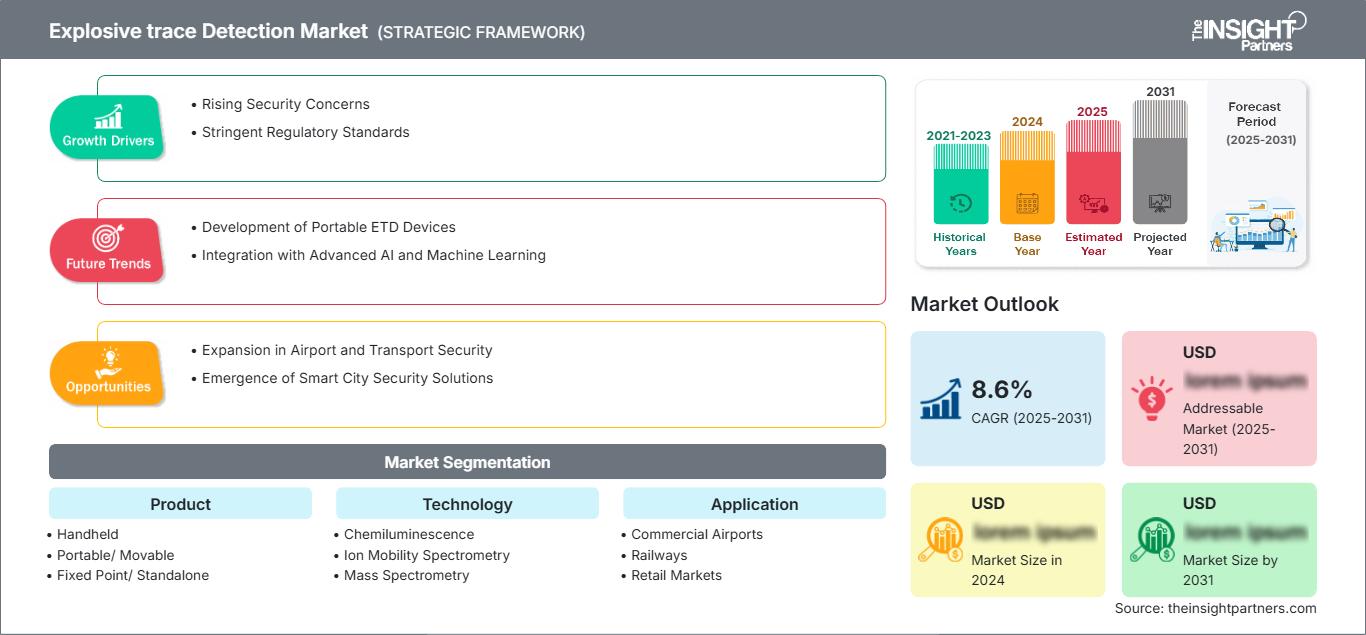
The Explosive Trace Detection Market is projected to grow from US$ 1.44 Billion in 2025 to US$ 3.23 Billion by 2034, registering a CAGR of 9.39% during 2026–2034. Demand is supported by aviation security mandates, cargo inspection modernization, and wider deployment across public infrastructure where authorities need rapid identification of microscopic explosive residues without disrupting passenger, freight, or vehicle movement.
North America remains the most mature procurement base, with the Explosive Trace Detection Market size supported by airport checkpoint upgrades, border security programs, and cargo screening investments. The region is expected to expand at a 8.7–9.2% CAGR during 2026–2034, driven by regulatory compliance cycles, high passenger throughput, and replacement demand for systems that combine faster sampling, lower false alarms, and improved operator usability.
Explosive trace Detection Market Assessment and Insights
- North America: The region accounted for 36–39% share in 2025 and is projected to grow at a CAGR of 8.7–9.2% between 2026–2034, led by aviation, border, defense, and cargo screening modernization.
- US: The US represented 78–82% of North America in 2025 and is forecast to grow at a CAGR of 8.6–9.1% between 2026–2034.
- Europe: Europe held 25–28% share in 2025 and is expected to grow at a CAGR of 8.4–8.9% between 2026–2034, with the UK, Germany, and France leading airport and rail security spending.
- Asia Pacific: Asia Pacific captured 22–25% share in 2025 and is likely to grow at a CAGR of 10.1–10.8% between 2026–2034, supported by China, India, Japan, South Korea, and Australia.
- Largest Segment: Portable/ Movable systems held 42–45% market share in 2025 and are forecast to grow at a CAGR of 8.9–9.4% between 2026–2034.
- High Growth Segment: Mass Spectrometry represented 14–17% market share in 2025 and is projected to grow at a CAGR of 10.8–11.6% between 2026–2034.
- Key companies analyzed in detail: Safran S.A., Smiths Group plc, L3Harris Technologies, Inc., OSI Systems, Inc., Nuctech Company Limited, Implant Sciences Corporation, Teledyne FLIR LLC, Chemring Group PLC, American Science and Engineering, Inc., Analogic Corporation
Source: The Insight Partners' analysis based on proprietary research, government publications, company annual reports, investor presentations, industry databases, and expert interviews.
Procurement has moved beyond single-purpose checkpoint solutions to become more sophisticated and capable of functioning in networking environments and with minimal maintenance needs in aviation, rail, and cargo segments. Ion mobility spectrometry, miniaturized mass spectrometry, consumables, and algorithms that reduce the number of false positives are among the technological trends seen in the Explosive Trace Detection Market. The vendors are working towards enhancing the sensitivity and reliability of their products, while the end-users are emphasizing the significance of total cost of ownership, certification, and system portability.
In the coming years, new airports, port-based trade routes, and urban transport security deployments will be among the factors driving the increase in utilization beyond traditional aviation checkpoints. Regulations common in Europe, North America, and certain parts of Asia will push the demand for certified systems, while the development of infrastructures will increase deployments of both portable and fixed detectors.
Explosive trace Detection Market Report Scope
| Report Attribute | Details |
|---|---|
| Market size in 2025 | US$ 1.44 Billion |
| Market Size by 2034 | US$ 3.23 Billion |
| Global CAGR (2026 - 2034) | 9.39% |
| Historical Data | 2021-2024 |
| Forecast period | 2026-2034 |
Explosive trace Detection Market Analysis
The demand driver in the Explosive Trace Detection Market is transport security, but cargo security, customs modernization, and infrastructure screening are becoming additional drivers for the market expansion. Fast passenger and luggage screening is needed at airports, while container scanning, vehicle scanning, and parcel screening are required from cargo operators. The value chain consists of sensor modules, sampling media, calibration material, software, field service, and certification tests. Recurring consumable and maintenance are an integral part of revenues.
Supply dynamics are still highly specialized due to high threshold requirements for detection, environmental performance, and training. Ion mobility systems are mostly used in the routine screening due to their high speed and availability of certification paths, while mass spectrometry is more often applied in confirmatory testing due to its accuracy. Comparison of detection performance and total cost of ownership, batteries life, swab consumptions, connectivity, and response time becomes an essential procurement criterion.
The market concentration level is high among the security solution suppliers in the Explosive Trace Detection Market. Safran S.A., Smiths Group plc, L3Harris Technologies, Inc., OSI Systems, Inc., and Nuctech Company Limited are competing on the market due to installed airport bases, approvals, and service coverage. According to the market analysis, reliability and upgradeability are becoming equally valuable features alongside sensitivity for agencies who are planning to upgrade their equipment without changing workflows.
The investment trend in Explosive Trace Detection Market analysis is shifting toward portable instruments, use of AI to interpret alarm signals, and multi-threat systems which can detect explosives, narcotics, and chemical substances on the same platform. Teledyne FLIR LLC, Chemring Group PLC, American Science and Engineering, Inc., Analogic Corporation, and Implant Sciences Corporation contribute to the specialized layer via handheld, imaging, and trace technologies.
● REPORT CUSTOMIZATION
Tailor This Report To Align With Your Specific Business Requirements
This report can be customized to align precisely with your business objectives, scope, and target markets. Customization options include tailored segmentation, geography, competitive analysis, and strategic insights to support informed decision-making.
Customize This Report →WHAT YOU CAN ADJUST
- ● Segmentations
- ● Geography
- ● Competitive Analysis
- ● Language Preferences
Explosive trace Detection Market: Strategic Insights
Regional Insights
North America Explosive Trace Detection Market
North America held 36–39% share in 2025 and is expected to post an 8.7–9.2% CAGR during 2026–2034. Explosive Trace Detection Market share is backed up by Transportation Security Administration screening program efforts, Canadian airport upgrade initiatives, and consistent defense sector demand. Passenger traffic, combined baggage handling systems, and cargo scanning needs ensure the need for replacement cycles for portable and stationary scanning equipment.
Regionally, users value certified devices, training programs, swift maintenance services, and checkpoint operational compatibility. Usage is evolving beyond airport settings to include government facilities, borders, special event venues, and postal facilities, where portability makes for more efficient operations. Vendors with the ability to provide maintenance services locally and long-term consumable supplies are better off than others in framework agreements.
U.S. Explosive Trace Detection Market
The US represented 78–82% of North America in 2025 and is forecast to grow at an 8.6–9.1% CAGR during 2026–2034. The network of airports, security protocols at the federal level, border installations, and defense procurements ensure a steady market demand. The application trend includes secondary screening of passengers, screening of baggage, air cargo trace verification, vehicle screening, and event security.
OSI Systems, Inc., Smiths Group plc, Teledyne FLIR LLC, L3Harris Technologies, Inc., and established integrator relationships for transport and homeland security applications strengthen company presence. The platform approach in procurements ensures that the products procured are those already tested and working, with the provision of calibration, local support, configured consumables, and software upgrades.
Europe Explosive Trace Detection Market
Europe accounted for 25–28% share in 2025 and is projected to grow at an 8.4–8.9% CAGR during 2026–2034. The UK takes the lead in regional adoption with aviation and rail security enhancements, while the German airport and logistics network provides trace detection capability for cargo, airports, and government security operations. France, Italy, and Spain provide contributions via airport security modernization, port security, and public venues security.
European procurement is highly associated with the ECAC performance standards as well as harmonized passenger and cargo screening standards. Equipment enhancement by certified suppliers mitigates compliance risks for airport operators and civil aviation authorities. The region also enjoys cross border rail traffic, extensive urban transportation systems, and port security investments; thus, lifecycle services and regulatory enhancements become essential competitive criteria for suppliers.
APAC Explosive Trace Detection Market
Asia Pacific held 22–25% share in 2025 and is expected to record a 10.1–10.8% CAGR during 2026–2034, making it the fastest regional growth pool. With China driving demand by volume, Japan, South Korea, India, and Australia are seeing an increase in screening in airports, metro stations, freight facilities, and secure infrastructures.
There is pressure coming from industrial policies, new airport construction projects, defense modernization, and international logistics operations that will fuel market growth. There will be a greater demand for screening equipment operating in humid, dusty, and high-volume conditions.
Middle East & Africa Explosive Trace Detection Market
Middle East & Africa is projected to grow at a 9.0–9.7% CAGR during 2026–2034, with Saudi Arabia leading regional procurement. The UAE will continue to develop its airport, events, and logistics security sector, whereas South Africa and RoMEA will concentrate their efforts on port security, border control, and critical infrastructure security.
Given the fact that there is a requirement for such services for energy infrastructure, tourism centers, and large transportation projects, there is a strong need for mobile residue detection and fixed inspections. Difficulties with conditions of operations make ruggedness, training, spare parts, and vendor support more important.
Segmentation Analysis
Product
Product is expected to grow at an 8.8–9.4% CAGR during 2026–2034 as buyers balance checkpoint throughput, field mobility, and fixed-site protection. The Explosive Trace Detection Market scope across product types reflects different operating models: handheld devices support patrol teams, portable units serve flexible checkpoints, and standalone systems strengthen controlled access points where repeatable screening is required.
- Handheld systems support patrol, border, event, and vehicle inspection teams where compact design, battery life, and quick sampling matter. Demand is strongest where security staff require flexible deployment beyond fixed checkpoint infrastructure.
- Portable/ Movable systems are the largest product group because they combine checkpoint-grade detection with operational flexibility. Airports, cargo terminals, and temporary screening posts use them to manage changing passenger and freight flows.
- Fixed Point/ Standalone systems serve controlled entrances, baggage areas, and high-security facilities requiring repeatable inspection. Their strategic value lies in consistent screening, centralized operation, and integration with broader access-control workflows.
Technology
Technology is forecast to expand at a 9.2–9.8% CAGR during 2026–2034 as buyers seek higher sensitivity, faster alarm resolution, and lower false-positive rates. Ion mobility spectrometry remains the routine checkpoint standard, while mass spectrometry gains traction for demanding confirmation use cases. Chemical, optical, acoustic, and fluorescence techniques support niche workflows where sample type, operating environment, and detection confidence influence procurement.
- Chemiluminescence technology supports selective residue detection where chemical reactions provide visible or measurable signals. It remains strategically relevant for specialized environments needing relatively simple workflows and targeted confirmation.
- Ion Mobility Spectrometry is widely adopted because it offers rapid analysis, mature certification pathways, and strong checkpoint suitability. Its installed base supports recurring demand for consumables, calibration, and upgrades.
- Mass Spectrometry is gaining importance in high-confidence detection because it provides stronger molecular identification. It is strategically suited to laboratories, critical checkpoints, and advanced field confirmation.
- Thermo-Redox approaches support detection of explosive compounds through thermal and reaction-based signatures. Their value is linked to robust operation where rapid screening and compact system design are required.
- Surface Acoustic Wave sensors enable compact detection through mass-sensitive acoustic changes on sensor surfaces. They are relevant for portable instruments where low power consumption and fast response are priorities.
- Chemical Reagents remain useful for field screening, secondary checks, and low-complexity applications. Their strategic role is strongest where cost control, basic training, and quick visual indication matter.
- Ultraviolet Fluorescence supports optical detection by identifying fluorescent responses from target residues. Applications benefit from non-destructive inspection, rapid scans, and compatibility with selected surface screening workflows.
Application
Application is expected to grow at a 9.0–9.7% CAGR during 2026–2034 as deployment broadens from aviation checkpoints to multimodal transport, cargo, finance, and public-space security. Commercial airports remain the core revenue base, but ports, vehicle inspection, and railways are gaining attention as governments connect passenger screening with supply-chain resilience and urban infrastructure protection.
- Commercial Airports remain the primary application because passenger and baggage screening require certified, high-throughput instruments. Replacement cycles, checkpoint redesigns, and cargo security maintain strong purchasing discipline.
- Railways are becoming more relevant as operators protect high-density stations, cross-border services, and urban transit nodes. Demand centers on portable systems that can support flexible screening without major disruption.
- Retail Markets use trace detection selectively for large venues, shopping complexes, and special-risk locations. Adoption depends on security budgets, threat perception, and integration with broader surveillance and access-control systems.
- Ports, Cargo & Vehicles represent a strategic growth area as customs agencies and logistics operators screen containers, trucks, parcels, and freight corridors for concealed explosive residue.
- BFSI users deploy detection in high-security branches, cash processing centers, vaults, and headquarters. Demand is focused on risk-sensitive facilities where controlled access and incident prevention are operational priorities.
Opportunity Snapshot
| Application | Revenue Contribution | Trend Tag | Adoption Stage |
| Commercial Airports | High | Checkpoint Upgrade | Mature |
| Railways | Medium | Station Security | Scaling |
| Retail Markets | Low | Venue Screening | Emerging |
| Ports, Cargo & Vehicles | High | Cargo Integrity | Scaling |
| BFSI | Medium | Facility Protection | Scaling |
| Others | Low | Public Safety | Emerging |
Explosive trace Detection Market Growth Drivers and Impact Analysis
Aviation Checkpoint Modernization and Compliance Renewal
There is also a need to upgrade old trace detection systems by airport operators and civil aviation agencies to be able to meet certification requirements, reduce queue time, and ensure precision during secondary screening. It is important to identify residues fast due to passenger recovery, increased number of baggage, and changing nature of threats at checkpoints, hold-baggage, and cargo facilities. The effect of the above-mentioned factors is very tangible and consistent as there is a constant need for media samples, calibrations, software upgrades, and maintenance services of the systems.
Expansion of Cargo, Port, and Vehicle Screening Programs
The application of explosive screening is now being expanded from airport checkpoints to freight corridors, container handling areas, postal offices, and inspection booths. Increasing use of e-commerce, cross-border shipping, and multimodal transport means there is a growing need for non-intrusive and quick detection solutions to complement the imaging systems. This driver contributes to the increase in the market size of portable detection instruments, especially where there is no fixed infrastructure. The market effect is most pronounced in ports and cargo hubs since trace detection provides a chemical detection element that enhances the evaluation of suspect cargo, vehicles, and cargo handling equipment.
Technology Improvements Lowering False Alarms and Downtime
Instrument upgrades are improving sensitivity, alarm discrimination, sample throughput, and operator usability, which directly affects procurement decisions in high-volume security environments. Better ion mobility spectrometry software, more robust sampling consumables, and emerging mass spectrometry configurations help reduce repeat tests and supervisor interventions. For buyers, lower false alarms translate into shorter queues, fewer manual inspections, and higher asset availability. For suppliers, this shift supports premium positioning through diagnostics, analytics, and service contracts. The market benefits because performance improvements make upgrades easier to justify even when security budgets are reviewed against broader infrastructure priorities.
Explosive trace Detection Market Future Trends
AI-Assisted Alarm Resolution and Connected Fleet Management
Future procurement will increasingly favor connected instruments that capture alarm history, consumable use, maintenance status, and operator actions for centralized review. The most important Explosive Trace Detection Market trends will involve AI-assisted interpretation that helps supervisors distinguish contamination patterns from credible threats while preserving human decision authority. This direction can reduce repeated sampling, improve training feedback, and support audit readiness across multi-terminal airport and cargo networks. Vendors that combine detection hardware with secure analytics dashboards, remote diagnostics, and updateable threat libraries are likely to gain advantage as buyers seek measurable performance improvement rather than isolated device purchases.
Multi-Threat Detection Platforms for Flexible Security Missions
Security agencies are expected to move toward instruments that detect explosives, narcotics, toxic chemicals, and emerging threat residues through a shared interface. This trend responds to operational pressure on border guards, customs officers, airport teams, and first responders who cannot maintain separate devices for every mission. Multi-threat platforms can improve asset utilization, simplify training, and support procurement consolidation. Adoption will require validated libraries, clear alarm categories, and rugged designs that perform in field conditions. Suppliers able to prove reliability across diverse substances will strengthen their position in public safety and transport security programs.
Explosive trace Detection Market Opportunities
Airport Replacement Cycles in Regulated Screening Networks
Airport operators seeking compliance continuity represent a strong investment opportunity because older trace systems must remain aligned with updated detection standards and checkpoint redesigns. Explosive Trace Detection Market Forecasts indicate that vendors can improve revenue visibility through upgrade kits, maintenance contracts, consumable supply, and operator training rather than relying only on new equipment tenders. Suppliers should prioritize certified platforms that reduce transition risk for regulated customers. Commercial teams can also target installed-base audits, software refresh programs, and service-level agreements that help airports extend equipment value while meeting evolving passenger and cargo screening requirements.
Port, Border, and Logistics Corridor Expansion
Ports, border crossings, and inland logistics hubs offer an attractive opportunity because screening needs are expanding beyond passenger terminals into freight-intensive environments. Vendors can address this demand with portable units, handheld detectors, rugged sampling kits, and service models designed for distributed inspection teams. The commercial priority should be workflow integration with existing imaging, customs, and access-control systems. Suppliers that demonstrate fast deployment, reliable consumables, and low downtime in dusty or humid conditions can win projects where agencies need chemical confirmation without slowing container, vehicle, or parcel movement.
Recent Developments
- June 2026: Astrotech Corporation announced that its Board approved a potential sale process for 1st Detect Corporation, developer of the TRACER 1000 mass-spectrometry-based explosive and narcotics trace detection platform. The company cited TSA air-cargo approval, ECAC passenger and cargo certifications, checkpoint certification activity, and a DHS development award as milestones increasing the subsidiary's strategic value.
- November 2025: Airports Authority of India (AAI) signed a ₹40-crore contract with Vehant Technologies to deploy 232 indigenous explosive trace detectors at more than 60 airports. The NanoSniffer systems are intended for passenger checkpoints, baggage handling, cargo, and transit areas. The deployment supports domestic manufacturing of security technology and reduces reliance on imported explosive-trace detection equipment.
- September 2025: Agilent Technologies Inc. launched its Insight Series Alarm Resolution Systems, including the Insight300M and InsightBLS, for airport security screening of liquids, aerosols, and gels. The systems are designed to improve alarm resolution through opaque and multilayered containers, with rapid scanning, low false-alarm performance, and software-upgrade capability. The launch expanded Agilent’s airport security portfolio and built on its earlier Insight systems.
Frequently Asked Questions

- Comprehensive Market Sizing and Forecast Analysis
- Detailed Segmentation Analysis
- In-Depth Market Dynamics Assessment
- Regional and Country-Level Insights
- Competitive Landscape and Company Benchmarking
- Strategic Business Intelligence
Recent Reports
Testimonials

The Insight Partners' SCADA System Market report is comprehensive, with valuable insights on current trends and future forecasts. The team was highly professional, responsive, and supportive throughout. We are very satisfied and highly recommend their services.
RAN KEDEM Partner, Reali Technologies LTDs
I requested a report on a very specific software market and the team produced the report in a few days. The information was very relevant and well presented. I then requested some changes and additions to the report. The team was again very responsive and I got the final report in less than a week.
JEAN-HERVE JENN Chairman, Future Analytica
We worked with The Insight Partners for an important market study and forecast. They gave us clear insights into opportunities and risks, which helped shape our plans. Their research was easy to use and based on solid data. It helped us make smart, confident decisions. We highly recommend them.
PIYUSH NAGPAL Sr. Vice President, High Beam Global
The Insight Partners delivered insightful, well-structured market research with strong domain expertise. Their team was professional and responsive throughout. The user-friendly website made accessing industry reports seamless. We highly recommend them for reliable, high-quality research services
YUKIHIKO ADACHI CEO, Deep Blue, LLC.
This is the first time I have purchased a market report from The Insight Partners.While I was unsure at first, I visited their web site and felt more comfortable to take the risk and purchase a market report.I am completely satisfied with the quality of the report and customer service. I had several questions and comments with the initial report, but after a couple of dialogs over email with their analyst I believe I have a report that I can use as input to our strategic planning process.Thank you so much for taking the extra time and making this a positive experience.I will definitely recommend your service to others and you will be my first call when we need further market data.
JOHN SUZUKI President and Chief Executive Officer, Board Director, BK Technologies
I wish to appreciate your support and the professionalism you displayed in the course of attending to my request for information regarding to infectious disease IVD market in Nigeria. I appreciate your patience, your guidance, and the fact that you were willing to offer a discount, which eventually made it possible for us to close a deal. I look forward to engaging The Insight Partners in the future, all thanks to the impression you have created in me as a result of this first encounter.
DR CHIJIOKE ONYIA MANAGING DIRECTOR, PineCrest Healthcare Ltd.Reason to Buy
- Informed Decision-Making
- Understanding Market Dynamics
- Competitive Analysis
- Identifying Emerging Markets
- Customer Insights
- Market Forecasts
- Risk Mitigation
- Boosting Operational Efficiency
- Strategic Planning
- Investment Justification
- Tracking Industry Innovations
- Aligning with Regulatory Trends





 Get Free Sample for