
Fall Detection System Market Size, Trends & Growth by 2034
Coverage: by Product Type (Automatic Fall Detection system, Manual Fall Detection System); Technology (GPS Systems Based, Mobile Phones Based, Sensors Based); Sensing Method (Wearable Systems, Non-Wearable Systems); End User (Senior Citizens-Home, Senior Citizens-Outside, Senior Assisted Living Facilities, Lone Workers, Others) , and Geography (North America, Europe, Asia Pacific, and South and Central America)
- Status : Data Released
- Report Code : TIPRE00009572
- Category : Electronics and Semiconductor
- No. of Pages : 150
- Available Report Formats :


- Last update date : September 09, 2026


2025 Market Size
US$ 545.56 Mn
Base year value
2034 Forecast
US$ 843.12 Mn
Projected by 2034
CAGR 2026-2034
4.96 %
Growth rate
Addressable Market
US$ 6,303.64 Mn
(2026-2034)
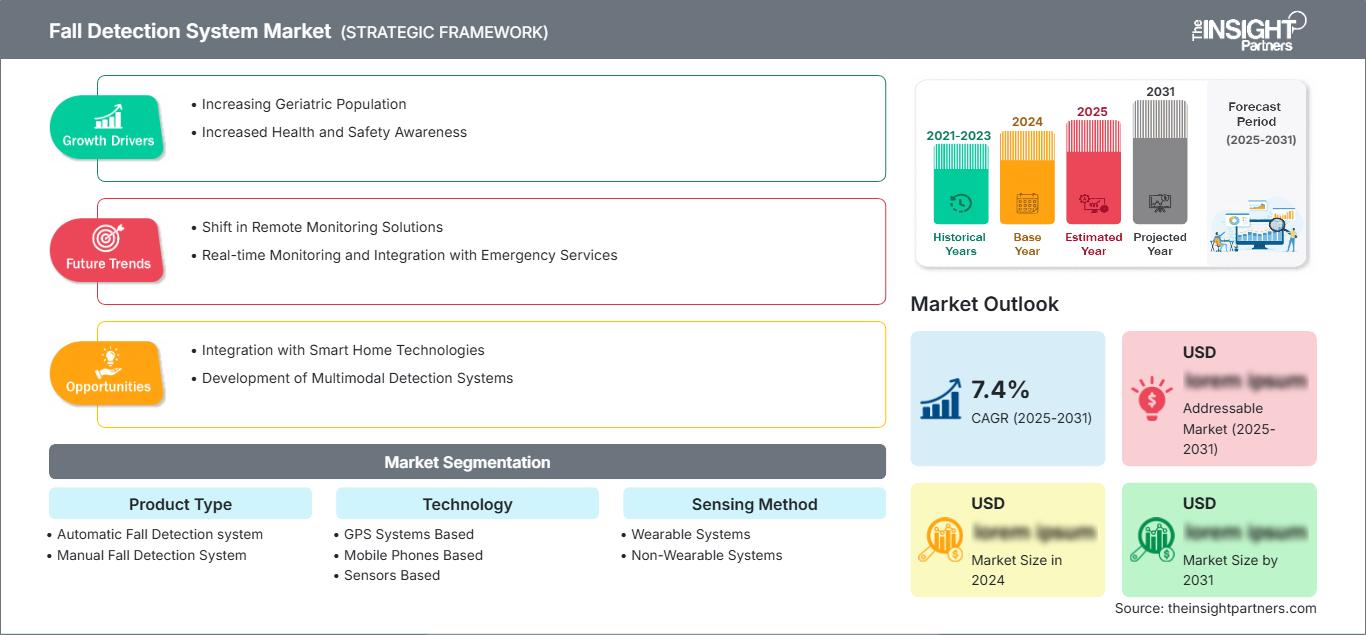
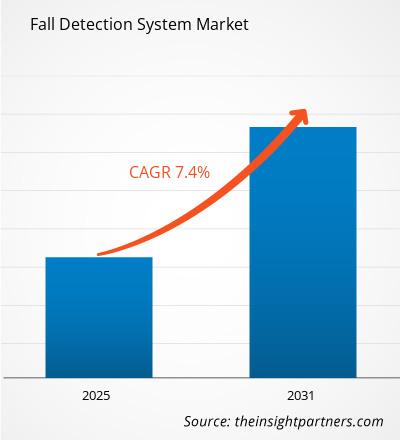
The Fall Detection Systems Market size was valued at US$ 545.56 Million in 2025 and is projected to reach US$ 843.12 Million by 2034, registering a CAGR of 4.96% during 2026–2034. Demand is being shaped by aging populations, preference for independent living, expansion of remote monitoring, and greater use of connected safety technologies across senior care, healthcare, workplace safety, and emergency response environments.
North America remains a structurally important Fall Detection Systems Market because medical alert adoption is supported by established emergency response infrastructure and consumer familiarity with connected health devices. The Fall Detection Systems size outlook is further supported by aging-in-place preferences, expansion of remote patient monitoring, and growing use of wearable and sensor-enabled technologies across home and assisted-care environments.
Fall Detection System Market Assessment and Insights
- North America: North America represents the leading regional market, supported by mature personal emergency response services, connected healthcare infrastructure, aging-in-place preferences, and established reimbursement and monitoring ecosystems, with a 38–42% share in 2025 and a 4.8–5.5% CAGR between 2026–2034.
- US: The US is the principal regional demand center, accounting for an 82–87% Fall Detection Systems Market share of North America in 2025 and expanding at a 4.7–5.4% CAGR between 2026–2034, supported by home-based care.
- Europe: Europe benefits from expanding digital health infrastructure, senior-care modernization, and demand for independent living technologies, holding a 27–31% share in 2025 and growing at a 4.5–5.2% CAGR between 2026–2034, led by Germany, the UK, France, Italy, and Spain.
- Asia Pacific: Asia Pacific is developing rapidly through population aging, smart-home adoption, hospital digitization, and healthcare technology investment, representing a 16–20% share in 2025 and recording a 5.8–6.7% CAGR between 2026–2034, with China, Japan, South Korea, India, and Australia as key markets.
- Largest Segment: Automatic Fall Detection system is the largest segment, representing a 58–62% market share in 2025 and expanding at a 5.0–5.8% CAGR from 2026–2034, reflecting demand for unattended alerts.
- High Growth Segment: Sensors Based technology represents a 36–40% market share in 2025 and is projected to grow at a 5.8–6.8% CAGR from 2026–2034, supported by ambient monitoring.
- Key companies analyzed in detail: ALERTONE SERVICES LLC., Bay Alarm Medical, Connect America, Koninklijke Philips N.V., LifeFone Medical Alert Services, Medical Guardian, LLP, MobileHelp, Semtech Corporation, Singapore Technologies Engineering Ltd, VitalConnect.
Source: The Insight Partners' analysis based on proprietary research, government publications, company annual reports, investor presentations, industry databases, and expert interviews.
Fall Detection Systems Market has advanced from simple alert buttons to sophisticated networks of sensors that include accelerometers, gyroscopes, GPS, cellular connectivity, radar, apps, data analytics on the cloud, and auto-alert capabilities. Design priorities include minimalistic designs, longer battery lives, improved handling of false alarms, and compatibility with care delivery systems. Architectures are either wearable or non-wearable and have been designed for use in diverse environments including independent living facilities, hospitals, and eldercare homes.
Going forward, investments in the Fall Detection Systems market will focus more on ambient sensing, AI, edge computing, and remote care workflow integration. The Asia-Pacific region will be significant owing to the expansion in the user base on account of the growing trend towards digital health care in aging populations. North America and Europe will continue to be focused on replacement and maintenance of devices.
Fall Detection System Market Report Scope
| Report Attribute | Details |
|---|---|
| Market size in 2025 | US$ 545.56 Million |
| Market Size by 2034 | US$ 843.12 Million |
| Global CAGR (2026 - 2034) | 4.96% |
| Historical Data | 2021-2024 |
| Forecast period | 2026-2034 |
Fall Detection System Market Analysis
Factors fueling Fall Detection Systems market growth include aging-in-place needs, rising workload of caregivers, and the necessity to shorten time between an incident and the intervention. An ecosystem consists of players such as sensor manufacturers, wearable devices developers, connectivity solutions, emergency response centers, health care facilities, assisted living facilities, insurance agencies, caregivers, and technology integrators. More and more often, buyers evaluate such aspects as detection effectiveness, alerting speed, battery life, user friendliness, and integration with current care process.
Value chain includes sensors and embedded components, device assembly, connectivity, cloud-based analytics, monitoring, and response services. Companies capable of offering subscription-based monitoring services are able to derive revenue not only from selling hardware, but also providing services on a recurring basis. Suppliers of components can benefit from growing needs in low power wireless connectivity solutions. Inefficient algorithms and false alarms can add up to operational costs, which explains the growing role of context-based sensing.
Fall Detection Systems market is characterized by the competition between the traditional providers of personal emergency response systems, diversified healthcare technology vendors, sensor suppliers, and connected devices manufacturers. Koninklijke Philips N.V. unites patient monitoring and wearables in its portfolio, whereas Bay Alarm Medical, Connect America, LifeFone Medical Alert Services, Medical Guardian, and MobileHelp offer products and services that emphasize emergency response and seniors' safety. ALERTONE SERVICES LLC competes in personal safety services industry.
The ability to distinguish itself is based on combination of detection and other services such as communication, location, monitoring, and caregiver notifications. Semtech Corporation provides technologies that facilitate low-power connectivity and distributed sensor architecture, whereas Singapore Technologies Engineering Ltd and VitalConnect enter the competition in contactless sensing and clinical monitoring areas. Consequently, investments are focused on multimodal fall detection, cloud analytics, remote diagnostics, and service models with ongoing engagement.
● REPORT CUSTOMIZATION
Tailor This Report To Align With Your Specific Business Requirements
This report can be customized to align precisely with your business objectives, scope, and target markets. Customization options include tailored segmentation, geography, competitive analysis, and strategic insights to support informed decision-making.
Customize This Report →WHAT YOU CAN ADJUST
- ● Segmentations
- ● Geography
- ● Competitive Analysis
- ● Language Preferences
Fall Detection System Market: Strategic Insights
Regional Insights
North America Fall Detection Systems Market
North America held a 38–42% Fall Detection Systems market share in 2025 and is expected to expand at a 4.8–5.5% CAGR during 2026–2034. The US constitutes the majority of demand in the region, while Canada represents an emerging market for personal emergency response systems, home health monitoring services, and eldercare technologies. The availability of robust healthcare infrastructure and consumer awareness about products contributes towards the acceptance of connected monitoring devices.
According to the Fall Detection Systems market report, another factor working to the benefit of this region is the presence of high smartphone and connected device penetration. AARP estimates that 75% of adults above 50 years of age are interested in staying in their homes, whereas home safety technology adoption has been rising, leading to the demand for non-invasive monitoring solutions.
U.S. Fall Detection Systems Market
The US represents an 82–87% share of North America in 2025 and is projected to grow at a 4.7–5.4% CAGR during 2026–2034. This will be aided by preferences for aging-in-place, existing subscriptions to medical alert systems, growth in home health care and adoption of smartphones and connected devices by elderly people.
Bay Alarm Medical, Connect America, LifeFone Medical Alert Services, Medical Guardian, MobileHelp, Koninklijke Philips N.V., and VitalConnect are some of the companies that operate in the market in both consumer and clinical settings as well as connected care. As per AARP, about 90% of adults aged 50 and above owned smartphones in 2025 in the US.
Europe Fall Detection Systems Market
Europe accounted for a 27–31% Fall Detection Systems market in 2025 and is forecast to register a 4.5–5.2% CAGR during 2026–2034. Germany is one of the key markets, backed by systematic senior care, healthcare digitization, and the need for technologies that allow people to stay independent. The United Kingdom also continues to be a significant market owing to community care programs and use of digital health solutions.
France, Italy, and Spain also add to the demand due to their aging population, development of homecare solutions, and connected healthcare solutions. Europeans typically pay a lot of attention to such aspects as privacy, interoperability, reliability, and usability of products. Consequently, technology vendors have to prove effective data processing capabilities and reliable alert management procedures in addition to detection efficacy.
APAC Fall Detection Systems Market
APAC represented a 16–20% Fall Detection Systems market in 2025 and is expected to expand at a 5.8–6.7% CAGR during 2026–2034. While Japan is the front-runner in regional deployment, China, South Korea, India, and Australia offer increasing possibilities. Aging population trends, healthcare digitization initiatives, smart home investments, and connected devices manufacturing are all contributing to increased demands.
While Japan focuses on independent living and advanced monitoring solutions, both China and India have more user base that would be using these devices for a longer period of time. While South Korea has infrastructure to connect homes through devices, Australia already has demand established for aged care technologies.
Middle East & Africa Fall Detection Systems Market
Middle East and Africa Fall Detection Systems market demand remains smaller but is supported by healthcare modernization, private senior-care development, smart-city programs, and connected infrastructure. Saudi Arabia and the UAE are leading markets, while South Africa provides the strongest southern African base. The region is expected to record a 3.8–4.8% CAGR during 2026–2034.
Saudi Arabia and the UAE are investing in digitally enabled healthcare and smart infrastructure, creating opportunities for connected safety systems. South Africa supports demand through private healthcare and assisted-care applications, while the rest of MEA remains more project-driven. High-quality connectivity, localized support, and affordable device configurations will influence broader adoption.
Segmentation Analysis
Product Type
The Product Type segment is projected to grow at a 5.1–5.8% CAGR during 2026–2034. Automatic Fall Detection system adoption is supported by the need for unattended alerts, while Manual Fall Detection System solutions remain relevant where users can reliably activate assistance. Product selection depends on user mobility, cognitive capability, care setting, and acceptable false-alarm levels.
- Automatic Fall Detection system: Automatic systems are increasingly preferred for users who may be unable to press an emergency button, with demand centered on sensor accuracy, rapid alert transmission, false-alarm reduction, and continuous monitoring.
- Manual Fall Detection System: Manual systems remain important for users capable of initiating alerts, offering simple interaction, lower sensing complexity, and dependable user control across home and assisted-care environments.
Technology
The Technology segment is expected to record a 5.0–5.7% CAGR during 2026–2034. GPS Systems Based solutions provide location awareness, Mobile Phones Based systems leverage existing consumer hardware, and Sensors Based architectures support continuous motion or environmental monitoring. Technology choice depends on mobility, connectivity, privacy, installation complexity, and monitoring objectives.
- GPS Systems Based: GPS-enabled systems are strategically important for mobile users, lone workers, and seniors who travel outside controlled environments, enabling location-aware alerts and broader response coordination.
- Mobile Phones Based: Mobile-phone solutions reduce dedicated hardware requirements by using smartphones for connectivity, positioning, notifications, and application interfaces, supporting flexible deployments among technology-comfortable users.
- Sensors Based: Sensor-based architectures support continuous motion, posture, occupancy, and environmental monitoring, making them valuable for ambient detection where users may not consistently wear or operate devices.
Sensing Method
The Sensing Method segment is forecast to expand at a 5.2–6.0% CAGR during 2026–2034. Wearable Systems provide direct body-motion data and portability, whereas Non-Wearable Systems can reduce adherence barriers by monitoring rooms or activity without requiring constant device use. Both approaches will remain relevant across different care models.
- Wearable Systems: Wearables provide direct physiological and movement information while supporting location tracking and personal alerts, but sustained adoption depends on comfort, battery life, charging routines, and user compliance.
- Non-Wearable Systems: Non-wearable technologies reduce dependence on user behavior through ambient sensing, radar, cameras, or room-based sensors, supporting continuous monitoring in homes, hospitals, and care facilities.
End User
The End User segment is expected to grow at a 4.8–5.5% CAGR during 2026–2034. Senior Assisted Living Facilities represent a structured institutional environment, Lone Workers require mobile safety coverage, and Others include hospitals, home users, and specialized care settings. Deployment priorities vary by response protocol and monitoring intensity.
- Senior Assisted Living Facilities: Facilities prioritize centralized monitoring, rapid staff notification, resident safety, and integration with care workflows, making scalable sensing and alert management strategically important.
- Lone Workers: Lone-worker applications require dependable communication, location awareness, and rapid escalation because users may operate without immediate assistance in industrial, field, or remote environments.
- Others: Other users encompass home healthcare, hospitals, rehabilitation settings, and specialized populations, creating demand for adaptable solutions that can connect safety alerts with broader monitoring services.
Opportunity Snapshot
| End User | Revenue Contribution (High/Medium/Low) | Trend Tag | Adoption Stage |
| Senior Assisted Living Facilities | High | Ambient Care | Scaling |
| Lone Workers | Medium | Mobile Safety | Scaling |
| Others | Medium | Remote Monitoring | Emerging |
Fall Detection System Market Growth Drivers and Impact Analysis
Aging-in-Place Preferences Increase Demand for Continuous Safety
The desire for aging in place is generating an infrastructure need for solutions that offer safety without the need for human intervention. According to AARP research, 75 percent of US adults aged 50 and above prefer to stay at their homes, whereas 55 percent of caregivers rely on some kind of technology, including motion sensors and remote patient monitoring. This behavior supports the creation of solutions that detect emergencies and inform caregivers without human intervention. Commercially, this phenomenon applies to a wide array of players ranging from the vendors of medical alert systems in the home environment to sensor makers, connectivity firms, and monitoring stations. Solutions that reduce the interaction with users help overcome adherence problems, whereas service providers bundle monitoring, notifications, and support services along with devices.
Connected Healthcare Expands Remote Monitoring Use Cases
The growing trend among healthcare providers is the deployment of connectivity solutions that allow for observations outside of clinical environments. A wearable biosensor could incorporate such parameters as physical activity, patient’s position, vital signs, and fall detection, enabling care providers to get notifications as the patient moves about and recovers in the home setting. The integration of wearable monitoring with clinical processes by Koninklijke Philips N.V. illustrates how safety functionality may be incorporated into patient observation, thus expanding the pool of addressable customers to include users outside the medical alert sphere. Hospitals, post-acute care facilities, home healthcare firms, and assisted living providers may employ the same technology for a variety of monitoring purposes. Suppliers able to integrate safety notifications into electronic medical records and dashboards would be able to cater to bigger budgets.
Low-Power Connectivity Enables Distributed Safety Architectures
A growing number of connected fall detection systems are now relying on communication that consumes very little power due to the fact that the devices have to be operational continuously and should charge as infrequently as possible. The LR2021 by Semtech Corporation was launched in 2025 and featured AI capabilities and was designed to work in applications such as fall detection. Long range, low power consumption and multi-protocol capabilities were the key features of this device. The introduction of such components may lower barriers for implementing sensors in various locations such as homes, facilities and workplaces. Another advantage of this approach is that it allows having architectures where several devices communicate to a single gateway or a cloud.
Fall Detection System Market Future Trends
AI-Based Contextual Detection and Personalized Alerting
The Fall Detection Systems market trends show that future systems are likely to evolve past merely identifying movement thresholds, towards using context-based models that distinguish between falling and common activities like sitting, bending, physical exercises, and even dropping one’s wearables. Machine learning technology can use acceleration, posture, positioning, environmental factors, and behavioral history to enhance decision-making process efficiency. Bay Alarm Medical explains that the accuracy of automated detection is dependent on the capabilities of the sensors and algorithms used, while its systems are progressively becoming AI-based. Personalized thresholds can be introduced to make each system adapt based on an individual user’s movements, as opposed to the same thresholds being applied across the board.
Ambient Monitoring Will Complement Wearable Devices
The Fall Detection Systems market forecasts show that non-wearable sensing is expected to gain importance as providers seek continuous monitoring without placing compliance demands on users. Radar, room sensors, smart-home devices, and connected infrastructure can observe movement and occupancy while preserving greater freedom of movement. Singapore Technologies Engineering Ltd offers a motionless and fall detection system using contactless radar sensing, illustrating the direction toward ambient monitoring architectures. Future installations may combine room-based sensors with wearable devices, allowing systems to use the most appropriate detection source for each environment. This hybrid approach can improve coverage in bathrooms, bedrooms, corridors, and other locations where wearables may be removed. Privacy-preserving edge processing is likely to become increasingly important as customers balance monitoring effectiveness with concerns about continuous observation and data security.
Fall Detection System Market Opportunities
Integrated Senior-Care Platforms
Providers can capture additional value by integrating fall detection with medication reminders, activity monitoring, telehealth, caregiver communication, and emergency response. Such platforms can create a unified digital interface for families and professional caregivers rather than requiring separate applications for each safety function. AARP research shows strong interest in technology that helps older adults remain independent, with 80% of older Americans reported as owning at least one technology supporting aging at home. Investors should prioritize vendors with scalable software architectures, interoperable devices, and recurring service models. Partnerships with assisted-living operators and home healthcare organizations can accelerate institutional adoption. The strongest opportunities are likely to arise where providers can demonstrate measurable improvements in response coordination, caregiver efficiency, and user engagement without materially increasing operational complexity.
Workplace Safety and Lone-Worker Expansion
Lone-worker protection offers an adjacent opportunity because the core technologies used for senior safety can also detect incidents among employees operating without immediate assistance. Construction, utilities, transportation, field services, security, and industrial maintenance can use wearable or connected systems to identify sudden movement, immobility, or location anomalies. Low-power connectivity is particularly relevant where workers operate across large facilities or remote areas. The Fall Detection Systems Forecasts opportunity therefore extends beyond healthcare and residential applications into occupational safety programs. Vendors can adapt existing platforms by adding geofencing, two-way communication, escalation workflows, and workforce management dashboards. Commercial strategies should focus on partnerships with employers, insurers, safety integrators, and industrial technology providers. Flexible deployment models could also help organizations scale coverage without extensive infrastructure investment.
Recent Developments
- July 2026: D-Link launched the DCS-8610 2.5K QHD Pan & Tilt Pro Wi-Fi Camera with AI-powered fall detection for elderly care and home safety. The system uses built-in AI to identify potential falls and send real-time alerts to family members and caregivers through the mydlink app, while Auto Person Tracking helps maintain visibility across a room. The solution is designed for seniors aging in place, solo dwellers, assisted living facilities and professional care environments, supporting the adoption of AI-enabled, privacy-conscious fall detection technologies.
- March 2026: Deepfens AI launched a multimodal edge AI fall detection system in partnership with Avalue Technology, targeting high-risk areas such as bathrooms and restrooms in hospitals and long-term care facilities. The system combines AI sensing, behavioral analysis and Avalue’s medical-grade edge computing platform to provide real-time fall detection and alerts while addressing privacy concerns associated with traditional camera-based monitoring. The solution supports smart healthcare and long-term care environments by enabling continuous, contactless safety monitoring and helping caregivers respond more quickly to potential falls.
- October 2025: CarePredict partnered with KamiCare to integrate AI-powered, vision-based fall detection into CarePredict’s Resident Care Platform, creating a unified system for monitoring fall events across senior living communities. The integration combines fall alerts from KamiCare’s vision sensors and CarePredict’s wearable devices into a centralized dashboard and mobile app, enabling real-time incident monitoring, faster caregiver response, and analytics for identifying fall patterns and supporting proactive prevention. The solution is available to senior living communities using the CarePredict platform, supporting the adoption of connected and AI-enabled fall detection technologies.
Frequently Asked Questions

- Comprehensive Market Sizing and Forecast Analysis
- Detailed Segmentation Analysis
- In-Depth Market Dynamics Assessment
- Regional and Country-Level Insights
- Competitive Landscape and Company Benchmarking
- Strategic Business Intelligence
Recent Reports
Testimonials

The Insight Partners provided valuable market intelligence that supported our global go-to-market strategy. Their team was professional, responsive, and attentive to our feedback, providing thoughtful analysis and helpful methodological clarifications throughout the project.
Junmo Kim Chief Financial Officer (CFO), Enertech Co., Ltd.
The Insight Partners' SCADA System Market report is comprehensive, with valuable insights on current trends and future forecasts. The team was highly professional, responsive, and supportive throughout. We are very satisfied and highly recommend their services.
RAN KEDEM Partner, Reali Technologies LTDs
I requested a report on a very specific software market and the team produced the report in a few days. The information was very relevant and well presented. I then requested some changes and additions to the report. The team was again very responsive and I got the final report in less than a week.
JEAN-HERVE JENN Chairman, Future Analytica
We worked with The Insight Partners for an important market study and forecast. They gave us clear insights into opportunities and risks, which helped shape our plans. Their research was easy to use and based on solid data. It helped us make smart, confident decisions. We highly recommend them.
PIYUSH NAGPAL Sr. Vice President, High Beam Global
The Insight Partners delivered insightful, well-structured market research with strong domain expertise. Their team was professional and responsive throughout. The user-friendly website made accessing industry reports seamless. We highly recommend them for reliable, high-quality research services
YUKIHIKO ADACHI CEO, Deep Blue, LLC.
This is the first time I have purchased a market report from The Insight Partners.While I was unsure at first, I visited their web site and felt more comfortable to take the risk and purchase a market report.I am completely satisfied with the quality of the report and customer service. I had several questions and comments with the initial report, but after a couple of dialogs over email with their analyst I believe I have a report that I can use as input to our strategic planning process.Thank you so much for taking the extra time and making this a positive experience.I will definitely recommend your service to others and you will be my first call when we need further market data.
JOHN SUZUKI President and Chief Executive Officer, Board Director, BK Technologies
I wish to appreciate your support and the professionalism you displayed in the course of attending to my request for information regarding to infectious disease IVD market in Nigeria. I appreciate your patience, your guidance, and the fact that you were willing to offer a discount, which eventually made it possible for us to close a deal. I look forward to engaging The Insight Partners in the future, all thanks to the impression you have created in me as a result of this first encounter.
DR CHIJIOKE ONYIA MANAGING DIRECTOR, PineCrest Healthcare Ltd.Reason to Buy
- Informed Decision-Making
- Understanding Market Dynamics
- Competitive Analysis
- Identifying Emerging Markets
- Customer Insights
- Market Forecasts
- Risk Mitigation
- Boosting Operational Efficiency
- Strategic Planning
- Investment Justification
- Tracking Industry Innovations
- Aligning with Regulatory Trends





 Get Free Sample for