
Femtocell Market Size, Trends & Growth by 2034
Coverage: by Type (2G femtocell, 3G femtocell, 4G femtocell); Application (Consumers, Commercial, Public Space) , and Geography (North America, Europe, Asia Pacific, and South and Central America)
- Status : Data Released
- Report Code : TIPEL00002156
- Category : Electronics and Semiconductor
- No. of Pages : 150
- Available Report Formats :


- Last update date : September 09, 2026


2025 Market Size
US$ 5.15 Bn
Base year value
2034 Forecast
US$ 38.68 Bn
Projected by 2034
CAGR 2026-2034
25.11 %
Growth rate
Addressable Market
US$ 167.04 Bn
(2026-2034)
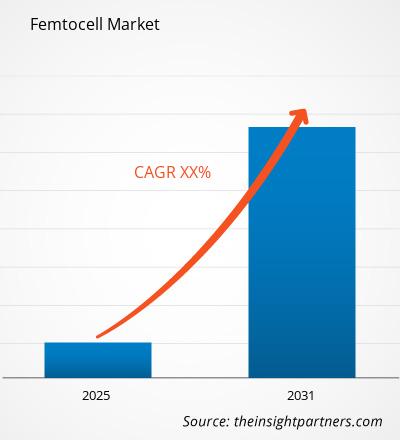
Femtocell Market is positioned for substantial expansion as operators and enterprises seek localized cellular coverage, capacity relief, and reliable indoor connectivity. The market is valued at US$ 5.15 Billion in 2025 and is projected to reach US$ 38.68 Billion by 2034, advancing at a 25.11% CAGR from 2026 to 2034. Growth is supported by network densification, indoor data consumption, enterprise digitization, and increasing deployment of compact cellular infrastructure.
North America remains a structurally important adoption center, with the Femtocell Market size supported by mature LTE infrastructure, extensive enterprise mobility, and continued 5G densification. The regional market is estimated to expand at a 13.5–15.5% CAGR from 2026 to 2034, as operators prioritize indoor capacity, private cellular deployments, and cost-efficient coverage extensions across offices, campuses, retail facilities, and public venues.
Femtocell Market Assessment and Insights
- North America: North America held a 38–39% Femtocell Market share in 2025 and is expected to grow at a 13.5–14.5% CAGR between 2026–2034, supported by mature LTE networks, enterprise mobility, high indoor traffic, and continued investment in 5G network densification.
- US: The US represented 75–76% of North America's 2025 share and is projected to expand at a 14.0–15.0% CAGR between 2026–2034, driven by enterprise connectivity and indoor capacity requirements.
- Europe: Europe accounted for a 24–25% share in 2025 and is forecast to register a 13.0–14.0% CAGR between 2026–2034, with Germany, the UK, France, Italy, and Spain supporting enterprise and public-space deployments.
- Asia Pacific: Asia Pacific represented a 22–23% share in 2025 and is projected to grow at a 17.0–18.0% CAGR between 2026–2034, led by China, Japan, South Korea, India, and Australia as operators densify networks.
- Largest Segment: 4G femtocells held a 52–53% market share in 2025 and are estimated to grow at a 20.0–22.0% CAGR from 2026–2034, benefiting from the established LTE installed base.
- High Growth Segment: Commercial applications represented a 40–42% market share in 2025 and are expected to expand at a 16.0–18.0% CAGR from 2026–2034, reflecting enterprise connectivity requirements.
- Key companies analyzed in detail: Airvana, Inc.; Alcatel-Lucent; Aricent, Inc.; China Mobile Limited; Fujitsu Limited; Nokia Solutions and Networks B.V.; Samsung Electronics Co., Ltd.; UbeeAirWalk, Inc.; Ubiquisys Ltd.; Vodafone Group Plc.
Source: The Insight Partners' analysis based on proprietary research, government publications, company annual reports, investor presentations, industry databases, and expert interviews.
The Femtocell Market report shows a shift beyond the basic residential range extension femto cells to more advanced indoor cellular infrastructure that offers multi-standard 4G and 5G, plug & play deployment, self-optimization, and easy integration into operator core networks. Manufacturing considerations have been evolving to include small footprint radio, energy-efficient designs, software management, and heterogeneous network interoperability.
The market expansion will most probably occur in areas where the mobile operators integrate their small cell infrastructures with private and neutral host network models and edge-based services. New installations being considered in Asia Pacific, the Middle East, and enterprise-oriented Europe regions will offer growth opportunities. Spectrum policy, 5G Standalone deployment, infrastructure sharing practices, and regulations enabling efficient indoor connections should drive buying decisions and investments in the forecast period.
Femtocell Market Report Scope
| Report Attribute | Details |
|---|---|
| Market size in 2025 | US$ 5.15 Billion |
| Market Size by 2034 | US$ 38.68 Billion |
| Global CAGR (2026 - 2034) | 25.11% |
| Historical Data | 2021-2024 |
| Forecast period | 2026-2034 |
Femtocell Market Analysis
Increasingly demand is influenced by growth opportunities for Femtocell Market driven by indoor mobile traffic, cloud-based enterprise applications, private cellular networks and offloading congested macro layers. Ecosystem consists of chipset vendors, radio equipment vendors, telecom carriers, broadband carriers, system integrators and end user enterprises. Value addition is more and more shifting away from sales of stand-alone equipment to integration, software management, backhaul capacity, and lifecycle services.
Supply chain is driven by availability of semiconductor components, RF-components, spectrum compatibility and manufacturing scale. Vendor product development is increasingly focused on developing smaller units, making deployment easier and less dependent on particular site characteristics. At the same time operator purchases are increasingly favoring systems with multi-generation capabilities to prolong asset life during the networks' evolution from LTE towards 5G. It creates an advantage for vendors with existing RAN portfolios, software development experience and long-term carrier relationships.
Competitive Femtocell Market landscape is characterized by multilevel structure with the competition between well-known network equipment vendors, dedicated small cell equipment developers, and telecom carriers which are able to deploy their equipment internally. Nokia Solutions and Networks B.V. features wide portfolio of indoor equipment. Samsung Electronics Co., Ltd. offers RAN hardware and software with chipset capabilities. Fujitsu Limited and China Mobile Limited provide additional depth of the ecosystem through network infrastructure equipment and telecom expertise.
Strategic positioning is increasingly focused on modular architecture, software-based management systems, flexible spectrum capabilities and enterprise-specific solutions. Alcatel-Lucent, Aricent, Inc., and Vodafone Group Plc feature strong historical and operational background in terms of telecom infrastructure and services. At the same time, Airvana, Inc., UbeeAirWalk, Inc., and Ubiquisys Ltd. have their strong heritage in the field of small cell development. Therefore investment is increasingly made into integrated platforms.
● REPORT CUSTOMIZATION
Tailor This Report To Align With Your Specific Business Requirements
This report can be customized to align precisely with your business objectives, scope, and target markets. Customization options include tailored segmentation, geography, competitive analysis, and strategic insights to support informed decision-making.
Customize This Report →WHAT YOU CAN ADJUST
- ● Segmentations
- ● Geography
- ● Competitive Analysis
- ● Language Preferences
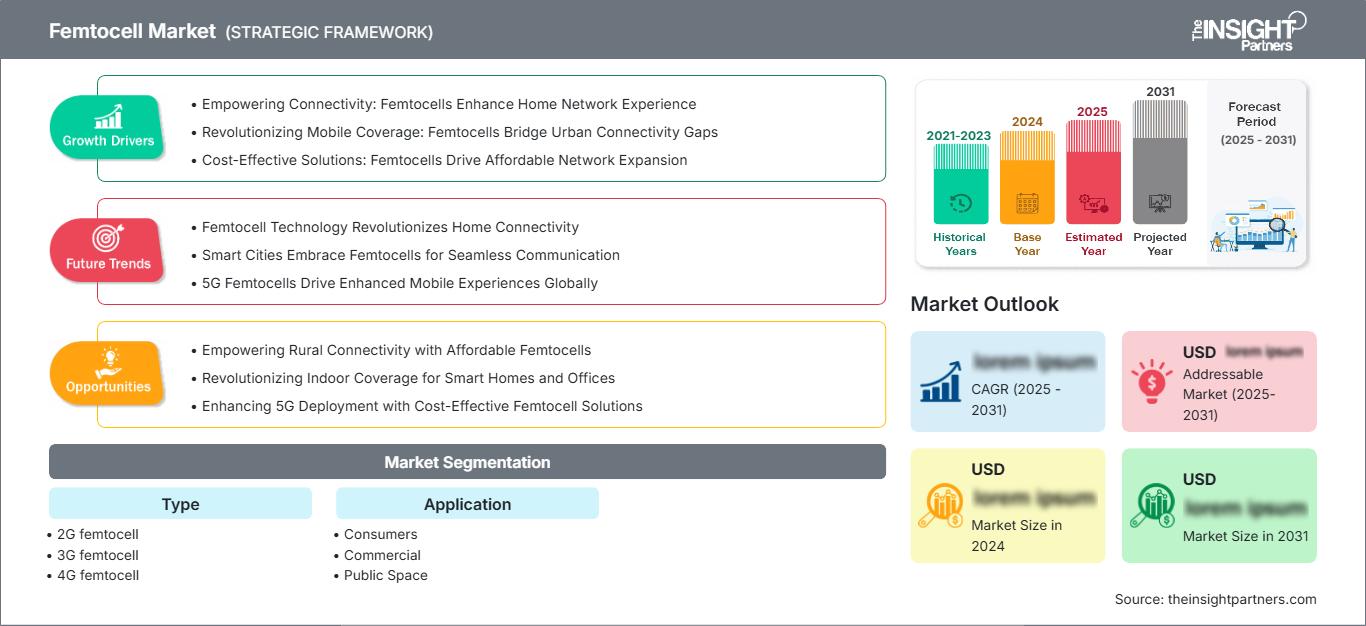
Femtocell Market: Strategic Insights
Regional Insights
North America Femtocell Market
North America accounted for a 38–39% share in 2025 and is expected to record a 13.5–14.5% CAGR through 2034. Advantages in the area include LTE availability, the use of smartphones, developed broadband infrastructure, and the need for reliable indoor connectivity at enterprises. The solution used by operators to address this problem includes the use of localized cellular infrastructure for capacity augmentation without depending solely on macro sites expansion, especially in busy urban centers, universities, health centers, and large venues.
The United States stands as the core region with its enterprise mobility, private cellular deployment, and the use of spectrum suitable for localized networking. Canada will contribute due to carrier upgrades and connectivity demands in commercial and institutional buildings. Demand will be driven by cloud applications, video collaboration, and connected devices. All this will ensure that procurement of small indoor radio systems continues where macro coverage cannot guarantee needed results.
U.S. Femtocell Market Market
The US represented 75–76% of North America's 2025 market and is projected to grow at a 14.0–15.0% CAGR through 2034. Carrier investments, enterprise wireless, and indoor dense traffic are all driving the demand. Network operators are considering localized cellular infrastructure solutions along with Wi-Fi, Distributed Antenna Systems (DAS), and other wireless networks to ensure better continuity and capacity.
The use cases include offices, retail, healthcare, educational, hospitality, and public spaces. The inclusion of such vendors in Nokia Solutions and Networks B.V., Samsung Electronics Co., Ltd., and Vodafone Group Plc in the overall industry environment increases competition among the solutions vendors. The procurement considerations have focused on easy deployment, central management capabilities, and simultaneous support of LTE and 5G.
Europe Femtocell Market
Europe represented a 24–25% share in 2025 and is expected to grow at a 13.0–14.0% CAGR, with Germany serving as the leading country. The region has several strengths that include industrial digitization, enterprise connectivity needs, high density of cities, and continuous investments in 5G. Germany, the UK, France, Italy, and Spain make up a diverse deployment base including manufacturing, transportation, office, retail, and infrastructures.
It is important to note that the UK still has significance in terms of operators and enterprises focusing on network coverage indoors, spectrum management, and private connectivity. Germany stands out due to industrial campuses and logistics facilities that need wireless connectivity. France, Italy, and Spain add up demand from smart infrastructures, hospitality, venues, and modernization of enterprises.
APAC Femtocell Market
APAC held a 22–23% share in 2025 and is forecast to grow at a 17.0–18.0% CAGR, making it the fastest-growing major region. China is at the top of the regional demand chain, with Japan, South Korea, India, and Australia following behind. Urban density, 5G growth, digitization of enterprises, and growth in broadband facilities can aid local coverage solutions.
Automation of industries, smart buildings, transport terminals, and high-density commercial facilities have been creating new opportunities for expansion. The presence of policy support in telecommunications infrastructure development, along with efforts made by operators in spectrum management, will ensure investment continuity. India and China have particular potential for the long term.
Middle East & Africa Femtocell Market Market
Middle East and Africa is expected to register a 15.0–16.0% CAGR through 2034, with Saudi Arabia representing a leading opportunity. UAE deployments benefit from smart-city programs, premium commercial infrastructure, and digital transformation. Saudi Arabia is advancing enterprise connectivity alongside Vision 2030 initiatives, while South Africa remains important for commercial and industrial wireless modernization.
The Rest of MEA presents a more selective opportunity shaped by infrastructure maturity, backhaul availability, and operator investment capacity. Energy facilities, airports, logistics centers, hotels, and government campuses provide relevant deployment environments. Compact cellular systems can address localized coverage requirements where conventional macro expansion is costly or operationally difficult, particularly across new infrastructure developments.
Segmentation Analysis
Type
Type segmentation reflects the transition from legacy cellular technologies toward higher-capacity indoor networks. The segment is estimated to expand at a 19.0–21.0% CAGR from 2026–2034, with 4G femtocells retaining the largest installed-base position. Operators continue balancing legacy service support with gradual migration toward more advanced radio architectures.
- 2G femtocell: Legacy coverage applications remain concentrated in markets where voice continuity and machine-to-machine connectivity require continued support. Replacement activity is increasingly linked to network retirement schedules and spectrum refarming decisions.
- 3G femtocell: 3G systems retain relevance in selected installed bases, but demand is increasingly replacement-oriented as operators decommission legacy networks and redirect spectrum toward LTE and newer technologies.
- 4G femtocell: LTE systems maintain strong commercial importance because of broad device compatibility, established operator infrastructure, and continuing requirements for reliable indoor voice and data services.
Application
Application segmentation is estimated to grow at a 16.0–18.0% CAGR from 2026–2034, with commercial deployments representing the largest opportunity. Enterprise digitization, private wireless initiatives, and the growing dependence on cloud-based workflows are increasing the value of predictable indoor cellular connectivity.
- Consumers: Residential users prioritize dependable voice and data connectivity in buildings where macro signals are weakened by construction materials, building density, or distance from outdoor sites.
- Commercial: Commercial deployments address offices, retail, hospitality, healthcare, manufacturing, and campuses where consistent cellular performance supports business applications, employee mobility, customer engagement, and connected operations.
- Public Space: Public-space deployments target airports, transit facilities, stadiums, convention centers, and other high-density environments where localized capacity can complement macro networks and existing distributed antenna infrastructure.
Opportunity Snapshot
| Application | Revenue Contribution (High/Medium/Low) | Trend Tag | Adoption Stage |
|---|---|---|---|
| Consumers | High | Home Coverage | Mature |
| Commercial | High | Private Wireless | Scaling |
| Public Space | Medium | Venue Capacity | Scaling |
Femtocell Market Growth Drivers and Impact Analysis
Indoor Data Traffic and Coverage Quality Requirements
Dependence on cloud collaboration services, streaming services, device connectivity, and real-time enterprise apps is causing the need for better performance of mobile network indoors. A large share of mobile traffic is created indoors, thus coverage quality matters more and more not only for customers but for businesses too. This effect goes beyond better signal coverage as there should be capacity management, interference handling, and service continuity indoors for network operators. Compact cellular network is an efficient way to solve the problem caused by physical propagation constraints of macro layers. For vendors, competition is shifting towards radio performance, centralized management, and multitechnology support. For operators, local deployment may help to decrease the burden on macro network and differentiate the service levels in valuable indoor locations.
5G Densification and Enterprise Wireless Adoption
The expansion of 5G is creating new requirements for localized coverage because higher-frequency spectrum can deliver substantial capacity while encountering greater propagation limitations inside complex buildings. Private wireless networks are also being explored for use in automation, logistics, machine-to-machine connectivity, and secure communication needs. Such trends would widen the usage of small cells not only for residential purposes but also for a wider array of enterprise needs. Vendors who integrate femtocell functionality with software for private networking, edge connectivity, and orchestration can fulfill a more comprehensive procurement need. From a commercial standpoint, this would mean a growth in project size, importance of lifecycle services, and integration of carriers and system integrators. In the long run, this convergence will lead to decreased differentiation between femtocells and small cell architecture for indoors.
Spectrum Efficiency and Network Offloading Economics
Spectrum constraints and rising traffic intensity encourage operators to improve utilization of existing licensed resources rather than depending exclusively on new macro sites. Localized cellular infrastructure can reuse spectrum across small coverage areas, increasing capacity in high-demand buildings while limiting interference through controlled radio planning. This economic rationale is particularly relevant in urban areas where site acquisition, power, backhaul, and construction costs can make macro expansion difficult. Operators can also use indoor nodes to offload traffic from congested macro layers, improving network efficiency without redesigning the entire access network. The market impact extends to component suppliers and software providers because successful deployment requires precise radio management, secure core integration, monitoring, and remote configuration. These capabilities increasingly influence purchasing decisions alongside hardware specifications.
Femtocell Market Future Trends
Convergence of Femtocells With Private Cellular Platforms
The Femtocell Market trends are expected to increasingly reflect convergence between indoor coverage products and private cellular networking. Instead of deploying nodes solely to eliminate dead zones, enterprises will increasingly expect localized cellular systems to support identity management, device segmentation, operational technology, analytics, and application-specific quality of service. This transition should encourage vendors to integrate radio access functions with cloud-native management and edge platforms. Smaller enterprises may favor managed services supplied through telecom operators, while large organizations could adopt independently controlled private networks. The resulting architecture will emphasize modularity, automated provisioning, and policy-based network control. Suppliers able to bridge carrier-grade reliability with enterprise IT requirements will be better positioned as procurement shifts from standalone equipment toward complete connectivity environments.
Energy-Aware Indoor Network Architecture
Energy efficiency is likely to become a more explicit design criterion as operators expand the number of localized radio sites. Future systems are expected to combine lower-power components, intelligent sleep modes, adaptive transmission, and software-based traffic management to align capacity with actual demand. Building operators may also favor infrastructure that can share power, backhaul, and management resources with other communications systems. Such architectures could reduce operating expenses while supporting sustainability objectives across large portfolios of offices, retail facilities, transport hubs, and campuses. Integration with building management platforms may eventually allow network resources to respond dynamically to occupancy and traffic conditions. This direction will shift product differentiation toward energy performance, automation, and lifecycle economics rather than radio capability alone.
Femtocell Market Opportunities
Enterprise Connectivity-as-a-Service Models
The Femtocell Market Forecasts indicate an opportunity for operators and infrastructure providers to package indoor connectivity as a recurring service rather than a one-time equipment sale. Enterprise customers increasingly prefer predictable operating costs, centralized support, and simplified technology management. A managed model can combine femtocells, private-network functions, backhaul, monitoring, security, and service-level agreements within one commercial contract. This approach is particularly relevant for multi-site retailers, healthcare groups, hotel chains, logistics operators, and distributed office networks. Investors should evaluate providers with strong carrier relationships, remote-management capabilities, and scalable installation models. Service-based offerings can also create opportunities for system integrators that lack proprietary radio hardware but can manage deployment, optimization, security, and ongoing operations across geographically dispersed customer locations.
Localized Wireless Infrastructure for Emerging Markets
Emerging economies present an opportunity to deploy targeted indoor cellular infrastructure alongside broader 4G and 5G network expansion. Rather than replicating dense macro coverage everywhere, operators can prioritize hospitals, universities, business parks, airports, government campuses, manufacturing clusters, and hospitality developments where connectivity quality directly supports economic activity. The Femtocell Market analysis can therefore inform investment screening around infrastructure maturity, spectrum availability, broadband penetration, and enterprise density. Suppliers that provide compact equipment, flexible backhaul options, simple installation, and remote administration may be particularly competitive in these environments. Strategic partnerships with local carriers, tower companies, construction firms, and managed-service providers can reduce deployment friction while creating scalable routes into fragmented markets where direct enterprise sales would otherwise be expensive.
Recent Developments
- June 2025: Comba Telecom launched its next-generation 5G Residential Femtocell, an ultra-compact and energy-efficient indoor small cell designed to provide seamless 4G and 5G connectivity across homes, apartments, small businesses and workspaces. The dual-mode solution supports plug-and-play deployment, integrates with public or private backhaul networks, and uses Comba’s carrier-grade Gateway platform to deliver secure, always-on indoor connectivity, supporting the growing adoption of residential femtocells for addressing indoor mobile coverage gaps.
- January 2025: Nokia and Zain KSA announced a partnership to implement the first 4G/5G Femtocell solution in Saudi Arabia and the Middle East and Africa region, targeting enterprise customers with indoor mobile coverage challenges. The solution combines Nokia’s 4G and 5G Smart Nodes with its IP Security Gateway, Femto Manager and end-to-end delivery services to provide robust, secure connectivity and improve indoor coverage for enterprises across the Kingdom, supporting the adoption of advanced femtocell solutions in enterprise environments.
- October 2024: AxyomCore announced the commercial launch of its 4G/5G dual-mode enterprise femtocell, designed to extend cellular coverage in indoor environments where macro-network access is limited or unavailable. The solution supports both 5G Non-Standalone (NSA) and Standalone (SA) architectures and targets enterprises including hospitals, offices, retail stores and schools, providing higher capacity, improved throughput and stronger indoor signal quality. The launch supports growing demand for flexible and cost-effective femtocell solutions driven by 5G adoption and the need for reliable indoor connectivity.
Frequently Asked Questions

- Comprehensive Market Sizing and Forecast Analysis
- Detailed Segmentation Analysis
- In-Depth Market Dynamics Assessment
- Regional and Country-Level Insights
- Competitive Landscape and Company Benchmarking
- Strategic Business Intelligence
Recent Reports
Testimonials

The Insight Partners provided valuable market intelligence that supported our global go-to-market strategy. Their team was professional, responsive, and attentive to our feedback, providing thoughtful analysis and helpful methodological clarifications throughout the project.
Junmo Kim Chief Financial Officer (CFO), Enertech Co., Ltd.
The Insight Partners' SCADA System Market report is comprehensive, with valuable insights on current trends and future forecasts. The team was highly professional, responsive, and supportive throughout. We are very satisfied and highly recommend their services.
RAN KEDEM Partner, Reali Technologies LTDs
I requested a report on a very specific software market and the team produced the report in a few days. The information was very relevant and well presented. I then requested some changes and additions to the report. The team was again very responsive and I got the final report in less than a week.
JEAN-HERVE JENN Chairman, Future Analytica
We worked with The Insight Partners for an important market study and forecast. They gave us clear insights into opportunities and risks, which helped shape our plans. Their research was easy to use and based on solid data. It helped us make smart, confident decisions. We highly recommend them.
PIYUSH NAGPAL Sr. Vice President, High Beam Global
The Insight Partners delivered insightful, well-structured market research with strong domain expertise. Their team was professional and responsive throughout. The user-friendly website made accessing industry reports seamless. We highly recommend them for reliable, high-quality research services
YUKIHIKO ADACHI CEO, Deep Blue, LLC.
This is the first time I have purchased a market report from The Insight Partners.While I was unsure at first, I visited their web site and felt more comfortable to take the risk and purchase a market report.I am completely satisfied with the quality of the report and customer service. I had several questions and comments with the initial report, but after a couple of dialogs over email with their analyst I believe I have a report that I can use as input to our strategic planning process.Thank you so much for taking the extra time and making this a positive experience.I will definitely recommend your service to others and you will be my first call when we need further market data.
JOHN SUZUKI President and Chief Executive Officer, Board Director, BK Technologies
I wish to appreciate your support and the professionalism you displayed in the course of attending to my request for information regarding to infectious disease IVD market in Nigeria. I appreciate your patience, your guidance, and the fact that you were willing to offer a discount, which eventually made it possible for us to close a deal. I look forward to engaging The Insight Partners in the future, all thanks to the impression you have created in me as a result of this first encounter.
DR CHIJIOKE ONYIA MANAGING DIRECTOR, PineCrest Healthcare Ltd.Reason to Buy
- Informed Decision-Making
- Understanding Market Dynamics
- Competitive Analysis
- Identifying Emerging Markets
- Customer Insights
- Market Forecasts
- Risk Mitigation
- Boosting Operational Efficiency
- Strategic Planning
- Investment Justification
- Tracking Industry Innovations
- Aligning with Regulatory Trends





 Get Free Sample for