
Ferroelectric RAM Market Trends, Size & Growth by 2034
Coverage: by Component (Personal Digital Assistants (PDA), Smart Card, Power Meters, Others); Application (Automotive Electronics, Industrial Control and Automation Equipment, Medical Devices, Others) , and Geography (North America, Europe, Asia Pacific, and South and Central America)
- Status : Data Released
- Report Code : TIPRE00010762
- Category : Electronics and Semiconductor
- No. of Pages : 150
- Available Report Formats :


- Last update date : August 17, 2026


2025 Market Size
US$ 420.65 Mn
Base year value
2034 Forecast
US$ 880.27 Mn
Projected by 2034
CAGR 2026-2034
8.55 %
Growth rate
Addressable Market
US$ 5,834.61 Mn
(2026-2034)
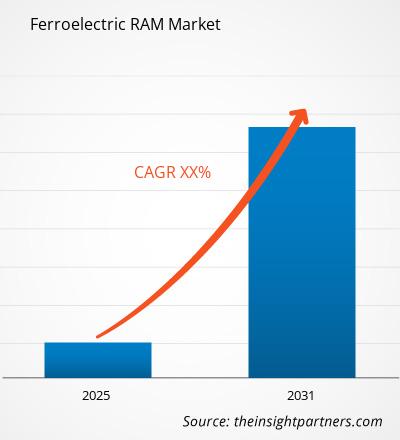
The Ferroelectric Ram Market size is valued at US$ 420.65 Million in 2025 and is projected to reach US$ 880.27 Million by 2034, expanding at a CAGR of 8.55% during the forecast period from 2026 to 2034. This growth trajectory reflects increasing adoption across automotive electronics, industrial automation, and medical devices where non-volatile, high-endurance memory is critical.
North America maintains a significant position in the Ferroelectric Ram Market, with the region expected to grow at a CAGR range of 7–9% through 2034. Structural drivers include widespread integration of FRAM in automotive safety systems, industrial IoT deployments, and smart metering infrastructure across the United States and Canada.
Ferroelectric RAM Market Assessment and Insights
- North America – The region holds approximately 32–35% Ferroelectric Ram Market share in 2025 and is growing at a CAGR range of 7–9% between 2026–2034, driven by strong automotive electronics demand and industrial automation investments.
- US – Accounts for nearly 75–78% of North America share in 2025, advancing at a CAGR range of 6–8% between 2026–2034, supported by leading semiconductor companies and smart meter deployments.
- Europe – Represents approximately 22–25% share in 2025 and is expanding at a CAGR range of 7–9% between 2026–2034, with Germany, the UK, and France leading adoption in automotive and industrial applications.
- Asia Pacific – Holds roughly 33–36% share in 2025 and is projected to grow at the fastest CAGR range of 9–11% between 2026–2034, propelled by China, Japan, South Korea, and India's electronics manufacturing.
- Largest Segment – Automotive Electronics commands the largest application share at 38–41% in 2025, growing at a CAGR range of 8–10% between 2026–2034, as ADAS and EV systems require high-endurance memory.
- High Growth Segment – Medical Devices represents the fastest-growing segment with a CAGR range of 10–12% between 2026–2034, holding 18–21% share in 2025, fueled by wearable health monitors and implantable device adoption.
- Key companies analyzed in detail: Cypress Semiconductor Corporation, Fujitsu Ltd., Hyundai Electronics Industries Co., Ltd., IBM Corporation, Infineon Technologies, LAPIS Semiconductor Co. Ltd., Samsung Electronics, Symetrix Corporation, USA, Texas Instruments, and Toshiba Corporation.
Source: The Insight Partners' analysis based on proprietary research, government publications, company annual reports, investor presentations, industry databases, and expert interviews.
According to the Ferroelectric Ram market forecast, the market has been facilitated by breakthroughs in ferroelectric material technology with a shift from PZT capacitors to HfO2 capacitors that make it possible to achieve CMOS integration and sub-10nm feature size. The production process has changed to embed FRAM with microcontrollers and SoC systems targeting automotive, industrial, and Internet-of-things use cases that need low power and near infinite write lifetime.
The Ferroelectric Ram market report indicates that growth will be driven by increasing demand in new geographic regions such as South East Asia, Latin America, and Eastern Europe. Technology investments in FeFET research, projects related to smart city construction, and legislation on precision of energy metering will boost adoption further. Standardization of automotive-grade memory specifications and multi-sourcing will enlarge the list of potential applications for FRAM.
Ferroelectric RAM Market Report Scope
| Report Attribute | Details |
|---|---|
| Market size in 2025 | US$ 420.65 Million |
| Market Size by 2034 | US$ 880.27 Million |
| Global CAGR (2026 - 2034) | 8.55% |
| Historical Data | 2021-2024 |
| Forecast period | 2026-2034 |
Ferroelectric RAM Market Analysis
The Ferroelectric Ram Market trends indicate that demand from automobile security systems, industrial Internet-of-Things (IoT) sensors, and medical devices is fuelling the market. The value chain consists of ferroelectric materials suppliers, wafer fabrication plants, memory chip producers, and system integrators providing end-user solutions. Material providers such as Fujitsu and Samsung have managed to scale up the production of ferroelectric thin films made from hafnium dioxide. Wafer fabrication facilities like Infineon and Texas Instruments have developed FRAM processes in conjunction with CMOS processes.
The dynamics of the supply side are characterized by the transition towards vertically integrated systems that combine the process of memory production with microcontroller production and analog circuit production. Providers like Cypress Semiconductor and LAPIS Semiconductor provide ready-to-use solutions with embedded FRAM along with the analog circuits. Such integration decreases the complexity of the system for OEMs and increases its performance for applications that require logging and retention of data. The focus is being put on automotive-grade FRAM products that are qualified to ISO 26262 and AEC-Q100 standards.
There are incumbent semiconductor vendors, specialized ferroelectric memory suppliers, and FeFET technology innovators competing in the market. Infineon Technologies holds 22-24% market share owing to the Excelon FRAM family that covers density ranges from 4 Kbit to 16 Mbit and is certified for automotive use. Fujitsu Ltd. owns 18-20% market share with the help of its FRAM platform family suited to smart meters and industrial control, whereas Texas Instruments takes up 14-16% market share owing to analog-FRAM integrated solutions targeting medical and automotive sectors.
Among investment trends, strategic positioning based on FeFET technology and embedded non-volatile memory should be noted. For example, Samsung Electronics developed FeFET memory in 2025 that consumes up to 96% less power and allows dense memory storage, which demonstrates its new technological roadmap. Symetrix Corporation strengthens its cooperation with academic organizations to develop HfO₂ ferroelectric process for logic nodes of advanced generation. Such a trend shows the industry recognition that FRAM will still stay relevant when applications require higher endurance and lower power usage in comparison with flash/eeprom solutions.
● REPORT CUSTOMIZATION
Tailor This Report To Align With Your Specific Business Requirements
This report can be customized to align precisely with your business objectives, scope, and target markets. Customization options include tailored segmentation, geography, competitive analysis, and strategic insights to support informed decision-making.
Customize This Report →WHAT YOU CAN ADJUST
- ● Segmentations
- ● Geography
- ● Competitive Analysis
- ● Language Preferences
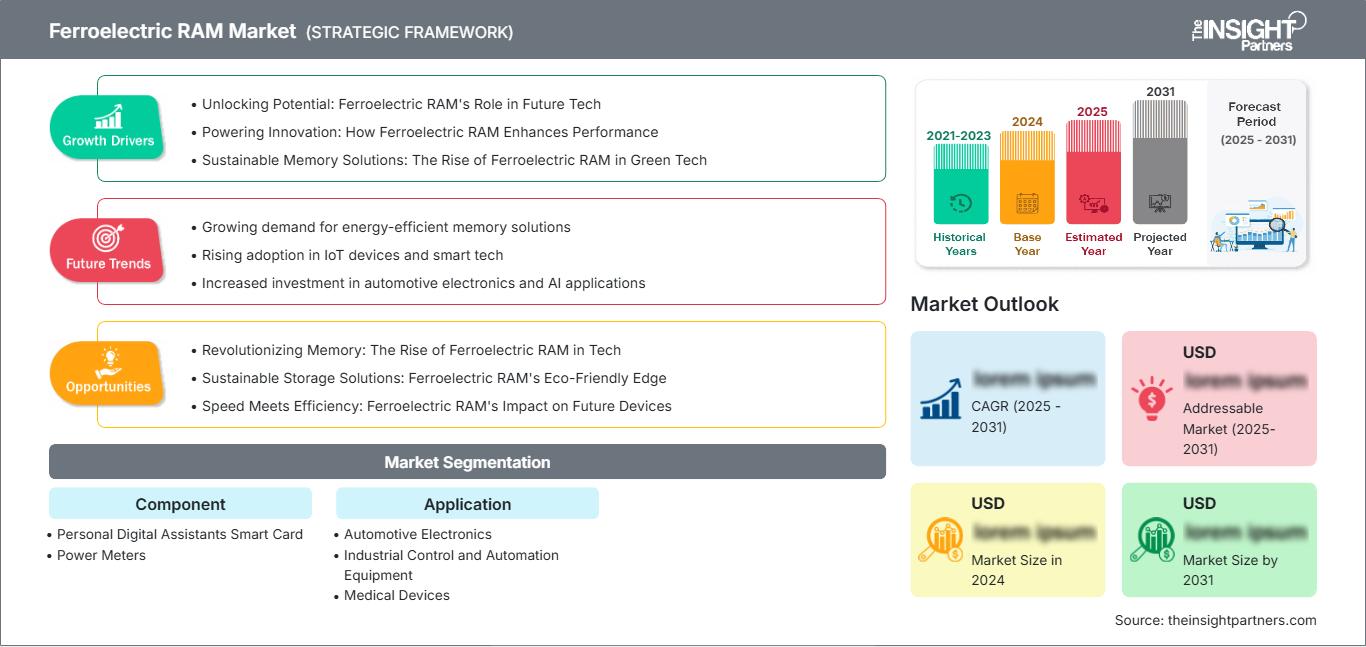
Ferroelectric RAM Market: Strategic Insights
Regional Insights
North America Ferroelectric Ram Market
North America holds around 32–35% market share of the global Ferroelectric Ram in 2025, with the region projected to grow at a CAGR of 7–9% till 2034. The U.S. leads in terms of demand for Ferroelectric RAM due to the involvement of many semiconductor companies, auto electronics manufacture, and installations of smart metering solutions by utilities. Canada contributes through manufacturing of industrial automation machinery and medical devices with FRAM technology.
Factors driving structural growth include the use of ADAS and EVs that require memory with endurance, government rules on smart metering solutions, and expansion of IoT sensors in industries. In addition, many companies dealing in semiconductors and memory reside in California, Texas, and Oregon, ensuring innovation in ferroelectric materials and memory systems.
U.S. Ferroelectric Ram Market
The United States constitutes about 75–78% of the North America Ferroelectric Ram market in 2025, growing with a compound annual growth rate between 6 and 8% until 2034. The demand within the country is driven by automotive electronic installation in more than 60% of all new cars, smart meter installation in excess of 100 million units, and use of FRAM by medical equipment companies in portable and implantable products.
Company location is limited to Texas Instruments located in Dallas, Cypress Semiconductor located in California, and Infineon Technologies that operates across several states. Application usage includes a steady increase in automotive electronic installations where the major OEMs have started using FRAM in their engine control units, transmission units, and battery management units. Industrial control and automation represent other application uses of FRAM.
Europe Ferroelectric Ram Market
In Europe, the Ferroelectric Ram accounts for 22–25% of the global market share in 2025 and is growing at a Compound Annual Growth Rate (CAGR) of 7-9% through 2034. Germany is leading the European region in terms of Ferroelectric Ram utilization with a market share of 35-38%, due to Ferroelectric Ram implementation in cars produced by Automotive Original Equipment Manufacturer (OEMs) and in Industrial Internet-of-Things (IoT).
The United Kingdom makes up for 18-21% of Europe market share, with its growth aided by medical devices production and installation of smart meters as part of governmental energy savings measures. Together France, Italy, and Spain hold 22-25% of the Europe market share, due to growing demand in automotive electronics, industrial automation, and medical monitoring systems.
APAC Ferroelectric Ram Market
Asia Pacific contributes about 33-36% to worldwide shares of Ferroelectric Ram market by 2025 and is expected to achieve the highest growth rate within the CAGR of 9-11% till 2034. China captures 38-41% share of APAC, driven by local manufacturing of electronic products and automobiles, as well as efforts towards self-reliance in semiconductors and construction of smart infrastructures.
Other APAC players include Japan, South Korea, India, and Australia, and their demand drivers differ across regions. Demand from Japan and South Korea arises from the manufacture of sophisticated automotive and consumer devices, while Indian demand is rising due to deployment of smart meters and automation projects. Demand drivers comprise initiatives like "Make in India," manufacturing of semiconductors, and increasing electronics production to incorporate FRAM technology into various end-uses.
Middle East & Africa Ferroelectric Ram Market
MEA is expected to contribute about 5-7% to global Ferroelectric Ram market in 2025, growing at a CAGR of 8-10% during 2026-2034. Leading MEA countries include Saudi Arabia and UAE, together accounting for 50-55% of MEA market share with the help of smart cities, utility modernization, and digital transformation projects from the government.
South Africa accounts for 20-23% MEA market share, driven by deployment of industrial automation and telecommunications infrastructure projects. RoMEA accounts for emerging demand for FRAM chips in energy metering and industrial monitoring applications. Context includes investment in smart grid networks, water management systems, and increased industrialization for data logging and control systems.
Segmentation Analysis
Component
The Component segment is projected to grow at a CAGR range of 8–10% between 2026–2034. This segment encompasses personal digital assistants, smart cards, and power meters that integrate FRAM technology for non-volatile data storage and high-endurance write operations in diverse applications.
- Personal Digital Assistants – Personal Digital Assistants command 28–31% share in 2025, serving as portable computing devices with FRAM enabling fast boot times and persistent user data storage without battery backup requirements.
- Smart Card – Smart Card represents 35–38% share in 2025, providing secure identity and payment applications with FRAM offering superior write endurance and tamper resistance compared to EEPROM alternatives.
- Power Meters – Power Meters account for 32–35% share in 2025, integrating FRAM for consumption data logging, tariff storage, and outage event recording with multi-year data retention and frequent write cycles.
Application
The Application segment is expected to expand at a CAGR range of 8–10% between 2026–2034. This segment includes automotive electronics, industrial control and automation equipment, and medical devices where FRAM enables reliable, low-power, high-endurance memory for safety-critical and data-intensive operations.
- Automotive Electronics – Automotive Electronics hold 38–41% share in 2025, with ADAS, engine control, and battery management systems driving adoption in vehicles requiring automotive-grade memory with extended temperature ranges.
- Industrial Control and Automation Equipment – Industrial Control and Automation Equipment represent 32–35% share in 2025, integrating FRAM in PLCs, sensors, and HMIs for configuration storage, event logging, and process data retention in harsh environments.
- Medical Devices – Medical Devices account for 18–21% share in 2025, leveraging FRAM in portable diagnostics, implantable devices, and patient monitoring systems for reliable data storage with minimal power consumption.
Opportunity Snapshot
| Application | Revenue Contribution | Trend Tag | Adoption Stage |
|---|---|---|---|
| Automotive Electronics | High | ADAS Integration | Scaling |
| Industrial Control and Automation Equipment | High | IIoT Sensors | Scaling |
| Medical Devices | Medium | Wearable Health | Emerging |
Ferroelectric RAM Market Growth Drivers and Impact Analysis
Automotive Electronics and ADAS Integration
The proliferation of advanced driver assistance systems and electric vehicle platforms creates substantial demand for Ferroelectric Ram technology. Automotive manufacturers require non-volatile memory with ultra-high write endurance for event data recorders, configuration storage, and real-time sensor data logging in safety-critical applications. Industry estimates suggest over 60% of new vehicles shipped globally in 2025 integrate some form of ADAS, with FRAM increasingly specified for applications requiring AEC-Q100 Grade 1 or Grade 0 qualification. This trend generates multi-year design win pipelines for semiconductor companies offering automotive-grade FRAM with extended temperature ranges and zero-defect quality requirements.
Smart Metering and Utility Infrastructure Modernization
Global deployment of smart electricity, water, and gas meters accelerates FRAM adoption in power meter applications requiring frequent data logging and multi-year retention without battery backup. Regulatory mandates around metering accuracy, tamper detection, and time-of-use tariff storage drive specifications that favor FRAM over EEPROM or flash alternatives. Utilities in North America, Europe, and Asia Pacific have deployed over 100 million smart meters as of 2025, with FRAM specified in premium meters for consumption profiling, outage event recording, and firmware update logging. This infrastructure modernization creates recurring revenue opportunities for FRAM suppliers throughout the meter replacement cycle.
Medical Device Portability and Implantable Applications
Growing demand for portable diagnostic equipment, wearable health monitors, and implantable medical devices drives FRAM adoption in applications requiring ultra-low power consumption and reliable data retention. Medical device manufacturers prioritize memory technologies that minimize battery drain while ensuring patient data integrity over extended operational lifespans. FRAM's near-infinite write endurance and fast write speeds enable continuous logging of vital signs, therapy delivery records, and device configuration changes without compromising battery life. This trend creates opportunities for companies offering medical-grade FRAM solutions with biocompatibility certifications and integration into low-power microcontroller platforms.
Ferroelectric RAM Market Future Trends
FeFET Technology and CMOS Compatibility
Future Ferroelectric Ram systems will increasingly leverage ferroelectric field-effect transistor technology that replaces the gate dielectric in standard MOSFETs with ferroelectric HfO₂-based materials. This approach enables sub-10 nm scaling, non-destructive read operations, and direct integration with advanced logic processes without additional masking steps. Samsung Electronics and Symetrix Corporation have demonstrated FeFET prototypes achieving 96% power reduction compared to conventional FRAM architectures. This trend will reshape product designs across embedded memory, standalone FRAM, and emerging non-volatile memory segments as manufacturers differentiate through density, power efficiency, and manufacturing cost advantages.
Embedded FRAM and System-on-Chip Integration
As IoT devices and edge computing platforms proliferate, embedding FRAM directly within microcontrollers and system-on-chip platforms becomes critical for reducing system complexity and power consumption. Integrated FRAM eliminates external memory interfaces, reduces PCB footprint, and enables zero standby power configurations for battery-operated devices. Infineon Technologies and Texas Instruments have expanded embedded FRAM offerings integrated with analog peripherals and low-power modes for automotive and industrial applications. This integration will accelerate FRAM adoption in cost-sensitive segments where discrete memory solutions face competition from flash and EEPROM alternatives.
Ferroelectric RAM Market Opportunities
Industrial IoT and Edge Computing Deployment
Industrial IoT applications present significant opportunities for Ferroelectric Ram deployment in factory automation, predictive maintenance, and energy management systems. Sensors and edge nodes in these settings require frequent data logging with minimal power consumption, making FRAM ideal for configuration storage, event buffering, and operational parameter retention. Ruggedized FRAM solutions designed for extended temperature ranges and harsh industrial environments can enable reliable operation in manufacturing, oil and gas, and utility infrastructure settings. Companies offering industrial-grade FRAM with integration to wireless connectivity and edge AI platforms can capture value in this underserved segment as Industry 4.0 initiatives accelerate globally.
Wearable Health and Remote Patient Monitoring
Wearable health devices and remote patient monitoring systems offer compelling opportunities for FRAM integration in applications requiring continuous data logging with minimal battery drain. Continuous glucose monitors, cardiac rhythm recorders, and activity trackers benefit from FRAM's fast write speeds and low power consumption compared to flash-based alternatives. Fujitsu Ltd. and LAPIS Semiconductor have demonstrated FRAM integration in wearable platforms with multi-year battery life and secure data storage for healthcare applications. Regulatory pathways for medical device certification and reimbursement models for remote monitoring will shape commercialization timelines, but long-term market potential remains substantial as aging populations drive demand for home-based healthcare solutions.
Recent Developments
- November 2025: Samsung Electronics announced FeFET memory technology based on ferroelectric transistors that reduces energy consumption by up to 96% while enabling denser storage capacity, representing a significant advancement in next-generation non-volatile memory architectures for AI and edge computing applications.
- April 2025: Ferroelectric Memory Co. partnered with Neumonda to restart DRAM+ production in Germany, introducing a non-volatile memory using hafnium-oxide FeRAM technology that delivers DRAM-level performance with SSD-like data retention for data center and high-performance computing applications.
- June 2024: Infineon Technologies AG announced the industry's first space-qualified radiation-hardened 1 Mb and 2 Mb parallel interface F-RAMs, offering up to 120 years of data retention at 85 degrees Celsius and near-infinite endurance for aerospace and defense applications requiring extreme reliability.
Frequently Asked Questions

- Comprehensive Market Sizing and Forecast Analysis
- Detailed Segmentation Analysis
- In-Depth Market Dynamics Assessment
- Regional and Country-Level Insights
- Competitive Landscape and Company Benchmarking
- Strategic Business Intelligence
Recent Reports
Testimonials

The Insight Partners' SCADA System Market report is comprehensive, with valuable insights on current trends and future forecasts. The team was highly professional, responsive, and supportive throughout. We are very satisfied and highly recommend their services.
RAN KEDEM Partner, Reali Technologies LTDs
I requested a report on a very specific software market and the team produced the report in a few days. The information was very relevant and well presented. I then requested some changes and additions to the report. The team was again very responsive and I got the final report in less than a week.
JEAN-HERVE JENN Chairman, Future Analytica
We worked with The Insight Partners for an important market study and forecast. They gave us clear insights into opportunities and risks, which helped shape our plans. Their research was easy to use and based on solid data. It helped us make smart, confident decisions. We highly recommend them.
PIYUSH NAGPAL Sr. Vice President, High Beam Global
The Insight Partners delivered insightful, well-structured market research with strong domain expertise. Their team was professional and responsive throughout. The user-friendly website made accessing industry reports seamless. We highly recommend them for reliable, high-quality research services
YUKIHIKO ADACHI CEO, Deep Blue, LLC.
This is the first time I have purchased a market report from The Insight Partners.While I was unsure at first, I visited their web site and felt more comfortable to take the risk and purchase a market report.I am completely satisfied with the quality of the report and customer service. I had several questions and comments with the initial report, but after a couple of dialogs over email with their analyst I believe I have a report that I can use as input to our strategic planning process.Thank you so much for taking the extra time and making this a positive experience.I will definitely recommend your service to others and you will be my first call when we need further market data.
JOHN SUZUKI President and Chief Executive Officer, Board Director, BK Technologies
I wish to appreciate your support and the professionalism you displayed in the course of attending to my request for information regarding to infectious disease IVD market in Nigeria. I appreciate your patience, your guidance, and the fact that you were willing to offer a discount, which eventually made it possible for us to close a deal. I look forward to engaging The Insight Partners in the future, all thanks to the impression you have created in me as a result of this first encounter.
DR CHIJIOKE ONYIA MANAGING DIRECTOR, PineCrest Healthcare Ltd.Reason to Buy
- Informed Decision-Making
- Understanding Market Dynamics
- Competitive Analysis
- Identifying Emerging Markets
- Customer Insights
- Market Forecasts
- Risk Mitigation
- Boosting Operational Efficiency
- Strategic Planning
- Investment Justification
- Tracking Industry Innovations
- Aligning with Regulatory Trends





 Get Free Sample for