
Fertigation Control System Market Trends, Demand & Growth by 2034
Coverage: by Product Type (Fertilizers, Pesticides , Nutrients, Others); Channel Type (Single Channel, Dual Channel, Multi Channel); Application (Field Crops, Orchard Crops, Plantation Crops, Horticulture Crops, Others) , and Geography (North America, Europe, Asia Pacific, and South and Central America)
- Status : Data Released
- Report Code : TIPRE00007676
- Category : Electronics and Semiconductor
- No. of Pages : 150
- Available Report Formats :


- Last update date : August 07, 2026


2025 Market Size
US$ 1.73 Bn
Base year value
2034 Forecast
US$ 3.65 Bn
Projected by 2034
CAGR 2026-2034
8.65 %
Growth rate
Addressable Market
US$ 24.12 Bn
(2026-2034)
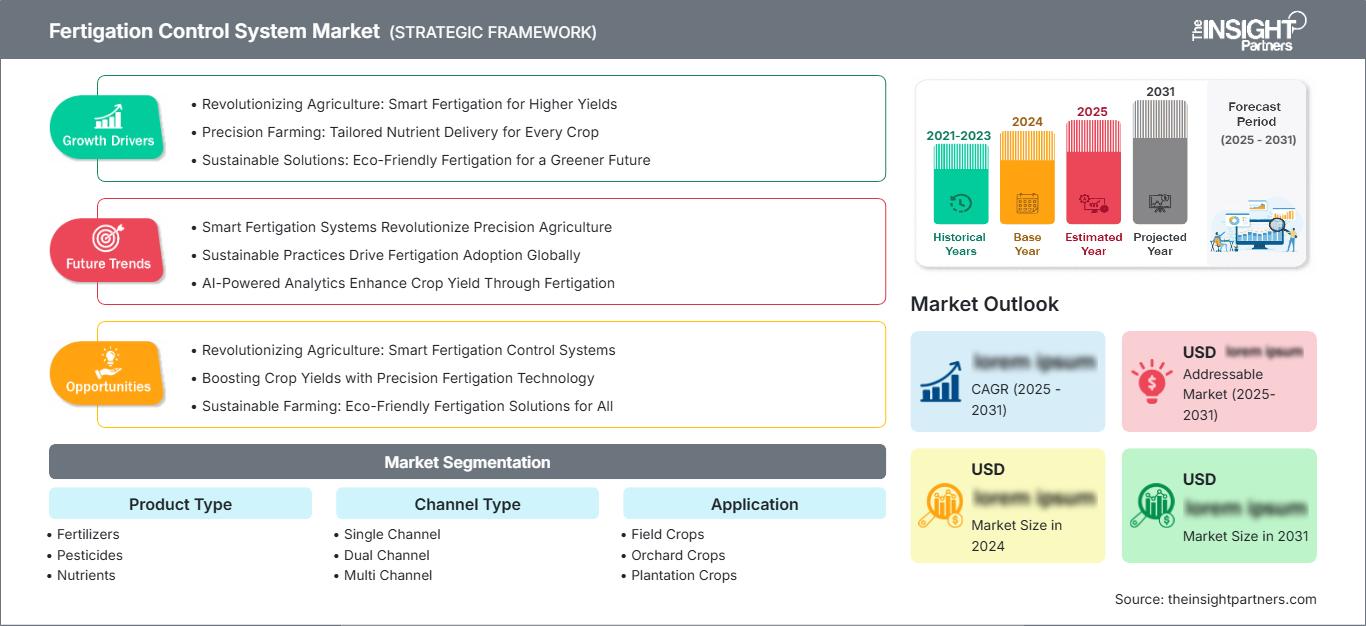
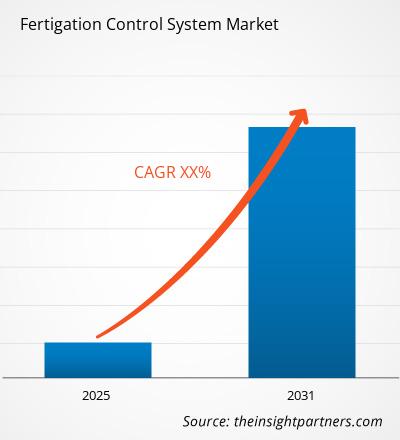
The Fertigation Control System Market stood at US$ 1.73 Billion in 2025 and is estimated to reach US$ 3.65 Billion by 2034 at a CAGR of 8.65% during 2026-2034 driven by precision fertigation, irrigation scheduling automation, and increasing pressure on the farms for efficient inputs across field crops, orchards, plantations, and horticultural applications.
The size of North America Fertigation Control System Market size is expected to grow at a CAGR of 8.0-8.7% during 2026-2034 backed by specialty crop acreage, compliance to water use norms, and fast switching of manual injection to automated sensors based dose control. The growers in the US and Canada are going for multi-line systems which regulate EC, pH and the concentration of the fertilizer in drip, micro-sprinkler and greenhouse irrigation systems.
Fertigation Control System Market Assessment and Insights
- North America held 31–33% share in 2025 and is growing at a CAGR of 8.0–8.7% during 2026–2034, driven by controlled irrigation adoption, specialty crops, and farm automation.
- US represented 76–80% of North American revenue in 2025 and is growing at a CAGR of 8.1–8.8% during 2026–2034, led by orchards, vegetables, and greenhouse operations.
- Europe accounted for 25–27% share in 2025 and is growing at a CAGR of 7.6–8.3% during 2026–2034, with Spain, Italy, France, Germany, and the Netherlands leading adoption.
- Asia Pacific captured 29–31% share in 2025 and is growing at a CAGR of 9.2–10.0% during 2026–2034, led by China, India, Japan, Australia, and South Korea.
- Largest Segment Multi Channel systems held 46–49% market share in 2025 and are growing at a CAGR of 9.0–9.8% during 2026–2034 because farms require simultaneous nutrient, acid, and pesticide dosing.
- High Growth Segment Horticulture Crops represented 27–30% market share in 2025 and are growing at a CAGR of 9.4–10.2% during 2026–2034, supported by greenhouse, nursery, and protected cultivation demand.
- Key companies analyzed in detail: Agricontrol S.n.c. di Balbo e Secco; Argus Control Systems Limited; Irritec S.p.A.; J. Huete Greenhouses S.L.; Jain Irrigation Systems Limited; Lindsay Corporation; Netafim Ltd.; Novedades Agrícolas S.A.; T-L Irrigation Co.; Valmont Industries, Inc.
Source: The Insight Partners' analysis based on proprietary research, government publications, company annual reports, investor presentations, industry databases, and expert interviews.
From basic venturi injection, fertigation has grown into sophisticated automatic dosing stations, integrating valves, pumps, sensors, recipes and irrigation scheduling. The production trends include modular skids, cloud dashboard management, programmable logic controller, EC and pH sensor feedback, and compatibility with either drip irrigation or pivots. The future of the Fertigation Control System lies in growers demanding consistent delivery of nutrients through fertigation rather than occasional manual application of fertilizers.
Future demand is bound to be fueled by factors such as water scarcity, high prices of fertilizers, and grower demands for traceability. The new regions entering into the market include regions that have invested in micro irrigation, protection cultivation, and fruit export. There is also regulation on nutrient runoff which favors automatic dosing since it makes it easier for growers to document their fertilizer application rates.
Fertigation Control System Market Report Scope
| Report Attribute | Details |
|---|---|
| Market size in 2025 | US$ 1.73 Billion |
| Market Size by 2034 | US$ 3.65 Billion |
| Global CAGR (2026 - 2034) | 8.65% |
| Historical Data | 2021-2024 |
| Forecast period | 2026-2034 |
Fertigation Control System Market Analysis
The growth of Fertigation Control System Market is led by precision farming practices, shortage of irrigation labor, and necessity of improving the efficiency of fertilizers' utilization. The smart dosing systems help growers to apply nutrients in a more precise way, in smaller quantities and in pulse doses. This reduces the risk of over-application of fertilizers and helps to ensure consistent yields in orchards, plantations, vegetables and greenhouses.
The ecosystem consists of controllers manufacturers, pumps and valves manufacturers, sensors companies, irrigation equipment dealers, agronomists, greenhouse integration companies, and farm management software companies. The supply chain dynamics are defined by the availability of stainless steel dosing manifolds, chemical resistant pumps, flow meters, conductivity probes, filters, controllers and the level of after-sales services.
The Fertigation Control System Market Report reveals rivalry between major irrigators of the world and specialists in automation. Netafim Ltd., Jain Irrigation Systems Limited, Lindsay Corporation, and Valmont Industries, Inc. use their wide dealer base, while Agricontrol S.n.c. di Balbo e Secco, Argus Control Systems Limited, Irritec S.p.A., J. Huete Greenhouses S.L., and Novedades Agrícolas S.A. use their greenhouse, orchard, or project-oriented experience to compete.
Current investments include AI-assisted recipes, multi-channel dosing, fertigation as a service model, as well as integration of dashboards which combine sensors with irrigation events. It is not sufficient for vendors to prove their hardware robustness; it is important to show the agronomic benefits. Those vendors who integrate rugged dosing systems with agronomy assistance, installation, and remote diagnostics will be able to capitalize on recurrent service opportunities.
● REPORT CUSTOMIZATION
Tailor This Report To Align With Your Specific Business Requirements
This report can be customized to align precisely with your business objectives, scope, and target markets. Customization options include tailored segmentation, geography, competitive analysis, and strategic insights to support informed decision-making.
Customize This Report →WHAT YOU CAN ADJUST
- ● Segmentations
- ● Geography
- ● Competitive Analysis
- ● Language Preferences
Fertigation Control System Market: Strategic Insights
Regional Insights
North America Fertigation Control System Market
In 2025, the North American Fertigation Control System Market share was 31–33%, and its growth rate for the period 2026–2034 will be CAGR of 8.0–8.7%. Adoption occurs in vegetable growing regions, orchards, vineyards, nurseries, and greenhouses where the consistency of nutrients influences the quality of products in terms of grading, shelf life, and export.
The drivers behind the development of the segment comprise micro-irrigation adoption, need to report on water usage, increase in fertilizers prices, and well-developed network of dealers. Producers are moving from a constant rate injection towards a sensor-driven rate based on EC, pH, crop stage, and irrigation time.
U.S. Fertigation Control System Market
In 2025, the US held a revenue share of 76-80% of North America and is projected to have a CAGR of 8.1-8.8% during 2026-2034. The greatest demand is in California, Florida, Pacific Northwest, and controlled environment systems where the quality of water for irrigation, application time of fertilizers and nutrients are carefully monitored.
The companies in the market include Netafim Ltd., Jain Irrigation Systems Limited, Lindsay Corporation, Valmont Industries, Inc., and Argus Control Systems Limited through their dealers, greenhouse system integrators, and irrigation systems contractors. Usage patterns include multi-channel fertigation for vegetables, berries, almonds, citrus fruits, vineyards, and nurseries as farmers require exact nutrient recipes depending on the crop stage.
Europe Fertigation Control System Market
Europe held the market share of 25–27% in 2025 and is estimated to register growth at a CAGR of 7.6–8.3% from 2026 to 2034. Spain is the leader in terms of usage via greenhouse vegetables, citrus fruits, olives, and water-scarce irrigation schemes. Italy is followed with orchards, vineyards, and protected horticulture, and France has field vegetables, nurseries, and specialty fruits.
The two nations of Germany and the Netherlands emphasize greenhouse automation, water recycling, and fertilization in controlled conditions. The United Kingdom has growers of soft fruits, nurseries, and glass houses having needs for these products. Local businesses such as Irritec S.p.A., J. Huete Greenhouses S.L., Novedades Agrícolas S.A., and Agricontrol S.n.c. di Balbo e Secco gain due to being near horticulture regions.
APAC Fertigation Control System Market
The Asia Pacific region accounted for 29–31% market share in 2025 and is expected to grow at CAGR of 9.2–10.0% between 2026 and 2034. China dominates on account of modernization of greenhouses and big fruit production areas, whereas micro-irrigation initiatives drive growth in India, which also gains from horticulture development.
Market and policy drivers involve food security, water efficiency, protected agriculture, and fertilizers utilization. The main players like Jain Irrigation Systems Limited, Netafim Ltd., Lindsay Corporation, and Valmont Industries, Inc. have their positions via irrigation system networks, whereas regional integrators customize systems for small farms, orchards, plantations, and horticultural farms for exports.
Middle East & Africa Fertigation Control System Market
The MEA and Africa regions are expected to achieve a CAGR of 8.5–9.2% between 2026 and 2034. Leading growth in the MEA region includes greenhouse vegetables, date farms, and efficient agriculture, whereas UAE promotes controlled-environment agriculture. South Africa and Rest of MEA include orchard, vineyards, and plantations demand.
Energy and infrastructure background is important due to the dependency of farms on pumps, desalination, reservoirs, and filtration technology. Fertigation technology helps reduce wastage of energy as well as maintains nutrient ratio in case of salty water. Developers favor rugged control systems and remote monitoring systems.
Segmentation Analysis
Product Type
Product Type is projected to grow at a CAGR of 8.3–9.0% during 2026–2034. The Fertigation Control System Market scope covers fertilizer, pesticide, and nutrient dosing modules that integrate with irrigation infrastructure. Buyers select product configurations based on crop sensitivity, chemical compatibility, flow rate, tank design, and the ability to maintain stable concentration during long irrigation cycles.
- Fertilizers remain central because growers use fertigation to deliver nitrogen, potassium, phosphorus, calcium, and micronutrients with better timing, uniformity, and reduced labor compared with manual field application.
- Pesticides support specialized chemigation where regulations and crop protocols permit controlled delivery, especially when operators need uniform application through existing irrigation networks and careful concentration management.
- Nutrients include soluble blends and corrective inputs that help growers fine-tune EC, pH, and crop-stage recipes in greenhouse, orchard, plantation, and high-value horticulture systems.
Channel Type
Channel Type is forecast to grow at a CAGR of 8.6–9.3% during 2026–2034. Multi-channel platforms are gaining importance because farms increasingly manage several fertilizer tanks, acid correction, irrigation zones, and crop recipes at once. Single and dual-channel systems remain relevant for simpler farms, but high-value cultivation favors scalable dosing architecture.
- Single Channel systems serve farms with basic nutrient programs, limited crop diversity, or smaller irrigation areas where affordability, ease of operation, and low maintenance are primary buying criteria.
- Dual Channel systems support separate fertilizer and acid dosing or two nutrient lines, making them practical for orchards, vegetables, and protected farms requiring moderate recipe control.
- Multi Channel systems are strategically important for advanced operations because they manage multiple inputs, recipes, zones, and real-time corrections across high-value crops and complex irrigation schedules.
Application
Application is expected to grow at a CAGR of 8.7–9.4% during 2026–2034. Application demand reflects the economics of yield quality, irrigation intensity, and nutrient responsiveness. Field crops need cost-efficient dosing, orchards require stage-specific feeding, plantations need broad-area reliability, and horticulture crops justify advanced control through higher value per hectare.
- Field Crops use fertigation where drip, sprinkler, or pivot systems are installed, helping farms improve nutrient timing, reduce passes, and support uniform crop development over large areas.
- Orchard Crops benefit from staged nutrient programs that match flowering, fruit set, sizing, and post-harvest recovery, making controlled fertigation important for quality and yield consistency.
- Plantation Crops require reliable dosing across wide areas and long production cycles, supporting fertilizer efficiency in crops such as banana, coffee, tea, and other perennial systems.
- Horticulture Crops drive high-value adoption because vegetables, berries, floriculture, nurseries, and greenhouse crops need precise EC, pH, and nutrient recipes throughout short production cycles.
Opportunity Snapshot
| Application | Revenue Contribution | Trend Tag | Adoption Stage |
| Field Crops | Medium | Pivot Dosing | Scaling |
| Orchard Crops | High | Stage Feeding | Mature |
| Plantation Crops | Medium | Perennial Control | Emerging |
| Horticulture Crops | High | Recipe Automation | Scaling |
Fertigation Control System Market Growth Drivers and Impact Analysis
Water Scarcity Pushes Precision Nutrient Delivery
Agriculture remains exposed to tightening water availability, higher pumping costs, and pressure to produce more output from limited irrigated land. Fertigation control systems help growers synchronize nutrient delivery with irrigation events, reducing losses caused by uneven application, runoff, or excessive flushing. The market impact is strongest in water-stressed horticulture belts, arid orchards, and greenhouse clusters where each irrigation cycle has agronomic and economic consequences. Automated EC and pH control also supports compliance with nutrient management expectations because application records become easier to verify. This driver lifts demand for sensors, dosing pumps, controllers, and service packages across the market.
High-Value Crops Require Recipe-Based Fertigation
Growers of berries, vegetables, flowers, citrus, grapes, almonds, and greenhouse crops increasingly manage nutrition by growth stage rather than by fixed seasonal routines. Recipe-based fertigation allows operators to adjust nutrient concentration during rooting, vegetative growth, flowering, fruit sizing, and recovery phases. The impact is higher willingness to invest in multi-channel systems, tank mixing safeguards, and remote dashboards that reduce crop variability. This driver also strengthens the role of agronomists and integrators because the equipment must translate crop plans into repeatable dosing events. Suppliers that provide calibration, training, and crop-specific templates gain an advantage over component-only vendors.
Farm Labor Constraints Accelerate Automation
Manual fertilizer mixing, valve operation, tank checks, and field supervision are becoming harder to sustain as farms scale and labor availability tightens. Automated systems reduce repetitive tasks by scheduling irrigation zones, triggering dosing pumps, recording application volumes, and alerting managers when values move outside set limits. The market impact is a broader customer base among mid-sized farms that previously viewed fertigation automation as complex or costly. Remote access also supports multi-site farm management and reduces dependence on highly experienced operators being present every day. This creates demand for intuitive interfaces, dealer support, and preventive maintenance contracts.
Fertigation Control System Market Future Trends
AI-Assisted Nutrient Recipes Move Into Commercial Farms
Fertigation Control System Market trends point toward AI-assisted dosing that interprets sensor readings, crop stage, weather, irrigation history, and agronomic targets before recommending nutrient adjustments. Future systems will not replace agronomists, but they will reduce guesswork by flagging abnormal EC, pH, flow, and uptake patterns. Commercial adoption will depend on transparent recommendations, local calibration, and confidence that algorithms can handle water-quality variation. Vendors with strong datasets from orchards, greenhouses, and vegetable farms will be able to convert automation into advisory value, making software subscriptions a larger part of revenue.
Integrated Irrigation Platforms Replace Standalone Controllers
Future procurement will increasingly favor platforms that connect fertigation, irrigation scheduling, weather data, soil moisture, pump control, filtration, and farm records in one operating environment. This shift will reduce fragmented decision-making and help growers link nutrient delivery with actual crop demand. Interoperability will become a differentiator because farms often operate mixed brands of valves, controllers, pumps, and sensors. Open APIs, mobile dashboards, and cloud diagnostics will help dealers support larger installed bases. The trend also favors companies that can combine equipment reliability with software usability and agronomic workflows.
Fertigation Control System Market Opportunities
Dealer-Led Automation Packages for Orchards and Horticulture
Fertigation Control System Market Forecasts support packaged offerings that combine dosing stations, tanks, sensors, valves, filtration, installation, calibration, and annual service for orchard and horticulture growers. Many farms want measurable nutrient control but prefer a single accountable supplier rather than assembling components independently. Dealers can create application-specific packages for citrus, vineyards, berries, nurseries, vegetables, and protected cultivation. The opportunity is strongest where growers need rapid deployment before a season and value local support during peak irrigation periods. Financing, training, and remote diagnostics can further reduce adoption barriers.
Retrofit Upgrades for Existing Drip and Pivot Networks
A large installed base of drip, sprinkler, and pivot irrigation systems still uses manual or basic injection methods. Retrofitting these networks with controllers, flow sensors, dosing pumps, and cloud monitoring creates a practical path to automation without full infrastructure replacement. Suppliers can target farms that already understand irrigation efficiency but need better nutrient precision. The opportunity requires compatibility audits, hydraulic checks, chemical safety reviews, and farmer training. Retrofit programs also create recurring revenue through seasonal calibration, sensor replacement, software subscriptions, and agronomy support, making them attractive for both manufacturers and irrigation dealers.
Recent Developments
- February 2026: Orbia Advance Corporation’s S.A.B. de C.V. (BMV: ORBIA*) Precision Agriculture business Netafim, the global leader in precision agriculture solutions, announced the introduction of its Dosing 5G product range designed for optimal fertigation management with advanced, AI-automated dosing technology, intuitive remote control and monitoring. The suite of updated dosing products includes FertiKit 5G, FertiOne 5G, NetaJet 5G and NetaFlex 5G.
- September 2023: AGRIVI releases new fertigation management module that remodels crop yield and sustainability.
- June 2023: ICL (NYSE: ICL) (TASE: ICL), a leading global specialty minerals company, announced the North American launch of a new line of advanced foliar and fertigation solutions under their Nova brand of water-soluble fertilizers. Flagship products include Nova FINISH, Nova PULSE, Nova ELEVATE, and Nova FLOW.
Frequently Asked Questions

- Comprehensive Market Sizing and Forecast Analysis
- Detailed Segmentation Analysis
- In-Depth Market Dynamics Assessment
- Regional and Country-Level Insights
- Competitive Landscape and Company Benchmarking
- Strategic Business Intelligence
Recent Reports
Testimonials

The Insight Partners provided valuable market intelligence that supported our global go-to-market strategy. Their team was professional, responsive, and attentive to our feedback, providing thoughtful analysis and helpful methodological clarifications throughout the project.
Junmo Kim Chief Financial Officer (CFO), Enertech Co., Ltd.
The Insight Partners' SCADA System Market report is comprehensive, with valuable insights on current trends and future forecasts. The team was highly professional, responsive, and supportive throughout. We are very satisfied and highly recommend their services.
RAN KEDEM Partner, Reali Technologies LTDs
I requested a report on a very specific software market and the team produced the report in a few days. The information was very relevant and well presented. I then requested some changes and additions to the report. The team was again very responsive and I got the final report in less than a week.
JEAN-HERVE JENN Chairman, Future Analytica
We worked with The Insight Partners for an important market study and forecast. They gave us clear insights into opportunities and risks, which helped shape our plans. Their research was easy to use and based on solid data. It helped us make smart, confident decisions. We highly recommend them.
PIYUSH NAGPAL Sr. Vice President, High Beam Global
The Insight Partners delivered insightful, well-structured market research with strong domain expertise. Their team was professional and responsive throughout. The user-friendly website made accessing industry reports seamless. We highly recommend them for reliable, high-quality research services
YUKIHIKO ADACHI CEO, Deep Blue, LLC.
This is the first time I have purchased a market report from The Insight Partners.While I was unsure at first, I visited their web site and felt more comfortable to take the risk and purchase a market report.I am completely satisfied with the quality of the report and customer service. I had several questions and comments with the initial report, but after a couple of dialogs over email with their analyst I believe I have a report that I can use as input to our strategic planning process.Thank you so much for taking the extra time and making this a positive experience.I will definitely recommend your service to others and you will be my first call when we need further market data.
JOHN SUZUKI President and Chief Executive Officer, Board Director, BK Technologies
I wish to appreciate your support and the professionalism you displayed in the course of attending to my request for information regarding to infectious disease IVD market in Nigeria. I appreciate your patience, your guidance, and the fact that you were willing to offer a discount, which eventually made it possible for us to close a deal. I look forward to engaging The Insight Partners in the future, all thanks to the impression you have created in me as a result of this first encounter.
DR CHIJIOKE ONYIA MANAGING DIRECTOR, PineCrest Healthcare Ltd.Reason to Buy
- Informed Decision-Making
- Understanding Market Dynamics
- Competitive Analysis
- Identifying Emerging Markets
- Customer Insights
- Market Forecasts
- Risk Mitigation
- Boosting Operational Efficiency
- Strategic Planning
- Investment Justification
- Tracking Industry Innovations
- Aligning with Regulatory Trends





 Get Free Sample for