
Fiberglass Light Poles Market Growth, Trends & Forecast by 2034
Coverage: By Type (Square Straight Fiberglass Pole, Round Tapered Fiberglass Pole); Application (Street Lighting, Traffic Lights, Decorative and Garden Lighting, Others ); End-user (Commercial, Industrial, Residential), and Geography (North America, Europe, Asia Pacific, and South and Central America)
- Status : Data Released
- Report Code : TIPRE00015714
- Category : Electronics and Semiconductor
- No. of Pages : 150
- Available Report Formats :


- Last update date : September 09, 2026


2025 Market Size
US$ 669.67 Mn
Base year value
2034 Forecast
US$ 1,038.23 Mn
Projected by 2034
CAGR 2026-2034
4.99 %
Growth rate
Addressable Market
US$ 7,749.44 Mn
(2026-2034)
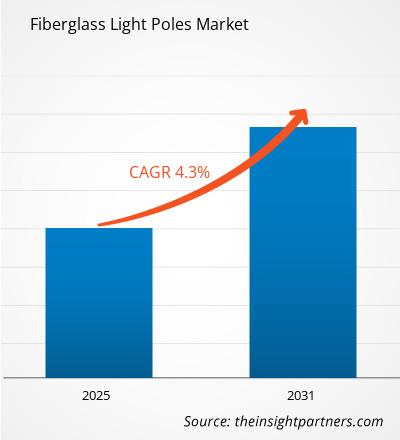
The Fiberglass Light Poles Market is valued at US$ 669.67 Million in 2025 and is projected to reach US$ 1,038.23 Million by 2034, expanding at a CAGR of 4.99% during 2026–2034. The market trends towards preference for light weight and corrosion resistant structures in outdoor illumination projects, while the composite production processes continue to ensure product longevity, efficient installation process, and overall performance throughout various uses in municipalities, commerce, industry, and residences.
The North American market is still considered as structurally advantageous, owing to the replacement of aged outdoor lighting infrastructures, municipal roads updating, and demand for materials that are less complicated in installation and exposed to corrosion. The Fiberglass Light Poles Market growth rate is estimated between 5.4 and 6.2% CAGR in 2026-2034.
Fiberglass Light Poles Market Assessment and Insights
- North America: North America is expected to account for a 34–38% share in 2025 and grow at a 5.4–6.2% CAGR between 2026–2034, supported by municipal replacements, corrosion resistance requirements, and established composite-pole supply capabilities.
- US: The US is estimated to represent 72–76% of North America in 2025 and expand at a 5.5–6.3% CAGR between 2026–2034, led by roadway, campus, and municipal lighting projects.
- Europe: Europe is projected to hold a 27–31% share in 2025 and grow at a 4.6–5.4% CAGR between 2026–2034, with the UK, Germany, France, Italy, and Spain supporting demand through infrastructure refurbishment and efficient outdoor lighting programs.
- Asia Pacific: Asia Pacific is estimated at a 22–26% share in 2025 and is expected to expand at a 5.8–6.7% CAGR between 2026–2034, led by China, Japan, India, South Korea, and Australia.
- Largest Segment: Round Tapered Fiberglass Pole is estimated to hold a 58–62% market share in 2025 and expand at a 5.1–5.7% CAGR during 2026–2034, supported by broad street-lighting suitability.
- High Growth Segment: Decorative and Garden Lighting is estimated at a 12–16% market share in 2025 and projected to grow at a 6.2–7.0% CAGR during 2026–2034, driven by aesthetic outdoor projects.
- Key companies analyzed in detail: Acuity Brands Lighting Inc., Alliance Composites Inc., Continental Pole & Lighting, Inc., Elsewedy Electric, Main Street Lighting, Inc., NAFCO International, Inc., PLP Composite Technologies, Inc., Shanghai Tunghsing Composites Co., Ltd., Unicomposite Technology Co., Ltd., Valmont Industries, Inc.
Source: The Insight Partners' analysis based on proprietary research, government publications, company annual reports, investor presentations, industry databases, and expert interviews.
From an alternative to steel and aluminum light poles to a composite construction material alternative that focuses on corrosion resistance, low weight, and customizable finish options, the Fiberglass Light Poles Market has come a long way. The process of product innovation has been increasingly focused on the combination of reinforced fiberglass poles with standard mountings, enhanced UV protection and customized geometry based on application requirements. Manufacturing has been focused on processes such as pultrusion, filament winding, resin preparation, finishing, and testing of structures. Customization has become a factor in influencing procurement decisions.
Future demand is likely to expand to emerging urban areas, coast infrastructure, parks, pedestrian walkways, and replacement projects. Areas of investment interest are moving away from innovative products toward standard design, localized distribution, expedited project completion, and interoperability with LED lighting fixtures and control systems. Regulations regarding energy efficient outdoor lighting will continue to positively impact pole replacement since cities are evaluating the entire lighting asset instead of just the fixture.
Fiberglass Light Poles Market Report Scope
| Report Attribute | Details |
|---|---|
| Market size in 2025 | US$ 669.67 Million |
| Market Size by 2034 | US$ 1,038.23 Million |
| Global CAGR (2026 - 2034) | 4.99% |
| Historical Data | 2021-2024 |
| Forecast period | 2026-2034 |
Fiberglass Light Poles Market Analysis
The Fiberglass Light Poles Market demand is based on outdoor lighting system improvements in areas where corrosion, logistics, accessibility, or labor considerations impact the overall cost-effectiveness of the undertaking. Fiberglass materials represent a combination that is well suited to their low weight, electrically non-conductive properties, weather resistance, and ease of design. The supply chain comprises of glass fiber, resin manufacturers, composite makers, pole makers, luminaires, engineering firms, distribution centers, contractors, utilities, and city authorities.
In this supply chain, specification will usually occur prior to purchase. Therefore, engineering expertise and structural design take a critical role in the process. Resin supply, glass reinforcement, tooling, finish, transportation costs, and project specific dimensions influence the supply situation. Companies with reliable manufacturing process can improve consistency and provide standardized mounting arrangements.
As per the Fiberglass Light Poles Market report, the competitive landscape features a blend of diversified lighting firms and specialized composites makers. Acuity Brands Lighting Inc. operates in outdoor lighting and pole solutions whereas PLP Composite Technologies, Inc. is a firm that concentrates exclusively on composite poles. Unicomposite Technology Co., Ltd. focuses on fiberglass lighting applications whereas Valmont Industries, Inc. has extensive expertise in infrastructure manufacturing. Continental Pole & Lighting, Inc., NAFCO International, Inc. and Main Street Lighting, Inc. add to the specialization aspect.
Competitive positioning is becoming more dependent on engineering customization, applicability, distributor support and the ability to match project specifications as opposed to competing in terms of price alone. Alliance Composites Inc., Elsewedy Electric and Shanghai Tunghsing Composites Co., Ltd. add value to the competitive landscape within composites and infrastructure space. Future investments would then be geared towards efficient tooling, certification, logistics and designs compatible with new LED, control and smart city products.
● REPORT CUSTOMIZATION
Tailor This Report To Align With Your Specific Business Requirements
This report can be customized to align precisely with your business objectives, scope, and target markets. Customization options include tailored segmentation, geography, competitive analysis, and strategic insights to support informed decision-making.
Customize This Report →WHAT YOU CAN ADJUST
- ● Segmentations
- ● Geography
- ● Competitive Analysis
- ● Language Preferences
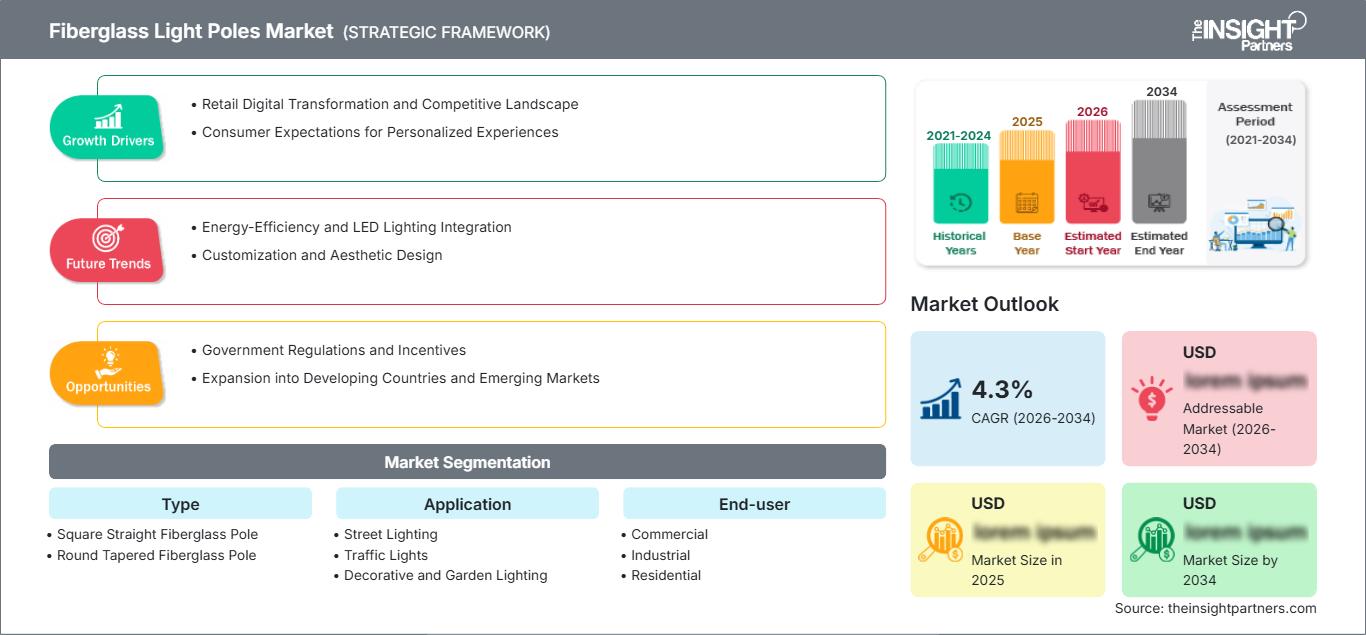
Fiberglass Light Poles Market: Strategic Insights
Regional Insights
North America Fiberglass Light Poles Market
North America is projected to have a Fiberglass Light Poles Market Share of 34-38% in 2025 and grow at a CAGR of 5.4-6.2% until 2034. The US is the primary consumer market, with roadway rehabilitation, municipal lighting replacement, parks, campuses, coastal applications, and applications where corrosion or weight impacts lifecycle costs.
The contribution of Canada is through the transportation, infrastructure, and difficult environmental condition that necessitates sturdy outdoor infrastructure. The considerations in the purchase include installation equipment, cost of labor, cost of logistics, and risks in maintenance, together with the cost. The composite poles have a strength in being easy to install.
U.S. Fiberglass Light Poles Market
The U.S. comprises an estimated 72% - 76% of North America in 2025 and is forecasted to record a growth rate of 5.5% - 6.3% CAGR until 2034. The demand is spread across municipalities, utilities, commercial establishments, transport infrastructures, universities, parks, and residential sites that need outdoor lighting.
Acuity Brands Lighting Inc. and PLP Composite Technologies Inc. demonstrate the presence of products related to outdoor lighting and composite poles, respectively, while specialist manufacturers cater to the needs of individual projects. The trends of application include replacement of roads, walkways, recreational spaces, ornamental lighting, and wet or salty environments. Procurement by government agencies considers the maintenance, structural aspects, and installation of alternatives to metallic poles.
Europe Fiberglass Light Poles Market
Europe has been estimated to make up for 27-31% of 2025 demand and is forecasted to grow by a 4.6-5.4% CAGR during the period until 2034, with the UK being one of the major markets. Europe can benefit from infrastructure revitalization programs, advanced lighting solutions, and durability considerations.
The UK retains demand for roads, public spaces, parks, and commercial sites, whereas Germany focuses on engineered infrastructures, industrial sites, and municipal revitalization programs. France, Italy, and Spain can be considered another promising markets for urban renovation, hospitality sites, transport infrastructures, and decoration. European clients pay special attention to longevity of materials, environmental conditions, installation issues, and compatibility with the new LED technology, offering opportunities for composite poles.
APAC Fiberglass Light Poles Market
Estimations indicate that APAC will have a market share of 22-26% in 2025 and register growth at 5.8-6.7% CAGR till 2034. China will be the major consumer driven by large-scale development of urbanization and manufacturing sectors.
Demand will also be driven by Japan, South Korea, India, and Australia through various lighting projects for transportation, public spaces, residential, and commercial purposes. Exposure to coastal areas and development of infrastructure provide compelling reason for the usage of corrosion resistant composite poles.
Middle East & Africa Fiberglass Light Poles Market
The Middle East and Africa will witness a growth in demand at a CAGR of 5.0-5.8% through 2034, with Saudi Arabia and UAE emerging as the leading Gulf players. In Africa, South Africa becomes an important consumer through municipal, commercial, and infrastructure applications.
Urban projects on a large scale, extreme weather conditions, coastal regions, and investments in infrastructure will drive composite poles' growth. In the Gulf, the energy-intensive construction along with outdoor lighting projects drive the need for efficient lighting solutions, while the markets in Africa are fragmented and project-driven. The RoMEA region will continue growing steadily due to increased availability of composite products through distributors and engineers.
Segmentation Analysis
Type
The Type segment is projected to expand at a 4.7–5.5% CAGR during 2026–2034. Demand is shaped by pole geometry, structural loading, installation environment, aesthetic requirements, and compatibility with different luminaire configurations. Standardized designs support repeat procurement, while customized dimensions remain relevant for infrastructure and decorative projects. The Fiberglass Light Poles Market scope increasingly reflects engineering-led selection rather than material substitution alone.
- Square Straight Fiberglass Pole: Square straight designs support applications requiring a conventional visual profile, straightforward mounting, and consistent dimensions. Their geometry can simplify specification for commercial, residential, and selected municipal lighting projects.
- Round Tapered Fiberglass Pole: Round tapered designs provide broad application flexibility for roadway and area lighting, combining familiar pole aesthetics with composite durability and efficient structural material distribution for varied outdoor environments.
Application
The Application segment is estimated to grow at a 5.0–6.0% CAGR through 2034. Street lighting remains the principal demand base because of large installed infrastructure and replacement cycles. However, decorative and garden projects can generate faster incremental adoption where aesthetics, corrosion resistance, and lightweight installation are valued. Application diversity reduces dependence on a single procurement channel.
- Street Lighting: Street lighting remains the core application because municipal and transportation projects require standardized poles, predictable structural performance, and compatibility with LED luminaires, controls, and roadway-specific mounting arrangements.
- Traffic Lights: Traffic-light applications require stable structures, reliable mounting interfaces, and visibility-oriented positioning. Composite poles can serve selected installations where corrosion resistance and reduced handling weight provide operational advantages.
- Decorative and Garden Lighting: Decorative and garden lighting favors customizable finishes, proportions, and colors. Fiberglass supports architectural integration across parks, pathways, hospitality venues, landscaped developments, and residential outdoor environments.
End-user
The End-user segment is expected to grow at a 4.8–5.8% CAGR during 2026–2034. Commercial buyers emphasize aesthetics and maintenance, industrial users prioritize durability and environmental resistance, while residential projects typically favor design flexibility and manageable installation. These requirements create differentiated purchasing criteria across project scales and procurement structures.
- Commercial: Commercial users include campuses, retail developments, hospitality properties, and office environments where lighting supports security, navigation, branding, and landscape design while minimizing recurring maintenance exposure.
- Industrial: Industrial facilities require durable outdoor infrastructure around warehouses, plants, yards, logistics areas, and processing sites. Composite poles can be attractive where corrosion, electrical conductivity, or difficult installation conditions influence material selection.
- Residential: Residential demand is concentrated in landscaped communities, private roads, gardens, driveways, and recreational areas. Buyers typically prioritize appearance, corrosion resistance, installation convenience, and compatibility with decorative luminaires.
Opportunity Snapshot
| End-user | Revenue Contribution | Trend Tag | Adoption Stage |
|---|---|---|---|
| Commercial | High | Campus Lighting | Scaling |
| Industrial | Medium | Yard Lighting | Scaling |
| Residential | Medium | Garden Lighting | Scaling |
Fiberglass Light Poles Market Growth Drivers and Impact Analysis
Corrosion resistance improves lifecycle economics in harsh environments
Fiberglass Light Poles Market can address a persistent infrastructure problem in coastal, humid, chemically exposed, and salt-affected environments where conventional metallic structures may require coatings, inspection, or replacement. Their resistance to rust and corrosion can reduce maintenance interventions and improve asset availability when project conditions are suitable. The commercial impact is strongest where access is difficult or maintenance crews face high mobilization costs. Buyers can also evaluate lightweight composite structures against installation equipment requirements because lower handling weight may reduce field complexity. As municipalities and private owners increasingly evaluate total cost of ownership, corrosion exposure becomes a more explicit specification criterion. This favors suppliers capable of providing structural documentation, weather-resistant finishes, and application-specific designs rather than generic commodity products. The resulting demand is likely to support higher-value engineered pole offerings.
Lower installation weight supports labor and logistics efficiency
Fiberglass structures generally weigh less than comparable metallic alternatives, creating potential advantages during transportation, unloading, positioning, and field installation. This characteristic becomes commercially relevant when projects involve constrained access, remote sites, limited lifting equipment, or elevated labor costs. The impact extends beyond freight because lighter components can simplify handling procedures and shorten selected installation activities. Contractors may therefore consider composite poles for retrofit projects where minimizing disruption is important. Manufacturers that standardize lengths, mounting interfaces, and accessories can further reduce field preparation requirements. However, weight reduction does not eliminate the need for structural engineering because wind loading, deflection, fatigue, anchorage, and luminaire configuration remain application-specific considerations. Market adoption should therefore favor suppliers combining lightweight products with engineering support and clear installation documentation, particularly for municipal and commercial projects requiring predictable execution.
Outdoor lighting modernization expands replacement opportunities
Replacement of aging outdoor lighting infrastructure creates a recurring opportunity because municipalities, businesses, institutions, and residential developers increasingly upgrade luminaires, controls, and associated structures together. Pole replacement becomes strategically relevant when existing structures cannot accommodate new fixtures, wiring, mounting arrangements, or desired aesthetics. Composite poles can enter this process as an alternative material where corrosion resistance, appearance, and installation requirements align with project objectives. The impact is amplified by the expansion of LED and connected lighting because modernization programs can trigger broader asset evaluation rather than isolated fixture replacement. Suppliers can capture value by offering complete pole configurations, mounting hardware, documentation, and compatible accessories. Projects with phased procurement also create opportunities for standardized product families that support multiple heights and applications, allowing buyers to maintain visual consistency while reducing engineering effort across individual sites.
Fiberglass Light Poles Market Future Trends
Integration of connected lighting infrastructure
The Fiberglass Light Poles Market trends are likely to increasingly reflect the convergence of structural products with connected outdoor lighting infrastructure. Future specifications may accommodate sensors, communication equipment, electrical interfaces, charging components, and modular mounting systems without compromising the pole's primary structural function. This creates opportunities for manufacturers to redesign shafts, handholes, bases, and accessory interfaces around future equipment requirements. Procurement teams may increasingly request digital engineering files and standardized mounting dimensions to simplify integration across multiple projects. Product differentiation could consequently move beyond fiberglass composition toward platform-level compatibility, upgradeability, and serviceability. Suppliers that anticipate additional equipment loads and provide flexible configurations can strengthen their position in smart-campus, municipal, transportation, and commercial developments. Over time, composite poles could become infrastructure platforms supporting several functions rather than structures dedicated exclusively to holding luminaires.
Circularity and material-efficiency priorities
Future product development is expected to place greater emphasis on resin efficiency, manufacturing waste reduction, service life, repairability, and end-of-life management. Composite poles already offer durability advantages in many environments, but sustainability evaluation is becoming more sophisticated as infrastructure owners examine embodied impacts alongside operating performance. Manufacturers may respond through optimized fiber orientation, lower-material designs, improved finishing systems, and production methods that reduce scrap. Procurement specifications could also request environmental documentation, traceability, or defined disposal pathways. These changes may encourage closer collaboration between composite manufacturers, resin suppliers, engineering firms, and lighting companies. The commercial opportunity is not limited to premium projects because standardized environmental documentation can reduce specification friction across multiple procurement categories. Companies able to demonstrate measurable material efficiency without compromising structural performance may gain greater consideration in infrastructure tenders.
Fiberglass Light Poles Market Opportunities
Localized manufacturing and distribution networks
The Fiberglass Light Poles Market Forecasts indicate an opportunity for manufacturers to establish regional production, stocking, and distribution arrangements near major municipal and commercial demand centers. Long-distance transportation can materially influence composite-pole economics because poles are large, lightweight structures that occupy substantial freight volume relative to mass. Regional inventory can shorten lead times, support replacement projects, and improve responsiveness to customized orders. Investors and manufacturers can prioritize facilities that combine standardized pultrusion or winding capabilities with finishing and accessory assembly. Partnerships with electrical distributors, lighting representatives, engineering consultants, and installation contractors can further improve specification visibility. Local technical support may be especially valuable where buyers require structural calculations, mounting guidance, or compliance documentation. A regional model can therefore create competitive differentiation without depending solely on lower manufacturing cost.
Integrated pole and lighting specification platforms
A second opportunity lies in developing integrated specification packages that combine poles, luminaires, mounting hardware, controls, and project documentation. Buyers increasingly seek predictable project execution rather than isolated component purchases, especially for municipal upgrades and large commercial developments. Manufacturers can use this shift to simplify engineering coordination and reduce incompatibility risks between pole geometry and lighting equipment. Digital configurators, BIM-ready files, structural calculation tools, and standardized accessory interfaces can strengthen the value proposition. The approach also creates opportunities for cross-selling across replacement and new-build projects. Suppliers should prioritize configurations covering common mounting heights, finishes, wind conditions, and application environments while retaining customization for specialized projects. Over time, integrated specification capability could become a stronger competitive differentiator than product availability alone, particularly for contractors managing compressed project schedules.
Recent Developments
- March 2026: Trident Industries in Granite City, Illinois, supplied storm-resilient composite power poles that helped utility crews maintain and restore electricity following severe storms. The fiberglass-reinforced composite poles are being deployed by Ameren as part of its grid-hardening efforts because their high strength and resistance to storm-related damage can help reduce cascading failures and improve recovery times. The adoption of composite poles highlights growing demand for durable, weather-resistant FRP infrastructure in utility applications.
- June 2024: Creative Composites Group launched a full line of StormStrong® utility, telecommunications and light poles, expanding its fiberglass-reinforced polymer (FRP) portfolio for municipal lighting and infrastructure applications. The StormStrong light poles are available in 8-inch and 10-inch diameters, multiple lengths and strength ratings, and are reinforced with high-strength electrical-grade fiberglass. The lightweight poles provide corrosion resistance and resilience against hurricane-force winds, blizzards, deep freezes, rot, termites and other forms of damage, supporting the adoption of durable and low-maintenance fiberglass light poles for outdoor infrastructure.
Frequently Asked Questions

- Comprehensive Market Sizing and Forecast Analysis
- Detailed Segmentation Analysis
- In-Depth Market Dynamics Assessment
- Regional and Country-Level Insights
- Competitive Landscape and Company Benchmarking
- Strategic Business Intelligence
Recent Reports
Testimonials

The Insight Partners provided valuable market intelligence that supported our global go-to-market strategy. Their team was professional, responsive, and attentive to our feedback, providing thoughtful analysis and helpful methodological clarifications throughout the project.
Junmo Kim Chief Financial Officer (CFO), Enertech Co., Ltd.
The Insight Partners' SCADA System Market report is comprehensive, with valuable insights on current trends and future forecasts. The team was highly professional, responsive, and supportive throughout. We are very satisfied and highly recommend their services.
RAN KEDEM Partner, Reali Technologies LTDs
I requested a report on a very specific software market and the team produced the report in a few days. The information was very relevant and well presented. I then requested some changes and additions to the report. The team was again very responsive and I got the final report in less than a week.
JEAN-HERVE JENN Chairman, Future Analytica
We worked with The Insight Partners for an important market study and forecast. They gave us clear insights into opportunities and risks, which helped shape our plans. Their research was easy to use and based on solid data. It helped us make smart, confident decisions. We highly recommend them.
PIYUSH NAGPAL Sr. Vice President, High Beam Global
The Insight Partners delivered insightful, well-structured market research with strong domain expertise. Their team was professional and responsive throughout. The user-friendly website made accessing industry reports seamless. We highly recommend them for reliable, high-quality research services
YUKIHIKO ADACHI CEO, Deep Blue, LLC.
This is the first time I have purchased a market report from The Insight Partners.While I was unsure at first, I visited their web site and felt more comfortable to take the risk and purchase a market report.I am completely satisfied with the quality of the report and customer service. I had several questions and comments with the initial report, but after a couple of dialogs over email with their analyst I believe I have a report that I can use as input to our strategic planning process.Thank you so much for taking the extra time and making this a positive experience.I will definitely recommend your service to others and you will be my first call when we need further market data.
JOHN SUZUKI President and Chief Executive Officer, Board Director, BK Technologies
I wish to appreciate your support and the professionalism you displayed in the course of attending to my request for information regarding to infectious disease IVD market in Nigeria. I appreciate your patience, your guidance, and the fact that you were willing to offer a discount, which eventually made it possible for us to close a deal. I look forward to engaging The Insight Partners in the future, all thanks to the impression you have created in me as a result of this first encounter.
DR CHIJIOKE ONYIA MANAGING DIRECTOR, PineCrest Healthcare Ltd.Reason to Buy
- Informed Decision-Making
- Understanding Market Dynamics
- Competitive Analysis
- Identifying Emerging Markets
- Customer Insights
- Market Forecasts
- Risk Mitigation
- Boosting Operational Efficiency
- Strategic Planning
- Investment Justification
- Tracking Industry Innovations
- Aligning with Regulatory Trends





 Get Free Sample for