
Field-Erected Cooling Tower Market Share, Size & Demand by 2034
Coverage: by Type (Dry, Wet, Hybrid); End Use Industry (Power Generation, Paper Mills, Oil and Gas, Iron and Steel, Others) , and Geography (North America, Europe, Asia Pacific, and South and Central America)
- Status : Data Released
- Report Code : TIPRE00009325
- Category : Electronics and Semiconductor
- No. of Pages : 150
- Available Report Formats :


- Last update date : September 10, 2026


2025 Market Size
US$ 2.75 Bn
Base year value
2034 Forecast
US$ 4.19 Bn
Projected by 2034
CAGR 2026-2034
4.76 %
Growth rate
Addressable Market
US$ 31.45 Bn
(2026-2034)
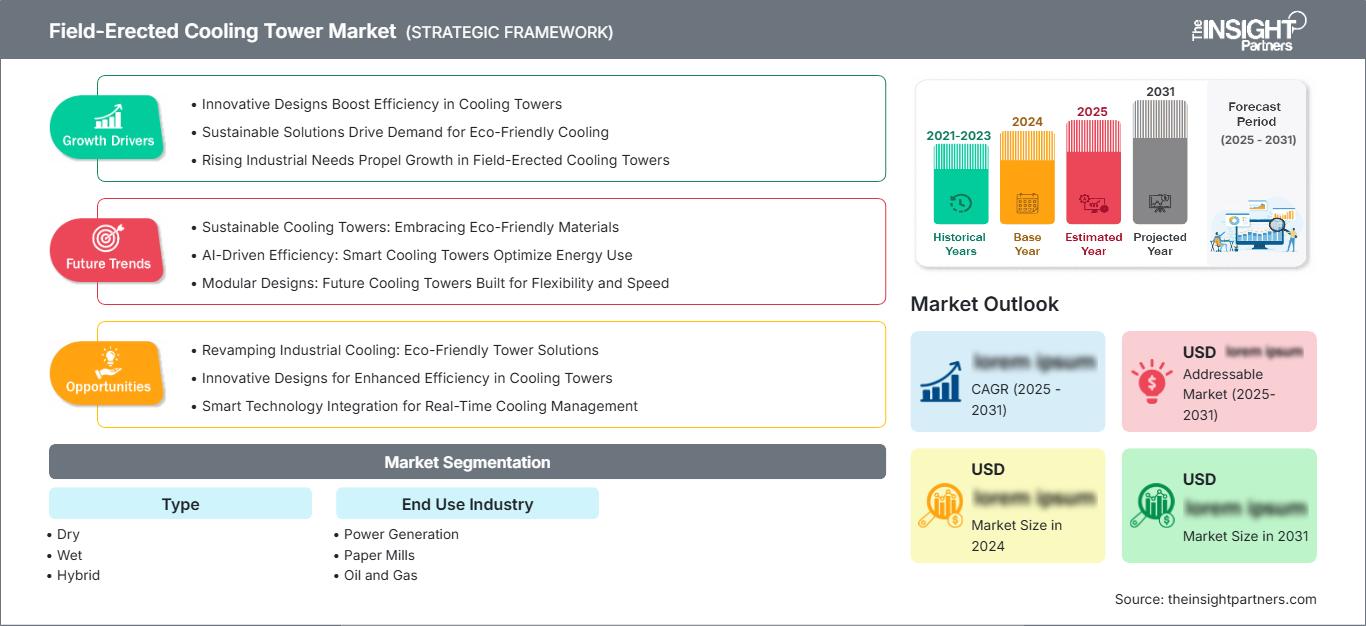
The Field-Erected Cooling Tower Market was valued at US$ 2.75 Billion in 2025 and is projected to reach US$ 4.19 Billion by 2034, registering a CAGR of 4.76% during 2026–2034. The market encompasses large-scale cooling towers assembled on-site for industrial and power generation applications, providing heat rejection for power plants, paper mills, oil and gas facilities, and iron and steel production. These towers employ dry, wet, and hybrid cooling technologies to manage thermal loads in demanding industrial environments worldwide.
North America Field-Erected Cooling Tower Market size is expected to expand at a CAGR of 4.2–4.9% during 2026–2034, supported by power generation infrastructure, industrial facilities, and replacement programs across the US and Canada. Demand is reinforced by aging infrastructure replacement, environmental regulations, and procurement preferences for reliable, efficient cooling solutions in power and industrial applications.
Field-Erected Cooling Tower Market Assessment and Insights
- North America held 25–28% share in 2025 and is growing at a CAGR of 4.2–4.9% during 2026–2034, led by power generation, industrial facilities, and replacement programs across the US and Canada.
- US represented 82–85% of North American revenue in 2025 and is growing at a CAGR of 4.4–5.1% during 2026–2034.
- Europe accounted for 20–23% share in 2025 and is growing at a CAGR of 4.0–4.7% during 2026–2034, led by Germany, the UK, France, Italy, and Spain.
- Asia Pacific held 38–41% share in 2025 and is growing at a CAGR of 5.5–6.2% during 2026–2034, led by China, India, Japan, South Korea, and Australia.
- Largest Segment Wet held 58–62% market share in 2025 and is growing at a CAGR of 4.5–5.2% during 2026–2034.
- High Growth Segment Dry represented 18–21% market share in 2025 and is growing at a CAGR of 5.5–6.2% during 2026–2034.
- Key companies analyzed in detail: Babcock and Wilcox Enterprises, Inc.; Baltimore Aircoil Company (AMSTED Industries Incorporated); Delta Cooling Towers Pvt. Ltd. (DCTPL); ENEXIO Management GmbH; EVAPCO, Inc.; MESAN Group; Paharpur Cooling Towers Ltd.; S.A. HAMON; SPX Cooling Technologies, Inc.; Watco Group; Brentwood Industries; GEA Group.
Source: The Insight Partners' analysis based on proprietary research, government publications, company annual reports, investor presentations, industry databases, and expert interviews.
Field-Erected Cooling towers have undergone significant improvement from conventional wet cooling towers to hybrid, dry, and advanced types that offer better water use, environmental sustainability, and performance. Production trends are characterized by modularity, materials used, and testing under different climate conditions and thermal loads. The market for Field-Erected Cooling Towers is also influenced by engineering contractors and plant managers who match their cooling towers solutions with thermal performance criteria and environmental requirements of power and industrial applications.
Investments are increasingly being directed towards Asia Pacific, North America, and Middle East regions where power generation, industrial growth, and environmental legislation demand advanced cooling solutions with enhanced water efficiency. The regulatory conformity to environmental standards and thermal performance requirement facilitates the certification of the solution. There is growing preference for solutions that integrate thermal performance, reliability, and environmental sustainability with engineering responsiveness and life cycle management.
Field-Erected Cooling Tower Market Report Scope
| Report Attribute | Details |
|---|---|
| Market size in 2025 | US$ 2.75 Billion |
| Market Size by 2034 | US$ 4.19 Billion |
| Global CAGR (2026 - 2034) | 4.76% |
| Historical Data | 2021-2024 |
| Forecast period | 2026-2034 |
Field-Erected Cooling Tower Market Analysis
Growth drivers for Market include increasing power generation, industrial facilities needs, replacement, and regulations. Value chain includes parts suppliers, cooling towers providers, engineering firms, and industrial customers. Supply dynamics include material availability, construction capabilities, and industrial investment cycles. Analysis of the Field-Erected Cooling Tower Market Report reveals that wet cooling towers account for largest market share due to proven performance while dry systems increase their share due to water savings potential. Services are important as engineering, construction, and maintenance services impact installation and operation of cooling towers.
Market players are mostly cooling tower producers and industrial equipment manufacturers. They include SPX Cooling Technologies, Inc., Baltimore Aircoil Company (AMSTED Industries Incorporated), EVAPCO, Inc., ENEXIO Management GmbH, Babcock and Wilcox Enterprises, Inc., S.A. HAMON, Watco Group, Paharpur Cooling Towers Ltd., MESAN Group, Delta Cooling Towers Pvt. Ltd. (DCTPL), Brentwood Industries, and GEA Group. Market trends involve investments into hybrid cooling technologies, water conservation solutions, and modular construction. SPX Cooling Technologies, Inc. and Baltimore Aircoil Company (AMSTED Industries Incorporated) have leading position due to full range of cooling towers and partnerships with industrial companies, while EVAPCO, Inc. and ENEXIO Management GmbH have advantage due to technological capabilities. Strategic positioning requires certified
Technological innovations in the Field-Erected Cooling Tower market have been driven by the need for enhanced thermal performance, reduction in water usage, and more flexible operation by the industry players. Hybrid cooling system configurations, innovative fill materials, optimized fan assemblies, and automation systems in monitoring are becoming popular choices amid the efforts to ensure that cooling needs are balanced with environmental conditions and operating costs. The modernization trend is providing openings for manufacturers able to design custom towers, upgrade components, and retrofit systems while keeping disruption levels low during installations and maintenance processes.
The demand within the regions is driven by the investments made in power generation, chemicals, petrochemicals, manufacturing, and other industries consuming vast amounts of water resources. The market is anticipated to see the APAC region continue to be a prominent growth region owing to industrialization, development of energy infrastructure, and rising investments in large-scale manufacturing plants. At the same time, North America and Europe will continue to generate demand from replacement activities and efficiency enhancement, in addition to rising environmental regulations. Companies are enhancing their market positions via service agreements and project management.
● REPORT CUSTOMIZATION
Tailor This Report To Align With Your Specific Business Requirements
This report can be customized to align precisely with your business objectives, scope, and target markets. Customization options include tailored segmentation, geography, competitive analysis, and strategic insights to support informed decision-making.
Customize This Report →WHAT YOU CAN ADJUST
- ● Segmentations
- ● Geography
- ● Competitive Analysis
- ● Language Preferences
Field-Erected Cooling Tower Market: Strategic Insights
Regional Insights
North America Field-Erected Cooling Tower Market
North America accounted for 25–28% of Field-Erected Cooling Tower Market share in 2025 and is projected to grow at a CAGR of 4.2–4.9% during 2026–2034. Demand is supported by power generation infrastructure, industrial facilities, replacement programs, and environmental regulations across the US and Canada. The region's power and industrial infrastructure drive consistent cooling tower demand. SPX Cooling Technologies, Inc., Baltimore Aircoil Company (AMSTED Industries Incorporated), EVAPCO, Inc., Babcock and Wilcox Enterprises, Inc., and S.A. HAMON support installed bases across power plants, industrial facilities, and processing operations in the US and Canada.
U.S. Field-Erected Cooling Tower Market
In 2025, the U.S. accounted for 82–85% of North America’s revenue and is expected to experience a CAGR of 4.4–5.1% from 2026 to 2034. The applications of these systems mainly include power generation, industrial processing, pulp and paper mills, and oil and gas plants. Market participants in the region include SPX Cooling Technologies, Inc., Baltimore Aircoil Company (AMSTED Industries Incorporated), EVAPCO, Inc., Babcock and Wilcox Enterprises, Inc., and Watco Group. Thermal efficiency, reliability, compliance, technical expertise, as well as proper project management, are crucial factors for buyers.
Europe Field-Erected Cooling Tower Market
The Europe market share was recorded at 20-23% in 2025 and is expected to experience growth at a CAGR of 4.0-4.7% in 2026-2034. In Europe, Germany takes the lead position due to its presence in the power generation and industrial applications sector, and the UK helps boost the demand coming from power generation and industrial installations. France, Italy, and Spain help drive the demand coming from industrial and power generation infrastructure. The regulations and efficiency standards prefer the suppliers with proven performance and compliance.
APAC Field-Erected Cooling Tower Market
The Asia Pacific region held the 38%–41% market share in 2025 and is estimated to grow at a CAGR of 5.5%–6.2% from 2026 to 2034. China is leading due to power generation and industrial growth, whereas India is growing due to investments in power generation and industrial sectors. Japan and South Korea focus on advanced cooling solutions for power and industrial applications, while Australia includes power generation and mining operations. The policy backing for power generation and industrial growth drive the adoption of the Field-Erected Cooling Tower Market.
Middle East & Africa Field-Erected Cooling Tower Market
The Middle East & Africa market is projected to grow at a CAGR of 4.0–4.7% during 2026–2034. Saudi Arabia leads through power generation and industrial development, while the UAE adds power and processing applications. South Africa and Rest of MEA rely on power and industrial infrastructure. Power generation and industrial investment create demand for cooling solutions. Suppliers succeed when they combine product quality, engineering expertise, and project capability.
Segmentation Analysis
Type
Type is projected to grow at a CAGR of 4.5–5.2% during 2026–2034. Field-Erected Cooling Tower Market scope covers Dry, Wet, and Hybrid. Selection depends on water availability, environmental requirements, and thermal performance needs. Wet leads through established performance and widespread adoption.
- Dry cooling towers use air-cooled heat exchange with reduced water consumption for water-scarce regions.
- Wet cooling towers use evaporative cooling for efficient thermal performance in industrial applications.
- Hybrid systems combine dry and wet cooling for balanced water conservation and thermal performance.
End Use Industry
End Use Industry is forecast to grow at a CAGR of 4.8–5.5% during 2026–2034. Power Generation, Paper Mills, Oil and Gas, and Iron and Steel represent key industrial sectors.
- Power Generation applications require large-scale cooling for thermal power plants and combined cycle facilities.
- Paper Mills applications need reliable cooling for processing and equipment.
- Oil and Gas applications demand robust cooling for processing and refining operations.
- Iron and Steel applications require high-capacity cooling for steel production.
Opportunity Snapshot
| End Use Industry | Revenue Contribution | Trend Tag | Adoption Stage |
|---|---|---|---|
| Power Generation | High | Thermal Cooling | Mature |
| Paper Mills | Medium | Process Cooling | Mature |
| Oil and Gas | High | Refinery Cooling | Mature |
| Iron and Steel | High | Steel Production | Mature |
Field-Erected Cooling Tower Market Growth Drivers and Impact Analysis
Power Generation Infrastructure Investment Drives Demand
Power generation infrastructure investment across thermal, nuclear, and combined-cycle facilities is creating significant demand for field-erected cooling towers used for heat rejection and thermal management. As power generation capacity expands and existing facilities undergo upgrades, reliable cooling infrastructure remains essential for maintaining efficient and stable plant operations. Each large-scale power facility requires effective heat dissipation systems, making continued investment in electricity generation a direct driver of cooling tower demand. The expansion of thermal and combined-cycle power capacity, along with modernization of existing plants, supports sustained requirements for high-performance cooling solutions. The practical impact is growing demand for reliable, efficient, and durable field-erected cooling towers capable of supporting increasing power generation capacity, optimizing thermal performance, and meeting the operational requirements of large-scale electricity generation facilities across global markets.
Industrial Facility Requirements Drive Cooling Adoption
Industrial facility requirements across paper, oil and gas, iron and steel, chemical processing, and other process industries are driving demand for field-erected cooling towers used for process cooling and heat rejection. These industries rely on continuous and reliable cooling systems to maintain production efficiency, equipment performance, and operational stability. As industrial facilities expand production capacity, upgrade equipment, and invest in new processing infrastructure, the need for effective cooling solutions increases. Field-erected cooling towers provide scalable and durable solutions for large industrial applications requiring substantial heat dissipation capacity. This ongoing industrial development creates consistent demand for reliable cooling infrastructure. The market driver particularly benefits suppliers capable of delivering robust, efficient, and durable cooling towers designed to withstand demanding operating conditions while supporting process reliability and the thermal management requirements of large-scale industrial facilities.
Environmental Regulations Drive Technology Adoption
Environmental regulations and water conservation requirements across global jurisdictions are driving demand for advanced cooling tower technologies that improve water efficiency and support environmental compliance. Industrial and power generation facilities face increasing pressure to reduce water consumption, manage discharge, and comply with evolving environmental standards. These requirements encourage operators to upgrade existing cooling infrastructure and adopt technologies that optimize water usage while maintaining effective heat rejection and operational performance. Regulatory compliance therefore creates consistent demand for modern, efficient cooling tower solutions designed to meet increasingly stringent environmental requirements. The market impact is growing adoption of cooling towers that combine improved water efficiency, reliable thermal performance, and enhanced environmental compliance. Suppliers offering innovative technologies that reduce water consumption and support regulatory requirements are well positioned to benefit from ongoing infrastructure upgrades and sustainability-focused investments.
Field-Erected Cooling Tower Market Future Trends
Hybrid Cooling Systems Enable Water Conservation
Field-erected cooling tower market trends increasingly point toward hybrid cooling systems that combine wet and dry cooling technologies to improve water conservation while maintaining effective thermal performance. As concerns over water scarcity and resource availability increase, industrial and power generation facilities are seeking cooling solutions that reduce water consumption without compromising operational efficiency. The next generation of field-erected cooling towers is expected to integrate hybrid configurations that enable operators to balance water usage, cooling capacity, and energy efficiency according to operating conditions. This shift is significant as environmental regulations and sustainability objectives place greater emphasis on efficient water management. Vendors with expertise in hybrid cooling technologies will be better positioned to address evolving customer requirements and capture opportunities as industries increasingly prioritize water conservation, operational flexibility, and reliable thermal management.
Modular Construction Reduces Installation Time
Modular construction and prefabrication are emerging trends in the field-erected cooling tower market, offering opportunities to reduce installation time, improve project efficiency, and accelerate commissioning. As project developers face tighter schedules and increasing construction requirements, modular components can simplify assembly and reduce on-site labor and installation complexity. Next-generation field-erected cooling tower designs are expected to incorporate greater use of prefabricated and modular components, enabling faster assembly while maintaining structural integrity, thermal performance, and operational reliability. This evolution supports accelerated project schedules and can help reduce overall installation costs and execution risks. Suppliers capable of delivering modular cooling tower designs with proven performance, reliable quality, and scalable configurations are likely to gain greater credibility among project developers seeking efficient, predictable, and time-saving solutions for large-scale industrial and power generation projects.
Field-Erected Cooling Tower Market Opportunities
Cooling Tower Replacement Programs for Aging Infrastructure
Field-Erected Cooling Tower Market forecasts indicate strong opportunities for cooling tower replacement programs across aging power generation and industrial infrastructure. As existing cooling towers reach the end of their operational life, facilities require replacement systems that provide improved reliability, thermal efficiency, water management, and compliance with current performance and environmental standards. Aging infrastructure is therefore creating sustained demand for modern field-erected cooling towers capable of supporting continued plant operations while addressing evolving operational requirements. Suppliers can capture opportunities by offering replacement solutions tailored to existing facility layouts, capacity requirements, and operating conditions. The opportunity is particularly strong in markets with aging power and industrial assets, where operators are prioritizing infrastructure modernization and reliability improvements. Vendors offering efficient, durable, and standards-compliant replacement towers are well positioned to benefit from this demand.
Water-Efficient Cooling Solutions for Water-Scarce Regions
Water-efficient cooling solutions are creating significant opportunities in water-scarce regions, where industrial and power generation facilities face increasing pressure to reduce water consumption. Dry and hybrid cooling towers provide alternatives to conventional water-intensive systems by minimizing water usage while maintaining effective thermal performance. As project developers prioritize sustainable and water-conscious infrastructure, demand for advanced cooling technologies is expected to increase across regions facing water availability constraints. Suppliers with expertise in dry and hybrid cooling technologies can capture opportunities by delivering solutions that balance water efficiency, cooling performance, operational reliability, and lifecycle costs. This opportunity particularly benefits companies capable of designing and supplying cooling systems tailored to local environmental and operating conditions. The growing focus on water conservation is therefore supporting adoption of efficient cooling technologies across water-stressed industrial and power generation markets globally.
Recent Developments
- December 2025: Metso is launching the third-generation OKTOP Cooling Tower to address key customer challenges in demanding slurry and electrolyte cooling duties in metals refining. Designed for reliability and performance, the new OKTOP Cooling Tower combines Metso’s proven technology with a highly compact footprint ideal for brownfield installations, effortless maintenance and rapid installation to deliver maximum value with simplified design. With the lowest emissions in the market, the solution is part of the Metso Plus- Opens in a new window offering.
- July 2025: ebm‑papst SEA and Truwater officially launched the i-VX-S Series cooling tower, an energy-efficient solution powered by the DV280 external rotor EC motor. Held at the ebm‑papst SEA’s Customer Experience Center, the event brought together sustainability-focused professionals from the built environment sector for an afternoon of knowledge exchange, networking, and innovation. A key highlight of the event was the live product demonstration, which offered attendees an up-close look at the i-VX-S Series’ advanced features and high-efficiency performance. The launch comes at a timely moment for the industry, as demand for greener HVAC solutions continues to accelerate across Southeast Asia.
- January 2025: Delta Cooling Towers has unveiled the latest and largest addition to its innovativelineup. The new TMX series delivers unmatched cooling capacity, performance and reliabilityfrom its High-Density Polyethylene (HDPE) design.At the heart of this groundbreaking series is a massive 20-foot-long sump molded from a single,seamless piece of engineered plastic. This revolutionary design eliminates the joints, seams, andwelds typically prone to leaks and maintenance issues in metal-clad cooling tower options,ensuring long-lasting, trouble-free operation.
Frequently Asked Questions

- Comprehensive Market Sizing and Forecast Analysis
- Detailed Segmentation Analysis
- In-Depth Market Dynamics Assessment
- Regional and Country-Level Insights
- Competitive Landscape and Company Benchmarking
- Strategic Business Intelligence
Recent Reports
Testimonials

The Insight Partners' SCADA System Market report is comprehensive, with valuable insights on current trends and future forecasts. The team was highly professional, responsive, and supportive throughout. We are very satisfied and highly recommend their services.
RAN KEDEM Partner, Reali Technologies LTDs
I requested a report on a very specific software market and the team produced the report in a few days. The information was very relevant and well presented. I then requested some changes and additions to the report. The team was again very responsive and I got the final report in less than a week.
JEAN-HERVE JENN Chairman, Future Analytica
We worked with The Insight Partners for an important market study and forecast. They gave us clear insights into opportunities and risks, which helped shape our plans. Their research was easy to use and based on solid data. It helped us make smart, confident decisions. We highly recommend them.
PIYUSH NAGPAL Sr. Vice President, High Beam Global
The Insight Partners delivered insightful, well-structured market research with strong domain expertise. Their team was professional and responsive throughout. The user-friendly website made accessing industry reports seamless. We highly recommend them for reliable, high-quality research services
YUKIHIKO ADACHI CEO, Deep Blue, LLC.
This is the first time I have purchased a market report from The Insight Partners.While I was unsure at first, I visited their web site and felt more comfortable to take the risk and purchase a market report.I am completely satisfied with the quality of the report and customer service. I had several questions and comments with the initial report, but after a couple of dialogs over email with their analyst I believe I have a report that I can use as input to our strategic planning process.Thank you so much for taking the extra time and making this a positive experience.I will definitely recommend your service to others and you will be my first call when we need further market data.
JOHN SUZUKI President and Chief Executive Officer, Board Director, BK Technologies
I wish to appreciate your support and the professionalism you displayed in the course of attending to my request for information regarding to infectious disease IVD market in Nigeria. I appreciate your patience, your guidance, and the fact that you were willing to offer a discount, which eventually made it possible for us to close a deal. I look forward to engaging The Insight Partners in the future, all thanks to the impression you have created in me as a result of this first encounter.
DR CHIJIOKE ONYIA MANAGING DIRECTOR, PineCrest Healthcare Ltd.Reason to Buy
- Informed Decision-Making
- Understanding Market Dynamics
- Competitive Analysis
- Identifying Emerging Markets
- Customer Insights
- Market Forecasts
- Risk Mitigation
- Boosting Operational Efficiency
- Strategic Planning
- Investment Justification
- Tracking Industry Innovations
- Aligning with Regulatory Trends





 Get Free Sample for