
Field Programmable Gate Array (FPGA) Market Growth, Share & Trends by 2034
Coverage: by Technology (Static RAM, Anti-Fuse technology, Flash Technology and EPROM); and Application (IT and Telecommunications, Automotive, Military & Aerospace, Healthcare, and Consumer electronics), and Geography (North America, Europe, Asia Pacific, and South and Central America)
- Status : Data Released
- Report Code : TIPTE100001032
- Category : Electronics and Semiconductor
- No. of Pages : 150
- Available Report Formats :


- Last update date : August 18, 2026


2025 Market Size
US$ 7.76 Bn
Base year value
2034 Forecast
US$ 14.8 Bn
Projected by 2034
CAGR 2026-2034
7.44 %
Growth rate
Addressable Market
US$ 101.71 Bn
(2026-2034)
The Field Programmable Gate Array Market is valued at US$ 7.76 Billion in 2025 and is projected to reach US$ 14.8 Billion by 2034, expanding at a CAGR of 7.44% during the forecast period from 2026 to 2034. This growth trajectory reflects increasing adoption across IT and telecommunications, automotive, military and aerospace, healthcare, and consumer electronics where reconfigurable logic and parallel processing capabilities are critical.
North America maintains a significant position in the Field Programmable Gate Array Market, with the region expected to grow at a CAGR range of 6–8% through 2034. Structural drivers include widespread deployment of 5G networks, hyperscale data center expansion, and defense electronics modernization programs across the United States and Canada.
Field Programmable Gate Array (FPGA) Market Assessment and Insights
- North America – The region holds approximately 28–31% share in 2025 and is growing at a CAGR range of 6–8% between 2026–2034, driven by strong hyperscale AI investment and defense modernization programs.
- US – Accounts for nearly 79–82% of North America share in 2025, advancing at a CAGR range of 5–7% between 2026–2034, supported by leading semiconductor companies and telecommunications infrastructure deployments.
- Europe – Represents approximately 18–21% share in 2025 and is expanding at a CAGR range of 6–8% between 2026–2034, with Germany, the UK, and France leading adoption in automotive and industrial automation applications.
- Asia Pacific – Holds roughly 45–48% share in 2025 and is projected to grow at the fastest CAGR range of 8–10% between 2026–2034, propelled by China, Japan, South Korea, and India's electronics manufacturing and telecommunications sectors.
- Largest Segment – Static RAM commands the largest technology share at 65–68% in 2025, growing at a CAGR range of 7–9% between 2026–2034, as high-performance computing and data center applications demand reprogrammable logic devices.
- High Growth Segment – Flash Technology represents the fastest-growing segment with a CAGR range of 9–11% between 2026–2034, holding 19–22% share in 2025, fueled by industrial IoT and automotive applications requiring non-volatile configuration storage.
- Key companies analyzed in detail: Intel Corporation, Microsemi Corporation, Xilinx, Lattice Semiconductor, Altera Corporation, Atmel Corporation, Texas Instruments, QuickLogic Corporation, Cypress Semiconductor Corporation, and Teledyne e2v.
Source: The Insight Partners' analysis based on proprietary research, government publications, company annual reports, investor presentations, industry databases, and expert interviews.
The evolution of the Field Programmable Gate Array market size has been defined by developments in semiconductor process technologies, migration from 28 nm to 7 nm and 5 nm process nodes, as well as incorporating AI accelerators into the FPGA fabric. The trend towards heterogeneous system architectures featuring FPGA logic along with ARM processors, DSP blocks, and high-speed transceivers allowed achieving integrated solutions for complex embedded systems on a single chip. The production landscape has seen the rise of chiplet architecture solutions, as well as advanced packaging technologies involving several FPGA dies alongside with memory and analog chips in a single package.
In the future, the Field Programmable Gate Array market growth is expected to capitalize on the growing demand in emerging regions such as Southeast Asia, Latin America, and Eastern Europe. The adoption rate will be increased due to investments in the areas of AI-enhanced FPGA platforms, edge computing hardware, and regulations on resilient semiconductor supply chain. Standardization of HLS tools and open source FPGA frameworks will diversify the target markets worldwide.
Field Programmable Gate Array (FPGA) Market Report Scope
| Report Attribute | Details |
|---|---|
| Market size in 2025 | US$ 7.76 Billion |
| Market Size by 2034 | US$ 14.8 Billion |
| Global CAGR (2026 - 2034) | 7.44% |
| Historical Data | 2021-2024 |
| Forecast period | 2026-2034 |
Field Programmable Gate Array (FPGA) Market Analysis
Demand for reconfigurable computing solutions in telecom systems, automotive ADAS, and industrial automation is fueling the growth of the Field Programmable Gate Array Market. The value chain includes silicon foundries, FPGA design tool providers, intellectual property (IP) cores providers, and system integrators providing turnkey embedded solutions. Leading silicon foundries, like TSMC and Samsung, produce advanced-node FPGA chips based on 7 nm and 5 nm process geometries, while FPGA design tool providers, like AMD and Intel, include AI-powered place and route algorithms in their design tools, reducing design cycles from months to weeks.
The supply side dynamics are characterized by a move towards vertical platforms featuring FPGA fabric, embedded processors, AI acceleration engines, and high-speed interface technology, all working within a single software environment. Leading FPGA providers, such as Xilinx and Altera Corporation, provide adaptive computing platforms with software development tools, pre-verified IP cores, and reference designs for use in telecommunication, automotive, and industrial systems. These platforms help to simplify the system architecture and enhance performance in systems where real-time signal processing and fast decision-making are required.
Competing companies in the Field Programmable Gate Array Market Report include traditional semiconductor companies, dedicated FPGA companies, and adaptive computing platforms firms. The leader among these competitors is Intel Corporation with around 23–25% market share with families of FPGAs, namely, Stratix and Agilex, which are used in acceleration of data centers, 5G, and military/aerospace technologies where programmable high performance logic is required. Xilinx leads the second place with 26–28% market share with Versal adaptive SoC platform and Zynq UltraScale+ MPSoC products with FPGA fabric integrated with ARM Cortex processors for use in embedded vision and industrial IoT applications, and Lattice Semiconductor ranks third with 6–8% market share.
Recent investment focus includes strategic positioning on AI-accelerated FPGA platforms and edge computing infrastructure. Altera Corporation announced its independence in operation after Silver Lake acquired 51% equity of the corporation in 2025 to allow focused investments in next-generation Agilex 9 RF-series SoC FPGAs for aerospace and defense applications. Microsemi Corporation has strengthened relationships with radiation hardened FPGA customers to develop space grade RTAX and RTG4 FPGA families for satellite and deep space applications. These actions show the awareness of the industry on the importance of FPGAs as applications would require real-time processing, protocol flexibility, and field upgradability, which are not provided by ASICs.
● REPORT CUSTOMIZATION
Tailor This Report To Align With Your Specific Business Requirements
This report can be customized to align precisely with your business objectives, scope, and target markets. Customization options include tailored segmentation, geography, competitive analysis, and strategic insights to support informed decision-making.
Customize This Report →WHAT YOU CAN ADJUST
- ● Segmentations
- ● Geography
- ● Competitive Analysis
- ● Language Preferences
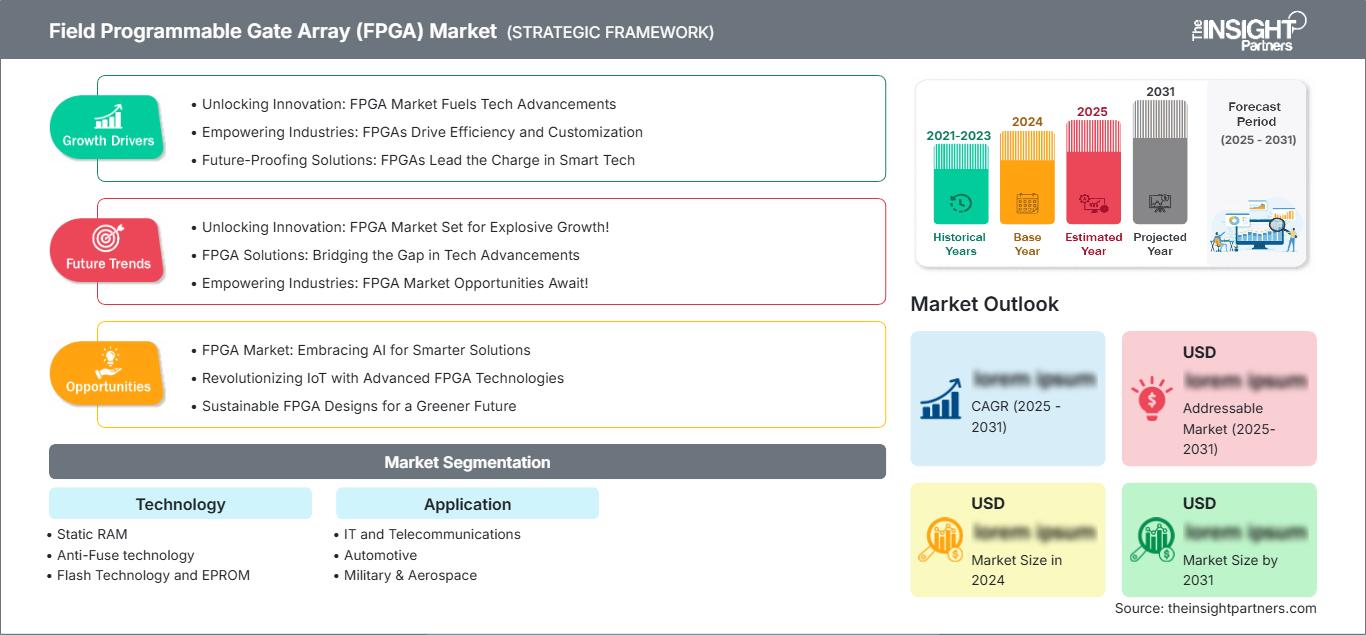
Field Programmable Gate Array (FPGA) Market: Strategic Insights
Regional Insights
North America Field Programmable Gate Array Market
The Field Programmable Gate Array Market share of North America in the global FPGA market in 2025 is around 28-31%, and the region is forecast to witness growth of CAGR ranging between 6-8% from 2024 to 2034. United States remains the key driver of demand in the region driven by strong presence of semiconductor players, construction of hyperscale data centers, and upgrades of defense electronics systems.
Drivers for the North American FPGA market include the adoption of artificial intelligence computing in cloud data centers, budget allocation from Department of Defense for FPGA based radar and electronic warfare systems, and 5G network infrastructure deployments demanding programmable baseband processing. Presence of key FPGA players in California, Oregon, and Massachusetts results in innovations in adaptive computing and high-level synthesis tools.
U.S. Field Programmable Gate Array Market
United States contributes to around 79% - 82% of the North America Field Programmable Gate Array market share by 2025, expanding at a CAGR between 5% - 7% during 2034. The domestic demand is being driven by investments made on hyperscale data centers over USD 50 billion per year, application in more than 40% of vehicles in automotive ADAS solutions, and military/aerospace segment requirements of FPGA in radar communication and electronic warfare system.
Presence of players is found mainly in Intel Corporation in California, Xilinx in California, and Altera Corporation in multiple states. Trend of application highlights growth in IT & telecommunication integration, where cloud services players integrate FPGA solutions for AI inference, video transcoding, and NFV in data centers. The military & aerospace applications are becoming secondary growth opportunities for radar signal processing, satellite communication, and UAV autopilot systems.
Europe Field Programmable Gate Array Market
The region of Europe accounts for 18 to 21 percent of the global share of Field Programmable Gate Arrays in 2025, growing at a CAGR rate of 6 to 8 percent till 2034. Germany is the leader of the regional market share with 34 to 37 percent of Europe share, owing to implementation of FPGAs by automotive original equipment manufacturers in ADAS and industrial automation makers in programmable logic in factory devices.
United Kingdom accounts for 19 to 22 percent of Europe share, with growth being propelled by investments in the telecommunications infrastructure and aerospace electronics manufacturing in defense and satellite projects. Together, France, Italy, and Spain account for 22 to 25 percent of Europe share, with growing demand in automotive electronics, industrial control system, and medical imaging applications.
APAC Field Programmable Gate Array Market
The Asia Pacific region holds around 45-48% of the global FPGA market share by 2025, estimated to expand at the highest rate of 8-10% CAGR during 2025 to 2034. The share is driven mainly by China, accounting for 42-45% of the APAC region, backed by local electronics manufacturing, growing 5G network infrastructure, and governmental initiatives for self-sufficiency in semiconductors and FPGA technology.
Japan, South Korea, India, and Australia together make up the rest of the demand in the APAC region. Japan and South Korea contribute through consumer electronics and FPGA application in automobiles, whereas India experiences fast-paced growth due to 5G network expansion and industrial automation projects. These are made possible due to Make in India policies, 5G spectrum allocation, and electronics manufacturing.
Middle East & Africa Field Programmable Gate Array Market
The Middle East & Africa region accounts for about 4 to 6% of global Field Programmable Gate Array market share in 2025 and is forecast to grow at a CAGR of 7-9% from 2025 to 2034. Countries like Saudi Arabia and UAE dominate MEA regional adoption, accounting for 52-55% of MEA share owing to applications in smart city projects, telecommunications infrastructure modernization, and procurement of defense electronics for military modernization programs.
South Africa contributes to 18-21% of MEA share, growing due to automation in mining applications and telecommunications networks. RoMEA (Rest of Middle East & Africa) nations see emerging opportunities in oil and gas exploration and telecommunications infrastructures. Energy & Infrastructure background includes investments made in 5G networks, smart cities, and increasing industrialization helping in adopting FPGAs in telecommunications, defense, and industrial automation applications.
Segmentation Analysis
Technology
The Technology segment is projected to grow at a CAGR range of 7–9% between 2026–2034. This segment encompasses Static RAM, Anti-Fuse technology, Flash Technology, and EPROM that determine FPGA configuration storage, reprogrammability, and suitability for different application requirements across telecommunications, automotive, and aerospace sectors.
- Static RAM – Static RAM commands 65–68% share in 2025, offering unlimited reprogrammability and highest logic density at advanced process nodes, particularly suited for high-performance computing and data center applications requiring frequent configuration updates.
- Anti-Fuse technology – Anti-Fuse technology represents 9–12% share in 2025, providing one-time programmable configuration with highest radiation tolerance and design security, exclusively used in space-grade and high-security military applications.
- Flash Technology – Flash Technology accounts for 19–22% share in 2025, delivering non-volatile configuration storage with instant-on capability and lower static power, preferred in industrial IoT and aerospace applications requiring persistent configuration through power cycles.
- EPROM – EPROM comprises 3–5% share in 2025, offering erasable programmable read-only memory configuration with moderate reprogrammability and radiation tolerance for legacy industrial and automotive applications requiring infrequent configuration updates.
Application
The Application segment is expected to expand at a CAGR range of 7–9% between 2026–2034. This segment includes IT and telecommunications, automotive, military and aerospace, healthcare, and consumer electronics where FPGAs enable reconfigurable computing and real-time signal processing for diverse operational requirements.
- IT and Telecommunications – IT and Telecommunications hold 38–41% share in 2025, with 5G deployment and hyperscale data center interconnects driving adoption in baseband processing, network function virtualization, and AI acceleration for cloud computing workloads.
- Automotive – Automotive represents 18–21% share in 2025, integrating FPGAs in advanced driver assistance systems, in-vehicle infotainment, and autonomous driving platforms requiring real-time sensor fusion and low-latency decision-making capabilities.
- Military and Aerospace – Military and Aerospace account for 20–23% share in 2025, deploying FPGAs in radar systems, electronic warfare, satellite communications, and avionics requiring radiation-hardened devices and high-reliability operation under extreme conditions.
- Healthcare – Healthcare comprises 10–13% share in 2025, utilizing FPGAs in medical imaging systems, patient monitoring devices, and surgical robots for real-time image processing and low-latency control loop execution in clinical environments.
- Consumer Electronics – Consumer Electronics represents 8–11% share in 2025, serving smart TVs, gaming consoles, and home automation systems with FPGAs enabling flexible protocol conversion and in-field firmware updates for evolving connectivity standards.
Opportunity Snapshot
Market Opportunity Snapshot
| Application | Revenue Contribution | Trend Tag | Adoption Stage |
|---|---|---|---|
| IT and Telecommunications | High | 5G Baseband | Scaling |
| Automotive | Medium | ADAS Integration | Scaling |
| Military and Aerospace | High | Electronic Warfare | Mature |
| Healthcare | Medium | Medical Imaging | Scaling |
| Consumer Electronics | Low | Smart Home | Emerging |
Field Programmable Gate Array (FPGA) Market Growth Drivers and Impact Analysis
5G Infrastructure and Network Function Virtualization
Global deployment of 5G networks creates substantial demand for Field Programmable Gate Array technology in baseband processing, network function virtualization, and edge computing applications. Telecommunications equipment manufacturers require FPGAs for software-defined radio implementations, massive MIMO beamforming, and network slicing that enable flexible, upgradeable base station architectures supporting multiple wireless standards. Industry estimates suggest over USD 50 billion invested annually in global 5G infrastructure as of 2025, with FPGAs specified in every base station's digital front-end and baseband processing units. This infrastructure expansion generates recurring revenue opportunities for FPGA suppliers throughout the network build-out and ongoing technology upgrade cycles.
Automotive ADAS and Autonomous Driving Development
Rapid advancement in advanced driver assistance systems and autonomous vehicle development accelerates FPGA adoption in automotive applications requiring real-time sensor fusion, image processing, and low-latency decision-making. Automotive manufacturers and Tier 1 suppliers prioritize FPGAs that enable flexible integration of cameras, radar, lidar, and ultrasonic sensors with centralized computing platforms for ADAS and autonomous driving functions. Xilinx and Intel have expanded automotive-grade FPGA offerings with integrated safety features meeting ISO 26262 ASIL requirements for functional safety in automotive applications. This trend creates opportunities for companies offering automotive-qualified FPGAs with extended temperature ranges, long-term supply commitments, and integration into centralized vehicle computing architectures.
Defense Electronics and Electronic Warfare Modernization
Growing investment in military-grade electronics for radar, electronic warfare, and secure communications drives FPGA demand in applications requiring radiation-hardened devices and high-reliability operation under extreme environmental conditions. Defense contractors and aerospace manufacturers prioritize FPGAs that maintain performance under shock, vibration, temperature extremes, and ionizing radiation encountered in military and space applications. Teledyne e2v and Microsemi Corporation have expanded radiation-hardened FPGA capabilities with space-grade RTAX and RTG4 families for satellite and deep-space missions requiring multi-year reliable operation. This trend generates multi-year contracts for FPGA suppliers supporting defense modernization programs across ground, air, sea, and space platforms.
Field Programmable Gate Array (FPGA) Market Future Trends
AI-Accelerated FPGA and Adaptive Computing Platforms
Field Programmable Gate Array Market Trends will increasingly leverage AI-accelerated architectures that integrate dedicated matrix multiplication engines and neural network accelerators within FPGA fabric for edge AI inference applications. AI-enhanced FPGAs enable real-time object detection, natural language processing, and predictive maintenance analytics at the edge without cloud dependency. Altera Corporation introduced Agilex 9 RF-series SoC FPGAs in 2026 with integrated AI accelerators optimized for radar signal processing and electronic warfare applications requiring real-time AI inference. This trend will reshape FPGA specifications and development tools as applications demand both programmable logic flexibility and AI acceleration performance previously available only in dedicated neural processing units.
High-Level Synthesis and Software-Defined Hardware
As software developers increasingly program FPGAs for data center acceleration and edge computing, high-level synthesis tools that translate C++, Python, and other high-level languages into hardware descriptions become critical for broadening FPGA accessibility. HLS-enabled development environments eliminate the need for deep hardware description language expertise, reducing development cycles from months to weeks. Intel Corporation and AMD have expanded HLS toolchains with AI-driven optimization algorithms that automatically balance performance, power, and area constraints for target applications. This integration will accelerate FPGA adoption in cost-sensitive segments where software development approaches face competition from fixed-function GPU and CPU alternatives.
Field Programmable Gate Array (FPGA) Market Opportunities
Edge Computing and Industrial IoT Deployment
Edge computing applications present significant opportunities for Field Programmable Gate Array Market Forecast deployment in factory automation, predictive maintenance, and industrial IoT platforms requiring real-time processing and low-latency decision-making. Industrial operators prioritize FPGAs that enable flexible integration of diverse sensors, actuators, and communication protocols within unified computing platforms for smart factory deployments. Lattice Semiconductor and QuickLogic Corporation have expanded low-power FPGA offerings with integrated edge AI capabilities for industrial IoT applications requiring battery-operated or energy-harvesting operation. This trend creates opportunities for companies offering industrial-grade FPGAs with extended temperature ranges, long-term supply commitments, and integration into Industry 4.0 automation platforms.
Satellite Communications and Space Exploration
Satellite communications and space exploration programs offer compelling opportunities for FPGA integration in applications requiring radiation-hardened devices and high-reliability operation under extreme space environmental conditions. Satellite manufacturers benefit from FPGAs that enable in-orbit reconfiguration, software-defined radio implementations, and adaptive payload processing for multi-mission satellite platforms. Teledyne e2v and Microsemi Corporation have demonstrated space-grade FPGA integration in satellite communication payloads with radiation tolerance exceeding 100 krad total ionizing dose for long-duration missions. Regulatory pathways for space qualification and multi-year supply agreements will shape commercialization timelines, but long-term market potential remains substantial as commercial satellite constellations and deep-space exploration missions proliferate.
Recent Developments
- June 2026: Altera Corporation announced the Agilex 9 Direct RF-Series SoC FPGA at the International Microwave Symposium, delivering industry-leading data converters and integrated RF capabilities for high-performance radar, electronic warfare, and advanced communications systems requiring real-time signal processing.
- April 2025: Intel Corporation announced the sale of 51% of Altera business to Silver Lake, valuing the FPGA leader at USD 8.75 billion and establishing Altera as the largest pure-play FPGA company with operational independence to drive innovation in AI, edge computing, and programmable solutions.
- February 2024: Intel launched Altera as a standalone FPGA company with Agilex 9 in volume production offering fastest data converters for radar and military-aerospace applications, Agilex 5 broadly available with AI-infused fabric, and Agilex 3 coming soon for low-power cloud and edge applications.
Frequently Asked Questions

- Comprehensive Market Sizing and Forecast Analysis
- Detailed Segmentation Analysis
- In-Depth Market Dynamics Assessment
- Regional and Country-Level Insights
- Competitive Landscape and Company Benchmarking
- Strategic Business Intelligence
Recent Reports
Testimonials

The Insight Partners' SCADA System Market report is comprehensive, with valuable insights on current trends and future forecasts. The team was highly professional, responsive, and supportive throughout. We are very satisfied and highly recommend their services.
RAN KEDEM Partner, Reali Technologies LTDs
I requested a report on a very specific software market and the team produced the report in a few days. The information was very relevant and well presented. I then requested some changes and additions to the report. The team was again very responsive and I got the final report in less than a week.
JEAN-HERVE JENN Chairman, Future Analytica
We worked with The Insight Partners for an important market study and forecast. They gave us clear insights into opportunities and risks, which helped shape our plans. Their research was easy to use and based on solid data. It helped us make smart, confident decisions. We highly recommend them.
PIYUSH NAGPAL Sr. Vice President, High Beam Global
The Insight Partners delivered insightful, well-structured market research with strong domain expertise. Their team was professional and responsive throughout. The user-friendly website made accessing industry reports seamless. We highly recommend them for reliable, high-quality research services
YUKIHIKO ADACHI CEO, Deep Blue, LLC.
This is the first time I have purchased a market report from The Insight Partners.While I was unsure at first, I visited their web site and felt more comfortable to take the risk and purchase a market report.I am completely satisfied with the quality of the report and customer service. I had several questions and comments with the initial report, but after a couple of dialogs over email with their analyst I believe I have a report that I can use as input to our strategic planning process.Thank you so much for taking the extra time and making this a positive experience.I will definitely recommend your service to others and you will be my first call when we need further market data.
JOHN SUZUKI President and Chief Executive Officer, Board Director, BK Technologies
I wish to appreciate your support and the professionalism you displayed in the course of attending to my request for information regarding to infectious disease IVD market in Nigeria. I appreciate your patience, your guidance, and the fact that you were willing to offer a discount, which eventually made it possible for us to close a deal. I look forward to engaging The Insight Partners in the future, all thanks to the impression you have created in me as a result of this first encounter.
DR CHIJIOKE ONYIA MANAGING DIRECTOR, PineCrest Healthcare Ltd.Reason to Buy
- Informed Decision-Making
- Understanding Market Dynamics
- Competitive Analysis
- Identifying Emerging Markets
- Customer Insights
- Market Forecasts
- Risk Mitigation
- Boosting Operational Efficiency
- Strategic Planning
- Investment Justification
- Tracking Industry Innovations
- Aligning with Regulatory Trends





 Get Free Sample for