
Filter Connectors Market Research Report by Size Share Analysis 2034
Coverage: By Product Type (Circular Connectors, Rectangular Connectors); Application (Consumer Electronics, Avionics Systems, Industrial, Others) , and Geography (North America, Europe, Asia Pacific, and South and Central America)
- Status : Data Released
- Report Code : TIPRE00021522
- Category : Electronics and Semiconductor
- No. of Pages : 150
- Available Report Formats :


- Last update date : September 09, 2026


2025 Market Size
US$ 3.54 Bn
Base year value
2034 Forecast
US$ 5.75 Bn
Projected by 2034
CAGR 2026-2034
5.58 %
Growth rate
Addressable Market
US$ 42.21 Bn
(2026-2034)
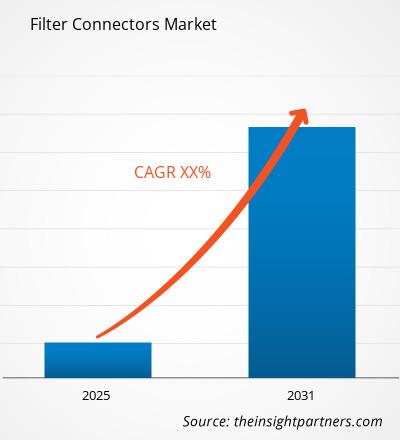
The Filter Connectors Market begins from a base of US$ 3.54 Billion in 2025 and is projected to reach US$ 5.75 Billion by 2034, registering a CAGR of 5.58% during 2026–2034. Expansion results from the growing demands on electromagnetic interference management, effective signal transmission, and durable interconnects in the aerospace, industrial, automotive, and electronic industries. The inclusion of the filtration process into connector systems is also assisting in simplifying circuit boards for device manufacturers and making their products more reliable.
In North America, the demand for Filter Connectors is forecasted to grow at around 5.8%-6.3% CAGR during the forecast period 2026-2034 due to the modernization process in aerospace and defense electronics procurement. The growth of the Filter Connectors Market is additionally affected by the increase in the content of avionics, increased standards of electromagnetic compatibility, and investments into automation in the industry.
Filter Connectors Market Assessment and Insights
- North America: North America is expected to retain a leading position, with a 2025 share of 37–41% and CAGR of 5.8–6.3% between 2026–2034, supported by aerospace, defense, industrial automation, and high-reliability electronics.
- US: The US is estimated to represent 78–82% of North American demand in 2025 and grow at a 5.9–6.4% CAGR between 2026–2034, led by defense electronics and avionics modernization.
- Europe: Europe is projected to account for 25–29% share in 2025 and grow at 5.1–5.7% CAGR through 2034. Germany, France, the UK, Italy, and Spain support demand through aerospace, automotive, industrial automation, and electronics manufacturing.
- Asia Pacific: Asia Pacific is estimated at 23–27% share in 2025 and is expected to register a 6.4–7.0% CAGR. China, Japan, South Korea, and India benefit from electronics production, automotive electrification, and industrial investment.
- Largest Segment: Circular Connectors are expected to hold a 43–47% market share in 2025, supported by mature aerospace and industrial use, with a 5.0–5.6% CAGR through 2034.
- High Growth Segment: Rectangular Connectors are estimated at 39–43% share in 2025 and are projected to achieve a 6.1–6.8% CAGR, driven by compact, high-density system architectures.
- Key companies analyzed in detail: Glenair, Amphenol ICC, TE Connectivity, Smiths Interconnect, Conesys, Molex, Cristek Inc., ITT Inc., Weald Electronics Ltd., Deltron AG.
Source: The Insight Partners' analysis based on proprietary research, government publications, company annual reports, investor presentations, industry databases, and expert interviews.
Connector architecture designs have moved from the simple physical connection to a designed assembly with the use of shielding, filters, environmental sealing, and stringent signal integrity performance. Ceramic capacitors, ferrites, conducting layers, and miniature filter networks are finding their way into connectors, mitigating parasitics and streamlining overall system design. Fabrication processes now involve machining, molding, electroplating, assembly automation, and validation testing.
Future investments are anticipated to be made in high density interconnections, application specific filtering, and localized manufacturing. New programs for the aerospace industry, industrial equipment automation, electric vehicles, and high-performance data processing equipment will generate demand beyond traditional military equipment. Awareness and regulatory requirements concerning EMC, hazardous materials, and environmental robustness will result in increased documentation of materials and attenuation performance.
Filter Connectors Market Report Scope
| Report Attribute | Details |
|---|---|
| Market size in 2025 | US$ 3.54 Billion |
| Market Size by 2034 | US$ 5.75 Billion |
| Global CAGR (2026 - 2034) | 5.58% |
| Historical Data | 2021-2024 |
| Forecast period | 2026-2034 |
Filter Connectors Market Analysis
Growth in the Filter Connectors Market has a strong correlation with the increasing component density in electronics and the demand for the prevention of conducted and radiated interference without having to incorporate additional filtering assemblies. Such requirements are found in the following sectors: aerospace & defense equipment, industrial controls, automotive electronics, communication equipment, and instruments. The value chain includes: conductive material, dielectric material, contact, shell, filters, assembly, testing, certification, and system integration.
Aerospace & defense have high specificity with respect to the demand from the customers since connector qualification may become an issue that impacts the selection of the supplier over long program duration. The industrial customers' main concern is about reliability, ease of installation, environmental considerations, and total maintenance cost. In light of this, it is beneficial to be able to machine, plate, process ceramic, assemble in an automatic way, and have qualification lab.
The Filter Connectors Market Report reveals a market structure that is moderately concentrated, where general connector product lines exist along with specialist providers who cater to highly regulated applications. Glenair and Smiths Interconnect concentrate on rugged connectors, whereas Amphenol ICC and TE Connectivity leverage their large range of connector product lines and engineering capabilities. Molex has an array of electronics connectors, while Conesys, Cristek Inc., ITT Inc., Weald Electronics Ltd., and Deltron AG provide specific connectors for select aerospace, defense, industrial, and high-reliability segments.
Strategic investments focus on customization capabilities, high frequency operations, miniaturization, and manufacturing flexibility. The larger players are able to leverage their existing connector lines by offering their filter capabilities, while the specialist vendors compete on engineering agility, qualification skills, and specific environmental requirements. The M&A activity within the entire connector industry highlights the importance of technology diversification, manufacturing footprint, and access to fast-growing electronics applications.
● REPORT CUSTOMIZATION
Tailor This Report To Align With Your Specific Business Requirements
This report can be customized to align precisely with your business objectives, scope, and target markets. Customization options include tailored segmentation, geography, competitive analysis, and strategic insights to support informed decision-making.
Customize This Report →WHAT YOU CAN ADJUST
- ● Segmentations
- ● Geography
- ● Competitive Analysis
- ● Language Preferences
Filter Connectors Market: Strategic Insights

Regional Insights
North America Filter Connectors Market
North America is expected to hold 37–41% Filter Connectors Market Share in 2025, recording a 5.8–6.3% CAGR up to 2034. There are many advantages for the region due to its active aerospace and defense electronics industry, extensive connector qualification infrastructure, and demand for rugged connectors. There are recurrent demands for EMI shielding, environmental sealing, and robust power and data transmission from US aircraft, defense, industrial, and communications programs.
There are also well-developed engineering competencies and longstanding relationships with aerospace and defense system integrators in the region. The country’s aerospace manufacturing and industrial electronics sector makes the contribution in Canada, and electronics and automotive manufacturing in Mexico. Reliability, local availability, long lifecycle, and compliance with environmental specifications become more significant procurement considerations. Those trends would help maintain the North American dominance but give Asia-Pacific an opportunity to narrow the regional growth gap.
U.S. Filter Connectors Market
The United States accounts for 78-82% of North America's market share in 2025 and is projected to witness a 5.9-6.4% CAGR up to 2034. Defense electronics, aircraft modernization, satellites, industrial controls, and advanced communication platforms are among the prominent applications driving the demand for the product. Companies with existing qualifications stand to gain from repeated demands and cycles of replacement of platforms.
There is a noticeable trend in the application side of reduced connectors that can offer increased signal density and improved protection against electromagnetic interference. Companies such as Glenair, Amphenol ICC, TE Connectivity, Smiths Interconnect, Molex, and ITT Inc. have significant relevance in aerospace, defense, industrial, and electronic applications. The domestic manufacturing focus in the United States offers a significant advantage to the US market.
Europe Filter Connectors Market
Europe is forecasted to make up 25-29% of global demand in 2025 and grow at 5.1-5.7% CAGR up until 2034. The leading demand is driven in Europe by Germany where automotive electronics and industrial automation are strong areas, with the aerospace and defense industry being represented by France and the UK.
For the UK market, the sources of demand will be aerospace engineering, defense electronics, and manufacturing with an emphasis on highly reliable equipment. Germany will be driven by automotive electronics, automation and industrial machines. The sources of demand in France will be aerospace, defense, and electronics while Italy and Spain will add automotive, industrial and transportation. Compliance, traceability, miniaturization, and reliability are essential to European purchasing.
APAC Filter Connectors Market
The APAC region is predicted to have 23-27% share in 2025 and a 6.4-7.0% CAGR during 2025-2034. The region is dominated by China in terms of size, Japan and South Korea for electronics expertise, India for growing via manufacturing localization, and Australia for military and resource-based end uses. Industrial automation and automotive electronics continue to be key market drivers.
Electronics manufacturing driven by policy support, defense localization, electric mobility, and industrial development create strong opportunities in the region. Electronic connector companies are also becoming closer to electronics and automobile clusters for faster lead times and engineering support. The APAC region thus becomes the most attractive geography for growth despite North America having a larger installed base and qualification infrastructure.
Middle East & Africa Filter Connectors Market
Middle East and Africa demand is expected to expand at a 4.6–5.2% CAGR through 2034. Saudi Arabia leads regional development, followed by the UAE, while South Africa remains an important industrial and defense market. Oil and gas infrastructure, energy projects, transportation systems, and defense modernization support requirements for durable interconnect technologies.
UAE gains from its investments in aviation, communication, and infrastructure while Saudi Arabia continues to develop its industry and defense sectors. South Africa makes its contributions in mining, industrial automation, and transport industry. RoMEA still faces a diversified demand pattern, yet energy infrastructure and localized manufacturing can provide a chance for robust connectors with environmental and electromagnetic protection.
Segmentation Analysis
Product Type
Product Type remains a fundamental segmentation dimension, with circular and rectangular architectures serving different mechanical, density, and installation requirements. Circular designs benefit from mature aerospace and industrial adoption, while rectangular formats increasingly address high-density configurations. The Product Type segment is projected to expand at a 5.3–6.0% CAGR through 2034. The Filter Connectors Market scope therefore includes both established rugged applications and newer compact architectures.
- Circular Connectors: Circular Connectors retain strong demand where environmental sealing, vibration resistance, and secure mating are priorities. Their established qualification base supports aerospace, defense, industrial machinery, and transportation applications requiring reliable operation under harsh conditions.
- Rectangular Connectors: Rectangular Connectors support high-density layouts and efficient packaging, making them strategically important for modular electronics, avionics, industrial controls, and equipment where space utilization and simplified system integration influence connector selection.
Application
Application demand is shaped by different performance requirements across Consumer Electronics, Avionics Systems, and Industrial environments. Avionics Systems remain an important high-reliability application because filtering can be integrated with rugged interconnection requirements. Consumer Electronics emphasize compactness and cost, while Industrial customers prioritize durability and predictable performance. Application demand is expected to grow at a 5.7–6.4% CAGR through 2034.
- Consumer Electronics: Consumer Electronics require compact filtering and reliable signal integrity as device functionality becomes denser. Adoption is influenced by miniaturization, higher operating frequencies, space constraints, and pressure to simplify board-level electromagnetic protection.
- Avionics Systems: Avionics Systems require highly reliable interconnects capable of maintaining signal integrity under vibration, temperature variation, and electromagnetic stress. Qualification requirements and long platform lifecycles make performance consistency strategically important.
- Industrial: Industrial applications emphasize robustness, serviceability, contamination resistance, and predictable electrical performance. Factory automation, instrumentation, motor controls, robotics, and connected machinery create recurring demand for filtered interconnection solutions.
Opportunity Snapshot
| Application | Revenue Contribution | Trend Tag | Adoption Stage |
|---|---|---|---|
| Consumer Electronics | Medium | Miniaturized EMI | Scaling |
| Avionics Systems | High | Rugged Avionics | Mature |
| Industrial | High | Factory Automation | Scaling |
Filter Connectors Market Growth Drivers and Impact Analysis
Rising Electronic Density Increases EMI Control Requirements
Higher electronic density is increasing the likelihood of unwanted electromagnetic coupling between power, control, communication, and sensing circuits. Filter connectors address this problem at the interconnection point, reducing the need for separate filtering components and helping equipment designers manage constrained board space. The impact is particularly relevant in avionics, industrial controls, defense electronics, and vehicle systems where malfunction caused by interference can create operational and safety consequences. As systems incorporate more processors, sensors, switching power electronics, and high-speed communications, connector specifications increasingly include attenuation, shielding, grounding, and signal-integrity requirements. This shift raises the engineering value of filtered connectors and encourages suppliers to offer application-specific configurations rather than standardized components alone. It also strengthens demand for qualified products capable of maintaining performance across temperature, vibration, moisture, and mechanical stress.
Aerospace and Defense Modernization Supports High-Reliability Demand
Aerospace and defense programs create structurally attractive demand because electronic systems must function under severe environmental and electromagnetic conditions. Modern aircraft, unmanned systems, radar equipment, communication platforms, and mission computers contain increasingly sophisticated electronics, creating more interfaces where interference control becomes necessary. Connector suppliers benefit when filtering, shielding, environmental sealing, and mechanical robustness can be integrated into a single qualified assembly. Long program cycles also create repeat business after initial design wins, although qualification requirements can extend adoption timelines. The market impact extends beyond new aircraft because avionics upgrades, communications modernization, and equipment replacement can require connector changes within existing platforms. Suppliers with established engineering documentation, testing capabilities, and aerospace relationships are therefore better positioned to capture specification-led demand. This driver also encourages continuous development of lighter, smaller, and higher-density connector architectures.
Industrial Automation Expands Demand for Reliable Interconnections
Industrial automation is increasing the number and complexity of electronic interfaces used in factories, warehouses, process plants, and machine-control systems. Robots, sensors, programmable controllers, variable-speed drives, industrial networks, and machine-vision equipment can generate or encounter electromagnetic noise that affects neighboring circuits. Filtered connectors provide a practical method for improving interface robustness without requiring extensive redesign of the surrounding electrical architecture. The resulting market impact is strongest where downtime has measurable operational costs and equipment operates in electrically noisy environments. Manufacturers are responding with connectors designed for vibration, dust, chemicals, moisture, and repeated maintenance cycles. As industrial facilities move toward connected production and more distributed intelligence, connector specifications are increasingly influenced by signal integrity and electromagnetic compatibility alongside conventional mechanical requirements. This creates opportunities for suppliers capable of combining filtering with modularity, field serviceability, and compact installation.
Filter Connectors Market Future Trends
Integration of Filtering With Higher-Speed Interconnect Architectures
Product developments in Filter Connectors Market Trends are likely to combine EMI suppression with higher-speed signal transmission in increasingly compact connector assemblies. Instead of treating filtering as a separate protective function, manufacturers are expected to integrate attenuation elements, shielding structures, grounding features, and high-frequency contact geometries within common connector platforms. This approach can reduce system footprint while limiting additional assembly operations. Demand should emerge across avionics, industrial communications, advanced vehicles, and electronic equipment where data rates continue rising. Product qualification will become more dependent on measured insertion loss, return loss, crosstalk, shielding effectiveness, thermal behavior, and environmental durability. Suppliers that can validate these characteristics across multiple configurations will have an advantage when customers seek platform-level standardization. The trend should also increase collaboration between connector engineers and system designers earlier in the product-development cycle.
Miniaturization and Custom Engineering Become Core Design Priorities
Miniaturization is expected to influence future connector development as equipment designers attempt to reduce weight, enclosure size, and wiring complexity without compromising electromagnetic protection. Smaller shells, finer contact pitches, compact filter elements, and optimized mounting configurations can support tighter packaging in avionics, industrial electronics, and portable equipment. Custom engineering will become more important because customers increasingly require connector dimensions, termination methods, filtering characteristics, and environmental performance tailored to specific system architectures. Digital design tools and faster prototyping can shorten development cycles and enable manufacturers to validate customized configurations before committing to larger production volumes. The commercial implication is a broader shift from catalog-based purchasing toward engineered interconnection solutions. Suppliers with flexible manufacturing, application engineering, and qualification capabilities should be better positioned as customers prioritize weight reduction, installation efficiency, and integration density.
Filter Connectors Market Opportunities
Localized Production for Aerospace and Industrial Supply Chains
Manufacturing localization presents an opportunity for connector suppliers in the Filter Connectors Market Forecast seeking stronger positions within aerospace, defense, and industrial supply chains. Customers increasingly value shorter lead times, regional engineering support, traceable materials, and reduced dependence on distant production networks for mission-critical components. Establishing or expanding regional assembly, machining, testing, and qualification capabilities can improve responsiveness while supporting customer-specific configurations. The opportunity is particularly relevant in North America, Europe, India, and selected Asia Pacific manufacturing clusters where aerospace and electronics investment is strengthening. Suppliers can combine localized production with common global connector platforms, allowing regional customization without creating completely separate product architectures. Investment decisions should focus on processes that require specialized capabilities, including precision machining, plating, filter integration, environmental testing, and automated inspection. Such localization can improve resilience while also strengthening customer relationships through faster technical support and qualification coordination.
Advanced Filtering Platforms for Emerging High-Density Electronics
Filter Connectors Forecasts point toward opportunities created by high-density electronic architectures in avionics, industrial communications, advanced transportation, and specialized computing equipment. Suppliers can target this opportunity by developing modular connector families that accommodate multiple filtering characteristics, termination methods, and mounting configurations without extensive redesign. Such platforms can lower customer engineering effort while enabling suppliers to address several applications from a common manufacturing base. Investment should prioritize compact filter technologies, improved shielding materials, high-frequency simulation, thermal management, and automated quality inspection. Customers are likely to favor solutions that provide measurable electromagnetic performance alongside mechanical reliability, particularly where system certification is expensive. Vendors can also develop engineering partnerships with equipment manufacturers to influence connector specifications earlier in the design cycle. This approach can create stronger qualification positions and increase the likelihood of recurring demand across product generations.
Recent Developments
- July 2026: Amphenol Corporation reported record second-quarter sales of US$8.8 billion, up 55% year over year, while completing acquisitions of El.Com and Wilder Technologies. The transactions expanded its interconnect capabilities across industrial, defense, aerospace, and high-speed digital applications, reinforcing a broader strategy of combining organic product development with targeted acquisitions.
- February 2026: Amphenol Corporation's Amphenol Socapex introduced SpaceVPX, a commercial off-the-shelf interconnect system designed for space applications. The connector platform was developed for extreme temperatures, radiation-exposed environments, vibration, shock, and stringent space qualification requirements, demonstrating continued investment in ruggedized interconnect architectures for demanding aerospace applications.
- February 2025: Molex launched a portfolio of more than 250 configurable EMI-filtered interconnect and RF component configurations for aerospace and defense applications. The portfolio included EMI-filtered D-Sub products, filter plates, circular connectors, RF attenuators, and terminations designed to improve signal integrity and electromagnetic compatibility in radar, avionics, navigation, and other mission-critical systems.
Frequently Asked Questions

- Comprehensive Market Sizing and Forecast Analysis
- Detailed Segmentation Analysis
- In-Depth Market Dynamics Assessment
- Regional and Country-Level Insights
- Competitive Landscape and Company Benchmarking
- Strategic Business Intelligence
Recent Reports
Testimonials

The Insight Partners' SCADA System Market report is comprehensive, with valuable insights on current trends and future forecasts. The team was highly professional, responsive, and supportive throughout. We are very satisfied and highly recommend their services.
RAN KEDEM Partner, Reali Technologies LTDs
I requested a report on a very specific software market and the team produced the report in a few days. The information was very relevant and well presented. I then requested some changes and additions to the report. The team was again very responsive and I got the final report in less than a week.
JEAN-HERVE JENN Chairman, Future Analytica
We worked with The Insight Partners for an important market study and forecast. They gave us clear insights into opportunities and risks, which helped shape our plans. Their research was easy to use and based on solid data. It helped us make smart, confident decisions. We highly recommend them.
PIYUSH NAGPAL Sr. Vice President, High Beam Global
The Insight Partners delivered insightful, well-structured market research with strong domain expertise. Their team was professional and responsive throughout. The user-friendly website made accessing industry reports seamless. We highly recommend them for reliable, high-quality research services
YUKIHIKO ADACHI CEO, Deep Blue, LLC.
This is the first time I have purchased a market report from The Insight Partners.While I was unsure at first, I visited their web site and felt more comfortable to take the risk and purchase a market report.I am completely satisfied with the quality of the report and customer service. I had several questions and comments with the initial report, but after a couple of dialogs over email with their analyst I believe I have a report that I can use as input to our strategic planning process.Thank you so much for taking the extra time and making this a positive experience.I will definitely recommend your service to others and you will be my first call when we need further market data.
JOHN SUZUKI President and Chief Executive Officer, Board Director, BK Technologies
I wish to appreciate your support and the professionalism you displayed in the course of attending to my request for information regarding to infectious disease IVD market in Nigeria. I appreciate your patience, your guidance, and the fact that you were willing to offer a discount, which eventually made it possible for us to close a deal. I look forward to engaging The Insight Partners in the future, all thanks to the impression you have created in me as a result of this first encounter.
DR CHIJIOKE ONYIA MANAGING DIRECTOR, PineCrest Healthcare Ltd.Reason to Buy
- Informed Decision-Making
- Understanding Market Dynamics
- Competitive Analysis
- Identifying Emerging Markets
- Customer Insights
- Market Forecasts
- Risk Mitigation
- Boosting Operational Efficiency
- Strategic Planning
- Investment Justification
- Tracking Industry Innovations
- Aligning with Regulatory Trends





 Get Free Sample for