
Filtration and Contamination Control Market Size, Growth & Demand by 2034
Coverage: by Filtration Type (Liquid Filtration, Air Filtration); Application (Engine, Industrial, Others) , and Geography (North America, Europe, Asia Pacific, and South and Central America)
- Status : Data Released
- Report Code : TIPRE00011661
- Category : Electronics and Semiconductor
- No. of Pages : 150
- Available Report Formats :


- Last update date : August 11, 2026


2025 Market Size
US$ 45.32 Bn
Base year value
2034 Forecast
US$ 78.74 Bn
Projected by 2034
CAGR 2026-2034
6.33 %
Growth rate
Addressable Market
US$ 561.37 Bn
(2026-2034)
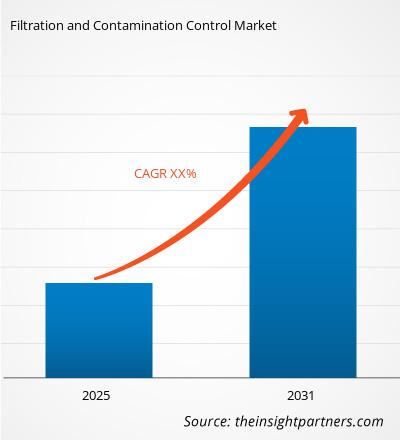
The Filtration and Contamination Control Market was valued at US$ 45.32 Billion in 2025 and is projected to reach US$ 78.74 Billion by 2034, registering a CAGR of 6.33% during 2026–2034. The demand for the product depends on the reliability of the machine, compliance with clean air requirements, quality of the hydraulic fluids, prevention of engine damage, and industrial manufacturing processes where contamination control is required.
North America Filtration and Contamination Control Market size is forecast to grow at a CAGR of 5.9-6.7% during 2026-2034, backed by industrial reshoring, high expectations for workplace air quality, and a significant base of off-highway, oil and gas, and power equipment. The replacement demand will continue to be robust since filters prevent damage and failure of pumps, turbines, compressors, engines, and HVAC systems.
Filtration and Contamination Control Market Assessment and Insights
- North America held 31–34% share in 2025 and is growing at a CAGR of 5.9–6.7% during 2026–2034, supported by manufacturing compliance, aftermarket maintenance, and energy-sector filtration demand.
- US represented 78–82% of North American revenue in 2025 and is growing at a CAGR of 6.0–6.8% during 2026–2034, led by heavy equipment, aerospace, food processing, and industrial plants.
- Europe accounted for 23–26% share in 2025 and is growing at a CAGR of 5.4–6.2% during 2026–2034, with Germany, the UK, France, Italy, and Spain leading adoption.
- Asia Pacific captured 30–33% share in 2025 and is growing at a CAGR of 7.0–7.8% during 2026–2034, led by China, India, Japan, South Korea, and Australia.
- Largest Segment Liquid Filtration held 56–60% market share in 2025 and is growing at a CAGR of 6.1–6.8% during 2026–2034 because fluid cleanliness directly affects equipment uptime.
- High Growth Segment Air Filtration represented 40–44% market share in 2025 and is growing at a CAGR of 6.8–7.6% during 2026–2034, supported by cleanrooms, dust collection, and emission control.
- Key companies analyzed in detail: American Air Filter Company, Inc.; Bry-Air (Asia) Private Limited; Camfil AB; Parker-Hannifin Corporation; Cummins Inc.; Donaldson Company, Inc.; Eaton Corporation plc; Filtration Group Corporation; MANN+HUMMEL International GmbH & Co. KG; Pall Corporation.
Source: The Insight Partners' analysis based on proprietary research, government publications, company annual reports, investor presentations, industry databases, and expert interviews.
Filtration systems have transitioned from being consumables in terms of maintenance to being indispensable for production processes owing to tighter manufacturing tolerances and the measurement of contamination-induced malfunctions. Media, nanofibers, electrostatic components, intelligent sensors, and pulse cleaning systems in dust collectors are revolutionizing production processes. The Market is now more inclined towards life cycle costs, replacement intervals, contaminant capacity, and compatibility with automated maintenance programs.
The future demand for filtration and control systems is expected to increase due to higher standards from users in industries like semiconductors, batteries, pharmaceuticals, food processing, construction, mining, and energy in terms of clean production environments. The regulation of particulate exposure, industrial emissions, effluent water, and indoor air quality also drives efficient filtration. Upgrading equipment in emerging markets is an area of focus.
Filtration and Contamination Control Market Report Scope
| Report Attribute | Details |
|---|---|
| Market size in 2025 | US$ 45.32 Billion |
| Market Size by 2034 | US$ 78.74 Billion |
| Global CAGR (2026 - 2034) | 6.33% |
| Historical Data | 2021-2024 |
| Forecast period | 2026-2034 |
Filtration and Contamination Control Market Analysis
The market is driven by increased utilization of industrial assets, stringent emission standards, reliable operation of fluid power system objectives, and need for clean process environments. WHO has estimated that air pollution results in 7 million early deaths per year. Increase in the manufacturing of clean energy as per IEA data will drive demand for filtration in batteries, hydrogen, and power.
Market value chain consists of filter media suppliers, membrane suppliers, filter housings suppliers, sensor suppliers, original equipment manufacturers, after-market distributors, maintenance providers, and end users. Factors affecting supply consist of quality of fiber media, pleating abilities, stainless steel housings, activated carbon availability, and distribution coverage. Industries require validated filtration that does not cause downtime.
The Filtration and Contamination Control Market Report reveals that the market is competitive, and there are diverse filtration companies competing against application specialists. Parker-Hannifin Corporation, Donaldson Company, Inc., Cummins Inc., Eaton Corporation plc, Camfil AB, and MANN+HUMMEL International GmbH & Co. KG focus on their global aftermarket presence, whereas Bry-Air (Asia) Private Limited and American Air Filter Company, Inc. target specific air quality requirements.
Investments are being made in high efficiency dust collectors, hydraulic filtration diagnostics, molecular contamination controls, water reuse systems, and replacement-oriented business model. The proposed acquisition of Filtration Group Corporation by Parker-Hannifin Corporation highlights the growing trend towards proprietary media and aftermarket sales. Strategic positioning is becoming more important based on validation data, installed base, digital monitoring, and dual OEM/ replacement market capability.
● REPORT CUSTOMIZATION
Tailor This Report To Align With Your Specific Business Requirements
This report can be customized to align precisely with your business objectives, scope, and target markets. Customization options include tailored segmentation, geography, competitive analysis, and strategic insights to support informed decision-making.
Customize This Report →WHAT YOU CAN ADJUST
- ● Segmentations
- ● Geography
- ● Competitive Analysis
- ● Language Preferences
Filtration and Contamination Control Market: Strategic Insights
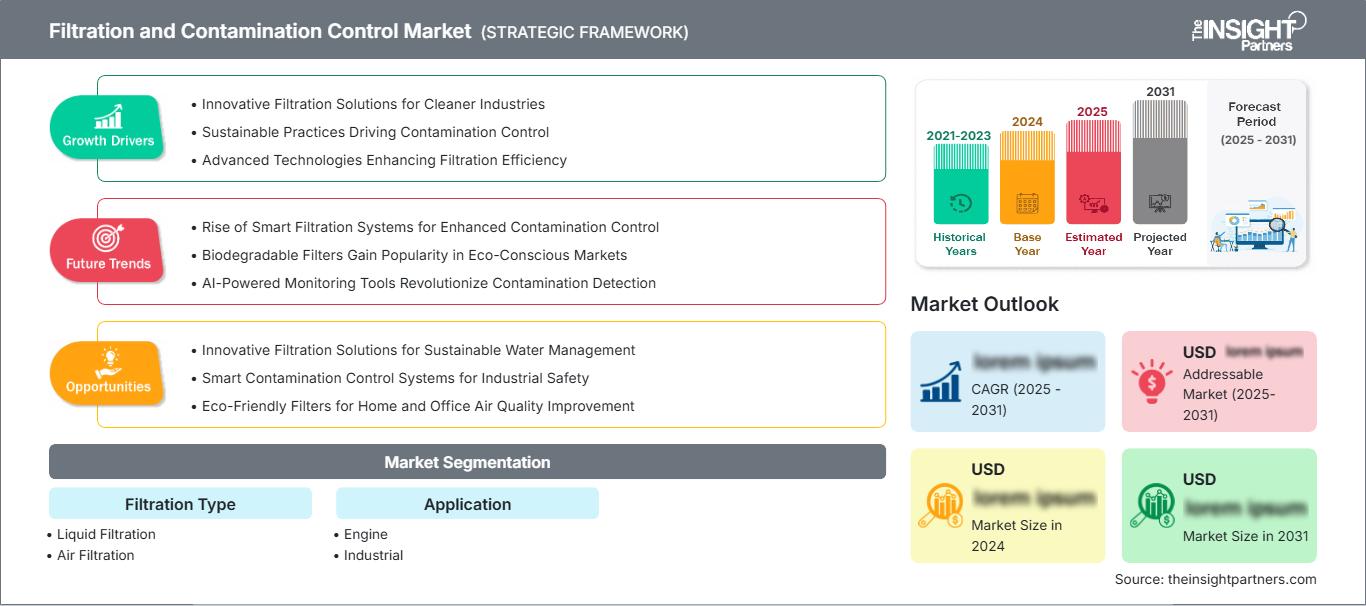
Regional Insights
North America Filtration and Contamination Control Market
North America held 31–34% of the Filtration and Contamination Control Market share in 2025 and is estimated to expand at a CAGR of 5.9–6.7% between 2026 and 2034. There is demand driven by EPA-compliant emissions requirements, OSHA workplace safety standards, advanced manufacturing processes, and equipment fleets that need hydraulic, engine, and dust filter controls.
North America will have well-established aftermarket infrastructure and good installed base in sectors such as construction, mining, agriculture, oil & gas, power generation, and food processing. Additionally, the market is aided by semiconductor fabrication facilities and battery plants that have contamination control needs in their cleanroom operations, process fluids, and compressed air.
U.S. Filtration and Contamination Control Market
The U.S. held 78% to 82% of North America's revenue in 2025 and is anticipated to grow at a CAGR of 6.0% to 6.8% from 2026 to 2034. Market demand includes the modernization of manufacturing, use of heavy machinery, shale production, aerospace manufacturing, quality requirements for pharmaceuticals, and food & beverages manufacturing.
Industry participants include Donaldson Company, Inc., Parker-Hannifin Corporation, Cummins Inc., Eaton Corporation plc, Pall Corporation, American Air Filter Company, Inc., and Filtration Group Corporation. The application areas include protection of engine intake, cleanliness of hydraulic fluid, industrial dust collection, molecular filtration, and contamination detection.
Europe Filtration and Contamination Control Market
In 2025, Europe accounted for 23-26% share and is expected to record growth at a CAGR of 5.4-6.2% between 2026 and 2034. Germany holds its position via its industries in automobiles, machinery, chemicals, and industrial automation. The UK will stimulate its demand via improvements in aerospace, healthcare, and food processing. France will sustain its high filtration activity in sectors of energy, transport, and pharmaceuticals.
Demand in Italy and Spain will be supplemented via industrial clusters, water treatment, cement, and industrial HVAC. Important regional vendors include Camfil AB and MANN+HUMMEL International GmbH & Co. KG. Policies stressing worker exposure and circular industrial production stimulate advanced filters and filter media life.
APAC Filtration and Contamination Control Market
APAC had 30-33% market share in 2025 and is expected to have a CAGR of 7.0-7.8% from 2026-2034. China dominates via manufacturing volumes, power generation, electronics, and industrial wastewater recycling, whereas Japan and South Korea provide support for ultra-pure filtration of semiconductors, batteries, and manufacturing processes.
India and Australia expand through infrastructure development, mining industry, pharmaceutical industry, and environmental regulations. Bry-Air (Asia) Private Limited is responsible for developing the capabilities of air treatment technology in the region. Industrial policies, export manufacturing, and urban air quality push factors contribute to the usage of dust collectors, HEPA filters, hydraulic filters, and liquid contamination prevention technologies.
Middle East & Africa Filtration and Contamination Control Market
The Middle East and Africa region is projected to grow at a CAGR of 6.2–7.0% during 2026–2034. Saudi Arabia leads through petrochemicals, desalination, mining, and giga-project construction, while the UAE supports demand from airports, data centers, district cooling, and premium indoor air-quality systems.
South Africa and Other Countries in MEA have filtration requirements in the mining industry, power industry, cement industry, food processing, and water infrastructures. Filtration of engines, turbines, compressors, and hydraulics is needed due to uptime in energy sector and tough dust environments.
Segmentation Analysis
Filtration Type
Filtration Type is projected to grow at a CAGR of 6.3–7.0% during 2026–2034. The Filtration and Contamination Control Market scope covers fluid cleanliness, airborne particulate capture, molecular contaminant control, and process-quality assurance. Adoption is shaped by contaminant type, loading rate, pressure drop, maintenance cost, and end-use risk tolerance across industrial, engine, HVAC, and cleanroom applications.
- Liquid Filtration holds the largest position because hydraulic oils, fuels, coolants, water, chemicals, and process liquids require particulate, moisture, and degradation-product removal to protect pumps, valves, engines, and product quality.
- Air Filtration is strategically important as factories, laboratories, cleanrooms, commercial buildings, and mobile equipment require dust, fume, microbial, odor, and molecular contaminant control for compliance and productivity.
Application
Application is forecast to grow at a CAGR of 6.5–7.2% during 2026–2034. Engine and industrial applications require different filtration economics. Engine systems prioritize compact designs, thermal stability, and high dirt-holding capacity, while industrial users emphasize continuous operation, clean process media, pressure-drop control, and predictive replacement schedules that reduce unplanned shutdowns.
- Engine applications depend on intake air, fuel, oil, crankcase ventilation, and coolant filters to protect combustion efficiency, emissions systems, and equipment life across vehicles and off-highway machinery.
- Industrial applications include dust collection, compressed-air treatment, hydraulic filtration, process-liquid purification, wastewater polishing, cleanrooms, and HVAC filtration where reliability and regulatory compliance are central purchasing factors.
Opportunity Snapshot
| Application | Revenue Contribution | Trend Tag | Adoption Stage |
| Engine | High | Uptime Protection | Mature |
| Industrial | High | Clean Production | Scaling |
Filtration and Contamination Control Market Growth Drivers and Impact Analysis
Equipment Reliability Priorities Increase Filter Replacement Discipline
Industrial operators increasingly treat contamination as a direct cost driver because particles, water, fumes, and chemical residues shorten asset life and reduce production yield. Hydraulic systems, engines, compressors, turbines, and precision manufacturing tools are especially sensitive to contamination-related wear. The market impact is stronger demand for higher-efficiency media, condition monitoring, and scheduled replacement programs. Suppliers that demonstrate lower total cost of ownership through longer service intervals, pressure-drop stability, and failure reduction can win premium contracts. This driver also supports aftermarket growth because installed equipment requires recurring filters even when new machinery investment slows.
Air Quality Compliance Raises Demand for Advanced Dust Control
Regulators and plant managers are intensifying focus on airborne particles, fumes, and process emissions across manufacturing, chemicals, pharmaceuticals, metals, and food processing. WHO’s air-pollution burden and occupational respiratory risks make industrial air management a board-level issue rather than a facility-only concern. The impact is rising adoption of HEPA filters, cartridge collectors, molecular filters, mist collectors, and real-time monitoring. Facilities with cleanrooms or sensitive products must also prevent cross-contamination. The Market benefits as users upgrade from basic dust capture to validated, energy-efficient systems with documented performance.
Industrial Modernization Expands High-Purity Process Requirements
New investment in semiconductors, batteries, pharmaceuticals, desalination, food safety, and hydrogen production increases the need for clean process fluids and controlled air environments. IEA reporting on clean-energy manufacturing expansion highlights how battery and hydrogen supply chains add filtration intensity through slurry handling, water treatment, gas purification, and equipment protection. The market impact is a shift toward application-engineered systems that combine membranes, cartridges, coalescers, adsorbents, and sensors. Suppliers able to validate performance under specific temperature, chemical, and particulate conditions will capture more value than commodity media vendors.
Filtration and Contamination Control Market Future Trends
Sensor-Enabled Filtration Becomes a Maintenance Standard
Filtration and Contamination Control Market trends point toward wider use of differential-pressure sensors, particle counters, oil-condition monitors, and connected dashboards that tell operators when filters are nearing performance limits. This shift will reduce unnecessary replacement while preventing failures caused by clogged or bypassing elements. Future procurement will increasingly compare filtration packages by data visibility, maintenance integration, cybersecurity readiness, and analytics quality. Suppliers that combine media expertise with monitoring platforms can strengthen service contracts and create recurring revenue beyond filter elements. Adoption will be fastest in plants where downtime costs exceed filter costs by a wide margin.
Sustainable Media and Lower Energy Designs Gain Priority
Filter buyers will increasingly evaluate environmental performance through pressure drop, energy consumption, service life, disposal volume, and recyclability. Air filtration systems with lower resistance can reduce fan energy, while longer-life liquid filters cut waste and maintenance visits. Future tenders in Europe, North America, and advanced Asian manufacturing hubs are likely to include sustainability metrics alongside efficiency ratings. Suppliers will respond with bio-based media, washable elements, modular housings, and designs that reduce compressed-air use in pulse-cleaning systems. This trend will favor engineering-led brands with measurable lifecycle data.
Filtration and Contamination Control Market Opportunities
Aftermarket Programs for Critical Industrial Equipment
Filtration and Contamination Control Market Forecasts support service-led aftermarket programs for fleets, factories, mines, and energy assets where recurring filter replacement is essential. Suppliers can bundle element supply, contamination audits, oil analysis, dust-collector inspections, and inventory management to reduce customer downtime. The opportunity is attractive because aftermarket demand remains linked to equipment operating hours rather than only new machinery sales. Distributors and OEM-aligned suppliers should prioritize installed-base mapping, digital reorder systems, and performance documentation. Customers will pay premiums when programs clearly reduce failures, extend component life, and simplify maintenance planning.
Clean Manufacturing Investments in Asia Pacific
Asia Pacific offers a strong investment opportunity as electronics, batteries, pharmaceuticals, automotive components, and food processing capacity expands. Suppliers should localize application engineering, build regional service centers, and certify products for demanding process environments. China, India, Japan, and South Korea require different channel strategies, but all reward filtration systems that improve yield, reduce contamination incidents, and meet export-quality expectations. Partnerships with EPC contractors, equipment OEMs, and industrial distributors can accelerate market access. The opportunity extends to air filtration, hydraulic filtration, process-liquid purification, and water reuse systems.
Recent Developments
- April 2026: DuPont (NYSE: DD) announced the launch of Inge ultrafiltration modules with integrated pre-filter (iP-F). Where conventional ultrafiltration plant processes require a separate pre-filtration manifold to remove debris and particulates, the integrated pre-filter offering combines pre-filtration and ultrafiltration into a single module housing—which can help reduce plant footprint and the associated capital and operational costs of standalone pre-filtration units.
- January 2026: Cleanova, a leading global manufacturer of advanced industrial filtration solutions owned by PX3 Partners, the London-headquartered private equity firm, announces today the strategic acquisitions of two U.S.-based companies: Airflotek and TES-Clean Air Systems. Founded in 1993, Airflotek designs and manufactures custom air filtration and controlled-environment systems used in state-of-the-art cleanroom environments worldwide, serving industries with exceptionally stringent air-quality requirements, including semiconductor manufacturing, biotechnology, and pharmaceuticals. Founded in 1986, TES-Clean Air Systems is the exclusive distributor of Airflotek products and brings decades of cleanroom and semiconductor application expertise, supporting a global customer base. These acquisitions give Cleanova immediate entry into ultra-clean, controlled environments critical to AI-driven semiconductor manufacturing, the rapid build-out of data centers and high-performance computing infrastructure, and aseptic pharmaceutical and biotechnology production, where reliability, performance, and contamination control are absolutely mission-critical.
- July 2025: Veolia launches the latest addition to its water filtration portfolio - the Hydrotech Cloth Filter: Confidence Series. Developed with a true focus on health and safety for the user, the new Confidence Series of filters from Hydrotech provide reliable performance and predictable operating costs all underpinned by robust mechanical features
Frequently Asked Questions

- Comprehensive Market Sizing and Forecast Analysis
- Detailed Segmentation Analysis
- In-Depth Market Dynamics Assessment
- Regional and Country-Level Insights
- Competitive Landscape and Company Benchmarking
- Strategic Business Intelligence
Recent Reports
Testimonials

The Insight Partners provided valuable market intelligence that supported our global go-to-market strategy. Their team was professional, responsive, and attentive to our feedback, providing thoughtful analysis and helpful methodological clarifications throughout the project.
Junmo Kim Chief Financial Officer (CFO), Enertech Co., Ltd.
The Insight Partners' SCADA System Market report is comprehensive, with valuable insights on current trends and future forecasts. The team was highly professional, responsive, and supportive throughout. We are very satisfied and highly recommend their services.
RAN KEDEM Partner, Reali Technologies LTDs
I requested a report on a very specific software market and the team produced the report in a few days. The information was very relevant and well presented. I then requested some changes and additions to the report. The team was again very responsive and I got the final report in less than a week.
JEAN-HERVE JENN Chairman, Future Analytica
We worked with The Insight Partners for an important market study and forecast. They gave us clear insights into opportunities and risks, which helped shape our plans. Their research was easy to use and based on solid data. It helped us make smart, confident decisions. We highly recommend them.
PIYUSH NAGPAL Sr. Vice President, High Beam Global
The Insight Partners delivered insightful, well-structured market research with strong domain expertise. Their team was professional and responsive throughout. The user-friendly website made accessing industry reports seamless. We highly recommend them for reliable, high-quality research services
YUKIHIKO ADACHI CEO, Deep Blue, LLC.
This is the first time I have purchased a market report from The Insight Partners.While I was unsure at first, I visited their web site and felt more comfortable to take the risk and purchase a market report.I am completely satisfied with the quality of the report and customer service. I had several questions and comments with the initial report, but after a couple of dialogs over email with their analyst I believe I have a report that I can use as input to our strategic planning process.Thank you so much for taking the extra time and making this a positive experience.I will definitely recommend your service to others and you will be my first call when we need further market data.
JOHN SUZUKI President and Chief Executive Officer, Board Director, BK Technologies
I wish to appreciate your support and the professionalism you displayed in the course of attending to my request for information regarding to infectious disease IVD market in Nigeria. I appreciate your patience, your guidance, and the fact that you were willing to offer a discount, which eventually made it possible for us to close a deal. I look forward to engaging The Insight Partners in the future, all thanks to the impression you have created in me as a result of this first encounter.
DR CHIJIOKE ONYIA MANAGING DIRECTOR, PineCrest Healthcare Ltd.Reason to Buy
- Informed Decision-Making
- Understanding Market Dynamics
- Competitive Analysis
- Identifying Emerging Markets
- Customer Insights
- Market Forecasts
- Risk Mitigation
- Boosting Operational Efficiency
- Strategic Planning
- Investment Justification
- Tracking Industry Innovations
- Aligning with Regulatory Trends





 Get Free Sample for