
Flare Monitoring Market Size, Share & Trends by 2034
Coverage: by Mounting Method (Remote Mounting and In Process Mounting); Connectivity (Wired and Wireless); Product Type (Pipe Flares, Steam Assisted Flares, Gas Assisted Flares, High Pressure Flares, Specialty Flares, Ring-Of-Fire Flares and Others); Industry (Oil & Gas, Petrochemical & Chemical, Industrial Sector, Iron & Steel, Landfills, Water Treatment and Others); and Geography (North America, Europe, Asia Pacific, and South and Central America)
- Status : Data Released
- Report Code : TIPRE00004801
- Category : Electronics and Semiconductor
- No. of Pages : 150
- Available Report Formats :


- Last update date : September 09, 2026


2025 Market Size
US$ 1.45 Bn
Base year value
2034 Forecast
US$ 2.98 Bn
Projected by 2034
CAGR 2026-2034
8.33 %
Growth rate
Addressable Market
US$ 19.89 Bn
(2026-2034)
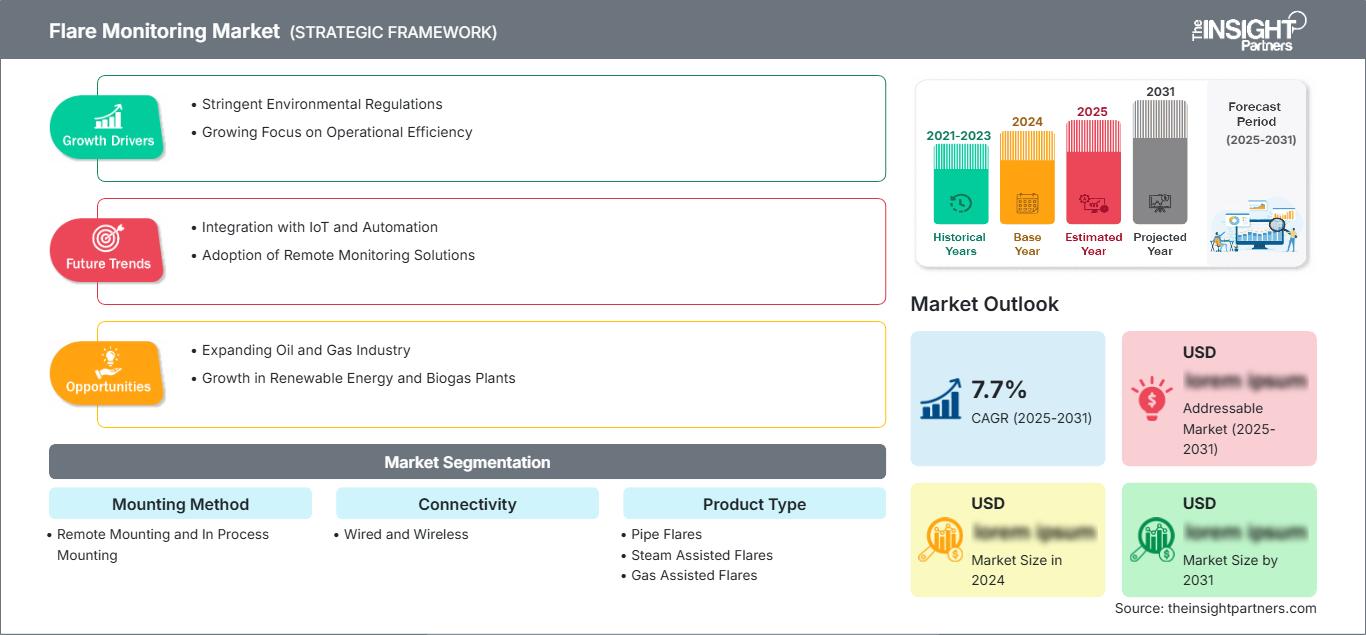
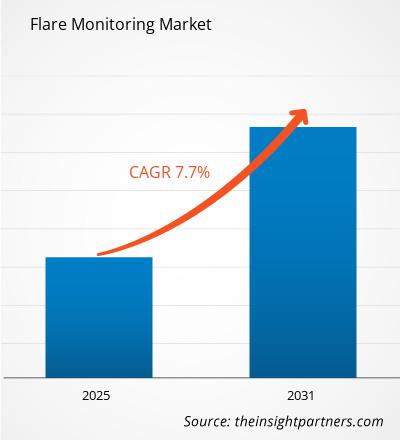
The global Flare Monitoring market was valued at US$ 1.45 billion in 2025 and is expected to reach US$ 2.98 billion by 2034; it is estimated to record a CAGR of 8.33% during 2026-2034.
Flare Monitoring Market Assessment and Insights
- North America: North America is estimated to hold a 31–35% Flare Monitoring Market share in 2025 and grow at an 8.5–10.0% CAGR between 2026–2034, supported by environmental compliance, refinery modernization, and continuous emissions measurement requirements.
- US: The US is estimated to represent 84–89% of North American revenue in 2025 and expand at an 8.0–9.5% CAGR through 2034, supported by federal flare-monitoring requirements.
- Europe: Europe is estimated at a 25–29% share in 2025 and a 8.0–9.5% CAGR during 2026–2034, with Germany, the UK, France, Italy, and Spain supported by refinery, chemical, and environmental-monitoring investments.
- Asia Pacific: Asia Pacific is estimated to command a 27–31% share in 2025 and grow at a 10.0–11.5% CAGR during 2026–2034, led by China, India, Japan, South Korea, and Australia.
- Largest Segment: Oil & Gas is estimated to hold a 48–53% market share in 2025 and expand at a 9.0–10.5% CAGR during 2026–2034, reflecting extensive flare infrastructure.
- High Growth Segment: Wireless Connectivity is estimated at a 16–21% market share in 2025 and is projected to grow at a 11.0–13.0% CAGR during 2026–2034.
- Key companies analyzed in detail: AMETEK, Inc., Emerson Electric Co., Endress+Hauser Management AG, Teledyne FLIR LLC, Fluenta AS, John Zink Company LLC, LumaSense Technologies, Inc., MKS Instruments, Inc., OleumTech Corporation, and Thermo Fisher Scientific Inc.
Source: The Insight Partners' analysis based on proprietary research, government publications, company annual reports, investor presentations, industry databases, and expert interviews.
Technology for Flare Monitoring Market has moved beyond the stage of regular inspections and isolated measurements of flows to constant, digitally connected monitoring. Ultrasonic flow measurement can cope with fast changes in velocity and composition of gas, and analyzers can offer real-time composition information for combustion and emission estimation. According to Endress+Hauser, flare conditions involve velocities up to 120 m/s, along with self-diagnostics, predictive maintenance, and digital verification for the modern measurement system.
The future implementation of such systems will need to be based on connected architecture able to deliver auditable information to the control, environmental and maintenance systems of the plant. According to the IEA, 150 billion cubic meters of natural gas are flared each year globally. There is a need for better measurement, monitoring, reporting, and verification to cut down emissions.
Flare Monitoring Market Report Scope
| Report Attribute | Details |
|---|---|
| Market size in 2025 | US$ 1.45 Billion |
| Market Size by 2034 | US$ 2.98 Billion |
| Global CAGR (2026 - 2034) | 8.33% |
| Historical Data | 2021-2024 |
| Forecast period | 2026-2034 |
Flare Monitoring Market Analysis
The Flare Monitoring Market report shows that development is now becoming increasingly dependent on environmental regulations, efficiency, and economical value of preventing unaccounted loss of hydrocarbons. The ecosystem encompasses technologies related to flare stack instrumentation, ultrasonic meters, gas analyzers, optical cameras, transmitters, wireless technologies, control technologies, engineering services and plant operation. High demand occurs when facility requires continuous monitoring of flare efficiency instead of manual periodic monitoring.
Vendor advantages occur if supplier integrates measurement equipment with analytical and control interface solutions. Flare gas is characterized by rapid changes in pressure, velocity, temperature and composition, thus creating challenging measurement environment. According to Endress+Hauser, applications include measurement of velocities from close to zero to 120 m/s and changing mixture, such as natural gas, hydrogen and carbon dioxide. These conditions create qualification challenges and favor companies that have capabilities of application engineering.
The Flare Monitoring Market analysis reveals that competition among participants is based on measurement accuracy, response time, suitability for hazardous areas, diagnostic capabilities, installation complexity and compatibility with existing control infrastructure. Emerson and AMETEK cover general requirements of process measurements, Endress+Hauser unites ultrasonic flare flow measurement with diagnostic capabilities, Fluenta specializes in ultrasonic flow measurements and gas emissions, John Zink Company LLC unites flare monitoring with combustion expertise.
The Flare Monitoring Market report shows that investments are shifting towards integrated solutions rather than individual devices. MKS Instruments, Inc. provides application-specific gas analysis for flare-stack streams, Thermo Fisher Scientific Inc. provides participation in industrial analytical instrumentation, OleumTech Corporation provides wireless industrial communication technologies. Teledyne FLIR LLC provides optical monitoring technologies, thus creating possibilities for multimodal architecture, which involves thermal or visual information alongside flow and gas composition measurements.
● REPORT CUSTOMIZATION
Tailor This Report To Align With Your Specific Business Requirements
This report can be customized to align precisely with your business objectives, scope, and target markets. Customization options include tailored segmentation, geography, competitive analysis, and strategic insights to support informed decision-making.
Customize This Report →WHAT YOU CAN ADJUST
- ● Segmentations
- ● Geography
- ● Competitive Analysis
- ● Language Preferences
Flare Monitoring Market: Strategic Insights
Regional Insights
North America Flare Monitoring Market
North America is estimated to account for 31–35% of global revenue in 2025 and is projected to expand at an 8.5–10.0% CAGR through 2034. The US is the dominant source of demand, owing to its refineries, natural gas treatment, petrochemical, and environmental compliance programs. Canada is represented through oil sands and upstream production. In the case of Mexico, there are opportunities for growth since the country's refining and industry are being upgraded.
Additionally, the region sees opportunities owing to the retrofit business due to the possibility of adding instruments to an existing flare system. Continuous monitoring may be used for documentation, optimization, and maintenance purposes. It should be noted that the EPA interim final rule in July 2025 did extend some of the compliance dates related to the operation of flares and combustion devices.
U.S. Flare Monitoring Market
The US is estimated to represent 84–89% of North American revenue in 2025 and is projected to grow at an 8.0–9.5% CAGR through 2034. Demand is concentrated in Texas, Louisiana, Oklahoma, California, and other industrial regions containing large refining, petrochemical, gas-processing, and upstream assets. Federal regulation is a major structural factor because applicable facilities must demonstrate flare operating conditions through defined measurement approaches.
AMETEK, Inc., Emerson Electric Co., MKS Instruments, Inc., Thermo Fisher Scientific Inc., and OleumTech Corporation have capabilities relevant to instrumentation, analytics, process control, or industrial connectivity. Application trends are shifting toward continuous measurement, automated alerts, remote diagnostics, and data integration. The combination of compliance requirements and brownfield modernization makes retrofit-friendly systems particularly relevant to US operators.
Europe Flare Monitoring Market
Europe is estimated to hold a 25–29% share in 2025 and is projected to grow at an 8.0–9.5% CAGR through 2034, with Germany serving as the leading country. There will always be demand in Germany, the UK, France, Italy, and Spain for reliable flare flow and emission measurements from refining and chemical clusters, and the expectation of environmental reporting will encourage the development of continuous measurement systems.
The UK has a strong presence in refining and chemicals, while Germany is a leading producer of petrochemicals and industrial measurement equipment. There is potential in France in refining and chemical facilities, while Italy and Spain generate demand from their Mediterranean refineries, petrochemical, and industrial clusters. Accuracy in measurement has become more important in these markets because of changing composition and high velocity of the gases, and this is recognized as a key challenge by Endress+Hauser.
APAC Flare Monitoring Market
APAC is estimated at a 27–31% share in 2025 and is projected to expand at a 10.0–11.5% CAGR through 2034. China leads, followed by India, Japan, South Korea, and Australia. Refinery additions, petrochemical capacity, gas processing, and industrial modernization are supporting instrumentation demand across established and emerging facilities.
China and India provide the largest expansion opportunities, while Japan and South Korea emphasize technologically advanced process control. Australia adds demand from LNG and resource projects. Regional investment increasingly favors connected measurement because operators require stronger environmental reporting and operational visibility. The IEA's methane work highlights the importance of measurement and abatement across oil and gas operations, reinforcing the strategic relevance of monitoring infrastructure.
Middle East & Africa Flare Monitoring Market
Middle East & Africa is projected to expand at a 9.0–11.0% CAGR through 2034, with Saudi Arabia leading regional demand, followed by the UAE and South Africa. Large hydrocarbon-processing assets and new industrial infrastructure support demand for continuous flare measurement, while energy-efficiency programs strengthen interest in reducing hydrocarbon losses.
Saudi Arabia and the UAE have substantial oil, gas, refining, and petrochemical infrastructure, whereas South Africa provides applications across refining and industrial facilities. Rest of MEA remains more fragmented, but LNG, gas processing, and industrial projects can create project-based opportunities. The IEA reports that flaring remains a significant source of lost gas globally, strengthening the economic case for measurement and abatement.
Segmentation Analysis
Mounting Method
Mounting Method comprises Remote Mounting and In Process Mounting. The segment is projected to grow at a 8.5–10.0% CAGR during 2026–2034. Remote configurations remain valuable where equipment must be isolated from harsh flare conditions, while in-process approaches support direct measurement and compact installation. Selection depends on temperature, pressure, accessibility, hazardous-area classification, maintenance strategy, and measurement accuracy.
- Remote Mounting: Remote Mounting supports applications where sensors or analyzers must be positioned away from extreme temperatures, vibration, or hazardous process conditions. It can simplify maintenance and protect sensitive instrumentation.
- In Process Mounting: In Process Mounting provides direct access to process conditions and can reduce measurement-path complexity. Its adoption depends strongly on instrument ruggedness, hazardous-area certification, temperature limits, and maintenance requirements.
Connectivity
Connectivity includes Wired and Wireless. The segment is forecast to expand at a 9.0–10.5% CAGR through 2034. Wired systems retain importance for deterministic plant communications and established control architectures, whereas wireless deployment is gaining relevance where long cable runs, difficult access, or retrofit constraints increase installation costs.
- Wired: Wired connectivity remains the established choice for critical process instrumentation because it provides predictable communication, established control-system compatibility, and continuous power availability in many fixed industrial installations.
- Wireless: Wireless connectivity supports remote assets and brownfield upgrades by reducing cabling requirements. It is particularly relevant where flare stacks are geographically dispersed or where new monitoring points must be added with minimal construction work.
Product Type
Product Type consists of Pipe Flares, Steam Assisted Flares, Gas Assisted Flares, High Pressure Flares, Specialty Flares, Ring-Of-Fire Flares and Others. The segment is projected to grow at a 8.8–10.2% CAGR through 2034, reflecting varied monitoring requirements across flare designs and operating regimes.
- Pipe Flares: Pipe Flares require monitoring suited to continuous or intermittent hydrocarbon combustion, with emphasis on flow measurement, operating stability, and environmental performance.
- Steam Assisted Flares: Steam Assisted Flares require coordinated monitoring of flare gas and steam because combustion conditions depend on the relationship between assist medium and waste-gas flow.
- Gas Assisted Flares: Gas Assisted Flares require accurate observation of assist-gas consumption and combustion conditions to support reliable operation and control operating costs.
- High Pressure Flares: High Pressure Flares operate under demanding velocity conditions, increasing the importance of fast-response measurement and instrumentation capable of maintaining accuracy during rapid process changes.
- Specialty Flares: Specialty Flares address application-specific combustion requirements and therefore favor configurable monitoring systems capable of accommodating unusual process conditions, compositions, or installation geometries.
- Ring-Of-Fire Flares: Ring-Of-Fire Flares can require distributed observation across larger combustion zones, increasing the importance of coordinated sensing and reliable plant-level data acquisition.
Industry
Industry includes Oil & Gas, Petrochemical & Chemical, Industrial Sector, Iron & Steel, Landfills, Water Treatment and Others. The segment is expected to expand at a 9.2–10.8% CAGR during 2026–2034. Oil and gas remains the core application base, while chemical, industrial, landfill, and wastewater operations broaden the addressable market.
- Oil & Gas: Oil & Gas represents the principal application base because upstream, midstream, refining, and gas-processing facilities use flares for controlled combustion during routine operations and process upsets.
- Petrochemical & Chemical: Petrochemical & Chemical plants require monitoring because complex gas mixtures and variable process conditions can affect combustion behavior, emissions reporting, and process optimization.
- Industrial Sector: Industrial Sector applications include facilities handling combustible process gases where monitoring can support environmental compliance, operational visibility, and maintenance planning.
- Iron & Steel: Iron & Steel facilities can use flare-related monitoring for combustible process-gas systems, particularly where integrated production processes create variable gas streams requiring controlled combustion.
- Landfills: Landfills generate methane-rich gas streams that may require controlled combustion, creating demand for monitoring technologies that track gas flow and support environmental management.
- Water Treatment: Water Treatment facilities can generate biogas and methane-containing streams, making flare monitoring relevant where gas is combusted rather than recovered or utilized.
Opportunity Snapshot
| Industry | Revenue Contribution | Trend Tag | Adoption Stage |
|---|---|---|---|
| Oil & Gas | High | Flare Compliance | Mature |
| Petrochemical & Chemical | High | Process Emissions | Scaling |
| Industrial Sector | Medium | Gas Control | Scaling |
| Iron & Steel | Medium | Process Gas | Scaling |
| Landfills | Medium | Methane Control | Scaling |
| Water Treatment | Low | Biogas Flaring | Emerging |
Flare Monitoring Market Growth Drivers and Impact Analysis
Stricter requirements for continuous flare performance measurement
Regulatory requirements are converting flare monitoring from a periodic operational activity into a continuous measurement function. In the US, EPA requirements address net heating value, flare-tip velocity, and inlet flow, requiring operators to maintain reliable measurement and compliance records. EPA The commercial impact extends beyond new installations because existing facilities need instrumentation capable of meeting evolving measurement requirements. Operators are consequently evaluating ultrasonic meters, gas analyzers, and connected data systems that can provide evidence of operating conditions. This favors vendors offering retrofit-compatible instruments and digital verification capabilities. Endress+Hauser's flare solution includes self-monitoring, verification functions, and predictive-maintenance capabilities, illustrating how compliance requirements can increase demand for instrumentation with embedded diagnostics rather than basic measurement alone.
Economic pressure to reduce wasted hydrocarbon resources
Flare monitoring has a direct economic dimension because accurate measurement can identify the quantity and composition of gas being combusted rather than recovered or utilized. The IEA estimates that about 150 billion cubic metres of natural gas is flared globally each year, with much of the activity classified as routine rather than emergency flaring. Better measurement can help operators identify abnormal flaring, evaluate recovery projects, and improve process-control decisions. The commercial effect is particularly relevant where gas prices, carbon costs, or production targets make lost hydrocarbons economically material. Monitoring suppliers can therefore position systems around both environmental compliance and operational optimization, increasing the justification for capital expenditure in facilities where emissions reduction and resource efficiency are evaluated together.
Expansion of digital monitoring and remote asset management
Industrial operators are increasingly connecting field instrumentation to centralized control and asset-management platforms. Flare stacks are often located in difficult-to-access areas, making remote diagnostics and automated data transfer valuable for reducing inspection requirements and improving response times. Endress+Hauser highlights self-diagnosis, verification, and predictive-maintenance functions in its current flare-flow architecture. Wireless connectivity can further reduce cabling requirements during brownfield upgrades, while analytics can transform raw flow and composition measurements into maintenance or compliance indicators. The impact is a gradual increase in system value per installation, because customers increasingly assess connectivity, diagnostics, cybersecurity, and data usability alongside sensor accuracy. Vendors able to integrate these capabilities should capture a greater portion of project spending.
Flare Monitoring Market Future Trends
Integration of emissions measurement with digital plant twins
Flare Monitoring Market trends are expected to move toward digital representations of flare systems that combine real-time flow, composition, pressure, temperature, combustion, and maintenance information. Such systems could compare measured behavior with operating models to identify abnormal flaring, instrument drift, or changing combustion conditions. Integration with digital twins would also allow operators to evaluate flare performance against production schedules and process disturbances. Artificial intelligence can assist by identifying patterns that precede excessive flaring or maintenance events. Over time, this architecture should shift monitoring from compliance documentation toward predictive operational management. The commercial opportunity will favor suppliers capable of connecting field devices, analytics software, and plant-control systems without requiring operators to replace established automation platforms.
Greater use of multimodal optical and process sensing
Future systems are likely to combine optical observation with direct process measurements to improve visibility into flare performance. Thermal imaging can provide information about flame behavior, while ultrasonic flow measurement establishes the quantity of gas reaching the flare and analyzers characterize composition. Combining these data streams can create a more complete assessment than any single instrument. Multimodal architectures may become especially useful where flare visibility is affected by weather, changing combustion patterns, or complex process conditions. The approach can also support remote operator interfaces by converting visual and process measurements into coordinated alerts. As sensor costs decline and industrial networks become more capable, integrated monitoring packages should become increasingly practical for large refineries, chemical plants, gas-processing facilities, and other continuous-process operations.
Flare Monitoring Market Opportunities
Retrofit packages for aging refinery and petrochemical assets
A major investment opportunity lies in standardized retrofit packages designed for operating facilities with aging flare instrumentation. Many plants can improve measurement capability without replacing the flare structure itself by installing modern ultrasonic flowmeters, gas analyzers, wireless transmitters, or digital gateways. Vendors should prioritize compact installation, hazardous-area certification, minimal process interruption, and compatibility with legacy control systems. Retrofit packages can also bundle commissioning, calibration, diagnostics, and compliance reporting to create recurring service opportunities. Flare Monitoring Market Forecasts should therefore account for replacement-driven spending alongside greenfield projects. Suppliers that develop modular architectures for different flare geometries can shorten engineering cycles and improve scalability across refinery groups with multiple facilities.
Integrated flare intelligence for emissions and operational optimization
Investors can target integrated platforms that convert flare measurements into actionable operating intelligence. Rather than selling separate flowmeters and analyzers, suppliers can combine measurement, historian integration, alarms, performance dashboards, and emissions calculations into one service layer. Such platforms can help operators distinguish routine flaring from process disturbances, identify abnormal gas compositions, and prioritize maintenance. The IEA's emphasis on robust measurement, monitoring, reporting, and verification reinforces the importance of reliable data infrastructure for methane reduction programs. Commercial models could include software subscriptions, analytics services, remote diagnostics, and periodic verification, creating revenue streams beyond the initial instrument sale and improving customer retention through ongoing operational support.
Recent Developments
- May 2026: IONODES highlighted the use of its Secure Display Stations for continuous monitoring of flare stacks at oil and gas facilities, where flares safely burn excess or hazardous gases during startups, shutdowns, maintenance and unexpected process upsets. The solution enables live video feeds of flare activity to remain continuously visible on dedicated screens in control rooms and other secure locations, eliminating the need for operators to log into software or switch between systems to check flare conditions.
- April 2026: Endava partnered with Flare to strengthen clients’ cybersecurity posture and deliver managed threat intelligence services, combining Endava’s cyber threat intelligence expertise with Flare’s Threat Exposure Management platform. The collaboration provides organisations with enhanced visibility into external cyber risks through real-time dark web monitoring, enriched threat intelligence and proactive risk detection, enabling security teams to identify, prioritise and respond to emerging threats faster.
- March 2026: Flare launched Foretrace, a business-to-business-to-employee (B2B2E) identity protection product designed to give employees real-time visibility into personal digital identity exposures and tools to remediate them. Built on Flare’s threat intelligence infrastructure, the solution monitors data from approximately 100 million stealer logs, more than 57,000 Telegram channels and roughly 20 billion leaked credentials, providing exposure intelligence from sources used by attackers for account takeovers and social engineering.
Frequently Asked Questions

- Comprehensive Market Sizing and Forecast Analysis
- Detailed Segmentation Analysis
- In-Depth Market Dynamics Assessment
- Regional and Country-Level Insights
- Competitive Landscape and Company Benchmarking
- Strategic Business Intelligence
Recent Reports
Testimonials

The Insight Partners provided valuable market intelligence that supported our global go-to-market strategy. Their team was professional, responsive, and attentive to our feedback, providing thoughtful analysis and helpful methodological clarifications throughout the project.
Junmo Kim Chief Financial Officer (CFO), Enertech Co., Ltd.
The Insight Partners' SCADA System Market report is comprehensive, with valuable insights on current trends and future forecasts. The team was highly professional, responsive, and supportive throughout. We are very satisfied and highly recommend their services.
RAN KEDEM Partner, Reali Technologies LTDs
I requested a report on a very specific software market and the team produced the report in a few days. The information was very relevant and well presented. I then requested some changes and additions to the report. The team was again very responsive and I got the final report in less than a week.
JEAN-HERVE JENN Chairman, Future Analytica
We worked with The Insight Partners for an important market study and forecast. They gave us clear insights into opportunities and risks, which helped shape our plans. Their research was easy to use and based on solid data. It helped us make smart, confident decisions. We highly recommend them.
PIYUSH NAGPAL Sr. Vice President, High Beam Global
The Insight Partners delivered insightful, well-structured market research with strong domain expertise. Their team was professional and responsive throughout. The user-friendly website made accessing industry reports seamless. We highly recommend them for reliable, high-quality research services
YUKIHIKO ADACHI CEO, Deep Blue, LLC.
This is the first time I have purchased a market report from The Insight Partners.While I was unsure at first, I visited their web site and felt more comfortable to take the risk and purchase a market report.I am completely satisfied with the quality of the report and customer service. I had several questions and comments with the initial report, but after a couple of dialogs over email with their analyst I believe I have a report that I can use as input to our strategic planning process.Thank you so much for taking the extra time and making this a positive experience.I will definitely recommend your service to others and you will be my first call when we need further market data.
JOHN SUZUKI President and Chief Executive Officer, Board Director, BK Technologies
I wish to appreciate your support and the professionalism you displayed in the course of attending to my request for information regarding to infectious disease IVD market in Nigeria. I appreciate your patience, your guidance, and the fact that you were willing to offer a discount, which eventually made it possible for us to close a deal. I look forward to engaging The Insight Partners in the future, all thanks to the impression you have created in me as a result of this first encounter.
DR CHIJIOKE ONYIA MANAGING DIRECTOR, PineCrest Healthcare Ltd.Reason to Buy
- Informed Decision-Making
- Understanding Market Dynamics
- Competitive Analysis
- Identifying Emerging Markets
- Customer Insights
- Market Forecasts
- Risk Mitigation
- Boosting Operational Efficiency
- Strategic Planning
- Investment Justification
- Tracking Industry Innovations
- Aligning with Regulatory Trends





 Get Free Sample for