
Flash Point Tester Market Growth, Size, Share, Trends, Key Players Analysis, and Forecast till 2034
Coverage: by Type (Open Cup Flash Point Tester and Closed Cup Flash Point Tester); and Applications (Petrochemical, Consumer Chemical, Waste Disposal, Chemical & Solvents and Others), and Geography (North America, Europe, Asia Pacific, and South and Central America)
- Status : Data Released
- Report Code : TIPTE100001029
- Category : Electronics and Semiconductor
- No. of Pages : 150
- Available Report Formats :


- Last update date : September 09, 2026


2025 Market Size
US$ 1.08 Bn
Base year value
2034 Forecast
US$ 1.94 Bn
Projected by 2034
CAGR 2026-2034
6.72 %
Growth rate
Addressable Market
US$ 13.65 Bn
(2026-2034)
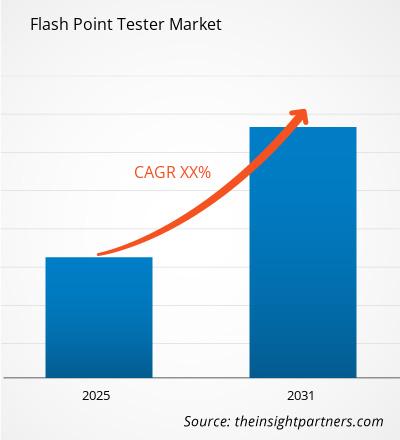
The global Flash Point Tester market was valued at US$ 1.08 billion in 2025 and is expected to reach US$ 1.94 billion by 2034; it is estimated to record a CAGR of 6.72% during 2026-2034.
Flash Point Tester Market Assessment and Insights
- North America: North America is estimated to hold 27–31% Flash Point Tester Market share in 2025 and grow at a 4.5–5.0% CAGR between 2026–2034, supported by mature petroleum laboratories, chemical safety testing, equipment replacement, and automation.
- US: The US is estimated to represent 76–80% of North American revenue in 2025 and grow at a 4.6–5.1% CAGR during 2026–2034, supported by refinery, chemical, and independent laboratory testing.
- Europe: Europe is projected to account for 24–28% share in 2025 and expand at a 4.3–4.8% CAGR through 2034, led by Germany, the UK, France, Italy, and Spain through laboratory modernization and chemical-safety testing.
- Asia Pacific: Asia Pacific is estimated at 29–33% share in 2025 and is projected to grow at a 5.5–6.1% CAGR between 2026–2034, led by China, Japan, South Korea, India, and Australia.
- Largest Segment: Closed Cup Flash Point Tester holds an estimated 58–62% market share in 2025 and is projected to grow at a 5.1–5.6% CAGR through 2034, reflecting broad petroleum and chemical applications.
- High Growth Segment: Consumer Chemical applications represent an estimated 21–25% market share in 2025 and are projected to grow at a 5.4–5.9% CAGR through 2034, supported by expanding product-safety testing.
- Key companies analyzed in detail: Anton Paar GmbH, Eralytics GmbH, AMETEK Inc., Koehler Instrument Company, Inc., Normalab France S.A.S, Labtron Equipment Ltd, Elcometer Limited, PAC, Seta, TIMEPOWER.
Source: The Insight Partners' analysis based on proprietary research, government publications, company annual reports, investor presentations, industry databases, and expert interviews.
Flash Point Tester market has seen a move from manual temperature controls and ignition to automation in temperature control, use of optical or electrical devices for flash point detection, safety systems, and result management through electronics. Recent devices will also allow for multiple tests according to different standards with minimal manual interference and faster processing of tests. Manufacturing of the Flash Point Testers has concentrated on standardized parts, specific designs for each method, calibration abilities, and conformance with standards for petroleum and chemicals.
In the future, more automated instruments that ensure both safety of process and digital documentation of the results will be demanded. The Asia Pacific region has good potential for taking additional capacities as the refining industry, chemical processes, and industries are developed in the region. Investments in the renewable fuels, blended fuels, specialty chemicals, and waste-based products will add diversity in testing samples.
Flash Point Tester Market Report Scope
| Report Attribute | Details |
|---|---|
| Market size in 2025 | US$ 1.08 Billion |
| Market Size by 2034 | US$ 1.94 Billion |
| Global CAGR (2026 - 2034) | 6.72% |
| Historical Data | 2021-2024 |
| Forecast period | 2026-2034 |
Flash Point Tester Market Analysis
The demand for Flash Point Tester Market products is created due to the need to measure properties of combustible liquids in a laboratory setting. ASTM standards such as D92 and D93 continue to be important standard procedures for testing petroleum products, while D56, ISO 2719 and ISO 13736 cover other types of liquids. Value chain actors include instrument makers, component suppliers, calibration services, laboratories, refineries, chemical producers, distribution companies, and testing agencies.
In addition, factors influencing the market ecosystem include type of sample, range of temperatures needed, test volume, degree of automation, and relevant standards. Open-cup apparatus continues to play an important role in testing of certain petroleum products and liquids with higher flash point, while closed-cup apparatus is used in most cases requiring control over vapor accumulation and ignition. Competition on the market comes down to temperature stability, repeat-ability, fire resistance, method capabilities, software, serviceability, and standards support.
Competitive positioning on the Flash Point Tester Market has become increasingly based not on hardware alone but on analytical product portfolio. Anton Paar GmbH integrates flash point instruments into larger range of laboratory measurement devices, and AMETEK Inc. is represented in the market through Koehler Instrument Company, Inc. activities. PAC provides automated flash point instruments for petroleum laboratories, and Normalab France S.A.S. sells instruments covering Cleveland, Pensky-Martens, Abel and related methods.
Eralytics GmbH, Labtron Equipment Ltd., Elcometer Limited, Seta and TIMEPOWER act as specialist competitors using regional and application-specific approaches. Investments in the industry increasingly go into automation, flexibility of methods, smaller sample size, digital traceability, and safer ignition techniques. Competition is therefore based on capability of combining measurement accuracy with laboratory process improvement.
● REPORT CUSTOMIZATION
Tailor This Report To Align With Your Specific Business Requirements
This report can be customized to align precisely with your business objectives, scope, and target markets. Customization options include tailored segmentation, geography, competitive analysis, and strategic insights to support informed decision-making.
Customize This Report →WHAT YOU CAN ADJUST
- ● Segmentations
- ● Geography
- ● Competitive Analysis
- ● Language Preferences
Flash Point Tester Market: Strategic Insights

Regional Insights
North America Flash Point Tester Market
North America is estimated to hold 27–31% of global revenue in 2025 and is projected to grow at a 4.5–5.0% CAGR through 2034. The US dominates as the regional market due to petroleum refining, testing of lubricants, chemical manufacture, fuel testing in aviation and independent laboratories. The contribution from Canada arises from energy, fuels, mining chemicals, and industrial testing. Mature laboratories will be a source of recurring replacement needs as old manual machinery is replaced with automated equipment with better temperature control and reporting capabilities. Safety protocols for combustible liquids further promote standardization of laboratory procedures.
ASTM procedure utilization across petroleum and chemical testing increases US demand. Automated machinery is increasingly appealing where laboratories handle many samples, with the need for consistent results regardless of shifts. Other products include specialty chemicals, fuels, paints, and solvents. The suppliers differentiate on procedure coverage, calibration, serviceability, safety considerations, and compatibility with laboratory processes.
U.S. Flash Point Tester Market Market
The US accounts for an estimated 76–80% of North American revenue in 2025 and is projected to grow at a 4.6–5.1% CAGR through 2034. Key vendors ensure an established market base in refinery laboratories, external test labs, chemical plants, and research organizations. The closed cup method is more useful for petroleum products, fuels, solvents, and chemicals that need control of vapors.
Needs for application include standard quality control, product specification tests, transport categorization, and contamination testing. Repeatability is important in refineries and lubricants manufacturing companies, whereas flexibility in terms of temperatures and methodology is important in chemical laboratories. Equipment upgrade is recommended in cases where manual methods cannot be easily maintained or electronic record is necessary.
Europe Flash Point Tester Market
Europe is estimated to represent 24–28% share in 2025 and is projected to grow at a 4.3–4.8% CAGR through 2034, with Germany expected to remain a leading national market. The United Kingdom and Germany have a very capable laboratory and industrial testing industry, while France, Italy, and Spain offer additional demand for petroleum, chemicals, transport, and manufacturing sectors. The purchasing process in Europe is characterized by its focus on standards compliance, repeatability, documentation, and product lifecycle.
United Kingdom can utilize existing petroleum laboratories and testing facilities, which generate demand for testing of fuels, lubricants, solvents, and chemical products. Germany has a very strong industrial sector, which requires applications for chemicals, automotive products, energy, and laboratories. France, Italy, and Spain offer demand from refinery, specialty chemicals, manufacturing, and environmental testing sectors. Regional laboratories tend to favor automated systems, which decrease operator variability and make it easier to manage results digitally.
APAC Flash Point Tester Market
APAC is estimated to hold 29–33% Flash Point Tester Market in 2025 and is projected to grow at a 5.5–6.1% CAGR through 2034. China is expected to lead regional demand, followed by Japan, South Korea, India, and Australia. Refining capacity, chemical manufacturing, industrial expansion, and laboratory modernization support equipment adoption.
The Flash Point Tester Market report shows that China benefits from its large industrial and chemical base, while Japan and South Korea emphasize precision and established quality systems. India is supported by expanding refining, chemicals, and laboratory infrastructure, and Australia contributes through resources and energy testing. Policy emphasis on industrial safety and fuel quality should encourage standardized instrumentation.
Middle East & Africa Flash Point Tester Market Market
Middle East and Africa Flash Point Tester Market is supported by refining, petrochemicals, lubricants, aviation fuels, industrial chemicals, and infrastructure development. Saudi Arabia and the UAE represent leading markets, while South Africa provides an established laboratory base. The region is projected to grow at a 5.0–5.6% CAGR through 2034, with energy-sector testing remaining a major demand source.
Saudi Arabia benefits from refinery and petrochemical investment, while the UAE combines energy, aviation, logistics, and trading activity. South Africa contributes through mining, chemicals, fuels, and independent laboratories. The rest of MEA remains more project-driven, with industrial development and energy infrastructure creating opportunities for robust automated testing systems and localized technical support.
Segmentation Analysis
Type
Flash Point Tester Market scope by type is determined by sample volatility, applicable standards, petroleum-product characteristics, laboratory workflow, and safety requirements. Open-cup instruments remain important for specific petroleum and high-temperature applications, while closed-cup systems offer controlled vapor conditions and broad applicability across combustible liquids. Open Cup Flash Point Tester systems are projected to grow at a 4.3–4.8% CAGR during 2026–2034, while Closed Cup Flash Point Tester systems are expected to grow at 5.1–5.6%.
- Open Cup Flash Point Tester: Open-cup systems remain important for petroleum products and materials where Cleveland-style methods are specified, supporting laboratories requiring flash and fire-point measurements.
- Closed Cup Flash Point Tester: Closed-cup systems maintain the leading position because controlled vapor conditions support petroleum, solvent, chemical, and combustible-liquid testing across diverse laboratory environments.
Applications
Application demand is influenced by testing frequency, regulatory exposure, sample volatility, laboratory specialization, and production scale. Petrochemical remains a major application because refineries and fuel laboratories routinely evaluate petroleum products. Consumer Chemical applications are expanding as manufacturers emphasize product safety and specification control. Petrochemical applications are projected to grow at a 4.7–5.2% CAGR, Consumer Chemical at 5.4–5.9%, Waste Disposal at 4.4–4.9%, and Chemical & Solvents at 5.0–5.5% during 2026–2034.
- Petrochemical: Petrochemical laboratories use flash-point testing extensively for fuels, lubricants, and refinery products, making standardized, repeatable instruments strategically important for quality assurance.
- Consumer Chemical: Consumer chemical producers require dependable flammability characterization for solvents, formulations, coatings, and household products, supporting demand for flexible automated laboratory systems.
- Waste Disposal: Waste-disposal facilities use flash-point testing to characterize potentially combustible streams and improve handling decisions, especially where mixed or recovered materials require controlled evaluation.
- Chemical & Solvents: Chemical and solvent laboratories prioritize temperature accuracy, safety, method flexibility, and repeatability because volatile samples can require carefully controlled testing procedures.
Opportunity Snapshot
| Applications | Revenue Contribution | Trend Tag | Adoption Stage |
| Petrochemical | High | Fuel Testing | Mature |
| Consumer Chemical | Medium | Safety Testing | Scaling |
| Waste Disposal | Low | Waste Screening | Emerging |
| Chemical & Solvents | High | Solvent Testing | Scaling |
Flash Point Tester Market Growth Drivers and Impact Analysis
Automation of High-Throughput Laboratory Testing
Automation is increasing the value proposition of modern flash-point instruments by reducing manual temperature control, ignition timing, endpoint observation, and transcription. The use of labs that deal with big volumes of samples will increase their consistency, while decreasing dependence on the operator. Automated labs will also help to create standardized protocols for use in different places; this feature will be very useful for international companies working with oil and chemicals. The financial benefit is mostly noticeable in laboratories where tests have to be conducted repeatedly in the process of production or quality control. Vendors may compete by providing the equipment with automatic fire detection, heating, extinction, programmed protocols, and computerized data output. The safe operation will also be guaranteed as the instrument can turn off itself under certain conditions.
Expansion of Petroleum and Chemical Testing Requirements
The testing of flash point is still important in terms of petroleum quality, classification of combustible liquids, storage conditions, shipping considerations, and specifications. There are well-established test methods by ASTM and ISO for specific samples, which ensure a continued need for the equipment that meets those standards. The upgrading of refineries, lubricants production, production of special chemicals, solvents, and blending of fuels increases the number of laboratories that need their own testing devices. The business implications include the companies that manufacture testing equipment, distribute the equipment, calibrate the equipment, and service the equipment due to the fact that the equipment used to perform testing needs calibration according to specific standards. The new product formulations may increase the demand for such equipment due to the need to have wider temperatures and different cup types.
Rising Demand for Traceable Digital Laboratory Results
There is an increasing need in laboratories for accurate documentation to link identification of samples, testing parameters, information about the operator, choice of method used, and finally, test results. A digital interface will ensure accuracy and ease of internal audit, quality investigations, and documentation processes. This becomes highly significant when we consider the oil and chemical industries with standardized methods of laboratory testing across various plants. Machinery that allows for electronic result storage and export will make work processes more efficient while also being useful in lab information management systems. Digital traceability would present new opportunities for the manufacture of software applications, maintenance services, and remote assistance for their equipment. With the growing reliance on information in laboratories, flash point testers are becoming increasingly important as part of an analytical process rather than just an apparatus for heating and ignition.
Flash Point Tester Market Future Trends
Compact Systems and Lower Sample Volumes
The Flash Point Tester Market trends show that future instruments are likely to place greater emphasis on compact designs, reduced sample consumption, and faster preparation. Smaller samples can lower material costs and improve testing practicality for expensive specialty chemicals, research formulations, and limited production batches. Compact platforms may also support mobile laboratories and decentralized quality-control environments where laboratory space is constrained. Manufacturers can combine reduced sample requirements with automated temperature control, optical detection, and integrated safety systems without sacrificing method compliance. This trend should broaden flash-point testing beyond large centralized laboratories into smaller production facilities, field-support environments, and research settings. Product development will increasingly focus on balancing analytical performance, thermal stability, repeatability, and ease of cleaning within smaller instrument footprints. Suppliers able to maintain recognized method performance while reducing sample requirements can gain relevance in specialized testing applications.
Multi-Method Platforms and Connected Laboratory Workflows
Flash-point instruments are likely to evolve toward platforms capable of supporting multiple test methods through software-selected procedures and interchangeable configurations. Such flexibility can reduce equipment duplication for laboratories testing fuels, solvents, chemicals, lubricants, and waste-derived materials. Connected workflows will further enable automatic transfer of sample identifiers, methods, results, and quality records into laboratory information systems. This architecture can help organizations standardize procedures across geographically dispersed facilities while maintaining local method requirements. Future products may increasingly combine user authentication, automated calibration reminders, remote diagnostics, and controlled software updates. These features can improve laboratory governance while reducing administrative effort. The trend also encourages manufacturers to compete through software architecture and service ecosystems, making interoperability and long-term support increasingly important factors in purchasing decisions.
Flash Point Tester Market Opportunities
Growth of Testing Capacity in Emerging Industrial Markets
Flash Point Tester Market Forecasts indicate an attractive opportunity in countries expanding refining, petrochemical, chemical manufacturing, and independent laboratory capacity. India, Southeast Asia, the Middle East, and selected Latin American markets can generate demand as producers strengthen quality-control infrastructure and align testing practices with international standards. Suppliers can target these markets through distributor partnerships, localized technical training, regional service centers, and method-specific application support. Investment should prioritize products that accommodate multiple standards and sample categories because laboratories in developing markets often seek broad functionality from limited equipment fleets. Local calibration and maintenance capabilities can further reduce customer downtime and improve adoption. Manufacturers that combine competitive pricing with recognized compliance, dependable service, and training can build sustainable positions as industrial laboratory capacity expands.
Digital Services and Instrument Lifecycle Management
A second opportunity in the Flash Point Tester Market lies in combining instruments with digital service offerings covering calibration reminders, maintenance planning, diagnostics, documentation, and performance monitoring. Laboratories increasingly seek predictable equipment availability rather than one-time hardware purchases. Suppliers can develop service models around preventive maintenance, annual verification, software updates, replacement planning, and technical support. Such offerings are especially relevant for regulated petroleum and chemical laboratories where equipment downtime can delay production release or quality decisions. Digital records can also help laboratories demonstrate consistent procedures during internal audits and external assessments. Manufacturers should consider tiered service packages aligned with laboratory size and testing frequency. Combining reliable hardware with lifecycle support can create recurring revenue while increasing customer retention. The strategy also provides suppliers with operational data that can inform future product development and service improvements.
Recent Developments
- 2025: Normalab launched the NPM TECH 2, an automated Pensky-Martens flash-point tester conforming to ASTM D93, featuring integrated fire detection, automatic flash detection, barometric correction, and improved safety and ergonomics. The instrument was planned for availability in Q4 2025.
- December 2023:— Anton Paar launched the TAG 500/300 series, automatic high-precision flash-point testers for applications including jet fuels, solvents, and fragrances. The systems provide automated testing, enhanced fire safety, broad temperature ranges, and connectivity with AP Connect laboratory software.
Frequently Asked Questions

- Comprehensive Market Sizing and Forecast Analysis
- Detailed Segmentation Analysis
- In-Depth Market Dynamics Assessment
- Regional and Country-Level Insights
- Competitive Landscape and Company Benchmarking
- Strategic Business Intelligence
Recent Reports
Testimonials

The Insight Partners' SCADA System Market report is comprehensive, with valuable insights on current trends and future forecasts. The team was highly professional, responsive, and supportive throughout. We are very satisfied and highly recommend their services.
RAN KEDEM Partner, Reali Technologies LTDs
I requested a report on a very specific software market and the team produced the report in a few days. The information was very relevant and well presented. I then requested some changes and additions to the report. The team was again very responsive and I got the final report in less than a week.
JEAN-HERVE JENN Chairman, Future Analytica
We worked with The Insight Partners for an important market study and forecast. They gave us clear insights into opportunities and risks, which helped shape our plans. Their research was easy to use and based on solid data. It helped us make smart, confident decisions. We highly recommend them.
PIYUSH NAGPAL Sr. Vice President, High Beam Global
The Insight Partners delivered insightful, well-structured market research with strong domain expertise. Their team was professional and responsive throughout. The user-friendly website made accessing industry reports seamless. We highly recommend them for reliable, high-quality research services
YUKIHIKO ADACHI CEO, Deep Blue, LLC.
This is the first time I have purchased a market report from The Insight Partners.While I was unsure at first, I visited their web site and felt more comfortable to take the risk and purchase a market report.I am completely satisfied with the quality of the report and customer service. I had several questions and comments with the initial report, but after a couple of dialogs over email with their analyst I believe I have a report that I can use as input to our strategic planning process.Thank you so much for taking the extra time and making this a positive experience.I will definitely recommend your service to others and you will be my first call when we need further market data.
JOHN SUZUKI President and Chief Executive Officer, Board Director, BK Technologies
I wish to appreciate your support and the professionalism you displayed in the course of attending to my request for information regarding to infectious disease IVD market in Nigeria. I appreciate your patience, your guidance, and the fact that you were willing to offer a discount, which eventually made it possible for us to close a deal. I look forward to engaging The Insight Partners in the future, all thanks to the impression you have created in me as a result of this first encounter.
DR CHIJIOKE ONYIA MANAGING DIRECTOR, PineCrest Healthcare Ltd.Reason to Buy
- Informed Decision-Making
- Understanding Market Dynamics
- Competitive Analysis
- Identifying Emerging Markets
- Customer Insights
- Market Forecasts
- Risk Mitigation
- Boosting Operational Efficiency
- Strategic Planning
- Investment Justification
- Tracking Industry Innovations
- Aligning with Regulatory Trends





 Get Free Sample for