
Flexible AC Transmission Systems Market Size, Share & Forecast by 2034
Coverage: by Compensation Type (Series compensation, Shunt compensation, Combined series-shunt compensation); Controller (STATCOM, SVC, UPFC, TCSC, Others); Industry Vertical (Oil and Gas, Industrial, Railways, Electric Utilities, Renewables), and Geography (North America, Europe, Asia Pacific, and South and Central America)
- Status : Data Released
- Report Code : TIPRE00003611
- Category : Electronics and Semiconductor
- No. of Pages : 150
- Available Report Formats :


- Last update date : August 10, 2026


2025 Market Size
US$ 1.42 Bn
Base year value
2034 Forecast
US$ 2.81 Bn
Projected by 2034
CAGR 2026-2034
7.88 %
Growth rate
Addressable Market
US$ 19.03 Bn
(2026-2034)
The Flexible AC Transmission Systems Market was valued at US$ 1.42 Billion in 2025 and is projected to reach US$ 2.81 Billion by 2034, registering a CAGR of 7.88% during 2026–2034. It comprises power-electronic based solutions which increase the controllability, stability and capacity of the transmission network, comprising alternating current (AC) grids. They allow for dynamic regulation of voltage, impedance, and phase angle, helping grid operators to optimize their existing capacity in terms of electricity transfer, while handling increased energy demands and varying renewable energy output.
The North America Flexible AC Transmission Systems Market size is forecasted to grow at a CAGR of 6.3%–7.0% in 2026–2034, driven by improvements in transmission network infrastructure, grid modernization programs and the increased adoption of renewable energy sources. This growth will be supported by the replacement cycle of old network infrastructure, as well as investments in advanced power flow control solutions by utilities companies.
Flexible AC Transmission Systems Market Assessment and Insights
- North America held 29–32% share in 2025 and is growing at a CAGR of 6.3–7.0% during 2026–2034, led by transmission grid upgrades, renewable integration, and utility modernization programs across the US and Canada.
- US represented 78–82% of North American revenue in 2025 and is growing at a CAGR of 6.4–7.1% during 2026–2034.
- Europe accounted for 24–27% share in 2025 and is growing at a CAGR of 5.8–6.5% during 2026–2034, led by Germany, the UK, France, Italy, and Spain.
- Asia Pacific held 31–34% share in 2025 and is growing at a CAGR of 7.2–7.9% during 2026–2034, led by China, India, Japan, South Korea, and Australia.
- Largest Segment Shunt Compensation held 48–52% market share in 2025 and is growing at a CAGR of 7.4–8.1% during 2026–2034.
- High Growth Segment Combined Series-Shunt Compensation represented 14–17% market share in 2025 and is growing at a CAGR of 8.2–8.9% during 2026–2034.
- Key companies analyzed in detail: ABB Ltd.; Alstom SA; American Superconductor Corporation; General Electric Company; Hyosung Corporation; Infineon Technologies; Mitsubishi Electric; Siemens AG; Sieyuan Electric; Toshiba Corporation.
Source: The Insight Partners' analysis based on proprietary research, government publications, company annual reports, investor presentations, industry databases, and expert interviews.
Modern transmission lines have moved from the fixed-compensation method to dynamic control platforms utilizing power electronics and incorporating STATCOMs, SVCs, UPFCs, and TCSCs along with advanced control methods. Production developments involve modular converters, advanced semiconductors like silicon carbide and gallium nitride, and calibration of the systems for quick installation in any grid environment. The market for Flexible AC Transmission System is also propelled by the system integrators who incorporate the FACTS devices in renewable generation systems, energy storage systems, and industrial loads.
The future investments are geared towards the energy centers in the Asia Pacific, Europe, and North America, which require quicker response and controllability due to the presence of renewable generation systems, interconnections of grids, and industrialization of grids. Regulatory compliance can be achieved through meeting grid codes, IEC requirements, and reliability standards, which would make it easy to achieve replacement cycles as well as new installations. The end users prefer service-oriented products that help in easier proof testing and remote diagnostics while maintaining regulatory compliance.
Flexible AC Transmission Systems Market Report Scope
| Report Attribute | Details |
|---|---|
| Market size in 2025 | US$ 1.42 Billion |
| Market Size by 2034 | US$ 2.81 Billion |
| Global CAGR (2026 - 2034) | 7.88% |
| Historical Data | 2021-2024 |
| Forecast period | 2026-2034 |
Flexible AC Transmission Systems Market Analysis
Factors contributing to the growth of Flexible AC Transmission Systems Market include optimization of transmission capacity, mandatory installation of renewable energy, requirement for grid stability, and power quality requirements in industry. Value Chain consists of power electronics, transformers, control systems, engineering contractors, system integrators, transmission system operators, and service providers. Dynamics in the supply chain are influenced by qualification of components, adherence to grid codes, and project-based procurement cycle. Flexible AC Transmission Systems Market report shows that STATCOM and SVC systems are preferred when there is need for voltage regulation, reactive power support, and fast response. Service capabilities play a critical role because commissioning, testing, and documentation influence grid availability.
Competition is characterized by the power automation companies and the transmission equipment companies. Competing firms in this industry include ABB Ltd., Siemens AG, General Electric Company, Mitsubishi Electric, Hyosung Corporation, Toshiba Corporation, Alstom SA, Sieyuan Electric, American Superconductor Corporation, and Infineon Technologies. The trend of investment is towards incorporation of digital control, modular systems architecture, and incorporation within grid management systems. Siemens AG and ABB Ltd. are leading in this market owing to their extensive product range and project footprint while General Electric Company and Mitsubishi Electric are gaining advantage due to their power electronics expertise and utility relations.
● REPORT CUSTOMIZATION
Tailor This Report To Align With Your Specific Business Requirements
This report can be customized to align precisely with your business objectives, scope, and target markets. Customization options include tailored segmentation, geography, competitive analysis, and strategic insights to support informed decision-making.
Customize This Report →WHAT YOU CAN ADJUST
- ● Segmentations
- ● Geography
- ● Competitive Analysis
- ● Language Preferences
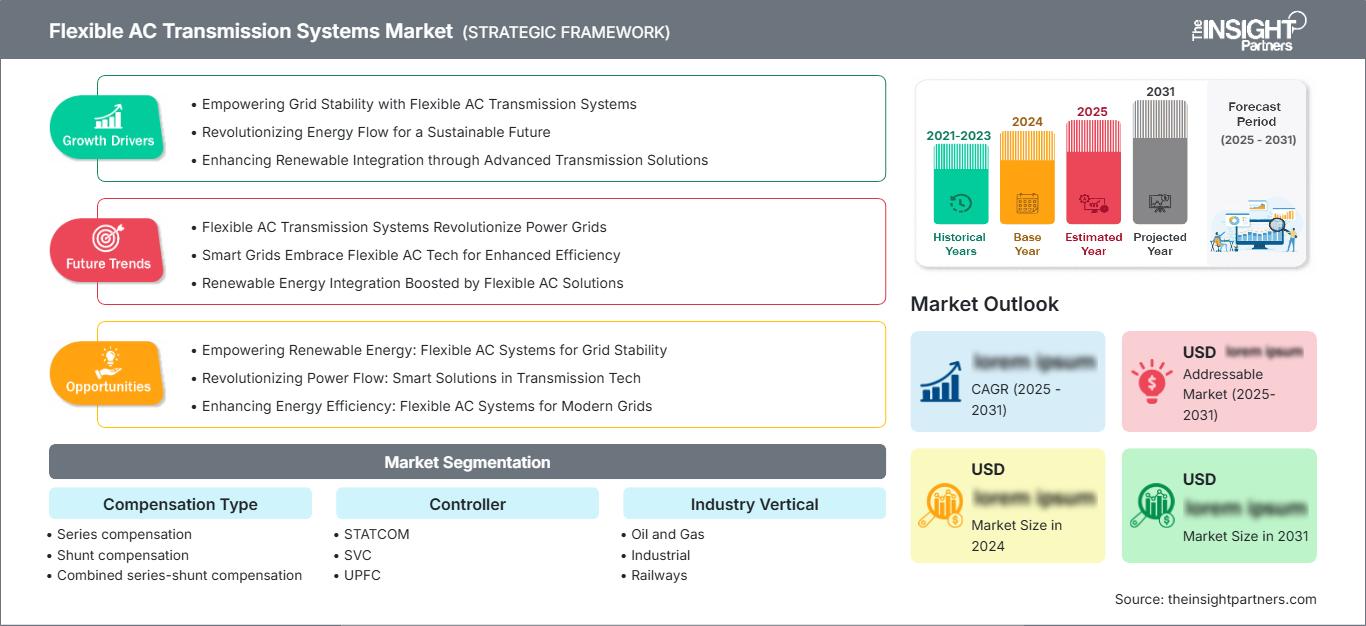
Flexible AC Transmission Systems Market: Strategic Insights
Regional Insights
North America Flexible AC Transmission Systems Market
North America held the share of 29-32% of the FATS market in 2025 and is expected to expand at a CAGR of 6.3-7.0% from 2026 to 2034. The growth will be driven by modernizing transmission grid, renewables integration, replacing aging infrastructure and electrification in industry and transport. NERC standards continue to serve as practical guidelines for transmission operation and planning, and utilities have a preference for solutions that increase capacity without building new lines. The companies ABB Ltd., Siemens AG, General Electric Company, Mitsubishi Electric and American Superconductor Corporation have installed base in transmission corridors, interconnections and industrial campuses in the US and Canada.
U.S. Flexible AC Transmission Systems Market
The U.S. accounted for 78-82% of the North America market in 2025 and is anticipated to experience growth at a CAGR of 6.4-7.1% over 2026-2034. The applications are focused in terms of transmission system upgrade, renewable energy integration zone, industrial power quality, and interconnection in the ERCOT, MISO, PJM, and CAISO regions. Companies such as ABB Ltd., Siemens AG, General Electric Company, Mitsubishi Electric, Hyosung Corporation, and American Superconductor Corporation bolster the presence of the companies. Purchasers emphasize FERC requirements, NERC reliability criteria, and grid code certifications along with diagnostics that mitigate downtime and make auditing easier.
Europe Flexible AC Transmission Systems Market
Europe possessed a market share of 24–27%, and Europe’s market is anticipated to expand by a CAGR of 5.8–6.5% from 2026–2034. Germany is leading due to integration of renewable energy sources, connection of offshore wind power generation, and certification of grid automation. UK is supporting the demand due to upgrades in transmission systems, interconnectivity projects, and construction of HVDC lines. France, Italy, and Spain will generate demand in the market owing to interconnectivity of systems, integration of renewable sources, and expansion of transmission systems. Grid planning of ENTSO-E, renewable target set by EU, and investment of transmission operators are favoring vendors with clear approvals.
APAC Flexible AC Transmission Systems Market
The Asia Pacific region had a market share between 31–34% in 2025 and has an expected growth rate between 7.2–7.9%, with CAGR from 2026 to 2034. China is leading due to ultra-high voltage transmission, renewables addition, and grid modernization; India is growing by developing transmission corridors, integrating renewables, and making investment in the power industry; Japan and South Korea focus on having high-reliability systems for grid stability and energy security, while Australia is incorporating renewables and transmission interconnection needs. Policies supporting grid infrastructure development and improved reliability regulations make FATS market adoption favorable where congestion, renewable intermittency, and transmission issues are expensive.
Middle East & Africa Flexible AC Transmission Systems Market
The market in the ME&A region is forecast to have a CAGR of 6.5–7.2% between 2026 and 2034. Saudi Arabia takes the lead through transmission network expansion, upgrades to the power grid and infrastructure megaprojects; in the UAE there is added support for renewable integration, power grid upgrades and specialized transmission equipment. South Africa and RoMEA depend on power infrastructure expansion, industrialization and reliability programs. Renewable energy goals and increased transmission capacity drive the need for control solutions. Success comes from combining qualified products, fast availability of spares, field engineering and local support.
Segmentation Analysis
Compensation Type
Compensation Type is projected to grow at a CAGR of 7.3–8.0% during 2026–2034. Flexible AC Transmission Systems Market scope covers Series Compensation, Shunt Compensation, and Combined Series-Shunt Compensation. Selection depends on grid topology, transmission distance, load characteristics, and system requirements. Shunt Compensation leads because it provides effective voltage control and reactive power support across transmission networks, improving stability and power quality.
- Series Compensation serves long-distance transmission lines, interconnections, and congested corridors where line reactance reduction increases power transfer capability. These solutions enable utilities to optimize existing assets and defer new construction investments.
- Shunt Compensation balances voltage levels, provides reactive power support, and enhances stability in heavily loaded transmission corridors. STATCOMs and SVCs are widely deployed to maintain voltage stability and improve power quality.
- Combined Series-Shunt Compensation integrates both approaches for comprehensive power flow control. UPFC devices combine series and shunt functions, offering coordinated control over voltage, impedance, and phase angle across complex transmission networks.
Controller
Controller is forecast to grow at a CAGR of 7.5–8.2% during 2026–2034. STATCOM, SVC, UPFC, and TCSC devices are becoming more strategic as operators standardize grid operations, control strategies, and system integration. Controller selection intensity rises when transmission systems integrate renewable energy, manage congestion, and require fast dynamic response. Controller technology defines operational capability and determines system performance under varying grid conditions.
- STATCOM provides rapid reactive power support and precise voltage control, making it highly suitable for modern transmission networks with increasing renewable penetration. Compact footprint, modular design, and efficient operation across voltage ranges strengthen adoption.
- SVC delivers voltage regulation and reactive power compensation using thyristor-controlled reactors and capacitor banks. SVC systems support grid stability in heavily loaded corridors and industrial environments.
- UPFC combines series and shunt compensation for comprehensive power flow control. UPFC systems enable independent control of voltage, impedance, and phase angle, offering flexibility for complex transmission networks.
- TCSC provides dynamic line compensation and congestion relief. Thyristor-controlled series capacitors allow rapid adjustment of line impedance, managing power flow and improving transmission capacity.
Industry Vertical
Industry Vertical is expected to grow at a CAGR of 7.1–7.8% during 2026–2034. Electric utilities remain the anchor vertical, while renewables, railways, and industrial sectors adopt control solutions where grid stability, power quality, and transmission constraints elevate deployment needs. Procurement increasingly favors integrated grid solutions rather than standalone devices.
- Oil and Gas industry requires transmission control for remote operations, offshore platforms, and processing facilities where grid stability and power quality are critical for continuous operations.
- Industrial demand is tied to manufacturing, mining, and processing facilities requiring voltage regulation, power quality improvement, and reliable transmission for automated production systems.
- Railways use FACTS solutions for traction power systems, voltage stabilization, and power quality management across electrified rail networks and high-speed corridors.
- Electric Utilities remain the largest vertical because transmission system operators require certified solutions for voltage control, reactive power compensation, and grid stability management.
- Renewables adoption is rising for wind and solar integration, where FACTS devices mitigate intermittency, regulate power flow, and improve grid stability for renewable energy plants.
Opportunity Snapshot
| Industry Vertical | Revenue Contribution | Trend Tag | Adoption Stage |
|---|---|---|---|
| Oil and Gas industry | Medium | Remote Ops | Scaling |
| Industrial | High | Power Quality | Mature |
| Railways | Medium | Traction Power | Scaling |
| Electric Utilities | High | Grid Stability | Mature |
| Renewables | High | Grid Integration | Scaling |
Flexible AC Transmission Systems Market Growth Drivers and Impact Analysis
Aging Transmission Infrastructure Requires Advanced Control Solutions
Many developed economies operate transmission networks that were constructed decades ago, with equipment approaching or exceeding design life. These aging systems face increased stress from rising electricity demand, renewable integration, and changing load patterns. FACTS technologies enable utilities to modernize existing infrastructure, enhance capacity, and improve reliability without constructing new transmission lines, which face lengthy permitting processes and high capital costs. The practical impact is higher spending on system studies, certified equipment, and service contracts that keep transmission assets operating reliably across both urban load centers and remote renewable generation zones.
Grid Codes and Reliability Mandates Convert Planning Into Investment
Transmission reliability standards, grid codes, and regulatory requirements are transforming FACTS deployment from optional upgrades into documented compliance items. NERC reliability standards address transmission planning, voltage support, and system stability, while regional grid codes influence technology selection across multinational projects. System operators increasingly demand recorded performance data, diagnostic histories, and approved equipment listings to demonstrate compliance during audits. This driver benefits suppliers that combine certified hardware, engineering studies, lifecycle services, and training programs, because procurement teams must justify not only performance but also maintainability and regulatory traceability.
Renewable Energy Integration Raises Grid Stability Requirements
Power systems are becoming more complex with high penetration of inverter-based renewable generation, which introduces variability, voltage fluctuations, and intermittency challenges. As conventional power plants are gradually retired, modern grids increasingly rely on FACTS technologies for fast voltage regulation, dynamic reactive power support, and oscillation damping. Operators require solutions that respond rapidly to disturbances, manage power flows, and maintain system stability. The market impact is a premium for reliable FACTS devices and service programs that support higher renewable shares, reduce curtailment, and enable transmission operators to achieve decarbonization targets while maintaining reliability.
Flexible AC Transmission Systems Market Future Trends
Digital Control and Smart Grid Integration Reshape FACTS Platforms
Flexible AC Transmission Systems Market trends point toward digital control platforms that integrate FACTS devices with wide-area monitoring systems, synchrophasor networks, and advanced grid management systems. The next product cycle will combine power electronics, digital controls, and real-time optimization capabilities to enhance system visibility and operational flexibility. This shift matters because utilities increasingly measure FACTS value by grid performance benefits as well as equipment reliability. Vendors with strong software validation, cybersecurity discipline, and operational datasets will be better positioned as transmission systems become part of broader grid modernization initiatives.
Modular and Scalable Architectures Address Evolving Grid Requirements
Utilities are increasingly favoring modular FACTS architectures that can be expanded as grid requirements evolve. STATCOM systems with scalable converter modules enable operators to add capacity incrementally, matching investment with system needs. Future procurement will scrutinize system flexibility, upgrade pathways, and integration with emerging technologies such as battery storage and hydrogen infrastructure. Suppliers that can document scalability and provide clear migration paths will gain credibility with utilities seeking defensible investment strategies for long-term transmission planning.
Flexible AC Transmission Systems Market Opportunities
Lifecycle Services and Performance-Based Contracts for Grid Operators
Flexible AC Transmission Systems Market Forecasts support investment in engineering, maintenance, and managed services for transmission system operators managing assets across several regions. Operators need standardized asset registers, performance records, spare-part planning, and system reviews that remain consistent despite personnel turnover. Service providers can create recurring revenue by combining system studies, compliance documentation, remote diagnostics, and upgrade roadmaps. The opportunity is strongest where utilities already use FACTS devices but lack centralized visibility into equipment health, operational issues, or upcoming obsolescence risks.
Emerging Transmission Corridors in High-Growth Regions
New transmission projects, renewable integration corridors, and interconnection schemes in Asia Pacific, the Middle East, and Latin America create demand for certified FACTS solutions that balance performance and cost. Many projects need STATCOM or SVC protection but cannot justify premium configurations across every zone. Vendors can win by offering scalable device families, local commissioning partners, training, and rapid spare availability. This opportunity rewards companies that translate global grid expertise into practical project packages for utilities, EPC firms, and transmission operators building grid infrastructure to support economic growth and energy transition.
Recent Developments
- July 2026: Hitachi Energy, a global leader in electrification, and Larsen & Toubro (L&T), a leading Indian multinational known for its Engineering, Procurement and Construction (EPC), manufacturing, and Services, announced receiving the award of Nederwiek3 and LanWin5, the thisrd and fourth projects under their previously announced multi-year Framework Agreement with TenneT.Hitachi Energy and L&T are already collaborating to deliver Nederwiek1 and IJmuiden Ver Alpha. Today’s announcement further strengthens this partnership through Nederwiek3 and LanWin5, HVDC links that will each transmit 2 gigawatts (GW) of renewables from the North Sea to shore, enabling the integration of offshore wind power into the national grids of the Netherlands and Germany, respectively.
- August 2024: GE Vernova Inc. (NYSE:GEV) announced the launch of its latest innovation, FACTSFLEX GFMe, an advanced Flexible Alternating Current Transmission System (FACTS) solution aimed at strengthening power grids and facilitating the increased use of renewable energy sources.
- April 2023: GE Renewable Energy’s Grid Solutions business (NYSE:GE) has won five Flexible AC Transmission Systems (FACTS) in recent months, reflecting customers’ confidence in GE’s technology to help them increase the power transfer capabilitsy and controllability of their alternating current (AC) grids. The contracts include a Fixed Series Compensation (FSC) bank reconfiguration project for Public Service Company of New Mexico (PNM) in the U.S. and a Static Synchronous Compensator (STATCOM) project for Saudi Electricity Company, one of the largest producers of electricity in the Middle East and North Africa.
Frequently Asked Questions

- Comprehensive Market Sizing and Forecast Analysis
- Detailed Segmentation Analysis
- In-Depth Market Dynamics Assessment
- Regional and Country-Level Insights
- Competitive Landscape and Company Benchmarking
- Strategic Business Intelligence
Recent Reports
Testimonials

The Insight Partners provided valuable market intelligence that supported our global go-to-market strategy. Their team was professional, responsive, and attentive to our feedback, providing thoughtful analysis and helpful methodological clarifications throughout the project.
Junmo Kim Chief Financial Officer (CFO), Enertech Co., Ltd.
The Insight Partners' SCADA System Market report is comprehensive, with valuable insights on current trends and future forecasts. The team was highly professional, responsive, and supportive throughout. We are very satisfied and highly recommend their services.
RAN KEDEM Partner, Reali Technologies LTDs
I requested a report on a very specific software market and the team produced the report in a few days. The information was very relevant and well presented. I then requested some changes and additions to the report. The team was again very responsive and I got the final report in less than a week.
JEAN-HERVE JENN Chairman, Future Analytica
We worked with The Insight Partners for an important market study and forecast. They gave us clear insights into opportunities and risks, which helped shape our plans. Their research was easy to use and based on solid data. It helped us make smart, confident decisions. We highly recommend them.
PIYUSH NAGPAL Sr. Vice President, High Beam Global
The Insight Partners delivered insightful, well-structured market research with strong domain expertise. Their team was professional and responsive throughout. The user-friendly website made accessing industry reports seamless. We highly recommend them for reliable, high-quality research services
YUKIHIKO ADACHI CEO, Deep Blue, LLC.
This is the first time I have purchased a market report from The Insight Partners.While I was unsure at first, I visited their web site and felt more comfortable to take the risk and purchase a market report.I am completely satisfied with the quality of the report and customer service. I had several questions and comments with the initial report, but after a couple of dialogs over email with their analyst I believe I have a report that I can use as input to our strategic planning process.Thank you so much for taking the extra time and making this a positive experience.I will definitely recommend your service to others and you will be my first call when we need further market data.
JOHN SUZUKI President and Chief Executive Officer, Board Director, BK Technologies
I wish to appreciate your support and the professionalism you displayed in the course of attending to my request for information regarding to infectious disease IVD market in Nigeria. I appreciate your patience, your guidance, and the fact that you were willing to offer a discount, which eventually made it possible for us to close a deal. I look forward to engaging The Insight Partners in the future, all thanks to the impression you have created in me as a result of this first encounter.
DR CHIJIOKE ONYIA MANAGING DIRECTOR, PineCrest Healthcare Ltd.Reason to Buy
- Informed Decision-Making
- Understanding Market Dynamics
- Competitive Analysis
- Identifying Emerging Markets
- Customer Insights
- Market Forecasts
- Risk Mitigation
- Boosting Operational Efficiency
- Strategic Planning
- Investment Justification
- Tracking Industry Innovations
- Aligning with Regulatory Trends





 Get Free Sample for