
Flexible Heater Market Trends, Demand & Growth by 2034
Coverage: by Type (Silicone Rubber-Based, Polyimide- Based, Polyester-Based, Mica-Based); Industry (Electronics and Semiconductor, Medical, Aerospace and Defense, Food and Beverages, Automotive, Oil and Gas and Mining) , and Geography (North America, Europe, Asia Pacific, and South and Central America)
- Status : Data Released
- Report Code : TIPRE00004135
- Category : Electronics and Semiconductor
- No. of Pages : 150
- Available Report Formats :


- Last update date : September 09, 2026


2025 Market Size
US$ 1.58 Bn
Base year value
2034 Forecast
US$ 2.86 Bn
Projected by 2034
CAGR 2026-2034
6.82 %
Growth rate
Addressable Market
US$ 20.07 Bn
(2026-2034)
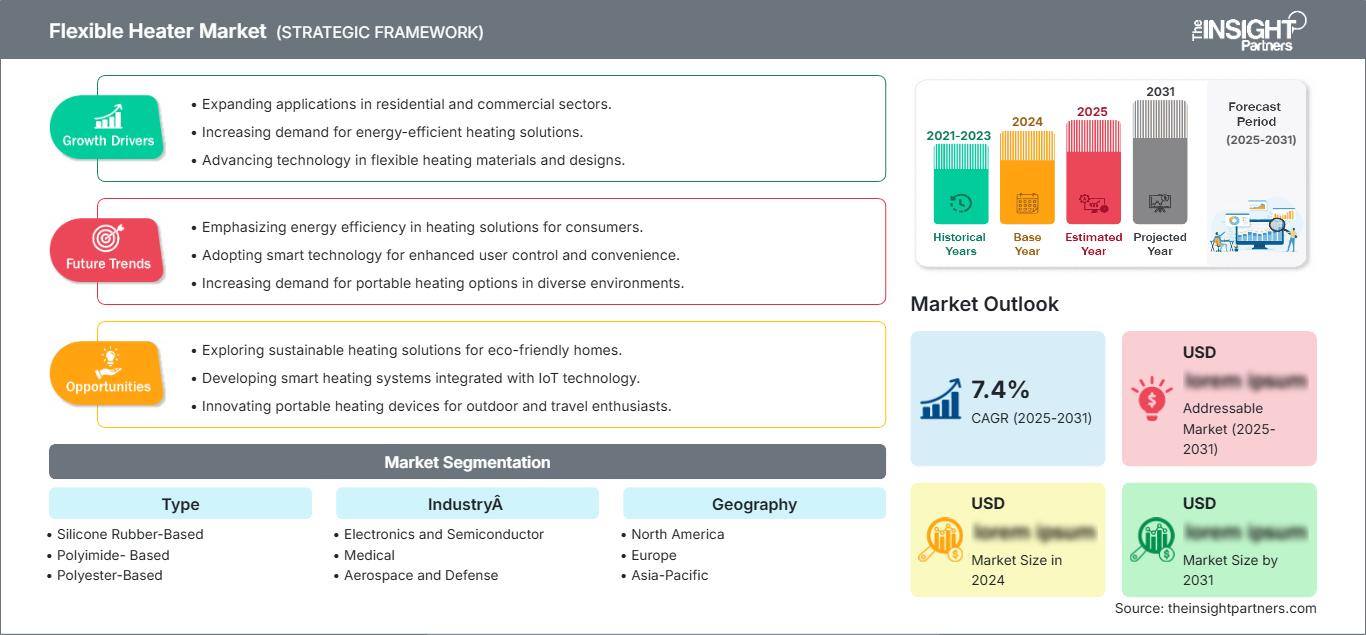
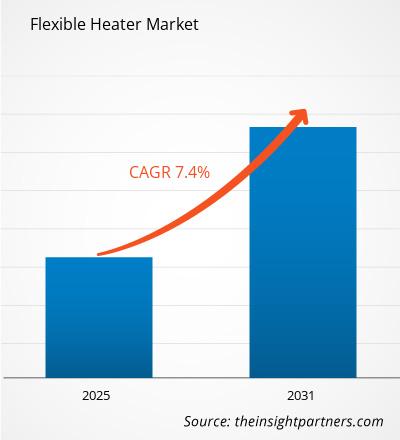
The Flexible Heater Market size is projected to expand from US$ 1.58 Billion in 2025 to US$ 2.86 Billion by 2034, registering a CAGR of 6.82% during 2026–2034. Expansion reflects increasing use of conformable heating elements for precise thermal management across electronics, medical equipment, aerospace systems, automotive platforms, and industrial machinery. Material innovation, compact device architectures, and demand for localized temperature control are strengthening adoption across established and emerging end-use environments.
North America remains a technology-intensive market, with an estimated 6.3–6.8% CAGR through 2034. The Flexible Heater Market is supported by semiconductor manufacturing expansion, medical-device production, aerospace programs, and growing requirements for battery and electronics thermal management. High engineering content, stringent qualification requirements, and established OEM ecosystems encourage suppliers to prioritize customized heaters, rapid prototyping, and application-specific certification for demanding industrial and commercial systems.
Flexible Heater Market Assessment and Insights
- North America: North America represents a 29–32% Flexible Heater Market share in 2025 and is projected to grow at a 6.3–6.8% CAGR between 2026–2034, supported by semiconductor, aerospace, medical, automotive, and industrial thermal-management requirements.
- US: The US accounts for 80–83% of North America's 2025 market and is expected to grow at a 6.1–6.6% CAGR during 2026–2034, led by advanced manufacturing and medical applications.
- Europe: Europe holds a 21–24% share in 2025 and is forecast to expand at a 5.8–6.3% CAGR between 2026–2034, with Germany, the UK, France, Italy, and Spain supporting demand through industrial automation, automotive electrification, medical equipment, and aerospace manufacturing.
- Asia Pacific: Asia Pacific represents a 38–41% share in 2025 and is expected to record a 7.4–7.9% CAGR between 2026–2034, with China, Japan, South Korea, and India benefiting from electronics production, semiconductor capacity, automotive manufacturing, and industrial automation.
- Largest Segment: Silicone Rubber-Based holds a 50–54% market share in 2025 and is expected to grow at a 6.4–6.8% CAGR during 2026–2034, reflecting broad industrial suitability.
- High Growth Segment: Polyimide-Based represents a 28–32% market share in 2025 and is projected to expand at a 7.3–7.8% CAGR during 2026–2034, driven by high-performance applications.
- Key companies analyzed in detail: Bucan, Holroyd Components Ltd, Honeywell International Inc., I.R.C.A. S.p.A., Minco Products, Inc., NIBE Industrier AB, OMEGA Engineering Inc., Smiths Group plc, Spirax-Sarco Engineering plc, Tempco Electric Heater Corporation.
Source: The Insight Partners' analysis based on proprietary research, government publications, company annual reports, investor presentations, industry databases, and expert interviews.
Flexible Heater market has progressed from simple surface heating components to sophisticated thermal management systems. Etched foil, wire wound, printed heaters, and self regulating types now allow for closer temperature tolerances, thinner forms and complex shapes. Silicone rubber is still relevant for tough conditions, but polyimide construction allows light weight heaters used in aerospace, electronics, medical instrumentation, and semiconductor equipment. Manufacturing increasingly emphasizes individual sizes, watt density maps, sensors, adhesives, and application specific qualifying criteria in place of standard heater sizes.
Future growth may see increased presence in Southeast Asia, India, Mexico, and certain European manufacturing clusters as investment occurs in electronics, electrical vehicles, medical equipment, and industrial automation markets. Supplying companies may emphasize automated manufacturing, computerized thermal modeling, higher watt density heaters, and sensors. Regulations on electrical safety and heat management will also drive growth for companies that can demonstrate validation, traceability, and material control. These will increase qualification expenses, yet build high barriers to entry for technologically oriented manufacturers.
Flexible Heater Market Report Scope
| Report Attribute | Details |
|---|---|
| Market size in 2025 | US$ 1.58 Billion |
| Market Size by 2034 | US$ 2.86 Billion |
| Global CAGR (2026 - 2034) | 6.82% |
| Historical Data | 2021-2024 |
| Forecast period | 2026-2034 |
Flexible Heater Market Analysis
Demand becomes increasingly dependent upon thermal management concerns related to non-conformable heaters. Growth of Flexible Heater Market is driven by the following factors such as miniaturization in electronics, increased sensitivity of semiconductor process, portable medical devices, battery conditioning, aerospace temperature control, and freeze prevention in industries. The buyer will typically specify geometry of the heater, working temperature, watt density, voltage, insulation, adhesive system, and environmental resistance altogether.
The supply chain consists of raw material and resistance material suppliers, flexible heater designers, heater fabricators, encapsulators/laminators, sensor/controllers producers, OEMs, and after-market distributors. Supply is conditioned by specialty polymers, alloys, adhesives, and fabrication capability. High switching costs result from customization because the qualification of heaters is connected to the assembly process, operating environment, and reliability requirements.
Competitive landscape represents a combination of diversified thermal management companies along with flexible heater specialists. Analysis of the Flexible Heater Market reveals that competition is driven by engineering service provision, prototyping capabilities, certification capabilities, and integration of the sensor/controller into the heater. Among the former group, Minco Products, Inc. focuses on integrated thermal solutions. As for the latter one, OMEGA Engineering Inc. and Tempco Electric Heater Corporation serve general industrial requirements. Holroyd Components Ltd and I.R.C.A. S.p.A. add specialized competencies to engineered heating.
Competitors occupy different market positions depending on the application. Honeywell International Inc. can benefit from comprehensive portfolio of automation and industrial technologies, whereas NIBE Industrier AB has exposure to electrical heating components and controls. Smiths Group plc and Spirax-Sarco Engineering plc are involved in engineered thermal and industrial systems. Bucan, Elcometer-type ecosystems, and specialized flexible heaters compete on the basis of customization, responsiveness, application knowledge, and lower batch sizes.
● REPORT CUSTOMIZATION
Tailor This Report To Align With Your Specific Business Requirements
This report can be customized to align precisely with your business objectives, scope, and target markets. Customization options include tailored segmentation, geography, competitive analysis, and strategic insights to support informed decision-making.
Customize This Report →WHAT YOU CAN ADJUST
- ● Segmentations
- ● Geography
- ● Competitive Analysis
- ● Language Preferences
Flexible Heater Market: Strategic Insights
Regional Insights
North America Flexible Heater Market
North America commands a 29–32% share in 2025 and is projected to expand at a 6.3–6.8% CAGR through 2034. Advantages in the region include the availability of semiconductors capacity build-up, aerospace production, medical device fabrication, electric vehicles, and industrial automation. The main consumers in the region are US clients due to frequent requirements for custom heaters needed to provide documentation of thermal properties in assemblies. In Canada, there are such industries as aerospace production, energy, and industrial equipment, and in Mexico there is growing production base for automotive and electronics sectors.
Lightweight construction, even heating, localized heating, and compatibility with automatic temperature control are some features that the regional consumers are looking for. In particular, polyimide heaters are relevant for aerospace and semiconductor industry, and silicone rubber heaters can be used in industrial, automotive, and equipment applications. Medical device producers also need thin and flexible heaters. Design and prototyping capabilities are essential in the region due to qualification requirements and short engineering cycle.
U.S. Flexible Heater Market
The US represents 80–83% of North America's 2025 market and is forecast to grow at a 6.1–6.6% CAGR through 2034. The demand is concentrated in the sectors of semiconductor equipment, aerospace and defense, medical devices, automotive thermal systems, and industrial machinery. Honeywell International Inc., Minco Products, Inc., and OMEGA Engineering Inc. are some examples of companies with the capability to perform thermal management. Specialized suppliers will be able to provide customization for OEM programs.
There is a trend towards heaters with the following attributes: low mass, controlled heat dissipation, and controlled temperature sensing. In the case of semiconductor industry, there is a need for thermal consistency near the processing and test equipment, and medical devices require small size and controlled operating temperatures. In the case of aerospace industry, the priority attributes are low outgassing, reliability, and thermal cycling resistance. Automotive requirements now include battery conditioning and localized component heating.
Europe Flexible Heater Market
Europe accounts for a 21–24% share in 2025 and is projected to grow at a 5.8–6.3% CAGR through 2034, with Germany leading regional demand. The UK, France, Italy, and Spain generate further demand for the application of automotive products, aerospace products, industrial machinery, medical devices, food processing systems, and energy products. Europeans are known to put a lot of importance on the energy efficiency, electrical safety, traceability, and performance of materials.
The UK and Germany have advanced engineering industries where there is demand for thermal parts that can be integrated into the machinery, automobiles, and aerospace equipment. France has an important aerospace and industrial industry while Italy has a heating component and appliance industry. The Spanish market is made up of automotive products, food equipment, and industrial automation.
APAC Flexible Heater Market
APAC represents a 38–41% share in 2025 and is expected to grow at a 7.4–7.9% CAGR through 2034, making it the leading regional market. China tops the list, with Japan, South Korea, India, and Australia following close behind. The highest demand for industrial automation arises from electronics, semiconductor fabrication, electric cars, and medical equipment.
Support for manufacturing industries, electronics localization, and batteries through industrial policies is driving investment. China and South Korea leverage their electronics and semiconductor value chains, while Japan focuses on precise manufacturing and industrial machinery. India is increasing its capabilities in electronics and automobiles, while Australia adds through its mining capabilities and industrial applications. Regional suppliers are becoming adept at cost-effective manufacturing along with customization for various applications, which presents great opportunities for foreign businesses.
Middle East & Africa Flexible Heater Market
Middle East and Africa demand remains smaller but is expected to expand at a 6.0–6.6% CAGR through 2034. Saudi Arabia leads regional requirements, followed by the UAE and South Africa. Oil and gas processing, mining, desalination, infrastructure development, industrial equipment, and specialized transportation systems create applications where freeze protection and controlled surface heating are important.
Saudi Arabia and the UAE are increasing industrial diversification and infrastructure investment, supporting demand for engineered heating solutions. South Africa contributes through mining, energy, food processing, and industrial equipment. The rest of MEA remains fragmented, with procurement often driven by project-based requirements. Harsh ambient conditions, equipment reliability, maintenance access, and corrosion resistance influence heater selection. Suppliers able to provide ruggedized products, installation guidance, and dependable after-sales support are better positioned in these applications.
Segmentation Analysis
Type
Type remains a critical purchasing dimension because substrate selection determines thermal range, flexibility, moisture resistance, electrical insulation, durability, and cost. The segment is projected to expand at a 6.5–7.0% CAGR during 2026–2034. Flexible Heater Market scope increasingly includes application-specific combinations of etched foil, wire-wound elements, adhesives, sensors, and insulation rather than heater material alone.
- Silicone Rubber-Based: Broadly adopted for industrial, automotive, food equipment, and outdoor applications because it combines flexibility, moisture resistance, conformability, and robust mechanical performance. It remains the principal volume-oriented heater construction.
- Polyimide-Based: Preferred for thin, lightweight assemblies requiring high electrical insulation, low outgassing, chemical resistance, and controlled heating. Its importance is rising across aerospace, semiconductor, medical, and advanced electronics applications.
- Polyester-Based: Offers economical flexible construction for moderate-temperature applications where low profile, lightweight design, and cost control are more important than extreme environmental performance.
- Mica-Based: Serves specialized heating configurations requiring strong dielectric characteristics and thermal stability, particularly where rigid support or elevated-temperature performance is more important than maximum conformability.
Industry
Industry is forecast to grow at a 6.9–7.4% CAGR during 2026–2034 as thermal control becomes increasingly important in compact electronics, medical equipment, transportation systems, and industrial processes. Flexible Heater Market analysis shows that industry-specific qualification and reliability requirements increasingly influence heater design, materials, and supplier selection.
- Electronics and Semiconductor: Demand centers on localized thermal control, condensation prevention, process equipment, test fixtures, and compact assemblies where temperature uniformity can influence equipment reliability and manufacturing performance.
- Medical: Portable diagnostics, patient warming, analytical equipment, fluid management, and laboratory systems require compact heaters capable of controlled, repeatable thermal output and integration within space-constrained devices.
- Aerospace and Defense: Lightweight construction, low outgassing, thermal cycling resistance, and reliability support use in avionics, sensors, spacecraft systems, aircraft equipment, and defense electronics operating under demanding conditions.
- Food and Beverages: Heating elements support temperature maintenance, fluid management, condensation control, dispensing equipment, and food-processing machinery where consistent localized heating can improve operational stability.
- Automotive: Vehicle electronics, batteries, sensors, fluid systems, and cabin components increasingly require compact heating for cold-weather operation, condensation management, and thermal conditioning.
- Oil and Gas and Mining: Flexible heaters provide freeze protection, viscosity management, moisture control, and localized process heating for equipment exposed to remote, variable, or harsh operating environments.
Opportunity Snapshot
| Industry | Revenue Contribution | Trend Tag | Adoption Stage |
| Electronics and Semiconductor | High | Wafer Heating | Scaling |
| Medical | Medium | Device Warming | Scaling |
| Aerospace and Defense | Medium | Avionics Heating | Scaling |
| Food and Beverages | Medium | Process Heating | Mature |
| Automotive | High | Battery Warming | Scaling |
| Oil and Gas and Mining | Low | Freeze Protection | Mature |
Flexible Heater Market Growth Drivers and Impact Analysis
Semiconductor and Electronics Thermal Density
Rising semiconductor integration increases the importance of localized and uniform thermal control within manufacturing equipment, testing systems, sensors, and compact electronics. The expansion of domestic chip manufacturing in North America and continued electronics production in Asia Pacific creates a broader installed base requiring controlled heating. Flexible constructions can be positioned directly on irregular surfaces, reducing thermal losses associated with indirect heating. This changes purchasing decisions from commodity heater selection toward engineered thermal assemblies. Suppliers capable of supporting rapid prototyping, clean manufacturing, precise resistance patterns, and repeatable temperature distribution can capture higher-value programs. The impact extends beyond heater volumes because qualification with semiconductor and electronics OEMs can generate recurring orders across equipment platforms, replacement cycles, and new production lines.
Electrification and Battery Thermal Management
Vehicle electrification is creating additional requirements for controlled heating around battery packs, sensors, fluid circuits, and electronic modules. Flexible elements can provide localized pre-conditioning without adding substantial mass or occupying significant packaging volume. Their ability to conform to curved surfaces makes them relevant to battery modules and auxiliary systems where conventional heaters may be difficult to integrate. As electric mobility expands into colder climates, thermal conditioning becomes a functional requirement rather than an optional comfort feature. Suppliers can therefore participate in higher-value automotive programs when products meet vibration, moisture, electrical insulation, and durability requirements. The market impact is strongest for polyimide and silicone constructions that combine compact geometry with reliable thermal output and can be manufactured in application-specific shapes.
Demand for Compact Medical and Aerospace Systems
Medical and aerospace equipment increasingly requires thermal functions within smaller and lighter assemblies. Diagnostic instruments, fluid-handling systems, sensors, avionics, and spacecraft components may require stable temperatures despite limited installation space or extreme environmental conditions. Flexible heaters address these constraints by placing heat directly on the target surface and reducing dependence on bulky thermal hardware. Medical qualification emphasizes repeatability, safety, and controlled operation, whereas aerospace programs add low outgassing, thermal cycling, vibration, and mass constraints. The resulting demand favors suppliers with engineering documentation and long-term component reliability rather than suppliers competing solely on unit price. This driver also supports deeper collaboration between heater manufacturers, OEM engineering teams, sensor providers, and control-system developers during product design.
Flexible Heater Market Future Trends
Integrated Self-Regulating Thermal Assemblies
Flexible Heater Market trends are moving toward integrated thermal assemblies that combine heating elements, temperature sensing, insulation, and control functions within one engineered package. Self-regulating materials and distributed sensing can reduce dependence on separate control hardware while improving response to changing thermal loads. Future designs are likely to use multiple independently controlled heating zones, enabling different temperatures across a single component. This approach can reduce unnecessary energy consumption and improve process consistency in medical instruments, semiconductor equipment, battery systems, and laboratory devices. Manufacturers are also expected to develop thinner constructions with improved adhesion and more durable encapsulation. Design software, digital thermal modeling, and automated resistance patterning should shorten development cycles while enabling more application-specific heater geometries and repeatable production.
Printed and Ultra-Thin Heating Architectures
Future product development is likely to expand the use of printed conductive materials, ultra-thin polymer substrates, and advanced etched patterns. These architectures can support heating functions in applications where conventional wire-wound elements are too thick or mechanically restrictive. Flexible displays, sensors, wearable equipment, compact medical devices, analytical instruments, and next-generation electronics could benefit from transparent or highly conformable heating layers. Manufacturing improvements should increasingly focus on precise conductive deposition, multilayer insulation, localized watt-density control, and automated inspection. As volumes rise, suppliers may shift from manually assembled custom heaters toward digitally controlled manufacturing platforms that preserve customization while improving consistency. This transition could widen the addressable market by making complex heater geometries more economically viable.
Flexible Heater Market Opportunities
Localized Production for Advanced Manufacturing Clusters
Flexible Heater Market Forecasts indicate an opportunity for suppliers to establish regional engineering and production capabilities near semiconductor, automotive, aerospace, and medical manufacturing clusters. Localized operations can shorten prototype cycles, simplify technical communication, and reduce qualification delays caused by long international supply chains. India, Southeast Asia, Mexico, and selected Eastern European markets offer opportunities where manufacturing capacity is expanding and component localization is becoming strategically important. Investment priorities should include automated cutting, etching, lamination, resistance testing, and thermal mapping. Suppliers can also differentiate through application engineering teams that work directly with OEM designers before production begins. Such regional models can increase customer retention because heater specifications become embedded in the customer's assembly and qualification documentation.
Integrated Thermal Solutions for Industrial OEMs
Another opportunity lies in moving beyond standalone heating elements toward complete thermal-management modules combining heaters, sensors, controllers, insulation, connectors, and mounting systems. This approach can address customer demand for fewer suppliers and simplify validation of the finished thermal function. Flexible Heater Market Report evaluations increasingly need to consider the value created by integration rather than comparing heaters solely by wattage or material. Suppliers with electronics, sensing, and control capabilities can use this model to increase content per system and strengthen design-in relationships. Target applications include semiconductor equipment, medical analyzers, battery systems, industrial process machinery, and aerospace electronics. Investment in modular architectures can allow manufacturers to reuse validated platforms while customizing dimensions, resistance, sensors, and interfaces for individual OEM requirements.
Recent Developments
- August 2026: Ciarra launched its Smart Electric Heater Series for European homes, offering ceramic inertia, dry ceramic inertia, and convection heaters with smart features such as Wi-Fi control, scheduling, digital thermostats, open-window detection, and overheat protection.
- February 2025: Hydraflex Group completed the acquisition of Hydralectric International and its European subsidiaries, expanding its manufacturing and distribution capabilities in hoses, valves, pumps, and plumbing/cooling products across Europe.
- March 2026: Lennox entered the residential water-heater market with a new product lineup, expanding its home-comfort portfolio through its joint venture with Ariston Group and leveraging Ariston’s water-heating expertise..
Frequently Asked Questions

- Comprehensive Market Sizing and Forecast Analysis
- Detailed Segmentation Analysis
- In-Depth Market Dynamics Assessment
- Regional and Country-Level Insights
- Competitive Landscape and Company Benchmarking
- Strategic Business Intelligence
Recent Reports
Testimonials

The Insight Partners' SCADA System Market report is comprehensive, with valuable insights on current trends and future forecasts. The team was highly professional, responsive, and supportive throughout. We are very satisfied and highly recommend their services.
RAN KEDEM Partner, Reali Technologies LTDs
I requested a report on a very specific software market and the team produced the report in a few days. The information was very relevant and well presented. I then requested some changes and additions to the report. The team was again very responsive and I got the final report in less than a week.
JEAN-HERVE JENN Chairman, Future Analytica
We worked with The Insight Partners for an important market study and forecast. They gave us clear insights into opportunities and risks, which helped shape our plans. Their research was easy to use and based on solid data. It helped us make smart, confident decisions. We highly recommend them.
PIYUSH NAGPAL Sr. Vice President, High Beam Global
The Insight Partners delivered insightful, well-structured market research with strong domain expertise. Their team was professional and responsive throughout. The user-friendly website made accessing industry reports seamless. We highly recommend them for reliable, high-quality research services
YUKIHIKO ADACHI CEO, Deep Blue, LLC.
This is the first time I have purchased a market report from The Insight Partners.While I was unsure at first, I visited their web site and felt more comfortable to take the risk and purchase a market report.I am completely satisfied with the quality of the report and customer service. I had several questions and comments with the initial report, but after a couple of dialogs over email with their analyst I believe I have a report that I can use as input to our strategic planning process.Thank you so much for taking the extra time and making this a positive experience.I will definitely recommend your service to others and you will be my first call when we need further market data.
JOHN SUZUKI President and Chief Executive Officer, Board Director, BK Technologies
I wish to appreciate your support and the professionalism you displayed in the course of attending to my request for information regarding to infectious disease IVD market in Nigeria. I appreciate your patience, your guidance, and the fact that you were willing to offer a discount, which eventually made it possible for us to close a deal. I look forward to engaging The Insight Partners in the future, all thanks to the impression you have created in me as a result of this first encounter.
DR CHIJIOKE ONYIA MANAGING DIRECTOR, PineCrest Healthcare Ltd.Reason to Buy
- Informed Decision-Making
- Understanding Market Dynamics
- Competitive Analysis
- Identifying Emerging Markets
- Customer Insights
- Market Forecasts
- Risk Mitigation
- Boosting Operational Efficiency
- Strategic Planning
- Investment Justification
- Tracking Industry Innovations
- Aligning with Regulatory Trends





 Get Free Sample for