
Flexographic Printing Machine Market Share, Size & Demand by 2034
Coverage: by Type (Stack Press, In-line Press, Common Impression Cylinder Press, Others); Technology (Semi-Automatic, Automatic); Printable Substance (Polyethylene, Papers, Others); Application (Label, Packaging, Print Media, Others) , and Geography (North America, Europe, Asia Pacific, and South and Central America)
- Status : Data Released
- Report Code : TIPRE00004634
- Category : Electronics and Semiconductor
- No. of Pages : 150
- Available Report Formats :


- Last update date : September 09, 2026


2025 Market Size
US$ 2.75 Bn
Base year value
2034 Forecast
US$ 3.25 Bn
Projected by 2034
CAGR 2026-2034
1.87 %
Growth rate
Addressable Market
US$ 27.18 Bn
(2026-2034)
The global Flexographic Printing Machine market was valued at US$ 2.75 billion in 2025 and is expected to reach US$ 3.25 billion by 2034; it is estimated to record a CAGR of 1.87% during 2026-2034.
Flexographic Printing Machine Market Assessment and Insights
- North America: Represents 31–33% share in 2025 and is growing at a 1.8–2.2% CAGR between 2026–2034, supported by label modernization, replacement demand, and connected press controls.
- US: Accounts for 79–81% of North America in 2025 and advances at a 1.9–2.3% CAGR through 2034 as converters automate short-run packaging workflows.
- Europe: Holds 27–29% share in 2025 and grows at a 1.5–1.9% CAGR, led by Germany, the UK, Italy, France, and Spain amid regulatory pressure for recyclable packaging.
- Asia Pacific: Captures 30–32% share in 2025 and grows at a 2.8–3.2% CAGR, with China, India, Japan, and South Korea driving packaging capacity additions.
- Largest Segment: Packaging holds 48–52% market share in 2025 and grows at a 2.3–2.7% CAGR through 2034, sustained by food, household, and e-commerce formats.
- High Growth Segment: Automatic technology represents 54–58% market share in 2025 and advances at a 2.8–3.2% CAGR through 2034 as converters prioritize repeatability and waste reduction.
- Key companies analyzed in detail: AIM Machintechnik Pvt. Ltd.; BOBST Group SA; Comexi Group Industries, S.A.U.; Edale Ltd.; Heidelberger Druckmaschinen AG; Koenig & Bauer AG; Mark Andy Inc.; MPS Systems B.V.; Nilpeter A/S; OMET S.r.l.; Printing Machine Co.
Source: The Insight Partners' analysis based on proprietary research, government publications, company annual reports, investor presentations, industry databases, and expert interviews.
The press technology has evolved from mechanical systems to servo-controlled, networked production cells incorporating auto register, viscosity control, inspection and job recall features. The use of common impression cylinders enhanced high-speed film printing, and modular inline systems expanded the capabilities of flexo for labels, shrink sleeves and light carton printing. Extended color gamut, photopolymer plates and LED UV or water-based curing now minimize set up waste and ensure color consistency. In terms of production economics, there is an increasing preference for presses which cater to shorter runs without loss in repeatability.
Over the forecast period, investment will increasingly flow with packaging conversion growth in India, Southeast Asia, the Gulf and selected African markets. Recyclability regulations in Europe and material simplification programs by brand owners will drive trials using paper and mono-material polyethylene. Regional presence will also be key in vendor selection. Investment will be moderated due to the fact that converters have a tendency to upgrade inspection, drying and workflow systems on existing press lines rather than replace the whole line.
Flexographic Printing Machine Market Report Scope
| Report Attribute | Details |
|---|---|
| Market size in 2025 | US$ 2.75 Billion |
| Market Size by 2034 | US$ 3.25 Billion |
| Global CAGR (2026 - 2034) | 1.87% |
| Historical Data | 2021-2024 |
| Forecast period | 2026-2034 |
Flexographic Printing Machine Market Analysis
The Flexographic Printing Machine market expansion is reliant on volumes of packaging, the number of stock keeping units, and converters' efforts to reduce makeready waste. Applications like food and beverages, personal care, pharmaceuticals, and logistics help presses to maintain a good run rate, while smaller projects require automatic presetting and closed loop inspection. Value chain consists of press manufacturers, anilox & plate manufacturers, ink and curing professionals, software vendors, system integrators, distributors, and maintenance service providers.
Suppliers continue to be highly engineering-oriented, with cast frame, cylinder, servo, dryer, and electronics forming a lengthy validation process. European brands dominate premium wide-web and modular presses, while the Indian and Asian brands dominate stack and in-line machines due to cost consciousness. Component availability, service capability, and training become more significant than upfront cost for ownership economics because of unexpected downtime.
Fragmentation is apparent from Flexographic Printing Machine Market Report due to differences in applications of each company. BOBST Group SA and Comexi Group Industries, S.A.U. are oriented towards automation for flexible packaging, Mark Andy Inc., Nilpeter A/S, MPS Systems B.V., OMET S.r.l., and Edale Ltd. are oriented towards narrow and medium web labels and Heidelberger Druckmaschinen AG and Koenig & Bauer AG are oriented towards broader engineering and print.
The needs of developing regions like India are being addressed by companies like AIM Machintechnik Pvt. Ltd. and Printing Machine Co. The investment is being made in the areas of connected services, automated colour controls, hybrid systems and application centers. There has been strategic positioning which has started involving equipment with lifecycle, recipes and analytics along with retrofit options.
● REPORT CUSTOMIZATION
Tailor This Report To Align With Your Specific Business Requirements
This report can be customized to align precisely with your business objectives, scope, and target markets. Customization options include tailored segmentation, geography, competitive analysis, and strategic insights to support informed decision-making.
Customize This Report →WHAT YOU CAN ADJUST
- ● Segmentations
- ● Geography
- ● Competitive Analysis
- ● Language Preferences
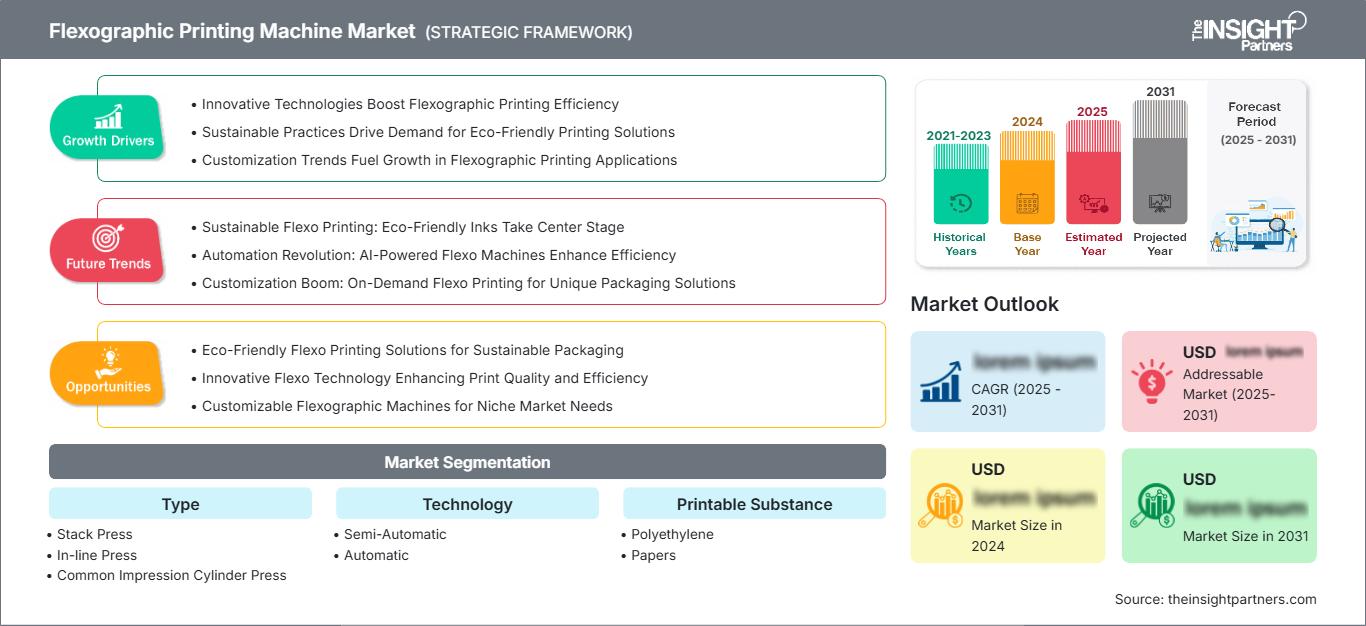
Flexographic Printing Machine Market: Strategic Insights
Regional Insights
North America Flexographic Printing Machine Market
The region accounts for 31–33% of Flexographic Printing Machine Market Share in 2025 and is forecast to post a 1.8–2.2% CAGR through 2026–2034. The market's Flexographic Printing Machine share is characterized by substantial installed capacity that serves food packaging, pressure-sensitive labeling, corrugated pre-print, and consumer goods applications. Increasingly, replacement investments will value automatic impression setting, inspection and cloud-based maintenance over simply speed of operation.
The clustering of converters leads to uniformity in the fleet and processes. Canada supplies for paper and flexible packaging, whereas nearshoring and manufacturing of consumer goods allow Mexico to do its part. Maturity constrains the growth rate; nevertheless, sustainability, lack of labor, and shorter campaign duration motivate improvements in machinery. Demonstrability, spare parts, and training are very much valued because downtime is crucial in automation.
U.S. Flexographic Printing Machine Market
The United States comprised 79-81% of North America’s revenue in 2025 and is projected to grow at a 1.9-2.3% CAGR up to 2034. Growth drivers include pressure sensitive labels, shrink sleeve labels, flexible food packaging, healthcare ID labels, and e-commerce corrugated products. With more brands available, there will be more frequent staff turnover, thus servo control, automatic registration, and inline inspection play important roles in choosing printing presses.
Internally, Mark Andy Inc. is a major player, whereas BOBST Group SA, Nilpeter A/S, MPS Systems B.V., OMET S.r.l., and Edale Ltd. have operations in the United States through sales, demonstrations, and servicing. Availability of less labor favors the application of recipe manufacturing and diagnosis. The investments are not evenly distributed because interest rates influence finance for machinery purchase; however, there are some replacement projects, especially new printing presses that help to minimize substrate wastage and set-up time.
Europe Flexographic Printing Machine Market
Europe’s market was estimated at 27-29% in 2025 and projected to expand at a 1.5-1.9% CAGR. Germany dominates in terms of packaging machinery engineering, exports-focused converters, and a well-developed infrastructure for services. In the UK, label and flexible packaging modernization continues driven by labor efficiency and sustainable practices among retailers supporting automation, LED curing, and inspection improvements. Germany’s projected CAGR of 1.4-1.8% results from more mature replacement market rather than capacity growth.
In France, Italy, and Spain, additional diversity in food, beverages, pharmaceuticals, and premium labeling demand comes into play. Local know-how of equipment and flexible packaging cluster development are the key factors for Italy and Spain, while France puts an emphasis on traceability and regulations. The EU Packaging and Packaging Waste Regulation contributes to material redesign and validation, making presses working both with paper and recyclable mono-material films preferred. Growth rates remain moderate: UK – 1.6-2.0%, France – 1.4-1.8%, Italy – 1.7-2.1%, and Spain – 1.8-2.2%.
APAC Flexographic Printing Machine Market
APAC share was calculated to be 30-32%, with growth of 2.8-3.2% CAGR anticipated for 2025. Installed capacity in the APAC region is driven by China, whereas India is growing thanks to packaging of food, drugs, and organized retailing. Good quality labels and flexibility of design are popular in Japan and South Korea, with Australia needing replacements.
Policies encouraging local production, exports, and automation encourage investment in machinery. Buyers blend the efficiency of Europe with local cost advantages via services and training. Testing of monomaterial films and paper packaging encourages versatility of presses, in particular the use of impression cylinders and modular inline systems.
Middle East & Africa Flexographic Printing Machine Market
MEA will grow at a 2.4-2.8% CAGR until 2034. The highest level of investment will come from Saudi Arabia due to its efforts for diversifying industry, ensuring food security, and producing locally manufactured consumer goods. The UAE will be involved in regional business and premium label applications, whereas South Africa will have the broadest converting base in MEA.
Purchases in RoMEA will depend on projects and will be sensitive to financial considerations such as currency exchange rates and financing as well as technical assistance. Availability of energy helps the operation of high-capacity packaging facilities; however, proper dryers and solvent management will become crucial.
Segmentation Analysis
Type
The Type segment is projected to expand at a 1.9–2.3% CAGR during 2026–2034. The Flexographic Printing Machine Market scope across press architectures reflects substrate behavior, web width, run length, registration tolerance, and inline converting needs. Common impression cylinder presses remain central to flexible films, in-line presses support labels and finishing, and stack presses retain value where versatility, accessible maintenance, and moderate capital requirements influence procurement.
- Stack Press: Favored by cost-conscious converters processing paper, bags, and simpler flexible materials, stack configurations provide accessible stations, application flexibility, and incremental capacity without premium automation.
- In-line Press: Strong in labels and light packaging, in-line systems combine printing, coating, embellishment, and die-cutting, increasing finished-output efficiency and reducing separate converting steps.
- Common Impression Cylinder Press: The architecture supports stable web handling, tight registration, and high-speed printing on extensible films, making it strategically important for demanding flexible-packaging production.
Technology
The Technology segment is modeled to grow at a 2.5–2.9% CAGR through 2034. Automation gains share as job lengths shorten and skilled operators remain scarce, although semi-automatic machines retain relevance for lower-volume converters and constrained budgets. Procurement decisions increasingly compare waste, changeover time, recipe repeatability, and staffing requirements rather than rated speed alone, supporting modular upgrades where full replacement is uneconomic.
- Semi-Automatic: These presses remain practical for smaller converters with varied work, lower utilization, and available operator expertise, offering manageable acquisition costs and straightforward maintenance.
- Automatic: Automatic platforms lead investment because presetting, register control, cleaning, inspection, and job recall improve repeatability, reduce startup waste, and support multi-shift production.
Printable Substance
The Printable Substance segment is expected to record a 2.0–2.4% CAGR during 2026–2034. Polyethylene demand remains connected to flexible food, hygiene, and household packaging, requiring controlled tension and effective drying. Paper gains strategic relevance as brands assess recyclable wraps, bags, labels, and cartons. Presses capable of switching between porous and nonporous webs offer converters resilience amid uncertain material transitions.
- Polyethylene: Flexible packaging volumes sustain demand, while downgauging and mono-material structures require precise tension, registration, drying, and ink adhesion across increasingly thin films.
- Papers: Paper supports labels, bags, wraps, cartons, and print media, benefiting from recyclability initiatives and requiring presses that manage absorbency, fiber variability, and coating differences.
Application
The Application segment is projected to grow at a 2.2–2.6% CAGR through 2034. Packaging provides the broadest equipment demand, labels generate frequent short-run and embellishment requirements, and print media remains mature. Application mix shapes web width, curing, inspection, and finishing configurations. Suppliers that demonstrate production economics on customers’ actual designs and substrates can shorten validation cycles and strengthen capital approvals.
- Label: SKU diversity, regulatory information, and premium decoration support modular in-line presses capable of rapid changes, multiple processes, and consistent quality across shorter campaigns.
- Packaging: Food, beverage, personal-care, household, and logistics uses make packaging the largest application, supporting wide-web film presses and versatile paper-focused configurations.
- Print Media: This mature application favors dependable, economical equipment for recurring volumes, with replacement decisions centered on maintenance burden, energy consumption, and compatibility with existing workflows.
Opportunity Snapshot
| Application | Revenue Contribution | Trend Tag | Adoption Stage |
| Label | High | Smart Labels | Scaling |
| Packaging | High | Mono Material | Mature |
| Print Media | Low | Lean Retrofit | Mature |
Flexographic Printing Machine Market Growth Drivers and Impact Analysis
Packaging SKU Proliferation Raises Changeover Intensity
Brand owners are fragmenting volumes according to flavor, language, promotion, size, and distribution channel, resulting in reduced average run lengths and increased jobs. This production model increases the worth of automatic registration, pressure setting, wash-up, recipe storage, and inline inspection. A press that reaches acceptable color quicker requires less film, paper, ink, and operator effort, thus justifying automation even with minor tonnage increases each year. Equipment needs move from pure speed to productivity and consistency of makeready. Flexible packaging and label converters who serve diverse customers feel the effect more strongly because of increased scheduling difficulty associated with small volumes. Those equipment manufacturers who can quantify the savings on waste incurred by their customers will be well-served.
Material Redesign Requires Wider Substrate Capability
Packaging manufacturers have been experimenting with recyclable polyethylene constructions, down-gauged films, coated papers, and fiber-based substrates in order to comply with regulatory standards and commitments made by their brands. Every type of substrate affects the level of tension, heat resistance, ink adhesion, drying processes, and register performance. Hence, converters are more likely to prefer presses with the ability to provide precise servo control, versatile drying process, constant impression, and repeatable job recipes for porous and nonporous substrates. The influence is not only felt in new installations but also in case when the existing lines require modification in terms of corona treatment, inspection, drying, and control system. Suppliers that provide application centers can speed up trials and scale-up process.
Operator Scarcity Accelerates Practical Automation
Experienced press operators remain difficult to recruit and retain in many mature converting markets, increasing dependence on intuitive controls and standardized procedures. Automated impression setting, camera-based inspection, viscosity management, cleaning sequences, and remote diagnostics reduce manual intervention and enable less-experienced teams to achieve consistent output. The market impact is strongest where converters operate multiple shifts or geographically dispersed plants, because standardized interfaces and transferable recipes improve continuity. Automation also changes supplier selection: training quality, remote response, spare-parts availability, and software support become part of the equipment decision. Rather than pursuing fully autonomous production immediately, buyers often adopt practical functions with measurable payback, creating opportunities for modular upgrades, controls retrofits, and lifecycle service contracts.
Flexographic Printing Machine Market Future Trends
Closed-Loop Pressrooms Become the Operating Standard
Flexographic Printing Machine Market trends will increasingly center on closed-loop production linking job files, color targets, press settings, inspection data, and maintenance alerts. By 2034, scalable connectivity should matter as much as mechanical architecture, particularly for multi-site converters seeking comparable output across plants. Recipe portability and automated exception reporting will reduce dependence on individual operator memory. Cybersecurity, data ownership, and compatibility with existing management systems will become procurement criteria. Suppliers are expected to offer tiered software services, allowing smaller converters to begin with monitoring and expand toward predictive maintenance, scheduling, and performance benchmarking without replacing the core press platform.
Mid-Web Hybridization Expands Application Boundaries
Mid-web flexographic platforms will increasingly bridge labels, shrink sleeves, light cartons, and short-run flexible packaging. Wider modular presses provide enough area for productive packaging output while retaining inline decoration, converting, and digital variable-data options. This convergence allows converters to diversify without establishing separate production departments for every format. Investment will favor configurable architectures that add inkjet, screen, foil, lamination, or die-cutting modules as demand develops. Hybridization will not displace conventional flexography; instead, digital units will handle versioning and variable content while flexo stations apply economical colors, coatings, and white ink, creating balanced workflows for fragmented brand portfolios.
Flexographic Printing Machine Market Opportunities
Regional Application Centers and Financing Packages
Equipment suppliers can unlock demand in India, Southeast Asia, the Middle East, and Africa in the Flexographic Printing Machine Market Forecast by combining demonstration capability with financing and local service. Many converters understand flexography’s potential but cannot validate unfamiliar films, inks, or workflows without production-scale trials. Regional application centers can host substrate testing, operator certification, and customer job simulations, reducing technical uncertainty before purchase. Vendor-backed financing, leasing, and staged automation packages can address capital constraints while preserving upgrade pathways. The opportunity is action-oriented: manufacturers should align distributors, lenders, consumables partners, and spare-parts hubs around defined converting clusters. Success depends on documented uptime, rapid commissioning, and transparent lifecycle costs rather than equipment price alone.
Retrofit Ecosystems for Installed Presses
The large installed base creates an opportunity to sell controls, inspection, drying, cleaning, and connectivity upgrades before full press replacement. Converters facing limited budgets can improve waste, consistency, and operator productivity by modernizing bottleneck functions, extending asset life while preparing data systems for future platforms. Suppliers should develop audited retrofit packages by press generation, supported by remote diagnostics and service-level agreements. Partnerships with camera, viscosity, curing, and workflow specialists can broaden coverage without diluting engineering accountability. A structured upgrade roadmap also strengthens customer retention because performance data reveals when incremental investment no longer matches replacement economics, creating qualified leads for new equipment.
Recent Developments
- March 2026: Multitec has introduced its new S3S 670 mm sleeve-based flexographic press, developed specifically for the flexible packaging market. The company showcased the machine during a two-day open house at its Faridabad facility. The launch comes as Indian packaging converters face growing demand for shorter production runs, more product variations and faster turnaround times. While rotogravure remains well suited to large-volume production, brands are increasingly looking for greater flexibility as they introduce more SKUs and customized packaging.
- May 2026: Royal Packing has announced the launch of a new Printing Flexo Plate Production Line, developed to improve efficiency, consistency and print quality for modern packaging and labeling operations. The system was introduced on May 8, 2026, as the company looks to address the increasing demand for high-speed and high-resolution flexographic printing.
- May 2025: FLU has introduced a new two-colour high-speed flexographic printing machine aimed at packaging manufacturers looking for faster production, consistent print quality and improved operational efficiency. The machine was announced on May 10, 2025, as the packaging industry continues to demand higher productivity and more precise printing.
Frequently Asked Questions

- Comprehensive Market Sizing and Forecast Analysis
- Detailed Segmentation Analysis
- In-Depth Market Dynamics Assessment
- Regional and Country-Level Insights
- Competitive Landscape and Company Benchmarking
- Strategic Business Intelligence
Recent Reports
Testimonials

The Insight Partners provided valuable market intelligence that supported our global go-to-market strategy. Their team was professional, responsive, and attentive to our feedback, providing thoughtful analysis and helpful methodological clarifications throughout the project.
Junmo Kim Chief Financial Officer (CFO), Enertech Co., Ltd.
The Insight Partners' SCADA System Market report is comprehensive, with valuable insights on current trends and future forecasts. The team was highly professional, responsive, and supportive throughout. We are very satisfied and highly recommend their services.
RAN KEDEM Partner, Reali Technologies LTDs
I requested a report on a very specific software market and the team produced the report in a few days. The information was very relevant and well presented. I then requested some changes and additions to the report. The team was again very responsive and I got the final report in less than a week.
JEAN-HERVE JENN Chairman, Future Analytica
We worked with The Insight Partners for an important market study and forecast. They gave us clear insights into opportunities and risks, which helped shape our plans. Their research was easy to use and based on solid data. It helped us make smart, confident decisions. We highly recommend them.
PIYUSH NAGPAL Sr. Vice President, High Beam Global
The Insight Partners delivered insightful, well-structured market research with strong domain expertise. Their team was professional and responsive throughout. The user-friendly website made accessing industry reports seamless. We highly recommend them for reliable, high-quality research services
YUKIHIKO ADACHI CEO, Deep Blue, LLC.
This is the first time I have purchased a market report from The Insight Partners.While I was unsure at first, I visited their web site and felt more comfortable to take the risk and purchase a market report.I am completely satisfied with the quality of the report and customer service. I had several questions and comments with the initial report, but after a couple of dialogs over email with their analyst I believe I have a report that I can use as input to our strategic planning process.Thank you so much for taking the extra time and making this a positive experience.I will definitely recommend your service to others and you will be my first call when we need further market data.
JOHN SUZUKI President and Chief Executive Officer, Board Director, BK Technologies
I wish to appreciate your support and the professionalism you displayed in the course of attending to my request for information regarding to infectious disease IVD market in Nigeria. I appreciate your patience, your guidance, and the fact that you were willing to offer a discount, which eventually made it possible for us to close a deal. I look forward to engaging The Insight Partners in the future, all thanks to the impression you have created in me as a result of this first encounter.
DR CHIJIOKE ONYIA MANAGING DIRECTOR, PineCrest Healthcare Ltd.Reason to Buy
- Informed Decision-Making
- Understanding Market Dynamics
- Competitive Analysis
- Identifying Emerging Markets
- Customer Insights
- Market Forecasts
- Risk Mitigation
- Boosting Operational Efficiency
- Strategic Planning
- Investment Justification
- Tracking Industry Innovations
- Aligning with Regulatory Trends





 Get Free Sample for