
Forest Wildfire Detection System Market Size, Trends & Demand by 2034
Coverage: by Offering (Hardware, Software); Applications (Park, Forest), and Geography (North America, Europe, Asia Pacific, and South and Central America)
- Status : Data Released
- Report Code : TIPRE00013583
- Category : Electronics and Semiconductor
- No. of Pages : 150
- Available Report Formats :


- Last update date : September 10, 2026


2025 Market Size
US$ 291.84 Mn
Base year value
2034 Forecast
US$ 583.53 Mn
Projected by 2034
CAGR 2026-2034
8.00 %
Growth rate
Addressable Market
US$ 3,935.92 Mn
(2026-2034)
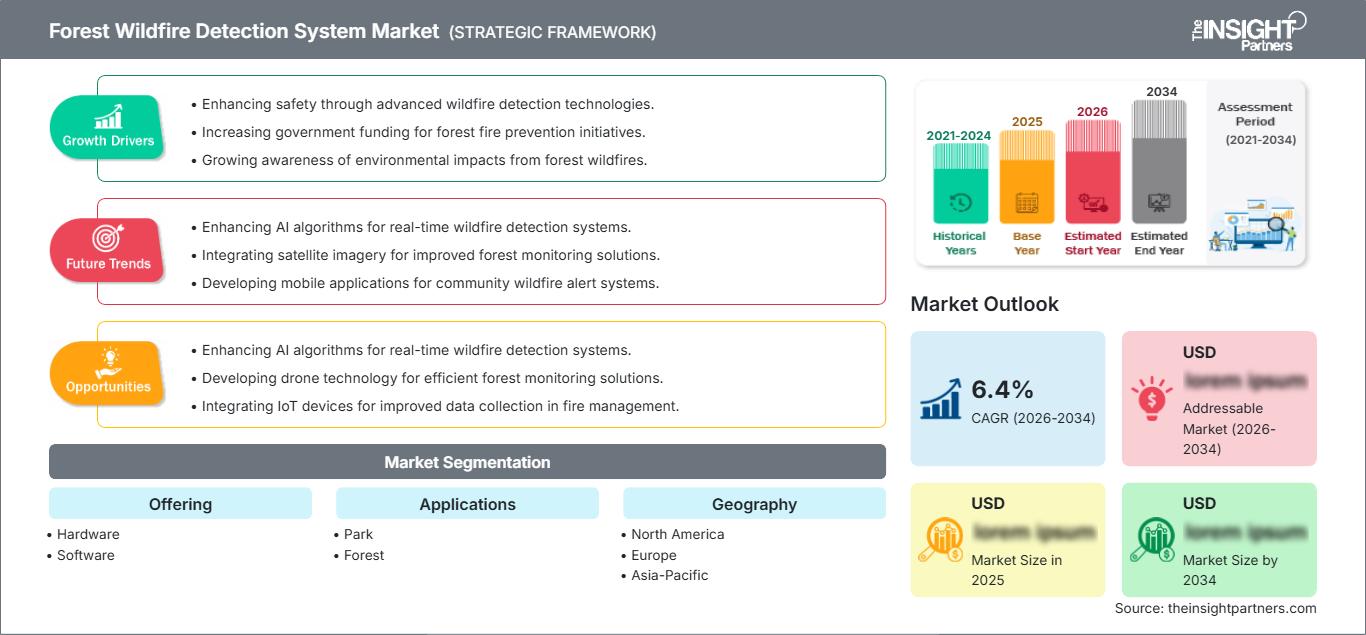
The Forest Wildfire Detection System Market size was valued at US$ 291.84 Million in 2025 and is projected to reach US$ 583.53 Million by 2034, registering a CAGR of 8.00% during 2026–2034. The market encompasses integrated hardware and software used to identify smoke, heat anomalies, and fire ignition points across parks and forests. Increasing deployment of automated surveillance, connected sensors, AI analytics, and geospatial platforms is reshaping early-warning capabilities.
North America remains a structurally important geography, supported by recurring wildfire exposure, extensive forested areas, established emergency-response infrastructure, and public investment in resilience. The Forest Wildfire Detection System size outlook in the region is supported by modernization of legacy observation networks, wider use of thermal and optical cameras, and integration of automated alerts with incident-command platforms. Regional growth is expected to remain above the global average.
Forest Wildfire Detection System Market Assessment and Insights
- North America holds a leading position, with a 2025 Forest Wildfire Detection System Market share of 39–41% and CAGR of 9.5–10.0% between 2026–2034, supported by technology maturity, wildfire exposure, and established public procurement programs.
- US represents approximately 81–82% of North American demand in 2025 and is expected to grow at a CAGR of 9.5–9.8% during 2026–2034, reflecting extensive technology deployment and recurring fire risk.
- Europe accounts for a 28–30% share in 2025 and is projected to expand at a CAGR of 9.6–10.0%, with Germany, the UK, France, Italy, and Spain forming important national markets.
- Asia Pacific represents an 18–20% share in 2025 and is expected to record a CAGR of 10.8–11.3% during 2026–2034, led by China, Japan, India, South Korea, and Australia.
- Largest Segment is Hardware, holding a 2025 market share of 58–59% and expanding at a CAGR of 4.6–5.0%, supported by cameras, sensing equipment, communications, and field infrastructure.
- High Growth Segment is Software, representing a 2025 share of 41–42% and growing at a CAGR of 7.0–7.4%, driven by analytics, AI detection, dashboards, and subscription-based platforms.
- Key companies analyzed in detail: EnviroVision Solutions, Indra Sistemas, S.A., Insight Robotics Limited, IQ Technologies for Earth and Space GmbH, Libelium Comunicaciones Distribuidas S.L., PARATRONIC SAS, Robotics Cats, SENSIA Solutions SL, Smokedsystem (IT for Nature), Xiamen Ursalink Technology Co., Ltd.
Source: The Insight Partners' analysis based on proprietary research, government publications, company annual reports, investor presentations, industry databases, and expert interviews.
The Forest Wildfire Detection System Market has matured from independent watch towers and operators’ visual inspections to a system that integrates thermal imaging, visible cameras, environmental sensors, communications, edge computing, and software. The hardware will be crucial since remote installations require resilient sensing and communication infrastructure, whereas software enabled by AI plays an increasingly important role in defining detection capability, alert classification, geolocation, and integration into emergency management processes.
The Forest Wildfire Detection System Market report shows that for the future, investments will move toward interoperable systems capable of integrating terrestrial observations with satellite images, weather data, geographical information systems, and autonomous systems. Early deployments in Asia Pacific, Southern Europe, and select African regions may well favor modular systems since infrastructure availability is very uneven. Programs for public resilience and adaptation to the climate will contribute to detection system procurement.
Forest Wildfire Detection System Market Report Scope
| Report Attribute | Details |
|---|---|
| Market size in 2025 | US$ 291.84 Million |
| Market Size by 2034 | US$ 583.53 Million |
| Global CAGR (2026 - 2034) | 8.00% |
| Historical Data | 2021-2024 |
| Forecast period | 2026-2034 |
Forest Wildfire Detection System Market Analysis
Furthermore, there is growing demand for technologies which can decrease the period of time from ignition, verification, and dispatch. The Forest Wildfire Detection System Market growth environment consists of such stakeholders as camera and sensor providers, communications providers, AI software developers, systems integrators, forestry departments, parks, emergency services, and specialized service providers. Demand shifts towards solutions which are capable of continuous operation in remote areas and provide efficient communications and maintenance.
Availability of thermal imaging sensors, optical sensors, edge processors, connectivity components, weather stations, and other hardware components plays role in supply dynamics. Thus, hardware providers compete on the level of their reliability and capability of providing coverage while software providers compete on detection accuracy, prevention of false alarms, interoperability, and simplicity of deployment. Such approach allows buyers to make an upgrade to analytics without replacement of full networks in field.
Competitive differentiation is based on combination of proprietary detection features with general command-and-control functions. According to the analysis of the Forest Wildfire Detection System Market, differentiated approaches are observed among the ten profiled players. Specifically, EnviroVision Solutions uses ForestWatch cameras; Indra uses thermal cameras along with predictive and geospatial capabilities; Insight Robotics combines EO/IR sensing, robotics, machine learning, and GIS. IQ Technologies for Earth and Space develops multispectral FireWatch systems; PARATRONIC provides for smoke detection and operator verification.
At the same time, competitive intensity is increasing on the software level. Specifically, Robotics Cats offers AI detection using its LookOut in conjunction with cameras; SENSIA offers infrared hardware along with its own AI-based analytics; Libelium develops wireless sensing capabilities for environmental monitoring. Smokedsystem and Xiamen Ursalink Technology Co., Ltd. expand the competition landscape to software-based smoke detection and Internet of Things (IoT) infrastructure.
● REPORT CUSTOMIZATION
Tailor This Report To Align With Your Specific Business Requirements
This report can be customized to align precisely with your business objectives, scope, and target markets. Customization options include tailored segmentation, geography, competitive analysis, and strategic insights to support informed decision-making.
Customize This Report →WHAT YOU CAN ADJUST
- ● Segmentations
- ● Geography
- ● Competitive Analysis
- ● Language Preferences
Forest Wildfire Detection System Market: Strategic Insights
Regional Insights
North America Forest Wildfire Detection System Market
North America is estimated to command a 2025 share of 39–41%, with a CAGR of 9.5–10.0% through 2034. The US provides the lead demand for the region, backed by regular fires of high severity levels, presence of wildland-urban interface, communication networks, and emergency response initiatives based on technology. Canadian demand comes from forest surveillance needs that are remote, as well as aerial surveillance demands.
Demand in the region has become increasingly focused on camera surveillance that is continuous, use of thermal cameras, AI-based video analytics, and command platforms. Power utilities, forestry organizations, parks, and cities/municipalities are among the key customers due to the risk that wildfires pose to power assets, communities, forests, and parks.
U.S. Forest Wildfire Detection System Market
The US accounts for approximately 81–82% of North American demand in 2025 and is projected to expand at a CAGR of 9.5–9.8%. Procurement is enabled by wildfire exposure in western states, heightened focus on the wildland-urban interface, and need for quick incident confirmation.
The application range includes forests, park lands, utility installations, infrastructure assets, and privately owned properties. Camera analysis, thermal imaging, satellite feed integration, and GIS systems by providers allow for meeting a number of operational needs within one system. EnviroVision Solutions, Insight Robotics, Robotics Cats, and IQ Technologies for Earth and Space GmbH are examples of such companies in North America.
Europe Forest Wildfire Detection System Market
Europe holds an estimated 28–30% share in 2025 and is expected to grow at a CAGR of 9.6–10.0%. Germany leads the regional market, followed by the UK, France, Italy, and Spain. Demand is supported by recurring Mediterranean fire risk, forest protection requirements, and cross-border emergency coordination.
The UK and Germany maintain mature technology adoption profiles, with Germany particularly associated with established automated smoke-monitoring infrastructure. France, Italy, and Spain face stronger seasonal wildfire exposure and increasingly prioritize rapid detection across protected forests and rural communities. Country-level growth ranges are approximately 10.0–10.3% for the UK, 10.3–10.7% for Germany, 9.1–9.4% for France, 9.3–9.6% for Italy, and 10.0–10.3% for Spain.
APAC Forest Wildfire Detection System Market
APAC represents an estimated 18–20% share in 2025 and is expected to expand at a CAGR of 10.8–11.3%. The Chinese lead the region, but Japan, South Korea, India, and Australia present strong demand bases.
Big forest land areas, rugged terrains, drought periods, and government-initiated environmental initiatives encourage usage. The Chinese focus on large-scale monitoring systems, the Japanese merge disaster management systems with automated monitoring systems, while the Australians continue to invest in bushfire monitoring systems. There is growth potential for India and South Korea as environmental monitoring becomes more digitized.
Middle East & Africa Forest Wildfire Detection System Market
MEA is expected to register a CAGR of 8.0–8.5%, with Saudi Arabia leading the Middle Eastern market. Demand is concentrated around protected landscapes, newly developed green areas, agricultural assets, and infrastructure exposed to extreme heat and fire conditions.
Saudi Arabia and the UAE have greater capacity for high-specification technology investment, while South Africa represents an important African market because of commercial forestry, conservation areas, and recurring vegetation fires. Rest of MEA adoption remains more selective, with satellite monitoring, drones, mobile connectivity, and ruggedized sensors offering practical routes where fixed infrastructure is difficult to maintain.
Segmentation Analysis
Offering
Hardware remains the foundational offering because wildfire detection requires physical sensing, communications, power, and field infrastructure. Its 2025 share is estimated at 58–59%, with a CAGR of 4.6–5.0% during 2026–2034. The Forest Wildfire Detection System Market scope increasingly includes thermal cameras, optical cameras, environmental sensors, edge devices, and communications equipment.
- Hardware: Demand centers on ruggedized cameras, thermal sensors, communication units, weather stations, and edge-processing equipment. Replacement cycles and expansion into remote territories sustain procurement, while modular hardware reduces lifecycle disruption.
- Software: Analytics platforms, AI detection engines, visualization tools, GIS interfaces, and alert-management applications increasingly determine system intelligence. Cloud and SaaS models support scalable deployment and recurring revenue structures.
Applications
Park applications are estimated to grow at a CAGR of 5.4–5.8% during 2026–2034. Visitor safety, conservation, protected-area management, and rapid emergency notification shape adoption, particularly where authorities require continuous observation across large recreational or ecological territories.
- Park: Demand emphasizes rapid visitor alerts, perimeter surveillance, remote camera coverage, and integration with park-management systems. Deployment decisions prioritize broad visibility, operational simplicity, and reliable alerts across dispersed protected areas.
Forest applications are projected to grow at a CAGR of 5.7–6.1% during 2026–2034. Larger monitoring footprints, timber protection, biodiversity preservation, and remote terrain create stronger requirements for continuous detection and multi-sensor integration.
- Forest: Forest deployments prioritize early smoke and heat detection, wide-area surveillance, geolocation, and integration with weather information. Fixed towers, thermal cameras, IoT sensors, and AI analytics are strategically important for difficult terrain.
Opportunity Snapshot
| Application | Revenue Contribution | Trend Tag | Adoption Stage |
| Park | Medium | Visitor Safety | Scaling |
| Forest | High | Wide-Area Monitoring | Mature |
Forest Wildfire Detection System Market Growth Drivers and Impact Analysis
Escalating Wildfire Exposure Raises Detection Infrastructure Requirements
The growing severity of wildfires is transforming wildfire detection from an operational activity that occurs seasonally to a resilient one. Various entities such as governments, forestry agencies, utilities companies, and park services require constant surveillance since a fire may start at any time outside the usual period of surveillance and spread quickly due to dry and windy weather conditions. The business implication is that there is a transition towards a solution that works all day and provides automatic alerts rather than relying solely on human monitoring. This means that the demand will persist for camera technology, thermal sensors, connectivity, edge computing, and analytic software. Those vendors who can prove their reliability when working under the effects of smoke, haze, darkness, and different weather conditions stand better chances of being procured.
AI and Multisensor Fusion Improve Detection Decision Quality
AI enhances the worth of the current surveillance infrastructure through automated analysis of visual, infrared, weather-related, and geographic data. Rather than analyzing each signal from a camera/sensor separately, integration platforms can make use of several signals before raising the alarm. This helps reduce operator workload, prioritize real alerts and enhance the reliability of the incidents. For commercial purposes, this increases the need for software solutions that can run on mixed hardware systems. In addition, existing networks of cameras can be upgraded to digital assets rather than becoming obsolete infrastructure. The companies providing APIs, edge analytics, customizable alerts, and GIS integrations will meet the needs of their clients looking to upgrade gradually.
Public Resilience Spending Expands Addressable Procurement Channels
Government agencies remain central buyers because forests, parks, communities, and emergency infrastructure create public responsibilities that cannot be managed solely through private investment. Funding for climate resilience, disaster preparedness, environmental protection, and digital infrastructure can therefore create procurement opportunities for detection systems even where direct commercial returns are difficult to quantify. Public projects also tend to favor interoperable platforms that can connect agencies, emergency responders, utilities, and local authorities. This requirement increases the value of standardized communications, GIS integration, secure data exchange, and configurable alert workflows. For suppliers, successful public-sector deployments can create reference architectures that support expansion into neighboring jurisdictions. Procurement cycles may be lengthy, but contract visibility and multi-year maintenance requirements can provide relatively durable revenue once systems become embedded in operational procedures.
Forest Wildfire Detection System Market Future Trends
Predictive Fire Intelligence Moves Beyond Detection
Future platforms in the Forest Wildfire Detection System Market are likely to combine ignition detection with contextual intelligence that estimates where a fire could move and which assets may be exposed. Instead of treating a detected flame or smoke plume as the endpoint, systems will increasingly combine weather, vegetation, terrain, historical incidents, satellite observations, and live sensor information to create dynamic risk layers. This development will encourage closer integration between detection vendors and emergency-management software providers. Edge computing will remain important because remote installations cannot always depend on uninterrupted cloud connectivity. At the same time, centralized platforms will aggregate alerts from multiple territories, enabling regional command centers to compare conditions and allocate resources. The result will be a gradual transition from alert-centric systems toward decision-support infrastructure capable of prioritizing response actions and continuously updating risk assessments.
Hybrid Space-Air-Ground Monitoring Becomes More Practical
A second major Forest Wildfire Detection System Market trend will be the convergence of satellite observations, drones, fixed cameras, ground sensors, and mobile response assets. Each layer addresses a different coverage constraint: satellites provide geographic scale, drones offer flexible inspection, towers deliver persistent observation, and ground sensors can monitor localized environmental changes. Advances in connectivity and edge processing will make it easier to combine these streams within common operating platforms. Such architectures will be especially relevant in large forests where fixed infrastructure cannot economically cover every area. Vendors will increasingly compete on interoperability and orchestration rather than individual sensor specifications. Procurement models may consequently shift toward integrated monitoring services in which customers purchase coverage, alerts, analytics, and operational support as a combined capability.
Forest Wildfire Detection System Market Opportunities
Scalable Detection-as-a-Service Models
A significant opportunity exists in subscription-based monitoring models that reduce the upfront cost of deploying advanced detection infrastructure. Under a service-oriented structure, customers could pay for camera connectivity, AI analytics, alert management, maintenance, and software updates rather than purchasing every system component outright. This approach is particularly relevant to municipalities, smaller forestry organizations, and protected areas with limited capital budgets. Vendors can create standardized packages for different coverage levels while retaining the ability to integrate customer-owned cameras and sensors. Recurring contracts would also support continuous algorithm improvement and remote system maintenance. The Forest Wildfire Detection System Market Forecast outlook therefore favors providers that can transform capital-intensive deployments into flexible operating expenditure models without compromising reliability, cybersecurity, or response performance.
Emerging-Market Localization and Resilient Infrastructure
Expansion into emerging wildfire-prone regions offers another opportunity, provided suppliers adapt systems to local infrastructure conditions. Markets across Asia, Africa, the Middle East, and parts of Latin America may require solar-powered equipment, low-bandwidth communications, satellite backhaul, ruggedized hardware, and simplified operator interfaces. Localization can extend beyond hardware to include regional weather models, vegetation characteristics, languages, alert protocols, and emergency-service workflows. Partnerships with telecommunications providers, forestry agencies, conservation organizations, and local systems integrators can reduce deployment barriers. Providers that design modular architectures can enter these markets with smaller pilot installations and expand coverage as operational confidence develops. Investment priorities should therefore emphasize adaptability, low maintenance, remote diagnostics, and interoperability rather than relying exclusively on high-density infrastructure models developed for mature markets.
Recent Developments
- July 2026: West Virginia University (WVU) developed the WildFIRE-DS AI framework enabling satellite constellations to autonomously detect and validate wildfires, coordinate observations, and dynamically reposition or reschedule satellites as fires evolve. The system combines AI image analysis, statistical validation, and autonomous satellite tasking to provide emergency responders with more frequent, accurate updates and continuous monitoring without requiring additional spacecraft.
- March 2026: Airbus completed a first-of-its-kind forest firefighting trial integrating aircraft, helicopters, drones, ground personnel, satellite imagery, and AI-enabled data processing. The system analysed and geolocated real-time infrared imagery alongside terrain, wind, and firefighter data to generate a shared tactical picture and transmit optimised flight paths and water-drop points to firefighting aircraft. The development advances Airbus’s digital firefighting ecosystem for faster coordination between aerial and ground teams and shorter detection-to-suppression times.
- April 2026: Satellites on Fire raised $2.7 million in seed funding led by Dalus Capital to expand its AI-powered wildfire detection platform, including its US market entry. The software integrates imagery from more than eight NASA, NOAA, and ESA satellites with tower cameras, fire-propagation modelling, and real-time alerts, with the company reporting detection approximately 35 minutes ahead of NASA’s FIRMS alerts on average. The funding will support AI optimisation, US pilots, a parametric wildfire insurance product with Aon, and a new intelligence dashboard.
Frequently Asked Questions

- Comprehensive Market Sizing and Forecast Analysis
- Detailed Segmentation Analysis
- In-Depth Market Dynamics Assessment
- Regional and Country-Level Insights
- Competitive Landscape and Company Benchmarking
- Strategic Business Intelligence
Recent Reports
Testimonials

The Insight Partners provided valuable market intelligence that supported our global go-to-market strategy. Their team was professional, responsive, and attentive to our feedback, providing thoughtful analysis and helpful methodological clarifications throughout the project.
Junmo Kim Chief Financial Officer (CFO), Enertech Co., Ltd.
The Insight Partners' SCADA System Market report is comprehensive, with valuable insights on current trends and future forecasts. The team was highly professional, responsive, and supportive throughout. We are very satisfied and highly recommend their services.
RAN KEDEM Partner, Reali Technologies LTDs
I requested a report on a very specific software market and the team produced the report in a few days. The information was very relevant and well presented. I then requested some changes and additions to the report. The team was again very responsive and I got the final report in less than a week.
JEAN-HERVE JENN Chairman, Future Analytica
We worked with The Insight Partners for an important market study and forecast. They gave us clear insights into opportunities and risks, which helped shape our plans. Their research was easy to use and based on solid data. It helped us make smart, confident decisions. We highly recommend them.
PIYUSH NAGPAL Sr. Vice President, High Beam Global
The Insight Partners delivered insightful, well-structured market research with strong domain expertise. Their team was professional and responsive throughout. The user-friendly website made accessing industry reports seamless. We highly recommend them for reliable, high-quality research services
YUKIHIKO ADACHI CEO, Deep Blue, LLC.
This is the first time I have purchased a market report from The Insight Partners.While I was unsure at first, I visited their web site and felt more comfortable to take the risk and purchase a market report.I am completely satisfied with the quality of the report and customer service. I had several questions and comments with the initial report, but after a couple of dialogs over email with their analyst I believe I have a report that I can use as input to our strategic planning process.Thank you so much for taking the extra time and making this a positive experience.I will definitely recommend your service to others and you will be my first call when we need further market data.
JOHN SUZUKI President and Chief Executive Officer, Board Director, BK Technologies
I wish to appreciate your support and the professionalism you displayed in the course of attending to my request for information regarding to infectious disease IVD market in Nigeria. I appreciate your patience, your guidance, and the fact that you were willing to offer a discount, which eventually made it possible for us to close a deal. I look forward to engaging The Insight Partners in the future, all thanks to the impression you have created in me as a result of this first encounter.
DR CHIJIOKE ONYIA MANAGING DIRECTOR, PineCrest Healthcare Ltd.Reason to Buy
- Informed Decision-Making
- Understanding Market Dynamics
- Competitive Analysis
- Identifying Emerging Markets
- Customer Insights
- Market Forecasts
- Risk Mitigation
- Boosting Operational Efficiency
- Strategic Planning
- Investment Justification
- Tracking Industry Innovations
- Aligning with Regulatory Trends





 Get Free Sample for