
Frame Grabber Market Size, Growth & Demand by 2034
Coverage: by Application (Factory Automation, Network Security, Transportation Safety and Maintenance, Industrial Camera Manufacturing, Web Inspection, Others); End-user (Manufacturers, System Integrators) , and Geography (North America, Europe, Asia Pacific, and South and Central America)
- Status : Data Released
- Report Code : TIPRE00008369
- Category : Electronics and Semiconductor
- No. of Pages : 150
- Available Report Formats :


- Last update date : August 17, 2026


2025 Market Size
US$ 572.41 Mn
Base year value
2034 Forecast
US$ 1,480.62 Mn
Projected by 2034
CAGR 2026-2034
11.14 %
Growth rate
Addressable Market
US$ 9,064.21 Mn
(2026-2034)
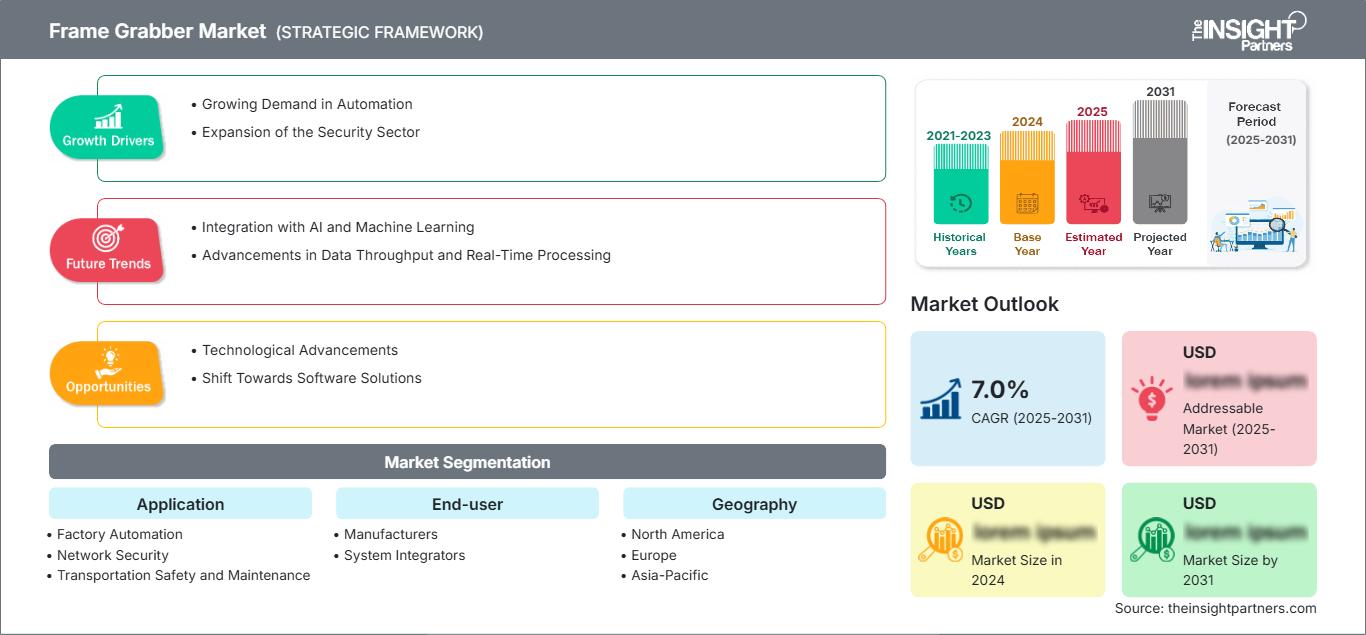
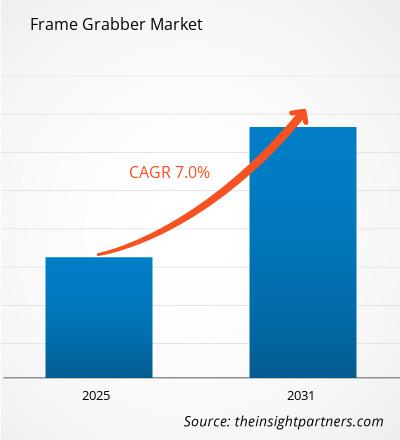
The Frame Grabber Market was valued at US$ 572.41 Million in 2025 and is projected to reach US$1,480.62 Million by 2034, registering a compound annual growth rate (CAGR) of 11.14% during the forecast period from 2026 to 2034. Frame grabbers are specialized hardware devices that capture individual video frames from analog or digital signals, converting them into digital format for processing and analysis in machine vision systems.
The Frame Grabber Market Size in North America is estimated to grow at a CAGR of 6.2% to 6.6% during the forecast period, driven by the increasing adoption of automation in manufacturing and the expansion of surveillance infrastructure. The region's strong emphasis on quality control and precision manufacturing supports sustained demand for high-performance frame grabber solutions across industrial and security applications.
Frame Grabber Market Assessment and Insights
- North America: Accounts for approximately 24% to 28% of the global Frame Grabber Market share in 2025, growing at a CAGR of 6.2%–6.6% from 2026 to 2034. The region is driven by advanced manufacturing automation and strong machine vision adoption across industrial sectors.
- US: Holds a dominant position within North America with a market share of 80%–85% in 2025, growing at a CAGR of 6.4%–6.8% during the forecast period, supported by extensive industrial automation investments and surveillance infrastructure modernization.
- Europe: Accounts for 20%–24% of the global market share in 2025, growing at a CAGR of 6.0%–6.4% from 2026 to 2034. Leading countries include Germany, the UK, and France, with significant demand from automotive manufacturing and industrial automation sectors.
- Asia Pacific: Represents the fastest-growing regional market with a share of 35%–39% in 2025, growing at an impressive CAGR of 8.5%–8.9% during 2026–2034. China, Japan, South Korea, and India are key contributors, driven by rapid industrialization and smart factory initiatives.
- Largest Segment: The Factory Automation application segment dominates the market with a share of 40%–44% in 2025, growing at a CAGR of 9.2%–9.6% during 2026–2034, owing to widespread machine vision integration in production lines for quality control and inspection.
- High Growth Segment: The Industrial Camera Manufacturing segment exhibits the highest growth potential, with a CAGR of 9.8%–10.2% from 2026 to 2034, driven by increasing demand for high-resolution cameras and embedded vision systems across multiple industries.
- Key companies analyzed in detail: Active Silicon, ADLINK Technology Inc., Advantech Co., Ltd., BitFlow, Inc., EPIX, Inc., EURESYS S.A., Imperx, Inc., KAYA Instruments, Matrox, Teledyne DALSA.
Source: The Insight Partners' analysis based on proprietary research, government publications, company annual reports, investor presentations, industry databases, and expert interviews.
The Market evolution reflects a transformative shift from traditional analog capture devices toward advanced digital solutions capable of handling ultra-high-definition imaging and real-time processing requirements. Production dynamics are increasingly characterized by the integration of high-speed interfaces such as PCI Express and CoaXPress, which enable faster data transfer rates and support emerging applications in autonomous systems and smart manufacturing. Manufacturers are investing in developing frame grabbers with embedded artificial intelligence capabilities for on-device processing and analysis.
The future outlook for the Frame Grabber Market indicates significant growth potential in emerging economies, particularly in Southeast Asia and India, where industrial automation investments are accelerating. The growing emphasis on Industry 4.0 and Internet of Things integration is creating new opportunities for frame grabber solutions that enable real-time visual processing and data analytics. Regulatory frameworks promoting quality control standards in pharmaceuticals and food processing continue to support market expansion, with compliance requirements driving demand for high-performance imaging systems across diverse application areas.
Frame Grabber Market Report Scope
| Report Attribute | Details |
|---|---|
| Market size in 2025 | US$ 572.41 Million |
| Market Size by 2034 | US$ 1,480.62 Million |
| Global CAGR (2026 - 2034) | 11.14% |
| Historical Data | 2021-2024 |
| Forecast period | 2026-2034 |
Frame Grabber Market Analysis
The demand-driven nature of the Frame Grabber can be attributed to high-end demands of the manufacturing sector that requires the use of frame grabbers to capture images at high speeds for quality control purposes. This increase in machine vision applications in industrial settings such as semiconductor inspection and robotics guidance calls for the need for high-performing frame grabbers that can handle high-resolution images in the shortest time possible. The supply chain analysis indicates significant integration between frame grabber vendors and camera companies, with key vendors such as Teledyne DALSA, Matrox, and ADLINK Technology having diverse product lines. The supply of frame grabbers depends on the availability of high-performance semiconductors and interface chips.
In the competitive dynamics of the Frame Grabber Market Report, there is a mixture of existing global giants as well as technology-focused firms. The biggest companies occupy a significant chunk of the world market share. Investments in research and development are oriented towards improving data transfer rates, developing efficient image processing solutions, and developing software-based technologies. Such companies as BitFlow, Inc., EURESYS S.A., and Active Silicon have become more inclined to develop products in application-specific sectors such as autonomous vehicle testing, medical imaging, and security surveillance. Competitive advantage depends on factors such as reliability of products, compatibility with different interfaces, and integrated hardware-software solution. Recently, new types of frame grabbers based on CoaXPress 2.0 and Camera Link HS standards have been developed.
● REPORT CUSTOMIZATION
Tailor This Report To Align With Your Specific Business Requirements
This report can be customized to align precisely with your business objectives, scope, and target markets. Customization options include tailored segmentation, geography, competitive analysis, and strategic insights to support informed decision-making.
Customize This Report →WHAT YOU CAN ADJUST
- ● Segmentations
- ● Geography
- ● Competitive Analysis
- ● Language Preferences
Frame Grabber Market: Strategic Insights
Regional Insights
North America Frame Grabber Market
The North America Frame Grabber Market Share is amounting to around 24% to 28% of the worldwide market value in 2025, at a projected CAGR of 6.2% to 6.6% until 2034. Factors driving the growth of this market include the highly developed manufacturing base in the region with significant efforts being made toward the advancement of industrial automation systems and surveillance technology infrastructure in the US and Canada. The presence of prominent players offering machine vision products along with a well-established semiconductor industry helps in fostering innovation as well as ensuring efficient supply chains. Quality and safety standards for automobiles, aerospace products, and pharmaceutical manufacturing processes encourage the need for reliable frame grabbers.
U.S. Frame Grabber Market
The U.S. Market is one of the most dominant markets at the country level in North America, constituting roughly 80%-85% of the regional market share in 2025 and expanding at a CAGR of 6.4%-6.8%. The large number of industries, including semiconductor manufacturing industry, automotive manufacturing industry, and defense electronics industry, is boosting the demand for high-speed image capturing technology among other quality control and automation applications. U.S. has a lot of research and development spending on imaging technology and early adoption of imaging technology. There are some prominent vendors, including BitFlow, Inc., EPIX, Inc., and Teledyne DALSA, that have significant operations in the United States and therefore are making developments in technology and regional markets. Supply chain resiliency and domestic manufacturing trends are making automation technology adoption more common, hence increasing the demand for frame grabbers for automation purposes.
Europe Frame Grabber Market
The Europe makes up about 20%–24% of the global market share in 2025, exhibiting growth at a CAGR of 6.0%–6.4% during the period 2026 to 2034, with Germany, UK, France, Italy, and Spain as dominant regional markets. The Germany market experiences considerable demand for machine vision solutions owing to the presence of an extensive manufacturing base within its automotive and machinery manufacturing industries. The UK is driven by a strong focus on scientific research, medical imaging, and surveillance applications owing to its top-notch research facilities and technology sectors. Aerospace, defense, and transport application make up the major applications in France, whereas Italy contributes towards packaging, robotics, and manufacturing equipment applications. Spain has been witnessing demand for automotive, renewable energy, and industrial upgradeation solutions. The Europe Market is dominated by strict regulatory requirements with respect to industrial safety and quality standards.
APAC Frame Grabber Market
Asia Pacific holds the biggest and fastest-growing market share of around 35%–39% of the total Market share in 2025, where China, Japan, South Korea, India, and Australia play important roles. The market grows at an estimated CAGR of 8.5%–8.9% during the forecast period, backed by fast industrialization, electronics production, robotics, and smart factories. China is the most significant market in the region, as it has a vast manufacturing sector and makes many investments in automation, making it the most significant volume market across the globe. Industrial policies focused on local manufacturing, adoption of smart factories, and capabilities of Industry 4.0 are forming the Market dynamics in the APAC region. India develops in terms of automotive, electronics manufacturing, and public manufacturing initiatives, whereas Japan continues to develop robotics, precision machinery, and factory automation.
Middle East & Africa Frame Grabber Market
The Middle East & Africa Frame Grabber Market presents a promising regional market segment that is expected to show strong growth, which is primarily due to increasing diversity of industries, smart city projects, and security infrastructures development. Saudi Arabia and UAE are among the leading countries in terms of the size of market segments, where a significant number of investments have been made in industry diversification projects and smart cities development projects, resulting in a need for machine vision and security solutions. In addition, the regional market segment is projected to show CAGR of 7.2% – 7.6% within the forecast period due to the increasing investments in energy infrastructure, logistics, and public safety applications. South Africa plays a noticeable role in the African market segment, with the presence of numerous mining operations and industrial processing applications, contributing to the increased use of imaging solutions.
Segmentation Analysis
Application
The Application segment encompasses Factory Automation, Network Security, Transportation Safety and Maintenance, Industrial Camera Manufacturing, Web Inspection, and Others. This segment is expected to register a CAGR of 8.5%–8.9% from 2026 to 2034. The evolution of frame grabber applications reflects the growing demand for high-speed image acquisition across diverse industries, with each application area requiring specific performance characteristics including resolution, frame rate, and interface compatibility. Factory automation remains the dominant application segment due to extensive machine vision deployment.
- Factory Automation: The dominant application segment accounting for 40%–44% of market share in 2025, extensively utilized for quality control, robotic guidance, and process monitoring in manufacturing environments. Frame grabbers enable real-time inspection and defect detection in production lines.
- Network Security: Represents a growing application segment driven by increasing demand for surveillance and security systems requiring high-quality video capture and analysis for public safety and facility protection applications.
- Transportation Safety and Maintenance: Utilizes frame grabbers for traffic monitoring, railway inspection, and infrastructure assessment applications requiring reliable image capture under varying environmental conditions for safety and maintenance purposes.
- Industrial Camera Manufacturing: The fastest-growing application segment with a CAGR of 9.8%–10.2%, driven by increasing demand for high-resolution cameras and embedded vision systems across multiple industries requiring frame grabber integration for image processing and analysis.
- Web Inspection: Used in continuous web processes such as paper, textile, and metal manufacturing for real-time defect detection and quality assessment. Frame grabbers enable high-speed capture and processing of moving web materials.
End-user
The End-user segment comprises Manufacturers and System Integrators. This segment is projected to grow at a CAGR of 8.3%–8.7% from 2026 to 2034. Manufacturers represent the primary end-user segment, directly deploying frame grabber solutions in production lines and quality control applications, while system integrators provide value-added services including system design, integration, and support for comprehensive machine vision solutions.
- Manufacturers: The largest end-user segment, directly deploying frame grabber solutions in production facilities for quality control, automated inspection, and process monitoring applications. Manufacturing industries increasingly rely on machine vision for quality assurance and defect detection.
- System Integrators: Represent a growing end-user segment providing customized machine vision solutions integrating frame grabbers with cameras, lighting, and software for specific application requirements. System integrators offer value-added services including system design, integration, and ongoing technical support.
Opportunity Snapshot
| Application Segment | Revenue Contribution | Trend Tag | Adoption Stage |
|---|---|---|---|
| Factory Automation | High | Quality Inspection | Mature |
| Network Security | Medium | Surveillance Modernization | Scaling |
| Transportation Safety and Maintenance | Medium | Infrastructure Monitoring | Scaling |
| Industrial Camera Manufacturing | High | Embedded Vision | Emerging |
| Web Inspection | Medium | Process Control | Mature |
Frame Grabber Market Growth Drivers and Impact Analysis
Industrial Automation and Smart Factory Expansion
The accelerating adoption of industrial automation and smart factory initiatives is a primary driver for the Market, as manufacturers increasingly deploy machine vision systems for quality control, robotics guidance, and process monitoring applications. The growing emphasis on Industry 4.0 and digital transformation in manufacturing necessitates high-speed image acquisition solutions capable of handling high-resolution imaging for precise inspection and defect detection. The market impact is evident in the increasing integration of frame grabbers in automated production lines across automotive, electronics, and pharmaceutical industries, where real-time visual inspection ensures product quality and reduces waste. Manufacturers such as Teledyne DALSA and Matrox are developing advanced frame grabber solutions with enhanced processing capabilities to meet the demanding requirements of modern factory automation environments.
Advancements in Imaging Technologies and Interfaces
Continuous advancements in imaging technologies and high-speed interfaces represent a significant driver for the Market, as the development of ultra-high-definition cameras and faster data transfer standards creates demand for compatible capture hardware. The introduction of interfaces such as CoaXPress 2.0 and Camera Link HS enables frame grabbers to handle increasing data rates from high-resolution, high-frame-rate cameras essential for demanding applications. The market impact includes the development of frame grabbers capable of supporting emerging camera technologies and interface standards, with manufacturers investing in products that offer greater bandwidth and lower latency for real-time processing in automotive testing, semiconductor inspection, and medical imaging applications.
Growing Demand for Surveillance and Security Solutions
The increasing demand for surveillance and security solutions in both public and private sectors is driving growth in the Market, as frame grabbers enable reliable video capture and processing for network security and public safety applications. Government initiatives promoting smart city development and transportation safety are creating substantial demand for high-performance imaging solutions capable of capturing and analyzing video streams in real-time for threat detection and incident monitoring. The market impact includes increased adoption of frame grabbers in traffic monitoring, border security, and critical infrastructure protection applications, where high-quality image acquisition is essential for effective monitoring and response. Market participants are developing specialized solutions for security applications that offer robust performance in challenging environmental conditions.
Frame Grabber Market Future Trends
Artificial Intelligence Integration for On-Device Processing
The integration of artificial intelligence and machine learning capabilities into frame grabber solutions is emerging as a transformative Frame Grabber Market Trend, with manufacturers developing products that incorporate AI acceleration for on-device image analysis and processing. AI-powered frame grabbers enable real-time defect detection, pattern recognition, and anomaly identification without requiring data transfer to external processing systems, reducing latency and bandwidth requirements for demanding applications. This trend reflects the growing demand for intelligent edge processing solutions in manufacturing, autonomous systems, and security applications. Market participants are investing in developing frame grabbers with embedded AI capabilities that combine high-speed image capture with sophisticated analysis algorithms, enabling smarter and more efficient vision systems.
Software-Defined and Flexible Frame Grabber Architectures
The development of software-defined and flexible frame grabber architectures is transforming the market landscape, as manufacturers move toward solutions that offer greater flexibility, interoperability, and field-upgradable capabilities. Software-defined frame grabbers enable users to adapt to changing interface standards and application requirements through firmware updates, extending product lifecycle and reducing total cost of ownership. This trend reflects the growing demand for adaptable solutions that can accommodate evolving camera technologies and processing requirements without hardware replacement. Manufacturers are increasingly offering software development kits and application programming interfaces that enable system integrators to customize frame grabber functionality for specific applications, creating new opportunities for differentiation and value-added services.
Frame Grabber Market Opportunities
Expansion in Emerging Markets and Industrialization
Significant opportunities exist in the Frame Grabber Market sforecast arising from the expansion of manufacturing and automation infrastructure in emerging economies, particularly in Southeast Asia, India, and Latin America. Government-led industrialization initiatives and smart factory programs are creating substantial demand for machine vision solutions, including frame grabbers for quality control and automation applications. Investment opportunities include developing region-specific product variants suited to local infrastructure conditions and price sensitivities, establishing distribution partnerships, and participating in industrial modernization programs. The growing emphasis on manufacturing quality and competitiveness in emerging economies is driving adoption of advanced imaging technologies, creating favorable conditions for market expansion.
Emerging Applications in Autonomous Systems and Healthcare
The emergence of new applications in autonomous systems and healthcare presents significant opportunities for the Market, as these sectors require high-performance imaging solutions for navigation, diagnostics, and inspection tasks. Autonomous vehicles, drones, and robotics applications demand frame grabbers capable of capturing and processing high-resolution video streams for environment perception and navigation. Healthcare applications including medical imaging, diagnostics, and surgical robotics require specialized frame grabber solutions with stringent reliability and certification requirements. Investment opportunities include developing application-specific frame grabber solutions for autonomous systems and medical imaging, establishing partnerships with system integrators and equipment manufacturers, and creating solutions that meet regulatory requirements for healthcare applications.
Recent Developments
- July 2026: BitFlow highlighted its DDR-free architecture for frame grabbers, enabling continued product availability amid global memory supply constraints. Unlike conventional frame grabber designs that rely on onboard DDR memory for image buffering, BitFlow's solutions use scatter-gather DMA technology to transfer image data directly into host system memory, reducing latency, minimizing CPU usage, and eliminating dependency on DDR components. The architecture supports high-speed imaging interfaces such as Camera Link and CoaXPress, making it suitable for machine vision, semiconductor inspection, life sciences, and defense applications. This innovation strengthens BitFlow's position in the frame grabber market by improving supply-chain resilience while delivering high-bandwidth, low-latency image acquisition for advanced vision systems.
- June 2025: iWave Global expanded into the video and vision market with the launch of a new portfolio of high-performance frame grabbers, including HDMI 2.1, 12G-SDI, and ARINC 818 solutions. Designed for AI vision, industrial automation, medical imaging, broadcasting, aerospace, and defense applications, the frame grabbers support ultra-low-latency 4K/8K video capture and high-speed data transfer while leveraging FPGA-based processing for advanced imaging performance. This launch strengthens iWave Global's position in the market by broadening its embedded vision portfolio and addressing the growing demand for high-bandwidth image acquisition and processing solutions across multiple industries.
- December 2025: Teledyne DALSA introduced the Xtium™3 PCIe Gen4 Frame Grabber Series for ultra-fast image acquisition in high-performance machine vision applications. Built on the PCIe Gen4 platform, the new series delivers sustained host transfer rates of up to 13.2 GB/s, supports Camera Link HS (CLHS) interfaces, and enables real-time image processing with reduced CPU overhead for industrial automation, semiconductor inspection, life sciences, and advanced imaging systems. This launch strengthens Teledyne's position in the market by expanding its high-speed image acquisition portfolio and meeting the increasing demand for scalable, high-bandwidth machine vision solutions.
Frequently Asked Questions

- Comprehensive Market Sizing and Forecast Analysis
- Detailed Segmentation Analysis
- In-Depth Market Dynamics Assessment
- Regional and Country-Level Insights
- Competitive Landscape and Company Benchmarking
- Strategic Business Intelligence
Recent Reports
Testimonials

The Insight Partners provided valuable market intelligence that supported our global go-to-market strategy. Their team was professional, responsive, and attentive to our feedback, providing thoughtful analysis and helpful methodological clarifications throughout the project.
Junmo Kim Chief Financial Officer (CFO), Enertech Co., Ltd.
The Insight Partners' SCADA System Market report is comprehensive, with valuable insights on current trends and future forecasts. The team was highly professional, responsive, and supportive throughout. We are very satisfied and highly recommend their services.
RAN KEDEM Partner, Reali Technologies LTDs
I requested a report on a very specific software market and the team produced the report in a few days. The information was very relevant and well presented. I then requested some changes and additions to the report. The team was again very responsive and I got the final report in less than a week.
JEAN-HERVE JENN Chairman, Future Analytica
We worked with The Insight Partners for an important market study and forecast. They gave us clear insights into opportunities and risks, which helped shape our plans. Their research was easy to use and based on solid data. It helped us make smart, confident decisions. We highly recommend them.
PIYUSH NAGPAL Sr. Vice President, High Beam Global
The Insight Partners delivered insightful, well-structured market research with strong domain expertise. Their team was professional and responsive throughout. The user-friendly website made accessing industry reports seamless. We highly recommend them for reliable, high-quality research services
YUKIHIKO ADACHI CEO, Deep Blue, LLC.
This is the first time I have purchased a market report from The Insight Partners.While I was unsure at first, I visited their web site and felt more comfortable to take the risk and purchase a market report.I am completely satisfied with the quality of the report and customer service. I had several questions and comments with the initial report, but after a couple of dialogs over email with their analyst I believe I have a report that I can use as input to our strategic planning process.Thank you so much for taking the extra time and making this a positive experience.I will definitely recommend your service to others and you will be my first call when we need further market data.
JOHN SUZUKI President and Chief Executive Officer, Board Director, BK Technologies
I wish to appreciate your support and the professionalism you displayed in the course of attending to my request for information regarding to infectious disease IVD market in Nigeria. I appreciate your patience, your guidance, and the fact that you were willing to offer a discount, which eventually made it possible for us to close a deal. I look forward to engaging The Insight Partners in the future, all thanks to the impression you have created in me as a result of this first encounter.
DR CHIJIOKE ONYIA MANAGING DIRECTOR, PineCrest Healthcare Ltd.Reason to Buy
- Informed Decision-Making
- Understanding Market Dynamics
- Competitive Analysis
- Identifying Emerging Markets
- Customer Insights
- Market Forecasts
- Risk Mitigation
- Boosting Operational Efficiency
- Strategic Planning
- Investment Justification
- Tracking Industry Innovations
- Aligning with Regulatory Trends





 Get Free Sample for