
Frequency Synthesizer Market Growth, Trends & Forecast by 2034
Coverage: by Type (Analog, Digital); Application (Research and Measurement, Military and Aerospace, Telecommunications) , and Geography (North America, Europe, Asia Pacific, and South and Central America)
- Status : Data Released
- Report Code : TIPRE00011662
- Category : Electronics and Semiconductor
- No. of Pages : 150
- Available Report Formats :


- Last update date : August 17, 2026


2025 Market Size
US$ 1.97 Bn
Base year value
2034 Forecast
US$ 2.98 Bn
Projected by 2034
CAGR 2026-2034
4.71 %
Growth rate
Addressable Market
US$ 22.48 Bn
(2026-2034)
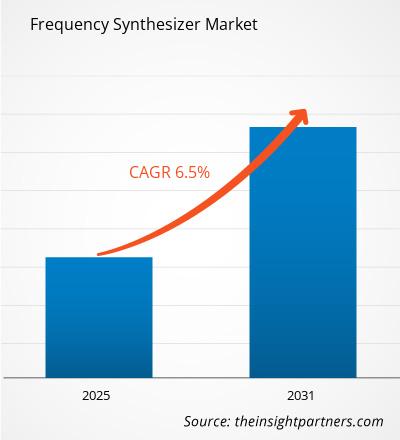
The global Frequency Synthesizer market was valued at US$ 1.97 billion in 2025 and is expected to reach US$ 2.98 billion by 2034; it is estimated to record a CAGR of 4.71% during 2026-2034.
Frequency Synthesizer Market Assessment and Insights
- North America represented 32–34% share in 2025 and is projected to grow at a 4.8–5.4% CAGR during 2026–2034, supported by defense electronics, satellite payloads, semiconductor testing, and advanced wireless infrastructure.
- US accounted for 78–82% of North American revenue in 2025 and is expected to grow at a 4.9–5.5% CAGR through 2034.
- Europe held 25–27% share in 2025 and should register a 4.5–5.1% CAGR, led by Germany, the UK, and France across aerospace, industrial test, and communications programs.
- Asia Pacific captured 29–31% share in 2025 and is forecast to advance at a 6.0–6.6% CAGR, with China, Japan, South Korea, and India driving telecom and electronics demand.
- Largest Segment Analog held 61–65% market share in 2025 and is projected to post a 4.4–5.0% CAGR during 2026–2034.
- High Growth Segment Digital represented 35–39% market share in 2025 and is expected to expand at a 6.5–7.1% CAGR during 2026–2034.
- Key companies analyzed in detail: Analog Devices, Inc.; EM Research, Inc.; FEI-Elcom Tech, Inc.; L3Harris Technologies, Inc.; Narda-MITEQ; Micro Lambda Wireless, Inc.; National Instruments Corporation; Programmed Test Sources, Inc.; Qorvo, Inc.; SignalCore, Inc.; and Texas Instruments Incorporated.
Source: The Insight Partners' analysis based on proprietary research, government publications, company annual reports, investor presentations, industry databases, and expert interviews.
From mixer/divider-type discrete units, frequency synthesizers advanced towards fractional N PLL, direct digital synthesis, and combinations thereof. Consequently, this leads to reduced space requirement, improved calibration, and fast frequency hopping via increased bandwidth. The production process is turning towards mixed-signal semiconductor devices; however, the specialized module manufacturers remain active in cases where extremely low phase noise, robustness, or custom frequency generation would warrant higher cost per device. Such tendencies are an example of how the Market evolves towards software-programmable radio/analyzer/radar/coherent instrument signal chains.
Until 2034, investments will go into millimeter-wave timing, chiplet clocking systems, tough military supply chains, and native electronics initiatives in Asia and the Middle East. Efficiency of the spectrum usage and increased electromagnetic compatibility needs will be beneficial for those manufacturers that produce synthesizers with low spurious content and simple calibration procedure. Additional revenue will come from satellite ground stations, quantum control instruments, and private wireless network applications where coherent multi-channel operation may prevail over cost per part.
Frequency Synthesizer Market Report Scope
| Report Attribute | Details |
|---|---|
| Market size in 2025 | US$ 1.97 Billion |
| Market Size by 2034 | US$ 2.98 Billion |
| Global CAGR (2026 - 2034) | 4.71% |
| Historical Data | 2021-2024 |
| Forecast period | 2026-2034 |
Frequency Synthesizer Market Analysis
Growth in Frequency Synthesizer market comes from high carrier frequencies, more channelization and phase noise requirements. Multiband radios require flexible local oscillators from telecom equipment suppliers; reliable sources are required by research laboratories for testing; frequency hopping ability and coherent radar functionality is needed for military applications. The value chain includes crystal oscillators, mixed signal chips, packaging, loop filters, software/firmware and distribution.
Supply conditions vary depending on product category. Bulk ICs are helped by economies of scale of semiconductors, but qualification times are still long for aviation and metrology-oriented modules. Customers increasingly adopt dual suppliers of crystal oscillators and RF circuitry to mitigate risk related to specialty substrate shortages. It enables reusability, pin-compatible improvements, and modularity reducing redesign time while maintaining good spectra purity.
According to Frequency Synthesizer Market report, competition includes broadline semiconductor firms and specialized microwave companies. For example, Analog Devices, Inc. and Texas Instruments Incorporated focus on their comprehensive RF and clocking solutions, whereas Qorvo, Inc. integrates synthesis with frequency conversion. SignalCore, Inc., EM Research, Inc., FEI-Elcom Tech, Inc., Narda-MITEQ, Micro Lambda Wireless, Inc. and Programmed Test Sources, Inc. set themselves apart by offering low-noise modules, customization and robustness.
Modern positioning is more about the ability to support applications, design references, evaluation systems and interfaces than wide frequency range. National Instruments Corporation aligns synthesis with automated test flows, and L3Harris Technologies, Inc. adds mission-system integration expertise. Hence, capital is allocated toward platforms that can be reused, packaging which provides improved thermal behavior and calibration methods able to maintain performance in temperature range and during manufacturing.
● REPORT CUSTOMIZATION
Tailor This Report To Align With Your Specific Business Requirements
This report can be customized to align precisely with your business objectives, scope, and target markets. Customization options include tailored segmentation, geography, competitive analysis, and strategic insights to support informed decision-making.
Customize This Report →WHAT YOU CAN ADJUST
- ● Segmentations
- ● Geography
- ● Competitive Analysis
- ● Language Preferences
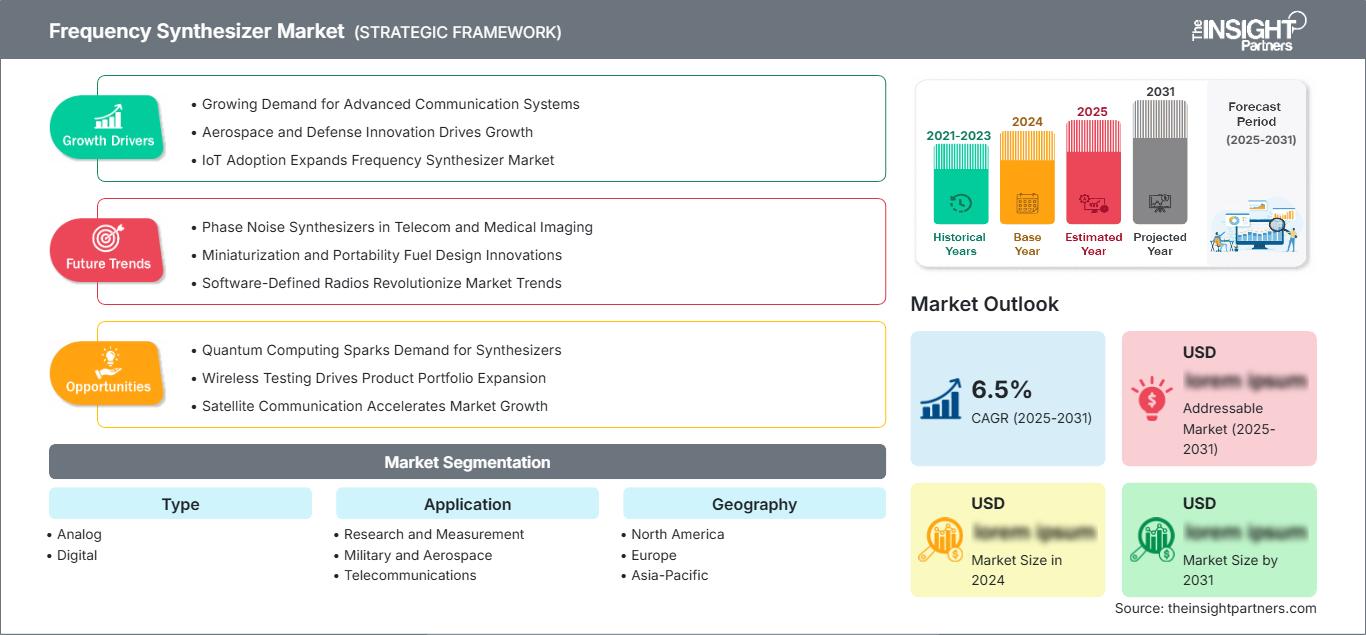
Frequency Synthesizer Market: Strategic Insights
Regional Insights
North America Frequency Synthesizer Market
The Frequency Synthesizer Market Share in North America was worth 32%–34% in 2025 and is forecasted to register a CAGR of 4.8%–5.4% till 2034. This region is favored by consistent purchases for electronic warfare, phased array radar, satellite payloads, and sophisticated testing equipment. Local semiconductor design expertise along with microwave laboratories enables timely qualification of low jitter wideband devices before they are utilized in critical applications.
Increased commercial requirement results from the 5G radio frequency refreshes, private networks, and fast data converter clocking. Purchasing policies favor manufacturers providing evaluation boards, simulation capabilities, and life cycle management as the cost of qualification may exceed that of the product itself. Canada supplies the region through its satellite communication facilities and research laboratories, and Mexico is represented by its electronics manufacturing capabilities.
U.S. Frequency Synthesizer Market
North America was 78-82% share of US in 2025 and it is expected to witness a 4.9-5.5% CAGR from 2026 through 2034. The region has a large footprint owing to its concentration in defense electronics, space systems development, semiconductor testing and RF instruments. Analog Devices, Inc., National Instruments Corporation, Qorvo, Inc., Texas Instruments Incorporated and specialized module suppliers have design teams, sales force or manufacturing operations that minimize customer development timelines.
Changing applications include coherent multi-channel radar, software defined radio, automated test and satellite ground station equipment. Increasing requirements include phase coherence, microsecond switch times, capability for an external reference and programmability of the system. Federal modernization budgets favor rugged modules, while laboratory facilities opt for PLL-VCOs to save on space and calibration time. Certification cycles are long enough to preserve established product designs and incentivize backward compatible upgrades.
Europe Frequency Synthesizer Market
Europe represented 25%–27% of the worldwide market in 2025 and is anticipated to grow at a 4.5%–5.1% CAGR till 2034. Germany holds sway due to its industrial measuring, automotive electronics validation, and communications engineering. The United Kingdom stands out in radar, electronic warfare, satellite payloads, and university research work, thereby maintaining the need for low phase noise sources and modular microwave sources.
Aerospace, Defense & Space Applications require coherent timekeeping and electromagnetic radiation design. Italy makes contribution through telecommunications & avionics equipment, while Spain adds research & development activities & satellite ground segment. Energy efficiency, electromagnetic compatibility, and supply chain transparency are gaining importance in European procurement decision making. European semiconductor projects will enhance design sovereignty but fragmented certifications may prolong commercialization beyond consumer market consolidation.
APAC Frequency Synthesizer Market
The Asia Pacific region had a market share of 29-31% in 2025 and is predicted to grow at the highest regional rate with a 6.0-6.6% CAGR. China dominates through telecommunication infrastructure and electronic manufacturing whereas Japan and South Korea have inputs such as precision components, semiconductor manufacturing equipment, and sophisticated wireless systems.
Defense localization programs and space applications within India have increased the scope of the market while Australia contributes satellite communication and instrument research. The policy-driven initiatives to develop the domestic semiconductor ecosystem can increase the region’s supply chain resilience but customers will still find a balance between local procurement and importation of devices based on performance specifications.
Middle East & Africa Frequency Synthesizer Market
The Middle East and Africa is forecasted to grow at a CAGR of 5.2–5.8% up until 2034. The leadership of Saudi Arabia lies in defense localization, satellite communication, and industrial digitalization, while the UAE bets on space, secure communication, and research facilities.
The contribution of South Africa is represented by radio astronomy, telecommunication, and test facilities. For the rest of the countries, the driver is the infrastructure development. Energy projects, remote connectivity, and airport modernization generate demand for timing devices. Growth is limited by import dependency and specialized expertise, thus partners in distribution channels and trainings are preferred.
Segmentation Analysis
Type
The Type segment is projected to grow at a 5.1–5.7% CAGR during 2026–2034. The Frequency Synthesizer Market scope covers analog and digital architectures, with purchasing determined by spectral purity, switching speed, programmability, power consumption, and integration. Analog devices retain mission-critical relevance, while digital solutions gain where agile control, fine resolution, and repeatable software configuration outweigh conversion and spur-management complexity.
- Analog remains the largest type because low phase noise and continuous-time signal behavior suit radar, microwave links, and precision instrumentation requiring stable spectral performance.
- Digital gains strategic importance in software-defined radios and automated test platforms, where fine frequency resolution, rapid reconfiguration, repeatability, and digital control simplify multiband operation.
Application
The Application segment should register a 5.0–5.6% CAGR through 2034. Demand spans laboratory signal generation, mission systems, and communications infrastructure, with each use case applying different trade-offs among bandwidth, noise, cost, and qualification. Telecommunications supplies recurring volume, military and aerospace supports premium performance, and research and measurement drives early adoption of wider-band, software-controllable architectures before they migrate into production platforms.
- Research and Measurement purchases prioritize traceable accuracy, low residual noise, flexible reference inputs, and instrument automation for semiconductor, communications, physics, and calibration workflows.
- Military and Aerospace demand centers on rapid hopping, coherent radar, secure communications, rugged packaging, lifecycle assurance, and dependable operation across temperature, vibration, and radiation conditions.
- Telecommunications represents broad deployment potential as multiband radios, microwave backhaul, satellite terminals, and private networks require compact, efficient, and programmable local-oscillator generation.
Opportunity Snapshot
| Application | Revenue Contribution | Trend Tag | Adoption Stage |
| Research and Measurement | Medium | Coherent Test | Mature |
| Military and Aerospace | High | Agile Radar | Scaling |
| Telecommunications | High | Multiband Radios | Scaling |
Frequency Synthesizer Market Growth Drivers and Impact Analysis
Expansion of Spectrum-Intensive Wireless Infrastructure
5G densification, private wireless networks, microwave backhaul, and satellite communications all present continuous needs for fast and spectrally clean local oscillators. Each new frequency band adds to the challenges of calibration and the need for wideband synthesizers that accommodate multiple radio types. Network equipment manufacturers enjoy the reduced part count offered by PLL/VCO solutions, while network operators enjoy lower power consumption and easier maintenance. Beyond its implications for base station hardware, the demand for synthesizers has an even larger reach because test labs, handset validation lines, and field service equipment all have to replicate increasingly sophisticated carriers.
Modernization of Radar and Electronic Warfare Systems
Defense programs increasingly use active electronically scanned arrays, cognitive electronic warfare, and frequency-agile communications, all of which depend on coherent and rapidly tunable sources. Low phase noise improves radar sensitivity, while short settling time supports agile waveforms and interference avoidance. These specifications favor specialist suppliers capable of rugged packaging, deterministic synchronization, and long lifecycle support. Program qualification can take years, but successful designs often remain in production through multiple upgrades, creating durable revenue. Domestic sourcing policies also encourage regional manufacturing and second-source strategies. Consequently, defense modernization affects product architecture, documentation, component traceability, and capacity planning rather than merely increasing unit demand.
Rising Precision Requirements in Automated Test
Semiconductor, photonics, quantum, and communications laboratories require repeatable frequency generation across broader bandwidths with lower jitter and tighter channel alignment. As devices integrate more RF paths, test systems must stimulate and measure several coherent signals without multiplying rack space or calibration time. This supports modular synthesizers with remote APIs, shared references, and self-calibration routines. Production impact is significant because faster switching raises throughput, while stable phase performance reduces false failures and retest costs. Vendors that connect hardware to automated workflows can command stronger customer loyalty than component-only suppliers. The driver therefore expands demand for both embedded sources and complete instrument subsystems.
Frequency Synthesizer Market Future Trends
Digitally Assisted Calibration Becomes Standard
Frequency Synthesizer Market trends will increasingly center on background calibration that compensates temperature drift, process variation, reference aging, and frequency-dependent spurs without interrupting operation. Embedded telemetry will allow systems to monitor lock quality and predict maintenance needs. Suppliers will combine fractional-N loops, DDS fine tuning, and digital predistortion to balance switching speed with spectral purity. Over time, customers will evaluate calibration algorithms as part of the product’s defensible intellectual property, not merely supporting firmware. This will favor architectures with secure update paths, documented diagnostics, and repeatable multichannel synchronization across radio, radar, and precision-test platforms.
Higher Integration Across the RF Signal Chain
Future products will integrate synthesizers with mixers, dividers, clock distribution, and monitoring functions to reduce board area and simplify wideband radio design. Packaging advances should improve isolation between digital control and sensitive analog paths, enabling compact modules without sacrificing spurious performance. Integration will also shift supplier competition toward complete reference platforms and verified signal-chain behavior. Customers may accept fewer discrete optimization choices in exchange for faster certification, lower power, and predictable thermal performance. Specialist modules will remain relevant at extreme frequencies, but mainstream volume will favor configurable devices spanning several bands and applications.
Frequency Synthesizer Market Opportunities
Localized Supply for Sovereign Defense and Space Programs
Frequency Synthesizer Market Forecasts support investment in regional assembly, screening, and calibration capabilities serving sovereign defense and space initiatives. New entrants need not replicate leading-edge semiconductor fabrication; they can create value through qualified packaging, reference integration, environmental testing, and application-specific firmware. Partnerships with established chip vendors can shorten development while meeting local-content requirements. Investors should target countries expanding satellite communications, radar, and secure radio production, where imported modules remain a bottleneck. Commercial success will depend on traceability, export-control competence, and multiyear support commitments. A localized model can also serve adjacent civil applications, improving utilization between program production cycles.
Coherent Sources for Quantum and Photonic Research
Quantum-control experiments, photonic links, and advanced sensing require several phase-coherent microwave tones with exceptionally low jitter and flexible synchronization. These applications remain smaller than telecommunications but offer attractive margins and influence future commercial architectures. Suppliers can enter through modular sources, shared-reference distribution, low-noise clocking, and software that coordinates channels. Collaboration with national laboratories and university facilities can generate early validation and application knowledge. To convert research orders into scalable business, vendors should standardize interfaces, publish noise characterization, and design upgradeable platforms capable of supporting additional channels and higher frequencies without replacing the entire control stack.
Recent Developments
- February 2025: Keysight Technologies expanded its RF and microwave instrumentation portfolio with the launch of new compact signal generators, RF synthesizers, and signal source analyzers. The new solutions are designed to support faster testing, improved signal purity, and flexible deployment for wireless communications, radar, defense, and advanced electronics applications. The frequency synthesizer additions provide engineers with high-performance signal generation capabilities, compact designs, and improved efficiency for component testing and system development.
- June 2025: Anritsu launched the EcoSyn Lite MG36021A Microwave Synthesizer Module, offering high-performance frequency generation in a compact form factor. The module provides low phase noise, rapid switching speed, and a frequency range from 10 MHz to 20 GHz, making it suitable for space-constrained applications requiring precision continuous-wave signal sources. The solution expands Anritsu’s signal generator portfolio and supports demanding RF testing requirements across communications, aerospace, and electronic measurement industries.
- June 2025: Mixed-Signal Devices introduced the MS4022 Frequency Synthesizer, designed to deliver advanced RF performance with output frequencies up to 22 GHz and ultra-low jitter of 25 fs RMS. The new synthesizer targets next-generation radar, wireless infrastructure, phased-array systems, and high-precision test equipment applications. The device addresses growing industry requirements for improved timing accuracy, lower noise, and enhanced signal quality in advanced RF and communication systems.
Frequently Asked Questions

- Comprehensive Market Sizing and Forecast Analysis
- Detailed Segmentation Analysis
- In-Depth Market Dynamics Assessment
- Regional and Country-Level Insights
- Competitive Landscape and Company Benchmarking
- Strategic Business Intelligence
Recent Reports
Testimonials

The Insight Partners' SCADA System Market report is comprehensive, with valuable insights on current trends and future forecasts. The team was highly professional, responsive, and supportive throughout. We are very satisfied and highly recommend their services.
RAN KEDEM Partner, Reali Technologies LTDs
I requested a report on a very specific software market and the team produced the report in a few days. The information was very relevant and well presented. I then requested some changes and additions to the report. The team was again very responsive and I got the final report in less than a week.
JEAN-HERVE JENN Chairman, Future Analytica
We worked with The Insight Partners for an important market study and forecast. They gave us clear insights into opportunities and risks, which helped shape our plans. Their research was easy to use and based on solid data. It helped us make smart, confident decisions. We highly recommend them.
PIYUSH NAGPAL Sr. Vice President, High Beam Global
The Insight Partners delivered insightful, well-structured market research with strong domain expertise. Their team was professional and responsive throughout. The user-friendly website made accessing industry reports seamless. We highly recommend them for reliable, high-quality research services
YUKIHIKO ADACHI CEO, Deep Blue, LLC.
This is the first time I have purchased a market report from The Insight Partners.While I was unsure at first, I visited their web site and felt more comfortable to take the risk and purchase a market report.I am completely satisfied with the quality of the report and customer service. I had several questions and comments with the initial report, but after a couple of dialogs over email with their analyst I believe I have a report that I can use as input to our strategic planning process.Thank you so much for taking the extra time and making this a positive experience.I will definitely recommend your service to others and you will be my first call when we need further market data.
JOHN SUZUKI President and Chief Executive Officer, Board Director, BK Technologies
I wish to appreciate your support and the professionalism you displayed in the course of attending to my request for information regarding to infectious disease IVD market in Nigeria. I appreciate your patience, your guidance, and the fact that you were willing to offer a discount, which eventually made it possible for us to close a deal. I look forward to engaging The Insight Partners in the future, all thanks to the impression you have created in me as a result of this first encounter.
DR CHIJIOKE ONYIA MANAGING DIRECTOR, PineCrest Healthcare Ltd.Reason to Buy
- Informed Decision-Making
- Understanding Market Dynamics
- Competitive Analysis
- Identifying Emerging Markets
- Customer Insights
- Market Forecasts
- Risk Mitigation
- Boosting Operational Efficiency
- Strategic Planning
- Investment Justification
- Tracking Industry Innovations
- Aligning with Regulatory Trends





 Get Free Sample for