
Gaming Laptop Market Size, Share & Trends by 2034
Coverage: by Components (RAM Size, Storage, Graphics Card, Display Size, Others); Price Range (Entry-Level Laptops, Mid-Range Laptops, High-End Laptops) , and Geography (North America, Europe, Asia Pacific, and South and Central America)
- Status : Data Released
- Report Code : TIPRE00010276
- Category : Electronics and Semiconductor
- No. of Pages : 150
- Available Report Formats :


- Last update date : August 17, 2026


2025 Market Size
US$ 21.91 Bn
Base year value
2034 Forecast
US$ 45.72 Bn
Projected by 2034
CAGR 2026-2034
8.52 %
Growth rate
Addressable Market
US$ 303.44 Bn
(2026-2034)
The Gaming Laptop Market was valued at US$ 21.91 Billion in 2025 and is projected to reach US$ 45.72 Billion by 2034, registering a CAGR of 8.52% during 2026–2034. Demand is being shaped by high-refresh displays, discrete GPUs, AI-ready processors, improved thermal modules, and the rising use of portable performance systems for gaming, streaming, design, and creator workflows.
North America remains a major revenue center, with the Gaming Laptop Market size supported by esports infrastructure, premium replacement cycles, and higher attach rates for RTX-class notebooks. The region is estimated to expand at a CAGR of 7.6%–8.1% during 2026–2034, as consumers upgrade from 1080p systems toward OLED, mini-LED, Wi-Fi 7, and AI-assisted performance tuning.
Gaming Laptop Market Assessment and Insights
- North America: Share in 2025 is estimated at 27%–31%, with CAGR between 2026 – 2034 at 7.6%–8.1%, driven by premium gaming adoption, creator use cases, and strong online retail penetration.
- US: Share in 2025 is 82%–87% of North America, with CAGR between 2026 – 2034 at 7.7%–8.2%, supported by Alienware, Omen, ROG, Legion, and Razer demand.
- Europe: Share in 2025 is 21%–25%, with CAGR between 2026 – 2034 at 7.2%–7.8%; Germany, the UK, and France lead through gaming communities and high-end component upgrades.
- Asia Pacific: Share in 2025 is 36%–40%, with CAGR between 2026 – 2034 at 9.2%–9.8%; China, Japan, South Korea, India, and Australia drive volume and manufacturing-linked availability.
- Largest Segment: Graphics Card holds 38%–43% market share in 2025 and grows at 8.7%–9.3% CAGR, as GPU class defines performance, pricing, and replacement decisions.
- High Growth Segment: High-End Laptops hold 22%–27% market share in 2025 and grow at 9.8%–10.6% CAGR, led by RTX 50-series systems and OLED configurations.
- Key companies analyzed in detail: Acer Inc., ASUSTeK Computer Inc., Dell Technologies Inc., Eluktronics Inc., GIGA-BYTE Technology Co., Ltd., HP Inc., Lenovo Group Limited, Micro-Star International Co., Ltd., ORIGIN PC Corporation, Razer Inc.
Source: The Insight Partners' analysis based on proprietary research, government publications, company annual reports, investor presentations, industry databases, and expert interviews.
Category dynamics have moved away from heavy enthusiast components and evolved into a diversified mobile-performance ecosystem. GPU performance, cooling, vapor chambers, OLED screens, PCIe drives, and DDR5 memory influence manufacturing plans more than the physical form factor today. The Market expansion is also indicative of general PC replacement trends, as Windows 11 adoption, remote work, and professional workloads boost the need for gaming-class machines that feature workstation-class performance.
Driving force is highest in regions where broadband, esports centers, local manufacturing of electronics, and digital payment systems are being developed in unison. India, Southeast Asia, the Gulf countries, and Latin America are becoming more interesting markets for tiered rollouts. Regulatory winds are also important as localization of electronics and energy efficiency standards make manufacturers optimize future gaming laptops for performance, repairability, and battery life.
Gaming Laptop Market Report Scope
| Report Attribute | Details |
|---|---|
| Market size in 2025 | US$ 21.91 Billion |
| Market Size by 2034 | US$ 45.72 Billion |
| Global CAGR (2026 - 2034) | 8.52% |
| Historical Data | 2021-2024 |
| Forecast period | 2026-2034 |
Gaming Laptop Market Analysis
The demand factors include three interlinked consumer segments: competitive gamers, students who want to have one machine for both learning and gaming, and graphic creators with intensive workflows. According to the Gaming Laptop Market Report, the value is formed by the graphics card, screen refresh rate, and thermal headroom rather than processor brand. Supply trends are vulnerable to GPU availability, memory prices, screen yield, and tariffs, making vendors carefully control the regional inventory.
The rivalry is based on the cadence and channel management. Products from ASUSTeK Computer Inc., Dell Technologies Inc., Lenovo Group Limited, and Micro-Star International Co., Ltd. are oriented to serve the high-end and middle market categories. The specific requirements of the enthusiasts are provided by Acer Inc., HP Inc., GIGA-BYTE Technology Co., Ltd., Razer Inc., Eluktronics Inc., and ORIGIN PC Corporation. The fields of investment are artificial intelligence performance tuning, serviceable memory, slimming power adapter, and retail builds.
● REPORT CUSTOMIZATION
Tailor This Report To Align With Your Specific Business Requirements
This report can be customized to align precisely with your business objectives, scope, and target markets. Customization options include tailored segmentation, geography, competitive analysis, and strategic insights to support informed decision-making.
Customize This Report →WHAT YOU CAN ADJUST
- ● Segmentations
- ● Geography
- ● Competitive Analysis
- ● Language Preferences
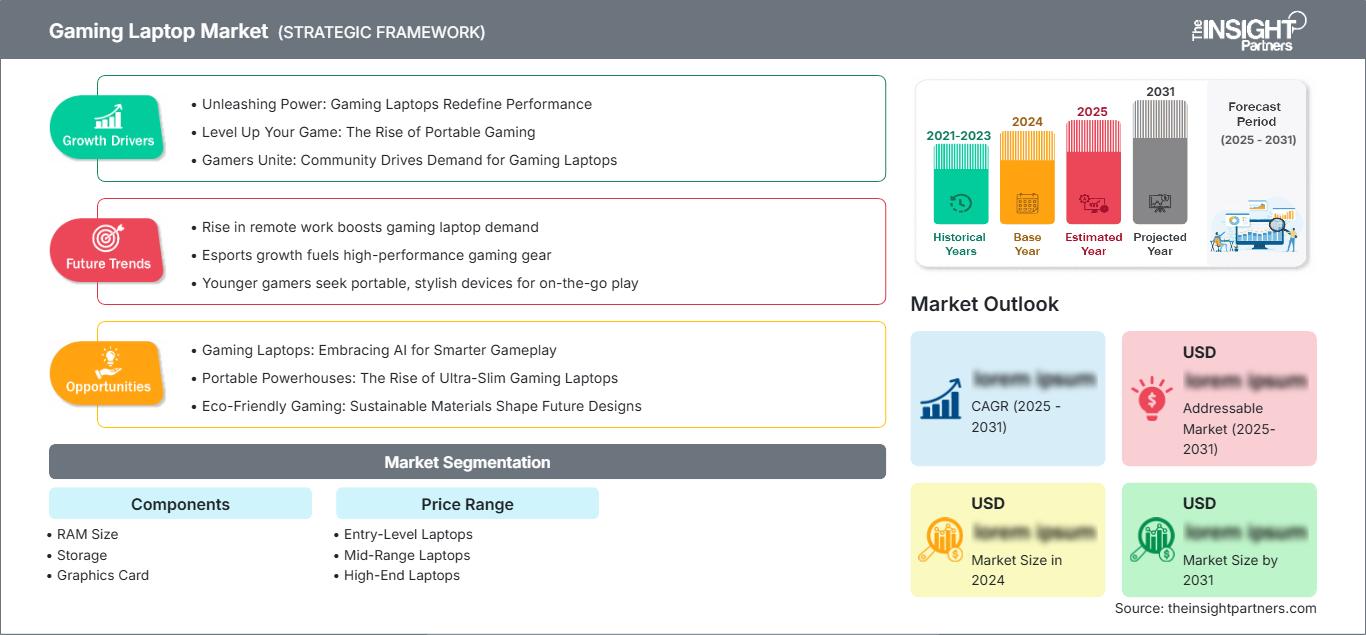
Gaming Laptop Market: Strategic Insights
Regional Insights
North America Gaming Laptop Market
North America has 27%-31% of global revenue in 2025 and is expected to register a CAGR of 7.6%-8.1% over the forecast period of 2026-2034. Demand in the region is driven by high expenditure on digital games, subscription gaming, eSports teams at universities, and premium consumer electronics channels. The Gaming Laptop Market Share in North America is focused mainly in the US and Canada delivers stable demand through offline and online channels.
Suppliers choose North America as the first market for the release of RTX 50 series laptops, OLED screens, and WiFi 7 due to the higher consumers' willingness to pay for high-quality graphics. Replacement demand is associated with refreshing Windows 11 PCs and AI PC marketing message. Channel strategy is increasingly divided into mass retailers for mid-level products and online configurators for enthusiasts.
U.S. Gaming Laptop Market Market
The U.S. constitutes 82% to 87% of North America revenue and is projected to register a CAGR of 7.7% to 8.2% until 2034. Market growth is fueled by AAA titles launches, streaming, college spending, and creators' interest. Brands Dell Technologies Inc., HP Inc., Lenovo Group Limited, Acer Inc., ASUSTeK Computer Inc., and Razer Inc. have an extensive presence in national retail and direct sales distribution channels.
The application scope is drifting from games-only laptop to more general performance oriented one. Buyers consider GPU power efficiency, screen refresh rate, keyboard durability, and upgradeability rather than price alone. Gaming enthusiast laptops with GPUs RTX 5070 – RTX 5090 are gaining popularity, but low-end models will also be relevant for students. Financing options and promotional campaigns define purchases in the US market.
Europe Gaming Laptop Market Market
Europe constitutes 21% to 25% of worldwide revenue for 2025 and is predicted to grow at a CAGR of 7.2% to 7.8% between 2026 and 2034. Germany leads Europe's demand due to the prevalence of PC gaming culture, strong local retail environment, and premium component adoption. The United Kingdom comes second owing to its vibrant esports community and online stores while France, Italy, and Spain are mid-tier buyers.
Germany and the United Kingdom lead premium adoption, especially for 16" and 18" systems that come with OLED and mini-LED display technologies. France has demand that is relatively balanced between creator and gamers' community while Italy and Spain are prone to promotions but gradually becoming interested in high-refresh screens. The energy efficiency and right to repair regulations in Europe encourage manufacturers to design durable chassis and easy-to-access components.
APAC Gaming Laptop Market Market
The APAC region generates 36% to 40% of worldwide revenue and has the highest regional CAGR at 9.2% to 9.8%. The leading country is China due to its scale, internal assembly capabilities, and extensive retail network. Japan and South Korea go for premium smartphones, whereas India and Australia add to increasing online buying and student purchases.
Industrial and governmental drivers are electronics manufacturing inducements, high-speed broadband infrastructure, electronic sports championships, and the development of digital payment systems. Both local and international manufacturers exploit APAC for testing their products based on price tiers, especially mid-range products. Local promotions, festival discounts, and parts availability determine demand trends quarterly.
Middle East & Africa Gaming Laptop Market Market
Middle East and Africa represents a developing revenue opportunity with CAGR forecasted at 8.0%-8.7% between 2026 and 2034. The leaders in demand within this region are Saudi Arabia and the UAE because of their investment in digital entertainment, gaming events, and sales of expensive electronics. South Africa adds to this market through its well-developed communities of PC gamers and specialized dealers.
It is significant to take into account the infrastructure background, as there is growing demand for fiber optics, cloud gaming, and mall-based gaming zones that make the gaming notebook more visible. Revenue from the energy sector and young demographics will help to ensure premium demand in Gulf countries, while affordability and after-sales support become decisive for Africa.
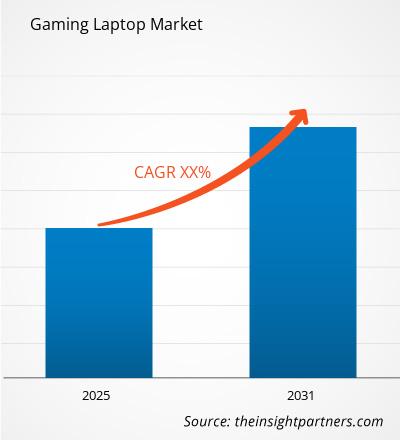
Segmentation Analysis
Components
Components are expected to grow at a CAGR of 8.4%–9.1% during 2026–2034. The Gaming Laptop Market scope across components is widening as buyers compare graphics wattage, RAM expansion, SSD speed, and display quality before choosing a configuration. Component strategy also shapes vendor margins, since GPU and panel choices determine price positioning.
- RAM Size: Demand favors 16 GB as the mainstream baseline, while 32 GB and higher options gain importance for streaming, modded games, multitasking, and creator workflows.
- Storage: SSD capacity is a key purchase trigger because large game files and content libraries require fast load times, PCIe performance, and upgrade-friendly slots.
- Graphics Card: This is the largest component sub-segment, as GPU class sets frame rates, ray tracing capability, AI acceleration, and overall system price hierarchy.
- Display Size: Sixteen-inch panels are becoming the preferred balance, while 14-inch designs target mobility and 18-inch notebooks address immersive desktop-replacement demand.
Price Range
Price Range is projected to grow at a CAGR of 8.6%–9.4% during 2026–2034. Entry-level systems sustain volume, mid-range notebooks capture the broadest buyer base, and high-end models improve revenue per unit. The segment is shaped by GPU launches, retailer promotions, student demand, and financing availability.
- Entry-Level Laptops: These systems target first-time buyers, students, and casual gamers who prioritize affordability, acceptable 1080p performance, and reliable thermals over premium displays or top-tier GPUs.
- Mid-Range Laptops: Mid-range models form the most competitive band, combining RTX-class graphics, high-refresh panels, upgradeable memory, and portable designs at accessible price points.
- High-End Laptops: Premium notebooks appeal to enthusiasts, streamers, and creators requiring RTX 5080 or RTX 5090 performance, OLED or mini-LED displays, and advanced cooling systems.
Opportunity Snapshot
| Price Range | Revenue Contribution | Trend Tag | Adoption Stage |
| Entry-Level Laptops | Medium | Student Gaming | Mature |
| Mid-Range Laptops | High | RTX Value | Scaling |
| High-End Laptops | High | AI Performance | Scaling |
Gaming Laptop Market Growth Drivers and Impact Analysis
GPU Performance Refresh Cycles Reshape Replacement Demand
GPU advancements are the most powerful real-world reason to replace one’s hardware owing to their effect on performance metrics such as frame rates, ray-tracing performance, AI rendering, and creator acceleration. Launches of RTX 50-series laptops from companies such as Acer Inc., ASUSTeK Computer Inc., Dell Technologies Inc., Lenovo Group Limited, and Razer Inc. are evidence of how current product cycles incorporate both gaming and AI aspects of marketing. The effects can be seen by how margins are increased in premium SKUs, while midrange models get value from the previous generation.
Esports, Streaming, and Creator Workflows Expand Use Cases
The modern portable gaming system is used not only to entertain but also for competitions, streaming, video editing, programming, and designing. This diversifies the market by adding non-gaming consumers to it, which leads to the increased need for larger amounts of RAM and storage space and better displays. The presence of esports tournaments in high school and university adds more popularity to the game on a laptop, while social networks give more value to systems able to edit, encode, and stream content.
Retail Financing and Tiered Configurations Broaden Access
The availability of performance notebooks through retail financing options, seasonal campaigns, and more complex configuration ladders does not diminish the significance of high specs on the part of vendors. Today, the offerings of low, medium, and high range laptops are based on defined steps regarding the GPU, RAM, and display features, and customers have an opportunity to upgrade from one level to another within a certain product family. Such positioning positively impacts the Market as the adoption rate among first-time customers, students, and creators increases due to their ability to purchase cheaper configuration first.
Gaming Laptop Market Future Trends
AI-Optimized Performance Profiles Become Standard
AI-assisted performance management will become a defining layer in premium and mid-range notebooks as vendors use embedded models to balance frame rates, acoustics, battery life, and thermal limits in real time. The Gaming Laptop Market trends point toward software-defined differentiation, where buyers value adaptive fan curves, automatic GPU switching, content creation presets, and game-level optimization as much as raw hardware. This shift will favor brands with strong control-center software, frequent driver collaboration, and transparent power profiles, because users increasingly expect stable performance across gaming, streaming, rendering, and productivity without manual tuning.
OLED, Mini-LED, and Larger Displays Redefine Premium Value
According to expectations, display innovations will move away from GPU nomenclature in the premium space, given that 16-inch and 18-inch laptops will be increasingly using OLEDs, Mini LED displays, brighter display screens, and fast refresh rates. The technology will help enhance value in gaming, streaming, designing, and video editing by providing accurate colors and immersive visuals in one mobile system. Display technology will be used by vendors to differentiate between their high-end models, and mid-range products will start gaining features like higher refresh rates and enhanced color reproduction.
Gaming Laptop Market Opportunities
Localized Mid-Range Portfolios for Emerging Buyers
Emerging markets present an actionable opportunity for vendors that can localize mid-range configurations around price, thermal durability, warranty coverage, and gaming community engagement. India, Southeast Asia, the Gulf, and parts of Latin America have expanding broadband access, larger student populations, and rising exposure to esports content, but buyers remain sensitive to financing and after-sales service. Gaming Laptop Market Forecasts indicate that brands can improve conversion by offering region-specific RTX-class systems, bundled accessories, local-language support, and festival-timed promotions. Channel investment should focus on online marketplaces, campus retail, and certified service networks that reduce ownership risk for first-time performance notebook buyers.
Creator-Gaming Convergence in Premium Systems
Premium gaming notebooks can increasingly capture creator and professional workloads if vendors position them around color accuracy, GPU acceleration, memory scalability, cooling stability, and software reliability. This opportunity is especially relevant for streamers, video editors, engineers, students in design programs, and independent developers who prefer one portable workstation rather than separate gaming and productivity devices. Companies can act by aligning launch messaging with creator benchmarks, offering calibrated OLED or mini-LED displays, and strengthening partnerships with GPU, software, and accessory ecosystems. The commercial upside is higher average selling price, stronger brand loyalty, and clearer differentiation from standard consumer laptops.
Recent Developments
- August 2025: Acer launched the Predator Helios Neo 16S AI, a new slim gaming laptop powered by up to an Intel Core Ultra 9 275HX processor and NVIDIA GeForce RTX 5070 Laptop GPU. The laptop features a 16-inch WQXGA OLED display with a 240 Hz refresh rate, Thunderbolt 4 connectivity, up to 32 GB DDR5 RAM, up to 2 TB PCIe Gen 4 SSD storage, advanced 5th Gen AeroBlade cooling, and AI-enhanced gaming capabilities in a premium thin-metal chassis. This launch strengthens Acer’s position in the high-performance gaming laptop by expanding its AI-powered Predator portfolio and addressing the growing demand for premium, portable gaming systems with high-refresh OLED displays and next-generation GPU performance.
- July 2026: GIGABYTE launched the GAMING A16, its first Made in India gaming laptop, manufactured locally in partnership with Dixon Technologies. Powered by AMD Ryzen processors, the laptop is designed for gaming and AI-ready workloads, with the global lineup offering features such as a 16-inch display with up to 165 Hz refresh rate, support for up to 64 GB DDR5 memory, up to 4 TB PCIe Gen4 SSD storage, Wi-Fi 6E, and Dolby Atmos audio. This launch strengthens GIGABYTE’s position in the Indian market by expanding its local manufacturing footprint, improving supply chain capabilities, and supporting the growing demand for high-performance, AI-capable gaming laptops in India.
- May 2026: NVIDIA, in collaboration with Microsoft, introduced RTX Spark™, a new AI-focused superchip designed to power the next generation of Windows PCs for personal AI agents. RTX Spark integrates CUDA, RTX, DLSS, TensorRT, OptiX, Reflex, and G-SYNC technologies into thin-and-light laptops and compact desktops, delivering high-performance AI computing, content creation, and gaming with all-day battery life. The platform is expected to be adopted by leading PC manufacturers for next-generation Windows AI PCs. This launch strengthens NVIDIA’s position in the AI PC market by expanding its hardware ecosystem beyond discrete GPUs and enabling a new class of AI-native personal computers optimized for agentic AI workloads.
Frequently Asked Questions

- Comprehensive Market Sizing and Forecast Analysis
- Detailed Segmentation Analysis
- In-Depth Market Dynamics Assessment
- Regional and Country-Level Insights
- Competitive Landscape and Company Benchmarking
- Strategic Business Intelligence
Recent Reports
Testimonials

The Insight Partners' SCADA System Market report is comprehensive, with valuable insights on current trends and future forecasts. The team was highly professional, responsive, and supportive throughout. We are very satisfied and highly recommend their services.
RAN KEDEM Partner, Reali Technologies LTDs
I requested a report on a very specific software market and the team produced the report in a few days. The information was very relevant and well presented. I then requested some changes and additions to the report. The team was again very responsive and I got the final report in less than a week.
JEAN-HERVE JENN Chairman, Future Analytica
We worked with The Insight Partners for an important market study and forecast. They gave us clear insights into opportunities and risks, which helped shape our plans. Their research was easy to use and based on solid data. It helped us make smart, confident decisions. We highly recommend them.
PIYUSH NAGPAL Sr. Vice President, High Beam Global
The Insight Partners delivered insightful, well-structured market research with strong domain expertise. Their team was professional and responsive throughout. The user-friendly website made accessing industry reports seamless. We highly recommend them for reliable, high-quality research services
YUKIHIKO ADACHI CEO, Deep Blue, LLC.
This is the first time I have purchased a market report from The Insight Partners.While I was unsure at first, I visited their web site and felt more comfortable to take the risk and purchase a market report.I am completely satisfied with the quality of the report and customer service. I had several questions and comments with the initial report, but after a couple of dialogs over email with their analyst I believe I have a report that I can use as input to our strategic planning process.Thank you so much for taking the extra time and making this a positive experience.I will definitely recommend your service to others and you will be my first call when we need further market data.
JOHN SUZUKI President and Chief Executive Officer, Board Director, BK Technologies
I wish to appreciate your support and the professionalism you displayed in the course of attending to my request for information regarding to infectious disease IVD market in Nigeria. I appreciate your patience, your guidance, and the fact that you were willing to offer a discount, which eventually made it possible for us to close a deal. I look forward to engaging The Insight Partners in the future, all thanks to the impression you have created in me as a result of this first encounter.
DR CHIJIOKE ONYIA MANAGING DIRECTOR, PineCrest Healthcare Ltd.Reason to Buy
- Informed Decision-Making
- Understanding Market Dynamics
- Competitive Analysis
- Identifying Emerging Markets
- Customer Insights
- Market Forecasts
- Risk Mitigation
- Boosting Operational Efficiency
- Strategic Planning
- Investment Justification
- Tracking Industry Innovations
- Aligning with Regulatory Trends





 Get Free Sample for