
Gaming Monitors Market Size, Share & Forecast by 2034
Coverage: By Screen Size (Below 27 Inch, 27-32 Inch, Above 32 Inch); Sales Channel (Online, Offline); End-user (Commercial, Individual) , and Geography (North America, Europe, Asia Pacific, and South and Central America)
- Status : Data Released
- Report Code : TIPRE00016974
- Category : Electronics and Semiconductor
- No. of Pages : 150
- Available Report Formats :


- Last update date : August 17, 2026


2025 Market Size
US$ 12.57 Bn
Base year value
2034 Forecast
US$ 39.33 Bn
Projected by 2034
CAGR 2026-2034
13.51 %
Growth rate
Addressable Market
US$ 224.77 Bn
(2026-2034)
The Gaming Monitor Market was valued at US$ 12.57 Billion in 2025 and is projected to reach US$ 39.33 Billion by 2034, expanding at a CAGR of 13.51% during 2026–2034. The demand has resulted from the use of displays that offer high refresh rates and low latency in gaming, hybrid entertainment, streaming, creation process, console gaming, and commercial esport establishments where visual reaction is critical to performance and buying decisions.
North America is anticipated to have 12.6% – 13.4% CAGR during the forecast period up to 2034 due to increased adoption of GPUs, organized esport competitions, and spending on peripherals, which helps fuel the replacement cycles. The North America Gaming Monitor Market size also benefits from the depth of online retailing, the presence of 120Hz and 4K upgrades for consoles, and purchasing by esport lounges, universities, training centers, and esports-focused broadcast facilities.
Gaming Monitors Market Assessment and Insights
- North America held 28–31% share in 2025 and is growing at a CAGR range of 12.6–13.4% during 2026–2034, supported by esports participation, premium PC hardware replacement, omnichannel retail, and content-creator display upgrades.
- US represented 78–82% of North America in 2025 and is growing at a CAGR range of 12.8–13.6% during 2026–2034, led by gaming PCs, streaming, console compatibility, and esports venues.
- Europe accounted for 21–24% share in 2025 and is growing at a CAGR range of 11.8–12.8% during 2026–2034, led by Germany, the UK, France, Italy, Spain, and Nordic gaming communities.
- Asia Pacific captured 34–38% share in 2025 and is growing at a CAGR range of 14.2–15.4% during 2026–2034, with China, Japan, South Korea, India, and Australia supporting broad gaming hardware adoption.
- Largest Segment 27-32 Inch held 45–49% market share in 2025 and is growing at a CAGR range of 13.2–14.0% during 2026–2034.
- High Growth Segment Online held 52–56% market share in 2025 and is growing at a CAGR range of 14.6–15.8% during 2026–2034.
- Key companies analyzed in detail: Acer Incorporated; AOC International; ASUSTeK Computer Inc.; BenQ Corporation; Dell Technologies Inc.; HP Inc.; Lenovo Group Limited; LG Electronics Inc.; Samsung Electronics Co., Ltd.; ViewSonic Corporation.
Source: The Insight Partners' analysis based on proprietary research, government publications, company annual reports, investor presentations, industry databases, and expert interviews.
The evolution of display demand has shifted from refresh-rate improvements to a performance pyramid that is driven by OLED, Mini LED, QD-OLED, 4K panels, refresh rate over 240Hz, low gray-to-gray response, HDMI 2.1, DisplayPort 2.1, USB-C docking, and adaptive sync technology. Moreover, the shift can be seen in production dynamics, with premium monitor panels as a priority for panel manufacturers. In particular, LG Display launched mass production of 27-inch OLED gaming panel with peak brightness of 1,500 nits and introduced 540Hz QHD OLED panel, while Samsung Display aimed to achieve over 50% shipment increase for QD-OLED monitor panels in 2025.
Future demand will be driven by premiumization of products in Asia Pacific, commercial buying of esports hardware in North America, and hybrid entertainment-driven product replacement cycles in Europe. Investments will be directed towards OLED burn-in prevention, provision of ultra-high refresh rate panels, 4K panels ready to be used with gaming consoles, and extension of curved and ultrawide panel types. Industry developments in the field of energy efficiency, reparability, and digital learning infrastructure will benefit long-living displays with better energy management.
Gaming Monitors Market Report Scope
| Report Attribute | Details |
|---|---|
| Market size in 2025 | US$ 12.57 Billion |
| Market Size by 2034 | US$ 39.33 Billion |
| Global CAGR (2026 - 2034) | 13.51% |
| Historical Data | 2021-2024 |
| Forecast period | 2026-2034 |
Gaming Monitors Market Analysis
Factors contributing to the development of the Gaming Monitor include the convergence of PC gaming, console gaming, livestreaming, and creator entertainment. Competitive gamers consider 144 Hz monitors as the bare minimum while enthusiast gamers are now looking to adopt 240 Hz, 360 Hz, 500 Hz, and 4K OLED. There is also an increasing demand due to more brilliant HDR, faster response time, increased pixel densities, and better color gamut among gamers requiring one display for gaming, working, viewing, and creation.
The value chain consists of panel makers, electronics components providers, firmware manufacturers, retail portals, gaming PC makers, peripheral companies, esports clubs, and venue providers. The supply situation still depends on OLED panels availability, pressure on LCD prices, logistics cost, and GPUs cycles. The Gaming Monitor Market Report suggests that product differentiation is achieved through the use of panel technology, refresh rate, warranty reliability, ergonomics, optimization, and channels rather than size only.
Competitive environment involves global PC ecosystem brand players and display manufacturers. Acer Incorporated and ASUSTeK Computer Inc. show strong competition in the segments of enthusiasts and esports players, whereas Samsung Electronics Co., Ltd. and LG Electronics Inc. are leaders in the development of OLED, curved and premium panels. Alienware positioning is used by Dell Technologies Inc., OMEN positioning is implemented by HP Inc., Lenovo Group Limited offers gaming PC kits, and BenQ Corporation, ViewSonic Corporation and AOC International stay strong in esports oriented and value performance lines.
Areas of investment change to the ones of OLED longevity, AI-based picture optimization, 4K 240Hz panels, 500Hz esports monitors, ultrawide immersion and enhanced docking options for hybrid users. Manufacturers increase focus on the improvement of configurator capabilities online, warranties messaging and creation-gamer products cross-over. Strategic positioning is based on multi-price range launches, fast panel innovations and premium/affordable high refresh rate monitors availability.
● REPORT CUSTOMIZATION
Tailor This Report To Align With Your Specific Business Requirements
This report can be customized to align precisely with your business objectives, scope, and target markets. Customization options include tailored segmentation, geography, competitive analysis, and strategic insights to support informed decision-making.
Customize This Report →WHAT YOU CAN ADJUST
- ● Segmentations
- ● Geography
- ● Competitive Analysis
- ● Language Preferences
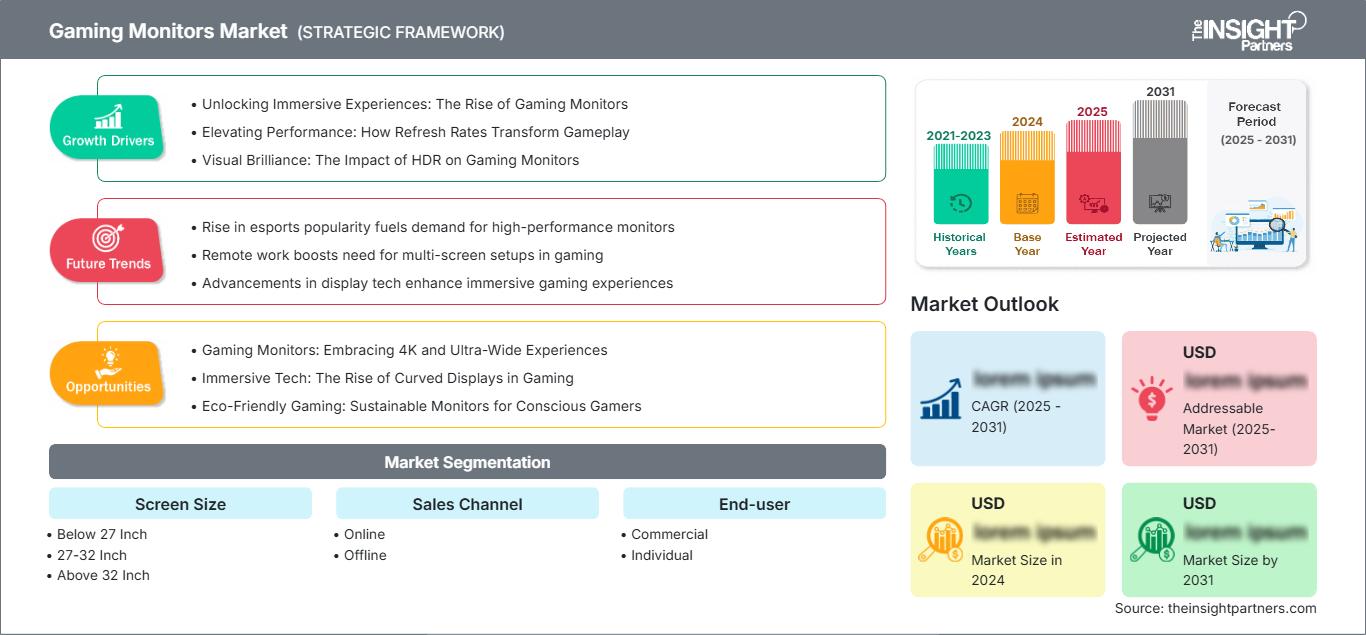
Gaming Monitors Market: Strategic Insights
Regional Insights
North America Gaming Monitor Market
North America held 28–31% share in 2025 and is expected to grow at a CAGR range of 12.6–13.4% during 2026–2034. Gaming Monitor Market share is supported by strong gaming PC penetration, console ownership, organized esports, streaming, influencer-led product discovery, and high disposable spending on peripherals. Retailers also promote bundles that combine monitors with GPUs, laptops, keyboards, and headsets.
This region is inclined to premium replacement as opposed to first time display adoption. Requirements include 27 inches QHD, 32-inch 4K, ultrawide OLED, and high refresh esports displays. Some of the commercial customers include esports arenas, colleges, gaming lounges, simulations centers, and studios among others. The branding power from Dell Technologies Inc., HP Inc., Acer Incorporated, Samsung Electronics Co., Ltd., LG Electronics Inc., and ASUS adds weight to this.
U.S. Gaming Monitor Market
The U.S. held 78-82% of the North America market in 2025, while the growth of this segment was expected to register a CAGR of 12.8-13.6% during the 2026-2034 period. The market was mainly driven by the demand for high-refresh rate gaming PC, 4K display compatible with consoles, streaming setup, gaming desk for remote working, and esports facility acquisitions.
The diversity in the availability of vendors included, among others, Dell Technologies Inc., HP Inc., ViewSonic Corporation, Acer Incorporated, ASUSTeK Computer Inc., Samsung Electronics Co., Ltd., LG Electronics Inc., BenQ Corporation, and AOC International, all via different distribution networks. Concerning applications, high demands were noticed in the areas of OLED contrast, motion clarity (above 240Hz), HDMI 2.1, USB-C connections, and ergonomic stands.
Europe Gaming Monitor Market
Europe constituted 21% to 24% share in 2025 and is expected to register a CAGR range of 11.8% to 12.8% through 2034. Germany holds the top position owing to the presence of premium monitors driven by PC games, simulation games, creator workstations, and the presence of electronics retailers.
Demand for quality monitors in the UK is fueled by gaming clans, online sales, console gaming, and gaming desks. Gaming cafes, gaming by students, creative communities, and improvement of retailers are the drivers of demand in France, Italy, and Spain. High specification monitors are favored by Nordic customers for their PC gaming and streaming activities. Europeans place additional emphasis on energy labeling, reparability, and ergonomics.
APAC Gaming Monitor Market
In 2025, APAC accounted for 34–38% market share and was forecasted to experience an estimated CAGR range of 14.2-15.4% during 2026-2034. China drives the region through gaming cafes, ecommerce size, local brands, and replacement subsidies that encourage electronics purchases. Japan and South Korea prefer higher-end panels, esports games, and gaming desks.
The increasing broadband penetration, gaming laptops, online shopping, and content creator purchases drive growth in India, Australia, and Southeast Asia. The industrial and policy factors driving growth are electronics manufacturing incentives, panel production clusters, esports growth, and digital entertainment investments. Growth in the region is driven by 27-inch QHD monitors, high refresh rate LCDs, and premium OLED displays.
Middle East & Africa Gaming Monitor Market
ME&A region is expected to expand at a CAGR range of 10.4%–11.6% between 2026 and 2034. Saudi Arabia is driving demand through esports events, gaming investments, smart entertainment solutions, and youth-related digital solutions. The adoption in UAE is driven by retail tourism, gaming lounges, electronic retail outlets, and creator studios.
South Africa and the RoMEA are driving demand through online gaming, upgraded internet cafés, console gaming, and educational digital solutions. This market is still sensitive to price compared to North America and Europe, although there are increasing pockets of premium users. Suppliers require a proper distribution network and after sales support for OLED, ultrawide, and high refresh rate products.
Segmentation Analysis
Screen Size
Screen Size is expected to grow at a CAGR range of 13.0–14.2% during 2026–2034. Gaming Monitor Market scope is defined by the balance between desk space, competitive visibility, immersion, resolution, and price. Buyers increasingly choose screen size based on game genre, graphics card capability, console use, streaming needs, and whether the display also supports productivity or content editing.
- Below 27 Inch remains relevant for esports players who prioritize fast eye tracking, compact desks, lower prices, and high refresh rates over immersive field of view.
- 27-32 Inch is the largest segment because QHD and 4K formats balance competitive clarity, visual detail, desk fit, and mainstream pricing for enthusiasts.
- Above 32 Inch addresses ultrawide, curved, simulator, and cinematic setups where immersion, multitasking, HDR, and premium OLED or Mini LED performance justify higher spending.
Sales Channel
Sales Channel is expected to grow at a CAGR range of 13.8–15.0% during 2026–2034. Online platforms gain traction because shoppers compare refresh rates, response times, panel types, warranty terms, and user reviews before purchase. Offline retail remains important where buyers want to evaluate screen curvature, brightness, ergonomics, and panel finish before committing to premium models.
- Online leads growth as ecommerce marketplaces, brand stores, seasonal promotions, creator reviews, and specification filters help buyers compare models quickly and access wider inventories.
- Offline remains strategically important for premium demonstrations, enterprise procurement, gaming lounge buyers, and customers evaluating curvature, stand quality, panel coating, and brightness personally.
End-user
End-user is expected to grow at a CAGR range of 12.9–14.1% during 2026–2034. Individual buyers dominate unit demand, but commercial buyers contribute larger-ticket purchases for esports venues, schools, training centers, gaming zones, and simulation facilities. Vendors that offer consistent model availability, warranty certainty, and low-latency performance can serve both personal and institutional requirements.
- Commercial demand comes from esports arenas, gaming cafes, universities, training labs, simulation centers, and creator studios that require durable displays and predictable service support.
- Individual buyers drive mainstream revenue through PC gaming, console upgrades, streaming setups, hybrid workstations, and entertainment desks that combine productivity and gaming use.
Opportunity Snapshot
| End-user | Revenue Contribution | Trend Tag | Adoption Stage |
| Commercial | Medium | Esports Venues | Scaling |
| Individual | High | Hybrid Desks | Mature |
Gaming Monitors Market Growth Drivers and Impact Analysis
OLED and QD-OLED panels raise the premium ceiling
OLED adoption is reshaping premium gaming displays because self-emissive pixels deliver fast response, deep contrast, wide viewing angles, and stronger HDR performance than conventional LCD designs. Samsung Display stated that OLED monitor panel shipments rose sharply from 8,300 units in 2021 to 820,000 units in 2023 and that it was targeting more than 50% QD-OLED monitor panel shipment growth in 2025. LG Display also began mass production of a 27-inch OLED gaming panel with 1,500-nit peak brightness and announced development of a 540Hz QHD OLED panel. The market impact is higher average selling prices, stronger product differentiation, and faster refresh cycles among enthusiasts.
Esports and creator-gamer overlap expand replacement demand
Gaming monitors increasingly serve competitive play, livestreaming, content editing, remote work, and entertainment from the same desk. This overlap pushes buyers toward better color accuracy, faster refresh rates, larger screens, ergonomic stands, and richer connectivity than traditional office monitors. Esports titles create clear demand for 240Hz, 360Hz, and 500Hz displays, while creators value OLED contrast, high brightness, and color fidelity for video, thumbnails, and social media assets. The market impact is a wider addressable audience where brands can sell premium products to users who justify the purchase through both recreation and productivity rather than gaming alone.
Online retail strengthens specification-led purchasing
Online retail has changed how buyers evaluate monitors because product pages, reviews, benchmarks, creator videos, and comparison filters make technical specifications highly visible. Refresh rate, response time, panel type, HDMI 2.1 support, adaptive sync, brightness, color coverage, and warranty claims directly affect conversion. This favors vendors with clear model naming, credible claims, strong availability, and promotional discipline. The market impact is faster diffusion of premium specifications because shoppers can compare OLED, QD-OLED, Mini LED, curved ultrawide, and esports monitors instantly. It also increases pressure on brands to maintain consistent channel pricing and after-sales service.
Gaming Monitors Market Future Trends
Ultra-high-refresh OLED becomes an esports benchmark
Gaming Monitor Market trends will increasingly converge around OLED speed rather than LCD refresh rate alone. Samsung Display highlighted a 27-inch QHD OLED panel supporting 500Hz, while LG Display disclosed development of a QHD OLED monitor panel supporting 540Hz. These advances suggest that esports displays will combine instantaneous pixel response, high refresh, and strong contrast in formats that previously required trade-offs. Over the forecast period, professional and enthusiast buyers will expect monitor brands to deliver motion clarity, HDR quality, and burn-in protection together, creating a new performance benchmark for premium competitive displays.
Hybrid productivity features become gaming differentiators
Gaming monitors will increasingly compete on connectivity, ergonomics, firmware, and desk integration as users adopt single-display setups for work, entertainment, and gaming. USB-C power delivery, KVM switching, webcam compatibility, low-blue-light modes, adjustable stands, picture-by-picture support, and software-based screen management will matter more in premium buying decisions. The trend will reward brands that design gaming monitors as desk hubs rather than single-purpose screens. Commercial buyers and individual users will both favor products that reduce cable clutter, support laptops and consoles, and maintain low-latency performance across multiple use cases.
Gaming Monitors Market Opportunities
Commercial esports and education deployments
Commercial esports venues, universities, schools, training centers, and gaming lounges create an opportunity for durable, standardized monitor fleets. These buyers need consistent refresh rates, low input lag, mounting compatibility, simple warranty handling, and availability across procurement cycles. Vendors can develop packages that include displays, service terms, calibration guidance, and purchasing support for esports labs or public gaming zones. The opportunity is attractive because institutional buyers make multi-unit purchases and can influence young gamers’ brand preferences. Suppliers that demonstrate reliability, easy replacement policies, and clear performance documentation will be better placed for commercial programs.
Affordable OLED and 4K upgrade paths
Premium OLED and 4K monitors remain aspirational for many gamers, creating a clear opportunity for brands to introduce lower-cost variants without weakening quality perception. Gaming Monitor Market Forecasts support phased product ladders across 27-inch QHD OLED, 32-inch 4K OLED, affordable high-refresh IPS, and curved ultrawide options. Vendors can capture upgrades by offering transparent warranty coverage, burn-in protection, seasonal bundles, and financing through online channels. The action point is to reduce buyer hesitation around durability and price while emphasizing visible performance benefits such as motion clarity, contrast, HDR, and console-ready connectivity.
Recent Developments
- May 2026: Samsung Electronics Co., Ltd. launched its 2026 Odyssey and ViewFinity monitor lineup, introducing the industry's first 6K gaming monitor alongside new OLED and professional displays. The portfolio features DisplayPort 2.1, higher refresh rates, and enhanced productivity capabilities to strengthen Samsung's position in premium gaming and professional monitors.
- May 2025: ASUS unveiled the ROG Strix OLED XG32UCWMG and XG32UCWG gaming monitors featuring 4K WOLED panels, the new TrueBlack Glossy coating, and dual-mode functionality supporting up to 480 Hz refresh rates. The monitors also incorporate OLED Care Pro technology to improve panel longevity and gaming performance.
- June 2026: ASUS expanded its display portfolio at Computex 2026 by introducing new ROG gaming monitors, ProArt professional displays, and ZenScreen portable monitors. The lineup emphasized advanced OLED technologies, higher resolutions, AI-enabled features, and creator-focused innovations to address evolving gaming and professional visualization requirements.
Frequently Asked Questions

- Comprehensive Market Sizing and Forecast Analysis
- Detailed Segmentation Analysis
- In-Depth Market Dynamics Assessment
- Regional and Country-Level Insights
- Competitive Landscape and Company Benchmarking
- Strategic Business Intelligence
Recent Reports
Testimonials

The Insight Partners provided valuable market intelligence that supported our global go-to-market strategy. Their team was professional, responsive, and attentive to our feedback, providing thoughtful analysis and helpful methodological clarifications throughout the project.
Junmo Kim Chief Financial Officer (CFO), Enertech Co., Ltd.
The Insight Partners' SCADA System Market report is comprehensive, with valuable insights on current trends and future forecasts. The team was highly professional, responsive, and supportive throughout. We are very satisfied and highly recommend their services.
RAN KEDEM Partner, Reali Technologies LTDs
I requested a report on a very specific software market and the team produced the report in a few days. The information was very relevant and well presented. I then requested some changes and additions to the report. The team was again very responsive and I got the final report in less than a week.
JEAN-HERVE JENN Chairman, Future Analytica
We worked with The Insight Partners for an important market study and forecast. They gave us clear insights into opportunities and risks, which helped shape our plans. Their research was easy to use and based on solid data. It helped us make smart, confident decisions. We highly recommend them.
PIYUSH NAGPAL Sr. Vice President, High Beam Global
The Insight Partners delivered insightful, well-structured market research with strong domain expertise. Their team was professional and responsive throughout. The user-friendly website made accessing industry reports seamless. We highly recommend them for reliable, high-quality research services
YUKIHIKO ADACHI CEO, Deep Blue, LLC.
This is the first time I have purchased a market report from The Insight Partners.While I was unsure at first, I visited their web site and felt more comfortable to take the risk and purchase a market report.I am completely satisfied with the quality of the report and customer service. I had several questions and comments with the initial report, but after a couple of dialogs over email with their analyst I believe I have a report that I can use as input to our strategic planning process.Thank you so much for taking the extra time and making this a positive experience.I will definitely recommend your service to others and you will be my first call when we need further market data.
JOHN SUZUKI President and Chief Executive Officer, Board Director, BK Technologies
I wish to appreciate your support and the professionalism you displayed in the course of attending to my request for information regarding to infectious disease IVD market in Nigeria. I appreciate your patience, your guidance, and the fact that you were willing to offer a discount, which eventually made it possible for us to close a deal. I look forward to engaging The Insight Partners in the future, all thanks to the impression you have created in me as a result of this first encounter.
DR CHIJIOKE ONYIA MANAGING DIRECTOR, PineCrest Healthcare Ltd.Reason to Buy
- Informed Decision-Making
- Understanding Market Dynamics
- Competitive Analysis
- Identifying Emerging Markets
- Customer Insights
- Market Forecasts
- Risk Mitigation
- Boosting Operational Efficiency
- Strategic Planning
- Investment Justification
- Tracking Industry Innovations
- Aligning with Regulatory Trends





 Get Free Sample for