
Gas Fixed Power Capacitor Market Share, Growth & Demand by 2034
Coverage: By Type (High Voltage, Low Voltage); Application (Reduce Reactive Power, Harmonic Filter, Series Capacitor, Direct Current Transmission), and Geography (North America, Europe, Asia Pacific, and South and Central America)
- Status : Data Released
- Report Code : TIPRE00016011
- Category : Electronics and Semiconductor
- No. of Pages : 150
- Available Report Formats :


- Last update date : August 19, 2026


2025 Market Size
US$ 1.29 Bn
Base year value
2034 Forecast
US$ 1.91 Bn
Projected by 2034
CAGR 2026-2034
4.46 %
Growth rate
Addressable Market
US$ 14.53 Bn
(2026-2034)
The Gas Fixed Power Capacitor Market was valued at US$ 1.29 Billion in 2025 and is projected to reach US$ 1.91 Billion by 2034, expanding at a CAGR of 4.46% during 2026–2034. Expansion results from the need for reactive-power compensation, voltage regulation, harmonics control, series compensation, and direct current transmission in utility and industrial grids. Gas insulation is needed for an enclosure design, where insulation performance and fire resistance are the key operational considerations.
In North America, the Gas Fixed Power Capacitor Market size is predicted to grow at a modeled CAGR of 3.8-4.4%. Growth is driven by grid modernization, demand from data centers, industrial electrification, and power quality. Voltage support is needed by utilities due to the transformation of grid conditions because of renewable energy sources and long-distance power transmission, while industry and commerce utilize fixed compensation in order to minimize reactive power charges and currents.
Gas Fixed Power Capacitor Market Assessment and Insights
- North America: The region held 24–28% share in 2025 and is projected to grow at a 3.8–4.4% CAGR between 2026–2034, supported by grid modernization, data centers, and industrial power-quality programs.
- US: The country represented 77–81% of North American revenue in 2025 and is expected to record a 3.9–4.5% CAGR during 2026–2034.
- Europe: Europe captured 22–26% share in 2025 and should post a 3.4–4.0% CAGR during 2026–2034, led by Germany, the UK, France, Italy, and Spain.
- Asia Pacific: APAC accounted for 37–41% share in 2025 and is forecast to expand at a 5.1–5.7% CAGR during 2026–2034, led by China, India, Japan, and South Korea.
- Largest Segment: Low Voltage held 55–59% market share in 2025 and is projected to register a 4.0–4.6% CAGR during 2026–2034.
- High Growth Segment: Harmonic Filter represented 20–24% market share in 2025 and is expected to grow at a 5.3–5.9% CAGR during 2026–2034.
- Key companies analyzed in detail: FRAKO Kondensatoren- und Anlagenbau GmbH, ICAR S.p.A., International Capacitors, S.A.U. (LIFASA), KEMET Electronics Corporation, Larsen & Toubro Limited, New Northeast Electric India Private Limited, RTR Energía, S.L., TDK Electronics AG, Vishay Intertechnology, Inc., and YAGEO Corporation.
Source: The Insight Partners' analysis based on proprietary research, government publications, company annual reports, investor presentations, industry databases, and expert interviews.
Product development has shifted from traditional fixed capacitor assemblies to those which are sealed, have low losses, and are designed to cope with higher dielectric stress, harmonics, and space constraints in substations. Modern products incorporate metallized film, sturdy terminals, pressure-disconnection systems, discharging circuits, and specially-designed enclosures depending on applications. Production is materials- and process-oriented since service performance depends on the quality of film, impregnation, winding process, and end tests. Thus, the Gas Fixed Power Capacitors Market favors proven manufacturing practices and certifications as opposed to undifferentiated volumes.
Investments up to 2034 are expected in Asia-Pacific transmission networks, North American consumption areas, Europe’s renewable energy interconnections, and some projects in the Middle East. Efficiency standards, power-quality needs of utilities, and industry-wide fines for inefficient power factors support long-term demand. Simultaneously, environmental concerns about insulating gases will promote better seals, lifecycle data management, and gas recovery operations, as well as other design approaches. Suppliers who are able to link equipment design with grid assessments will benefit more than their rivals who deal with components only.
Gas Fixed Power Capacitor Market Report Scope
| Report Attribute | Details |
|---|---|
| Market size in 2025 | US$ 1.29 Billion |
| Market Size by 2034 | US$ 1.91 Billion |
| Global CAGR (2026 - 2034) | 4.46% |
| Historical Data | 2021-2024 |
| Forecast period | 2026-2034 |
Gas Fixed Power Capacitor Market Analysis
The drivers of growth in the Gas Fixed Power Capacitor Market include voltage support for utilities, power factor correction for industries, and increasing harmonics from electronic loads. Fixed capacitors reduce reactive currents around motors, transformers, and feeders, thereby reducing losses and freeing up the capacity of the network. The ecosystem starts off with raw materials such as dielectric films, gases, aluminum, terminals, and protective devices, followed by capacitor manufacturers, panel manufacturers, engineering contractors, utilities, industrial owners, commissioning companies, and recoverers.
Supply conditions involve special winding machines, clean room manufacturing processes, extensive leak tests, and availability of electrical grade films and metals. Projects involving high voltage systems have longer qualification periods since insulation coordination and system studies become compulsory for them. Low voltage systems have wider distribution but intense price pressures. Increasingly harmonically rich networks necessitate detuned reactors/filters, thereby adding value to a single capacitor as an integrated package solution.
The Gas Fixed Power Capacitor Market Report shows competitive rivalry from different segments such as components and power quality. The companies like TDK Electronics AG, Vishay Intertechnology, Inc., KEMET Electronics Corporation, and YAGEO Corporation offer material knowledge and widespread market reach. Meanwhile, FRAKO Kondensatoren- und Anlagenbau GmbH, ICAR S.p.A., International Capacitors, S.A.U. (LIFASA), and RTR Energía, S.L. differentiate by their application engineering, banks of capacitors, harmonics compensation, and geographical presence.
The Larsen & Toubro Limited and New Northeast Electric India Private Limited provide an additional edge to project access within grid and industrial infrastructures. Capital investments go in automation, high-temperature film technology, digital monitoring, and localized assembly. Competitive edge is achieved through successful conversion of network measurement data into the correct-rated product, utilities' approval and commissioning. Acquisitions show the preference for specialists with prior installation experience and engineering and distribution channel knowledge.
● REPORT CUSTOMIZATION
Tailor This Report To Align With Your Specific Business Requirements
This report can be customized to align precisely with your business objectives, scope, and target markets. Customization options include tailored segmentation, geography, competitive analysis, and strategic insights to support informed decision-making.
Customize This Report →WHAT YOU CAN ADJUST
- ● Segmentations
- ● Geography
- ● Competitive Analysis
- ● Language Preferences
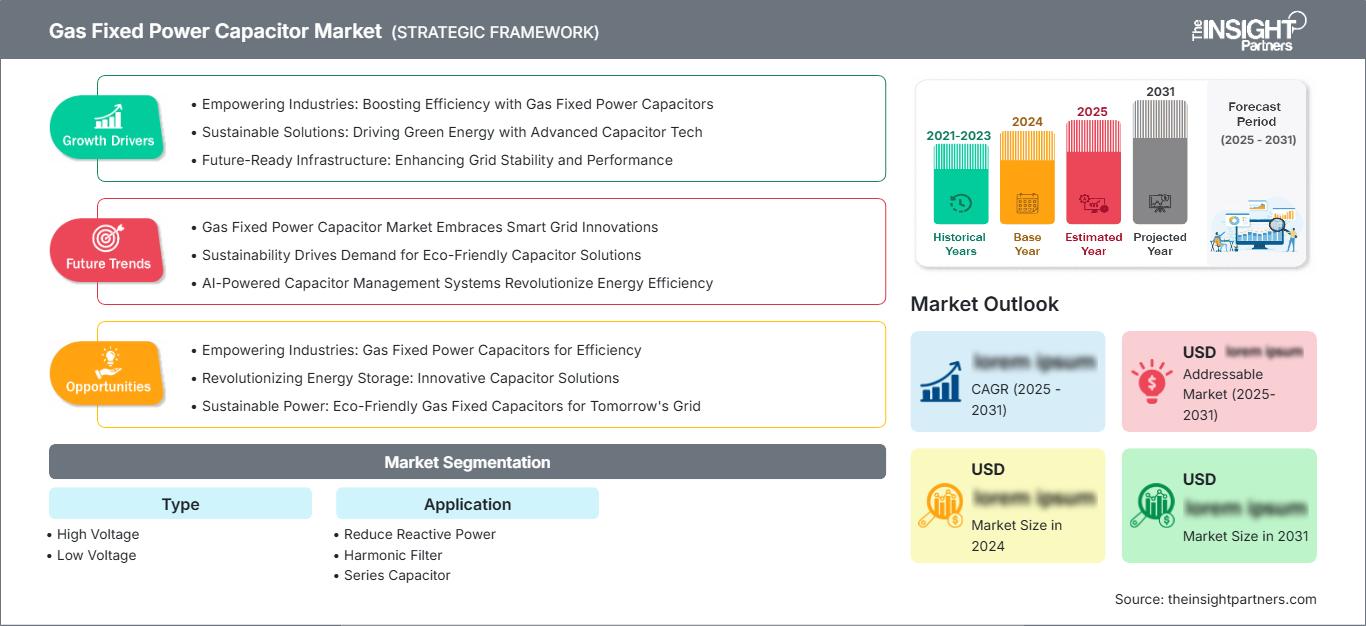
Gas Fixed Power Capacitor Market: Strategic Insights
Regional Insights
North America Gas Fixed Power Capacitor Market
The North America region occupied 24-28% Gas Fixed Power Capacitor Market Share in 2025 and is forecasted to grow at 3.8-4.4% CAGR up to 2034. The market share growth in North America is attributed to strengthening utilities, replacing aged substations, and an increase in consumption of electricity in electricity-consuming industries such as data centers and manufacturing. Capacitors are used for voltage regulation, feeder current reduction, and efficient asset management in cases when it is costly to extend a network.
Region specific purchases are done based on the reliability of the dielectric, standardization, serviceability, and compatibility with breakers, reactors, and protection relays. High voltage banks are usually used by utilities for substations and reinforcement purposes while low voltage fixed capacitors are usually installed by industries near the inductive loads. Harmonic filters have become more important due to the increased use of variable speed drives, UPS, chargers, and switching power supplies.
U.S. Gas Fixed Power Capacitor Market
The U.S. is responsible for 77-81% of North American revenue in 2025 and will report a CAGR between 3.9-4.5% in 2026-2034. Improvements in transmission lines, semiconductor production, data centers, batteries manufacturing, and resourced manufacturing are leading to highly localized reactive power needs. Fixed-compensation is ideal for applications where there are motors and transformers whose operating characteristics do not change much, while harmonic filters find increasing applications where nonlinear loads can cause resonance or heat the capacitors.
Products available cover component makers around the globe, domestic engineering distribution centers, panel houses, and authorized utility equipment. They have applications in low-voltage correction in industries and campus applications and high-voltage correction in generation and transmission sites. The selection process requires network analysis, fault duty assessment, heat studies, and harmonics study. There is a lot of concern with regard to compliance, lead times, and customer service because failure of capacitors can affect operations or reduce the capability during peak loads.
Europe Gas Fixed Power Capacitor Market
Europe contributed 22-26% share in 2025 and will record CAGR of 3.4-4.0% through 2034. Europe holds a dominant position owing to industrial automation, grid hardening, renewable energy integration, and availability of drive motors. The requirements are loss reduction, increased lifetime, standards adherence, and detuned reactor compatibility. In the UK, the requirements include those arising out of data centers, water utilities, transportation and commercial properties because of cost concerns and lack of grid connectivity.
France will be driving the market through industry electrification, railways, renewables connections, and utilities modernization. Italy and Spain are using a mix of manufacturing loads along with renewable energy grid needs, while capacitor banks experts have the chance to export through existing production facilities in Europe. Environmental issues lead to increased interest in gas containment, recovery, and lifecycle management. Suppliers equipped with network analysis capabilities are able to deal with the resonance issue due to converters and distributed generation.
APAC Gas Fixed Power Capacitor Market
In 2025, APAC gained a market share of 37-41% and is expected to grow at a CAGR of 5.1-5.7% until 2034. China leads due to its transmission development, renewable energy integration, and production. Industrial parks and distribution network characterize India, whereas Japan and South Korea concentrate on durable and small-scale products for advanced industrial use. Australia benefits from renewable energy zones and mining operations.
The drivers of growth are industrial policies, urbanization, electrification, and power electronic penetration. High voltage products are used for substations and transmissions, whereas low voltage devices are used for motor drives, transformers, real estate infrastructure, and industrial applications. Local production makes shipping faster, but product qualification is crucial for utilities.
Middle East & Africa Gas Fixed Power Capacitor Market
The MEA and Africa is designed to grow with a CAGR of 4.2-4.8% until 2034. Saudi Arabia will drive growth with network expansion, diversification of industries, water desalination, and huge infrastructure initiatives. UAE is expected to build data centers and commercial installations, and South Africa will need power quality services for its mines, industries, and underdeveloped networks.
High temperatures, dust, fluctuations in the voltage level, and restricted maintenance facilities make it necessary to use sealed, robust capacitors. Oil & gas, minerals, water supply, and transport infrastructure development needs engineering solutions related to power factor correction and harmonic filtering.
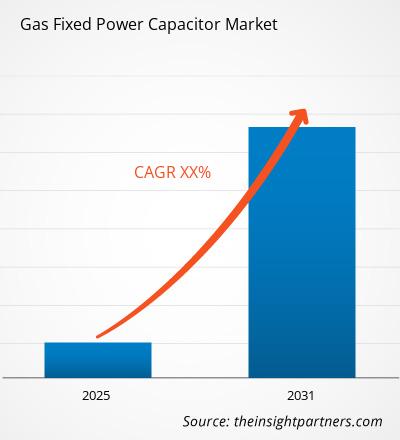
Segmentation Analysis
Type
The type segment is projected to record a 4.1–4.7% CAGR during 2026–2034. Gas Fixed Power Capacitor Market scope by type spans high-voltage equipment for substations and transmission networks and low-voltage units for motors, transformers, buildings, and factories. Adoption depends on operating voltage, kvar requirement, fault duty, harmonic exposure, available space, and service access. Low-voltage demand is broader, while high-voltage projects carry greater engineering content and qualification barriers.
- High Voltage: Utility substations, transmission corridors, renewable plants, and heavy industry require engineered banks that deliver voltage support, series compensation, and reactive-power control under demanding insulation and fault conditions.
- Low Voltage: The largest segment serves motors, transformers, commercial properties, and process equipment, benefiting from standardized ratings, distributor availability, straightforward installation, and measurable reductions in reactive-current penalties.
Application
The application segment is expected to expand at a 4.5–5.1% CAGR during 2026–2034. Reactive-power reduction remains the volume foundation, while harmonic filters advance fastest as electronic loads spread. Series capacitors and direct current transmission require fewer but larger, engineering-intensive projects. Selection depends on load stability, network impedance, voltage level, harmonic spectrum, switching duty, and the economic value of released grid capacity.
- Reduce Reactive Power: Fixed compensation near steady inductive loads lowers current, reduces losses, improves voltage, and helps users avoid utility penalties while deferring transformer and feeder upgrades.
- Harmonic Filter: Capacitors combined with reactors address distortion from drives, converters, UPS systems, and chargers, protecting equipment and avoiding resonance-related overheating or premature dielectric failure.
- Series Capacitor: Transmission operators use series compensation to increase transfer capability, manage line reactance, and improve stability, creating technically demanding projects with high protection and control requirements.
- Direct Current Transmission: Converter stations require capacitive components for filtering, energy handling, and voltage support, with demand tied to long-distance interconnectors, offshore wind links, and asynchronous grid connections.
Opportunity Snapshot
| Application | Revenue Contribution | Trend Tag | Adoption Stage |
| Reduce Reactive Power | High | Loss Reduction | Mature |
| Harmonic Filter | High | Drive Filtering | Scaling |
| Series Capacitor | Medium | Transfer Capacity | Scaling |
| Direct Current Transmission | Medium | HVDC Links | Emerging |
Gas Fixed Power Capacitor Market Forecasts indicate that harmonic-filter projects offer the most actionable near-term white space because customers increasingly need capacitance, reactors, protection, measurement, and commissioning as one package. Suppliers should target factories, data centers, renewable plants, charging hubs, and commercial campuses with high converter density. Fixed reactive-power reduction remains the largest recurring pool, while series compensation and direct current transmission offer selective, high-value utility opportunities.
Gas Fixed Power Capacitor Market Growth Drivers and Impact Analysis
Grid Modernization and Renewable Integration
Transmission and distribution systems face changing power flows as wind, solar, storage, and interconnectors expand. These assets can weaken local voltage profiles or create new reactive-power requirements, particularly across long lines and heavily loaded substations. Fixed capacitor banks provide an economical source of vars, improve voltage, reduce current, and release thermal capacity in existing conductors and transformers. Their impact is strongest where permitting makes network expansion slow or expensive. Utilities therefore evaluate capacitor placement alongside reactors, synchronous equipment, and power electronics. The resulting projects favor high-voltage suppliers with insulation coordination, protection engineering, switching studies, and field commissioning capability. Reliable equipment also reduces the risk that compensation assets become unavailable during peak demand or renewable-output swings.
Industrial Electrification Raises Reactive-Power Demand
Factories are adding automated production lines, large motors, compressors, furnaces, robotics, cooling systems, and electric-process equipment. These loads raise current and reactive demand, reducing usable capacity in transformers and feeders unless power factor is corrected. Fixed capacitors installed near predictable loads can lower losses, stabilize voltage, and postpone costly electrical upgrades. The commercial impact extends beyond energy savings because poor power factor may trigger utility charges or constrain output expansion. Semiconductor plants, battery factories, metals facilities, water systems, and logistics centers are priority users. Successful suppliers combine equipment with load studies, harmonic measurements, protection coordination, and maintenance planning. This service-led approach prevents overcompensation and resonance while converting a component purchase into a measurable capacity and reliability program.
Power Electronics Increase Harmonic Mitigation Needs
Variable-speed drives, rectifiers, UPS systems, chargers, inverters, and switch-mode supplies improve process control but inject non-linear currents. A conventional fixed capacitor can interact with network inductance and amplify specific harmonics, creating overheating, nuisance trips, or shortened dielectric life. The solution increasingly combines capacitors with detuned reactors or purpose-designed filters. This requirement lifts average project value and supports specialists able to measure harmonic spectra, calculate resonance points, and select suitable voltage and current margins. Real-world impact is visible in data centers, renewable plants, industrial campuses, and electrified transport infrastructure. Providers that package monitoring, protection, thermal design, and commissioning can reduce customer risk while securing recurring inspection and replacement revenue throughout the installation lifecycle.
Gas Fixed Power Capacitor Market Future Trends
Condition Monitoring Extends Asset Life
Gas Fixed Power Capacitor Market trends will increasingly emphasize condition visibility rather than calendar-based maintenance. Temperature, current imbalance, harmonic loading, switching counts, pressure indicators, and enclosure conditions can reveal deteriorating units before failure. Utilities and industrial sites will connect capacitor-bank data to power-quality platforms and asset-management systems, enabling targeted inspections and safer replacement planning. Manufacturers can differentiate through sensors, gateways, analytics, and clear diagnostic thresholds. Digital records also strengthen warranty assessment and lifecycle reporting. The transition will favor interoperable monitoring that works across mixed fleets, because most owners operate equipment from multiple generations and suppliers. Service revenue should rise as hardware becomes part of a continuously assessed power-quality system.
Lower-Impact Dielectric and Gas Strategies
Environmental scrutiny will reshape dielectric selection, enclosure sealing, gas recovery, and end-of-life documentation. Buyers will ask suppliers to demonstrate leakage control, safe service procedures, material traceability, and credible recovery routes, particularly for high-voltage equipment. Research will continue into alternative gases, mixed media, improved film systems, and compact designs that preserve dielectric strength without increasing losses. Procurement specifications are likely to weight lifecycle impact alongside price, kvar rating, and reliability. Companies with transparent declarations and field-service capability can convert compliance into differentiation. The shift will be gradual because utilities demand long validation histories, but early qualification programs can create durable positions in future tenders.
Gas Fixed Power Capacitor Market Opportunities
Engineered Harmonic-Filter Packages
Suppliers can expand margins by offering complete harmonic-filter packages instead of individual capacitors. The proposition should include measurement, modelling, capacitor and reactor selection, switching, protection, ventilation, commissioning, and periodic verification. Priority accounts include data centers, battery plants, semiconductor fabs, renewable facilities, charging depots, and factories with large drive populations. A standardized audit methodology can shorten sales cycles while application-specific engineering controls resonance risk. Partnerships with panel builders and electrical contractors can extend geographic coverage without heavy fixed investment. Investors should favor companies with reference installations, trained field teams, and repeatable software-supported studies. Long-term contracts can add monitoring, spares, and retuning as customer loads change.
Localized Utility Qualification in High-Growth Markets
Asia, the Middle East, and parts of Africa offer opportunities for localized assembly, testing, and utility qualification. Gas Fixed Power Capacitor Market Forecasts support investment near transmission programs, industrial corridors, and renewable-resource zones where long import lead times increase project risk. Entrants should prioritize accredited laboratories, disciplined process control, regional engineering talent, and agreements with established dielectric or component suppliers. Joint ventures can combine international designs with local tender access and service coverage. The strongest business cases pair high-voltage project capability with a recurring low-voltage portfolio. Localization must not compromise traceability because utilities require evidence of type testing, routine testing, fault performance, and long-term field reliability.
Recent Developments
- September 2025: TDK Corporation has introduced the new B3270xP series of ultra-small metallized polypropylene (MKP) film capacitors, designed for power factor correction (PFC) applications in consumer electronics power supplies. The compact components are aimed at space-constrained products such as laptop adapters, gaming-console power supplies and other high-density electronic systems.
- January 2026: TDK Electronics AG has announced a change in the tracer gas used during factory leak testing of several gas-impregnated power capacitor series. The company will replace sulfur hexafluoride (SF6) with helium, an inert and more environmentally friendly gas. The change affects TDK Electronics’ PhaseCap Energy Plus Gas, PhaseCap Energy HD Gas, PoleCap Gas and PhiCap EHD Gas capacitor series. These products currently contain a small quantity of SF6, below 500 ppm, which is used as a tracer during routine factory leak-detection tests rather than as part of the capacitor's operating function.
- September 2025: Vishay Intertechnology, Inc. (NYSE: VSH) today introduced a new AEC-Q200 qualified DC-Link metallized polypropylene film capacitor designed for the harsh conditions of automotive, energy, and industrial applications. Offering high temperature operation up to +125 °C, the Vishay Roederstein MKP1848e delivers ripple current up to 44.5 A and withstands temperature humidity bias (THB) in accordance with Grade III of IEC60384-16 ed.3 – 60 °C / 93 % R.H for 1344 hours at rated voltage.
Frequently Asked Questions

- Comprehensive Market Sizing and Forecast Analysis
- Detailed Segmentation Analysis
- In-Depth Market Dynamics Assessment
- Regional and Country-Level Insights
- Competitive Landscape and Company Benchmarking
- Strategic Business Intelligence
Recent Reports
Testimonials

The Insight Partners' SCADA System Market report is comprehensive, with valuable insights on current trends and future forecasts. The team was highly professional, responsive, and supportive throughout. We are very satisfied and highly recommend their services.
RAN KEDEM Partner, Reali Technologies LTDs
I requested a report on a very specific software market and the team produced the report in a few days. The information was very relevant and well presented. I then requested some changes and additions to the report. The team was again very responsive and I got the final report in less than a week.
JEAN-HERVE JENN Chairman, Future Analytica
We worked with The Insight Partners for an important market study and forecast. They gave us clear insights into opportunities and risks, which helped shape our plans. Their research was easy to use and based on solid data. It helped us make smart, confident decisions. We highly recommend them.
PIYUSH NAGPAL Sr. Vice President, High Beam Global
The Insight Partners delivered insightful, well-structured market research with strong domain expertise. Their team was professional and responsive throughout. The user-friendly website made accessing industry reports seamless. We highly recommend them for reliable, high-quality research services
YUKIHIKO ADACHI CEO, Deep Blue, LLC.
This is the first time I have purchased a market report from The Insight Partners.While I was unsure at first, I visited their web site and felt more comfortable to take the risk and purchase a market report.I am completely satisfied with the quality of the report and customer service. I had several questions and comments with the initial report, but after a couple of dialogs over email with their analyst I believe I have a report that I can use as input to our strategic planning process.Thank you so much for taking the extra time and making this a positive experience.I will definitely recommend your service to others and you will be my first call when we need further market data.
JOHN SUZUKI President and Chief Executive Officer, Board Director, BK Technologies
I wish to appreciate your support and the professionalism you displayed in the course of attending to my request for information regarding to infectious disease IVD market in Nigeria. I appreciate your patience, your guidance, and the fact that you were willing to offer a discount, which eventually made it possible for us to close a deal. I look forward to engaging The Insight Partners in the future, all thanks to the impression you have created in me as a result of this first encounter.
DR CHIJIOKE ONYIA MANAGING DIRECTOR, PineCrest Healthcare Ltd.Reason to Buy
- Informed Decision-Making
- Understanding Market Dynamics
- Competitive Analysis
- Identifying Emerging Markets
- Customer Insights
- Market Forecasts
- Risk Mitigation
- Boosting Operational Efficiency
- Strategic Planning
- Investment Justification
- Tracking Industry Innovations
- Aligning with Regulatory Trends





 Get Free Sample for