
Interferometer Market Size, Share & Trends by 2034
Coverage: by Type (Mach-Zehnder Interferometer, Michelson Interferometer, Fabry-Perot Interferometer, Sagnac Interferometer, Fiber Interferometer, Common Path Interferometer and Others); and Application (Physics & Astronomy, Engineering & Applied Science and Biology & Medicine), and Geography (North America, Europe, Asia Pacific, and South and Central America)
- Status : Data Released
- Report Code : TIPTE100000784
- Category : Electronics and Semiconductor
- No. of Pages : 150
- Available Report Formats :


- Last update date : September 21, 2026


2025 Market Size
US$ 768 Mn
Base year value
2034 Forecast
US$ 1,244.58 Mn
Projected by 2034
CAGR 2026-2034
5.51 %
Growth rate
Addressable Market
US$ 9,124.90 Mn
(2026-2034)
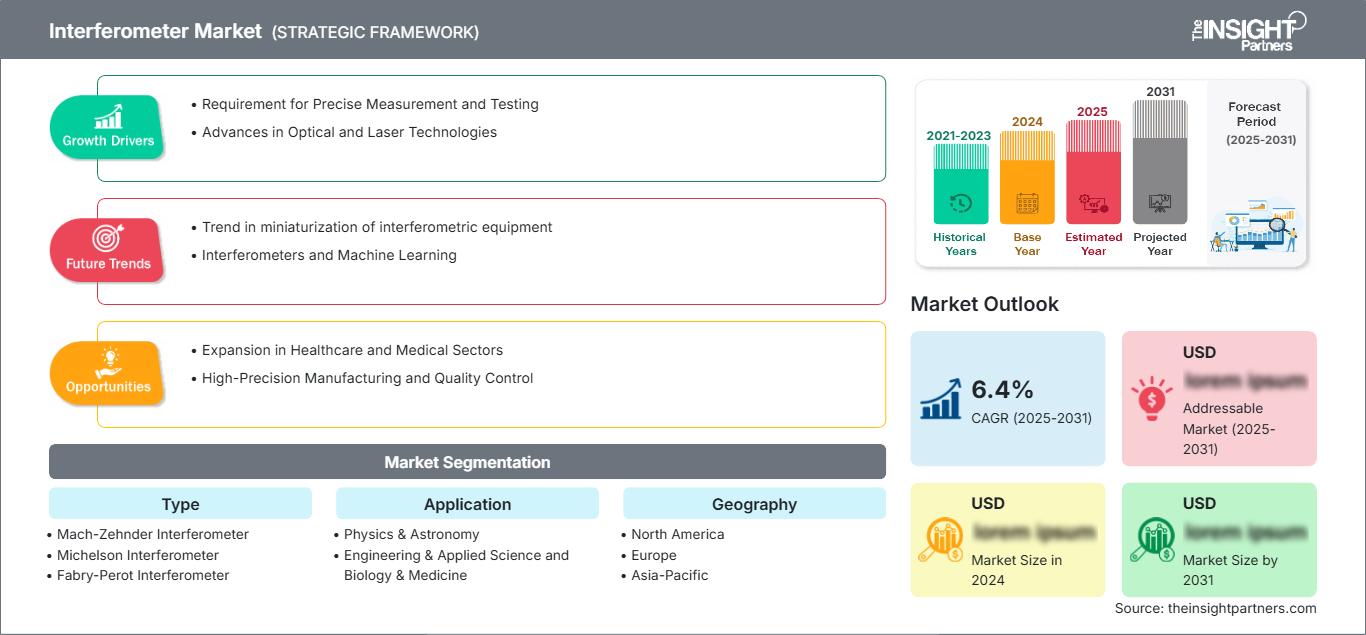
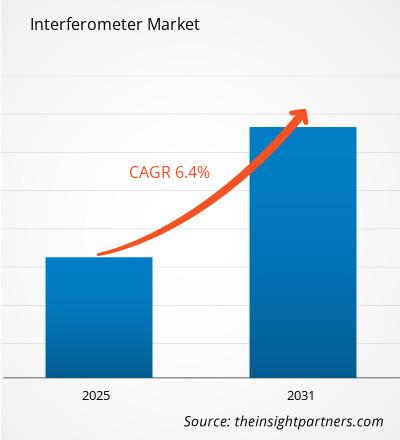
The Interferometer Market is valued at US$ 768 Million in 2025 and is projected to reach US$ 1,244.58 Million by 2034, registering a CAGR of 5.51% during 2026–2034. The market encompasses precision optical systems used for surface characterization, wavefront measurement, displacement calibration, optical testing, and scientific experimentation across industrial, research, medical, and engineering environments.
North America is expected to maintain a strong position, supported by precision manufacturing, aerospace and defense metrology, semiconductor research, and university laboratory investment. Regional growth is estimated at a 5.8–6.5% CAGR through 2034. Increasing requirements for traceable dimensional measurement and automated inspection are strengthening demand, while established research infrastructure supports continued adoption. The Interferometer Market size is also influenced by replacement of conventional measurement equipment with faster digital systems.
Interferometer Market Assessment and Insights
- North America: North America is expected to account for 35–39% Interferometer Market share in 2025 and grow at a CAGR of 5.8–6.5% between 2026–2034, supported by semiconductor, aerospace, defense, optics manufacturing, and research applications.
- US: The US is projected to represent 78–82% of North American demand in 2025 and expand at a CAGR of 5.9–6.6% through 2034, supported by advanced manufacturing and scientific research.
- Europe: Europe is expected to hold 27–31% share in 2025 and expand at a CAGR of 5.4–6.1%, led by Germany, the UK, France, Switzerland, and Italy across optics and industrial metrology.
- Asia Pacific: Asia Pacific is projected to capture 24–28% share in 2025 and grow at a CAGR of 6.2–7.0%, led by China, Japan, South Korea, Taiwan, and India.
- Largest Segment: Michelson Interferometer is expected to hold a 25–29% market share in 2025 and grow at a 5.6–6.3% CAGR through 2034, supported by broad laboratory and measurement applications.
- High Growth Segment: Biology & Medicine is expected to represent a 17–21% market share in 2025 and expand at a 6.4–7.2% CAGR, supported by optical diagnostics and biomedical research.
- Key companies analyzed in detail: Renishaw Plc., OptoTech Optikmaschinen GmbH, Palomar Technologies, Inc., 4D Technology, XONOX Technology GmbH, Trioptics, Inc., KYLIA, Zygo Corporation, Tosei Engineering Corp., Haag-Streit Holding AG.
Source: The Insight Partners' analysis based on proprietary research, government publications, company annual reports, investor presentations, industry databases, and expert interviews.
Digital camera technology, phase-shifting technologies, short coherence sources, vibration reduction techniques, and automatic data acquisition software have been revolutionizing interferometry measurement processes. There has been an increase in the combination of optical components with high-speed sensors and software by manufacturers, making measurements closer to actual production. Fizeau, Michelson, Twyman-Green interferometers, and other designs are being applied to increasingly difficult optical components, semiconductor devices, precision machined parts, and large aperture systems. This development will further improve the future growth expectations for the Interferometer Market.
During the forecast period, spending will be directed towards the automation of optical inspection, semiconductor metrology, advanced photonics, and biomedical imaging. There will be gains in semiconductor and precision optics manufacturing in the Asia Pacific region. North America and Europe regions will continue to enjoy demand in research and aerospace applications. Traceability needs, repeatability in measurements, and quality standards in manufacturing processes will push firms to invest in new metrology systems. Suppliers who will be providing software-based tools and modules will gain from this.
Interferometer Market Report Scope
| Report Attribute | Details |
|---|---|
| Market size in 2025 | US$ 768 Million |
| Market Size by 2034 | US$ 1,244.58 Million |
| Global CAGR (2026 - 2034) | 5.51% |
| Historical Data | 2021-2024 |
| Forecast period | 2026-2034 |
Interferometer Market Analysis
Demands for precision are becoming increasingly important in such industries as semiconductor fabrication, optical components manufacture, aerospace engineering, and scientific research. There are several reasons for the development of the Interferometer Market which include the necessity to determine the surface form, transmitted wavefront error, displacement, thickness, and optical quality without making any mechanical contact. The value chain consists of lasers, beam splitters, reference optics, detectors, imaging systems, motion stages, software for analysis, calibration services, and application-specific accessories.
It is also true that production facilities are becoming increasingly dependent on measurements due to the striving for tighter tolerances and faster throughput. Those interferometers that work without being affected by vibration or other kinds of disturbances reduce the necessity for any specific isolation equipment. With the help of automatic analysis, repeatability is improved and measurement results become usable in the quality control processes.
However, competitive dynamics in the Interferometer Market differ significantly depending on the applications considered. In the realm of laser-based measurements and machine calibration, Renishaw Plc. enjoys dominance. On the other hand, Zygo Corporation specializes in optical metrology, interferometry, and surface measurements. OptoTech Optikmaschinen GmbH is highly engaged in optical manufacturing metrology, whereas 4D Technology stands out owing to dynamic and vibration resistant interferometry. Trioptics, Inc. and Haag-Streit Holding AG provide solutions to specialized optical and ophthalmic measurement needs.
Innovation efforts are centered around high resolution sensing, automated analysis, compact optical architectures, and custom configurations. Palomar Technologies, Inc., XONOX Technology GmbH, KYLIA, and Tosei Engineering Corp. are examples of specialized optical and precision engineering ecosystems, and suppliers compete through customization and technical services. Analysis of the Interferometer Market reveals that competitive advantage now rests more on measurement repeatability, application versatility, integration, and lifecycle support.
● REPORT CUSTOMIZATION
Tailor This Report To Align With Your Specific Business Requirements
This report can be customized to align precisely with your business objectives, scope, and target markets. Customization options include tailored segmentation, geography, competitive analysis, and strategic insights to support informed decision-making.
Customize This Report →WHAT YOU CAN ADJUST
- ● Segmentations
- ● Geography
- ● Competitive Analysis
- ● Language Preferences
Interferometer Market: Strategic Insights
Regional Insights
North America Interferometer Market
North America is projected to hold 35–39% share in 2025 and grow at a 5.8–6.5% CAGR through 2034. The United States leads in regional demand, thanks to research and development in semiconductors, aerospace industry, defense optics, universities, national laboratories, and precision engineering. The Canadian contribution comes from photonics, scientific instrumentation, and advanced manufacturing. More and more end-users need digital measurement, automatic data analysis, and calibration traceability. Moreover, the region takes advantage of experience in optical engineering and the well-developed integration and calibration services infrastructure.
The most active demand is observed in cases when the accuracy of micron- and sub-micron level measurements affects the performance of products or the productivity of processes. Semiconductors involve precise characterization of optical and wafer features. Aerospace and defense companies make use of interferometry for components qualification, optical systems alignment and testing. Universities and research laboratories stimulate demand for flexible instruments for experimental arrangements. Suppliers able to offer not only hardware but also software, accessories and service programs will satisfy needs of both production and R&D customers.Replacement demand is stimulated by modernization of outdated laboratory equipment.
U.S. Interferometer Market Market
The U.S. is expected to represent 78–82% of North American demand in 2025 and expand at a 5.9–6.6% CAGR. Semiconductor fabrication, aerospace, defense, photonics, medical device design and manufacture, and academic research provide varied application areas. Renishaw Plc., Zygo Corporation, 4D Technology, Palomar Technologies, Inc., among other niche vendors, cater to industrial and research needs through varied instrument configurations. Precision and high-value applications consider aspects such as precision, repeatability, stability, and software compatibility.
Aerospace projects need measurement of large optical assemblies, while semiconductor and photonics producers are concerned about productivity and automated testing. Biological and medical research is an additional application area where specialized optical measurements and imaging instruments are required. U.S. customers additionally benefit from a robust national laboratory and university environment in which interferometers are used in physics experiments, astronomy, material science, and precision metrology. Interoperability, calibration capabilities, upgrade possibilities, and accessories for specific applications are becoming a part of purchasing criteria as well.
Europe Interferometer Market Market
Europe is projected to account for 27–31% share in 2025 and grow at a 5.4–6.1% CAGR, with Germany serving as a leading market. Germany is endowed with optical manufacturing and industrial metrology capabilities, whereas the UK can contribute through the aerospace, scientific instruments and precision engineering sectors. France, Italy, and Switzerland also make an important contribution through their photonics and medical optics industries and industrial automation and research organizations.
In Germany, the optical manufacturing industry allows widespread use of interferometric testing of lenses, mirrors, aspheres, and precision optics. For the UK, the strengths are aerospace, astronomy, and engineering applications, whereas France sees strengths in photonics, scientific research, and aerospace. Italy benefits from its precision manufacturing sector, which allows optical and mechanical inspection, whereas the strength of Switzerland lies in medical devices, ophthalmic instruments, and precision engineering. Traceability and repeatability are of great importance to European procurement processes.
APAC Interferometer Market Market
APAC is expected to hold 24–28% share in 2025 and grow at a 6.2–7.0% CAGR, led by China, Japan, South Korea, Taiwan, and India. Semiconductor manufacturing, optical-component production, electronics, industrial automation, and scientific research are expanding regional requirements for precision measurement.
China remains the growth hub, whereas Japan and South Korea maintain their capability in precision engineering. The Taiwanese semiconductor industry meets its demand for precision engineering, while India is building photonics and advanced manufacturing technology capability. The contributions made by Australia include astronomy and research. Industrial policy aimed at semiconductor localization and advanced manufacturing can ensure investments in precision measurement infrastructure.
Middle East & Africa Interferometer Market Market
Middle East and Africa demand is expected to expand at a 5.2–6.0% CAGR. Saudi Arabia and UAE offer strategic markets through manufacturing, R&D facilities, aerospace projects, and investments in technology. South Africa offers a substantial scientific research and astronomy hub, while the rest of MEA offers limited but emerging market potential through universities and industrial labs.
Market needs in the region revolve around specialized research, optical engineering, aerospace applications, and academia. Space-related research and astronomy will help generate the need for large optics characterization and wavefront sensing. Infrastructure diversification efforts in Gulf countries could present additional opportunities for manufacturing and photonics. Distributors of such equipment require local distribution, application know-how, and service capabilities as special interferometers require complicated installation, calibration, and operator training.
Segmentation Analysis
Type
The Type segment is projected to grow at a 5.5–6.2% CAGR during 2026–2034. Configuration selection depends on measurement geometry, wavelength, coherence requirements, sample characteristics, environmental conditions, and desired sensitivity. The Interferometer Market scope spans established laboratory configurations and specialized systems designed for industrial metrology, optical manufacturing, scientific experimentation, and precision engineering.
- Mach-Zehnder Interferometer: Mach-Zehnder configurations are important for wavefront, refractive-index, fluid-flow, and phase measurements. Their separated optical paths provide experimental flexibility and support research applications requiring controlled interference conditions.
- Michelson Interferometer: Michelson systems are widely applicable to displacement, wavelength, surface, and optical-path measurements. Their straightforward architecture supports laboratory education, industrial metrology, and research applications requiring established interferometric methods.
- Fabry-Perot Interferometer: Fabry-Perot systems support high-resolution spectral and optical measurements through multiple-beam interference. They are strategically relevant to spectroscopy, laser characterization, communications, and precision optical research.
- Sagnac Interferometer: Sagnac configurations are important for rotation sensing, phase measurements, and specialized optical experiments. Their common-path characteristics can improve stability and make them useful in demanding sensing applications.
- Fiber Interferometer: Fiber interferometers provide compact architectures for sensing, communications, biomedical measurement, and distributed optical applications. Their flexibility supports integration into systems where conventional free-space optical arrangements are impractical.
- Common Path Interferometer: Common-path configurations improve resistance to environmental disturbances because measurement beams share much of the optical path. They are useful where stability, compactness, and measurement repeatability are important.
- Others: Other configurations address specialized optical testing and research requirements where conventional architectures do not provide the necessary measurement geometry, wavelength range, coherence characteristics, or environmental performance.
Application
The Application segment is expected to advance at a 5.8–6.6% CAGR from 2026–2034. Research institutions, industrial laboratories, medical organizations, and engineering groups use interferometry for different measurement objectives. Demand depends on precision requirements, sample complexity, regulatory expectations, and the ability to integrate measurement data into broader experimental or production workflows.
- Physics & Astronomy: Physics and astronomy applications require precise wavefront, optical-path, displacement, and large-optics measurements. Research institutions use interferometry to characterize instruments, experimental systems, telescope components, and fundamental optical phenomena.
- Engineering & Applied Science: Engineering applications span optical fabrication, semiconductor technology, aerospace, automotive systems, precision machining, and materials research. Interferometers support dimensional verification, surface analysis, alignment, and process qualification.
- Biology & Medicine: Biology and medicine applications use optical interference for imaging, diagnostics, tissue characterization, cell studies, ophthalmology, and biomedical research. High sensitivity and non-contact measurement support specialized clinical and laboratory workflows.
Opportunity Snapshot
| Application | Revenue Contribution (High/Medium/Low) | Trend Tag (MAX 2 words) | Adoption Stage |
| Physics & Astronomy | Medium | Wavefront Science | Mature |
| Engineering & Applied Science | High | Precision Metrology | Scaling |
| Biology & Medicine | Medium | Optical Diagnostics | Scaling |
Interferometer Market Growth Drivers and Impact Analysis
Precision Requirements in Semiconductor and Photonics Manufacturing
Advanced semiconductor and photonics manufacturing increasingly requires measurement systems capable of identifying extremely small deviations in surfaces, dimensions, optical paths, and material characteristics. Non-contact interferometry offers sensitive measurements, which makes it an ideal technique for process control and development. Interferometry is also in high demand from semiconductor manufacturing because smaller dimensions make any variations in manufacturing highly problematic. In photonics manufacturing, interferometry is used to characterize lenses, waveguides, mirrors, and optical assemblies. As manufacturing automation becomes widespread, there is a growing need for metrology equipment to provide digital readings that can be immediately incorporated into the inspection process. This trend drives investments into high resolution cameras, automated analysis software, short coherence technology, and miniaturized measuring heads.
Expansion of Automated and In-Line Optical Metrology
Measurement devices are being brought closer to production in order to improve feedback loops and cut down scrap rate. Interferometers, which are immune to vibrations, temperature changes, or other environmental conditions, could enable measurement operations to take place outside standard laboratories. The above point is especially pertinent to aerospace components, precision machining, optical fabrication, and automation of inspection process. Fast digital acquisition and computerized processing enable quick delivery of measurement data into manufacturing control system. In-line or near-line operation of such equipment demands new hardware characteristics, such as compactness, ruggedness, and ease-of-operation of measuring tools by production staff. Manufacturers have been trying to address those needs with improvements in fast data acquisition, automatic focusing, calibration, and robotics. Automated measurement could be used more widely in manufacturing operations, driving demand for metrological devices.
Growth of High-Precision Research and Biomedical Optical Applications
Research organizations and medical technology developers continue to require increasingly sensitive optical measurement techniques for experimental and diagnostic applications. Interferometry can characterize wavefronts, surfaces, refractive-index variations, optical components, and biological structures without direct mechanical contact. In astronomy, large optical systems require precise testing before deployment, while physics laboratories use interferometric principles for experiments involving phase, displacement, and coherence. Biomedical applications can benefit from interference-based imaging and measurement where conventional mechanical techniques provide limited sensitivity. As research programs become more multidisciplinary, instrument flexibility becomes increasingly valuable. Suppliers can address this demand through modular optical paths, multiple wavelengths, specialized sample interfaces, and advanced software. The impact is a broader application base spanning scientific research, medical technology development, ophthalmology, and specialized laboratory diagnostics.
Interferometer Market Future Trends
Software-Driven Interferometric Measurement and Automated Interpretation
The Interferometer Market trends show that future systems are expected to place greater emphasis on software-driven acquisition, automated alignment, intelligent defect recognition, and simplified measurement workflows. Advanced analysis platforms can transform raw interference patterns into surface maps, wavefront information, dimensional results, and statistical process indicators with limited operator intervention. Machine-learning techniques may increasingly assist with artifact identification, noise reduction, fringe interpretation, and anomaly detection. Cloud-connected systems could also enable centralized monitoring of instruments deployed across multiple production sites. These capabilities can reduce dependence on highly specialized operators and improve consistency between facilities. Vendors will increasingly differentiate through data processing, integration interfaces, visualization tools, and automated reporting. As users demand faster decisions, the competitive value of software may approach the importance of optical hardware performance.
Compact and Environmentally Tolerant Interferometers Enter Production Settings
Interferometer design is likely to continue moving toward smaller measurement heads, fiber-coupled architectures, faster sensors, and vibration-tolerant acquisition. These characteristics enable deployment in locations that were traditionally unsuitable for precision optical measurement. Production engineers can use compact systems closer to machines, while aerospace and optical manufacturers can test large or complex components without relocating them to dedicated laboratories. Short-coherence and dynamic approaches can also improve the measurement of multilayer and transparent structures where conventional techniques face ambiguity. Improved portability will expand the addressable user base because organizations can deploy specialized measurement capabilities across multiple workstations. Future products are therefore likely to emphasize mechanical flexibility, automated calibration, remote control, and robust software alongside optical accuracy.
Interferometer Market Opportunities
Integrated Metrology Platforms for Advanced Manufacturing
Manufacturers have an opportunity to combine interferometers with robotic handling, automated positioning, machine-vision systems, and manufacturing execution software. Integrated platforms can reduce manual setup and make precision measurement part of the normal production cycle. Such solutions are particularly relevant to aerospace, semiconductor, photonics, and precision-machining organizations where quality deviations can create substantial downstream costs. Suppliers can strengthen their value proposition by providing application-specific fixtures, automated calibration, data interfaces, and analytics rather than selling standalone instruments. Regional systems integrators can also support deployment for customers lacking internal optical engineering resources. The Interferometer Market Forecasts therefore favor solution providers capable of linking optical measurement with broader factory automation. Investment should focus on repeatable workflows, scalable architectures, and software interoperability to capture higher-value industrial deployments.
Specialized Optical Systems for Medical and Scientific Research
Medical imaging, ophthalmology, biological research, astronomy, and advanced photonics provide opportunities for specialized interferometric systems tailored to application-specific measurement requirements. Vendors can develop compact instruments for laboratory environments, configurable optical paths for research users, and dedicated software for biomedical or scientific analysis. Collaboration with universities, hospitals, national laboratories, and research consortia can help suppliers identify emerging measurement requirements before they become mainstream procurement categories. The opportunity also extends to customized accessories, calibration services, application development, and training. Unlike standardized industrial equipment, research-oriented systems can command value through flexibility and technical support. Suppliers that maintain modular platforms can adapt existing interferometric architectures to new wavelengths, sample types, and measurement geometries, creating additional revenue opportunities without rebuilding complete instrument families.
Recent Developments
- August 2026: Renishaw Plc. announced its next-generation RLE100, RLE200, and RLE300 interferometric laser encoder systems for advanced semiconductor manufacturing motion control. The new family is designed to provide enhanced precision, stability, flexible integration, and faster setup for semiconductor equipment manufacturers responding to increasingly demanding positioning requirements.
- January 2026: Zygo Corporation published technical work on using its Qualifire 2.3 laser interferometer for multilayer components, including optical structures relevant to augmented-reality displays and photonic circuits. The approach uses short-coherence interferometry to isolate multiple surfaces and measure optical thicknesses down to 50 micrometres, addressing limitations associated with conventional interferometric measurement approaches.
- August 2026: 4D Technology presented a webinar focused on scaling aviation MRO inspection from traditional two-dimensional inspection toward automated optical three-dimensional measurement. The session highlighted the use of high-resolution optical measurement for aviation maintenance environments, reflecting the company's continuing focus on portable, shop-floor, and automated surface inspection technologies for demanding industrial applications.
Frequently Asked Questions

- Comprehensive Market Sizing and Forecast Analysis
- Detailed Segmentation Analysis
- In-Depth Market Dynamics Assessment
- Regional and Country-Level Insights
- Competitive Landscape and Company Benchmarking
- Strategic Business Intelligence
Recent Reports
Testimonials

The Insight Partners' SCADA System Market report is comprehensive, with valuable insights on current trends and future forecasts. The team was highly professional, responsive, and supportive throughout. We are very satisfied and highly recommend their services.
RAN KEDEM Partner, Reali Technologies LTDs
I requested a report on a very specific software market and the team produced the report in a few days. The information was very relevant and well presented. I then requested some changes and additions to the report. The team was again very responsive and I got the final report in less than a week.
JEAN-HERVE JENN Chairman, Future Analytica
We worked with The Insight Partners for an important market study and forecast. They gave us clear insights into opportunities and risks, which helped shape our plans. Their research was easy to use and based on solid data. It helped us make smart, confident decisions. We highly recommend them.
PIYUSH NAGPAL Sr. Vice President, High Beam Global
The Insight Partners delivered insightful, well-structured market research with strong domain expertise. Their team was professional and responsive throughout. The user-friendly website made accessing industry reports seamless. We highly recommend them for reliable, high-quality research services
YUKIHIKO ADACHI CEO, Deep Blue, LLC.
This is the first time I have purchased a market report from The Insight Partners.While I was unsure at first, I visited their web site and felt more comfortable to take the risk and purchase a market report.I am completely satisfied with the quality of the report and customer service. I had several questions and comments with the initial report, but after a couple of dialogs over email with their analyst I believe I have a report that I can use as input to our strategic planning process.Thank you so much for taking the extra time and making this a positive experience.I will definitely recommend your service to others and you will be my first call when we need further market data.
JOHN SUZUKI President and Chief Executive Officer, Board Director, BK Technologies
I wish to appreciate your support and the professionalism you displayed in the course of attending to my request for information regarding to infectious disease IVD market in Nigeria. I appreciate your patience, your guidance, and the fact that you were willing to offer a discount, which eventually made it possible for us to close a deal. I look forward to engaging The Insight Partners in the future, all thanks to the impression you have created in me as a result of this first encounter.
DR CHIJIOKE ONYIA MANAGING DIRECTOR, PineCrest Healthcare Ltd.Reason to Buy
- Informed Decision-Making
- Understanding Market Dynamics
- Competitive Analysis
- Identifying Emerging Markets
- Customer Insights
- Market Forecasts
- Risk Mitigation
- Boosting Operational Efficiency
- Strategic Planning
- Investment Justification
- Tracking Industry Innovations
- Aligning with Regulatory Trends





 Get Free Sample for