
Gesture Recognition System Market Demand, Size & Forecast by 2034
Coverage: by Type (Gesticulation, Language-Like Gestures, Pantomimes, Emblems and Sign Language); Technologies (Contact Type and Non-Contact Type); and Application (Automotive, Consumer Electronics, Defense, Home Automation, Gaming, Healthcare and Others), and Geography (North America, Europe, Asia Pacific, and South and Central America)
- Status : Data Released
- Report Code : TIPTE100001035
- Category : Electronics and Semiconductor
- No. of Pages : 150
- Available Report Formats :


- Last update date : September 16, 2026


2025 Market Size
US$ 24.09 Bn
Base year value
2034 Forecast
US$ 113.28 Bn
Projected by 2034
CAGR 2026-2034
18.77 %
Growth rate
Addressable Market
US$ 564.44 Bn
(2026-2034)
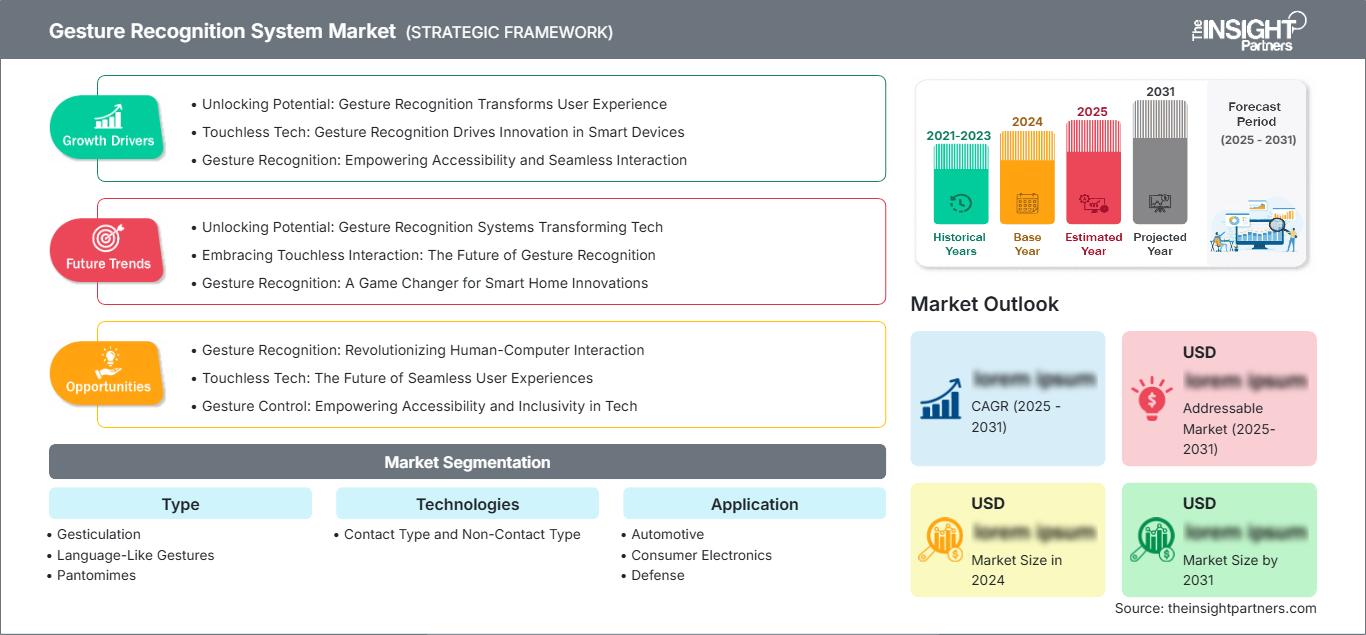
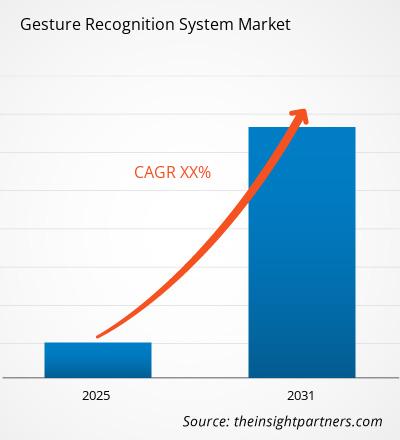
The Gesture Recognition System Market size was valued at US$ 24.09 Billion in 2025 and is projected to reach US$ 113.28 Billion by 2034, expanding at a CAGR of 18.77% during 2026–2034. The market comprises hardware, software, and integrated sensing platforms that interpret gesticulation, language-like gestures, pantomimes, emblems, and sign language across automotive, consumer electronics, defense, home automation, gaming, and healthcare applications.
Across North America, the Gesture Recognition System Market is expected to rise at a modelled 17.5–18.5% CAGR through 2034. Strong consumer-device ecosystems, automotive cabin digitization, and investment in spatial computing support adoption. In the United States, 2024 distracted-driving crashes caused 3,208 deaths and 315,167 injuries, reinforcing demand for interfaces that reduce manual interaction while preserving intuitive control.
Gesture Recognition System Market Assessment and Insights
- North America: The region held a modelled 34–36% Gesture Recognition System Market share in 2025 and should grow at 17.5–18.5% CAGR during 2026–2034, supported by spatial computing, advanced automotive interfaces, and large software ecosystems.
- US: The country represented 82–84% of North American revenue in 2025 and is projected to expand at 17.8–18.8% CAGR during 2026–2034.
- Europe: Europe accounted for a modelled 24–26% share in 2025 and should advance at 16.5–17.5% CAGR through 2034, led by Germany, the UK, France, Italy, and Spain.
- Asia Pacific: Asia Pacific captured a modelled 30–32% share in 2025 and is forecast to grow at 20.0–21.0% CAGR through 2034, led by China, Japan, South Korea, and India.
- Largest Segment: Consumer Electronics held a modelled 35–37% market share in 2025 and is expected to record a 17.5–18.5% CAGR during 2026–2034.
- High Growth Segment: Healthcare represented a modelled 10–12% share in 2025 and is projected to grow at 21.0–22.0% CAGR during 2026–2034.
- Key companies analyzed in detail: Cognitec Systems GmbH, Microsoft Corporation, Infineon Technologies AG, eyeSight Technologies Ltd., Intel Corporation, Apple Inc., Google LLC, Microchip Technology Inc., IrisGuard UK Limited, and PointGrab Ltd.
Source: The Insight Partners' analysis based on proprietary research, government publications, company annual reports, investor presentations, industry databases, and expert interviews.
The technology architecture has moved from fixed touch gestures to multimodal and contextual recognition based on cameras, TOF sensors, radar, capacitive arrays, inertial measurement units, and edge machine learning. Manufacturing involves the integration of semiconductor sensoring, embedded processing, application software, and trained models in contrast to the previous single input part. The focus for manufacturers has become minimizing latency, inference privacy, small form factor, and robustness in the changing light, clothes, distance, and behavior. Developers will ease the training process with gesture library reuse and interface development at the platform level.
In 2034, the funding needs to be diversified across Asia Pacific manufacturing, European car platforms, North American spatial computing, and Middle Eastern smart city infrastructure. Legislative trends towards driver distractions, inclusivity, and contactless government services will generate qualified demand, whereas less expensive edge processors will facilitate wider use. Commercialization will require consent, security, diverse training datasets, and performance irrespective of language, culture, mobility, and environment.
Gesture Recognition System Market Report Scope
| Report Attribute | Details |
|---|---|
| Market size in 2025 | US$ 24.09 Billion |
| Market Size by 2034 | US$ 113.28 Billion |
| Global CAGR (2026 - 2034) | 18.77% |
| Historical Data | 2021-2024 |
| Forecast period | 2026-2034 |
Gesture Recognition System Market Analysis
Growth in the Gesture Recognition System Market is facilitated by requirements for intuitive control when touching is either impractical, distracting, impractical, or hygienic. Consumer electronics and gaming provide mass adoption, automobiles reward minimal distraction, healthcare emphasizes accessibility, and home automation benefits from distance control. Value chain comprises imaging sensors, radar and capacitive components, processors, model development tools, middleware, applications, and system integration.
The economics of supply in the Gesture Recognition System Market vary by architectural type. Touch-based systems use mature touch and inertial components, while non-touch systems involve optical calibration or radar and data processing as well as application-specific inference. Edge processing lowers cloud dependence and latency but increases energy and memory consumption. There is need to handle false activations, occlusions, environment noise and individual user differences prior to volume production.
Analysis of Gesture Recognition System Market suggests that the competitors are positioning towards platforms with integrated sensing-to-software capabilities. Microsoft Corporation, Apple Inc., Google LLC, and Intel Corporation play a role in operating systems, spatial computing, developer frameworks and edge processing. Infineon Technologies AG and Microchip Technology Inc. offer radar, time of flight, capacitive and embedded controllers, while eyeSight Technologies Ltd. and PointGrab Ltd. focus on computer vision intelligence.
Investment in the Gesture Recognition System Market focuses on reusable models, sensor fusion, and privacy-aware on-device inference. Cognitec Systems GmbH and IrisGuard UK Limited bring biometric experience pertinent to multi-modal identity and interactions. However, the use of biometrics is governed by its own consent and governance requirements. Strategic advantage becomes dependent on validated application data, integration capability, processor efficiency and reliable performance as opposed to isolated algorithm accuracy. Suppliers who reduce calibration and certification process have an opportunity to win design across automotive, healthcare, defense and building programs.
● REPORT CUSTOMIZATION
Tailor This Report To Align With Your Specific Business Requirements
This report can be customized to align precisely with your business objectives, scope, and target markets. Customization options include tailored segmentation, geography, competitive analysis, and strategic insights to support informed decision-making.
Customize This Report →WHAT YOU CAN ADJUST
- ● Segmentations
- ● Geography
- ● Competitive Analysis
- ● Language Preferences
Gesture Recognition System Market: Strategic Insights
Regional Insights
North America Gesture Recognition System Market
North America held a modelled 34–36% Gesture Recognition System Market share in 2025 and is expected to expand at 17.5–18.5% CAGR during 2026–2034. The region consists of top operating system platforms, AI at the cloud and edge level, semiconductor design, high-end consumer device demand, and adoption of digital services. Spatial computing, gaming, automotive infotainment, smart buildings, military simulation, and assistive interfaces constitute diversified business avenues.
The adoption is shifting from novelty functions to multimodal control involving gesture, eye movement, speech, and nearness. Privacy demands result in local processing, while interoperability standards help in minimizing integration issues in devices. Enterprise solutions focus on productivity and accessibility, while consumer solutions concentrate on responsiveness and battery life. Canada provides AI research, gaming, healthcare, and adoption of smart buildings, while Mexico is involved in electronics and automotive manufacturing. Procurements give importance to inclusive data, error tests, and robust performance in lighting conditions, skin exposure, and dense populations.
U.S. Gesture Recognition System Market
The US represented a modelled 82–84% of North American revenue in 2025 and should grow at 17.8–18.8% CAGR during 2026–2034. The companies such as Microsoft Corporation, Apple Inc., Google LLC, Intel Corporation, and Microchip Technology Inc. have built a rich ecosystem ranging from platforms, processors, sensors, applications, and developer tools. Consumer electronics, mixed reality, gaming, defense training, healthcare accessibility, and smart workplace solutions drive demand.
Opportunities in automotive sector are driven by the nation’s safety priorities related to distraction: 2024 accidents involving distracted drivers led to 3,208 deaths and 315,167 injuries. Gesture interfaces cannot substitute attentive driving but well-designed shortcuts can help minimize reaching and visual search. Health and education sectors will also generate demand for sign language translation and gesture-based interaction. Customers will need local processing, bias tests, cybersecurity measures, and alternative input capabilities. Commercial success stories will prove low rates of false positives in real-world conditions.
Europe Gesture Recognition System Market
Europe accounted for a modelled 24–26% share in 2025 and is projected to grow at 16.5–17.5% CAGR during 2026–2034, with Germany leading. Such companies as Microsoft Corporation, Apple Inc., Google LLC, Intel Corporation, and Microchip Technology Inc. developed a vast ecosystem including platforms, processors, sensors, applications, and development kits. The drivers of the demand are consumer electronics, mixed reality, gaming, defense training, accessible healthcare, and smart workplaces.
There are opportunities in the automotive industry associated with the national priorities regarding safety from distraction: 2024 distractions resulted in 3,208 fatalities and 315,167 injuries. While gesture interfaces will not be able to replace the attentive driving, good-designed shortcuts will allow reducing reaching and visual search. There is also going to be the demand in the health care and education industries for sign language translation and gesture interaction. The customers will require local processing, testing for biases, cybersecurity, and alternative input methods. Commercial success will demonstrate that there will be low false positive rates in reality.
APAC Gesture Recognition System Market
Asia Pacific captured a modelled 30–32% share in 2025 and should grow at 20.0–21.0% CAGR through 2034, led by China. Large electronics supply chain, gaming communities, smartphones manufacturing, digitization of automobiles, and investment in smart cities speeds up commercialization. While China brings scale, Japan stresses robotics and automobiles, South Korea brings together display, memory, home appliances, and mobile phones.
India includes software engineering, healthcare delivery, and multilingual sign language possibilities. Australia brings defense simulation, mining automation, and research. Support to electronics manufacturing and AI helps in growing local design capabilities. Cost sensitivity helps in reusing cameras and edge model optimization, whereas expensive devices use radar and time of flight sensors for better performance in darkness, long range, and obstruction.
Middle East & Africa Gesture Recognition System Market
The Middle East and Africa is forecast to expand at 18.0–19.0% CAGR during 2026–2034, with the UAE leading. Smart airports, digital government, hospitality, secure facilities, healthcare modernization, and sovereign AI programs support demand. Gesture and contactless interfaces fit high-throughput environments, but localization, consent, and integration with legacy systems remain essential.
Saudi Arabia links adoption to new infrastructure and entertainment projects, while the UAE combines aviation, retail, finance, and smart buildings. South Africa provides healthcare, mining, education, and security opportunities. Across the Rest of MEA, deployment will favor focused use cases with dependable connectivity and local support. Energy efficiency matters because edge processing must operate within constrained device and building power budgets.
Segmentation Analysis
Type
Type is projected to register a modelled 18.0–19.0% CAGR during 2026–2034. The Gesture Recognition System Market scope covers expressive movement from simple commands to linguistically structured signing. Commercial value depends on vocabulary size, contextual interpretation, cultural localization, and error tolerance. Emblems support efficient commands, while sign-language applications demand deeper sequence modelling and user-inclusive datasets.
- Gesticulation: Natural hand and body movements support intuitive interaction in gaming, vehicles, and smart spaces, with demand driven by low learning requirements and flexible command design.
- Language-Like Gestures: Structured sequences bridge simple commands and full language, providing strategic value where applications need richer intent recognition without complete linguistic interpretation.
- Pantomimes: Mimicked actions enable discoverable commands in entertainment, training, and public interfaces, although interpretation requires contextual models that distinguish deliberate movement from ordinary activity.
- Emblems: Culturally established signs deliver fast, memorable input for consumer electronics and automotive shortcuts, but global deployment requires localization to prevent inconsistent or unintended meanings.
- Sign Language: Recognition supports communication accessibility in healthcare, education, public services, and devices, requiring continuous-motion analysis, regional language datasets, and careful validation with signing communities.
Technologies
Technologies is expected to expand at a modelled 18.5–19.5% CAGR during 2026–2034. Contact architectures retain advantages in cost, intentionality, and familiar interaction, while non-contact platforms gain where distance, hygiene, immersion, or reduced distraction matter. System selection depends on lighting, range, power, compute, weather exposure, privacy, false activation, and integration with existing displays or controls.
- Contact Type: Touch surfaces, wearables, and inertial sensors provide explicit input and mature integration, remaining important for cost-sensitive devices, gaming accessories, and environments with uncertain visibility.
- Non-Contact Type: Cameras, infrared, time-of-flight, radar, and electric-field sensing enable distant or touchless control, supporting automotive cabins, mixed reality, healthcare, appliances, and smart-building interfaces.
Application
Application demand is projected to grow at a modelled 18.8–19.8% CAGR during 2026–2034. Consumer Electronics provides the largest revenue base, while healthcare offers the highest growth potential through accessibility and touch-free workflows. Automotive prioritizes distraction reduction, defense values training and secure control, home automation favors convenience, and gaming rewards expressive, low-latency interaction.
- Automotive: In-cabin gesture control supports infotainment, climate, lighting, and contextual shortcuts, with strategic importance rising as digital cockpits require intuitive interaction and distraction-aware safeguards.
- Consumer Electronics: Smartphones, watches, computers, televisions, earbuds, and spatial devices create the broadest deployment base, emphasizing battery efficiency, embedded processing, developer support, and consistent everyday responsiveness.
- Defense: Simulation, command systems, robotics, and wearable interfaces use gestures where hands-free control improves situational workflow, although security, ruggedization, and mission-specific validation govern procurement.
- Home Automation: Distant control of lighting, entertainment, appliances, access, and climate supports convenience and accessibility, with adoption depending on privacy, interoperability, affordability, and reliable household context detection.
- Gaming: Motion-rich play, virtual reality, and fitness experiences reward low-latency skeletal tracking and expressive input, making software content, comfort, room calibration, and device affordability commercially decisive.
- Healthcare: Touch-free interfaces, rehabilitation, surgical support, patient communication, and sign-language tools address infection control and accessibility, requiring clinical workflow integration, consent, reliability, and inclusive validation.
Opportunity Snapshot
| Application | Revenue Contribution | Trend Tag | Adoption Stage |
| Automotive | High | Cabin Control | Scaling |
| Consumer Electronics | High | Spatial Devices | Mature |
| Defense | Medium | Mission Interfaces | Scaling |
| Home Automation | Medium | Ambient Control | Scaling |
| Gaming | Medium | Motion Play | Mature |
| Healthcare | Medium | Accessible Care | Emerging |
Gesture Recognition System Market Growth Drivers and Impact Analysis
Spatial Computing Expands Natural Interaction
Spatial computing uses the movements of the hands and body as the main mode of controlling the interface instead of being just one of the optional modes. Headsets and smart glasses need users to interact by selecting, manipulating, navigating and communicating without the help of traditional keypads or touch screens. As such, there is need for hand tracking technology, gesture recognition, eye and hand coordination and real time edge inference technology. Platform standards and developer access are shaped by companies such as Apple Inc., Microsoft Corporation, Google LLC and Intel Corporation, while depth sensors are guided by depth and power limitations, field of view limitations as well. Impact is not limited to gaming but extends to design, training, remote assistance, health care education and other industries.
Digital Cockpits Favor Lower-Distraction Controls
Automotive interior design is shifting toward a greater reliance on displays, making it increasingly necessary to design interfaces that maintain users' focus and enable fast execution of instructions. In the U.S., distraction-related accidents took 3,208 lives and injured 315,167 people in 2024. In Europe, automotive regulations mandate high-performance driver distraction warnings in all new automobiles and vans. Gesture recognition systems could be used along with voice control, haptic interaction, and gaze tracking to regulate climate controls, infotainment applications, lighting and context-aware shortcut functions. Commercial implications include cameras, radar, time-of-flight sensing, processing and cabin systems. To succeed, these features need a small set of commands, minimal false triggering, performance at night and graceful failure modes of fallback controls.
Accessibility Converts Unmet Need into Platform Demand
Accessibility generates sustained demand for sign-language recognition, gesture-based control, and alternate inputs. According to the World Health Organization, there are currently about 430 million people requiring rehabilitation for disabling hearing impairment, including 34 million children, with projections of over 700 million people by 2050. Gesture technology can be used in communication, education, telemedicine, public service, and device accessibility, but their usefulness relies on the extent of language support and validation from the community. Sign languages are complex linguistic systems which differ between regions, thus isolated sign classifiers will not suffice in most practical cases. Commercial implications include data collection, labeling, modeling of continuous sequences, deployment at the edge, and combination with captions or voice.
Gesture Recognition System Market Future Trends
Multimodal Intent Models Replace Isolated Commands
The Gesture Recognition System market trends will evolve towards systems that integrate gestures with gaze, speech, posture, proximity, and context of use. A gesture in itself is often ambivalent; contextual cues help determine whether the user wants to select, reject, point, or talk. The system will minimize false triggers and simplify memorization of commands. In the future, gesture systems will more and more keep the local context on the edge processor, ensuring low latency and privacy while syncing only the essential events. The developers will require confidence scores, ability for a user to override and get feedback on automation so that the automation process is predictable.
Privacy-Preserving Edge Recognition Becomes Default
Future generations of products will do more of their processing on-device, translating sensor feeds to anonymous coordinates, features, or commands. Edge detection lowers latency, network dependency, cloud costs, and vulnerability of intimate videos captured at home, on the road, in the office, and in the clinic. Processing at the sensor level will become ever more selective, waking up the host system only when significant movement occurs, for efficiency reasons. The tradeoff in designing future solutions will be between compactness of the model and its accuracy. Competing manufacturers will set themselves apart by offering secure updates to models, explainability of their confidence scores, and configurability of data retention policies. Procurement specifications need to clearly distinguish interactive from biometric data.
Gesture Recognition System Market Opportunities
Build Vertical Gesture Libraries and Validation Services
Investors can develop reusable gesture libraries, test datasets, and certification services for automotive, healthcare, appliances, gaming, and defense. Gesture Recognition System Market Forecasts favor vendors that reduce customers’ data-collection and calibration work while documenting performance under realistic lighting, distance, clothing, motion, and user diversity. A vertical platform can combine reference hardware, labelled data, edge models, integration software, and validation protocols. Revenue can mix licensing, engineering, and model-update services. Partnerships with manufacturers, clinics, universities, and user communities improve relevance and trust. Defensible value will come from application-specific evidence and deployment support rather than generic recognition accuracy reported on laboratory datasets.
Localize Sign-Language and Public-Service Interfaces
Healthcare providers, schools, transport hubs, government agencies, and financial institutions can invest in localized sign-language and touch-free service interfaces. Opportunity is strongest where existing kiosks, telehealth, or video-service channels can add recognition without replacing entire workflows. Developers should begin with constrained, high-value vocabularies, then expand through community-led data collection and continuous quality review. Commercial models can combine software subscriptions, implementation, and human escalation. Accuracy must be measured by completed service outcomes, not isolated gesture classification. Inclusive design also requires captions, text, speech, and manual alternatives so users can recover when recognition confidence is low or regional signing differs.
Recent Developments
- August 2026: Northwestern University have developed EITWatch, an open-source smartwatch that can recognize hand movements by measuring electrical changes beneath the skin. The project combines an ESP32-S3 microcontroller with electrical impedance tomography (EIT) to create a compact gesture-sensing system. Unlike conventional gesture interfaces that rely on cameras, accelerometers or sensors positioned around the wrist, EITWatch uses electrodes mounted directly on the rear of the watch. These electrodes detect changes in electrical impedance produced by movements of muscles and tendons in the hand.
- August 2026: HONOR has officially launched its unusual Robot Phone in China, combining a flagship smartphone with a motorized camera gimbal designed to physically move, track subjects and capture video from different angles. The device features a four-degree-of-freedom (4DoF) titanium gimbal integrated into the handset. Mounted on the mechanism is a 200-megapixel main camera, while HONOR has also partnered with cinema-camera manufacturer ARRI to bring professional imaging technologies and color workflows to the smartphone.
- August 2026: Google DeepMind has unveiled a new artificial intelligence system designed to understand sign language and convert signed communication into text, marking another step toward making AI-based communication tools more accessible to Deaf and hard-of-hearing users. The technology, called sign-language-to-text (SL2T), is aimed at addressing a long-standing limitation in AI. While speech-recognition systems have advanced rapidly and can now translate, transcribe and interpret spoken languages, sign languages have received far less attention despite being used by millions of people worldwide.
Frequently Asked Questions

- Comprehensive Market Sizing and Forecast Analysis
- Detailed Segmentation Analysis
- In-Depth Market Dynamics Assessment
- Regional and Country-Level Insights
- Competitive Landscape and Company Benchmarking
- Strategic Business Intelligence
Recent Reports
Testimonials

The Insight Partners' SCADA System Market report is comprehensive, with valuable insights on current trends and future forecasts. The team was highly professional, responsive, and supportive throughout. We are very satisfied and highly recommend their services.
RAN KEDEM Partner, Reali Technologies LTDs
I requested a report on a very specific software market and the team produced the report in a few days. The information was very relevant and well presented. I then requested some changes and additions to the report. The team was again very responsive and I got the final report in less than a week.
JEAN-HERVE JENN Chairman, Future Analytica
We worked with The Insight Partners for an important market study and forecast. They gave us clear insights into opportunities and risks, which helped shape our plans. Their research was easy to use and based on solid data. It helped us make smart, confident decisions. We highly recommend them.
PIYUSH NAGPAL Sr. Vice President, High Beam Global
The Insight Partners delivered insightful, well-structured market research with strong domain expertise. Their team was professional and responsive throughout. The user-friendly website made accessing industry reports seamless. We highly recommend them for reliable, high-quality research services
YUKIHIKO ADACHI CEO, Deep Blue, LLC.
This is the first time I have purchased a market report from The Insight Partners.While I was unsure at first, I visited their web site and felt more comfortable to take the risk and purchase a market report.I am completely satisfied with the quality of the report and customer service. I had several questions and comments with the initial report, but after a couple of dialogs over email with their analyst I believe I have a report that I can use as input to our strategic planning process.Thank you so much for taking the extra time and making this a positive experience.I will definitely recommend your service to others and you will be my first call when we need further market data.
JOHN SUZUKI President and Chief Executive Officer, Board Director, BK Technologies
I wish to appreciate your support and the professionalism you displayed in the course of attending to my request for information regarding to infectious disease IVD market in Nigeria. I appreciate your patience, your guidance, and the fact that you were willing to offer a discount, which eventually made it possible for us to close a deal. I look forward to engaging The Insight Partners in the future, all thanks to the impression you have created in me as a result of this first encounter.
DR CHIJIOKE ONYIA MANAGING DIRECTOR, PineCrest Healthcare Ltd.Reason to Buy
- Informed Decision-Making
- Understanding Market Dynamics
- Competitive Analysis
- Identifying Emerging Markets
- Customer Insights
- Market Forecasts
- Risk Mitigation
- Boosting Operational Efficiency
- Strategic Planning
- Investment Justification
- Tracking Industry Innovations
- Aligning with Regulatory Trends





 Get Free Sample for