
Gigabit Passive Optical LAN Market Growth, Trends & Demand by 2034
Coverage: By Component (Optical Cable, Coupler, Power Splitter, Connector, Others); Application (Loop Feeder, Synchronous Optical Network, Hybrid fiber-coaxial cable, Synchronous Digital Hierarchy, Others); End-User (Manufacturing, BFSI, Education, Healthcare, Government, Others), and Geography (North America, Europe, Asia Pacific, and South and Central America)
- Status : Data Released
- Report Code : TIPRE00015844
- Category : Electronics and Semiconductor
- No. of Pages : 150
- Available Report Formats :


- Last update date : August 19, 2026


2025 Market Size
US$ 7.50 Bn
Base year value
2034 Forecast
US$ 17.32 Bn
Projected by 2034
CAGR 2026-2034
9.75 %
Growth rate
Addressable Market
US$ 110.61 Bn
(2026-2034)
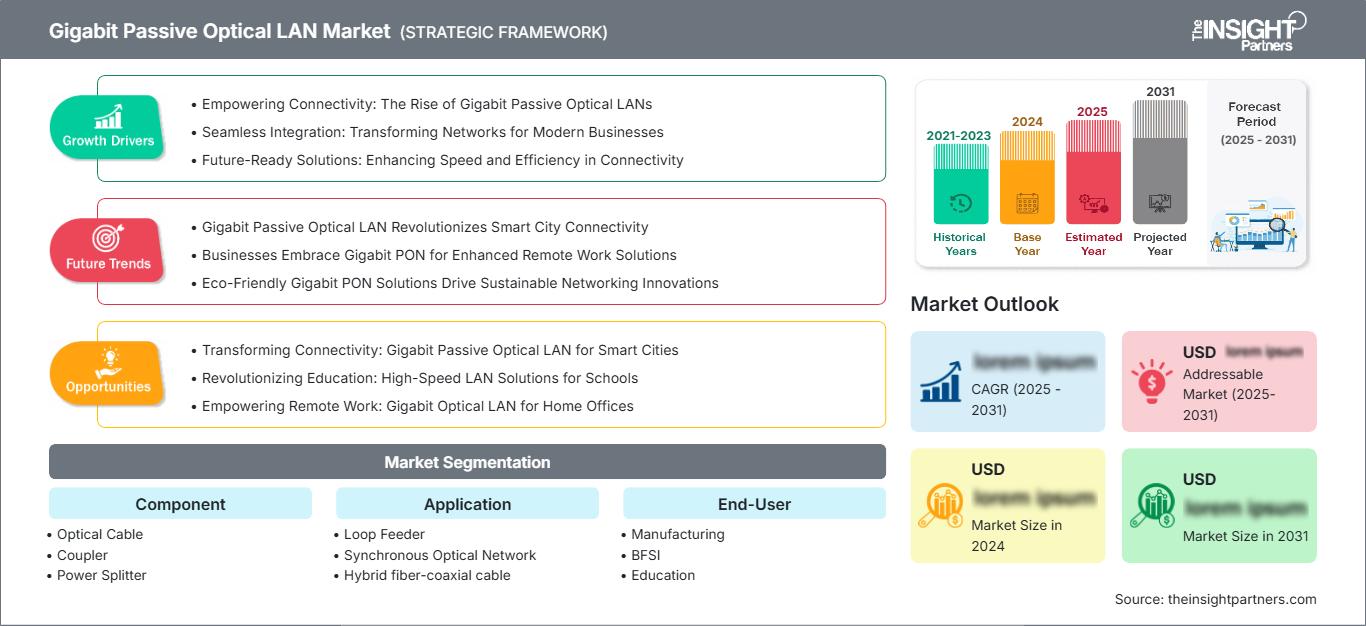
The Gigabit Passive Optical LAN market was valued at US$ 7.50 Billion in 2025 and is projected to reach US$ 17.32 Billion by 2034, registering a CAGR of 9.75% from 2026 to 2034. This growth trajectory underscores the increasing enterprise shift from legacy copper-based networks to fiber-optic passive optical LAN architectures. The market is driven by the need for high-bandwidth connectivity, lower power consumption, and reduced total cost of ownership across multiple end-user verticals.
North America accounted for a significant share of the Gigabit Passive Optical LAN market size in 2025, with projections indicating a steady CAGR of approximately 8.5–9.5% over the forecast period. The region's dominance is supported by extensive fiber infrastructure rollouts, early adoption of gigabit-speed enterprise networks, and strong presence of key technology providers. Increasing investments in smart building technologies and growing bandwidth demands from data-intensive applications further bolster regional market expansion.
Gigabit Passive Optical LAN Market Assessment and Insights
- North America: Estimated to hold approximately 32–36% share in 2025, growing at a CAGR of 8.5–9.5% from 2026 to 2034. Growth is driven by the high concentration of technology enterprises and early adoption of next-generation networking solutions.
- United States: Representing nearly 85–90% of the North American market in 2025, expanding at a CAGR of 8.0–9.0%. The market is supported by substantial investments in broadband infrastructure and a robust digital enterprise ecosystem.
- Europe: Accounting for approximately 24–28% of the global market in 2025, with a CAGR of 8.0–9.0%. Leading countries include the United Kingdom, Germany, and France, driven by stringent energy efficiency regulations and growing adoption of fiber-based enterprise networks.
- Asia Pacific: Representing roughly 26–30% of the global market in 2025, growing at the highest CAGR of 11.5–12.5%. Key contributors include China, Japan, India, and South Korea, fueled by rapid industrialization and large-scale smart city initiatives.
- Largest Segment: Component segment dominates with a market share of approximately 45–50% in 2025, growing at a CAGR of 8.5–9.5%. This is driven by the extensive deployment of optical cables, couplers, power splitters, and connectors across network infrastructure projects.
- High Growth Segment: Application segment projected to expand at a CAGR of 10.5–11.5%, driven by the rising adoption of synchronous optical network and hybrid fiber-coaxial cable solutions for high-speed enterprise connectivity.
- Key companies analyzed in detail: ADTRAN, Inc., Ericsson Inc., Freescale Semiconductors Inc., Huawei Technologies Co. Ltd., Mitsubishi Electric Corporation, Motorola Solutions Inc., Nokia Networks, TE Connectivity Ltd., Verizon Communications Inc., ZTE Corporation.
Source: The Insight Partners' analysis based on proprietary research, government publications, company annual reports, investor presentations, industry databases, and expert interviews.
The Gigabit Passive Optical LAN market is experiencing a shift towards widespread adoption as a result of technological advancements within fiber optic technology and network management applications. The dynamics within production are changing due to the fact that producers are diversifying their portfolio of optical cables and passive devices to serve different customer needs, while still providing compatibility with IT systems. This technological evolution simplifies installation processes and promotes widespread use of this solution, thus leading to faster substitution of copper LAN.
In the future, the Gigabit Passive Optical LAN market will continue to experience growth due to large-scale investments in digital and smart cities in developing countries. The favorable regulatory climate that favors energy-saving networking solutions, as well as growing demands for high-speed and low latency connections, will favor the market's further penetration. Investments in FTTP and 5G backhaul network installations will provide further opportunities for market expansion.
Gigabit Passive Optical LAN Market Report Scope
| Report Attribute | Details |
|---|---|
| Market size in 2025 | US$ 7.50 Billion |
| Market Size by 2034 | US$ 17.32 Billion |
| Global CAGR (2026 - 2034) | 9.75% |
| Historical Data | 2021-2024 |
| Forecast period | 2026-2034 |
Gigabit Passive Optical LAN Market Analysis
The main reason behind the demand for Gigabit Passive Optical LAN is the exponential rise in data traffic in enterprises together with the constraints of legacy copper-based networks. With the increasing use of cloud computing, Internet of Things (IoT), and HD video conferencing in organizations, there arises the necessity of having robust and scalable networking infrastructure. The key advantage with the Gigabit Passive Optical LAN lies in the fact that it provides symmetrical gigabit speeds, increased security, and savings in cable and power costs as compared to traditional Ethernet switches.
The competitive structure in the Gigabit Passive Optical LAN market consists of the strong participation of international manufacturers of telecommunications equipment and manufacturers of optical networking. Research and development efforts focus on increasing the efficiency of optical components and implementing software-defined networking. Among the companies working in this segment are ADTRAN, Inc., Huawei Technologies Co. Ltd., and Nokia Networks, which use their broad ranges of products and worldwide presence to establish themselves in the market. Moreover, recent mergers and product launches show the emergence of an approach aimed at providing end-to-end solutions for particular industries.
● REPORT CUSTOMIZATION
Tailor This Report To Align With Your Specific Business Requirements
This report can be customized to align precisely with your business objectives, scope, and target markets. Customization options include tailored segmentation, geography, competitive analysis, and strategic insights to support informed decision-making.
Customize This Report →WHAT YOU CAN ADJUST
- ● Segmentations
- ● Geography
- ● Competitive Analysis
- ● Language Preferences
Gigabit Passive Optical LAN Market: Strategic Insights
Regional Insights
North America Gigabit Passive Optical LAN Market
North America represents a developed and fast-growing Gigabit Passive Optical LAN market share that has a significant market share of 32-36% of global revenues in 2025. The development of the region is ensured by the rapid acceptance of sophisticated network solutions among companies, governments, and universities. The driving factors include significant financial support of the federal and regional governments for developing broadband infrastructure, presence of key innovators in the field, and focus on energy-efficient networks to address corporate sustainability needs. The expected CAGR for North America will be in the range of 8.5% to 9.5% from 2026 to 2034.
U.S. Gigabit Passive Optical LAN Market
The United States has been the biggest contributor to the market for North America Gigabit Passive Optical LANs, accounting for about 85-90% of the regional market in 2025, with the estimated CAGR of 8.0-9.0%. Such an achievement is due to the high number of data centers, tech companies, and research centers which require higher performance of the network. High adoption is taking place in the BFSI and healthcare sectors, as these sectors require secure and fast transfer of data. Companies in the market have been trying to establish themselves through collaborations with system integrators and managed service providers.
Europe Gigabit Passive Optical LAN Market
The share of Europe in the Global Gigabit Passive Optical LAN Market is around 24% - 28%, and it is expected to have a CAGR of 8.0% - 9.0% during the forecast period. In Europe, the United Kingdom and Germany are considered to be the largest market countries due to the high level of regulatory backing for digital technology and manufacturing centers. France, Italy, and Spain are considered as potential contributors as well thanks to the initiatives in updating public institutions and smart city projects.
APAC Gigabit Passive Optical LAN Market
Asia-Pacific has emerged as the fastest-growing market for Optical Gigabit Passive Optical LANs, accounting for around 26-30% in 2025, backed by a strong CAGR of 11.5-12.5%. The two leading nations in the region are China and Japan, due to huge infrastructure development projects backed by governments and the digital transformation in the industrial segments. The other countries growing rapidly are India and South Korea due to heavy investments being made in 5G infrastructure and smart city projects.
Middle East & Africa Gigabit Passive Optical LAN Market
The Middle East & Africa region is an up-and-coming market for Gigabit Passive Optical LAN with leading countries including Saudi Arabia and UAE as a result of considerable investments into smart cities and digital infrastructure. The region's growth is fueled by a CAGR of about 8.0-10.0%, which is attributed to the necessity of fast Internet connections in the energy industry and government modernization initiatives. South Africa is another key country of the region due to the increasing demand from the finance and telecom industries.
Segmentation Analysis
Component
The Component segment is a cornerstone of the Gigabit Passive Optical LAN market, encompassing essential hardware required for network deployment. This segment is projected to grow at a CAGR of 8.5–9.5% from 2026 to 2034, driven by the expanding need for fiber-optic infrastructure. Market dynamics are shaped by continuous innovations in optical technologies aimed at enhancing data transmission efficiency and network longevity. The segment's growth is further propelled by the rising demand for high-performance passive optical components capable of supporting increasing bandwidth requirements and longer transmission distances.
- Optical Cable: Serves as the primary medium for data transmission in Gigabit Passive Optical LAN, offering high bandwidth and immunity to electromagnetic interference. The increasing deployment of fiber-to-the-premises solutions across enterprise and residential sectors is significantly boosting demand.
- Coupler: Facilitates the splitting and combining of optical signals, enabling efficient distribution of data across multiple endpoints within a passive optical LAN architecture. Its strategic importance is growing with the rising number of connected devices and network endpoints.
- Power Splitter: A critical component that divides optical power evenly across multiple output ports, ensuring uniform signal distribution throughout the network. The demand is driven by the need for scalable and flexible network designs in large enterprises and campuses.
- Connector: Essential for establishing reliable and low-loss fiber-optic connections, enabling seamless integration of various network components. The growing emphasis on quick, plug-and-play deployments is increasing the demand for high-quality connectors.
Application
The Application segment is a key driver of the Gigabit Passive Optical LAN market, growing at a CAGR of 10.5–11.5% from 2026 to 2034. This growth is underpinned by the increasing need for high-speed, reliable data transmission across various network applications. The adoption of advanced applications such as synchronous optical networking is accelerating due to its ability to support high-capacity, low-latency communication critical for modern enterprises.
- Loop Feeder: Utilized in telecommunications to connect central offices to remote terminals, forming a crucial part of the access network. The ongoing upgrades of legacy copper loops to fiber-optic systems are driving demand in this sub-segment.
- Synchronous Optical Network (SONET): A standardized digital communication protocol used to transmit large volumes of data over optical fiber. Its robust error-correction and synchronization capabilities make it ideal for high-speed enterprise and carrier networks.
- Hybrid Fiber-Coaxial Cable (HFC): Combines optical fiber and coaxial cable to deliver broadband services, widely used in cable television networks. The growing demand for high-speed internet and video-on-demand services is sustaining demand for HFC upgrades.
- Synchronous Digital Hierarchy (SDH): An international standard for high-speed data transmission over fiber-optic networks, similar to SONET. Its widespread adoption in legacy telecommunications infrastructure ensures continued relevance in the market.
End-User
The End-User segment is crucial in shaping the demand for Gigabit Passive Optical LAN solutions, experiencing a CAGR of 9.0–10.0% from 2026 to 2034. The Manufacturing and BFSI sectors are significant contributors, driven by the need for high-bandwidth, secure, and low-latency networks to support automation and digital transactions. The growing adoption of IoT and Industry 4.0 in manufacturing is particularly boosting demand.
- Manufacturing: Relies on optical LAN for real-time data transmission in automated production lines, machine monitoring, and supply chain management. The shift towards smart factories and industrial IoT is a major growth driver for this sub-segment.
- BFSI: Requires ultra-secure and high-speed networks for digital banking, trading platforms, and customer data management. The increasing volume of online transactions is driving the adoption of optical LAN in this sector.
- Education: Utilizes high-speed LAN for e-learning, campus-wide connectivity, and administrative operations. The growing demand for online education and digital learning tools is fueling market growth in this sector.
- Healthcare: Employs optical LAN for telemedicine, electronic health records, and diagnostic imaging, requiring high bandwidth and low latency. The healthcare sector's digital transformation is a significant driver for optical LAN adoption.
- Government: Adopts optical LAN for secure communication, public service delivery, and smart city applications. Government initiatives for digital governance and infrastructure modernization are boosting demand.
Opportunity Snapshot
| End-User | Revenue Contribution | Trend Tag | Adoption Stage |
|---|---|---|---|
| Manufacturing | High | Smart Factory | Scaling |
| BFSI | High | Digital Banking | Mature |
| Education | Medium | E-Learning | Scaling |
| Healthcare | High | Telemedicine | Scaling |
| Government | Medium | Smart City | Emerging |
Gigabit Passive Optical LAN Market Growth Drivers and Impact Analysis
Rising Demand for High-Bandwidth Connectivity
The increasing consumption of data caused by cloud computing, streaming of videos, and IoTs forms the major driving force behind the growth of the Gigabit Passive Optical LAN industry. The conventional use of copper-based networks to satisfy the demands of bandwidth and latency has become increasingly difficult in the modern enterprise scenario. This driver forces enterprises to move towards using fiber optic networks that provide better performance in terms of speed and scalability. The effect is more significant in industries like BFSI and healthcare.
Cost and Energy Efficiency Benefits
The Gigabit Passive Optical LAN has the potential to save money and reduce energy usage when compared to conventional Ethernet-based networks. In essence, it cuts down on operational and capital costs since it avoids the use of several active switches and numerous cables. Moreover, the passive characteristics of the network save power, thereby making it in line with corporate sustainability.
Growing Adoption of Smart City and IoT Initiatives
Government and private sector investments in smart city projects and industrial IoT are fueling the demand for robust, high-speed network infrastructure. Gigabit Passive Optical LAN provides the ideal backbone for connecting a multitude of sensors, surveillance cameras, and communication systems. This driver is expected to significantly impact the public sector and manufacturing verticals, especially in emerging economies in Asia Pacific and the Middle East.
Gigabit Passive Optical LAN Market Future Trends
Integration with 5G and Edge Computing
The convergence of Gigabit Passive Optical LAN Market Trends with 5G networks and edge computing architectures is a key future trend. This integration will enable ultra-low latency applications such as autonomous systems and real-time industrial automation. Optical LAN will serve as an efficient backhaul solution for 5G small cells and edge data centers, enhancing overall network performance and reliability.
Growth of Managed Optical LAN Services
An emerging trend is the rise of managed services for Gigabit Passive Optical LAN, where service providers offer end-to-end deployment and management solutions to enterprises. This model reduces the operational burden on internal IT teams and ensures optimal network performance through continuous monitoring and maintenance. The trend is expected to accelerate adoption among small and medium-sized enterprises with limited networking expertise.
Gigabit Passive Optical LAN Market Opportunities
Expansion in Greenfield Enterprise Projects
There is a significant opportunity in the Gigabit Passive Optical LAN Market Forecast to penetrate new greenfield enterprise projects, such as newly constructed office complexes, hospitals, and educational campuses. Integrating Gigabit Passive Optical LAN during the initial construction phase allows for seamless implementation and avoids costly retrofitting. This opportunity is particularly relevant in rapidly developing regions like Asia Pacific and the Middle East.
Developing Vertical-Specific Solutions
Tailoring Gigabit Passive Optical LAN solutions to meet the unique requirements of verticals such as healthcare and manufacturing presents a substantial growth opportunity. For instance, developing solutions with enhanced security and low latency for telemedicine or industrial automation applications can create a competitive edge. This focused approach allows vendors to address specific pain points, fostering deeper market penetration.
Recent Developments
- October 2025: ZTE unveiled a comprehensive portfolio of optical access and networking solutions at Network X 2025 to accelerate FTTx deployment and the evolution of all-optical campuses. The company introduced the ZXA10 C604L and ZXA10 C608Z compact PON OLTs, with the outdoor C608Z supporting on-demand GPON and 10G PON ONUs for rural, suburban, remote, and HFC-to-FTTH deployment scenarios. ZTE also launched Wi-Fi 7 access points with XGS-PON uplinks and Power over Fiber (PoF), designed for hotels, offices, educational buildings, hospitals, and other campus environments.
- October 2024: Adtran and Netomnia announced a strategic partnership to launch the UK’s first 50G PON services, targeting the growing demand for multigigabit connectivity across residential and enterprise applications. The 50G PON technology is designed to support multiple Gigabit services simultaneously and address bandwidth-intensive applications including enterprise cloud computing, public Wi-Fi, smart campuses, data centers, and Wi-Fi and small-cell backhaul.
- March 2024: Nokia expanded its Optical LAN portfolio with a new in-wall Optical Network Terminal (ONT) designed to deliver gigabit-speed fiber connectivity across enterprise and campus environments, including offices, hotels, hospitals, schools, and other commercial facilities. The modular ONT features four Gigabit Ethernet ports with auto-negotiation and supports Power over Ethernet (PoE) of up to 60W per Ethernet port, enabling connectivity and power delivery to devices such as access points and cameras.
Frequently Asked Questions

- Comprehensive Market Sizing and Forecast Analysis
- Detailed Segmentation Analysis
- In-Depth Market Dynamics Assessment
- Regional and Country-Level Insights
- Competitive Landscape and Company Benchmarking
- Strategic Business Intelligence
Recent Reports
Testimonials

The Insight Partners provided valuable market intelligence that supported our global go-to-market strategy. Their team was professional, responsive, and attentive to our feedback, providing thoughtful analysis and helpful methodological clarifications throughout the project.
Junmo Kim Chief Financial Officer (CFO), Enertech Co., Ltd.
The Insight Partners' SCADA System Market report is comprehensive, with valuable insights on current trends and future forecasts. The team was highly professional, responsive, and supportive throughout. We are very satisfied and highly recommend their services.
RAN KEDEM Partner, Reali Technologies LTDs
I requested a report on a very specific software market and the team produced the report in a few days. The information was very relevant and well presented. I then requested some changes and additions to the report. The team was again very responsive and I got the final report in less than a week.
JEAN-HERVE JENN Chairman, Future Analytica
We worked with The Insight Partners for an important market study and forecast. They gave us clear insights into opportunities and risks, which helped shape our plans. Their research was easy to use and based on solid data. It helped us make smart, confident decisions. We highly recommend them.
PIYUSH NAGPAL Sr. Vice President, High Beam Global
The Insight Partners delivered insightful, well-structured market research with strong domain expertise. Their team was professional and responsive throughout. The user-friendly website made accessing industry reports seamless. We highly recommend them for reliable, high-quality research services
YUKIHIKO ADACHI CEO, Deep Blue, LLC.
This is the first time I have purchased a market report from The Insight Partners.While I was unsure at first, I visited their web site and felt more comfortable to take the risk and purchase a market report.I am completely satisfied with the quality of the report and customer service. I had several questions and comments with the initial report, but after a couple of dialogs over email with their analyst I believe I have a report that I can use as input to our strategic planning process.Thank you so much for taking the extra time and making this a positive experience.I will definitely recommend your service to others and you will be my first call when we need further market data.
JOHN SUZUKI President and Chief Executive Officer, Board Director, BK Technologies
I wish to appreciate your support and the professionalism you displayed in the course of attending to my request for information regarding to infectious disease IVD market in Nigeria. I appreciate your patience, your guidance, and the fact that you were willing to offer a discount, which eventually made it possible for us to close a deal. I look forward to engaging The Insight Partners in the future, all thanks to the impression you have created in me as a result of this first encounter.
DR CHIJIOKE ONYIA MANAGING DIRECTOR, PineCrest Healthcare Ltd.Reason to Buy
- Informed Decision-Making
- Understanding Market Dynamics
- Competitive Analysis
- Identifying Emerging Markets
- Customer Insights
- Market Forecasts
- Risk Mitigation
- Boosting Operational Efficiency
- Strategic Planning
- Investment Justification
- Tracking Industry Innovations
- Aligning with Regulatory Trends





 Get Free Sample for