
GPIO Expanders Market Demand, Trends & Forecast by 2034
Coverage: by Product (Totem Pole GPIO, Quasi-bidirectional GPIO, LED PWM Open-drain GPIO); Application (Cell Phones, Home Appliances, Cameras and Video Equipment, Portable Game Devices, Laptops and PCs, Others) , and Geography (North America, Europe, Asia Pacific, and South and Central America)
- Status : Data Released
- Report Code : TIPRE00008268
- Category : Electronics and Semiconductor
- No. of Pages : 150
- Available Report Formats :


- Last update date : September 10, 2026


2025 Market Size
US$ 804.18 Mn
Base year value
2034 Forecast
US$ 1,828.54 Mn
Projected by 2034
CAGR 2026-2034
9.56 %
Growth rate
Addressable Market
US$ 11,745.07 Mn
(2026-2034)
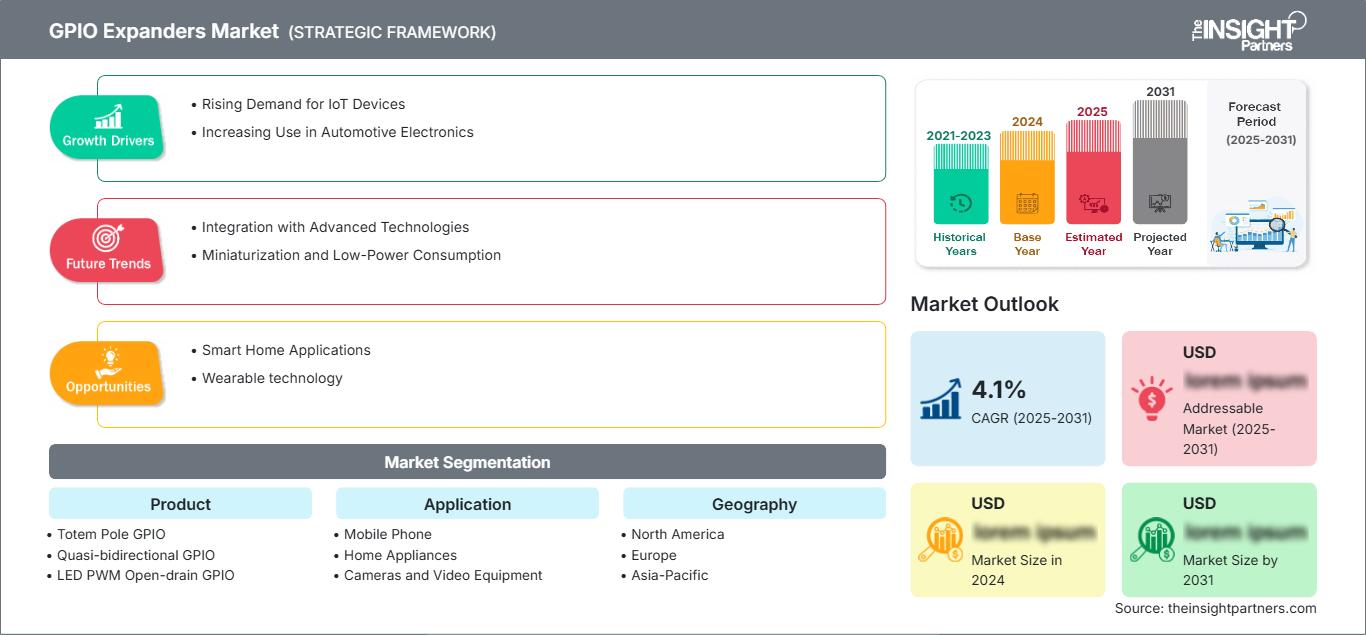
The GPIO Expanders Market size is positioned for sustained expansion as embedded systems require additional configurable I/O without increasing controller pin count. The market is valued at US$ 804.18 Million in 2025 and is projected to reach US$ 1,828.54 Million by 2034, advancing at a 9.56% CAGR from 2026 to 2034. Growth is supported by increasing electronic content across consumer devices, automotive systems, industrial equipment, and connected products.
North America remains an important technology and design center, supported by semiconductor development, automotive electronics, edge computing, and high-value embedded systems. The regional outlook indicates a 10.0–10.7% CAGR, with demand strengthened by higher interface complexity and increasing adoption of compact mixed-voltage architectures. The region also benefits from established semiconductor ecosystems and extensive engineering capabilities.
GPIO Expanders Market Assessment and Insights
- North America: North America is estimated to hold a 28–32% GPIO Expanders Market share in 2025, growing at a 10.0–10.7% CAGR between 2026–2034, supported by automotive electronics, embedded computing, industrial automation, and semiconductor design activity.
- US: The US accounts for 68–72% of North America in 2025 and is expected to grow at a 10.1–10.7% CAGR between 2026–2034, driven by advanced embedded electronics and automotive platforms.
- Europe: Europe represents a 24–28% share in 2025 and is projected to expand at an 8.8–9.4% CAGR between 2026–2034, with Germany, the UK, France, Italy, and Spain supported by automotive, industrial automation, and energy electronics.
- Asia Pacific: Asia Pacific holds a 34–38% share in 2025 and is expected to register a 10.4–11.0% CAGR between 2026–2034, led by China, Japan, South Korea, India, and Taiwan through electronics manufacturing and semiconductor investment.
- Largest Segment: The Product segment is the largest main segment, representing an estimated 55–60% share in 2025 and expanding at a 9.1–9.8% CAGR between 2026–2034, supported by diverse interface requirements.
- High Growth Segment: The Application segment is the high-growth main segment, with an estimated 40–45% share in 2025 and a 10.0–10.8% CAGR between 2026–2034, reflecting expanding device-level connectivity.
- Key companies analyzed in detail: Cypress Semiconductor Corporation, Lattice Semiconductor, Maxim Integrated, MaxLinear, Microchip Technology Inc., NXP Semiconductors, ON Semiconductor (Semiconductor Components Industries, LLC), Semtech Corp., STMicroelectronics, Texas Instruments Incorporated.
Source: The Insight Partners' analysis based on proprietary research, government publications, company annual reports, investor presentations, industry databases, and expert interviews.
GPIO Expanders Market has progressed from mere parallel I/O enhancement to sophisticated interface devices offering interrupt capability, reset capabilities, level conversion, output configuration, and lower power consumption. Increasing compatibility with mixed voltage processors and peripheral devices as well as decreasing board routing are among the factors causing the supplier focus towards compact packaging, wide voltage range, automotive-grade certification, and high integration, especially for mobile, computing, imaging, and embedded control devices.
Future growth in the GPIO Expanders Market will depend on the manufacturing capabilities of the Asia Pacific region, local content in automotive electronics, and spending on intelligent edge devices. Design considerations around safety, security, and power conservation will positively impact demand in the future. The suppliers that will be able to offer interface versatility and longer lifecycle will become relevant when original equipment manufacturers use common platforms over many generation of devices.
GPIO Expanders Market Report Scope
| Report Attribute | Details |
|---|---|
| Market size in 2025 | US$ 804.18 Million |
| Market Size by 2034 | US$ 1,828.54 Million |
| Global CAGR (2026 - 2034) | 9.56% |
| Historical Data | 2021-2024 |
| Forecast period | 2026-2034 |
GPIO Expanders Market Analysis
Rising functionality of electronics has driven a constant demand for GPIO expanders when the processors fail to fit all the controls, monitoring, LEDs, keypads, sensors, or peripheral connections. Hence, the Growth in GPIO Expanders Market is positively correlated with the amount of semiconductor content per device, miniaturization, and mixed voltage platforms.
The supply chain in the GPIO Expanders Market favors configurability of components that can work across different voltage ranges and interface types. I²C is used in basic designs with few pins, while SPI-based components cater to applications where fast communication and scalable expansion are required. Standby power savings, interrupt support, reset management, and level shifting have become critical criteria for component selection as they help to minimize the use of discrete components.
The competition in the GPIO Expanders Market is categorized based on the width of portfolio, qualification capabilities, packages offered and interface compatibility with other embedded systems. Some companies with extensive interface portfolio include Microchip Technology Inc., NXP Semiconductors and Texas Instruments Incorporated. Some companies specializing in specific areas include Maxim Integrated and Semtech Corp. with specialized interfaces in terms of low power and small form factors and also companies that have advantage with regard to their wider embedded systems such as Lattice Semiconductor and STMicroelectronics.
There has been more strategic investment in automotive interfaces, low voltage interfaces and design tools that reduce the interface qualification process. The companies which have automotive and industrial interfaces which include ON Semiconductor (Semiconductor Components Industries, LLC), Texas Instruments Incorporated and NXP Semiconductors could have an interface bundled with controllers and power devices.
● REPORT CUSTOMIZATION
Tailor This Report To Align With Your Specific Business Requirements
This report can be customized to align precisely with your business objectives, scope, and target markets. Customization options include tailored segmentation, geography, competitive analysis, and strategic insights to support informed decision-making.
Customize This Report →WHAT YOU CAN ADJUST
- ● Segmentations
- ● Geography
- ● Competitive Analysis
- ● Language Preferences
GPIO Expanders Market: Strategic Insights
Regional Insights
North America GPIO Expanders Market
North America is estimated at a 28–32% share in 2025, with a 10.0–10.7% CAGR through 2034. US is a key player in the regional market due to the concentration of semiconductor design, cloud computing, automotive electronics, military tech, and industrial automation. Canada helps via industrial electronics, communications, and embedded development. There is a growing need for high-value systems with compact interface expansion and mixed voltage.
The region has the benefit of having well-established semiconductor engineering abilities and advanced embedded designs. Sources of demand include automotive electronics, robotics, networking devices, and edge computing. Low power design, functional safety, and SPI/I²C interface scalability become more common in suppliers’ products. Product innovation and OEM needs allow further regional growth while local semiconductor manufacturing brings supply chain robustness.
U.S. GPIO Expanders Market Market
The US represents approximately 68–72% of North America's 2025 market, with a 10.1–10.7% CAGR through 2034. The demand is primarily from designers of semiconductor circuits, automotive electronics, industrial automation firms, and consumer electronics. Companies such as Texas Instruments Incorporated, Microchip Technology Inc., NXP Semiconductors, and others have very large interface offerings catering to these uses.
The demand in application use is heading towards compact modules, intelligent sensors, automotive controllers, network hardware, and portable devices. The integration of controllers does not lead to the elimination of the expanders since the design engineers will require more interrupt lines, LEDs, pushbuttons, diagnostics, and peripheral controllers. Zonal architecture of automobiles and the increasing complexity of embedded systems will provide avenues for denser and fail-safe products.
Europe GPIO Expanders Market Market
Europe is estimated at a 24–28% share in 2025, growing at an 8.8–9.4% CAGR, with Being the leader country in this case. The needs arise from automotive electronics, factory automation, energy systems, and industrial control, and more recently, European standards for design are becoming increasingly concerned with functional safety, security and longevity of components.
In the area of technology markets, the UK and Germany are still considered. The UK has advantages such as aerospace, industrial electronics, communications, and embedded systems design, and Germany has advantages in automotive electronics and industrial automation. France, Italy, and Spain play their role by means of transportation equipment, industrial machinery, consumer electronics, energy systems, and automotive.
APAC GPIO Expanders Market Market
APAC represents a 34–38% share in 2025 and is projected to grow at a 10.4–11.0% CAGR, making it the leading regional market. China is at the forefront of regional demand, with Japan, South Korea, India, and Australia following. Consumer electronics production, automotive electronics production, industrial equipment, and semiconductors drive adoption.
China represents high electronics production and growing domestic semiconductor capability. Japan and South Korea contribute robust automotive electronics demand, camera electronics, display electronics, and precision electronics, while India is growing in electronics production and embedded systems. Australia, on the other hand, contributes in industrial and communications equipment.
Middle East & Africa GPIO Expanders Market Market
Middle East and Africa demand is smaller but increasingly supported by industrial digitization, telecommunications, smart infrastructure, and energy projects. Saudi Arabia leads regional momentum, followed by the UAE and South Africa. The region is estimated to register a 7.4–8.2% CAGR through 2034 as connected equipment becomes more prevalent.
There is potential within Saudi Arabia and the UAE for technologies relating to smart infrastructure, automation, and digitization, allowing the use of embedded interface components. There is potential for contributions from South Africa regarding industrial automation, mining, energy, and telecoms. Everywhere else in the MEA region is fragmented, with deployment occurring mainly through infrastructure and industrial applications.
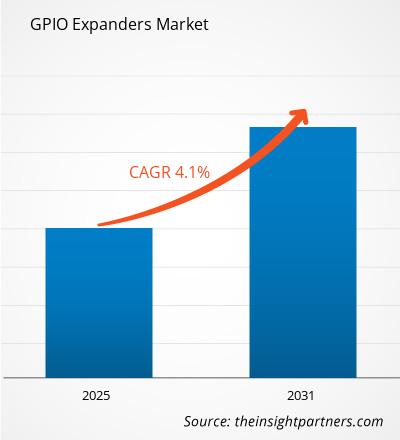
Segmentation Analysis
Product
The Product segment is estimated to grow at a 9.1–9.8% CAGR from 2026–2034. Demand is determined by output configuration, power consumption, voltage compatibility, switching requirements, and interface architecture. Designers increasingly prefer products that combine GPIO expansion with level shifting, interrupts, configurable outputs, and compact packaging, reducing board complexity while preserving controller flexibility.
- Totem Pole GPIO: Totem Pole GPIO devices remain important where designers require actively driven high and low states, supporting predictable digital switching across embedded controllers, sensors, displays, and general-purpose peripheral interfaces.
- Quasi-bidirectional GPIO: Quasi-bidirectional GPIO products provide flexible input and output behavior with simplified external circuitry, making them suitable for control interfaces, status monitoring, keyboards, and mixed peripheral architectures.
- LED PWM Open-drain GPIO: LED PWM Open-drain GPIO devices support current-sinking and brightness-control functions, making them strategically relevant for indicators, display subsystems, lighting controls, and compact consumer electronics requiring configurable outputs.
- Others: Other product configurations address specialized interface requirements where standard GPIO structures are insufficient, including application-specific control functions and customized embedded architectures requiring differentiated electrical characteristics.
Application
The GPIO Expanders Market forecast shows that the Application segment is projected to expand at a 10.0–10.8% CAGR from 2026–2034. Device manufacturers increasingly require additional control lines as product functionality expands without proportionally increasing processor pin counts. Compact consumer electronics, connected appliances, cameras, computing platforms, and portable systems therefore remain central adoption areas.
- Mobile Phone: Mobile phones use expansion interfaces for auxiliary controls, sensors, power management, indicators, and peripheral functions where processor resources and board space are constrained.
- Home Appliances: Home appliances increasingly use GPIO expansion for buttons, displays, sensors, relays, motor controls, and status indicators as connected functionality becomes embedded across product categories.
- Cameras and Video Equipment: Cameras and video systems require configurable control lines for sensors, lens mechanisms, indicators, storage interfaces, displays, and accessory management within increasingly compact electronic architectures.
- Portable Game Devices: Portable gaming systems use additional I/O for buttons, lighting, displays, haptic controls, sensors, and accessory functions while maintaining tight power and space constraints.
- Laptops and PCs: Computing platforms employ expanders for system management, keyboards, indicators, thermal controls, power sequencing, and peripheral functions, especially where motherboard space and controller resources are constrained.
- Others: Other applications include networking equipment, industrial controllers, smart devices, measurement systems, and specialized embedded products requiring scalable digital control and monitoring functions.
Opportunity Snapshot
| Application | Revenue Contribution | Trend Tag | Adoption Stage |
| Mobile Phone | High | Compact I/O | Mature |
| Home Appliances | High | Smart Controls | Scaling |
| Cameras and Video Equipment | Medium | Sensor Control | Scaling |
| Portable Game Devices | Medium | Haptic Control | Scaling |
| Laptops and PCs | High | System Management | Mature |
| Others | Medium | Embedded Control | Scaling |
GPIO Expanders Market Growth Drivers and Impact Analysis
Increasing Electronic Content per Connected Device
Connected products are incorporating more sensors, indicators, buttons, actuators, diagnostic functions, and peripheral controllers without proportionally increasing processor pin counts. This leads to an ongoing need for low-cost interface expansion. This effect is especially pronounced in miniaturized consumer electronics, smart appliances, cameras, and embedded computer systems where space on the board is tightly constrained. With GPIO expansion, it is possible to keep peripheral controls separate from the CPU, thereby preventing excessive usage of pins. With successive generations of products, it is possible to continue using the same controller even as the I/O capabilities of the system increase. This enables component reuse and can potentially speed up redesign cycles of hardware.
Growth of Mixed-Voltage Embedded Architectures
In today's electronic systems, it is common to find processor cores with low supply voltages alongside peripherals that have other voltage domains. It is for this reason that GPIO expanders are becoming more popular with their ability to translate the levels thus minimizing the use of translators and making routing easy. This is especially important in mobile phones, camera devices, industrial machines, and automotive electronics because in these platforms there may be several generations of semiconductor devices coexisting in one platform. By providing wide I/O supply range capabilities, fewer components will be used in the designs. It becomes easier for manufacturers to standardize the interface components between different product lines without compromising controller compatibility.
Expansion of Automotive and Industrial Embedded Electronics
Automotive and industrial platforms are adding electronic control points as systems become more distributed, connected, and software-defined. GPIO expanders can provide additional controls for lighting, switches, diagnostics, actuators, sensors, and system-management functions without requiring larger processors. In the case of automotive systems, the factors that will have an effect on component selection include qualification, temperature behavior, fail-safety, and lifecycle predictability. In industrial systems, the factors may include reliable communication, programmable interface, and availability. Such environment could lead to a situation where quality of products becomes more important than their cost. With modular architecture becoming common practice, the expanders may help simplify interfaces and allow for platform reuse.
GPIO Expanders Market Future Trends
Migration Toward Higher-Density and Smarter I/O Expansion
The GPIO Expanders Market trends show that future devices are expected to combine higher channel density with more configurable electrical behavior, enabling a single component to manage several peripheral functions. Rather than serving only as a collection of digital pins, next-generation products will increasingly integrate configurable pull structures, interrupt management, fail-safe features, programmable polarity, level translation, and improved output control. This evolution should reduce external components and simplify software-controlled system management. SPI-based expansion can gain relevance where multiple ports or faster configuration are required, while I²C remains attractive for cost-sensitive and low-bandwidth applications. Designers are also likely to favor products supporting daisy chaining and address flexibility. Such capabilities can make expansion devices more valuable within complex embedded platforms while supporting reuse across multiple hardware configurations.
Integration of Functional Safety and System Diagnostics
Functional safety requirements are likely to influence GPIO expansion increasingly as these components become embedded in automotive control and industrial automation architectures. Future products can incorporate diagnostic registers, fail-safe states, fault indication, controlled reset behavior, and stronger protection against unintended output conditions. Automotive developers may increasingly evaluate GPIO devices alongside broader safety architectures rather than treating them as commodity interface components. Industrial customers similarly require predictable behavior during power interruptions, communication faults, and abnormal operating conditions. This trend can raise qualification requirements and increase the importance of detailed reliability documentation. Vendors with established automotive and industrial semiconductor portfolios are positioned to extend GPIO offerings into safety-oriented applications, while specialized suppliers may differentiate through compact, low-power products designed for tightly constrained embedded systems.
GPIO Expanders Market Opportunities
Automotive Zonal Architecture and Distributed Control
Automotive zonal architectures create opportunities for GPIO expansion as electronic functions become distributed closer to sensors, actuators, and body-control components. Investors and suppliers can target devices supporting multiple voltage domains, fail-safe behavior, robust temperature performance, and scalable communication. Products designed for local control nodes can reduce wiring complexity while providing additional digital interfaces without increasing processor pin requirements. The strongest opportunities are likely to occur in lighting, body electronics, seat systems, thermal management, and auxiliary control modules. Suppliers should prioritize automotive qualification, long lifecycle commitments, diagnostic functionality, and reference designs that simplify integration. Partnerships with automotive Tier 1 suppliers and semiconductor platform developers can further improve design access and accelerate adoption in next-generation vehicle architectures.
Low-Power Expansion for Portable and Edge Electronics
Portable devices and edge equipment offer another opportunity for suppliers able to combine low standby current, small packages, voltage translation, and flexible GPIO configuration. Mobile accessories, handheld equipment, cameras, wearables, compact gateways, and battery-powered industrial sensors frequently face severe power and board-space constraints. A GPIO device that replaces several discrete interface components can improve system density while preserving processor resources. Suppliers can pursue this opportunity through ultra-low-power products, reference boards, software drivers, and evaluation tools that reduce development friction. Distributor availability is also important because many designs require rapid prototyping before volume commitment. Expanding channel coverage across Asian electronics manufacturing centers could improve access to emerging OEM programs and support higher-volume production opportunities.
Recent Developments
- August 2026: MaxLinear introduced RackCommander™, a portfolio of connectivity, monitoring, control, and power-management solutions designed for rack-level control-plane architectures in AI, cloud, enterprise, and edge infrastructure. The portfolio combines USB-UARTs, RS-485 transceivers, GPIO expanders, eFuse and power-protection technologies, telemetry, and monitoring capabilities to address the growing complexity of rack-scale AI systems. The launch strengthens MaxLinear’s positioning as a provider of silicon building blocks for next-generation AI data-center management and control.
- May 2025: Apogee Semiconductor introduced APIO16, a radiation-hardened 16-bit I/O expander designed for spaceborne and other high-reliability systems. The device combines I²C/SMBus and SPI interfaces with integrated voltage-level translation and radiation resilience, enabling low-voltage controllers to interface with higher-voltage peripherals while reducing the number of host processor pins required. The launch expands Apogee’s radiation-hardened interface portfolio for spacecraft, medical imaging, and other environments where reliable digital I/O expansion is critical.
Frequently Asked Questions

- Comprehensive Market Sizing and Forecast Analysis
- Detailed Segmentation Analysis
- In-Depth Market Dynamics Assessment
- Regional and Country-Level Insights
- Competitive Landscape and Company Benchmarking
- Strategic Business Intelligence
Recent Reports
Testimonials

The Insight Partners provided valuable market intelligence that supported our global go-to-market strategy. Their team was professional, responsive, and attentive to our feedback, providing thoughtful analysis and helpful methodological clarifications throughout the project.
Junmo Kim Chief Financial Officer (CFO), Enertech Co., Ltd.
The Insight Partners' SCADA System Market report is comprehensive, with valuable insights on current trends and future forecasts. The team was highly professional, responsive, and supportive throughout. We are very satisfied and highly recommend their services.
RAN KEDEM Partner, Reali Technologies LTDs
I requested a report on a very specific software market and the team produced the report in a few days. The information was very relevant and well presented. I then requested some changes and additions to the report. The team was again very responsive and I got the final report in less than a week.
JEAN-HERVE JENN Chairman, Future Analytica
We worked with The Insight Partners for an important market study and forecast. They gave us clear insights into opportunities and risks, which helped shape our plans. Their research was easy to use and based on solid data. It helped us make smart, confident decisions. We highly recommend them.
PIYUSH NAGPAL Sr. Vice President, High Beam Global
The Insight Partners delivered insightful, well-structured market research with strong domain expertise. Their team was professional and responsive throughout. The user-friendly website made accessing industry reports seamless. We highly recommend them for reliable, high-quality research services
YUKIHIKO ADACHI CEO, Deep Blue, LLC.
This is the first time I have purchased a market report from The Insight Partners.While I was unsure at first, I visited their web site and felt more comfortable to take the risk and purchase a market report.I am completely satisfied with the quality of the report and customer service. I had several questions and comments with the initial report, but after a couple of dialogs over email with their analyst I believe I have a report that I can use as input to our strategic planning process.Thank you so much for taking the extra time and making this a positive experience.I will definitely recommend your service to others and you will be my first call when we need further market data.
JOHN SUZUKI President and Chief Executive Officer, Board Director, BK Technologies
I wish to appreciate your support and the professionalism you displayed in the course of attending to my request for information regarding to infectious disease IVD market in Nigeria. I appreciate your patience, your guidance, and the fact that you were willing to offer a discount, which eventually made it possible for us to close a deal. I look forward to engaging The Insight Partners in the future, all thanks to the impression you have created in me as a result of this first encounter.
DR CHIJIOKE ONYIA MANAGING DIRECTOR, PineCrest Healthcare Ltd.Reason to Buy
- Informed Decision-Making
- Understanding Market Dynamics
- Competitive Analysis
- Identifying Emerging Markets
- Customer Insights
- Market Forecasts
- Risk Mitigation
- Boosting Operational Efficiency
- Strategic Planning
- Investment Justification
- Tracking Industry Innovations
- Aligning with Regulatory Trends





 Get Free Sample for