
Haptic Interface Market Size, Trends & Growth by 2034
Coverage: By Component (Hardware, Software); Technology (Tactile Feedback, Force Feedback); Operating System (Windows, Mobile Operating Systems, Others); Application (Manufacturing, Military and Defense, Consumer Electronics, Automotive, Gaming Console, Healthcare, Others), and Geography (North America, Europe, Asia Pacific, and South and Central America)
- Status : Data Released
- Report Code : TIPRE00015012
- Category : Electronics and Semiconductor
- No. of Pages : 150
- Available Report Formats :


- Last update date : September 02, 2026


2025 Market Size
US$ 6.39 Bn
Base year value
2034 Forecast
US$ 14.41 Bn
Projected by 2034
CAGR 2026-2034
9.46 %
Growth rate
Addressable Market
US$ 92.85 Bn
(2026-2034)
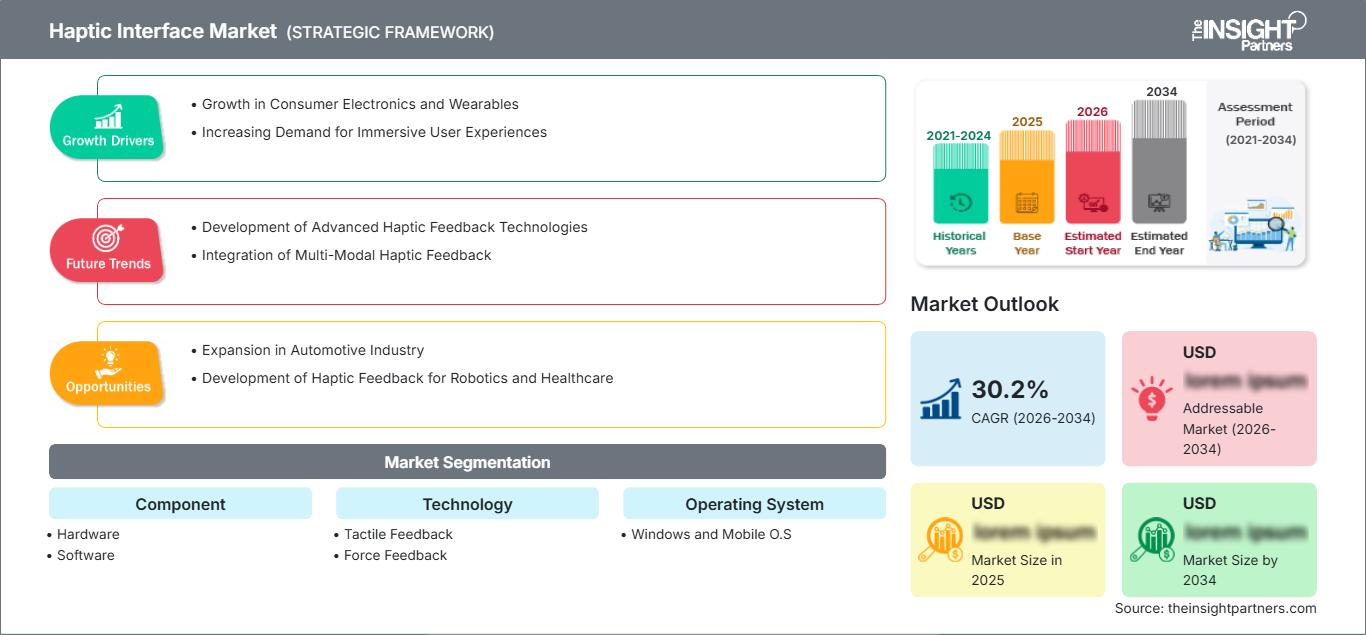
The Haptic Interface Market size stood at US$ 6.39 Billion in 2025 and is expected to rise to US$ 14.41 Billion by 2034, marking a CAGR of 9.46% for 2026-2034. This is attributed to the increasing incorporation of haptic feedback technology in mobile devices, gaming consoles, vehicle controls, training simulations, and defense systems as it adds more accuracy to the interaction and increases confidence among the users.
In North America, the Haptic Interface Market is set to experience a growth rate of around 6.3-6.9% CAGR up to 2034. Growth drivers include premium consumer electronics, well-developed gaming infrastructure, vehicle cockpit digitization, and defense simulation spending. Strong intellectual property rights and developer platforms reduce the time required for integration, while the demand for accessible digital experiences results in enhanced tactile signals from smartphones, mixed reality systems, workstations, and transportation interfaces.
Haptic Interface Market Assessment and Insights
- North America held 31–34% share in 2025 and is projected to grow at a 6.3–6.9% CAGR during 2026–2034, supported by gaming, premium devices, automotive HMI, and defense simulation.
- US represented 82–86% of North American revenue in 2025 and should expand at a 6.4–7.0% CAGR through 2034.
- Europe accounted for 24–27% share in 2025 and is expected to record a 6.1–6.7% CAGR, led by Germany, the UK, France, Italy, and Spain.
- Asia Pacific captured 34–38% share in 2025 and should advance at a 7.6–8.2% CAGR, led by China, Japan, South Korea, India, and Australia.
- Largest Segment Hardware held 67–71% market share in 2025 and is projected to post a 6.3–6.9% CAGR during 2026–2034.
- High Growth Segment Force Feedback represented 31–35% market share in 2025 and is expected to grow at a 7.8–8.4% CAGR during 2026–2034.
- Key companies analyzed in detail: Apple Inc.; HAPTION SAS; Immersion Corporation; 3D Systems, Inc.; NOVASENTIS, INC.; Ultraleap Limited; Qualcomm Technologies, Inc.; ALPS ALPINE CO., LTD.; NIDEC CORPORATION; and Johnson Electric Holdings Limited.
Source: The Insight Partners' analysis based on proprietary research, government publications, company annual reports, investor presentations, industry databases, and expert interviews.
Haptic technologies have moved from eccentric rotating mass vibration to more complex linear resonant, piezoelectric, electroactive polymer, ultrasonic, and multi-axis force systems managed by advanced software. Today’s manufacturing involves actuator calibration, mechanical design, waveform generation, and operating system integration. Standard signal formats are enhancing device portability, while small form factors enable local effect delivery within thin products. Such a development is making the Haptic Interface Market compatible with programmable surfaces, spatial computing, automobile touch interfaces, and realistic simulations rather than just notification vibration.
In the coming years until 2034, funding will be distributed among the Asian electronics clusters, the North American software and gaming communities, and the European vehicle engineering centers. The ISO/IEC 23090-31 publication on haptics coding in January 2025 facilitates interoperable vibrotactile and kinesthetic signal representation. In future procurements, efficient actuators, re-useable authoring, low latency control, and safety assurance in terms of training, teleoperation, and interaction with drivers will be valued.
Haptic Interface Market Report Scope
| Report Attribute | Details |
|---|---|
| Market size in 2025 | US$ 6.39 Billion |
| Market Size by 2034 | US$ 14.41 Billion |
| Global CAGR (2026 - 2034) | 9.46% |
| Historical Data | 2021-2024 |
| Forecast period | 2026-2034 |
Haptic Interface Market Analysis
Haptic Interface Market growth is driven by the requirement for re-establishing physical feedback in light of mechanical controls moving onto displays and virtual spaces. This market includes suppliers of actuators, driver ICs, materials, device OEMs, game developers, operating systems, and interaction designers. Performance is dependent on latency, resonance, mounting stiffness, power usage, and waveform quality, since the same actuators may result in drastically different haptic feedback depending on the product enclosure.
Scalable hardware platforms combined with software libraries are the ideal combination in terms of supply economics. Consumer electronics will provide volumes, whereas automotive, training, and defense applications will have longer qualification periods and more engineering content. Availability of components, access to patents, and calibration abilities play an important role in the source. Increasingly, developers want solutions for mapping audio, events, or physical simulation into haptic effects.
Haptic Interface Market Analysis shows competitive dynamics between vertically integrated platform providers and focused technology providers. Apple Inc. is vertically integrated across hardware, software, and behavior of content; Immersion Corporation focuses on IP, design tools, and licensing. HAPTION SAS and 3D Systems, Inc. provide solutions for force feedback and simulation workflow; Ultraleap Limited provides ultrasound-based mid-air haptic interaction.
The strategic positioning is further influenced by the depth of components. ALPS ALPINE CO., LTD., NIDEC CORPORATION, and Johnson Electric Holdings Limited offer actuator and motion control technologies; Qualcomm Technologies, Inc. provides mobile and extended reality computing platforms. NOVASENTIS, INC. offers thin electro-mechanical polymer technologies. Key investment areas are reduced power consumption, increased frequency range, automated authoring, and reference designs that reduce OEM integration time without compromising unique feel.
● REPORT CUSTOMIZATION
Tailor This Report To Align With Your Specific Business Requirements
This report can be customized to align precisely with your business objectives, scope, and target markets. Customization options include tailored segmentation, geography, competitive analysis, and strategic insights to support informed decision-making.
Customize This Report →WHAT YOU CAN ADJUST
- ● Segmentations
- ● Geography
- ● Competitive Analysis
- ● Language Preferences
Haptic Interface Market: Strategic Insights
Regional Insights
North America Haptic Interface Market
In 2025, North America accounted for 31–34% of Haptic Interface Market share and is expected to grow at a 6.3–6.9% CAGR over 2034. The premium smartphone market, console gaming, extended reality development, software licensing, and digital cockpit integration drive the growth. Force-based simulation systems find use in defense agencies and training institutes where the repeated physical stimuli help learn procedures without putting real-life operational assets and people at risk.
The regional significance lies in its semiconductor design, game development capabilities, patent portfolio, and platform integration. The device companies can align silicon, firmware, operating system, and content tools in existing supply chains. Canada provides research, simulation, and immersive media while Mexico provides electronics and automotive manufacturing. The region’s existing installed base helps generate recurring revenues from software, engineering, and licensing apart from replacement requirements for actuators, controllers, and professional interfaces.
U.S. Haptic Interface Market Market
The U.S. represented 82–86% of North American revenue in 2025 and is expected to grow at a 6.4–7.0% CAGR during 2026–2034. Apple Inc., Immersion Corporation, 3D Systems, Inc., NOVASENTIS, INC., and Qualcomm Technologies, Inc. maintain technology, licensing, or commercial presence. Demand spans mobile devices, consoles, mixed reality, automotive controls, medical simulation, industrial design, and military training.
Application development is shifting from generic vibration toward authored effects synchronized with sound, motion, and visual events. Automotive programs emphasize eyes-forward confirmation, while gaming prioritizes weapon recoil, surface texture, and directional cues. Education and defense users value measurable training transfer. U.S. customers therefore favor platform suppliers that combine low-latency hardware, APIs, content libraries, testing services, and clear patent rights across product generations.
Europe Haptic Interface Market Market
The European market represented 24-27% of world revenues in 2025 and will grow at a 6.1-6.7% CAGR until 2034. Germany dominates because of automotive HMI, simulation for industrial use, robotics, and engineering software. The UK provides mid-air haptic technology, immersive development, and research, and France helps in force feedback systems, aerospace simulation, defense training, and manufacturing that needs bilateral interaction.
Italy and Spain provide demand from the automotive, game, university, and industrial automation sectors. Europe is helped by its expertise in vehicle safety engineering and human factors, but the fragmented procurement process and long qualification cycle can hinder volume. Well-positioned suppliers are those who have local integration teams, cybersecurity documentation, and compliance ready components. Programmable touch surfaces and remote operation control will expand usage beyond high-end cars to machinery and public systems.
APAC Haptic Interface Market Market
Asia-Pacific had a market share of 34-38% in 2025 and is expected to have a CAGR of 7.6-8.2%, the highest among all regions. China dominates by virtue of its electronics industry, smartphone manufacturing, automotive electronic content, and gaming consoles. Japan and South Korea bring in high-end actuators, displays, consoles, and manufacturing capability.
Indian design centers and digital content development expand software opportunities, while Australia adds to applications in defense, mining, and simulation. Favorable industrial policies, local electronics ecosystems, and increasing adoption of premium devices make for conducive conditions for adoption. Competition is driven by pricing, favoring suppliers who can provide smaller actuators, drivers, firmware, and regional application engineering.
Middle East & Africa Haptic Interface Market Market
The Middle East & Africa region will see a 5.6–6.2% CAGR until 2034. UAE excels in aviation training, immersive experiences, smart infrastructure, and technology investments, whereas Saudi Arabia has defense simulation, industrial training, and digital entertainment owing to its diversification initiatives.
South Africa adds mining simulation, education technology, and automotive engineering; other countries in the MEA region are project-based. Lack of integration of specialists and imported equipment might limit implementation. Rugged devices, remote assistance, multilingual content development software, and partnership with local players can cater to scattered clientele by matching haptic training with infrastructure, energy, and safety issues.
Segmentation Analysis
Component
The Component segment is projected to grow at a 6.5–7.1% CAGR during 2026–2034. Haptic Interface Market scope covers actuators, controllers, mechanical assemblies, firmware, APIs, authoring tools, and effect libraries. Hardware captures greater immediate revenue, but software expands strategic value by enabling cross-device consistency, rapid prototyping, remote updates, and differentiated tactile behavior without redesigning every physical product.
- Hardware holds the leading position because devices require actuators, drivers, sensors, and mechanical integration, with demand concentrated in smartphones, controllers, vehicles, simulators, and professional interfaces.
- Software is strategically important for waveform creation, calibration, interoperability, and analytics, helping OEMs scale distinctive tactile experiences across product families while reducing repeated engineering effort.
Technology
The Technology segment should expand at a 7.0–7.6% CAGR through 2034. Tactile feedback dominates compact consumer and vehicle interfaces because it delivers localized confirmation with modest size and power. Force feedback gains faster adoption in training, robotics, teleoperation, and simulation, where resistance, weight, and directional load improve realism and task understanding.
- Tactile Feedback remains broadly deployed in mobile devices, touchscreens, controllers, and vehicle controls, translating digital events into taps, textures, clicks, and patterned vibration.
- Force Feedback carries strategic value in simulators, surgical planning, industrial design, robotics, and defense, where bidirectional resistance communicates contact, motion constraints, or virtual object properties.
Operating System
The Operating System segment is expected to register a 6.6–7.2% CAGR during 2026–2034. Windows supports engineering, simulation, gaming, and professional peripheral ecosystems, while Mobile O.S drives scale through smartphones, tablets, wearables, and portable gaming. APIs, latency control, device certification, and backward compatibility determine whether developers can deliver repeatable effects across fragmented hardware.
- Windows supports high-performance gaming, design, simulation, and training peripherals, with open hardware choice and established developer tools encouraging specialized force-feedback and multi-device configurations.
- Mobile O.S commands high unit volumes and frequent interaction, making power efficiency, compact actuators, API consistency, and application-level effect design central to commercial success.
Application
The Application segment is projected to expand at a 7.1–7.7% CAGR through 2034. Gaming supplies established volume, while automotive interfaces and professional training widen adoption. Education, military, and defense programs value repeatable practice and tactile situational cues. Integration economics depend on content quality, hardware durability, calibration, and whether measurable performance gains justify added system complexity.
- Education and Training uses tactile guidance to improve procedural practice, spatial understanding, and skill repetition, particularly where real equipment is scarce, hazardous, or expensive.
- Gaming Console remains a major revenue contributor as adaptive triggers, localized vibration, and synchronized effects deepen immersion and differentiate controllers, titles, and platform ecosystems.
- Automotive Industry adopts programmable feedback in steering wheels, seats, touchscreens, and controls to provide confirmation, warnings, and premium interaction while reducing mechanical switch complexity.
- Military demand centers on mission rehearsal, vehicle simulation, remote operation, and maintenance instruction, where rugged interfaces and realistic resistance support repeatable readiness programs.
- Defense programs prioritize secure, high-fidelity simulation and teleoperation, creating opportunities for validated force feedback, wearable cues, and multi-user training platforms with long service lives.
Opportunity Snapshot
| Application | Revenue Contribution | Trend Tag | Adoption Stage |
| Education and Training | Medium | Skill Simulation | Scaling |
| Gaming Console | High | Adaptive Triggers | Mature |
| Automotive Industry | High | Digital Cockpit | Scaling |
| Military | Medium | Mission Rehearsal | Scaling |
| Defense | Medium | Remote Operation | Emerging |
Haptic Interface Market Growth Drivers and Impact Analysis
Digital Controls Need Physical Confirmation
The elimination of the tactile click for confirming actions by using touch screens and virtual buttons generates uncertainty in automobiles, portable gadgets, machinery, and immersion environments. The use of haptics brings back the information by making use of programmable clicks, detents, texture, and resistance without adding more physical buttons. There are functional and economic implications for doing this as designers can now reduce interface clutter, personalize feedback through software, and modify the feedback after the product has been released. The automobile industry will have eyes-forward confirmation, and industrial panels will be able to communicate state changes by touching them. Proper localization and low latency are critical when it comes to adoption of haptics technology.
Immersive Content Expands Beyond Visual and Audio
Touch is becoming increasingly regarded as an essential medium in gaming, mixed reality, training, and simulation applications instead of an optional component. According to the survey carried out by the Haptics Industry Forum in 2025 for 27 gaming companies, 44.5% felt that there should have been greater use of haptics, which shows that there is a need for greater use despite varying levels of expertise. Haptic effects can be designed to provide feedback about impact, texture, collision, direction, and boundaries of virtual objects. It widens investment from actuators to middleware, authoring, testing, and content creation. Platform vendors gain from unique feedback that enhances user engagement, and professional users can rehearse procedures repeatedly.
Simulation and Teleoperation Require Bidirectional Touch
Educational, military, defense, industrial design, and remote robotics applications require an interface capable of representing contact force, weight, resistance, and movement constraints. Force feedback gives the operator a feeling of the virtual or remote world, which adds to the realism when visual feedback is not enough. The commercial implications include increased value added in terms of devices, engineering services, calibration, maintenance, and specialized software. An organization will be able to save on the use of expensive equipment and perform dangerous scenarios without risk, but this must be tested against training objectives. Stability of the mechanical system and of the control loop is crucial since otherwise oscillations will destroy the user’s confidence.
Haptic Interface Market Future Trends
Interoperable Haptic Media Pipelines
Haptic Interface Market trends will increasingly center on portable effect formats that separate creative intent from individual device hardware. ISO/IEC 23090-31, published in January 2025, defines representation and delivery for vibrotactile and kinesthetic signals, supporting both parametric and signal-based inputs. Over time, content creators should author one adaptable haptic track that devices render according to their actuator capabilities. This can improve consistency across games, streaming, XR, accessibility, and remote communication. Adoption will require conformance tools, device profiles, and rights frameworks, but interoperability should reduce duplicated engineering and expand the addressable audience for professionally authored tactile content.
AI-Assisted Effect Creation and Personalization
Future authoring platforms will use machine learning to translate audio, animation, game events, and physical simulations into candidate haptic effects. Designers will refine these outputs rather than building every waveform manually, reducing production cost for large content libraries. Devices may also adapt intensity, frequency, and timing to user preferences, grip, context, or actuator condition. Personalization can improve accessibility and comfort, but platforms must avoid inconsistent or distracting feedback. Suppliers will compete through training data, perceptual models, workflow integration, and device calibration. The strongest solutions will keep creators in control while automating repetitive synchronization and cross-hardware optimization tasks.
Haptic Interface Market Opportunities
Automotive Haptic Reference Platforms
Haptic Interface Market Forecasts support investment in standardized modules for touchscreens, steering wheels, seats, center consoles, and concealed controls. Suppliers can combine actuators, drivers, mechanical guidance, firmware, effect libraries, and validation methods into reference platforms that reduce automaker integration risk. The opportunity is strongest where programmable surfaces replace multiple switches while preserving physical confirmation. Investors should prioritize automotive-grade temperature tolerance, long operating life, electromagnetic compatibility, and functional-safety documentation. Partnerships with display, cockpit, and seating integrators can accelerate design wins. Recurring value can come from software updates, calibration, and platform reuse across vehicle lines rather than one-time component sales alone.
Scalable Training Content for High-Risk Workflows
Training providers can build reusable haptic modules for maintenance, vehicle operation, emergency response, manufacturing, and defense procedures. The investment case improves when one hardware platform supports multiple scenarios and captures performance data for instructors. Developers should focus on tasks where touch conveys force, sequence, or tool contact that visual simulation cannot reproduce adequately. Partnerships with equipment manufacturers can provide accurate digital models and access to customers. Revenue models may combine device sales, annual content licenses, analytics, and support. Demonstrating reduced training time, safer practice, or better retention will be more persuasive than immersion claims alone and can unlock multi-site deployments.
Recent Developments
- April 2025: Kyocera has integrated its HAPTIVITY tactile technology into Sigma’s new BF full-frame mirrorless camera, marking the first time the technology has been used in a mirrorless camera. The solution is designed to give photographers realistic physical feedback when operating the camera’s recessed controls. HAPTIVITY uses piezoelectric ceramic vibration elements to reproduce the sensation of pressing a conventional mechanical button. Instead of relying solely on visual confirmation, the technology stimulates the user’s fingertip with carefully controlled vibration patterns, helping confirm that an input has been registered.
- January 2026: Innovobot, XeelTech and STIWA Advanced Products have launched The Haptics Company, a new commercial venture focused on making advanced haptic technologies easier to integrate into next-generation products. The company aims to bridge the gap between haptic research and commercially deployable systems. The new company brings together expertise in haptic system design, programmable actuators, electronics, firmware, mechanical integration and precision manufacturing. Its approach covers the complete development process, from defining requirements and designing human-machine interfaces to system validation and production.
- December 2025: Cirrus Logic has launched a new family of closed-loop haptic drivers designed to bring more precise and consistent tactile feedback to automotive interfaces. The CS40L51, CS40L52 and CS40L53 are the company’s first haptic driver solutions qualified to the AEC-Q100 automotive reliability standard. The new devices are designed for vehicles increasingly replacing traditional physical controls with touchscreens, smart surfaces and digital interfaces. By providing high-definition tactile feedback, the technology aims to give drivers a more intuitive way to interact with displays, steering wheels, centre consoles, smart seats and other in-cabin controls.
Frequently Asked Questions

- Comprehensive Market Sizing and Forecast Analysis
- Detailed Segmentation Analysis
- In-Depth Market Dynamics Assessment
- Regional and Country-Level Insights
- Competitive Landscape and Company Benchmarking
- Strategic Business Intelligence
Recent Reports
Testimonials

The Insight Partners' SCADA System Market report is comprehensive, with valuable insights on current trends and future forecasts. The team was highly professional, responsive, and supportive throughout. We are very satisfied and highly recommend their services.
RAN KEDEM Partner, Reali Technologies LTDs
I requested a report on a very specific software market and the team produced the report in a few days. The information was very relevant and well presented. I then requested some changes and additions to the report. The team was again very responsive and I got the final report in less than a week.
JEAN-HERVE JENN Chairman, Future Analytica
We worked with The Insight Partners for an important market study and forecast. They gave us clear insights into opportunities and risks, which helped shape our plans. Their research was easy to use and based on solid data. It helped us make smart, confident decisions. We highly recommend them.
PIYUSH NAGPAL Sr. Vice President, High Beam Global
The Insight Partners delivered insightful, well-structured market research with strong domain expertise. Their team was professional and responsive throughout. The user-friendly website made accessing industry reports seamless. We highly recommend them for reliable, high-quality research services
YUKIHIKO ADACHI CEO, Deep Blue, LLC.
This is the first time I have purchased a market report from The Insight Partners.While I was unsure at first, I visited their web site and felt more comfortable to take the risk and purchase a market report.I am completely satisfied with the quality of the report and customer service. I had several questions and comments with the initial report, but after a couple of dialogs over email with their analyst I believe I have a report that I can use as input to our strategic planning process.Thank you so much for taking the extra time and making this a positive experience.I will definitely recommend your service to others and you will be my first call when we need further market data.
JOHN SUZUKI President and Chief Executive Officer, Board Director, BK Technologies
I wish to appreciate your support and the professionalism you displayed in the course of attending to my request for information regarding to infectious disease IVD market in Nigeria. I appreciate your patience, your guidance, and the fact that you were willing to offer a discount, which eventually made it possible for us to close a deal. I look forward to engaging The Insight Partners in the future, all thanks to the impression you have created in me as a result of this first encounter.
DR CHIJIOKE ONYIA MANAGING DIRECTOR, PineCrest Healthcare Ltd.Reason to Buy
- Informed Decision-Making
- Understanding Market Dynamics
- Competitive Analysis
- Identifying Emerging Markets
- Customer Insights
- Market Forecasts
- Risk Mitigation
- Boosting Operational Efficiency
- Strategic Planning
- Investment Justification
- Tracking Industry Innovations
- Aligning with Regulatory Trends





 Get Free Sample for