
HD Monitoring System Market Share, Growth & Demand by 2034
Coverage: by Component (Hardware, Software); End User (Residential, Commercial, Industrial), and Geography (North America, Europe, Asia Pacific, and South and Central America)
- Status : Data Released
- Report Code : TIPRE00013536
- Category : Electronics and Semiconductor
- No. of Pages : 150
- Available Report Formats :


- Last update date : September 10, 2026


2025 Market Size
US$ 2.82 Bn
Base year value
2034 Forecast
US$ 6.47 Bn
Projected by 2034
CAGR 2026-2034
9.65 %
Growth rate
Addressable Market
US$ 41.38 Bn
(2026-2034)
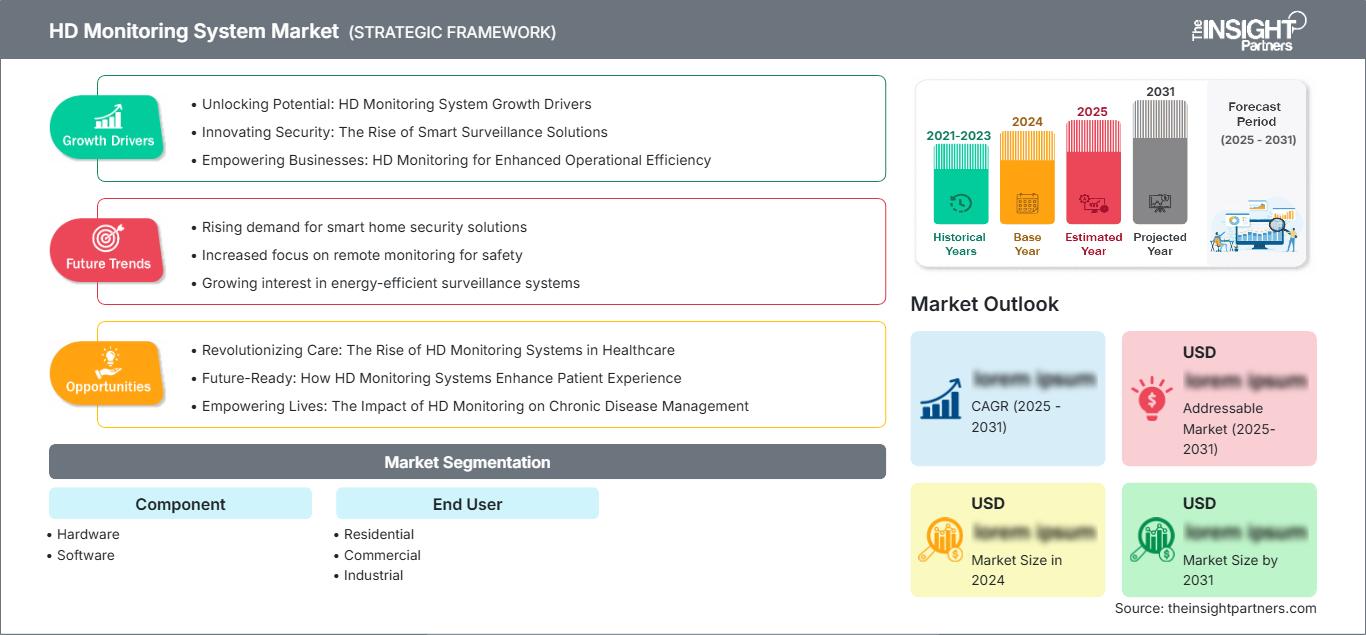
The HD Monitoring System Market was valued at US$ 2.82 Billion in 2025 and is projected to reach US$ 6.47 Billion by 2034, expanding at a CAGR of 9.65% during 2026–2034. The demand is rising since individuals, firms, and industries are upgrading from conventional SD surveillance equipment to smart, connected HD cameras, video recorders, advanced software and mobile apps for monitoring and managing the surveillance system for increased efficiency.
In North America, the HD Monitoring System Market size will expand at a 9.0%–9.7% CAGR through 2026–2034. High penetration of broadband services, adoption of smart home technology, and upgrading from analog technology drive the demand for HD monitoring system in the region. The demand is also rising among commercial users due to standardization of networked cameras, video management software and cybersecurity measures.
HD Monitoring System Market Assessment and Insights
- North America held 35–38% share in 2025 and is growing at a CAGR of 9.0–9.7% during 2026–2034, supported by smart-home adoption, commercial replacements, and mature cloud-service channels.
- US represented 83–86% of North America in 2025 and is growing at a CAGR of 9.1–9.8% during 2026–2034 as consumers and enterprises upgrade connected monitoring.
- Europe accounted for 24–27% share in 2025 and is growing at a CAGR of 8.5–9.2% during 2026–2034, led by the UK, Germany, France, Italy, and Spain.
- Asia Pacific captured 27–30% share in 2025 and is growing at a CAGR of 10.6–11.4% during 2026–2034, led by China, Japan, South Korea, India, and Australia.
- Largest Segment Hardware held 66–70% market share in 2025 and is growing at a CAGR of 8.8–9.5% during 2026–2034 through camera and recorder upgrades.
- High Growth Segment Software held 30–34% market share in 2025 and is growing at a CAGR of 11.2–12.0% during 2026–2034 through analytics and subscription adoption.
- Key companies analyzed in detail: ALC Wireless; Immedia Semiconductor, Inc. (Blink); Canary Connect, Inc.; Live Patrol Inc.; Lorex Technology Inc.; Motorola Mobility LLC; Panasonic Corporation; STONKAM Co., Ltd.; Uniden America Corporation; VTech Communications, Inc.
Source: The Insight Partners' analysis based on proprietary research, government publications, company annual reports, investor presentations, industry databases, and expert interviews.
Camera monitoring architectures have evolved from stand-alone 720p camera units and on-site DVRs to more advanced IP solutions that support high resolutions such as 1080p, 2K, and 4K and incorporate edge computing, encrypted communication, and mobile access apps. Camera hardware development focuses today on developing low-light sensitivity, energy-efficient chipsets, dynamic ranges, weather-resistant construction, and wireless installation ease. Software differentiation is provided by the ability of systems to detect people, cars, packages, and sounds, as well as on-site and cloud storage choices.
For future growth, companies can look at Asian cities, Middle East infrastructure, and smartly managed commercial real estate, where security services need to have better video and evidence management capabilities. Future investments will include AI-equipped firmware, subscription-based software, cybersecurity, and platform interoperability. Privacy policies, the need for update security, and government procurement rules should favor the vendors offering good privacy controls. Reduced costs of components and wireless technology development will drive further adoption among small business users.
HD Monitoring System Market Report Scope
| Report Attribute | Details |
|---|---|
| Market size in 2025 | US$ 2.82 Billion |
| Market Size by 2034 | US$ 6.47 Billion |
| Global CAGR (2026 - 2034) | 9.65% |
| Historical Data | 2021-2024 |
| Forecast period | 2026-2034 |
HD Monitoring System Market Analysis
Drivers of Growth of HD Monitoring System market include increasing security demands, remote property management, and falling prices of high-definition sensors. Customers evaluate image quality, low light performance, field of view, storage, wireless reliability, and mobile accessibility. The value chain comprises image sensor providers, chip makers, camera producers, recorders manufacturers, cloud services, distributors, installers, and surveillance vendors.
Issues regarding production are dependent on CMOS sensor chips, lenses, memory, connectivity chips, battery packs, and secure firmware. The companies endeavor to merge high resolution with low bandwidth and energy consumption through the use of efficient compression and edge computing. Dual sourcing, storage in regions, and over the air upgrades are important issues within the purchasing process, especially in business and industrial areas where maintenance and security risks factor in.
The HD Monitoring System Market Report reflects the competition among brands offering consumer-oriented wireless systems versus suppliers catering to professional applications or vehicle monitoring systems. Immedia Semiconductor, Inc. provides consumers with Blink hardware and application services, while Lorex Technology Inc. focuses on wired and wireless systems. Canary Connect, Inc., ALC Wireless, VTech Communications, Inc., and Uniden America Corporation focus on easy installation and remote monitoring.
There is a movement towards the use of software and device platforms to facilitate recurring revenue, enhanced security update lifetimes, and ease of installation. In the case of Panasonic Corporation and STONKAM Co., Ltd., their market includes commercial and vehicle uses; however, Motorola Mobility LLC and Live Patrol Inc. increase their reach through their channel partners. Investments in the strategy include AI inference, encryption, power connectivity, and integration through partners into detection networks.
● REPORT CUSTOMIZATION
Tailor This Report To Align With Your Specific Business Requirements
This report can be customized to align precisely with your business objectives, scope, and target markets. Customization options include tailored segmentation, geography, competitive analysis, and strategic insights to support informed decision-making.
Customize This Report →WHAT YOU CAN ADJUST
- ● Segmentations
- ● Geography
- ● Competitive Analysis
- ● Language Preferences
HD Monitoring System Market: Strategic Insights
Regional Insights
North America HD Monitoring System Market
In North America, in 2025, the market share is 35% – 38%, with a forecasted expansion at a rate of 9.0% – 9.7% CAGR till 2034. The HD Monitoring System market share is due to well-established broadband internet in households, existing online shopping channels, and high application of connected cameras in single-family homes, apartments, retail, education, healthcare, warehouses, and small offices. There is a growing demand for replacement of systems with higher resolution (2K/4K), larger fields of view, and high-quality night imaging.
The customers are more concerned about cybersecurity, time required for software updating, local storage vs cloud storage, and integration with voice assistants or access control systems. Canada makes contributions via residential construction, retail, logistics, and public facilities, whereas Mexico provides its support through manufacturing, commercial real estate, and urban security applications. Subscriptions add to customer lifetime value, although price sensitivity leads to demand for local recordings.
U.S. HD Monitoring System Market
The US held a share of 83-86% in North American revenue in 2025 and is projected to grow at a CAGR of 9.1-9.8% from 2026 to 2034. Detached houses, parcel delivery, telecommuting, and multi-site businesses are the key drivers of sales of indoor, outdoor, floodlight, and doorbell cameras. Consumers are demanding full-HD quality or above, people and vehicle detection capability, two-way audio, prompt alerts, and easy mobile onboarding process.
Immedia Semiconductor, Inc., Lorex Technology Inc., Canary Connect, Inc., ALC Wireless, Motorola Mobility LLC, Uniden America Corporation, and VTech Communications, Inc. are still significant through online shopping and specialty stores. Industrial uses include storefronts, inventory storage areas, construction sites, offices, and light industries. The industry is advancing into edge analytics so as to avoid unnecessary upload, and cloud computing is being utilized for search and storage purposes.Transparent security upgrades have become a necessary requirement.
Europe HD Monitoring System Market
The Europe market is estimated to have a 24–27% share in 2025 and will experience an 8.5–9.2% CAGR from 2026 to 2034, led by the United Kingdom. The United Kingdom has needs in areas like connected homes, retail, logistics, hospitality, and small businesses, with consumers preferring installation ease, mobility features, and local or subscription-based storage options. Privacy features, retention policies, and account management are significant in choosing brands.
Germany contributes to the region through industries, warehousing, transportation, and energy-saving smart buildings that require quality network cameras and professional installation service. France contributes to the region through deployments in the residential segment, municipalities, retail, and transportation. Italy and Spain contribute through hospitality, apartment and small business sectors with a need for cost-effective wireless systems. Data protection concerns of the region lead to the use of edge computing, consent control, encryption in storage and software support period over cloud.
APAC HD Monitoring System Market
In 2025, Asia Pacific captured 27-30% market share, which is projected to increase further at 10.6-11.4% CAGR from 2026 to 2034. China dominates by virtue of its extensive electronics supply chain, investment in city security infrastructure, factory facilities, logistics infrastructure, and apartment complexes. Japan and South Korea stress reliable imaging, small-sized equipment, and smart-building integration.
The rising numbers of broadband connections, digital retail services, and construction projects in India along with demand from detached homes, farms, retail stores, and warehouses in Australia help in the acceptance of wireless products.
Middle East & Africa HD Monitoring System Market
MEA & Africa is forecast to grow at a CAGR of 8.2-9.0% during 2026-2034, mainly driven by the UAE. Applications include smart building initiatives, hospitality, logistics, retail, and critical infrastructure providing high definition surveillance, control room integration, and analytics-based perimeter surveillance.
In Saudi Arabia, there will be major construction and industrial projects, and South Africa is driving adoption in retail, mining, estates, and SMBs. In Rest of MEA, purchasing will be project-based, and connectivity, installer skills, heat resistance, and technical support will drive purchases.
Segmentation Analysis
Component
The Component segment is expected to grow at a 9.4–10.1% CAGR during 2026–2034. HD Monitoring System Market scope across components reflects a shift from camera-led purchases toward integrated device, application, storage, and analytics stacks. Hardware remains revenue-dominant because every deployment requires imaging and recording infrastructure, while software expands faster as users adopt intelligent alerts, fleet management, evidence search, cloud retention, and subscription support.
- Hardware remains the principal revenue contributor as cameras, recorders, displays, sensors, batteries, and accessories form the physical installed base, with upgrades driven by resolution, coverage, durability, and connectivity.
- Software gains strategic importance through mobile applications, video management, analytics, cloud storage, account security, and device-health services that improve usability, reduce false alerts, and generate recurring revenue.
End User
The End User segment is anticipated to advance at a 9.2–9.9% CAGR during 2026–2034. Residential demand benefits from do-it-yourself wireless installation and mobile access, commercial buyers value multisite oversight and searchable evidence, and industrial users require ruggedized equipment, wider coverage, and integration with operational security. Each group increasingly evaluates cybersecurity, storage economics, update support, and total lifecycle management.
- Residential users prioritize affordable wireless cameras, doorbell monitoring, two-way audio, night visibility, and simple phone-based control, making installation ease, privacy settings, and optional subscriptions decisive purchase factors.
- Commercial demand spans retail, offices, education, healthcare, hospitality, warehouses, and property management, where centralized viewing, role-based access, reliable evidence retrieval, and scalable device administration create value.
- Industrial deployments emphasize rugged cameras, vehicle monitoring, perimeter coverage, remote sites, and integration with control rooms, requiring dependable networking, low-light performance, maintenance support, and cybersecurity governance.
Opportunity Snapshot
| End User | Revenue Contribution | Trend Tag | Adoption Stage |
| Residential | High | DIY Security | Mature |
| Commercial | High | Multisite Analytics | Scaling |
| Industrial | Medium | Rugged Vision | Scaling |
HD Monitoring System Market Growth Drivers and Impact Analysis
Migration from Analog Video to Networked High Definition
Legacy analog cameras and lower-resolution digital systems often cannot capture faces, license plates, package events, or activity across wide scenes with sufficient clarity. Replacement programs therefore prioritize 1080p, 2K, and 4K cameras, network recorders, efficient compression, and remote administration. The impact extends beyond image quality because IP migration enables centralized management, health monitoring, user permissions, and software updates. Retailers, schools, offices, warehouses, and apartment operators can reduce blind spots while consolidating evidence workflows. Vendors benefit from recorder, storage, accessory, and installation revenue, but must manage bandwidth, compatibility, and cybersecurity. Solutions that reuse existing cabling or support phased upgrades can unlock budgets where complete system replacement would otherwise be delayed.
Remote Property Management and Mobile-First Security
Households and organizations increasingly expect to review live video, receive alerts, speak through cameras, and share clips without being physically present. This behavior supports wireless indoor, outdoor, doorbell, and floodlight systems linked to mobile applications. For commercial operators, remote access enables centralized oversight of stores, offices, construction sites, and unattended facilities, improving response while limiting routine travel. The market impact includes higher demand for reliable notifications, low-latency streaming, simple account management, and scalable permissions. It also raises dependence on broadband and cloud infrastructure. Suppliers that combine fast onboarding, stable applications, local fallback recording, and transparent subscription options can reduce abandonment and increase device additions across existing customer accounts.
AI Analytics Improve Detection Value and Evidence Search
Basic motion detection generates excessive alerts from lighting changes, vegetation, insects, and harmless movement, limiting user confidence. Edge and cloud analytics improve relevance by classifying people, vehicles, packages, animals, and defined zones. Commercial users also benefit from rapid event search, occupancy patterns, and after-hours verification. The practical impact is lower monitoring workload and faster incident review, which supports premium devices and paid software tiers. Analytics can reduce uploaded footage when processing occurs on the device, easing bandwidth and privacy concerns. However, accuracy across weather, lighting, and crowded scenes remains critical. Vendors that publish clear capabilities, allow sensitivity tuning, and maintain models through secure updates can protect trust and retention.
HD Monitoring System Market Future Trends
Edge AI and Event-Based Recording
HD Monitoring System Market trends will increasingly center on edge processors that classify activity before footage leaves the camera. Event-based capture can extend battery life, reduce network traffic, and limit unnecessary cloud storage while improving alert relevance. Future devices will combine configurable detection zones, privacy masks, sound classification, and local search indexes. Commercial platforms will orchestrate analytics across mixed camera fleets rather than requiring a single hardware brand. Buyers will also expect explainable settings and measurable performance across darkness, rain, backlighting, and crowded scenes. Suppliers that pair efficient inference with secure over-the-air model updates can sustain accuracy without forcing frequent hardware replacement.
Hybrid Local and Cloud Video Architectures
Future deployments will blend on-device memory, network recorders, and cloud services according to cost, privacy, internet reliability, and retention requirements. Local storage offers control and continuous recording, while cloud platforms simplify off-site backup, clip sharing, search, and multisite administration. Hybrid designs can preserve evidence during outages and synchronize selected events after connectivity returns. Subscription flexibility will become a competitive differentiator as households resist mandatory fees and businesses seek predictable service levels. Open export formats, encryption, account recovery, and retention policies will influence procurement. Vendors that let customers choose storage tiers without losing core functionality can address both privacy-sensitive and convenience-driven users.
HD Monitoring System Market Opportunities
Managed Video Services for Small and Mid-Sized Businesses
Small retailers, clinics, restaurants, warehouses, schools, and property managers often lack internal security administrators despite needing dependable monitoring. Vendors and channel partners can package cameras, installation, connectivity checks, device health, storage, cybersecurity updates, and incident support into managed offerings. The model converts irregular equipment purchases into recurring revenue while reducing configuration and maintenance burdens for customers. Investment should prioritize standardized site surveys, remote diagnostics, role-based access, and transparent service tiers. Integration with alarms, access control, and point-of-sale systems can increase account value. Providers that maintain local installer coverage and clear data-governance terms can scale across fragmented commercial portfolios without enterprise-level complexity.
Rugged Monitoring for Vehicles and Remote Industrial Assets
Fleets, construction equipment, farms, mines, utilities, and remote industrial sites require cameras that withstand vibration, dust, moisture, temperature variation, and intermittent connectivity. Suppliers can develop rugged HD packages combining multiple views, local recording, cellular upload, GPS context, driver or operator displays, and centralized evidence retrieval. The opportunity extends beyond hardware to installation, health monitoring, storage, and maintenance contracts. Partnerships with vehicle manufacturers, telematics providers, insurers, and industrial integrators can accelerate specification. Investment should focus on low-bandwidth transfer, tamper protection, and fail-safe recording. Vendors proving reliability in harsh operating conditions can access accounts less exposed to consumer price competition.
Recent Developments
- August 2026 Amsterdam, Netherlands — Royal Philips has expanded its open patient-monitoring ecosystem through new collaborations with Blue Spark Technologies, Caretaker Medical, Cuviva, LifeSignals, Respiree, and smartQare. The partnerships are designed to help healthcare providers maintain continuous visibility of patients as they move between hospitals, outpatient facilities, and home-based care.
- May 2025: VTech Holdings Limited its gigaset business introduced four baby monitors, including a connected flagship model, with encrypted GIGASAFE communication, image and sound transmission, and a range of up to 300 metres. The launch extends VTech’s monitoring portfolio and emphasizes secure connectivity, service support, and differentiated price points for household monitoring.
- February 2025: Lorex Technology Inc. highlighted its 4K Spotlight Wi-Fi Camera after external testing recognized its indoor-outdoor design, object recognition, and local or cloud storage options. The development illustrates continued competition around higher resolution, flexible retention, and integrated analytics for consumers seeking advanced monitoring without complex professional installation.
Frequently Asked Questions

- Comprehensive Market Sizing and Forecast Analysis
- Detailed Segmentation Analysis
- In-Depth Market Dynamics Assessment
- Regional and Country-Level Insights
- Competitive Landscape and Company Benchmarking
- Strategic Business Intelligence
Recent Reports
Testimonials

The Insight Partners provided valuable market intelligence that supported our global go-to-market strategy. Their team was professional, responsive, and attentive to our feedback, providing thoughtful analysis and helpful methodological clarifications throughout the project.
Junmo Kim Chief Financial Officer (CFO), Enertech Co., Ltd.
The Insight Partners' SCADA System Market report is comprehensive, with valuable insights on current trends and future forecasts. The team was highly professional, responsive, and supportive throughout. We are very satisfied and highly recommend their services.
RAN KEDEM Partner, Reali Technologies LTDs
I requested a report on a very specific software market and the team produced the report in a few days. The information was very relevant and well presented. I then requested some changes and additions to the report. The team was again very responsive and I got the final report in less than a week.
JEAN-HERVE JENN Chairman, Future Analytica
We worked with The Insight Partners for an important market study and forecast. They gave us clear insights into opportunities and risks, which helped shape our plans. Their research was easy to use and based on solid data. It helped us make smart, confident decisions. We highly recommend them.
PIYUSH NAGPAL Sr. Vice President, High Beam Global
The Insight Partners delivered insightful, well-structured market research with strong domain expertise. Their team was professional and responsive throughout. The user-friendly website made accessing industry reports seamless. We highly recommend them for reliable, high-quality research services
YUKIHIKO ADACHI CEO, Deep Blue, LLC.
This is the first time I have purchased a market report from The Insight Partners.While I was unsure at first, I visited their web site and felt more comfortable to take the risk and purchase a market report.I am completely satisfied with the quality of the report and customer service. I had several questions and comments with the initial report, but after a couple of dialogs over email with their analyst I believe I have a report that I can use as input to our strategic planning process.Thank you so much for taking the extra time and making this a positive experience.I will definitely recommend your service to others and you will be my first call when we need further market data.
JOHN SUZUKI President and Chief Executive Officer, Board Director, BK Technologies
I wish to appreciate your support and the professionalism you displayed in the course of attending to my request for information regarding to infectious disease IVD market in Nigeria. I appreciate your patience, your guidance, and the fact that you were willing to offer a discount, which eventually made it possible for us to close a deal. I look forward to engaging The Insight Partners in the future, all thanks to the impression you have created in me as a result of this first encounter.
DR CHIJIOKE ONYIA MANAGING DIRECTOR, PineCrest Healthcare Ltd.Reason to Buy
- Informed Decision-Making
- Understanding Market Dynamics
- Competitive Analysis
- Identifying Emerging Markets
- Customer Insights
- Market Forecasts
- Risk Mitigation
- Boosting Operational Efficiency
- Strategic Planning
- Investment Justification
- Tracking Industry Innovations
- Aligning with Regulatory Trends





 Get Free Sample for