
High-End Lighting Market Size, Growth & Demand by 2034
Coverage: By Light Source (LED Lamps, HID Lamps, Fluorescent Lights, Others); Application (Wired, Wireless); Interior Design (Modern, Traditional, Transitional); End-User (Commercial, Industrial, Residential, Others), and Geography (North America, Europe, Asia Pacific, and South and Central America)
- Status : Data Released
- Report Code : TIPRE00014532
- Category : Electronics and Semiconductor
- No. of Pages : 150
- Available Report Formats :


- Last update date : September 10, 2026


2025 Market Size
US$ 21.42 Bn
Base year value
2034 Forecast
US$ 43.95 Bn
Projected by 2034
CAGR 2026-2034
8.31 %
Growth rate
Addressable Market
US$ 293.49 Bn
(2026-2034)
The High-End Lighting Market generated US$ 21.42 Billion in 2025 and is projected to reach US$ 43.95 Billion by 2034, expanding at a CAGR of 8.31% during 2026–2034. The market includes high-end luminaires, advanced light sources, architectural lighting fixtures, and intelligent lighting systems that cater to those environments where quality of design, control, performance, and aesthetics play a part in buying decision-making.
North America is still an attractive market from a structural perspective due to premium commercial building, hospitality renovation, luxury residential building, and upgrading of traditional lighting systems to LEDs. The High-End Lighting Market size in North America is forecasted to grow at a modeled CAGR of 7.4%–8.2% between 2026 and 2034.
High-End Lighting Market Assessment and Insights
- North America: North America held an estimated 31–35% share in 2025 and is modeled to grow at a 7.4–8.2% CAGR between 2026–2034, supported by premium construction, hospitality renovation, architectural specification, and intelligent lighting controls.
- US: The US represented an estimated 80–84% of North American revenue in 2025 and is modeled to grow at a 7.3–8.1% CAGR during 2026–2034, led by commercial and luxury residential applications.
- Europe: Europe accounted for an estimated 27–31% share in 2025 and is modeled to expand at a 7.6–8.4% CAGR during 2026–2034, with Germany, the UK, France, Italy, and Spain supporting premium architectural demand.
- Asia Pacific: Asia Pacific represented an estimated 22–26% share in 2025 and is modeled to grow at an 8.8–9.7% CAGR during 2026–2034, led by China, Japan, South Korea, India, and Australia.
- Largest Segment: LED Lamps held an estimated 66–70% market share in 2025 and is modeled to grow at an 8.0–8.7% CAGR during 2026–2034, reflecting premium efficiency and design flexibility.
- High Growth Segment: Wireless application held an estimated 32–36% market share in 2025 and is modeled to grow at a 9.2–10.1% CAGR during 2026–2034, supported by connected controls and retrofit flexibility.
- Key companies analyzed in detail: Acuity Brands Lighting, Inc., Cooper Lighting LLC, Cree Lighting, Digital Lumens, Inc., GE Lighting, HIGH END SYSTEMS, Honeywell International Inc., Koninklijke Philips N.V., Lutron Electronics Co., Inc., OSRAM GmbH.
Source: The Insight Partners' analysis based on proprietary research, government publications, company annual reports, investor presentations, industry databases, and expert interviews.
Luxury Lighting Market Trends have gone past decorative fixtures to engineered light environments encompassing optics, colors, heat management, controls and architecture. LED technology has gained prominence in premium specifications while premium differentiation has been achieved through tunable white, dynamic colors, micro optics, wireless commissioning, and digital addressing by manufacturers. The production processes will include electronics, controls, optics and configuration platforms besides traditional luminaire manufacturing.
The future holds promise for investments in connected architectural lighting, luxury hospitality, premium residences and digitally controlled commercial premises. Premium High-End Lighting Market are set to expand into emerging markets in India, Southeast Asia, Gulf region and select Latin American nations. Energy efficiency measures and building performance standards will help in replacing inefficient technologies while the designer will start considering lighting as an integral part of experience and identity.
High-End Lighting Market Report Scope
| Report Attribute | Details |
|---|---|
| Market size in 2025 | US$ 21.42 Billion |
| Market Size by 2034 | US$ 43.95 Billion |
| Global CAGR (2026 - 2034) | 8.31% |
| Historical Data | 2021-2024 |
| Forecast period | 2026-2034 |
High-End Lighting Market Analysis
Demand in the High-End Lighting Market is fuelled by premium building, renovation, experience design, and replacement of traditional luminaires with energy-efficient and controllable LED solutions. Increasing reliance of the growth profile of the Market on applications where visual performance and architectural integration call for premium solutions has been observed. The High-End Lighting Market ecosystem encompasses manufacturers of luminaires, LED and drivers, lighting designers, architects, electricians, distributors, controls engineers, interior designers, and building owners.
The factors that affect supply include LED packaging, drivers, optics, aluminum and specialty materials, electronic components, and software. The increasing prevalence of modular architectures that can be configured in terms of form factor, optics, color temperature, control interface, and finishing in order to suit project needs has been observed among manufacturers. It is more difficult to ensure component availability, quality assurance, proper thermal management, and integration in such architectures.
The basis for competitive positioning has moved beyond lighting output to design authenticity, optical capability, connectivity of controls, customizability, and specifications. The High-End Lighting Market report indicates distinct competitive approaches by companies like Acuity Brands Lighting, Inc., Cooper Lighting LLC, Cree Lighting, Digital Lumens, Inc., and Lutron Electronics Co., Inc. Each offers distinct sets of products for varying combinations of architectural, commercial, industrial, residential, and control applications.
Companies such as Koninklijke Philips N.V., Honeywell International Inc., OSRAM GmbH, GE Lighting, and HIGH END SYSTEMS add distinct competencies in the areas of professional illumination, controls, entertainment lighting, intelligent environments, and specialized solutions. Increasing amounts of investment are made into connected systems, software-driven controls, high-end optics, and multifunctional products. Strategic partnerships can help increase specification opportunities and project execution.
● REPORT CUSTOMIZATION
Tailor This Report To Align With Your Specific Business Requirements
This report can be customized to align precisely with your business objectives, scope, and target markets. Customization options include tailored segmentation, geography, competitive analysis, and strategic insights to support informed decision-making.
Customize This Report →WHAT YOU CAN ADJUST
- ● Segmentations
- ● Geography
- ● Competitive Analysis
- ● Language Preferences
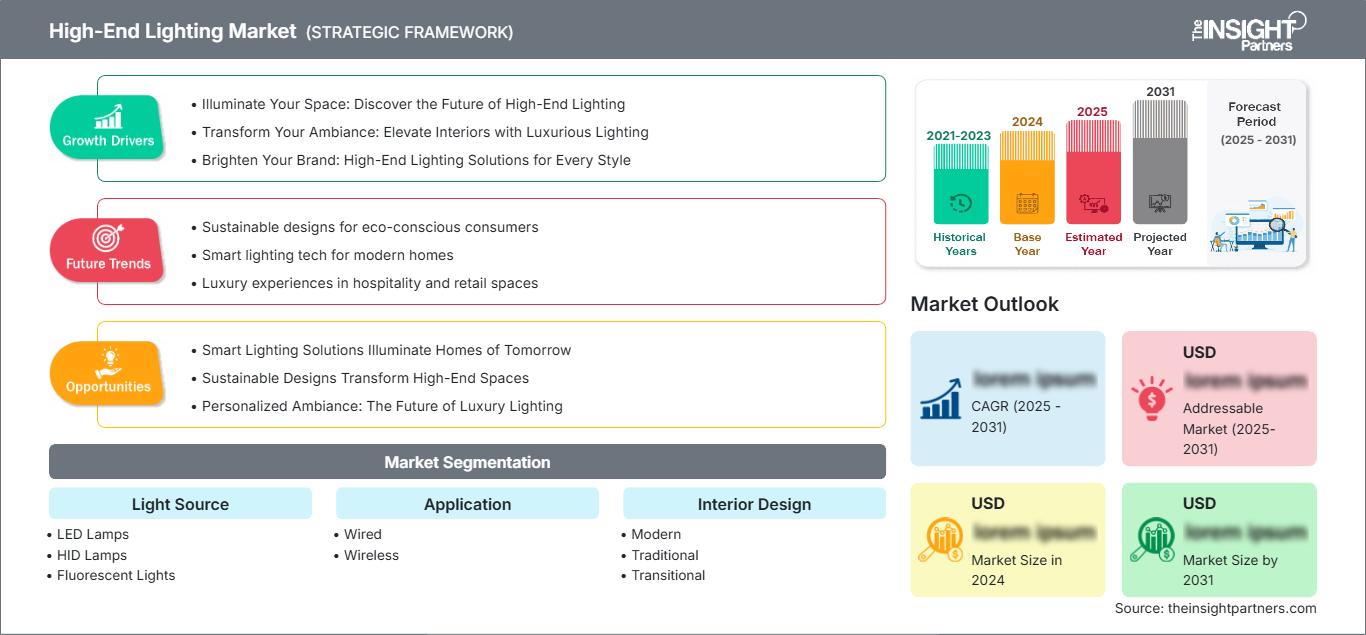
High-End Lighting Market: Strategic Insights
Regional Insights
North America High-End Lighting Market
The North American region had a High-End Lighting Market share of 31-35% in 2025 and is projected to grow at a CAGR of 7.4-8.2% until 2034. This region enjoys high-quality office buildings, renovations of hospitality venues, luxury residential constructions, retail modernizations, and architectural renovations. The demand is focused on those applications where light quality, control and visual distinction have an effect on the economics of the projects. The United States is the leading market region in the area, while Canada adds its part due to various commercial, residential, hospitality, and institutional projects.
One of the main structural factors behind growth is the increasing integration of advanced lighting controls in renovated buildings. Wireless commissioning allows minimizing the disturbance during the installation process, while tunable solutions enable designers to control the ambience and visual performance after the installation. In addition, the integration of premium lighting fixtures with shading, building automation and energy management systems becomes more widespread. Specification activities of architects and lighting designers become crucial since product specification usually takes place before purchasing.
U.S. High-End Lighting Market
The United States accounted for an approximate 80–84% market share of North America’s income in 2025 and is projected to register a 7.3–8.1% CAGR from 2026 to 2034. Demand includes luxury homes, corporate complexes, hotels, restaurants, shopping centers, cultural venues, and premium multifamily units. There is a trend towards designers opting for LEDs with advanced optics, sophisticated dimming, tuneable whites, and architectural finishes.
Several suppliers have a prominent presence in the market, namely Acuity Brands Lighting, Inc., Cooper Lighting LLC, Cree Lighting, Honeywell International Inc., Lutron Electronics Co., Inc., and GE Lighting. The application trend is moving away from individual fixtures toward integrated lighting and controls. Wireless lighting products are advantageous in the process of retrofits since they help reduce rewiring costs. High-end customers consider performance over time, servicing, and interoperability along with the price of the fixtures.
Europe High-End Lighting Market
Europe held an estimated 27–31% share in 2025 and is modeled to grow at a 7.6–8.4% CAGR through 2034. Germany is the leading country by industrial and specification depth, followed by the UK, France, Italy, and Spain. The region combines strong design traditions with increasing emphasis on efficient and digitally controlled illumination.
UK keeps the demand for hospitality, luxury housing, retail, and commercial renovation. High-end projects more often include architectural fittings in combination with automation controls and ambient management. Demand in Germany comes from commercial, industrial, automotive, hospitality and quality residential sectors due to advanced engineering and specification expertise. France, Italy and Spain offer demand through hotels, restaurants, cultural sites, luxury residences, retail facilities and heritage renovation. More durable construction, better optics, sustainability and energy efficiency become more valued by European customers, which is reflected in higher value specifications.
APAC High-End Lighting Market
The APAC region held an estimated 22-26% market share in 2025 and is forecasted to have a compound annual growth rate of 8.8-9.7% through 2034. China is the dominant country, followed by Japan, South Korea, India, and Australia. Premium commercial construction, hospitality, luxury residential, retail, and infrastructure modernization drives demand in the region.
While China combines extensive manufacturing with broad urban development projects, Japan and South Korea use sophisticated lighting and control systems. There are opportunities in India in the areas of hospitality, luxury residential, offices, and retail sectors. There are advantages in Australia due to the change in architecture and energy-efficient commercial buildings. Investments in industry, urbanization, and energy-efficient construction can add more incentive. The increasing sophistication in designs by developers has created a need for special luminaires.
Middle East & Africa High-End Lighting Market
Middle East and Africa demand is modeled to grow at a 7.0–7.8% CAGR through 2034, led by Saudi Arabia and the UAE. Luxury hospitality, mixed-use developments, airports, cultural destinations, commercial towers, and high-end residences provide strong project opportunities, while South Africa remains a key market for commercial and institutional applications.
Tourism and infrastructural development is of great advantage to Saudi Arabia, whereas UAE boasts of good hospitality, retail, and high-end residential constructions. South Africa contributes to the demand through commercial development and building designs. The Rest of MEA is a fragmented market but there are chances of growth through hotel developments, government buildings, and infrastructure programs. Energy efficiency becomes crucial where cost-effective architecture without compromising on energy savings is sought after, and challenging environmental conditions make thermal performance and durability a priority.
Segmentation Analysis
Light Source
LED Lamps constitute the dominant light-source category because premium fixtures increasingly require efficiency, compact form factors, optical precision, controllability, and long operating life. HID Lamps and Fluorescent Lights retain limited installed-base relevance but face replacement pressure. The segment is modeled to grow at an 8.0–8.7% CAGR during 2026–2034. The High-End Lighting Market scope within this category increasingly centers on premium LED performance and design integration.
- LED Lamps: LED lamps dominate premium specifications because they support compact optical systems, precise beam control, dimming, color tuning, lower energy consumption, and diverse architectural form factors.
- HID Lamps: HID lamps remain relevant in selected high-output and legacy applications, but replacement demand increasingly favors efficient LED alternatives where retrofit economics and fixture compatibility permit.
- Fluorescent Lights: Fluorescent systems retain installed-base demand in existing commercial environments, while refurbishment programs increasingly replace them with LED solutions offering improved controllability and reduced maintenance requirements.
Application
Wired applications remain important for established commercial and architectural installations, particularly where electrical infrastructure is already available. Wireless systems are gaining strategic relevance because they simplify retrofit deployment, enable flexible control zoning, and support connected environments. The application segment is modeled to grow at an 8.5–9.3% CAGR during 2026–2034 as connected specifications expand across premium spaces.
- Wired: Wired systems remain important in new construction and major renovations where permanent infrastructure can support centralized controls, predictable communication, and comprehensive commissioning.
- Wireless: Wireless systems increasingly appeal to retrofit and flexible-space projects because they reduce cabling requirements, simplify zoning changes, and support connected control architectures.
Interior Design
Interior design preferences influence fixture geometry, finishes, optical distribution, color quality, and integration with architectural elements. Modern interiors increasingly favor minimal forms and concealed technology, while Traditional and Transitional environments require products that complement established visual language. The segment is modeled to grow at a 7.8–8.6% CAGR during 2026–2034, supported by premium residential and hospitality design activity.
- Modern: Modern interiors favor slim profiles, concealed sources, geometric forms, neutral finishes, and digitally controlled illumination that emphasizes architectural surfaces and uncluttered visual composition.
- Traditional: Traditional settings favor decorative detailing, warmer visual tones, classic proportions, and fixtures that complement established architectural materials while incorporating modern efficiency.
- Transitional: Transitional interiors combine contemporary performance with traditional visual cues, creating demand for versatile fixtures that balance restrained geometry, decorative character, and sophisticated light quality.
End-User
Commercial applications remain strategically significant because premium lighting can influence workplace experience, hospitality ambience, retail presentation, and brand identity. Industrial environments increasingly adopt sophisticated illumination where visual performance and controls support operational needs, while residential buyers prioritize aesthetics, personalization, and integration. The segment is modeled to grow at an 8.2–9.0% CAGR during 2026–2034, supported by premium construction and renovation.
- Commercial: Commercial users prioritize architectural appearance, occupant experience, energy management, flexible controls, and coordinated specifications across offices, hotels, retail properties, restaurants, and cultural venues.
- Industrial: Industrial users require durable illumination, appropriate optical distribution, reliable controls, and maintenance efficiency across manufacturing, logistics, and specialized production environments.
- Residential: Residential demand is shaped by luxury construction, interior design preferences, personalization, smart-home integration, and growing interest in layered lighting that combines ambient, accent, and task illumination.
Opportunity Snapshot
| End-User | Revenue Contribution (High/Medium/Low) | Trend Tag (MAX 2 words) | Adoption Stage (Emerging/Scaling/Mature) |
| Commercial | High | Smart Architecture | Mature |
| Industrial | Medium | Connected Facilities | Scaling |
| Residential | High | Luxury Automation | Scaling |
High-End Lighting Market Growth Drivers and Impact Analysis
Premium Architectural Specification and Experiential Design
Premium architectural projects increasingly treat lighting as a design element that shapes perception, atmosphere, circulation, and brand identity. Hotels, restaurants, retail environments, cultural venues, and luxury residences use carefully selected luminaires to create differentiated experiences rather than simply satisfy illumination requirements. This increases the addressable value of fixtures with superior optics, finishes, color rendering, beam control, and compact form factors. Designers can also combine direct, indirect, accent, and decorative sources to create layered environments. The commercial impact is significant because specification decisions often occur before procurement, allowing manufacturers with strong design resources to influence project standards. Lighting companies that provide photometric data, visualization tools, samples, and customization can improve specification conversion. As experiential design becomes more central to premium developments, demand should increasingly favor specialized architectural products.
Energy Performance and Replacement of Conventional Light Sources
Energy performance continues to influence lighting replacement decisions as building owners seek lower operating costs and improved controllability. LED technology enables substantial design flexibility while reducing power consumption and maintenance requirements relative to many legacy systems. Premium projects can therefore justify sophisticated fixtures when energy savings are combined with longer service life, better dimming, and improved visual performance. Regulatory attention to building efficiency further strengthens the replacement case, particularly in commercial properties undergoing renovation. The impact extends across the supply chain because retrofit programs create demand for LED modules, drivers, controls, sensors, and installation services. Manufacturers with modular products can address projects where owners want to retain existing infrastructure while upgrading illumination. This replacement cycle supports recurring demand across offices, hotels, retail facilities, institutional buildings, and high-end residential properties.
Integration of Lighting With Intelligent Building Controls
Lighting increasingly operates as part of a broader digital building environment rather than as an isolated electrical system. Integration with occupancy sensing, daylight harvesting, automated shading, building-management platforms, and wireless control can improve operational flexibility and enable more responsive environments. High-value projects particularly benefit from centralized configuration because facility managers can adjust lighting scenes, schedules, and zones without extensive physical intervention. This changes competitive requirements because fixture manufacturers must increasingly support compatible communication protocols and control ecosystems. The commercial impact includes greater demand for connected luminaires, gateways, sensors, software interfaces, and commissioning services. Integration can also extend product relationships beyond installation by creating opportunities for software updates, maintenance, analytics, and system expansion. As building owners prioritize digital infrastructure, connected lighting should capture a larger portion of premium project specifications.
High-End Lighting Market Future Trends
Design-Led Connected Lighting Ecosystems
Future High-End Lighting Market trends will increasingly merge architectural design with connected functionality, allowing premium fixtures to deliver both visual differentiation and digital control. Luminaires will become more configurable through software, enabling changes in scenes, color temperature, intensity, and scheduling after installation. Designers will increasingly expect lighting systems to communicate with shading, audiovisual, security, and building-management platforms without compromising aesthetics. Miniaturized drivers, wireless modules, and compact control components should enable manufacturers to conceal technology within increasingly refined fixture forms. Digital twins and visualization platforms may also improve specification by allowing architects to evaluate illumination before construction. The competitive advantage will shift toward companies capable of preserving premium optical and aesthetic performance while delivering dependable connectivity, commissioning, interoperability, and lifecycle support across complex architectural environments.
Greater Personalization Through Tunable and Adaptive Illumination
Premium lighting will increasingly support personalized environments that respond to time, activity, occupancy, and user preference. Tunable white systems can adjust color temperature and intensity to support different scenes throughout a day, while dynamic color systems can create entertainment or hospitality experiences. Residential users may increasingly control lighting through intuitive interfaces, whereas commercial properties can automate scenes according to room schedules and occupancy. Adaptive illumination can also support differentiated environments within one building, allowing restaurants, hotel rooms, retail displays, and workplaces to change character without replacing hardware. Product development will therefore emphasize broader spectral capability, accurate color reproduction, low-flicker performance, and reliable digital control. Manufacturers that combine these attributes with elegant fixture design can address customers seeking personalization without visible technological complexity.
High-End Lighting Market Opportunities
Luxury Hospitality and Destination Development
Luxury hospitality represents an attractive investment opportunity because lighting contributes directly to ambience, guest experience, architectural identity, and perceived property quality. Hotels, resorts, restaurants, casinos, and destination developments often require multiple lighting layers across guestrooms, lobbies, restaurants, wellness spaces, landscapes, and event areas. Suppliers can capture value through coordinated fixture families, controls, shading integration, and project-specific customization. The High-End Lighting Market Forecasts for this application should therefore consider not only fixture demand but also recurring specification activity created by renovation cycles and brand refresh programs. Developers in the Gulf, Asia Pacific, and major global tourism centers are expanding premium hospitality capacity, creating opportunities for vendors with strong project management and international specification capabilities. Partnerships with architects, interior designers, hospitality groups, and lighting consultants can strengthen early-stage influence and improve conversion.
Premium Residential and Smart Interior Integration
Luxury residential projects offer another opportunity because homeowners increasingly view lighting as part of a broader technology and interior-design experience. High-value residences can support sophisticated combinations of architectural luminaires, decorative fixtures, motorized shades, automated scenes, and centralized controls. Suppliers can target new construction as well as renovations where owners want to modernize lighting without changing the overall architectural language. The opportunity is particularly relevant in North America, Europe, the Gulf, Australia, and affluent Asian urban centers. Products that offer elegant finishes, compact form factors, tunable illumination, and intuitive control can command stronger specification interest. Integrators also have opportunities to package lighting with audiovisual, security, and home-automation systems. This approach can increase project value while creating recurring service relationships around commissioning, upgrades, and system expansion.
Recent Developments
- July 2026: Messe Frankfurt acquired LiGHT Expo London from d&arc media and integrated the event into its Light + Building portfolio. The acquisition expands Messe Frankfurt’s international lighting exhibition portfolio and strengthens its presence in the UK lighting market, adding London to a network of lighting and building technology events across multiple global markets.
- February 2026: Lutron Electronics acquired Tanury Industries, a specialist in surface finishing and metal coatings that had supplied Lutron with metal faceplates for more than 25 years. The transaction brings plating and coating capabilities in-house, supporting greater control over manufacturing, expanded metal-finish options, product differentiation, and delivery capabilities.
- April 2026: Schréder acquired NLS Lighting, LLC, a US manufacturer of specification-grade outdoor LED lighting headquartered in Los Angeles. The acquisition expands Schréder’s North American footprint, adds domestic manufacturing capabilities, and strengthens its portfolio in area, roadway, and other specification-grade outdoor lighting applications.
Frequently Asked Questions

- Comprehensive Market Sizing and Forecast Analysis
- Detailed Segmentation Analysis
- In-Depth Market Dynamics Assessment
- Regional and Country-Level Insights
- Competitive Landscape and Company Benchmarking
- Strategic Business Intelligence
Recent Reports
Testimonials

The Insight Partners provided valuable market intelligence that supported our global go-to-market strategy. Their team was professional, responsive, and attentive to our feedback, providing thoughtful analysis and helpful methodological clarifications throughout the project.
Junmo Kim Chief Financial Officer (CFO), Enertech Co., Ltd.
The Insight Partners' SCADA System Market report is comprehensive, with valuable insights on current trends and future forecasts. The team was highly professional, responsive, and supportive throughout. We are very satisfied and highly recommend their services.
RAN KEDEM Partner, Reali Technologies LTDs
I requested a report on a very specific software market and the team produced the report in a few days. The information was very relevant and well presented. I then requested some changes and additions to the report. The team was again very responsive and I got the final report in less than a week.
JEAN-HERVE JENN Chairman, Future Analytica
We worked with The Insight Partners for an important market study and forecast. They gave us clear insights into opportunities and risks, which helped shape our plans. Their research was easy to use and based on solid data. It helped us make smart, confident decisions. We highly recommend them.
PIYUSH NAGPAL Sr. Vice President, High Beam Global
The Insight Partners delivered insightful, well-structured market research with strong domain expertise. Their team was professional and responsive throughout. The user-friendly website made accessing industry reports seamless. We highly recommend them for reliable, high-quality research services
YUKIHIKO ADACHI CEO, Deep Blue, LLC.
This is the first time I have purchased a market report from The Insight Partners.While I was unsure at first, I visited their web site and felt more comfortable to take the risk and purchase a market report.I am completely satisfied with the quality of the report and customer service. I had several questions and comments with the initial report, but after a couple of dialogs over email with their analyst I believe I have a report that I can use as input to our strategic planning process.Thank you so much for taking the extra time and making this a positive experience.I will definitely recommend your service to others and you will be my first call when we need further market data.
JOHN SUZUKI President and Chief Executive Officer, Board Director, BK Technologies
I wish to appreciate your support and the professionalism you displayed in the course of attending to my request for information regarding to infectious disease IVD market in Nigeria. I appreciate your patience, your guidance, and the fact that you were willing to offer a discount, which eventually made it possible for us to close a deal. I look forward to engaging The Insight Partners in the future, all thanks to the impression you have created in me as a result of this first encounter.
DR CHIJIOKE ONYIA MANAGING DIRECTOR, PineCrest Healthcare Ltd.Reason to Buy
- Informed Decision-Making
- Understanding Market Dynamics
- Competitive Analysis
- Identifying Emerging Markets
- Customer Insights
- Market Forecasts
- Risk Mitigation
- Boosting Operational Efficiency
- Strategic Planning
- Investment Justification
- Tracking Industry Innovations
- Aligning with Regulatory Trends





 Get Free Sample for