
High Temperature Cable Market Size, Trends & Growth by 2034
Coverage: by Temperature Range (Up to 125 degree C, 126 to 150 degree C, 151 to 200 degree C, 201 to 250 degree C, 251 to 450 degree C, 451 to 550 degree C); End-Users (Electronics, Energy and Power, Medical, Manufacturing, Aerospace and Defense, Others) , and Geography (North America, Europe, Asia Pacific, and South and Central America)
- Status : Data Released
- Report Code : TIPRE00011491
- Category : Electronics and Semiconductor
- No. of Pages : 150
- Available Report Formats :


- Last update date : September 15, 2026


2025 Market Size
US$ 2.03 Bn
Base year value
2034 Forecast
US$ 3.38 Bn
Projected by 2034
CAGR 2026-2034
5.83 %
Growth rate
Addressable Market
US$ 24.51 Bn
(2026-2034)
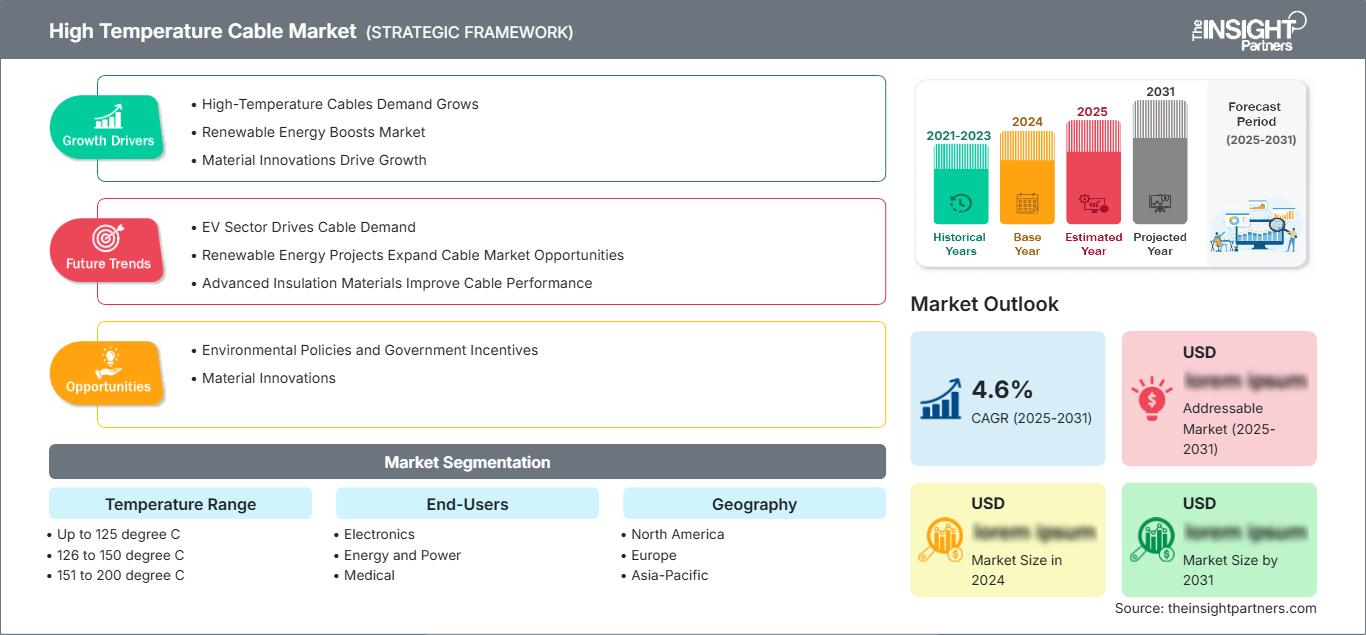
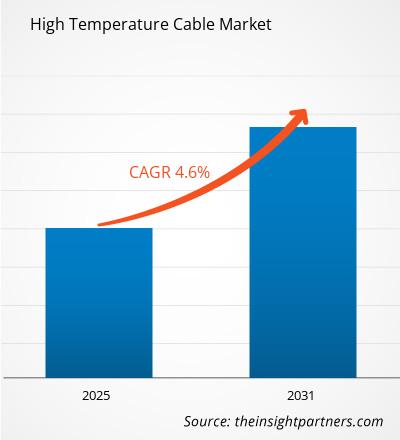
The global High Temperature Cable market was valued at US$ 2.03 billion in 2025 and is expected to reach US$ 3.38 billion by 2034; it is estimated to record a CAGR of 5.83% during 2026-2034.
High Temperature Cable Market Assessment and Insights
- North America: North America represented 25–27% share in 2025 and is expected to expand at a 6.1–6.5% CAGR during 2026–2034, supported by aerospace, electronics, industrial automation, semiconductor manufacturing, and advanced power infrastructure.
- US: The US accounted for 83–86% of North American demand in 2025 and is projected to grow at a 6.2–6.6% CAGR, supported by aerospace, electronics, energy, and manufacturing investments.
- Europe: Europe held 27–29% share in 2025 and is forecast to register a 5.8–6.2% CAGR, with Germany, France, Italy, the UK, and Spain supporting industrial automation and aerospace applications.
- Asia Pacific: Asia Pacific captured 34–36% share in 2025 and is expected to grow at a 7.0–7.4% CAGR, led by China, Japan, South Korea, and India across electronics, manufacturing, energy, and transportation.
- Largest Segment: Up to 125 degree C represented 30–33% market share in 2025 and is projected to grow at a 5.8–6.2% CAGR through 2034.
- High Growth Segment: 251 to 450 degree C represented 13–16% market share in 2025 and is forecast to expand at a 7.8–8.2% CAGR through 2034.
- Key companies analyzed in detail: Anixter International Inc., Belden Inc., HELUKABEL GmbH, Jiangsu Tongguang Electronic Wire and Cable Corp. Ltd., LAPP Holding AG, LEONI AG, Nexans SA, Prysmian S.p.A., Sumitomo Electric Industries Ltd., and Zhuhai Hansen Technology Co. Ltd.
Source: The Insight Partners' analysis based on proprietary research, government publications, company annual reports, investor presentations, industry databases, and expert interviews.
High Temperature Cable Market has progressed from conventional heat-resistant cables to engineered designs that incorporate thermal stability, flexibility, chemical resistance, shielding, fire resistance, and insulation suited to the application. New developments include silicone, fluoropolymers, polyimide, mica, and cross-linked materials. The manufacture of high temperature cables also is becoming increasingly concerned with close tolerance manufacture, specialized extrusion, advanced conductor treatment, and automation to meet the demand for reliable performance from small and hot equipment.
In the coming years, growth in the High Temperature Cable Market will be supported by investments in industrial facilities in Asia Pacific, in aerospace projects in North America and Europe, and electrification of manufacturing machinery. Investments in semiconductors plants, electric mobility infrastructure, renewable power generation, and advanced medical equipment could lead to the need for special high-temperature cable constructions.
High Temperature Cable Market Report Scope
| Report Attribute | Details |
|---|---|
| Market size in 2025 | US$ 2.03 Billion |
| Market Size by 2034 | US$ 3.38 Billion |
| Global CAGR (2026 - 2034) | 5.83% |
| Historical Data | 2021-2024 |
| Forecast period | 2026-2034 |
High Temperature Cable Market Analysis
High Temperature Cable Market is related to the requirement of superior performance when compared with ordinary PVC or conventional thermoplastics insulations, which are subjected to continuous heating. Demand begins from specification of conductor temperature, voltage, bending radius, chemical exposure, wear and tear, flame response, shielding, and estimated life of the equipment. The insulation companies make use of conductors such as copper along with insulation, jacket, shield, and connectors according to their requirements.
Supply consists of copper suppliers, specialty metal producers, polymer suppliers, insulation suppliers, compound developers, cable manufacturers, test labs, distributors, system integrators, and OEMs. Supply factors can include price of copper and specialty polymers and qualification periods. End-users are more interested in dimensional stability, traceability, heat ratings, and reliability of delivery. Cable manufacturers with comprehensive knowledge of materials are able to address a wide range of applications without having to re-engineer due to changes in equipment specifications.
Insulation technology, high temperature rating, mechanical durability, qualification capability, customizability, volume production, and application engineering have been used in the High Temperature Cable market report. LAPP Holding AG and HELUKABEL GmbH have extensive ranges of industrial cables whereas Belden Inc. is into connectivity and industrial customized solutions. Nexans SA, Prysmian S.p.A., and LEONI AG are complete cable companies and Sumitomo Electric Industries Ltd. is a company of advanced material and electrical technology.
Investment in the industry is increasingly focused on specialized materials, automation manufacturing processes, qualification capabilities, and application engineering. Companies are positioning themselves in the aerospace, semiconductor equipment, industrial robots, power electronics, and transportation segments, where high qualifications provide high barriers of entry. Regional manufacturing and distribution facilities continue to be significant due to the need for short lead time and replacement cables. The differentiation is therefore moving towards reliability and life cycle services.
● REPORT CUSTOMIZATION
Tailor This Report To Align With Your Specific Business Requirements
This report can be customized to align precisely with your business objectives, scope, and target markets. Customization options include tailored segmentation, geography, competitive analysis, and strategic insights to support informed decision-making.
Customize This Report →WHAT YOU CAN ADJUST
- ● Segmentations
- ● Geography
- ● Competitive Analysis
- ● Language Preferences
High Temperature Cable Market: Strategic Insights
Regional Insights
North America High Temperature Cable Market
North America had a High Temperature Cable Market share of 25-27% in 2025 and is expected to grow at a 6.1-6.5% CAGR up to 2034. United States represents majority of the regional demand; whereas, Canada contributes to the market with energy, mining, aerospace, and industrial applications. The demand drivers include aerospace manufacturing, semiconductors investment, industrial automation, power electronics, and advanced medical devices. Replacement of traditional insulating materials will create further opportunities where equipment operates above normal temperature range.
Adoption within the region depends upon strict requirements of reliable equipment performance and maintaining the electrical functionality in small and hot environment. Silicone, fluoropolymer, polyimide, and mica constructions play a role in these demanding applications. Local availability, support, and certification capabilities may enable better service delivery. Traceability and qualification of the cables are preferred in aerospace and defense projects, whereas, precise measurements, contamination resistance, thermal stability, and long term reliability are required by the semiconductor and electronics facilities.
U.S. High Temperature Cable Market
The US comprised 83-86% of North American consumption in 2025 and will be forecast to post a CAGR of 6.2-6.6% till 2034. Aerospace, electronics, energy, medical devices, industrial automation, and semiconductor manufacturing continue to play important roles. Higher performance wires are finding more use within compact systems that are exposed to heat, vibrations, chemical exposure, and repeated cycles of operation.
Belden Inc., Anixter International Inc., and Nexans SA are involved through their industrial, electrical, distribution, and wire business units. Some examples of application trends are growing use of high temperature wires for use in manufacturing equipment of semiconductors, robots, airplanes, power electronics, and advanced manufacturing equipment. The domestic market is also helped by investments in robust power grid and selected reshoring of electronics and manufacturing operations, which may boost demand for components that can operate reliably at higher temperatures.
Europe High Temperature Cable Market
The Europe region had a High Temperature Cable Market share of 27–29% in 2025 and is forecasted to grow at a 5.8–6.2% CAGR over 2034. Demand in the region is led by Germany, France, Italy, the United Kingdom, and Spain. Industrial automation, aerospace, electric vehicles, power infrastructure, machinery manufacturing, and electronics enable diverse application avenues. European purchases are highly focused on compliance with standards, materials, fire resistance, and environmental attributes.
Germany is a country with a wide industrial footprint in terms of automation, machinery, automobiles, chemicals, and electronics. The UK capitalizes on its aerospace, defense, energy, healthcare, and manufacturing initiatives. Aerospace, nuclear, transportation, and industrial equipment make up the key demands of France. Meanwhile, Italy provides demand through machinery manufacturing, automotive components, food equipment, and industrial automation, while renewable energy, transportation, manufacturing, and infrastructure are the key demands of Spain.
APAC High Temperature Cable Market
APAC accounted for 34-36% share in 2025 and will see 7.0-7.4% CAGR growth to reach 2034 to become the largest region. Leading consumers are China, Japan, South Korea, and India in that order. Key applications include electronics manufacturing, semiconductor fabrication, industrial automation, energy infrastructure, transportation, and machinery manufacturing.
The presence of industrial policy and manufacturing investments ensures the use of dedicated wiring. China takes advantage of the large electronics manufacturing industry in the region, while Japan focuses on precision engineering. South Korea is helped out by semiconductors, electronics, batteries, and industrial sectors. India is ramping up its manufacturing industry along with power infrastructure. Australia contributes through its mining industry and energy industry.
Middle East & Africa High Temperature Cable Market
The Middle East & Africa market will experience a growth rate of 6.0%–6.4% CAGR until 2034, with Saudi Arabia being the leading demand contributor within the region, with the UAE and South Africa coming in second and third place, respectively. Energy, petrochemicals, utilities, mining, industrial construction, and transportation infrastructure result in high ambient temperature cable needs.
Saudi Arabia and the UAE markets will benefit from energy diversification and infrastructural development, whereas South Africa will benefit from mining, power generation, manufacturing, and transportation sectors. The remaining MEA regions will depend on industrialization, oil and gas plants, utilities, and construction. High ambient temperatures contribute to higher requirements for stability of insulation and longevity of jackets because of installation near engines, furnaces, turbines, equipment, and outdoor systems.
Segmentation Analysis
Temperature Range
Temperature Range determines insulation selection, conductor design, jacket composition, service life, and application suitability. The segment is expected to expand at a 6.3–6.7% CAGR during 2026–2034. The High Temperature Cable Market scope extends from relatively moderate heat-resistant wiring to specialized constructions designed for furnaces, aerospace equipment, industrial ovens, and other severe environments.
- Up to 125 degree C: This range serves broad industrial and electronic requirements where elevated temperature exposure is moderate, providing a practical transition from conventional wiring while maintaining flexibility and manageable installation costs.
- 126 to 150 degree C: Demand is supported by motors, industrial controls, appliances, and equipment exposed to sustained thermal stress, where enhanced insulation durability can extend operating life and reduce replacement frequency.
- 151 to 200 degree C: This range addresses higher-duty industrial systems, automation equipment, transportation applications, and machinery where standard thermoplastic insulation can experience accelerated aging under continuous elevated temperatures.
- 201 to 250 degree C: Applications include industrial heating systems, specialized machinery, power electronics, and demanding control environments requiring insulation that retains electrical integrity during repeated thermal cycling.
- 251 to 450 degree C: This range supports severe-temperature applications such as furnaces, foundries, industrial ovens, aerospace systems, and specialized process equipment where conventional cable constructions are unsuitable.
- 451 to 550 degree C: The highest specified range serves specialized environments requiring mineral, mica, ceramic, or other advanced insulation approaches, with adoption concentrated in technically demanding industrial and high-temperature equipment.
End-Users
End-Users determine cable specifications according to operating temperature, mechanical exposure, installation environment, certification, and reliability requirements. The segment is projected to grow at a 6.7–7.1% CAGR during 2026–2034. Electronics and energy applications provide substantial demand, while aerospace and advanced manufacturing support higher-value specialized cable requirements.
- Electronics: Electronics manufacturers require compact, thermally stable cables for semiconductor equipment, power electronics, sensors, controls, appliances, and systems where heat can accelerate insulation degradation.
- Energy and Power: Power applications use heat-resistant cables around generators, transformers, turbines, switchgear, power electronics, and renewable-energy equipment where temperature and electrical reliability must be managed simultaneously.
- Medical: Medical equipment requires dependable cables for imaging, sterilization, diagnostic, and therapeutic systems, with flexibility, cleanliness, electrical stability, and material compatibility influencing product selection.
- Manufacturing: Manufacturing applications encompass robotics, furnaces, machinery, process controls, and automation systems where cables experience heat, repeated movement, abrasion, oils, and industrial chemicals.
- Aerospace and Defense: Aerospace and defense systems require lightweight, reliable, traceable cables capable of resisting temperature extremes, vibration, fluids, fire exposure, and demanding qualification requirements.
Opportunity Snapshot
| End-Users | Revenue Contribution (High/Medium/Low) | Trend Tag (MAX 2 words) | Adoption Stage (Emerging/Scaling/Mature) |
| Electronics | High | Semiconductor Equipment | Scaling |
| Energy and Power | High | Grid Modernization | Mature |
| Medical | Medium | Imaging Systems | Scaling |
| Manufacturing | High | Robotic Automation | Scaling |
| Aerospace and Defense | Medium | Thermal Avionics | Scaling |
| Others | Medium | Specialty Systems | Emerging |
High Temperature Cable Market Growth Drivers and Impact Analysis
Semiconductor Manufacturing Is Increasing Thermal Cable Requirements
Expansion of semiconductor manufacturing is creating demand for wiring that can operate reliably around high-temperature process equipment, ovens, deposition systems, inspection machinery, and automated material-handling systems. Semiconductor facilities also impose stringent requirements on contamination, dimensional consistency, electrical stability, and material selection. High-temperature cables can reduce insulation degradation where equipment cycles between elevated and ambient temperatures, supporting uptime and maintenance planning. The impact extends to cable suppliers because qualification requirements can create longer customer relationships once products are approved for production equipment. Manufacturing localization in the US, Europe, Japan, South Korea, Taiwan, and India can further diversify demand. Suppliers able to provide specialized insulation, low-outgassing materials, shielding, and traceable production can capture higher-value applications than standard industrial wiring.
Aerospace Electrification Is Raising Demand for Lightweight Thermal Wiring
Aircraft and defense platforms increasingly incorporate electrical systems for propulsion support, avionics, actuation, sensing, communication, and power management. These systems can operate in environments characterized by heat, vibration, fluids, limited installation space, and demanding weight constraints. High-temperature cable designs can support electrical reliability while allowing engineers to reduce insulation thickness or optimize routing where application-specific materials provide greater thermal performance. Qualification requirements create substantial barriers to substitution, making consistency and traceability important commercial factors. As aircraft architectures become more electric, cable requirements can expand across both primary and secondary systems. Suppliers with aerospace certifications, lightweight constructions, shielding expertise, and long-term production capability are therefore positioned to benefit from platform development and aftermarket demand without relying solely on volume-driven commodity applications.
Industrial Automation Is Expanding High-Temperature Wiring Applications
Industrial automation is increasing the number of sensors, actuators, motors, robots, heating systems, and control devices operating within manufacturing environments. Cables in these systems may encounter elevated temperatures alongside continuous flexing, torsion, abrasion, oils, coolants, and electromagnetic interference. Standard wiring can experience accelerated aging when thermal and mechanical stresses occur simultaneously, encouraging adoption of specialized constructions. Demand is particularly relevant to automotive production, metal processing, plastics, machinery, food equipment, and industrial robotics. Cable manufacturers can differentiate through flexibility, bend performance, shielding, chemical resistance, and connector integration rather than thermal rating alone. This creates opportunities for application-engineered cable assemblies that reduce installation complexity and maintenance requirements. The resulting demand is structurally linked to factory automation investment and equipment modernization rather than a single end-use industry.
High Temperature Cable Market Future Trends
Advanced Insulation Systems Will Improve Thermal and Mechanical Performance
High Temperature Cable Market trends are moving toward insulation systems that combine thermal endurance with flexibility, chemical resistance, flame performance, and long-term electrical stability. Silicone, fluoropolymer, polyimide, mica, ceramic, and cross-linked materials will increasingly be selected according to the complete operating environment rather than temperature rating alone. Manufacturers are likely to optimize multilayer constructions that balance heat resistance with bending and abrasion requirements. Material formulation can also reduce cable diameter while maintaining electrical performance, supporting equipment miniaturization. Digital simulation and laboratory testing should help suppliers predict insulation aging under combined temperature, voltage, vibration, and chemical exposure. Over time, this approach may shift product development toward application-specific material architectures rather than broad temperature classifications, allowing cable suppliers to address demanding applications with more precisely engineered solutions.
Miniaturized Systems Will Increase Demand for Compact Thermal Cables
Equipment designers are increasingly placing more electrical functions into smaller spaces, particularly in medical devices, electronics, robotics, aerospace systems, and power electronics. This trend increases localized heat density and reduces the physical space available for cable routing. Future cable designs will therefore need to combine high temperature resistance with smaller diameters, controlled bend radii, shielding, and reliable connector interfaces. Advanced insulation and conductor technologies can help maintain electrical performance without adding excessive bulk. Miniaturization may also increase demand for custom assemblies because standard cable dimensions may not fit tightly integrated equipment architectures. Suppliers that can engineer cable, connector, shielding, and termination combinations as a unified system should gain an advantage in applications where installation space is limited and replacement requires significant equipment downtime.
High Temperature Cable Market Opportunities
Localized Production Can Strengthen Supply Security for Critical Applications
High Temperature Cable Market Forecasts indicate that regional production and inventory strategies can become increasingly important as customers seek reliable supply for qualified components. Aerospace, semiconductor, medical, energy, and industrial customers may face costly production interruptions if specialized cable is unavailable. Establishing regional manufacturing, testing, and distribution can reduce lead times while improving technical support. Suppliers can prioritize locations with expanding electronics, aerospace, energy, and manufacturing ecosystems, including India, Southeast Asia, North America, and selected European markets. Localization can also support customer qualification and reduce logistics complexity for replacement requirements. The strongest opportunity lies in combining standardized global cable platforms with localized final assembly, testing, inventory, and application engineering. Such a model can preserve manufacturing efficiency while improving responsiveness for customers operating critical equipment.
High-Temperature Cable Assemblies Can Capture Higher-Value Applications
Cable assemblies provide an opportunity to move beyond commodity cable supply by combining conductors, insulation, shielding, connectors, terminations, identification, and testing into application-ready products. Customers in aerospace, medical equipment, semiconductor manufacturing, robotics, and energy systems often value validated assemblies because they reduce installation work and qualification complexity. Suppliers can use assembly capability to differentiate through application engineering, documentation, traceability, and integrated testing. Customized assemblies can also generate recurring demand when equipment platforms require replacement harnesses or periodic maintenance. Investment in automated cutting, stripping, termination, electrical testing, and inspection can improve manufacturing consistency while supporting customization. As equipment architectures become more compact and complex, integrated cable assemblies can address space constraints and simplify procurement, creating a higher-value route for manufacturers with both cable-material expertise and engineering capability.
Recent Developments
- March 2026: Maxdao, a global designer and manufacturer of infrastructure installation solutions, today announced the launch of its new PEEK (Polyether Ether Ketone) Cable Ties. Designed for cable bundling and wire management in demanding operating environments, the new cable ties provide a high-performance fastening solution for applications exposed to elevated temperatures, aggressive chemicals, radiation, and other challenging conditions.
- June 2025: Premix, LyondellBasell (LYB) and Maillefer have joined forces to deliver a technically advanced and recyclable power cable system, combining high-performance polypropylene materials, state-of-the-art compounding and leading cable manufacturing technology.
- April 2024: Amphenol TPC Wire & Cable, a leading supplier of high-performance wire, cable, connectors, and assemblies for harsh industrial environments, proudly announces the launch of its latest innovation: ATPC Medium Voltage Cables.
Frequently Asked Questions

- Comprehensive Market Sizing and Forecast Analysis
- Detailed Segmentation Analysis
- In-Depth Market Dynamics Assessment
- Regional and Country-Level Insights
- Competitive Landscape and Company Benchmarking
- Strategic Business Intelligence
Recent Reports
Testimonials

The Insight Partners provided valuable market intelligence that supported our global go-to-market strategy. Their team was professional, responsive, and attentive to our feedback, providing thoughtful analysis and helpful methodological clarifications throughout the project.
Junmo Kim Chief Financial Officer (CFO), Enertech Co., Ltd.
The Insight Partners' SCADA System Market report is comprehensive, with valuable insights on current trends and future forecasts. The team was highly professional, responsive, and supportive throughout. We are very satisfied and highly recommend their services.
RAN KEDEM Partner, Reali Technologies LTDs
I requested a report on a very specific software market and the team produced the report in a few days. The information was very relevant and well presented. I then requested some changes and additions to the report. The team was again very responsive and I got the final report in less than a week.
JEAN-HERVE JENN Chairman, Future Analytica
We worked with The Insight Partners for an important market study and forecast. They gave us clear insights into opportunities and risks, which helped shape our plans. Their research was easy to use and based on solid data. It helped us make smart, confident decisions. We highly recommend them.
PIYUSH NAGPAL Sr. Vice President, High Beam Global
The Insight Partners delivered insightful, well-structured market research with strong domain expertise. Their team was professional and responsive throughout. The user-friendly website made accessing industry reports seamless. We highly recommend them for reliable, high-quality research services
YUKIHIKO ADACHI CEO, Deep Blue, LLC.
This is the first time I have purchased a market report from The Insight Partners.While I was unsure at first, I visited their web site and felt more comfortable to take the risk and purchase a market report.I am completely satisfied with the quality of the report and customer service. I had several questions and comments with the initial report, but after a couple of dialogs over email with their analyst I believe I have a report that I can use as input to our strategic planning process.Thank you so much for taking the extra time and making this a positive experience.I will definitely recommend your service to others and you will be my first call when we need further market data.
JOHN SUZUKI President and Chief Executive Officer, Board Director, BK Technologies
I wish to appreciate your support and the professionalism you displayed in the course of attending to my request for information regarding to infectious disease IVD market in Nigeria. I appreciate your patience, your guidance, and the fact that you were willing to offer a discount, which eventually made it possible for us to close a deal. I look forward to engaging The Insight Partners in the future, all thanks to the impression you have created in me as a result of this first encounter.
DR CHIJIOKE ONYIA MANAGING DIRECTOR, PineCrest Healthcare Ltd.Reason to Buy
- Informed Decision-Making
- Understanding Market Dynamics
- Competitive Analysis
- Identifying Emerging Markets
- Customer Insights
- Market Forecasts
- Risk Mitigation
- Boosting Operational Efficiency
- Strategic Planning
- Investment Justification
- Tracking Industry Innovations
- Aligning with Regulatory Trends





 Get Free Sample for