
High Temperature Capacitor Market Trends, Size & Growth Opportunity by 2034
Coverage: by Type (Ceramic Capacitor, tantalum Capacitor, Plastic Film Capacitor, Mica Capacitor, Silicon Capacitor and Others); and Application (Automotive, Oil & Gas, Aerospace & Defense and Others), and Geography (North America, Europe, Asia Pacific, and South and Central America)
- Status : Data Released
- Report Code : TIPTE100000919
- Category : Electronics and Semiconductor
- No. of Pages : 150
- Available Report Formats :


- Last update date : August 19, 2026


2025 Market Size
US$ 1.58 Bn
Base year value
2034 Forecast
US$ 3.08 Bn
Projected by 2034
CAGR 2026-2034
7.66 %
Growth rate
Addressable Market
US$ 20.94 Bn
(2026-2034)
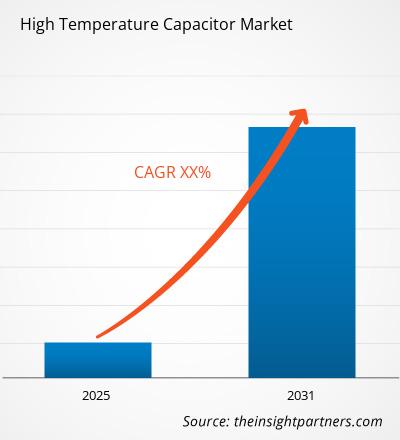
The High Temperature Capacitor Market is valued at US$ 1.58 Billion in 2025 and is projected to reach US$ 3.08 Billion by 2034, registering a CAGR of 7.66% during 2026–2034. Expansion is supported by increasing electronic content in harsh-environment systems, greater power-density requirements, and the adoption of components engineered for elevated thermal loads across automotive, oil and gas, and aerospace and defense applications.
North America continues to be a strategically significant market on the strength of aerospace modernization, domestic energy generation, automotive electronics, and the need for reliable components that operate in extreme temperatures. The regional High Temperature Capacitor Market is projected to grow at an approximate 7–8% CAGR up to 2034 on account of the qualification requirement and high-reliability procurement of premium components.
Demand is going beyond traditional endurance to temperatures and is now being driven by the need for the maintenance of electrical stability in the face of thermal, mechanical, and electrical stresses. Capacitors used in automotive power electronics, aerospace applications, and downhole tools must be able to endure temperature cycling without loss of capacitance and insulation properties. This trend is prompting suppliers to enhance their dielectric materials, metallized film, rugged packaging, and application-specific qualification initiatives.
Competitive dynamics in the High Temperature Capacitor Market are also shifting with suppliers trying to reconcile standard high-volume capacitors with application-specific components. Ceramic capacitors have gained traction due to size efficiency and reliability issues, whereas film, tantalum, mica, and silicon capacitors offer solutions to specific problems. End users are now giving increased attention to lifecycle reliability, traceability, and supply chain issues.
High Temperature Capacitor Market Assessment and Insights
- North America: North America represents approximately 30–32% share in 2025 and is expected to grow at a CAGR of 7–8% between 2026–2034, supported by aerospace electronics, oilfield instrumentation, and automotive power electronics.
- US: The US accounts for approximately 80–85% of North American demand in 2025 and is expected to grow at a CAGR of 7–8% during 2026–2034.
- Europe: Europe holds approximately 20–22% share in 2025 and is projected to grow at 5–6% CAGR, led by Germany, the UK, France, Italy, and Spain, with automotive electrification and aerospace demand supporting adoption.
- Asia Pacific: Asia Pacific represents approximately 38–40% share in 2025 and is projected to expand at 7–9% CAGR, led by China, Japan, South Korea, India, and expanding electronics manufacturing ecosystems.
- Largest Segment: Ceramic Capacitor represents approximately 50–54% market share in 2025 and is expected to expand at a CAGR of 7–8% during 2026–2034.
- High Growth Segment: Automotive represents approximately 32–36% market share in 2025 and is expected to grow at a CAGR of 9–11% during 2026–2034.
- Key companies analyzed in detail: KEMET Corporation, KYOCERA AVX Components Corporation, Vishay Intertechnology, Inc., Exxelia Dearborn, Presidio Components, Inc., Johanson Dielectrics, Inc., Wright Capacitors, Inc., Skyworks Solutions, Inc., Polyflon Company, Nanohmics Inc.
Source: The Insight Partners' analysis based on proprietary research, government publications, company annual reports, investor presentations, industry databases, and expert interviews.
The technological development has led the high-temperature capacitors to transition from being specialized components to being engineered power-electronics components that need stability in capacitance, lower equivalent series resistance, thermal derating capability, and mechanical strength. Ceramics, tantalums, and film capacitors have become the preferred options for compact assemblies, while fabrication has been directed towards automation and dielectric control for specific applications.
Future developments will be facilitated by localized manufacture in the Asia Pacific, investments in aerospace supply chains, and further electrification of vehicles and industrial machinery. Qualifications, environmental tests, and traceability will play an important role in deciding which supplier to choose. According to the International Monetary Fund, the world economy will maintain its robust growth in 2026, while technology investments will continue driving demand for industrial electronics.
High Temperature Capacitor Market Report Scope
| Report Attribute | Details |
|---|---|
| Market size in 2025 | US$ 1.58 Billion |
| Market Size by 2034 | US$ 3.08 Billion |
| Global CAGR (2026 - 2034) | 7.66% |
| Historical Data | 2021-2024 |
| Forecast period | 2026-2034 |
High Temperature Capacitor Market Analysis
High Temperature Capacitor Market is accelerating with the growing thermal challenges associated with electronic components due to higher power densities and restricted cooling. The demand starts from the raw material side with dielectrics, electrodes, films, tantalum powders, ceramics, and packaging materials followed by forming, sintering, winding, metallizing, assembling, testing, and qualification. Companies that have control of dielectric quality and thermal properties will benefit where the penalty for failure is significant.
Supply and demand dynamics in the High Temperature Capacitor market are application driven rather than volume driven. In automotive applications, the emphasis is on AEC-Q200 qualification, low loss properties, vibration resistance, and small packaging, while in aerospace and oil and gas industries, the emphasis is on long operational life, traceability, and thermal cycle resistance. Hence, it makes sense for companies with technical qualifications, manufacturing control, access to special materials, and the ability to customize designs.
High-Temperature Capacitor Market Report exhibit a competitive structure that involves major players in passive components alongside specialty companies catering to aerospace, oilfields, microwave and defense sectors. KEMET Corporation and Vishay Intertechnology, Inc. compete through diverse product lines and products suitable for automobiles while KYOCERA AVX Components Corporation competes using ceramic and RF-based technology strengths. Exxelia Dearborn, Presidio Components, Inc., Johanson Dielectrics, Inc. and Wright Capacitors, Inc. cater for special high-reliability applications.
Investment strategies focus on high temperature rating, small size, increased ripple current rating and qualification for electrified powertrains. Positioning strategies also include resilient manufacturing geographically and customer co-development. Specialty firms have room to protect their margins through custom designs and certifications while diversified firms rely on manufacturing networks, procurement economics and cross selling in different electronic systems.
● REPORT CUSTOMIZATION
Tailor This Report To Align With Your Specific Business Requirements
This report can be customized to align precisely with your business objectives, scope, and target markets. Customization options include tailored segmentation, geography, competitive analysis, and strategic insights to support informed decision-making.
Customize This Report →WHAT YOU CAN ADJUST
- ● Segmentations
- ● Geography
- ● Competitive Analysis
- ● Language Preferences
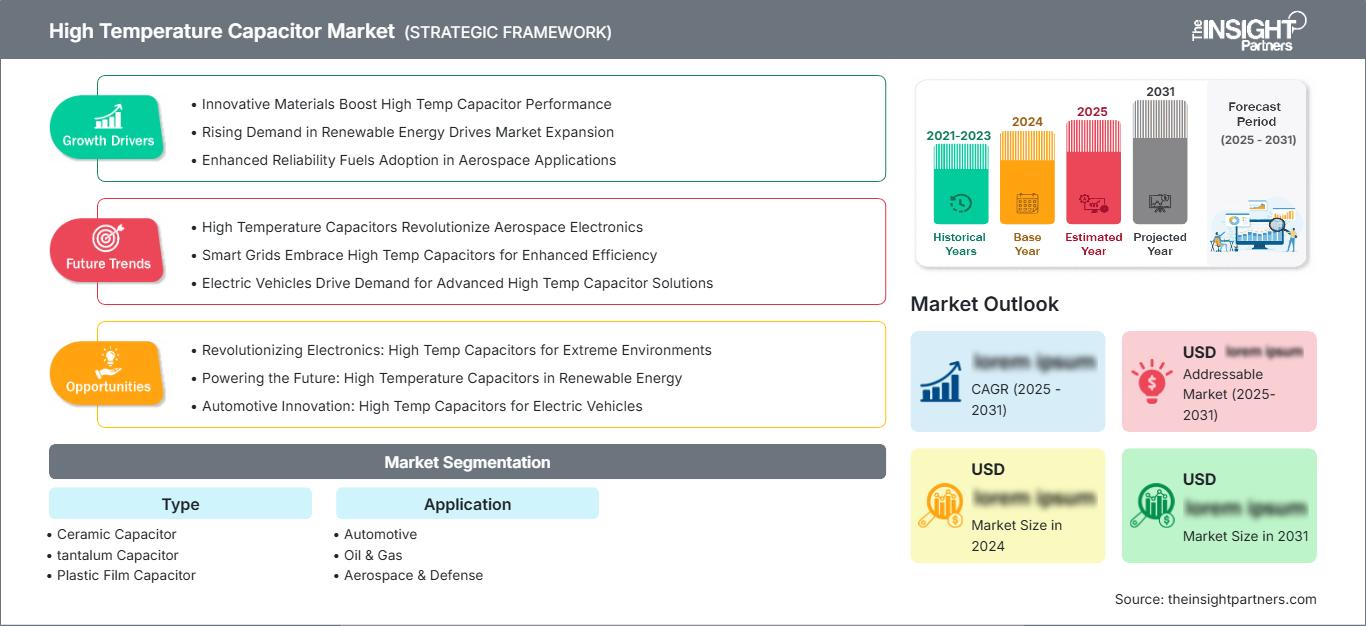
High Temperature Capacitor Market: Strategic Insights
Regional Insights
North America High Temperature Capacitor Market
North America constitutes about 30–32% of demand in 2025 and will grow at a CAGR of 7–8% between 2025 and 2034. The US dominates regional consumption, while Canada is a source through its oil sands, mining activities, energy equipment, and industrial electronics. There is also high-demand from aerospace and defense procurement.
Additional applications include automotive power electronics, downhole instrumentation, and industrial automation. The region has engineering strengths and qualification capabilities enabling suppliers to meet their unique thermal demands. Energy sector applications are still significant, even with reduced global oil demand growth, due to the need for advanced drilling and monitoring equipment that has to perform reliably under harsh thermal and pressure conditions.
U.S. High Temperature Capacitor Market
U.S. constitutes around 80–85% share in the demand from North America, and it is projected to grow at a CAGR of 7–8% during 2026-2034.
The High Temperature Capacitor market share for the U.S. is driven by the need for aerospace procurement, defense electronics, automotive power conversion, and oilfield instrumentation. Large manufacturers have application and engineering capabilities throughout the region, but demand is moving towards small and thermally stable devices. The automotive electrification is adding new demands for powertrain, charging, and conversion equipment.
Europe High Temperature Capacitor Market
Europe will constitute a market share of around 20-22% in 2025 and will show growth of 5-6% CAGR. Germany still takes the topmost position in the market due to the presence of automotive engineering, industrial machinery infrastructure and electronic intensive manufacturing. The UK contributes to demand due to aerospace, defense and advanced engineering applications, whereas France gets benefit due to aerospace and energy applications.
Germany uses vehicle electrification along with industrial automation, where the need arises for capacitors which work with stability under higher temperature. The UK focuses on aerospace, defense and highly reliable electronics. France, Italy, and Spain contribute demand due to aerospace, automobile production, rail and industrial equipment, France being a major aerospace producer.
APAC High Temperature Capacitor Market
The share of APAC will be about 38% to 40% in 2025 and further growth of 7% to 9% CAGR will take place. The key players of this region include China, which is followed by Japan and South Korea. The other regions that show growing demands include India and Australia.
The reasons behind growth for these regions are large manufacturing hubs for electronics and vehicles. The manufacturing activities of China include EV production and industrial automation. Japan focuses on high reliability electronics production. South Korea’s contributions include automobiles and electronics.
Middle East & Africa High Temperature Capacitor Market
Middle East and Africa demand is concentrated in oil and gas, defense electronics, industrial automation, and energy infrastructure. The regional market remains heavily import dependent, with the UAE serving as an important distribution and logistics hub. Saudi Arabia leads regional demand because of energy investment and industrial development.
SA Arabia and UAE are increasing localized manufacturing capacity, whereas South Africa offers demand for mining, energy, and industrial equipment. Rest of MEA is fragmented. High ambient temperatures, drilling needs, and infrastructure modernization contribute to high-temperature component usage, while demand trends of the region continue to be connected to energy and industrial capital expenditure.
Segmentation Analysis
Type
The Type segment is expected to grow at a CAGR of 7–8% between 2026–2034. High Temperature Capacitor scope across dielectric technologies is shaped by trade-offs among thermal stability, capacitance density, voltage capability, cost, and reliability. Ceramic products retain broad applicability, while film, tantalum, mica, and silicon technologies serve increasingly specialized operating conditions.
- Ceramic Capacitor: Ceramic capacitors maintain the strongest market position because of thermal stability, compact construction, and suitability for high-frequency filtering. Their strategic importance is highest in automotive, aerospace, and industrial electronics requiring reliable performance.
- tantalum Capacitor: Tantalum capacitors provide high capacitance efficiency and stable electrical behavior in compact packages. Demand remains concentrated in applications where board space, reliability, and controlled leakage characteristics are more important than lowest unit cost.
- Plastic Film Capacitor: Plastic film capacitors are increasingly important for power conversion, DC-link, filtering, and energy-storage functions. Their low loss, self-healing characteristics, and voltage-handling capability support demanding automotive and industrial designs.
- Mica Capacitor: Mica capacitors occupy specialized high-frequency and high-reliability applications where low losses, capacitance stability, and resistance to thermal variation outweigh higher material and manufacturing costs.
- Silicon Capacitor: Silicon capacitors address miniaturized RF and semiconductor-integrated applications where small form factors and stable performance across temperature variation are strategically important for advanced electronics.
Application
The Application segment is projected to expand at a CAGR of 8–9% during 2026–2034. Demand is increasingly linked to electronic content, thermal exposure, and reliability requirements within vehicles, energy equipment, and aerospace systems. Automotive represents the strongest growth opportunity as power conversion architectures become more electronically intensive.
- Automotive: Automotive adoption is supported by electrified powertrains, onboard chargers, DC/DC converters, HVAC systems, and ADAS electronics. High-temperature capability helps designers manage heat near power semiconductors while maintaining reliability.
- Oil & Gas: Oil and gas applications require capacitors for downhole instrumentation, drilling electronics, logging systems, and control equipment. Thermal endurance and pressure-environment reliability make specialized components strategically important.
- Aerospace & Defense: Aerospace and defense applications emphasize ruggedness, long life, traceability, vibration resistance, and stable electrical performance. Specialized capacitors support avionics, radar, communications, guidance, and power-management systems.
Opportunity Snapshot
| Application | Revenue Contribution (High/Medium/Low) | Trend Tag | Adoption Stage |
| Automotive | High | EV Powertrain | Scaling |
| Oil & Gas | Medium | Downhole Electronics | Mature |
| Aerospace & Defense | High | Avionics Reliability | Mature |
High Temperature Capacitor Market Growth Drivers and Impact Analysis
Higher electronic content in electrified vehicles
Vehicle electrification increases the number of power-conversion functions operating close to heat-generating semiconductors. The IEA reports that global electric car sales exceeded 20 million in 2025, with electric vehicles representing approximately one-quarter of new car sales. This structural shift increases requirements for DC-link, filtering, snubber, and decoupling components that can maintain performance under thermal and electrical stress. For capacitor suppliers, the commercial impact extends beyond unit volumes because EV platforms require higher qualification standards and longer reliability cycles. Manufacturers able to combine compact dimensions, low losses, high ripple-current capability, and extended-temperature operation can improve their position in powertrain programs. The resulting procurement shift favors suppliers with automotive qualification, application engineering support, and repeatable production controls.
Expansion of harsh-environment industrial electronics
Industrial equipment is increasingly deployed where heat, vibration, dust, humidity, and electrical stress cannot be controlled through conventional enclosure or cooling approaches. Oil and gas drilling illustrates this requirement because downhole tools operate under severe thermal and pressure conditions while maintaining continuous measurement and communication functions. The IEA also identifies petrochemicals as a major source of future oil-demand growth, reinforcing the importance of sophisticated processing and extraction equipment. High-temperature capacitors can reduce thermal derating requirements and improve system availability in such environments. The High Temperature Capacitor Market impact is strongest for suppliers offering ruggedized packaging, specialized dielectric formulations, and application-specific qualification. These characteristics create higher switching costs for customers because component replacement often requires validation of complete electronic assemblies.
Aerospace and defense modernization
Aerospace electronics face simultaneous requirements for miniaturization, reliability, vibration resistance, thermal cycling, and long service lives. IATA reported that global passenger demand increased 5.3% in 2025, while aircraft supply constraints remained significant, supporting continued attention to fleet utilization, maintenance, and new aircraft production. Defense programs similarly require highly reliable electronic subsystems. These conditions create demand for passive components with controlled electrical characteristics over extended temperature ranges. The commercial impact is concentrated in qualified suppliers because aerospace and defense programs typically involve lengthy validation cycles and strict traceability. Suppliers with established testing capabilities can secure recurring demand through platform programs, while specialists can compete effectively where customized capacitance, packaging, or environmental qualification is required.
High Temperature Capacitor Market Future Trends
Advanced dielectrics for higher operating temperatures
High Temperature Capacitor trends are moving toward dielectric systems that retain capacitance, insulation resistance, and low losses across broader temperature ranges. Research into lead-free ceramic films and advanced thin-film structures is expanding the technical envelope for energy storage and high-temperature electronics. Future products are likely to combine higher breakdown strength with improved thermal stability, enabling designers to reduce component count without sacrificing reliability. Silicon-based and advanced ceramic technologies may gain relevance in miniaturized RF, sensing, and semiconductor-integrated systems. Film technologies are also evolving toward higher temperature capability and improved volumetric efficiency. The competitive implication of the High Temperature Capacitor Market Trend is a gradual shift from standard component selection toward materials engineering, where suppliers that control dielectric formulation, electrode interfaces, and thermal aging characteristics can establish differentiated product platforms.
Application-specific qualification and digital design integration
Future product development will increasingly connect capacitor selection with digital simulation, thermal modeling, and application-specific reliability prediction. Engineers are seeking component data that reflects actual temperature, ripple current, voltage, and frequency conditions rather than relying only on nominal ratings. This approach can shorten qualification cycles and reduce overdesign. Suppliers are therefore likely to expand digital models, parameter libraries, application notes, and simulation tools alongside physical products. Automotive customers will emphasize lifetime prediction under realistic duty cycles, while aerospace and oilfield customers will prioritize traceability and environmental validation. The result should be a more integrated procurement model in which component suppliers participate earlier in system architecture decisions and provide verified performance data that supports thermal, electrical, and mechanical design optimization.
High Temperature Capacitor Market Opportunities
Premium products for wide-bandgap power electronics
The expansion of silicon carbide and gallium nitride power devices creates an opportunity for capacitors engineered for higher switching frequencies, greater power density, and increased thermal exposure. Suppliers can target inverter, charger, renewable-energy, industrial-drive, and aerospace applications where conventional components may require substantial thermal derating. High-value opportunities are particularly attractive where the capacitor is positioned close to the switching device and contributes directly to system efficiency and reliability. Product development should prioritize low equivalent series resistance, controlled inductance, high ripple-current capability, compact packaging, and stable dielectric behavior. Companies that secure qualification with major OEMs can create recurring design-in revenue because replacing a qualified capacitor platform later in a product lifecycle can impose significant engineering and validation costs.
Localized manufacturing for strategic electronics supply chains
High Temperature Capacitor Forecasts indicate attractive opportunities in regions seeking stronger domestic electronics supply chains. India and Southeast Asia are increasing their roles in electronics assembly, automotive production, and industrial equipment manufacturing, creating a growing customer base for qualified passive components. Local production, assembly, testing, or technology partnerships can reduce logistics exposure while improving response times for OEM customers. Investment priorities should focus on specialized product lines rather than broad commodity capacity, particularly for automotive-grade ceramics, film DC-link products, and high-reliability aerospace components. Regional qualification laboratories and application engineering centers can further strengthen High Temperature Capacitor Market Forecast. A localized model can also support customers that require documented traceability, shorter development cycles, and compliance with regional procurement policies.
Recent Developments
- June 2026: Exxelia — introduced the CF-PP140 high-temperature polypropylene film capacitor range, supporting 450–1,500 V operation and temperatures up to 140°C, with energy density reaching 250 J/L and applications including UAVs, eVTOL aircraft and high-temperature power electronics.
- May 2026: Samsung Electro-Mechanics — introduced its ultra-compact 008004-inch High Q C0G MLCC lineup for millimeter-wave RF applications, measuring 0.25 × 0.125 mm, reducing mounting area by approximately 50% versus 01005 components and offering capacitance from 0.2 pF to 10 pF, with mass production scheduled for October 2026.
- February 2025: Murata Manufacturing Co., Ltd. — launched mass production of the world’s first 15nF/1.25kV C0G multilayer ceramic capacitor in the compact 1210-inch (3.2 × 2.5mm) size, with capacitance options from 4.7nF to 15nF and ±1% to ±5% tolerance, targeting EV onboard chargers, SiC MOSFET power supplies, resonant circuits and snubber circuits.
Frequently Asked Questions

- Comprehensive Market Sizing and Forecast Analysis
- Detailed Segmentation Analysis
- In-Depth Market Dynamics Assessment
- Regional and Country-Level Insights
- Competitive Landscape and Company Benchmarking
- Strategic Business Intelligence
Recent Reports
Testimonials

The Insight Partners provided valuable market intelligence that supported our global go-to-market strategy. Their team was professional, responsive, and attentive to our feedback, providing thoughtful analysis and helpful methodological clarifications throughout the project.
Junmo Kim Chief Financial Officer (CFO), Enertech Co., Ltd.
The Insight Partners' SCADA System Market report is comprehensive, with valuable insights on current trends and future forecasts. The team was highly professional, responsive, and supportive throughout. We are very satisfied and highly recommend their services.
RAN KEDEM Partner, Reali Technologies LTDs
I requested a report on a very specific software market and the team produced the report in a few days. The information was very relevant and well presented. I then requested some changes and additions to the report. The team was again very responsive and I got the final report in less than a week.
JEAN-HERVE JENN Chairman, Future Analytica
We worked with The Insight Partners for an important market study and forecast. They gave us clear insights into opportunities and risks, which helped shape our plans. Their research was easy to use and based on solid data. It helped us make smart, confident decisions. We highly recommend them.
PIYUSH NAGPAL Sr. Vice President, High Beam Global
The Insight Partners delivered insightful, well-structured market research with strong domain expertise. Their team was professional and responsive throughout. The user-friendly website made accessing industry reports seamless. We highly recommend them for reliable, high-quality research services
YUKIHIKO ADACHI CEO, Deep Blue, LLC.
This is the first time I have purchased a market report from The Insight Partners.While I was unsure at first, I visited their web site and felt more comfortable to take the risk and purchase a market report.I am completely satisfied with the quality of the report and customer service. I had several questions and comments with the initial report, but after a couple of dialogs over email with their analyst I believe I have a report that I can use as input to our strategic planning process.Thank you so much for taking the extra time and making this a positive experience.I will definitely recommend your service to others and you will be my first call when we need further market data.
JOHN SUZUKI President and Chief Executive Officer, Board Director, BK Technologies
I wish to appreciate your support and the professionalism you displayed in the course of attending to my request for information regarding to infectious disease IVD market in Nigeria. I appreciate your patience, your guidance, and the fact that you were willing to offer a discount, which eventually made it possible for us to close a deal. I look forward to engaging The Insight Partners in the future, all thanks to the impression you have created in me as a result of this first encounter.
DR CHIJIOKE ONYIA MANAGING DIRECTOR, PineCrest Healthcare Ltd.Reason to Buy
- Informed Decision-Making
- Understanding Market Dynamics
- Competitive Analysis
- Identifying Emerging Markets
- Customer Insights
- Market Forecasts
- Risk Mitigation
- Boosting Operational Efficiency
- Strategic Planning
- Investment Justification
- Tracking Industry Innovations
- Aligning with Regulatory Trends





 Get Free Sample for