
home automation control systems Market Trends, Size & Forecast by 2034
Home Automation Control Systems Market Size and Forecasts (2021–2034), Global and Regional Share, Trends, and Growth Opportunity Analysis Report Coverage : By Component (Hardware, Software, Service); Technology (Cellular, Wireless, Others); Application (Security, Lighting, Entertainment, Others)
- Status : Data Released
- Report Code : TIPRE00039455
- Category : Electronics and Semiconductor
- No. of Pages : 150
- Available Report Formats :


- Last update date : August 25, 2026


2025 Market Size
US$ 129.8 Bn
Base year value
2034 Forecast
US$ 319.95 Bn
Projected by 2034
CAGR 2026-2034
10.54 %
Growth rate
Addressable Market
US$ 1,993.21 Bn
(2026-2034)
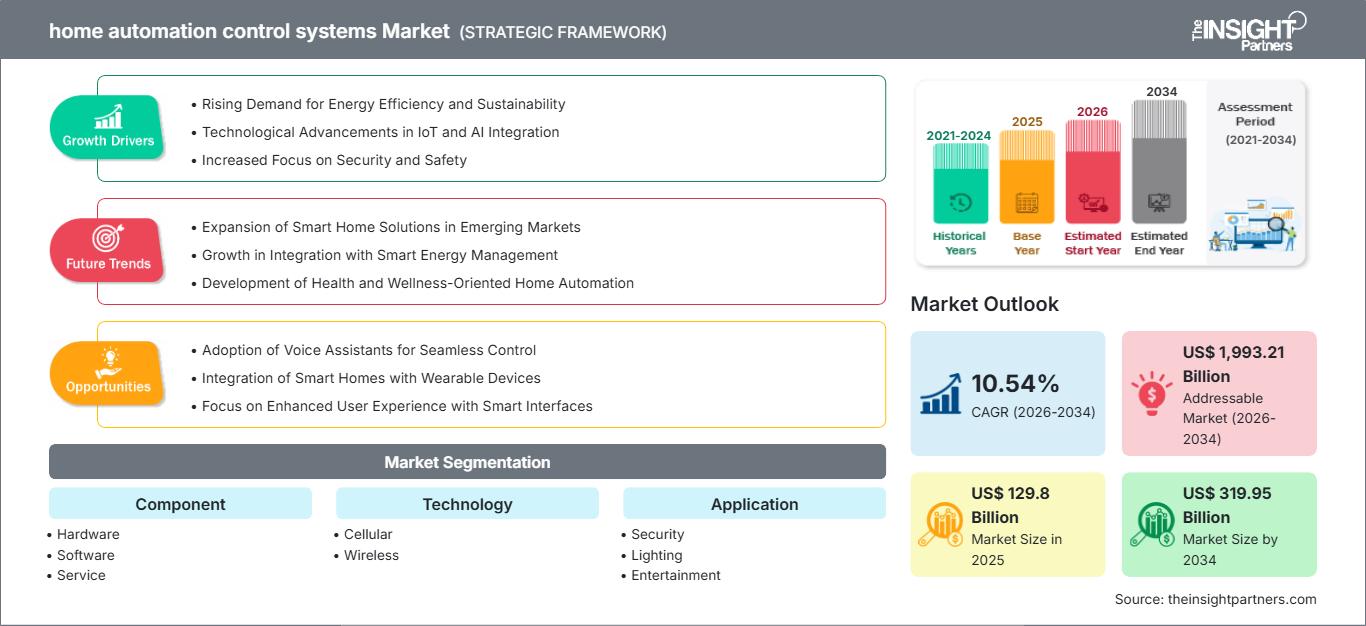
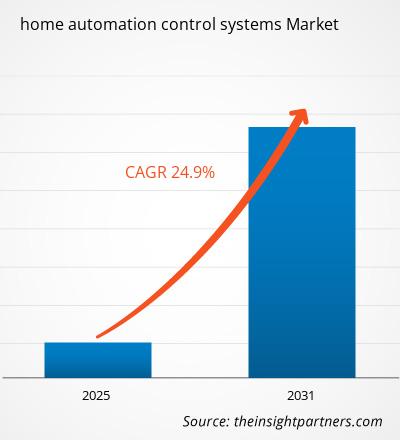
The Home Automation Control Systems Market is expected to grow sustainably due to increased integration between home automation, security systems, lights, entertainment, and intelligent control. The market is worth US$ 129.8 billion in 2025 and is estimated to be worth US$ 319.95 billion by 2034, growing at a CAGR of 10.54%. Wireless connectivity, need for centralized control, and increased usage of intelligent residential technology are transforming purchase trends.
The Home Automation Control Systems Market size in North America is driven by the development of smart homes, extensive use of devices, and need for security and energy management solutions. An estimated regional CAGR of 7-8% in 2034 is an indication of the existing installed base, replacement, retrofits, and investment in wireless control architecture.
The competitive landscape within the Home Automation Control Systems Market is impacted by the convergence of electrical systems, building controls, security solutions, and consumer electronics. The competition has expanded its boundaries in recent years through the increasing emphasis on interoperability, centralized solutions, cybersecurity, ease of installation, and life cycle service offerings. The convergence is widening the boundaries of competition beyond automation specialists and is driving existing electrical and building technology suppliers to diversify into residential systems.
As far as demand is concerned, security, lighting, and entertainment continue to represent key applications in the Home Automation Control Systems Market, and energy management represents another layer that is growing in importance. Wireless solutions have a particular relevance for retrofit projects since they minimize disruptions related to installation and enable phased implementation. New residential construction projects offer an opportunity to install integrated systems that can be specified at the construction phase.
Home Automation Control Systems Market Assessment and Insights
- North America holds a 37–39% Home Automation Control Systems Market share in 2025 and is projected to grow at a 7–8% CAGR between 2026–2034, supported by mature automation infrastructure, retrofit activity, connected security, and energy-management adoption.
- US accounts for 74–78% of North America's 2025 market and is expected to advance at a 9–10% CAGR during 2026–2034, supported by technology adoption and security-led residential upgrades.
- Europe represents a 24–26% share in 2025 and is expected to grow at an 8–10% CAGR through 2034, with Germany, the UK, France, Italy, and Spain forming important demand centers.
- Asia Pacific represents a 24–26% share in 2025 and is expected to expand at an 11–13% CAGR, led by China, Japan, South Korea, India, and Australia as connected housing and digital infrastructure deepen.
- Largest Segment: Hardware commands a 48–52% market share in 2025 and is projected to grow at a 10–12% CAGR, reflecting the central role of controllers, sensors, switches, gateways, and connected devices.
- High Growth Segment: Software represents an 18–22% market share in 2025 and is forecast to grow at a 13–15% CAGR as orchestration, analytics, automation rules, and centralized interfaces gain importance.
- Key companies analyzed in detail: ABB Ltd., Control4 Corporation, Crestron Electronics, Inc., Honeywell International Inc., Ingersoll-Rand plc, Johnson Controls, Legrand SA, Leviton Manufacturing Company, Inc., Lutron Electronics Co., Inc., Schneider Electric, Siemens AG
Source: The Insight Partners' analysis based on proprietary research, government publications, company annual reports, investor presentations, industry databases, and expert interviews.
The Home Automation Control Systems Market report indicates that the scenario has changed from separate control of devices to an integration of residential ecosystems that feature sensors, gateways, applications, and cloud services. Hardware still plays an important role, but software will define interoperability, personalization, diagnosis, and value throughout the product life cycle. Wireless technologies are minimizing installation efforts, whereas controllers integrate functionality related to lighting, security, entertainment, and access via a single interface. This is why manufacturing trends will tend to modular platforms and software-controlled devices.
Market growth will likely not be confined to traditional markets with higher income, as developers will incorporate automation capabilities in new residential buildings, and service providers will offer their solutions for existing residential complexes. APAC region will play an important role due to the combination of urbanization process, infrastructure development, and IT-savvy consumers. Regulations regarding energy efficiency, cybersecurity, and interoperability of connected devices should motivate manufacturers to enhance reliability and lifecycle management capabilities.
Home Automation Control Systems Market Report Scope
| Report Attribute | Details |
|---|---|
| Market size in 2025 | US$ 129.8 Billion |
| Market Size by 2034 | US$ 319.95 Billion |
| Global CAGR (2026 - 2034) | 10.54% |
| Historical Data | 2021-2024 |
| Forecast period | 2026-2034 |
Home Automation Control Systems Market Analysis
Demand is becoming driven by the challenge of combining convenience with measurable security and energy management results. Residential customers are progressing from individual connected components to coordinated systems capable of managing several functions using a single interface. Thus, the value chain includes semiconductor and sensor suppliers, device manufacturers, platform providers, distributors, installers, integrators, and after sales providers. Suppliers who can offer an integration of hardware and software can benefit more from systems value.
Supply dynamics are affected by component supply, wireless chipset economics, security requirements, and installer skills. Hardware providers are focusing on modular controllers and interoperable devices, while software providers are enhancing configuration, remote diagnostics and automation logic. Economics of installation are biased towards wireless solutions in retrofits, but wired architecture is still relevant in high-end projects where reliable and centralized infrastructure justifies complexity of installation.
The competition is intensifying as the players in the electrical equipment, building controls, security, and consumer electronics sectors are consolidating on home automation solutions. ABB Ltd., Crestron Electronics, Inc., Control4 Corporation, Legrand SA, Leviton Manufacturing Company, Inc., and Lutron Electronics Co., Inc. have integrated control and installer-focused ecosystems. The building and energy management solutions of Schneider Electric, Siemens AG, Honeywell International Inc., Johnson Controls, and Ingersoll-Rand plc help position them competitively within advanced residences.
Home Automation Control Systems Market trends Investment is becoming increasingly focused on software integration, energy intelligence, security, and interoperability as compared to device capabilities. For companies with existing installer channels, quicker deployment is achieved through reduced configurability, while for technology providers, partner-driven device expansion allows them to compete better. The competition is therefore being driven towards lifecycle management, interoperability, end-user experience, and ability to integrate home automation with energy, security, and building management infrastructures.
● REPORT CUSTOMIZATION
Tailor This Report To Align With Your Specific Business Requirements
This report can be customized to align precisely with your business objectives, scope, and target markets. Customization options include tailored segmentation, geography, competitive analysis, and strategic insights to support informed decision-making.
Customize This Report →WHAT YOU CAN ADJUST
- ● Segmentations
- ● Geography
- ● Competitive Analysis
- ● Language Preferences
Home Automation Control Systems Market: Strategic Insights
Regional Insights
North America Home Automation Control Systems Market
North America makes up 37-39% of the 2025 market and is anticipated to grow at a CAGR of 7-8% until 2034. Advantages of the region include mature broadband infrastructure, developed smart home infrastructure, greater penetration of connected security, and substantial opportunities for retrofits. The US is the major source of demand in the region, with Canada providing demand through initiatives related to energy-efficient homes and connected residential development. Mexico also provides some demand as a result of growing urban housing renovation efforts.
The Home Automation Control Systems Market forecast indicates that demand is becoming more structural in nature, with systems being preferred over stand-alone devices. Features such as security, access control, lighting, thermostatic control, and remote monitoring are still important factors influencing purchases, while integration capabilities are now becoming increasingly influential when deciding which vendor to use. Professionals are continuing to influence higher-end installation and deployment of systems, especially those that include multiple subsystems that need to be controlled.
U.S. Home Automation Control Systems Market
The US accounts for about 74–78% of North America’s 2025 market share and is forecasted to expand at a 9–10% CAGR between 2026 and 2034. A well-established awareness of connected devices and their integration, along with needs for home security, contribute to the high adoption rates of connected systems. A big installed base of devices opens up many upgrade possibilities.
More attention will be paid to security, lighting, and entertainment, and energy monitoring will become more significant for homeowners as they want to know how much power they consume. Main players have a strong presence in professional automation, electrical equipment, building control systems, and residential security. The market will be driven by new construction and renovation projects, with luxury projects preferring centralized control systems and mainstream projects being scalable wireless installations.
Europe Home Automation Control Systems Market
The Europe region makes up the 24–26% share in 2025 and will witness the rise at the CAGR of 8–10% until 2034. Germany is the leading nation here as it is characterized by good engineering skills and a great need for energy-efficient and building control systems. Such nations as the United Kingdom, France, Italy, and Spain also contribute to demand in such areas as retrofits, security, lighting, and connected home building infrastructure.
The UK still benefits from the high level of knowledge about the connected home and renovation processes as people prefer to install smart control along with improved heating and security measures. Germany focuses more on durable and energy-saving technologies, which is why there is a great need for professional automation architecture here. France, Italy, and Spain offer opportunities via renovation, lighting, security, and luxury housing projects.
APAC Home Automation Control Systems Market
APAC represents 24–26% of 2025 demand and is expected to grow at an 11–13% CAGR, making it one of the fastest-expanding regional markets. China leads regional demand, while Japan, South Korea, India, and Australia provide diverse growth pathways through connected housing, digital infrastructure, and consumer technology adoption.
China benefits from large-scale technology manufacturing and smart-residential development. Japan and South Korea emphasize advanced connected living and compact, efficient residential systems, while India offers significant long-term potential through urbanization and expanding digital connectivity. Australia remains attractive for premium residential automation and energy-management applications. Industrial capabilities, government-supported digitalization, and increasing interest in energy efficiency collectively strengthen the regional outlook.
Middle East & Africa Home Automation Control Systems Market
Middle East and Africa is expected to grow at approximately 10–12% through 2034, with Saudi Arabia emerging as a leading growth market. UAE demand benefits from premium residential projects and technology-oriented developments, while South Africa provides a comparatively established base for connected security and residential control solutions.
Saudi Arabia is supported by large-scale housing and urban-development programs, alongside increasing interest in energy efficiency and remote security. The UAE emphasizes high-end automation, integrated lighting, access, and entertainment. South Africa and the Rest of MEA present more selective opportunities linked to infrastructure modernization and connectivity. Energy-management requirements are particularly relevant in Gulf markets, where intelligent controls can support efficient operation of air conditioning, lighting, and other electricity-intensive household systems.
Segmentation Analysis
Component
Component is structured around hardware, software, and service requirements, with hardware retaining the largest commercial role. The segment is projected to grow at a 10–12% CAGR from 2026–2034. Increasing system complexity is nevertheless shifting value toward software and professional services, creating an ecosystem where physical devices, control platforms, installation, maintenance, and remote support increasingly operate as one solution.
- Hardware remains the foundational component because controllers, sensors, switches, gateways, and connected devices provide the physical infrastructure required for automation. Replacement cycles and new installations sustain demand across residential formats.
- Software is gaining strategic importance as users expect centralized configuration, analytics, automation routines, remote access, and interoperability. Platform quality increasingly determines whether multiple devices function as a coherent ecosystem.
- Service encompasses installation, integration, commissioning, maintenance, upgrades, and support. Professional services remain particularly important for complex projects requiring coordinated control across security, lighting, entertainment, and connected infrastructure.
Technology
Technology includes cellular and wireless architectures, with the segment forecast to expand at a 10–12% CAGR during 2026–2034. Adoption increasingly depends on installation economics, coverage, reliability, interoperability, and cybersecurity. Wireless solutions are particularly suited to retrofit environments, while cellular connectivity can extend remote monitoring and control where conventional local connectivity is insufficient.
- Cellular supports remote connectivity where continuous local broadband availability is limited or where independent communications are valuable. Its strategic relevance increases for monitoring, backup connectivity, and distributed residential applications.
- Wireless benefits from lower installation complexity and scalable deployment. Compatibility across sensors, switches, controllers, and user interfaces makes wireless architectures attractive for both incremental upgrades and complete residential automation projects.
Application
Application encompasses security, lighting, and entertainment and is expected to grow at a 10–12% CAGR during 2026–2034. Security remains a fundamental purchase trigger, while lighting provides practical automation benefits and entertainment supports premium integrated installations. Increasing convergence between applications is strengthening demand for unified control platforms rather than disconnected subsystem management.
- Security remains strategically important because connected cameras, access controls, alarms, sensors, and remote monitoring address tangible residential safety requirements. Integration with broader automation platforms increases the usefulness of security events.
- Lighting benefits from automation scenarios involving occupancy, schedules, daylight conditions, and centralized control. Its relatively straightforward installation makes lighting a practical entry point for broader residential automation.
- Entertainment supports premium automation by integrating displays, audio systems, media sources, lighting scenes, and user controls. Demand is strongest where homeowners prioritize coordinated experiences and centralized operation.
Opportunity Snapshot
| Application | Revenue Contribution (High/Medium/Low) | Trend Tag | Adoption Stage |
| Security | High | Remote Security | Mature |
| Lighting | High | Adaptive Lighting | Scaling |
| Entertainment | Medium | Media Integration | Scaling |
Home Automation Control Systems Market Growth Drivers and Impact Analysis
Integrated Residential Security and Remote Monitoring
Security is becoming a broader platform opportunity because homeowners increasingly expect cameras, access controls, sensors, alarms, and mobile notifications to operate through coordinated interfaces. This convergence changes purchasing criteria from individual device performance toward system-level reliability and responsiveness. For manufacturers, integrated security creates opportunities to cross-sell lighting, access, and monitoring capabilities after an initial installation. Installers also benefit because a security-led entry point can establish the infrastructure needed for subsequent automation upgrades. The market impact is strongest in mature residential markets where consumers already understand connected-device benefits and are willing to pay for remote visibility. In emerging markets, security can reduce the complexity of introducing automation by offering an immediately understandable use case, supporting wider adoption of connected control systems.
Energy Optimization Through Intelligent Residential Controls
Energy management is increasing the strategic relevance of automation because connected controls can coordinate lighting, temperature-related equipment, occupancy patterns, and selected household loads. Rather than treating energy efficiency as an independent appliance characteristic, integrated control enables households to manage consumption through schedules, sensors, and automated responses. This creates opportunities for vendors to connect home automation with distributed energy resources, smart meters, storage systems, and electric-vehicle charging infrastructure. The resulting ecosystem can generate recurring software and service opportunities while strengthening the value proposition of installed hardware. Regional priorities differ, with Europe emphasizing efficiency and building modernization, North America combining convenience with energy visibility, and Asia Pacific increasingly linking automation with digitally enabled residential development. Energy intelligence should therefore become a more important differentiator in system architecture and product selection.
Interoperability and Reduced Installation Complexity
System interoperability is becoming a decisive commercial factor as homeowners accumulate devices from different manufacturers and expect them to work together. Fragmented applications, incompatible protocols, and complicated configuration can increase installation costs and reduce user satisfaction. Greater emphasis on open interfaces, standardized connectivity, and simplified commissioning can therefore expand the addressable market by making professional automation easier to deploy and maintain. For vendors, interoperability can shift competition away from closed ecosystems toward platform quality, integration capability, and lifecycle support. Installers benefit from reusable configuration methods and reduced troubleshooting requirements, while consumers gain greater flexibility when replacing individual devices. The commercial impact extends beyond new construction because retrofit projects can progressively integrate existing electrical infrastructure with newer wireless devices, allowing automation providers to pursue incremental rather than exclusively full-system deployments.
Home Automation Control Systems Market Future Trends
Context-Aware and Localized Automation Intelligence
Future systems are likely to move beyond rule-based commands toward context-aware automation capable of interpreting occupancy, routines, environmental conditions, and user preferences. Artificial intelligence can help convert large volumes of sensor information into practical actions without requiring homeowners to create extensive automation rules manually. Local processing is also likely to gain importance because latency, privacy, resilience, and cybersecurity remain important considerations for residential environments. Vendors that combine local intelligence with optional cloud services can create differentiated architectures capable of maintaining essential functions during connectivity interruptions. Over time, control interfaces may become increasingly conversational, while automation engines operate in the background. This shift could increase software value relative to individual devices and encourage manufacturers to compete around intelligence, personalization, security, and long-term learning rather than hardware specifications alone.
Residential Energy Ecosystems Become More Integrated
Home automation is expected to increasingly connect with distributed energy technologies, including solar generation, battery storage, smart meters, heat pumps, and electric-vehicle charging. Instead of managing each system independently, intelligent controllers can coordinate consumption according to household priorities, energy availability, tariffs, and equipment status. This development expands the role of residential automation from convenience technology into an energy-management layer. Utilities, electrical-equipment companies, developers, and technology integrators may increasingly collaborate around solutions that combine automation with demand management and distributed generation. The trend should be especially relevant in markets where electricity costs, grid flexibility, or decarbonization policies encourage consumers to monitor and optimize household energy use. As these systems mature, software orchestration and interoperability are likely to become more important purchasing considerations than the individual connected devices themselves.
Home Automation Control Systems Market Opportunities
Integrated Retrofit Platforms for Existing Housing
The retrofit market presents an attractive opportunity because large numbers of existing homes were not originally designed around centralized automation infrastructure. Wireless controllers, sensors, switches, and software can reduce the physical disruption associated with modernization while allowing households to adopt automation incrementally. Vendors can target staged deployment models in which security, lighting, or access functions are installed first and additional applications are integrated later. This approach lowers the initial financial barrier and creates recurring opportunities for upgrades, support, and device replacement. Partnerships with electricians, renovation contractors, property managers, and residential developers can further expand distribution. The opportunity is particularly relevant in North America and Europe, where mature housing stocks provide extensive retrofit potential, while urban markets in Asia Pacific can support similar models as homeowners modernize properties and seek connected functionality without undertaking complete electrical reconstruction.
Smart Residential Development and Energy Infrastructure Integration
New residential developments provide an opportunity to embed automation at the design stage rather than adding systems after construction. Developers can integrate controllers, lighting, security, access, and energy-management capabilities into standardized building specifications, reducing installation friction and creating consistent user experiences across properties. The strongest opportunities are likely to emerge where residential projects combine premium amenities with energy-performance objectives. Vendors can strengthen their position by working directly with developers, electrical contractors, architects, and energy technology providers. Integrated solutions may also create service opportunities after handover through monitoring, maintenance, software upgrades, and remote support. In fast-urbanizing markets, standardized automation packages can help developers differentiate projects while controlling installation complexity. This opportunity therefore links residential technology demand with broader construction, electrification, and digital-infrastructure investment.
Recent Developments
- June 2026: Josh.ai — launched AI X OS, embedding AI throughout its whole-home control ecosystem to unify touch, text and voice interfaces, while adding AI-powered scene creation, personalized controls, intelligent recommendations, camera-event analysis and more intuitive automation across connected smart-home devices.
- February 2026: ABB — launched the ABB-free@home Wireless smart-home control system and System Access Point 3.0 Wireless, enabling retrofit-friendly installations without invasive wiring, support for around 150 devices, secure remote access, and integration with Matter, Thread, Apple Home, Google Home, Amazon Alexa and Samsung SmartThings.
- August 2026: SwitchBot — launched the kata AI Assistant, an LLM-powered smart-home expert integrated into the SwitchBot app that enables natural-language device control, automation creation, product setup and troubleshooting, with support for text and voice interactions and availability starting with SwitchBot App version 9.29.
Frequently Asked Questions

- Comprehensive Market Sizing and Forecast Analysis
- Detailed Segmentation Analysis
- In-Depth Market Dynamics Assessment
- Regional and Country-Level Insights
- Competitive Landscape and Company Benchmarking
- Strategic Business Intelligence
Recent Reports
Testimonials

The Insight Partners' SCADA System Market report is comprehensive, with valuable insights on current trends and future forecasts. The team was highly professional, responsive, and supportive throughout. We are very satisfied and highly recommend their services.
RAN KEDEM Partner, Reali Technologies LTDs
I requested a report on a very specific software market and the team produced the report in a few days. The information was very relevant and well presented. I then requested some changes and additions to the report. The team was again very responsive and I got the final report in less than a week.
JEAN-HERVE JENN Chairman, Future Analytica
We worked with The Insight Partners for an important market study and forecast. They gave us clear insights into opportunities and risks, which helped shape our plans. Their research was easy to use and based on solid data. It helped us make smart, confident decisions. We highly recommend them.
PIYUSH NAGPAL Sr. Vice President, High Beam Global
The Insight Partners delivered insightful, well-structured market research with strong domain expertise. Their team was professional and responsive throughout. The user-friendly website made accessing industry reports seamless. We highly recommend them for reliable, high-quality research services
YUKIHIKO ADACHI CEO, Deep Blue, LLC.
This is the first time I have purchased a market report from The Insight Partners.While I was unsure at first, I visited their web site and felt more comfortable to take the risk and purchase a market report.I am completely satisfied with the quality of the report and customer service. I had several questions and comments with the initial report, but after a couple of dialogs over email with their analyst I believe I have a report that I can use as input to our strategic planning process.Thank you so much for taking the extra time and making this a positive experience.I will definitely recommend your service to others and you will be my first call when we need further market data.
JOHN SUZUKI President and Chief Executive Officer, Board Director, BK Technologies
I wish to appreciate your support and the professionalism you displayed in the course of attending to my request for information regarding to infectious disease IVD market in Nigeria. I appreciate your patience, your guidance, and the fact that you were willing to offer a discount, which eventually made it possible for us to close a deal. I look forward to engaging The Insight Partners in the future, all thanks to the impression you have created in me as a result of this first encounter.
DR CHIJIOKE ONYIA MANAGING DIRECTOR, PineCrest Healthcare Ltd.Reason to Buy
- Informed Decision-Making
- Understanding Market Dynamics
- Competitive Analysis
- Identifying Emerging Markets
- Customer Insights
- Market Forecasts
- Risk Mitigation
- Boosting Operational Efficiency
- Strategic Planning
- Investment Justification
- Tracking Industry Innovations
- Aligning with Regulatory Trends





 Get Free Sample for