
Humidity Meter Market Growth, Trends & Forecast by 2034
Coverage: By Type (Absolute Humidity Meter, Relative Humidity Meter, Others); End-user (Food and Beverages, Pharmaceuticals, Industrial, Building Automation, Automotive, Agriculture, Others) , and Geography (North America, Europe, Asia Pacific, and South and Central America)
- Status : Data Released
- Report Code : TIPRE00019374
- Category : Electronics and Semiconductor
- No. of Pages : 150
- Available Report Formats :


- Last update date : September 15, 2026


2025 Market Size
US$ 1.47 Bn
Base year value
2034 Forecast
US$ 1.89 Bn
Projected by 2034
CAGR 2026-2034
2.83 %
Growth rate
Addressable Market
US$ 15.25 Bn
(2026-2034)
The global Humidity Meter market was valued at US$ 1.47 billion in 2025 and is expected to reach US$ 1.89 billion by 2034; it is estimated to record a CAGR of 2.83% during 2026-2034.
Humidity Meter Market Assessment and Insights
- North America: The region is estimated to represent 34–38% share in 2025 and is expected to grow at a 3.0–3.6% CAGR between 2026–2034, supported by industrial automation and HVAC modernization.
- US: The US accounts for 68–72% of North American demand in 2025 and is projected to grow at a 3.1–3.7% CAGR between 2026–2034, led by industrial and building applications.
- Europe: Europe represents 27–31% share in 2025 and is projected to grow at a 3.0–3.5% CAGR between 2026–2034, with Germany, the UK, France, Italy, and Spain supporting demand.
- Asia Pacific: Asia Pacific represents 22–26% share in 2025 and is projected to expand at a 3.7–4.4% CAGR between 2026–2034, led by China, Japan, South Korea, and India.
- Largest Segment: Relative Humidity Meter represents a 60–64% market share in 2025 and is expected to grow at a 3.1–3.6% CAGR during 2026–2034.
- High Growth Segment: Agriculture represents a 10–14% market share in 2025 and is expected to grow at a 4.0–4.6% CAGR during 2026–2034.
- Key companies analyzed in detail: Amprobe, Checkline Europe, E+E Elektronik Ges.m.b.H., Teledyne FLIR LLC, Fluke Corporation, OMEGA Engineering Inc., PCE Instruments, ROTRONIC AG, Schaller Messtechnik GmbH, Vaisala Oyj, Testo SE & Co. KGaA.
Source: The Insight Partners' analysis based on proprietary research, government publications, company annual reports, investor presentations, industry databases, and expert interviews.
Humidity meter manufacturing has shifted from simple analog devices to digital ones that include capacitive and resistive sensors, temperature corrections, data logging facilities, calibration features, and wireless capability. Also, production is gradually becoming more vertically integrated in that sensor makers control the sensing components, electronics, firmware, calibration, and application-specific packaging. Industries will be demanding instruments that convert humidity readings to useful information such as dew point, absolute moisture content, and environmental controls.
The future trends in development will concentrate on connected sensing, maintenance-free sensors, accurate measuring, and application-specific platforms. Emerging production facilities in the Asia Pacific region provide additional chances in relation to the ever-growing demand for pharmaceuticals, electronics, batteries, food processing, and advanced materials production. Concerning product quality and environmental conditions, the regulatory framework will help in gaining acceptance. The issue of energy efficiency will be driving the adoption of humidity sensors in HVAC and BMS systems.
Humidity Meter Market Report Scope
| Report Attribute | Details |
|---|---|
| Market size in 2025 | US$ 1.47 Billion |
| Market Size by 2034 | US$ 1.89 Billion |
| Global CAGR (2026 - 2034) | 2.83% |
| Historical Data | 2021-2024 |
| Forecast period | 2026-2034 |
Humidity Meter Market Analysis
Humidity Meter Market growth is driven by need for controlled environment conditions within manufacturing, pharmaceutical, food processing, agriculture and building systems industries. This ecosystem includes sensors, probes, handheld meters, transmitters, calibration services, software, distributors, system integrators and end customers. Buyers consider such factors as measurement reliability, calibration period, connection capabilities, environmental resistance and services along with the cost of purchase. Thus, market supply dynamics favor producers who can successfully balance between sensor performance and technical assistance and calibrated services.
Humidity measurements are required in pharmaceutical product storages. According to WHO recommendations, maximum humidity of products marked as dry stored or moisture protected should be no higher than 60%. Thus, the operational requirements to such facilities include humidity metering. In food & beverage manufacturing, humidity metering is used for drying, storing, packaging and contaminations control. Similar applications are found in industrial facilities that monitor humidity levels in compressed air systems, drying, clean rooms, material conditioning, production processes.
As per the Humidity Meter Market Report, there is competition from a wide variety of providers of solutions for testing and measurement, providers of humidity measurement instruments, as well as makers of sensors with wide ranges of environments. Amprobe and Fluke Corporation are aimed at professionals in measurement and maintenance whereas E+E Elektronik Ges.m.b.H., ROTRONIC AG, Schaller Messtechnik GmbH, Vaisala Oyj, and Testo SE & Co. KGaA focus on precise environmental measurement. This set of companies is expanded by OMEGA Engineering Inc., PCE Instruments, Checkline Europe, and Teledyne FLIR LLC.
Investments are being made into measurement solutions, not individual meters. Providers are distinguishing themselves based on such factors as calibration, ruggedness, digital interfacing, wireless capabilities, readiness for logging in cloud, and sensor stability. For instance, the portfolio of E+E Elektronik for 2026 will consist mainly of modular humidity and temperature measurement solutions, and Vaisala will continue its focus on moisture measurement. Thus, competitiveness will rely on accuracy, lifecycle support, integration capability, and technical requirements of regulated environments.
● REPORT CUSTOMIZATION
Tailor This Report To Align With Your Specific Business Requirements
This report can be customized to align precisely with your business objectives, scope, and target markets. Customization options include tailored segmentation, geography, competitive analysis, and strategic insights to support informed decision-making.
Customize This Report →WHAT YOU CAN ADJUST
- ● Segmentations
- ● Geography
- ● Competitive Analysis
- ● Language Preferences
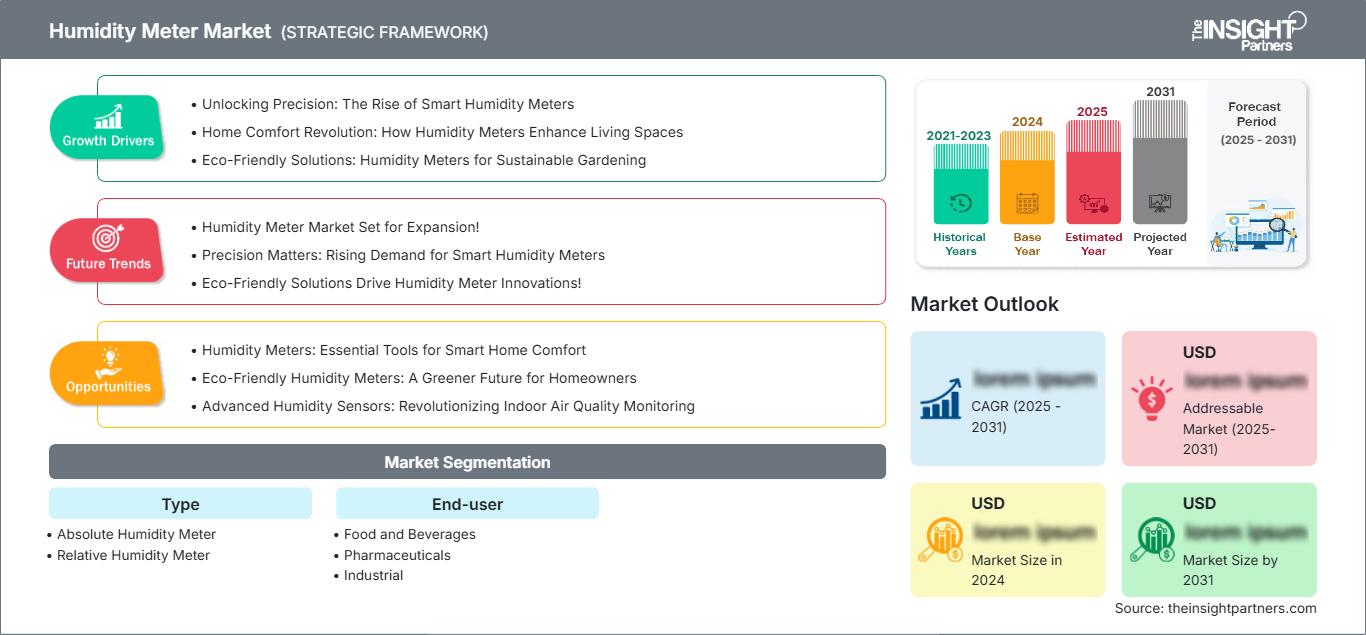
Humidity Meter Market: Strategic Insights
Regional Insights
North America Humidity Meter Market
North America is estimated to hold 34–38% of the Humidity Meter Market Share in 2025 and is expected to expand at a 3.0–3.6% CAGR through 2034. Demand is anchored by mature HVAC infrastructure, pharmaceuticals, food processing, advanced manufacturing, and industrial maintenance. The US remains the principal demand center because of its broad installed base of measurement equipment and extensive industrial applications.
There is a growing need for environmental monitoring solutions because there is a need for predictive maintenance and energy savings. There is a growing need for humidity measurements on a constant basis and not by manual testing. The Canadian and Mexican markets have increased their demands due to food production, automobile manufacturing, mining and other industrial applications, but still, the markets are not as large as the US.
U.S. Humidity Meter Market
The United States of America Humidity Meter Market constitutes 68-72% of North America’s demand in 2025, with growth estimated to be around 3.1-3.7% CAGR from 2025 through 2034. This is largely due to the fact that there is a substantial company presence in professional instrumentation, industrial sensing, HVAC testing, pharmaceutical production and facility monitoring.
There has been a shift in applications towards portable meter options, with options that log data, are capable of calibrations, and digital options. The pharmaceutical and life sciences facilities need their environment under control, while commercial buildings and data centers focus on optimizing their environment. Industrial maintenance provides a continuous source of demand for handheld units.
Europe Humidity Meter Market
The Humidity Meter Market in Europe will hold a market share of 27-31% in 2025 and will have a CAGR of 3.0-3.5% between 2025-2034. Germany leads the region because of its automation industry, instrumentation industry, pharma industry, automotive industry, and building efficiency programs. The UK is significant because of the life sciences industry, food processing industry, laboratories, and commercial buildings. France has demand because of the aerospace industry, pharma industry, food manufacturing industry, and HVAC systems. Italy and Spain drive the market because of their industrial production, agriculture, food processing, and building efficiency programs.
APAC Humidity Meter Market
The APAC region is predicted to possess 22–26% of the market for Humidity Meters in 2025 and forecasted to experience a growth rate of 3.7–4.4% CAGR between 2024 to 2034. China emerges as the key country in the region, trailed by Japan, South Korea, India, and Australia. Industries are responsible for creating demand for such devices due to frequent measurement needs.
There is also an increasing demand for such devices due to manufacturing investments made through policies in the region. There is growth in manufacturing capacity in India and Southeast Asian countries, along with established electronics and advanced manufacturing ecosystems in China and South Korea.
Middle East & Africa Humidity Meter Market
According to our research, the market for Middle East & Africa Humidity Meters will register an average growth rate of 3.0–3.8% from 2022 to 2034. Saudi Arabia is expected to be the highest revenue generating country, followed by UAE and South Africa. The need for monitoring of environment due to development of infrastructure, industries, agriculture, and energy intensive cooling systems are some of the reasons behind such demand.
In this case, the contribution of Saudi Arabia and UAE is through development of industrial, logistic, healthcare, and smart building infrastructures, while South Africa's contribution is through mining, food processing, manufacturing, and commercial infrastructure.
Segmentation Analysis
Type
The Type segment comprises Absolute Humidity Meter and Relative Humidity Meter. The segment is expected to expand at a 3.1–3.6% CAGR during 2026–2034. Relative humidity instruments retain broad adoption because users commonly evaluate moisture conditions against temperature and environmental thresholds. Absolute humidity measurement is strategically important where mass-based moisture content, drying performance, or process control requires a more direct representation of water vapor concentration.
- Absolute Humidity Meter: Used where moisture concentration must be evaluated independently of relative saturation. Demand is concentrated in technical processes, drying applications, material analysis, and environments requiring precise moisture characterization.
- Relative Humidity Meter: Maintains the leading market position because relative humidity is widely used for HVAC control, storage, laboratories, agriculture, food processing, and building monitoring. Its compatibility with temperature sensing supports integrated environmental management
End-user
The End-user segment includes Food and Beverages, Pharmaceuticals, Industrial, Building Automation, Automotive, Agriculture and is projected to grow at a 3.0–3.7% CAGR during 2026–2034. Demand is distributed across regulated storage, process control, facility management, vehicle climate systems, and crop environments. Adoption increasingly depends on measurement accuracy, calibration, durability, and compatibility with automation platforms.
- Food and Beverages: Humidity monitoring supports drying, storage, packaging, fermentation, and quality control, helping processors manage moisture-sensitive products and reduce deterioration during production and distribution.
- Pharmaceuticals: Measurement is strategically important for controlled storage, manufacturing, cleanrooms, and distribution environments where moisture can influence product stability, packaging integrity, and compliance procedures.
- Industrial: Broad industrial use spans drying, compressed air, materials, electronics, laboratories, and process monitoring, creating sustained demand for rugged instruments with dependable calibration.
- Building Automation: Humidity measurement supports HVAC control, indoor environmental management, energy optimization, and equipment protection, particularly in large commercial and critical facilities.
- Automotive: Applications include cabin comfort, windshield defogging, climate-control systems, component manufacturing, and testing environments where humidity affects performance and reliability.
- Agriculture: Adoption supports greenhouse management, crop storage, irrigation decisions, disease-risk monitoring, and precision farming, making humidity information increasingly relevant to resource-efficient production.
Opportunity Snapshot
| End Users | Revenue Contribution | Trend Tag | Adoption Stage |
|---|---|---|---|
| Food and Beverages | Medium | Process Drying | Scaling |
| Pharmaceuticals | Medium | Controlled Storage | Mature |
| Industrial | High | Process Monitoring | Mature |
| Building Automation | High | HVAC Integration | Scaling |
| Automotive | Medium | Cabin Climate | Scaling |
| Agriculture | Medium | Crop Monitoring | Scaling |
Humidity Meter Market Growth Drivers and Impact Analysis
Expansion of controlled pharmaceutical and food environments
Humidity control is becoming a more explicit operating requirement across pharmaceutical and food value chains because moisture can affect stability, packaging, shelf life, and process consistency. WHO storage guidance provides a measurable reference for dry conditions, reinforcing the need for instruments that can document environmental performance. Food manufacturers similarly use humidity readings to manage drying, storage, and production parameters. The market impact extends beyond initial equipment purchases because regulated facilities require calibration, verification, replacement probes, and periodic monitoring. Suppliers that offer traceable calibration and stable sensors can therefore capture recurring service demand. Growth is strongest where environmental measurements are integrated into documented quality systems rather than used only for occasional troubleshooting.
Digitization of industrial and building measurement workflows
Industrial facilities are increasingly shifting from manual readings toward connected measurement systems that support centralized monitoring, alarms, and historical analysis. Humidity instruments with digital outputs can feed building-management platforms, maintenance software, or production-control systems, allowing operators to identify deviations before they affect equipment or products. The IEA's energy-efficiency analysis identifies buildings as a major global energy consumer, strengthening the case for environmental controls that improve system performance. For the market, digitization expands the addressable value proposition from a handheld instrument to a broader sensing workflow. Vendors capable of combining accuracy, connectivity, cybersecurity, and easy commissioning are positioned to benefit as customers standardize measurement architectures across facilities.
Industrial expansion in Asia Pacific and advanced manufacturing
Asia Pacific is becoming increasingly important because electronics, semiconductors, batteries, pharmaceuticals, food processing, and advanced materials require controlled production environments. UNIDO reported that Asia and the Pacific led global manufacturing performance in early 2026, while higher-technology manufacturing showed stronger momentum than lower-technology industries. These production patterns increase the number of processes where moisture measurement can influence yield, reliability, and equipment performance. The resulting opportunity is not limited to handheld meters. Manufacturers increasingly require fixed probes, transmitters, calibration systems, and integrated monitoring. Suppliers with regional service networks and application expertise can therefore expand alongside new factories, while local industrial ecosystems create additional opportunities for customized sensing and maintenance solutions.
Humidity Meter Market Future Trends
Embedded intelligence and multi-parameter environmental sensing
Future instruments in the Humidity Meter Market Trends are likely to combine humidity with temperature, dew point, carbon dioxide, pressure, and airflow measurement on common platforms. This approach can reduce installation complexity while improving interpretation of environmental conditions. Instead of treating humidity as an isolated variable, software can correlate multiple parameters to identify condensation risk, drying performance, ventilation requirements, or process deviations. Artificial intelligence may gradually add anomaly detection and predictive recommendations, particularly in facilities with large sensor networks. Modular probes should also become more prevalent, allowing users to replace or upgrade sensing elements without replacing complete instruments. The result will be a transition from measurement hardware toward configurable environmental intelligence that supports operational decisions and automated control.
Precision sensing for energy-intensive critical facilities
Data centers, semiconductor fabs, laboratories, and advanced manufacturing sites will increasingly require high-stability humidity measurement as thermal loads and process sensitivity rise. The IEA projects data-center electricity consumption to approach 945 TWh by 2030, increasing pressure to optimize cooling without compromising operating conditions. Humidity sensors can contribute by helping cooling systems maintain appropriate environmental ranges and detect condensation risks. Future product development is therefore likely to emphasize low drift, fast response, remote diagnostics, and compatibility with facility-management systems. Vendors may also differentiate through lifecycle calibration, sensor-health monitoring, and redundant architectures. Such capabilities can support applications where a small measurement error has disproportionately large effects on energy consumption, product yield, or uptime.
Humidity Meter Market Opportunities
Integrated monitoring for smart industrial facilities
The Humidity Meter Market Forecasts point toward opportunities in integrated monitoring packages combining sensors, gateways, software, calibration, and analytics. Investors and suppliers can target industrial facilities where humidity is linked directly to production quality, maintenance, or energy use. The strongest commercial models are likely to emphasize recurring service revenue rather than one-time instrument sales. Opportunities include subscription-based monitoring, remote calibration support, fleet management, and predictive sensor replacement. Partnerships with automation integrators can accelerate adoption by embedding humidity measurement into broader control architectures. Suppliers should prioritize interoperable communications and modular hardware so customers can scale installations without redesigning their measurement infrastructure. This approach can increase switching costs while creating longer customer relationships.
Localized solutions for emerging manufacturing clusters
Emerging manufacturing clusters in India, Southeast Asia, the Middle East, and selected African markets offer opportunities for application-specific humidity solutions. New pharmaceutical, food, electronics, automotive, and infrastructure facilities require measurement systems during commissioning and throughout operations. Suppliers can strengthen market access through local calibration centers, technical training, distributor partnerships, and application engineering. Compact instruments designed for technicians can serve as entry products, while fixed transmitters and connected platforms provide expansion opportunities. Investors should evaluate markets where industrial development is accompanied by stronger quality standards and energy-management requirements. Localized support can be particularly valuable because measurement performance depends not only on sensor specifications but also on installation, calibration, maintenance, and interpretation.
Recent Developments
- June 2025: Sensirion launched the SHT40-AD1P-R2 and SHT41-AD1P-R2 digital humidity and temperature sensors with removable protective covers, combining high-precision measurement with enhanced durability for handling and deployment. Designed in a compact DFN package with a standard I²C interface, the sensors target space-constrained applications across industrial systems, HVAC equipment and consumer products, with humidity accuracy of up to ±1.8% RH and temperature accuracy of ±0.2°C.
- June 2026: ELEGRP launched a new humidity sensor and fan control switch series designed to automatically monitor indoor moisture and activate ventilation fans when excess humidity is detected, helping reduce condensation, mold and mildew while improving indoor air quality. The range includes standalone humidity-sensing fan controls and a combination model with integrated light control, with digital sensing, microprocessor-based control and tool-free adjustment of humidity thresholds and fan run times for bathrooms, laundry rooms, basements and other moisture-prone residential spaces.
- May 2026: Amazon entered into a multi-year commercial agreement with Transaera to deploy its cooling and dehumidification technology across Amazon logistics facilities, following a six-month field trial in Houston that demonstrated consistent energy savings in hot and humid conditions. Transaera’s systems use metal-organic-framework (MOF) solid desiccants to remove moisture before cooling, potentially reducing energy consumption by up to 40% versus conventional rooftop systems while improving humidity control, indoor air quality and HVAC efficiency.
Frequently Asked Questions

- Comprehensive Market Sizing and Forecast Analysis
- Detailed Segmentation Analysis
- In-Depth Market Dynamics Assessment
- Regional and Country-Level Insights
- Competitive Landscape and Company Benchmarking
- Strategic Business Intelligence
Recent Reports
Testimonials

The Insight Partners provided valuable market intelligence that supported our global go-to-market strategy. Their team was professional, responsive, and attentive to our feedback, providing thoughtful analysis and helpful methodological clarifications throughout the project.
Junmo Kim Chief Financial Officer (CFO), Enertech Co., Ltd.
The Insight Partners' SCADA System Market report is comprehensive, with valuable insights on current trends and future forecasts. The team was highly professional, responsive, and supportive throughout. We are very satisfied and highly recommend their services.
RAN KEDEM Partner, Reali Technologies LTDs
I requested a report on a very specific software market and the team produced the report in a few days. The information was very relevant and well presented. I then requested some changes and additions to the report. The team was again very responsive and I got the final report in less than a week.
JEAN-HERVE JENN Chairman, Future Analytica
We worked with The Insight Partners for an important market study and forecast. They gave us clear insights into opportunities and risks, which helped shape our plans. Their research was easy to use and based on solid data. It helped us make smart, confident decisions. We highly recommend them.
PIYUSH NAGPAL Sr. Vice President, High Beam Global
The Insight Partners delivered insightful, well-structured market research with strong domain expertise. Their team was professional and responsive throughout. The user-friendly website made accessing industry reports seamless. We highly recommend them for reliable, high-quality research services
YUKIHIKO ADACHI CEO, Deep Blue, LLC.
This is the first time I have purchased a market report from The Insight Partners.While I was unsure at first, I visited their web site and felt more comfortable to take the risk and purchase a market report.I am completely satisfied with the quality of the report and customer service. I had several questions and comments with the initial report, but after a couple of dialogs over email with their analyst I believe I have a report that I can use as input to our strategic planning process.Thank you so much for taking the extra time and making this a positive experience.I will definitely recommend your service to others and you will be my first call when we need further market data.
JOHN SUZUKI President and Chief Executive Officer, Board Director, BK Technologies
I wish to appreciate your support and the professionalism you displayed in the course of attending to my request for information regarding to infectious disease IVD market in Nigeria. I appreciate your patience, your guidance, and the fact that you were willing to offer a discount, which eventually made it possible for us to close a deal. I look forward to engaging The Insight Partners in the future, all thanks to the impression you have created in me as a result of this first encounter.
DR CHIJIOKE ONYIA MANAGING DIRECTOR, PineCrest Healthcare Ltd.Reason to Buy
- Informed Decision-Making
- Understanding Market Dynamics
- Competitive Analysis
- Identifying Emerging Markets
- Customer Insights
- Market Forecasts
- Risk Mitigation
- Boosting Operational Efficiency
- Strategic Planning
- Investment Justification
- Tracking Industry Innovations
- Aligning with Regulatory Trends





 Get Free Sample for