
HVAC Blower and Fan Systems Market Demand, Size & Forecast by 2034
Coverage: By Product Type (Axial, Centrifugal, Backward Inclined Fans, Others); Application (Industrial, Residential, Commercial) , and Geography (North America, Europe, Asia Pacific, and South and Central America)
- Status : Data Released
- Report Code : TIPRE00019782
- Category : Electronics and Semiconductor
- No. of Pages : 150
- Available Report Formats :


- Last update date : September 15, 2026


2025 Market Size
US$ 13.56 Bn
Base year value
2034 Forecast
US$ 20.24 Bn
Projected by 2034
CAGR 2026-2034
4.55 %
Growth rate
Addressable Market
US$ 153.46 Bn
(2026-2034)
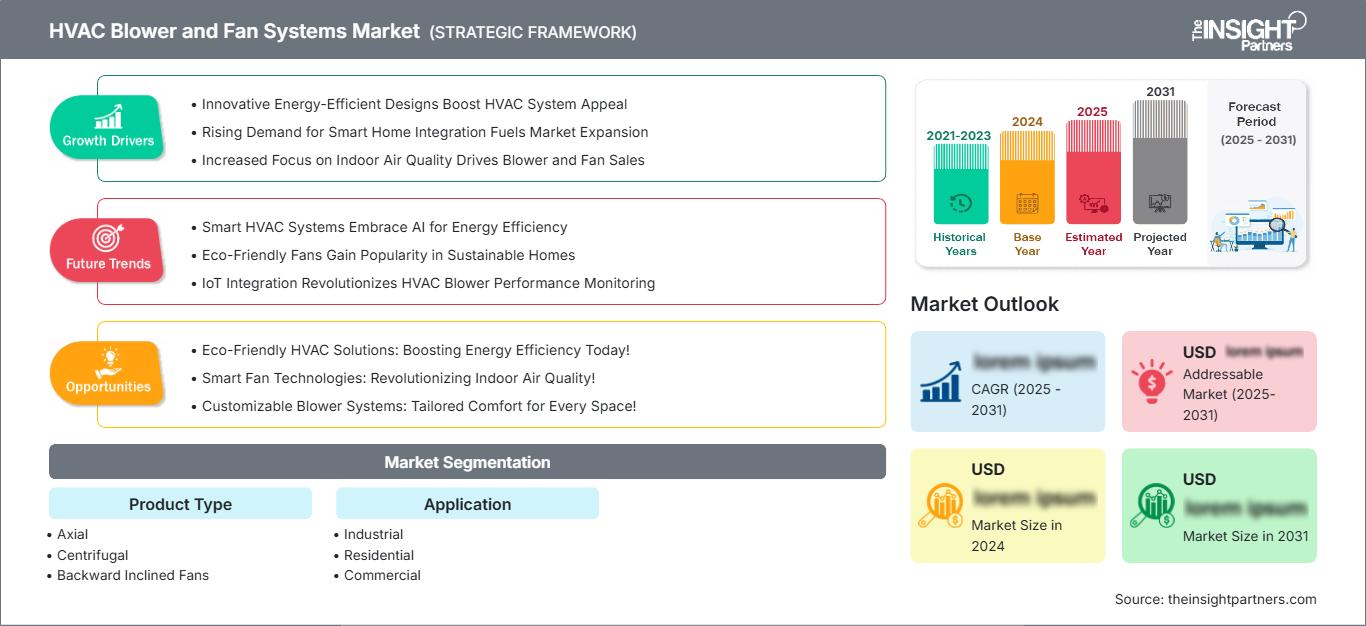
The HVAC Blower and Fan Systems Market was valued at US$ 13.56 Billion in 2025 and is projected to reach US$ 20.24 Billion by 2034, registering a CAGR of 4.55% during 2026–2034. The market includes axial, centrifugal, and backward inclined fans which are used in industrial, residential, and commercial applications and whose demand depends on ventilation needs, efficiency of the equipment, quality of indoor air, building construction, and industrial process air control.
In North America, steady growth is forecasted due to HVAC renovation in the commercial sector and investment in industrial ventilation. Factors influencing HVAC Blower and Fan Systems Market Size include stricter efficiency standards, construction of new data centers, warehouse construction, and demand for reliable air movement equipment.
HVAC Blower and Fan Systems Market Assessment and Insights
- North America: North America held a 24–28% share in 2025 and is projected to grow at a 4.2–4.8% CAGR during 2026–2034, supported by commercial retrofits, industrial ventilation, and replacement of inefficient fan systems.
- US: The US represented 78–82% of North American demand in 2025 and is expected to expand at a 4.1–4.7% CAGR during 2026–2034, led by commercial HVAC modernization.
- Europe: Europe accounted for 25–29% share in 2025 and is forecast to grow at a 4.0–4.6% CAGR during 2026–2034, with Germany, the UK, France, Italy, and Spain supporting efficiency-led replacement.
- Asia Pacific: Asia Pacific represented 30–34% share in 2025 and is anticipated to register a 5.0–5.6% CAGR during 2026–2034, with China, India, Japan, South Korea, and Australia driving construction and industrial ventilation demand.
- Largest Segment: Centrifugal fans held a 45–49% market share in 2025 and are projected to grow at a 4.7–5.1% CAGR during 2026–2034, supported by pressure-intensive applications.
- High Growth Segment: Axial fans represented a 34–38% market share in 2025 and are expected to grow at a 4.9–5.3% CAGR during 2026–2034, supported by ventilation demand.
- Key companies analyzed in detail: CG Power and Industrial Solutions Limited; Acme Engineering and Manufacturing Corporation; Air System Components Inc.; Wuhan General Group (China) Co., Ltd.; Continental Blower LLC; Air Master Fan Company, Inc.; DongKun Industrial Co., Ltd.; FläktGroup SA; Greenheck Fan Corporation; Howden Group Ltd.
Source: The Insight Partners' analysis based on proprietary research, government publications, company annual reports, investor presentations, industry databases, and expert interviews.
HVAC Blower and Fan Systems Market trends are moving towards direct-drive arrangements, electronically commutated motors, variable speed drives, better aerodynamic technology, and digital aided selection. Production methods increasingly focus on modularization, low maintenance design, small footprint, and better energy efficiency. These will impact the manufacturing of individual fans and blowers installed in air-handling units, rooftop systems, ventilation systems, and industrial processes.
Future demand is expected to grow in the Asia-Pacific region and selected developing countries as their urban construction and industrial expansion, as well as data center construction, lead to greater need for ventilation. North American and Western Europe markets will concentrate on replacements and efficiency improvements. Regulatory emphasis on building performance, indoor air quality, motor efficiency, and equipment energy use is also expected to stimulate the demand for more efficient air movement systems.
HVAC Blower and Fan Systems Market Report Scope
| Report Attribute | Details |
|---|---|
| Market size in 2025 | US$ 13.56 Billion |
| Market Size by 2034 | US$ 20.24 Billion |
| Global CAGR (2026 - 2034) | 4.55% |
| Historical Data | 2021-2024 |
| Forecast period | 2026-2034 |
HVAC Blower and Fan Systems Market Analysis
The demand stems from three primary application environments: industrial establishments that require process ventilation, residential buildings that require air movement and extraction, and commercial establishments that require air movement control. Factors driving HVAC Blower and Fan Systems Market include constructions, replacing old equipment, requirements for indoor air quality, and movement of large volumes of air. The value chain involves motor suppliers, fan suppliers, HVAC equipment assembly companies, distributors, engineering companies, contractors, and maintenance services.
Factors affecting supply include electric motors, impellers, casing, bearing, controls, material, and fabrication capabilities. Centrifugal designs are best suited for situations that involve high pressure, whereas axial fans are the most common designs for situations that require high volume and comparatively low pressure air movement. Backward inclined fans represent the design that is optimized in terms of efficiency of the air handling systems.
HVAC Blower and Fan Systems Market Report suggests that competition in the market features a combination of diversified HVAC companies and specialized manufacturers of fans and blowers. Greenheck Fan Corporation and FläktGroup SA feature diversified lines for moving air and ventilation, whereas Howden Group Ltd addresses complex industrial air and gas handling needs. Acme Engineering and Manufacturing Corporation, Continental Blower LLC, and Air Master Fan Company, Inc. enhance the ranks of specialized suppliers.
CG Power and Industrial Solutions Limited has strengths in motors and air handling solutions, as does Wuhan General Group (China) Co., Ltd. and DongKun Industrial Co., Ltd. that represent the Asian manufacture. Air System Components Inc. and its line of products, in combination with specialized suppliers, compete on the basis of application engineering, distribution access, customization, energy efficiency, and delivery assurance. Strategic investments will focus on efficient motors, direct-drive systems, digital selection tools, and local production.
● REPORT CUSTOMIZATION
Tailor This Report To Align With Your Specific Business Requirements
This report can be customized to align precisely with your business objectives, scope, and target markets. Customization options include tailored segmentation, geography, competitive analysis, and strategic insights to support informed decision-making.
Customize This Report →WHAT YOU CAN ADJUST
- ● Segmentations
- ● Geography
- ● Competitive Analysis
- ● Language Preferences
HVAC Blower and Fan Systems Market: Strategic Insights
Regional Insights
North America HVAC Blower and Fan Systems Market
North America had a HVAC Blower and Fan Systems Market share of 24-28% in 2025 and is expected to grow with a CAGR of 4.2-4.8% during 2026-2034. North America is dominated by the US, which is the largest demand center; Canada and Mexico add up to the opportunities through construction activities of commercial buildings, manufacturing units, warehouses, institutions, and replacements. Distribution channels for HVAC systems and installed equipment base in North America provide regular demand for replacement fans, motors, and blowers. Industrial facilities have their own needs for proper ventilation.
North American market has growing demand for direct-drive fans, variable speed motors, electronically commutated motors, and easy-to-maintain equipment. Data centers, logistics centers, healthcare centers, and commercial facilities are key investment destinations. There is a trend towards energy efficiency and this has prompted the owners to consider lifetime electrical consumption cost rather than equipment purchase cost. Such a situation provides scope for manufacturers having optimized fan curves, controls capability, application engineering and easy-to-integrate equipment.
U.S. HVAC Blower and Fan Systems Market
In 2025, the US had a market share ranging from 78–82% of the North America total and is expected to expand at a compound annual growth rate (CAGR) of 4.1–4.7% through 2034. Demand drivers include modernization of commercial HVAC systems, industrial manufacturing, warehouse construction, health care facilities, and data centers. Leading suppliers include Greenheck Fan Corporation, Acme Engineering and Manufacturing Corporation, Air Master Fan Company, Inc., among others.
Replacement demand is critical since existing structures have a large installed base of fans, blowers, air-handling systems, and ventilation systems. In addition, buyers consider the efficiency of motors, controllability, acoustic performance, reliability, and maintenance considerations. On the one hand, industrial users consider pressure and airflow considerations. On the other hand, commercial users focus on efficiency, occupant comfort, acoustics, and equipment integration.
Europe HVAC Blower and Fan Systems Market
Europe represented 25–29% of the market in 2025 and is projected to grow at a 4.0–4.6% CAGR during 2026–2034. Germany is a leading market, followed by the UK, France, Italy, and Spain. Germany benefits from advanced industrial production and engineering capabilities, while the UK combines commercial renovation with growing attention to ventilation and building efficiency. France has opportunities across commercial, industrial, and public infrastructure projects.
Demand from Italy and Spain comes from production industries, hospitality sector, commercial buildings, and residential construction. European buyers tend to think of energy efficiency, acoustic quality, space occupied by equipment, and cost throughout the lifetime of the installation. FläktGroup SA plays a major role in the region in supplying solutions for indoor climate control and ventilation systems.
APAC HVAC Blower and Fan Systems Market
The Asia Pacific segment accounted for 30–34% market share in 2025 and is projected to have a CAGR of 5.0–5.6% during the forecast period of 2026–2034. China is the leading country in the region, whereas India, Japan, South Korea, and Australia present considerable demands. Growth in industries, commercial buildings, logistics infrastructure, electronics manufacturing, and data centers requires more ventilation and airflow control.
Energy efficiency policies are making people pay attention to efficient motors and variable-speed devices. In China, there is high production and extensive construction, whereas in India, there is infrastructure and industrial investments. Japan and South Korea focus on efficient equipment, whereas in Australia there is demand coming from commercial buildings, industries, and ventilation systems.
Middle East & Africa HVAC Blower and Fan Systems Market
Middle East and Africa is projected to grow at a 3.8–4.4% CAGR during 2026–2034, with Saudi Arabia and the UAE leading regional demand. South Africa remains important for industrial and commercial applications, while the Rest of MEA is driven primarily by project-based infrastructure and construction activity.
Gulf markets' high cooling needs make it even more essential to have effective air movement and ventilation. There is plenty of scope for packaged air conditioning and related fans with respect to hotel complexes, hospitals, commercial spaces, airports, and mixed-use developments. There is potential to offer centrifugal and axial fans for industrial projects in Saudi Arabia and the United Arab Emirates (UAE).
Segmentation Analysis
Product Type
The Product Type segment covers Axial, Centrifugal, and Backward Inclined Fans. The HVAC Blower and Fan Systems Market scope by product type is projected to expand at a 4.4–4.8% CAGR during 2026–2034. Centrifugal fans remain important where pressure generation is critical, while axial designs address high-volume ventilation requirements and backward inclined configurations emphasize efficiency.
- Axial: Axial fans are widely used for high-volume, lower-pressure ventilation and air circulation. Their relatively straightforward construction, broad size availability, and suitability for industrial and commercial ventilation sustain demand.
- Centrifugal: Centrifugal fans serve applications requiring higher pressure and controlled airflow, including air-handling units, process ventilation, and filtration systems. Their broad operating range supports strong procurement across industrial and commercial facilities.
- Backward Inclined Fans: Backward inclined fans are selected where efficient operation, stable airflow characteristics, and reduced power consumption are priorities. They are strategically relevant in air-handling and commercial ventilation equipment.
Application
Application demand is projected to grow at a 4.6–5.0% CAGR during 2026–2034. Industrial facilities require airflow for process control, cooling, and contaminant removal, while residential and commercial buildings depend on ventilation, air circulation, and indoor environmental management. Application requirements therefore influence fan geometry, pressure capability, motor selection, acoustic performance, and controls.
- Industrial: Industrial facilities require fans for process ventilation, cooling, combustion-air movement, dust handling, and temperature management. Equipment reliability and resistance to demanding environments are important procurement considerations.
- Residential: Residential demand is supported by ventilation, exhaust, air circulation, and indoor air quality requirements. Compact products, low noise, efficient motors, and straightforward installation are increasingly relevant to homeowners and builders.
- Commercial: Commercial buildings require dependable airflow for offices, retail, healthcare, hospitality, education, and institutional facilities. Energy performance, acoustics, controllability, and compatibility with building-management systems influence specifications.
Opportunity Snapshot
| Application | Revenue Contribution | Trend Tag | Adoption Stage |
| Industrial | High | Process Ventilation | Mature |
| Residential | Medium | Quiet Ventilation | Scaling |
| Commercial | High | Smart Airflow | Scaling |
HVAC Blower and Fan Systems Market Growth Drivers and Impact Analysis
Rising Demand for Energy-Efficient Air Movement
Energy consumption is becoming a central procurement criterion for fans and blowers because these systems can operate for long periods in commercial and industrial facilities. Direct-drive configurations, electronically commutated motors, variable-speed drives, and improved impeller geometry can reduce unnecessary energy use when airflow requirements vary. This creates a market advantage for manufacturers capable of combining aerodynamic efficiency with flexible controls. Building owners are increasingly assessing operating costs over equipment lifecycles, encouraging replacement of inefficient legacy systems. Industrial customers also benefit where optimized airflow reduces pressure losses and improves process performance. The impact extends across motors, controls, fan assemblies, and engineering services because efficiency improvements often require coordinated system design rather than a simple component replacement.
Expansion of Industrial and Commercial Infrastructure
Industrial capacity additions, logistics facilities, commercial construction, healthcare projects, and data-center development create direct requirements for reliable air movement equipment. New facilities generally require purpose-designed ventilation systems, while existing properties generate replacement demand as equipment ages. Industrial applications can require high-pressure centrifugal systems, whereas warehouses, parking facilities, and large commercial spaces often require high-volume axial or mixed ventilation configurations. The diversity of operating conditions supports a broad product portfolio and reduces dependence on one application category. Manufacturers can capture additional value by offering selection engineering, controls integration, commissioning, and maintenance support. The market impact is strongest in regions where construction and manufacturing investment occur simultaneously, because each new facility adds both initial equipment demand and future replacement potential.
Stronger Indoor Air Quality and Ventilation Requirements
Indoor air quality remains an important consideration for commercial, healthcare, educational, and residential facilities. Greater attention to outdoor-air delivery, exhaust management, filtration, and controlled ventilation supports demand for dependable fan and blower systems. Modern ventilation designs increasingly require equipment that can adjust airflow according to occupancy, pressure, temperature, and operating schedules. This supports variable-speed motors and electronically controlled fan systems rather than constant-speed operation. Manufacturers can benefit by pairing airflow equipment with sensors, controls, and energy-recovery systems. The market impact is also visible in retrofit projects because building owners can upgrade ventilation without completely replacing HVAC infrastructure. Contractors and engineering firms therefore gain additional opportunities for system assessment, equipment selection, installation, balancing, commissioning, and lifecycle maintenance.
HVAC Blower and Fan Systems Market Future Trends
Digitally Optimized Fan Performance
The HVAC Blower and Fan Systems Market trends are moving toward digitally optimized equipment that can continuously adjust airflow according to operating conditions. Sensors, variable-speed motors, connected controls, and software-based monitoring can help facilities match fan output with actual demand instead of maintaining constant airflow. Future systems may increasingly provide performance diagnostics, maintenance alerts, and operating data through building-management platforms. This evolution can reduce energy waste while improving equipment visibility for facility managers. Manufacturers are likely to compete through integrated motor, control, and fan packages that simplify commissioning and monitoring. Product selection tools may also become more sophisticated, allowing engineers to evaluate efficiency, acoustics, pressure, airflow, and lifecycle cost within a single digital environment. These capabilities can strengthen long-term customer relationships.
Greater Adoption of EC and Direct-Drive Configurations
Direct-drive architectures and electronically commutated motors are likely to gain wider adoption as users prioritize efficiency, compact equipment, reduced maintenance, and controllability. Eliminating belts and pulleys can simplify maintenance while reducing mechanical losses, making direct-drive configurations attractive for commercial ventilation and air-handling applications. EC motors can also support variable-speed operation and more precise airflow control. Future product development is expected to combine these technologies with improved impeller geometry, lower-noise designs, and standardized control interfaces. Adoption will vary according to application economics, installed infrastructure, and required pressure levels. Industrial buyers may continue selecting specialized belt-driven or high-pressure configurations where operating conditions demand them, while commercial and institutional projects increasingly favor compact systems designed for efficient part-load operation.
HVAC Blower and Fan Systems Market Opportunities
Data Center and Critical Cooling Infrastructure
Data-center construction provides an attractive investment opportunity because critical facilities require continuous and highly reliable airflow management. Cooling systems increasingly need equipment capable of operating efficiently under variable loads while maintaining redundancy and predictable performance. Suppliers can target this opportunity through high-efficiency fans, direct-drive configurations, electronically commutated motors, and digitally monitored equipment. Local manufacturing and rapid service capabilities can further strengthen competitiveness because data-center operators prioritize uptime and maintenance responsiveness. Engineering partnerships with cooling-system integrators and mechanical contractors can help manufacturers enter projects earlier in the specification process. The HVAC Blower and Fan Systems Market Forecasts suggest that suppliers able to demonstrate efficiency, reliability, controllability, and lifecycle support can capture value beyond the initial fan sale as critical facilities expand across major technology hubs.
Retrofit Programs for Commercial and Industrial Buildings
Retrofit programs provide a scalable opportunity because many operating buildings contain aging fans, blowers, motors, and control systems. Suppliers can develop replacement packages that preserve existing ductwork while improving airflow efficiency, controllability, acoustics, and maintenance access. Commercial owners can combine fan upgrades with broader HVAC modernization, while industrial operators can target applications where continuous operation makes energy savings economically meaningful. Successful retrofit strategies require site surveys, fan selection, motor matching, electrical assessment, balancing, and commissioning, creating opportunities for distributors and service providers alongside equipment manufacturers. Suppliers can improve conversion rates by offering standardized retrofit kits, configurable mounting arrangements, and compatibility with existing controls. This approach can shorten project timelines and reduce disruption while creating recurring demand across large property portfolios.
Recent Developments
- May 2026: Modern HVAC technology faces rising energy costs, limited installation space and increasing performance requirements. With the RadiFlow 630, ebm‑papst introduces a fan solution that addresses these challenges head-on. High airflow rates, significantly improved efficiency in the application, and an exceptionally compact design open up new possibilities for manufacturers of HVAC units, CRAH units and fan wall units (FWU)—especially in data centers.
- February 2026: Carrier is redefining home comfort with the debut of a new home comfort system with four innovative HVAC solutions at the International Builders’ Show, Feb. 17-19 in Orlando, booth W6267. Driven by accelerating electrification, rising efficiency standards, and the growing demand for connected home systems, Carrier is unveiling a next‑generation residential HVAC platform engineered for the future. Designed to deliver superior energy efficiency, advanced connectivity, and streamlined installation, the new lineup empowers homeowners and contractors with smarter, more reliable performance and an intuitive experience. Carrier is a part of Carrier Global Corporation (NYSE: CARR), global leader in intelligent climate and energy solutions.
- April 2026: MAHLE presents a pioneering bionic radial blower for automotive air conditioning systems that improves efficiency while significantly reducing noise development. The development, which has been specially designed for vehicles with challenging installation space, has been guided by an example from nature: The aerodynamic shape of the fan blades has been modeled after the fins of a penguin, which glide swiftly and quickly through the water. Thanks to this innovative design, the bionic fan is 4 decibels (dB) or 60 percent quieter in comparison to similar components. At the same time, it is around 15 percent more efficient as the motor requires less energy due to the optimized design. MAHLE is setting a new benchmark with this innovation.
Frequently Asked Questions

- Comprehensive Market Sizing and Forecast Analysis
- Detailed Segmentation Analysis
- In-Depth Market Dynamics Assessment
- Regional and Country-Level Insights
- Competitive Landscape and Company Benchmarking
- Strategic Business Intelligence
Recent Reports
Testimonials

The Insight Partners provided valuable market intelligence that supported our global go-to-market strategy. Their team was professional, responsive, and attentive to our feedback, providing thoughtful analysis and helpful methodological clarifications throughout the project.
Junmo Kim Chief Financial Officer (CFO), Enertech Co., Ltd.
The Insight Partners' SCADA System Market report is comprehensive, with valuable insights on current trends and future forecasts. The team was highly professional, responsive, and supportive throughout. We are very satisfied and highly recommend their services.
RAN KEDEM Partner, Reali Technologies LTDs
I requested a report on a very specific software market and the team produced the report in a few days. The information was very relevant and well presented. I then requested some changes and additions to the report. The team was again very responsive and I got the final report in less than a week.
JEAN-HERVE JENN Chairman, Future Analytica
We worked with The Insight Partners for an important market study and forecast. They gave us clear insights into opportunities and risks, which helped shape our plans. Their research was easy to use and based on solid data. It helped us make smart, confident decisions. We highly recommend them.
PIYUSH NAGPAL Sr. Vice President, High Beam Global
The Insight Partners delivered insightful, well-structured market research with strong domain expertise. Their team was professional and responsive throughout. The user-friendly website made accessing industry reports seamless. We highly recommend them for reliable, high-quality research services
YUKIHIKO ADACHI CEO, Deep Blue, LLC.
This is the first time I have purchased a market report from The Insight Partners.While I was unsure at first, I visited their web site and felt more comfortable to take the risk and purchase a market report.I am completely satisfied with the quality of the report and customer service. I had several questions and comments with the initial report, but after a couple of dialogs over email with their analyst I believe I have a report that I can use as input to our strategic planning process.Thank you so much for taking the extra time and making this a positive experience.I will definitely recommend your service to others and you will be my first call when we need further market data.
JOHN SUZUKI President and Chief Executive Officer, Board Director, BK Technologies
I wish to appreciate your support and the professionalism you displayed in the course of attending to my request for information regarding to infectious disease IVD market in Nigeria. I appreciate your patience, your guidance, and the fact that you were willing to offer a discount, which eventually made it possible for us to close a deal. I look forward to engaging The Insight Partners in the future, all thanks to the impression you have created in me as a result of this first encounter.
DR CHIJIOKE ONYIA MANAGING DIRECTOR, PineCrest Healthcare Ltd.Reason to Buy
- Informed Decision-Making
- Understanding Market Dynamics
- Competitive Analysis
- Identifying Emerging Markets
- Customer Insights
- Market Forecasts
- Risk Mitigation
- Boosting Operational Efficiency
- Strategic Planning
- Investment Justification
- Tracking Industry Innovations
- Aligning with Regulatory Trends





 Get Free Sample for