
Hybrid-Satellite Cellular Terminal Market Growth, Size, Share, Trends, Key Players Analysis, and Forecast till 2034
Coverage: By Frequency Band (L-Band Terminal, S-Band Terminal, Ka- and Ku- Band Terminal); Service (Video and Voice Service, Data Service, Tracking and Monitoring); End User (Oil and Gas, Media and Entertainment, Defense, Aviation, Automotive, Logistics and Transportation, Telecommunication) , and Geography (North America, Europe, Asia Pacific, and South and Central America)
- Status : Data Released
- Report Code : TIPRE00025001
- Category : Electronics and Semiconductor
- No. of Pages : 150
- Available Report Formats :


- Last update date : October 26, 2026


2025 Market Size
US$ 1.71 Bn
Base year value
2034 Forecast
US$ 3.23 Bn
Projected by 2034
CAGR 2026-2034
7.34 %
Growth rate
Addressable Market
US$ 22.30 Bn
(2026-2034)
The Hybrid Satellite Cellular Terminal market is valued at US$ 1.71 Billion in 2025 and is projected to reach US$ 3.23 Billion by 2034, registering a CAGR of 7.34% during 2026–2034. The demand is driven by the need for connectivity in environments where mobile communications play an integral part of the process. This industry is growing as more organizations are seeking reliable and robust connectivity options that would integrate the terrestrial network with the satellite connectivity.
There are many factors that make North America Hybrid Satellite Cellular Terminal Market Size favorable in terms of adoption, such as the defense modernization initiatives, remote industrial applications and the increasing use of satellite connectivity in conjunction with cellular and private networks. The CAGR forecast in North America will be between 8.9% and 10.2%.
Hybrid-Satellite Cellular Terminal Market Assessment and Insights
- North America: North America represents a leading regional market, with a 2025 share of 34–36% and a 2026–2034 CAGR of 8.9–10.2%, supported by defense communications, remote connectivity, aviation, and commercial mobility deployments.
- US: The U.S. accounts for 78–80% of North America in 2025 and is expected to grow at a 2026–2034 CAGR of 9.0–10.3%, supported by defense, public safety, and enterprise connectivity.
- Europe: Europe holds a 2025 share of 26–28% and is projected to expand at a 2026–2034 CAGR of 8.7–10.0%, with the UK, Germany, France, Italy, and Spain supporting adoption through secure communications and mobility applications.
- Asia Pacific: Asia Pacific represents 23–25% of 2025 revenue and is expected to register a 2026–2034 CAGR of 9.8–11.5%, led by China, Japan, South Korea, India, and Australia as satellite and cellular infrastructure converge.
- Largest Segment: Ka- and Ku- Band Terminal holds a 2025 market share of 38–42%, with a 2026–2034 CAGR of 7.8–9.1%, reflecting high-throughput mobility requirements.
- High Growth Segment: Data Service represents a 2025 market share of 34–38% and is expected to grow at a 2026–2034 CAGR of 9.0–10.5%, driven by bandwidth-intensive connected operations.
- Key companies analyzed in detail: Comtech Telecommunications Corp., Cubic Telecom Ltd., EchoStar Corporation, Inmarsat Global Limited, IP Access International Ltd., JT Group Limited, Kymeta Corporation, OQ Technology GmbH, ORBCOMM Inc., Ultra Electronics Holdings plc.
Source: The Insight Partners' analysis based on proprietary research, government publications, company annual reports, investor presentations, industry databases, and expert interviews.
Hybrid Satellite Cellular Terminal Market growth has moved from dedicated satellite terminals to a system comprising satellite modems, cellular radios, software-defined networking, electronically-steered antennas, and intelligent traffic management. With the use of flat panel antennas, installation limitations are being overcome, with multi-orbital operations becoming more common as LEO, GEO, and terrestrial cellular operations interoperate. Hybrid Satellite Cellular Terminal implementations will therefore move from communications equipment to flexible network connectivity solutions for transport and mobile personnel applications.
Future growth will be helped by non-terrestrial 5G standardization, increased LEO coverage, and growing demand for secure communication solutions. Progress in regulation regarding spectrum sharing and interoperability between satellites and terrestrial systems will help drive the market, with government purchases helping to speed up qualifications for ruggedized systems. Demand in the Asia Pacific, Middle East, and African regions is especially relevant due to incomplete coverage along the industrial zones and other operating environments.
Hybrid-Satellite Cellular Terminal Market Report Scope
| Report Attribute | Details |
|---|---|
| Market size in 2025 | US$ 1.71 Billion |
| Market Size by 2034 | US$ 3.23 Billion |
| Global CAGR (2026 - 2034) | 7.34% |
| Historical Data | 2021-2024 |
| Forecast period | 2026-2034 |
Hybrid-Satellite Cellular Terminal Market Analysis
The demand for such services is influenced by companies that simply cannot afford any disruption in connectivity from their remote or mobile sites. Hence, the Hybrid Satellite Cellular Terminal market opportunity includes not only the manufacturers of the equipment but also the operators of satellites, cellular networks, modems, antennas, systems integrators, and even providers of managed services. Value creation will depend on switching capabilities, low energy consumption, network orchestration, and interoperability, not just satellite equipment. Additionally, through satellite and cellular convergence, companies have the possibility of using the terrestrial network where cost-effective and save the satellite capacity for the places without connectivity. Such a network would decrease reliance on any single connectivity solution and would be able to support connected assets moving between urban, rural, marine, and offshore locations.
The dynamics in supply are driven by the availability of semiconductors, electronically-steered antenna production, satellite modem development and hardware and software integration. Expansion of the Low Earth Orbit (LEO) constellation provides more networks, while existing Geosynchronous Orbits (GEO) and Mobile Satellite Services (MSS) networks also play an important role in providing coverage and reliability. Companies distinguish themselves through compact terminal, multiband operation, integrated cellular modems and software-defined traffic management. The resulting ecosystem benefits companies that can integrate multiple layers of the network, and not only sell terminal hardware.
Competitive advantage depends on interoperability, antenna shape, managed services and terminal integration for particular applications. From the Hybrid Satellite Cellular Terminal Market perspective, a company with well-established satellite business could bundle access to network with the hardware, whereas terminal vendor could compete with the help of low-profile terminal design and software switching capability. Kymeta Corporation offers multi-orbit and multiband connectivity, Comtech Telecommunications Corp. has experience with satellite modems and networking, EchoStar Corporation unites satellite and terrestrial wireless business.
Other companies explore differentiated niches in the Hybrid Satellite Cellular Terminal Market Report. The former company concentrates on connected mobility, the latter company offers mobile satellite connectivity, and the last company targets industrial Internet of Things applications using satellite-cellular technologies. Ultra Electronics Holdings plc. operates in difficult defense communication environment, while the rest of two companies diversify the ecosystem using their satellite and telecommunications services. Investments are getting more oriented to terminals that are capable of supporting multiple networks, minimizing operators' involvement, and offering resilient communication in contested or geographically difficult environments.
● REPORT CUSTOMIZATION
Tailor This Report To Align With Your Specific Business Requirements
This report can be customized to align precisely with your business objectives, scope, and target markets. Customization options include tailored segmentation, geography, competitive analysis, and strategic insights to support informed decision-making.
Customize This Report →WHAT YOU CAN ADJUST
- ● Segmentations
- ● Geography
- ● Competitive Analysis
- ● Language Preferences
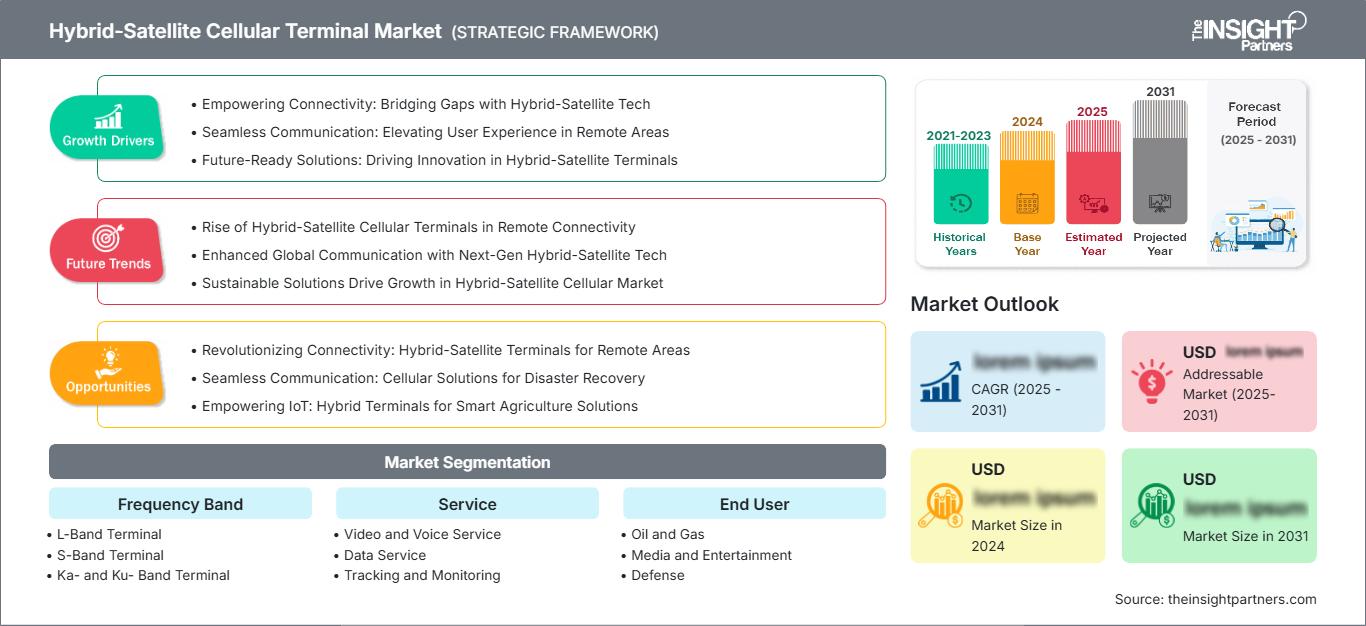
Hybrid-Satellite Cellular Terminal Market: Strategic Insights
Regional Insights
North America Hybrid Satellite Cellular Terminal Market
Region-wise, North America is anticipated to hold the largest Hybrid Satellite Cellular Terminal Market share, estimated at 34-36% in 2025, with a CAGR of 8.9-10.2% during 2023-34. The region enjoys advantages in terms of satellite infrastructure, cellular connectivity, defense procurements, and remoteness of industries. Resilient communication efforts of the government of the U.S. create a favorable qualification landscape, whereas Canada brings demands from remote areas, transport, energy, and mining.
In addition, the region offers a robust ecosystem comprising satellite operators, network integrators, defense contractors, and terminal developers. Hybrid systems will be able to help in emergency communications, connected cars, aviation, and field communications where terrestrial network coverage is not available. Adoption of the hybrid satellite cellular terminal market trends in North America will also be boosted by enterprise-level demands for network redundancy and software-defined routing.
U.S. Hybrid Satellite Cellular Terminal Market
The U.S. constitutes 78-80% of the North America revenue in 2025 and will register a CAGR of 9.0-10.3%. Defense modernization, public safety communication, aircraft connectivity, and remote industrial connectivity constitute the primary demand segments. The demand for systems with ability to keep communications alive during instances when terrestrial infrastructure is either not available or has been jammed/damaged is growing among government sector customers.
There are a number of companies like EchoStar Corporation, Comtech Telecommunications Corp., and Kymeta Corporation who possess relevant capabilities towards satellite-cellular convergence solutions. The applications include mobile command systems, emergency response system, connected vehicle applications, energy infrastructure application, etc. The adoption from enterprise applications is also rising due to the need of automatic network selection and service continuity.
Europe Hybrid Satellite Cellular Terminal Market
Europe accounts for 26–28% of revenue in 2025 and is expected to register growth at a rate of CAGR 8.7–10.0%. The UK is a key market driven by defense connectivity, aviation communications, maritime communication, and satellite sector capabilities. Germany will drive the region through industrial digitalization, automotive connectivity, secured communications, and satellite applications that need engineering efforts. France continues to be a key player owing to aerospace capabilities, governmental programs, and satellite infrastructure. Italy and Spain drive the demand through defense, transport, maritime, and remote industry applications.
European buyers are increasingly looking at interoperability of terminals for satellite orbits and terrestrial network rather than buying single use terminals. Military needs are being supplemented by connected transport, emergency communications, offshore activities, and corporate network needs. The UK is seen as the lead nation in the regional opportunity whereas Germany and France drive industrial and institutional demand. Harmonized regulation for spectrum and non-terrestrial networks can help drive economics further over the forecast period.
APAC Hybrid Satellite Cellular Terminal Market
APAC accounts for 23–25% of 2025 revenue and is projected to expand at a CAGR of 9.8–11.5%. China leads the regional opportunity, followed by Japan, South Korea, India, and Australia. Industrial connectivity, national satellite programs, maritime operations, and remote infrastructure support demand. China is also identified as a particularly fast-growing satellite communications market.
The push from policy to strengthen satellite communication systems and develop 5G infrastructures is growing the size of the addressable market. There are great prospects in the regions of India and Australia where remote communication, defense, mining, and transport solutions are needed, while Japan and South Korea offer solutions in advanced mobility and industry.
Middle East & Africa Hybrid Satellite Cellular Terminal Market
Middle East and Africa is expected to expand at a CAGR of 8.7–9.5%. Saudi Arabia and the UAE are leading demand centers because of digital infrastructure investment, defense modernization, smart-city programs, and energy-sector connectivity. South Africa contributes through telecommunications, mining, logistics, and public-sector requirements, while the rest of MEA remains relevant for remote connectivity.
Energy and infrastructure projects generate demand for communications in remote locations such as the offshore, desert, and geographically disparate areas. Hybrid solutions can help minimize coverage gaps, while maintaining the cost-effectiveness of cell phones where there are terrestrial networks. This opportunity is amplified by the development of satellite broadband services.

Segmentation Analysis
Frequency Band
Frequency Band remains central to terminal design because spectrum selection affects antenna dimensions, throughput, propagation characteristics, network availability, and application economics. The segment is projected to expand at a CAGR of 7.8–9.1% during 2026–2034. The Hybrid Satellite Cellular Terminal Market scope increasingly includes multi-band architectures that allow operators to match connectivity characteristics with mission requirements.
- L-Band Terminal: L-band terminals remain important for mobile satellite services, tracking, safety communications, and applications requiring dependable coverage and comparatively robust propagation characteristics.
- S-Band Terminal: S-band terminals support selected mobile and satellite applications where spectrum availability, network architecture, and moderate-bandwidth requirements make the band strategically suitable.
- Ka- and Ku- Band Terminal: Ka- and Ku- Band Terminal solutions address higher-throughput requirements across mobility, defense, aviation, media, and enterprise applications, supporting increasingly data-intensive connectivity architectures.
Service
Service segment in the Hybrid Satellite Cellular Terminal Market is projected to register a CAGR of 8.3–10.0% during 2026–2034 as users increasingly prioritize application continuity instead of connectivity hardware alone. Data-intensive operations, remote monitoring, connected mobility, and real-time information exchange are encouraging service providers to combine terrestrial and satellite resources. Managed connectivity and intelligent traffic routing can also improve network utilization.
- Video and Voice Service: These services remain important for mission-critical communications, live media, remote collaboration, emergency response, and operational coordination where terrestrial networks cannot provide consistent coverage.
- Data Service: Data services are increasingly strategic as connected assets generate larger volumes of telemetry, diagnostics, video, software updates, and operational information requiring resilient communications across network boundaries.
- Tracking and Monitoring: Tracking and monitoring applications support fleet visibility, asset management, environmental observation, security, and remote infrastructure oversight, particularly where cellular coverage is intermittent.
End User
End User segment in the Hybrid Satellite Cellular Terminal Market is projected to grow at a CAGR of 7.9–9.7% during 2026–2034. Adoption varies according to mobility, connectivity criticality, regulatory requirements, and operating geography. Defense and energy users typically prioritize resilience and security, while transportation and telecommunications users place greater emphasis on coverage continuity, scalability, and efficient network management.
- Oil and Gas: Remote production facilities, offshore platforms, pipelines, and field teams require dependable communications for monitoring, maintenance coordination, safety, and operational data exchange.
- Media and Entertainment: Mobile production teams require high-capacity connectivity for live contribution, content transfer, remote broadcasting, and event operations across locations with inconsistent terrestrial infrastructure.
- Defense: Defense users emphasize secure, resilient, low-profile communications capable of operating across mobile platforms, contested environments, and disrupted terrestrial networks.
- Aviation: Aviation applications include passenger connectivity, operational communications, aircraft monitoring, and data services that require continuity across flight routes and remote airspace.
- Automotive: Connected vehicles can use cellular connectivity as the primary path and satellite as a fallback or remote-area link, supporting navigation, telemetry, safety, and fleet applications.
- Logistics and Transportation: Fleets, cargo, rail systems, and maritime assets benefit from continuous tracking, operational visibility, and remote communications across terrestrial coverage gaps.
- Telecommunication: Telecom operators can use satellite links to extend coverage, provide backup connectivity, and support network infrastructure where terrestrial backhaul is unavailable or uneconomic.
Opportunity Snapshot
| End User | Revenue Contribution | Trend Tag | Adoption Stage |
|---|---|---|---|
| Oil and Gas | High | Remote Backhaul | Mature |
| Media and Entertainment | Medium | Live Uplink | Scaling |
| Defense | High | Resilient Networks | Mature |
| Aviation | High | Inflight Connectivity | Scaling |
| Automotive | Medium | Connected Mobility | Scaling |
| Logistics and Transportation | High | Fleet Continuity | Scaling |
| Telecommunication | High | Network Backup | Scaling |
Hybrid-Satellite Cellular Terminal Market Growth Drivers and Impact Analysis
Expansion of resilient communications requirements
Organizations increasingly treat connectivity resilience as an operational requirement rather than a convenience. Remote energy assets, transportation fleets, defense units, emergency teams, and aviation operators can face service degradation when terrestrial infrastructure is unavailable or congested. Hybrid architectures provide an alternative path by automatically shifting traffic between cellular and satellite networks. This changes purchasing criteria from basic coverage toward continuity, failover performance, security, and network orchestration. The commercial impact extends across terminal hardware, software-defined networking, managed services, and connectivity subscriptions. Vendors that can demonstrate rapid switching, low power consumption, and reliable operation under mobility conditions can address broader enterprise requirements. The shift also encourages system integrators to bundle terminals with network management, cybersecurity, and application services, increasing the strategic importance of interoperable equipment within enterprise communications architectures.
5G non-terrestrial network standardization
Progress in 3GPP non-terrestrial network standards is creating a more structured foundation for satellite-terrestrial integration. Release 17 and subsequent development cycles provide mechanisms for satellite connectivity to interact with cellular technologies, while later releases target broader mobility and broadband applications. This evolution can reduce fragmentation between satellite and wireless ecosystems and encourage chipset, modem, antenna, and network vendors to design for interoperable deployments. The commercial effect is significant because standardized interfaces can shorten integration cycles and make hybrid connectivity easier to incorporate into vehicles, industrial devices, and communications equipment. As standards mature, procurement decisions may increasingly favor terminals that support upgradeable software and multi-network compatibility. The resulting ecosystem could expand beyond traditional satellite specialists toward mobile operators, automotive suppliers, IoT developers, and communications technology companies.
Growth of remote and connected industrial operations
Industrial digitization is extending connectivity requirements into locations where fiber and terrestrial cellular infrastructure are difficult to deploy. Oil and gas fields, mining operations, logistics corridors, maritime assets, remote construction sites, and utility infrastructure increasingly rely on connected sensors, tracking systems, predictive maintenance, and remote control. Hybrid terminals provide a practical architecture because cellular networks can handle routine local traffic while satellite links provide continuity beyond terrestrial boundaries. This operating model can reduce the need for separate connectivity systems and support consistent application behavior across diverse geographies. Demand is consequently shifting toward equipment that integrates connectivity selection, device management, and secure data transport. Suppliers that address ruggedization, power constraints, remote provisioning, and cybersecurity are better positioned to capture industrial programs where communications equipment must operate for long periods with limited physical intervention.
Hybrid-Satellite Cellular Terminal Market Future Trends
Multi-orbit and multi-band terminal convergence
Future terminals are likely to combine L-band, S-band, Ku-band, and Ka-band capabilities with support for multiple satellite orbits and terrestrial cellular networks. This architecture will allow connectivity policies to consider coverage, latency, capacity, cost, and mission priority simultaneously. Intelligent controllers could select among GEO, LEO, and cellular paths without requiring users to manage individual links. Antenna technology will also evolve toward electronically steered, compact, and software-configurable designs that support mobility while reducing installation constraints. Kymeta Corporation demonstrated the direction of this transition in 2025 by operating simultaneously across Ku and Ka frequencies through a single compact antenna aperture. Such developments indicate that future equipment will increasingly resemble a programmable communications platform rather than a fixed satellite terminal.
Network intelligence embedded within terminals
Artificial intelligence and advanced policy engines are expected to move more connectivity decisions toward the terminal edge. Future equipment can evaluate signal quality, application priority, bandwidth cost, congestion, location, and service availability before selecting the appropriate communications path. This approach should reduce unnecessary satellite usage while preserving continuity for critical applications. Edge processing can also improve cybersecurity by enforcing traffic policies locally and identifying abnormal connectivity behavior before data reaches centralized systems. For fleet operators, the same architecture can support differentiated policies for safety telemetry, video, maintenance data, and administrative traffic. As satellite and cellular services become more integrated, terminal intelligence will become an important differentiator because users will increasingly expect connectivity to operate automatically. The commercial value will shift toward software capabilities, subscription management, and analytics alongside physical terminal sales.
Hybrid-Satellite Cellular Terminal Market Opportunities
Integrated connectivity platforms for mobility
Mobility provides a strong investment opportunity because vehicles, aircraft, vessels, and remote field platforms frequently cross between areas with strong cellular coverage and locations where satellite access becomes necessary. Suppliers can develop integrated platforms combining electronically steered antennas, cellular modems, satellite modems, SD-WAN functions, cybersecurity, and remote management. Such products can be packaged for logistics fleets, emergency vehicles, aircraft, defense platforms, and maritime operators. The Hybrid Satellite Cellular Terminal Market Forecasts should therefore be evaluated alongside the broader shift toward software-defined connectivity and connected mobility. Investment priorities should favor modular architectures that allow satellite operators and cellular carriers to be changed without replacing core hardware. Vendors can also build recurring revenue through managed connectivity, analytics, remote monitoring, and lifecycle support, creating a more predictable commercial model than equipment-only sales.
Remote industrial connectivity and infrastructure resilience
Industrial customers represent an attractive opportunity where connectivity failure can create operational delays, safety risks, or loss of asset visibility. Suppliers can target oil and gas, mining, utilities, transportation corridors, and remote infrastructure with ruggedized terminals that automatically combine cellular and satellite networks. Product development should emphasize low power consumption, secure remote provisioning, environmental durability, and compatibility with industrial protocols. Partnership strategies can involve satellite operators, mobile network operators, system integrators, and industrial automation providers to reduce deployment complexity. The strongest opportunities are likely to arise where customers operate geographically dispersed assets and need one communications architecture rather than multiple independent systems. Vendors can further differentiate through application-specific network policies, predictive connectivity analytics, and service-level agreements tailored to mission-critical industrial operations.
Recent Developments
- July 2026: Iridium and SKYWAVE, an ORBCOMM company, partnered to integrate Iridium’s Short Burst Data (SBD) services into SKYWAVE’s satellite IoT terminals, enabling heavy equipment manufacturers to combine pole-to-pole LEO satellite connectivity with cellular and Wi-Fi networks. The hybrid connectivity solution is designed to improve global asset visibility, remote diagnostics, predictive maintenance and service continuity for equipment operating in remote or disconnected environments.
- July 2026: Myriota expanded its HyperPulse 5G NTN ecosystem into a hybrid satellite-cellular IoT network, automatically switching between terrestrial cellular and satellite connectivity based on signal availability. The company also introduced AssetHawk, a rugged, battery-powered tracker supporting BLE sensor data, GPS and industrial telemetry, with the hybrid service starting at $0.99 per device per month and targeting logistics, heavy equipment and remote asset-monitoring applications.
- February 2026: GCT Semiconductor advanced its 5G-to-space strategy through partnerships and new chipset initiatives targeting satellite and non-terrestrial network (NTN) connectivity. Its collaboration with Skylo focuses on integrating GCT’s 4G/5G chipsets into satellite user equipment and jointly pursuing chip and module certification, while a separate satellite-provider agreement supports direct-to-satellite applications and hybrid satellite-terrestrial connectivity for next-generation IoT and connected devices.
Frequently Asked Questions

- Comprehensive Market Sizing and Forecast Analysis
- Detailed Segmentation Analysis
- In-Depth Market Dynamics Assessment
- Regional and Country-Level Insights
- Competitive Landscape and Company Benchmarking
- Strategic Business Intelligence
Recent Reports
Testimonials

The Insight Partners provided valuable market intelligence that supported our global go-to-market strategy. Their team was professional, responsive, and attentive to our feedback, providing thoughtful analysis and helpful methodological clarifications throughout the project.
Junmo Kim Chief Financial Officer (CFO), Enertech Co., Ltd.
The Insight Partners' SCADA System Market report is comprehensive, with valuable insights on current trends and future forecasts. The team was highly professional, responsive, and supportive throughout. We are very satisfied and highly recommend their services.
RAN KEDEM Partner, Reali Technologies LTDs
I requested a report on a very specific software market and the team produced the report in a few days. The information was very relevant and well presented. I then requested some changes and additions to the report. The team was again very responsive and I got the final report in less than a week.
JEAN-HERVE JENN Chairman, Future Analytica
We worked with The Insight Partners for an important market study and forecast. They gave us clear insights into opportunities and risks, which helped shape our plans. Their research was easy to use and based on solid data. It helped us make smart, confident decisions. We highly recommend them.
PIYUSH NAGPAL Sr. Vice President, High Beam Global
The Insight Partners delivered insightful, well-structured market research with strong domain expertise. Their team was professional and responsive throughout. The user-friendly website made accessing industry reports seamless. We highly recommend them for reliable, high-quality research services
YUKIHIKO ADACHI CEO, Deep Blue, LLC.
This is the first time I have purchased a market report from The Insight Partners.While I was unsure at first, I visited their web site and felt more comfortable to take the risk and purchase a market report.I am completely satisfied with the quality of the report and customer service. I had several questions and comments with the initial report, but after a couple of dialogs over email with their analyst I believe I have a report that I can use as input to our strategic planning process.Thank you so much for taking the extra time and making this a positive experience.I will definitely recommend your service to others and you will be my first call when we need further market data.
JOHN SUZUKI President and Chief Executive Officer, Board Director, BK Technologies
I wish to appreciate your support and the professionalism you displayed in the course of attending to my request for information regarding to infectious disease IVD market in Nigeria. I appreciate your patience, your guidance, and the fact that you were willing to offer a discount, which eventually made it possible for us to close a deal. I look forward to engaging The Insight Partners in the future, all thanks to the impression you have created in me as a result of this first encounter.
DR CHIJIOKE ONYIA MANAGING DIRECTOR, PineCrest Healthcare Ltd.Reason to Buy
- Informed Decision-Making
- Understanding Market Dynamics
- Competitive Analysis
- Identifying Emerging Markets
- Customer Insights
- Market Forecasts
- Risk Mitigation
- Boosting Operational Efficiency
- Strategic Planning
- Investment Justification
- Tracking Industry Innovations
- Aligning with Regulatory Trends





 Get Free Sample for