
Hybrid Streetlight Market Trends, Size & Growth by 2034
Coverage: By Type (0-100W, 100-200W, 200-500W, Above 500W); Application (Highway, Branch Road, Factory Area, Campus Area, Park Path, Other) , and Geography (North America, Europe, Asia Pacific, and South and Central America)
- Status : Data Released
- Report Code : TIPRE00029624
- Category : Electronics and Semiconductor
- No. of Pages : 150
- Available Report Formats :


- Last update date : September 17, 2026


2025 Market Size
US$ 3.67 Bn
Base year value
2034 Forecast
US$ 6.34 Bn
Projected by 2034
CAGR 2026-2034
6.26 %
Growth rate
Addressable Market
US$ 45.30 Bn
(2026-2034)
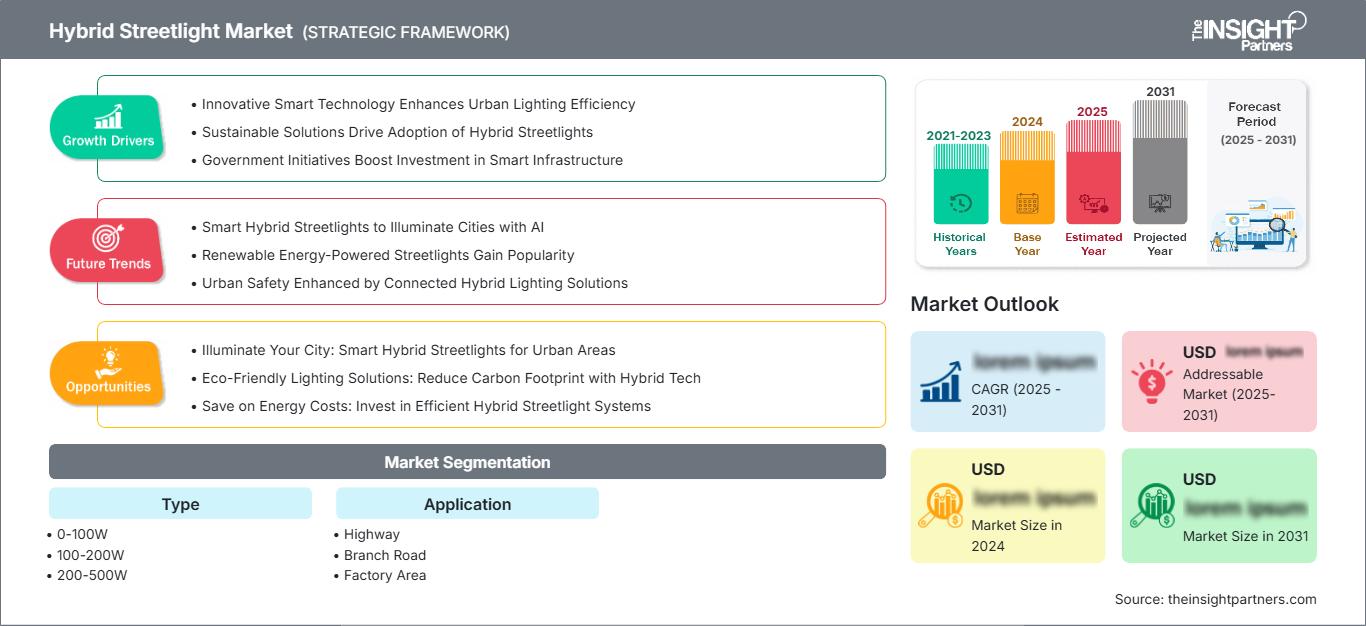
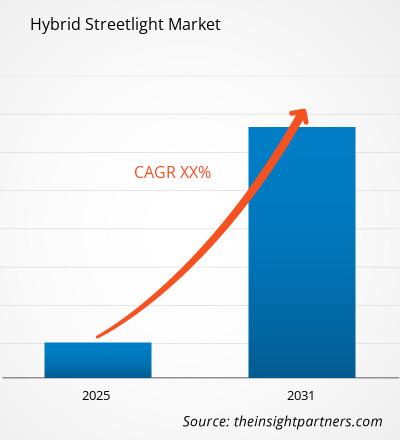
The Hybrid Streetlight Market was valued at US$ 3.67 Billion in 2025 and is projected to reach US$ 6.34 Billion by 2034, expanding at a CAGR of 6.26% from 2026 to 2034. The market is witnessing an increase in the implementation of lighting systems comprising renewable energy generation and storage along with lighting. Market demand is being driven by city-level initiatives for energy efficiency, decentralized power needs, and reliable lighting in areas where the infrastructure is underdeveloped.
In North America, the implementation of such lighting solutions will be driven by city upgrades, resilience, and low operating costs in remote or less-served regions. The Hybrid Streetlight Market Size projections in the region reveal growth at a rate between 5.2% to 5.8% between 2026 and 2034. Growth will be driven by lifecycle economics, battery performance, autonomy, and incorporation with the intelligent city infrastructure.
Hybrid Streetlight Market Assessment and Insights
- North America: North America is expected to represent a 17–21% share in 2025 and grow at a 5.2–5.8% CAGR between 2026–2034, supported by infrastructure renewal, resilience programs, and municipal energy-efficiency initiatives.
- US: The US is estimated to hold 70–74% of North America's 2025 share, with adoption expanding at a 5.3–5.9% CAGR between 2026–2034 through public infrastructure modernization.
- Europe: Europe is projected to account for an 18–22% share in 2025 and expand at a 5.8–6.4% CAGR between 2026–2034, led by Germany, the UK, France, Italy, and Spain through energy-efficiency and sustainable mobility programs.
- Asia Pacific: Asia Pacific is estimated at a 34–38% share in 2025 and is expected to grow at a 7.0–7.8% CAGR between 2026–2034, led by China, India, Japan, South Korea, and Australia.
- Largest Segment: The 0-100W category is expected to command a 48–52% market share in 2025, expanding at a 5.8–6.4% CAGR from 2026–2034.
- High Growth Segment: The 100-200W category is projected to hold a 26–30% market share in 2025 and register a 7.0–7.8% CAGR from 2026–2034, supported by broader roadway applications.
- Key companies analyzed in detail: Eolgreen, Guangzhou HY Energy Technology Co., Ltd., Phono Solar Technology Co., Ltd., Le-tehnika, Shanghai Ghrepower Green Energy Co., Ltd., UGE International Ltd., Best Solar Street Lights, Solar Wind Technologies, Jinhua Sunmaster Lighting Co., Ltd., and Solux.
Source: The Insight Partners' analysis based on proprietary research, government publications, company annual reports, investor presentations, industry databases, and expert interviews.
There has been a shift in the technology basis from simply relying on basic solar luminaires to more complex combinations of solar-powered energy generation, lithium ion battery storage, LEDs that optimize light delivery, charge controllers, movement sensors, and even remote monitoring systems. The product development process is now focusing more on making the lighting devices autonomous, easily servicable, weather-proof, and optimized for illumination.
There is a possibility for future application to include more secondary roads, industrial areas, educational institutions, and public gardens since extending the electrical grids in these areas can be costly. The regulation of energy productivity and lighting efficiency will help in the procurement of these products, and improvement in the technology of battery storage can also ensure that performance in lower levels of solar energy remains consistent. Another possible market is in countries where new roads are being constructed.
Hybrid Streetlight Market Report Scope
| Report Attribute | Details |
|---|---|
| Market size in 2025 | US$ 3.67 Billion |
| Market Size by 2034 | US$ 6.34 Billion |
| Global CAGR (2026 - 2034) | 6.26% |
| Historical Data | 2021-2024 |
| Forecast period | 2026-2034 |
Hybrid Streetlight Market Analysis
The demand is influenced by the municipality attempts to minimize the cost of electricity consumption without compromising illumination. The growth potential in the Hybrid Streetlight Market lies in photovoltaic panels, wind turbines in cases where they can be used, batteries, controllers, LED lamps, poles, sensors, software, and installation service. The role of system integrator becomes important for the interaction between the suppliers and buyers from the public sector, and engineering contractors affect the economics of project design, commissioning and maintenance.
Factors that affect the supply include batteries' chemistry, photovoltaic modules cost, aluminum, electronics, and transportation costs. Modularity allows for faster installation and simpler substitution in case of need, although customized solutions are still needed in the case of highways and industrial zones with increased requirements for illumination.
According to Hybrid Streetlight Market Report, there is a fragmented competition where specialist lighting firms, renewable energy firms, and infrastructure firms are competing for market share. Eolgreen focuses on hybrid lighting products, whereas Guangzhou HY Energy Technology Co., Ltd. and Shanghai Ghrepower Green Energy Co., Ltd. represent the Chinese tradition of solar-lighting manufacturing firms. On the other hand, Phono Solar Technology Co., Ltd. and UGE International Ltd. are involved in photovoltaics and distributed renewable energy respectively.
Product reliability, geographic coverage, customization, and post-sales services will be of increasing importance for strategic positioning in this market. Le-tehnika, Best Solar Street Lights, Solar Wind Technologies, Jinhua Sunmaster Lighting Co., Ltd., and Solux are involved in solar lighting, hybrid power generation, and various application projects. There are increased investments into battery management, diagnostics, adaptive dimming, and standardization of platform to accommodate various pole designs.
● REPORT CUSTOMIZATION
Tailor This Report To Align With Your Specific Business Requirements
This report can be customized to align precisely with your business objectives, scope, and target markets. Customization options include tailored segmentation, geography, competitive analysis, and strategic insights to support informed decision-making.
Customize This Report →WHAT YOU CAN ADJUST
- ● Segmentations
- ● Geography
- ● Competitive Analysis
- ● Language Preferences
Hybrid Streetlight Market: Strategic Insights
Regional Insights
North America Hybrid Streetlight Market
The North American Hybrid Streetlight Market Share is estimated to account for a 17-21% share in 2025, growing at a CAGR of 5.2-5.8% up to 2034. The cities will continue assessing hybrid technologies in cases when extending the grid is cost-ineffective or when resiliency is required. Highway interchanges, parks, university campuses, and remote public assets offer deployment opportunities. Purchasing considerations will include fewer maintenance visits, consistent light, and warranty coverage.
The US will hold 70-74% of the North American market share in 2025, with a CAGR of 5.3-5.9%. The Canadian segment supports the region’s market through their remote community infrastructure and energy resiliency initiatives. Cities consider renewable-powered street lights in smart city initiatives as part of a more extensive effort to build a sustainable future.
U.S. Hybrid Streetlight Market
The US accounts for 70-74% of the 2025 North American share and will grow at a CAGR of 5.3-5.9%. Government agencies, transportation departments, campuses, and private infrastructure owners are looking at hybrid lights for places where expansion from the grid is economically unfeasible. Applications are increasingly including pedestrian paths, parking lots, parks, and road stretches.
Supplier involvement includes dedicated firms specializing in renewable lighting as well as firms specializing in distributed energy. UGE International Ltd. is a renewable energy company which has infrastructure distribution expertise, and Solux is a solar light company. US buyers are increasingly considering battery life, remote control and monitoring, lighting uniformity, cybersecurity in connected equipment, and the ease of replacement.
Europe Hybrid Streetlight Market
In Europe, the market share is estimated at 18–22% with the 5.8–6.4% CAGR in 2025, while Germany is expected to continue being one of the lead countries. In the UK and Germany, efficient public infrastructure is important, while France, Italy, and Spain represent additional market possibilities due to municipal modernization and renewable-energy installations.
UK market relies on energy-management concerns of local authorities and low-maintenance lighting needs. Engineering excellence and municipal sustainability goals are driving forces in the development of efficient outdoor infrastructure in Germany. In France and Italy, there are opportunities related to parks, secondary roads, and public spaces. Favorable solar conditions in Spain make autonomous installations possible. The European buyers usually highly value certification, durability, performance, and economics of solutions.
APAC Hybrid Streetlight Market
The APAC region is forecast to represent a 34–38% share and a 7.0–7.8% CAGR, with China being the market leader. China takes advantage of manufacturing expertise, while India combines growing infrastructure with renewable energy policies. Japan and South Korea focus on efficient urban assets, and Australia offers applications for remote settings.
Industrial growth, rural development, smart cities projects, and renewable energy policies drive adoption in the region. India's public lighting policy shows how effective energy consumption from illumination can bring results; the IEA has pointed to significant demand reduction following mass installation of smart LEDs.
Middle East & Africa Hybrid Streetlight Market
The Middle East & Africa market has the potential due to the development of infrastructure, cost management of energy, and requirement of autonomous lighting systems. The opportunities in the region are led by Saudi Arabia and the United Arab Emirates, which have the advantage of urban and tourist infrastructures, and then come South Africa with potential in municipalities, transport corridors, and public infrastructure.
However, the future outlook of the region will stay strong owing to the fact that with hybrid lighting solutions, the dependency on grid availability can be reduced in certain areas. Saudi Arabia is the leading opportunity in the region, followed by the UAE and South Africa.
Segmentation Analysis
Type
The Type segment encompasses 0-100W, 100-200W, 200-500W, and Above 500W configurations. The segment is projected to expand at a 5.9–6.5% CAGR from 2026–2034, with lower-power systems benefiting from broad deployment across pedestrian areas and secondary roads. Higher-output systems remain important where wider roadways, greater mounting heights, and demanding illumination specifications require larger energy and storage capacities.
- 0-100W: This category serves parks, pathways, branch roads, and smaller public spaces where moderate illumination and compact system dimensions are preferred. Its broad application base supports strong procurement continuity.
- 100-200W: These systems address roadways and larger public areas requiring greater illumination while maintaining manageable solar and battery requirements. Their balance between performance and system cost supports expanding adoption.
- 200-500W: Higher-output installations suit industrial areas, major campuses, and demanding roadway applications. Buyers prioritize lighting uniformity, battery autonomy, structural strength, and reliable operation under variable environmental conditions.
- Above 500W: This category targets specialized high-output applications requiring substantial illumination. System engineering, renewable-generation capacity, storage sizing, and structural considerations become increasingly important in project selection.
Application
The Application segment comprises Highway, Branch Road, Factory Area, Campus Area, and Park Path. It is expected to grow at a 6.4–7.2% CAGR from 2026–2034, reflecting different requirements for illumination, traffic intensity, autonomy, and installation economics. Highway and factory deployments generally require higher output, while campus and park applications favor adaptive lighting, aesthetics, and low-maintenance operation.
- Highway: Highway projects require consistent illumination, durable structures, dependable battery autonomy, and carefully engineered light distribution. Procurement typically evaluates system reliability against traffic safety and long operating cycles.
- Branch Road: Branch roads offer a strong use case where extending electrical distribution may be uneconomic. Hybrid systems can provide autonomous illumination while reducing dependence on underground cabling and local grid availability.
- Factory Area: Industrial facilities can deploy hybrid lighting around internal roads, yards, parking areas, and perimeter zones. Operational continuity, robust enclosures, and illumination control are particularly important.
- Campus Area: Campuses require flexible lighting across roads, pedestrian routes, parking spaces, and shared facilities. Motion sensing and adaptive controls can improve energy management without compromising safety.
- Park Path: Park paths generally favor compact, visually acceptable systems with adaptive illumination. Renewable generation and storage can simplify installation where trenching would disturb landscaping or existing public spaces.
Opportunity Snapshot
| Application | Revenue Contribution | Trend Tag | Adoption Stage |
|---|---|---|---|
| Highway | High | Road Resilience | Scaling |
| Branch Road | High | Grid Independence | Scaling |
| Factory Area | Medium | Yard Lighting | Scaling |
| Campus Area | Medium | Smart Dimming | Scaling |
| Park Path | Medium | Motion Lighting | Mature |
Hybrid Streetlight Market Growth Drivers and Impact Analysis
Rising Demand for Grid-Independent Public Lighting
Growing pressure to provide reliable illumination without proportional expansion of electrical distribution infrastructure is a fundamental driver. Hybrid systems can combine renewable generation and storage to serve locations where trenching, cabling, transformers, or new distribution connections are expensive. This is particularly relevant for branch roads, parks, remote facilities, and developing urban areas. The impact extends beyond equipment sales because project economics include civil works, installation labor, energy consumption, and maintenance visits. Where grid connection costs are high, autonomous lighting can improve project feasibility even when initial equipment expenditure is higher. Public-sector buyers are therefore increasingly evaluating infrastructure on total lifecycle cost rather than acquisition price alone, creating opportunities for suppliers able to demonstrate reliable autonomy, predictable battery replacement requirements, and strong field-service capabilities.
Municipal Energy-Efficiency and Renewable Infrastructure Programs
Energy-efficiency policies are encouraging municipalities to reconsider conventional public-lighting architectures. The IEA has documented programs supporting LED street lighting and smart controls, including India's large-scale deployment that reduced peak electricity demand by more than 1,000 MW. Such precedents strengthen the economic rationale for combining efficient luminaires with renewable generation and storage. The market impact is strongest where authorities can aggregate procurement across multiple roads or public spaces, reducing installation and maintenance costs per unit. Hybrid systems can also support sustainability targets without requiring every lighting point to receive a dedicated grid connection. Suppliers with standardized designs, monitoring capabilities, and documented performance data are better positioned to participate in these programs, particularly when tenders require multi-year warranties and service commitments.
Advances in Battery Storage and Adaptive Lighting Controls
Battery performance is directly linked to the reliability of hybrid lighting because stored energy determines nighttime autonomy during cloudy or low-generation periods. Improvements in lithium-based storage, battery management, charge controllers, and adaptive controls are enabling more precise energy allocation. Motion sensing can reduce output when roads or paths are unoccupied and increase illumination when users are detected, improving the relationship between stored energy and lighting availability. This changes system design from fixed-duration operation toward demand-responsive illumination. The commercial impact includes smaller energy-storage requirements for selected applications, improved nighttime resilience, and greater flexibility in sizing photovoltaic generation. Suppliers that integrate batteries, controls, sensors, and luminaires as a coordinated system can differentiate through operating performance rather than competing solely on fixture pricing.
Hybrid Streetlight Market Future Trends
Adaptive Energy Management and Connected Lighting
Future Hybrid Streetlight Market trends will increasingly center on adaptive energy management, where lighting output, battery state, renewable generation, and occupancy information are coordinated continuously. Connected controllers can identify abnormal battery behavior, reduced photovoltaic performance, or communication failures before these issues become service disruptions. Remote diagnostics should reduce unnecessary maintenance visits, particularly across geographically dispersed municipal assets. Lighting profiles can also vary according to traffic patterns, pedestrian activity, weather conditions, and available stored energy. This approach shifts the value proposition from autonomous illumination toward managed infrastructure. Over time, buyers are likely to favor systems with interoperable communications, open monitoring interfaces, and modular electronics that can be upgraded without replacing the entire luminaire. The resulting architecture should support longer asset lifecycles while enabling municipalities to progressively add intelligence as budgets and connectivity improve.
Modular Platforms for Diverse Road and Public-Space Requirements
Product architecture is likely to become more modular as buyers seek one platform that can serve multiple installation environments. A common pole interface combined with interchangeable photovoltaic modules, batteries, controllers, optics, and mounting arrangements can reduce engineering effort across highway, branch-road, campus, and park projects. This design philosophy can also simplify inventory management for distributors and maintenance contractors. Higher-output configurations may use larger storage and generation modules without requiring a completely different control architecture. Modular products should therefore improve scalability while reducing spare-parts complexity. Manufacturers can further differentiate through configurable light distributions, adjustable mounting geometry, and software-defined operating profiles. As procurement becomes more standardized, compatibility with existing poles, installation practices, and maintenance procedures could become a significant purchasing criterion alongside energy performance and initial system cost.
Hybrid Streetlight Market Opportunities
Integrated Lighting Projects in Underserved Infrastructure Corridors
The Hybrid Streetlight Market Forecasts point toward opportunities in corridors where road development is advancing faster than electrical distribution. Suppliers can target municipalities, industrial developers, logistics zones, campuses, and rural authorities requiring illumination without extensive grid construction. Investment strategies should focus on complete project packages rather than individual luminaires, combining site assessment, solar-resource analysis, battery sizing, structural engineering, installation, commissioning, and maintenance. Public-private partnership models can further reduce upfront pressure on municipal budgets when long-term service arrangements are acceptable. Vendors with local installation networks can improve project execution and reduce response times. Particularly attractive opportunities exist where lighting requirements are distributed across many smaller sites, because standardized hybrid platforms can reduce engineering costs. Successful expansion will depend on demonstrating measurable lifecycle savings and reliable performance rather than relying solely on renewable-energy positioning.
Battery Lifecycle Services and Remote Asset Management
Another opportunity lies in extending the commercial model beyond initial installation through battery lifecycle management, remote monitoring, predictive maintenance, and performance optimization. Battery degradation remains a key determinant of long-term economics, making health monitoring valuable for municipalities managing large fleets of lighting assets. Suppliers can develop service contracts that combine periodic inspection with remote alerts for low state of charge, abnormal charging behavior, communication failures, and declining photovoltaic output. Such services can create recurring revenue while improving system availability for customers. The opportunity is particularly relevant in large public-lighting networks where manual inspection of every installation is expensive. Companies can strengthen differentiation by providing asset dashboards, maintenance histories, replacement planning, and energy-performance reports. This service-oriented model can also support future upgrades without requiring complete luminaire replacement.
Recent Developments
- September 2025: Signify (Euronext: LIGHT), the world leader in lighting, introduces four new products – the Signify SunStay Pro gen2 and SunStay Pro gen2 mini, Signify GreenVision Xceed Pro and Signify Actistar - highlighting the company's advances in solar and modular streetlighting as well as performance lighting for stadiums.
- March 2025: Atlas Copco has launched the second generation of solar powered light towers, the HiLight MS 4 and MS 5, a groundbreaking development in their commitment to providing the market with efficient, safe, and dependable lighting solutions for operators in a wide range of applications from events to oil and gas, construction, and mining.
- May 2024: Vedanta Aluminium, India’s largest aluminium producer, has installed 100 solar-powered streetlights along a 6 km stretch in and around the remote villages of Jamkhani, Girisma, Munderkhet, Jharpalam, and Hemgir in Sundargarh district, Odisha. This initiative marks a crucial move towards community empowerment, providing a reliable and eco-friendly solution for lighting in areas where access to electricity has been limited. The installation of solar-powered streetlights will not only enhance nighttime visibility but also ensure safer journeys for all individuals navigating through the region, thereby improving the overall quality of life in the community.
Frequently Asked Questions

- Comprehensive Market Sizing and Forecast Analysis
- Detailed Segmentation Analysis
- In-Depth Market Dynamics Assessment
- Regional and Country-Level Insights
- Competitive Landscape and Company Benchmarking
- Strategic Business Intelligence
Recent Reports
Testimonials

The Insight Partners' SCADA System Market report is comprehensive, with valuable insights on current trends and future forecasts. The team was highly professional, responsive, and supportive throughout. We are very satisfied and highly recommend their services.
RAN KEDEM Partner, Reali Technologies LTDs
I requested a report on a very specific software market and the team produced the report in a few days. The information was very relevant and well presented. I then requested some changes and additions to the report. The team was again very responsive and I got the final report in less than a week.
JEAN-HERVE JENN Chairman, Future Analytica
We worked with The Insight Partners for an important market study and forecast. They gave us clear insights into opportunities and risks, which helped shape our plans. Their research was easy to use and based on solid data. It helped us make smart, confident decisions. We highly recommend them.
PIYUSH NAGPAL Sr. Vice President, High Beam Global
The Insight Partners delivered insightful, well-structured market research with strong domain expertise. Their team was professional and responsive throughout. The user-friendly website made accessing industry reports seamless. We highly recommend them for reliable, high-quality research services
YUKIHIKO ADACHI CEO, Deep Blue, LLC.
This is the first time I have purchased a market report from The Insight Partners.While I was unsure at first, I visited their web site and felt more comfortable to take the risk and purchase a market report.I am completely satisfied with the quality of the report and customer service. I had several questions and comments with the initial report, but after a couple of dialogs over email with their analyst I believe I have a report that I can use as input to our strategic planning process.Thank you so much for taking the extra time and making this a positive experience.I will definitely recommend your service to others and you will be my first call when we need further market data.
JOHN SUZUKI President and Chief Executive Officer, Board Director, BK Technologies
I wish to appreciate your support and the professionalism you displayed in the course of attending to my request for information regarding to infectious disease IVD market in Nigeria. I appreciate your patience, your guidance, and the fact that you were willing to offer a discount, which eventually made it possible for us to close a deal. I look forward to engaging The Insight Partners in the future, all thanks to the impression you have created in me as a result of this first encounter.
DR CHIJIOKE ONYIA MANAGING DIRECTOR, PineCrest Healthcare Ltd.Reason to Buy
- Informed Decision-Making
- Understanding Market Dynamics
- Competitive Analysis
- Identifying Emerging Markets
- Customer Insights
- Market Forecasts
- Risk Mitigation
- Boosting Operational Efficiency
- Strategic Planning
- Investment Justification
- Tracking Industry Innovations
- Aligning with Regulatory Trends





 Get Free Sample for