
Hydraulic Power Unit Market Size, Share & Forecast by 2034
Coverage: by Component (Power, control, and auxilary); Pressure Rating (0-750 PSI, 750-2000 PSI, 2000-3000 PSI, >3000 PSI); and Application (Industrial Application, Mobile Market, Construction Industry, Machining Industry, Infrastructure Industry and Others), and Geography (North America, Europe, Asia Pacific, and South and Central America)
- Status : Data Released
- Report Code : TIPTE100001353
- Category : Manufacturing and Construction
- No. of Pages : 150
- Available Report Formats :


- Last update date : September 07, 2026


2025 Market Size
US$ 14.07 Bn
Base year value
2034 Forecast
US$ 23.04 Bn
Projected by 2034
CAGR 2026-2034
5.64 %
Growth rate
Addressable Market
US$ 168.28 Bn
(2026-2034)
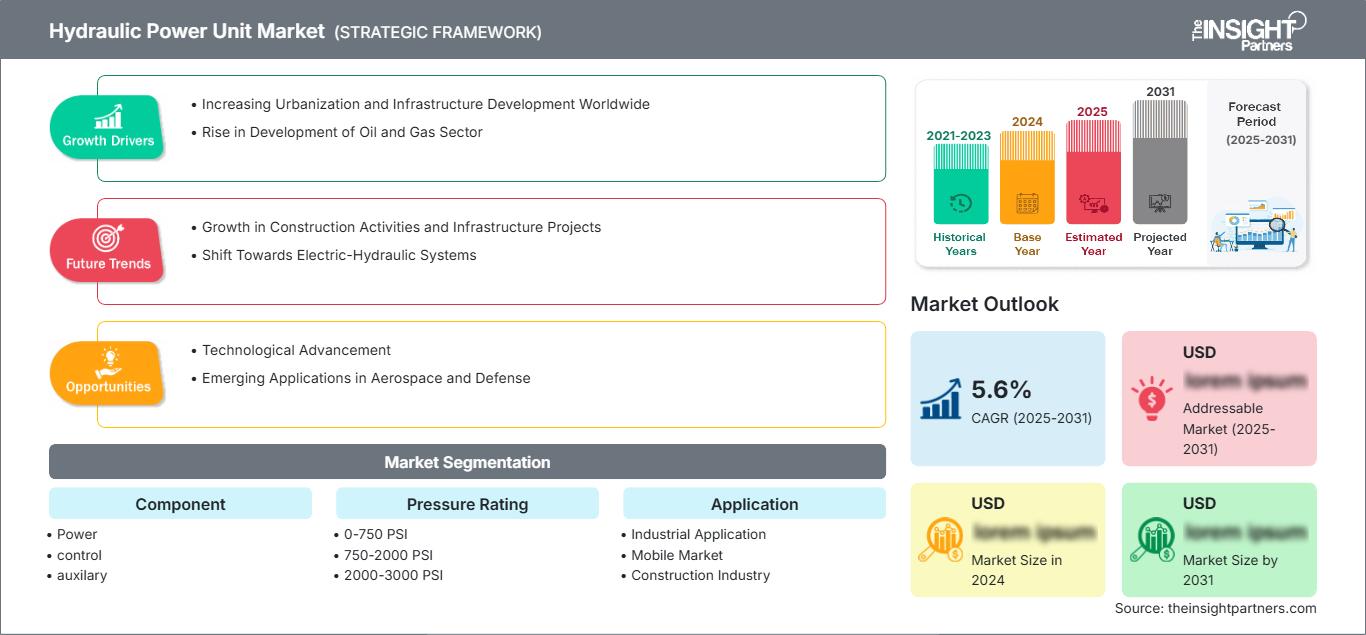
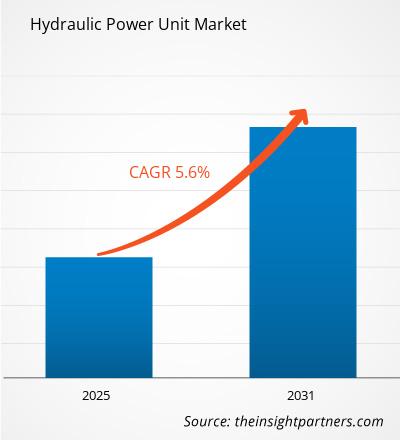
The hydraulic power unit market was valued at US$ 14.07 Billion in 2025 and is projected to reach US$ 23.04 Billion by 2034, expanding at a CAGR of 5.64% during 2026–2034. Demand reflects the continuing need for concentrated, controllable power in manufacturing systems, mobile equipment, construction machinery, machining operations, and infrastructure assets, where hydraulic actuation retains advantages in force density, durability, and dependable performance under demanding operating conditions.
Across North America, the hydraulic power unit market size is expected to advance at a modelled 5.4–5.8% CAGR through 2034. Replacement of aging factory assets and sustained spending on transportation, water, energy, and logistics infrastructure support demand. Buyers increasingly specify variable-speed drives, compact reservoirs, quieter operation, and connected condition monitoring, linking procurement decisions to measurable energy savings, reduced downtime, and easier compliance with workplace safety requirements.
Hydraulic Power Unit Market Assessment and Insights
- North America – The region represented an estimated 25–28% share in 2025 and is expected to grow at a 5.4–5.8% CAGR during 2026–2034, supported by factory modernization and infrastructure renewal.
- US – The country generated 80–84% of North American revenue in 2025 and is projected to expand at a 5.5–5.9% CAGR during 2026–2034.
- Europe – Europe accounted for an estimated 24–27% share in 2025 and should expand at a 4.8–5.2% CAGR during 2026–2034, led by Germany, the UK, Italy, France, and Spain.
- Asia Pacific – APAC held an estimated 39–42% share in 2025 and is forecast to grow at a 6.0–6.4% CAGR during 2026–2034, led by China, Japan, India, and South Korea.
- Largest Segment – Industrial Application represented an estimated 44–48% market share in 2025 and is projected to expand at a 5.3–5.7% CAGR during 2026–2034.
- High Growth Segment – The >3000 PSI category held an estimated 12–15% market share in 2025 and should grow at a 6.2–6.6% CAGR during 2026–2034.
- Key companies analyzed in detail: Bosch Rexroth AG, Dana Incorporated, Hydro-Tek Co., Ltd., HCS Control Systems Ltd., Bailey International, LLC, Shanghai Mocen Fluid Power Co., Ltd., Parker-Hannifin Corporation, Eaton Corporation plc, HYDAC International GmbH, and NACHI-FUJIKOSHI CORP.
Source: The Insight Partners' analysis based on proprietary research, government publications, company annual reports, investor presentations, industry databases, and expert interviews.
Product evolution is moving hydraulic power units from fixed-speed oversized units to compact variable-speed units with sensors, drives, filtration, cooling, and interfaces. Manufacturers are standardizing modular platforms while retaining application-specific manifolds and controls, saving time in engineering without compromising on duty cycle. Cost economics are driving configurability, regional assembly, and common electronics, along with demand-based pumping, which results in reduced heat generation, reduced reservoir size, reduced oil requirement, reduced sound level, and reduced energy usage during the lifecycle.
Investment in product development up to 2034 must be made in Asian manufacturing corridors, North American infrastructure initiatives, and Middle Eastern construction and energy projects. Increasing electrification and stringent efficiency requirements will push towards servo-based and inverter-based systems, whereas safety regulations will call for better diagnostics and cleaner fluids. Suppliers who can provide engineering in the region, rapid configuration, after-sales service, and compatible control systems will be able to grab market share without falling into the trap of price competition.
Hydraulic Power Unit Market Report Scope
| Report Attribute | Details |
|---|---|
| Market size in 2025 | US$ 14.07 Billion |
| Market Size by 2034 | US$ 23.04 Billion |
| Global CAGR (2026 - 2034) | 5.64% |
| Historical Data | 2021-2024 |
| Forecast period | 2026-2034 |
Hydraulic Power Unit Market Analysis
The Hydraulic Power Unit Market growth rests upon applications that still have difficulty replacing high force, shock resistance, control and compact power transfer economically. Manufacturing presses, injection molding machines, machine tools, lifts, cranes, and mobile equipment create recurring demand in the original equipment and replacement markets. Automation adds value to pressure repeatability, flow control, and machine diagnostics.
The ecosystem encompasses pump, motor, valve, reservoir, filtration, cooling, sensing, drive, and control vendors, system integrators, distributors, OEMs, and service companies. Steel, aluminum, copper, electric drives, seals, and machined parts impact cost and lead time. Platform standardization adds scale, but custom duty cycles and certifications ensure engineering intensity and localization in manufacturing and service inventories.
Hydraulic power unit market research finds a moderately fragmented market. Bosch Rexroth AG, Parker-Hannifin Corporation, Eaton Corporation plc, and HYDAC International GmbH compete by offering wide component ranges, controls capabilities, global service and configurable platforms. Dana Incorporated and NACHI-FUJIKOSHI CORP. contribute with motion control experience, while niche vendors compete with compact and customized products.
Increasing investments are being made in variable speed drives, connected monitoring, modular manifolds, thermal efficiency, and engineering software that reduces configuration time. Hydro-Tek Co., Ltd., HCS Control Systems Ltd., Bailey International, LLC, and Shanghai Mocen Fluid Power Co., Ltd. might distinguish themselves through responsiveness, product packaging and application support. Strategic position will be defined more and more by proven energy savings, availability, cyber security interfaces, and reliable aftermarkets.
● REPORT CUSTOMIZATION
Tailor This Report To Align With Your Specific Business Requirements
This report can be customized to align precisely with your business objectives, scope, and target markets. Customization options include tailored segmentation, geography, competitive analysis, and strategic insights to support informed decision-making.
Customize This Report →WHAT YOU CAN ADJUST
- ● Segmentations
- ● Geography
- ● Competitive Analysis
- ● Language Preferences
Hydraulic Power Unit Market: Strategic Insights
Regional Insights
North America hydraulic power unit market
North America’s hydraulic power unit market share is estimated at 25–28% in 2025, with a 5.4–5.8% CAGR projected for 2026–2034. The need for demand is justified through automation in manufacturing and warehouses, fleet of trucks in construction, oil and gas sector, aerospace manufacturing, and modernization of waterways and transportation systems. The high cost of labor makes a good case for miniaturized and sensor-equipped machines, which minimize the need for maintenance and unexpected machine failures.
Local companies enjoy the advantage of dense distribution and quick replacement, field support, and application engineering needs. Energy-efficient variable speed machines are being considered as there are idle duty cycles involved. The compliance with standards in terms of electrical and machinery safety makes it easier to choose pre-engineered solutions, whose components are known.
U.S. Hydraulic Power Unit Market
The U.S. accounts for an estimated 80–84% of North American revenue in 2025 and is expected to register a 5.5–5.9% CAGR through 2034. The market grows due to industrial reshoring, semiconductor fabrication facilities, battery manufacturing plants, logistics automation, government-sponsored transportation and water infrastructure projects. Machine builders are increasingly looking for power packs that can easily be set up to serve press, lift, work holding, forming and material handling applications.
Commercial access is maintained by Bosch Rexroth AG, Parker-Hannifin Corporation, Eaton Corporation plc, HYDAC International GmbH, Bailey International, LLC, and specialized integration firms. The customers value compliance with the UL requirements, quick deliveries, field serviceable parts, and remote monitoring options. The key application sectors include mobile machinery, construction machines, aerospace support equipment, and factory automation, where the aftersales business helps counter cyclical capital investments.
Europe Hydraulic Power Unit Market
Europe represented an estimated 24–27% share in 2025 and is projected to expand at a 4.8–5.2% CAGR during 2026–2034. Germany is at the fore in terms of machine tools, automotive machinery, presses, and factory automation. The United Kingdom includes its aerospace, offshore, and mobile machinery needs and is strict with its requirements regarding efficiency, noise reduction, and safety of machinery, which means that variable speed drives, small reservoirs, and maintenance connectivity are preferable.
France brings in aerospace, transportation, energy production, and process industry applications; Italy continues to be relevant in terms of packaging, plastics, metalworking, and special machinery; and Spain takes advantage of its infrastructure, renewable energy, and industrial renewal projects. In European purchasing, considerations include total energy consumption, acoustics, hydraulic fluid management, and maintenance together with cost.
APAC Hydraulic Power Unit Market
APAC held an estimated 39–42% share in 2025 and should grow at a 6.0–6.4% CAGR through 2034. China leads through machinery output, infrastructure, shipbuilding, and factory investment; Japan and South Korea emphasize high-precision, energy-efficient systems.
India’s manufacturing and construction expansion broadens mobile and industrial demand, while Australia supports mining, ports, and infrastructure applications. Industrial policy, automation incentives, localization, and urban investment encourage regional production, but price competition makes modular design and lifecycle service important differentiators.
Middle East & Africa Hydraulic Power Unit Market
MEA is projected to grow at a 5.1–5.5% CAGR during 2026–2034. Saudi Arabia leads through industrial diversification, construction, mining, and energy investment, while the UAE supports ports, logistics, aviation, utilities, and building projects.
South Africa provides mining, processing, and infrastructure demand, and the Rest of MEA offers selective opportunities in oil and gas, water, and transport. Harsh environments increase the value of robust filtration, cooling, corrosion protection, and accessible service.
Segmentation Analysis
Pressure Rating
Pressure Rating is projected to record a 5.5–5.9% CAGR during 2026–2034. The hydraulic power unit market scope spans low-pressure auxiliary functions through high-force forming, lifting, and mobile duties. Selection balances required force, flow, duty cycle, heat rejection, component life, and safety margin. Mid-pressure systems remain broadly applicable, while high-pressure packages gain strategic value where footprint and force density outweigh higher component and maintenance requirements.
- 0-750 PSI – Demand centers on light-duty clamping, lubrication, doors, small lifts, test equipment, and auxiliary functions where simplicity, cost control, and compact packaging outweigh extreme force density.
- 750-2000 PSI – This range serves general industrial machinery, material handling, agricultural systems, and moderate-duty mobile applications, balancing component availability, controllability, efficiency, and service familiarity.
- 2000-3000 PSI – Broad adoption in machine tools, presses, construction equipment, and manufacturing automation reflects strong force capability, standardized components, and suitability for continuous or demanding duty cycles.
- >3000 PSI – High-pressure units support space-constrained, heavy-load, and specialized operations, making filtration, sealing, thermal control, safety engineering, and condition monitoring central to lifecycle performance.
Application
Application is expected to expand at a 5.4–5.8% CAGR during 2026–2034. Industrial installations lead because presses, molding machines, production cells, and material handling assets need reliable centralized or dedicated power. Mobile and construction uses add cyclic but substantial equipment demand, while machining and infrastructure projects reward compactness, low noise, controllability, and predictive maintenance. Suppliers increasingly tailor reservoirs, cooling, filtration, and control logic to distinct duty profiles.
- Industrial Application – The largest demand pool spans presses, plastics machinery, assembly equipment, and process lines, prioritizing uptime, energy efficiency, low noise, repeatability, and serviceable modular architecture.
- Mobile Market – Compact DC and engine-driven units power lifts, work trucks, agricultural equipment, and specialty vehicles, where vibration resistance, weather protection, battery efficiency, and low weight matter.
- Construction Industry – Cranes, access platforms, concrete systems, tunneling equipment, and site machinery require rugged packages with high power density, contamination control, thermal stability, and responsive field support.
- Machining Industry – Machine tools use hydraulic power for clamping, tool changing, balancing, and workholding, encouraging quiet variable-speed units with tight pressure control and factory-network connectivity.
- Infrastructure Industry – Bridges, ports, rail systems, water facilities, gates, and renewable-energy assets create project-led demand for durable, corrosion-resistant units designed for long service intervals.
Opportunity Snapshot
| Application | Revenue Contribution | Trend Tag | Adoption Stage |
| Industrial Application | High | Smart Factories | Mature |
| Mobile Market | High | Fleet Electrification | Scaling |
| Construction Industry | High | Urban Infrastructure | Mature |
| Machining Industry | Medium | Precision Clamping | Scaling |
| Infrastructure Industry | Medium | Asset Renewal | Scaling |
| Others | Low | Specialized Systems | Emerging |
Hydraulic Power Unit Market Growth Drivers and Impact Analysis
Factory Automation and Equipment Modernization
Presses, molding machines, metal cutting cells, and material handling systems are being upgraded for higher efficiency, reliability, and labor productivity. Power units continue to find useful applications wherever heavy forces and load-holding capacity are required; however, modernization alters the buying criteria. The demands of end users now include speed control capability, electronically-based control, lower sound level, cleaner heat management, and machine networking. Such needs raise the average system cost, but also offer a chance for a retrofit upgrade for old installations. Additionally, it turns supplier rivalry into more measurable performance results, like less idle consumption, fewer failures due to temperatures, and quick troubleshooting of faults. Integration expertise in the fields of hydraulic and electronics, along with maintenance services, wins a bigger budget slice for integrators.
Infrastructure and Heavy Equipment Investment
The transport, water, ports, energy, mining, and urban development infrastructure project calls for cranes, access platforms, tunneling machinery, concrete machinery, gates, and mobile services equipment. The operations of such equipment call for small compact power units that are capable of producing a controllable power output in varying conditions. Public and private multi-year projects will generate demand for the original equipment, as well as increasing the number of installed filtration and sealing systems, pumps, valves, and packs. Increasingly, project owners require corrosion resistance, fluid cleaning, temperature resistance, and remote monitoring capabilities in order to increase service intervals. The influence of the market is not only related to equipment, since harsh-duty designs involve more engineering.
Demand for Higher Energy and Power Density
Productive machinery must be made available in smaller footprints to industrial and mobile designers, while higher costs of energy and cooling affect plants. The hydraulic units solve the force density problem, but there are losses of energy due to throttling and excess flow in traditional fixed-speed systems. The demand-driven solution, improved combinations of motors and pumps, smaller tanks and integrated thermal management help overcome the problem. Energy savings of up to 80% have been achieved in certain connected power unit solutions by Bosch Rexroth, which demonstrates the potential of the approach. There will be less noise and smaller amounts of oil as additional advantages. The consequence of the trend is the shift from capital cost minimization to total cost consideration.
Hydraulic Power Unit Market Future Trends
Connected Fluid Power Becomes a Standard Machine Node
The hydraulic power unit market trends increasingly point to native connectivity rather than add-on monitoring. Future units will combine pressure, temperature, fluid level, filter condition, vibration, and drive data in standardized machine interfaces. Analytics will move from alarm reporting toward remaining-life estimates, automatic operating-point adjustment, and service planning across fleets. Cybersecurity, data ownership, and interoperability will therefore become procurement criteria alongside pressure and flow. Suppliers that expose usable data without locking customers into inflexible platforms can integrate more readily with industrial software. This transition should expand software, commissioning, and subscription revenue while improving component design through anonymized duty-cycle insight.
Electro-Hydraulic Architectures Gain Ground
Electrification will not eliminate hydraulics where high force and ruggedness dominate; instead, it will reshape power generation and control. Servo motors, variable-frequency drives, bidirectional pumps, accumulators, and distributed compact units will reduce throttling losses and simplify machine architecture. Mobile equipment will increasingly pair battery systems with efficient hydraulic actuation, making standby consumption, thermal load, and regenerative capability critical. Industrial users will favor plug-and-produce packages that reduce cabinet space and commissioning time. Over the forecast period, these hybrid designs should blur boundaries between hydraulic, electrical, and automation suppliers, encouraging partnerships and modular interfaces.
Hydraulic Power Unit Market Opportunities
Retrofit Packages for Aging Industrial Assets
The installed base of fixed-speed units creates a scalable retrofit opportunity. Investors and suppliers can target presses, molding machines, test rigs, and material-handling systems with standardized upgrade kits combining variable-speed drives, sensors, filtration, and control software. The hydraulic power unit market forecasts support service-led models because replacements can be prioritized by duty cycle, energy intensity, and downtime exposure. Successful programs require site audits, baseline measurement, compatibility engineering, and verified post-installation savings. Channel partners can bundle financing, installation, and preventive maintenance, reducing customer capital barriers. A modular retrofit portfolio also shortens sales cycles and turns fragmented aftermarket demand into repeatable revenue.
Localized Platforms for High-Growth Industrial Corridors
Manufacturing expansion in India, Southeast Asia, the Middle East, and selected African markets creates room for locally assembled, application-ready platforms. Companies can establish reservoir fabrication, manifold machining, panel integration, and test capability near customers while sourcing critical pumps, valves, and drives globally. The approach reduces freight, lead time, and import exposure without sacrificing performance consistency. Investment should prioritize configurable bills of material, technician training, spare-parts stocking, and digital engineering support. Partnerships with mobile-equipment OEMs, machine builders, and infrastructure contractors provide predictable project pipelines. Local certification knowledge and climate-adapted cooling, filtration, and corrosion protection can strengthen margins.
Recent Developments
- July 2025: Bosch Rexroth AG – Introduced the second-generation CytroPac 2X compact hydraulic power unit with interchangeable function modules, integrated sensors, Ethernet connectivity, status indication, and an optimized motor-pump combination. The company stated that selected configurations can save up to 80% of energy compared with conventional small units of equivalent output.
- March 2025: HYDAC International GmbH – Presented smart compact power units for electrified machines, linking hydraulic actuation with efficiency-focused electric architectures. The development addressed mobile-machine priorities including reduced energy consumption, compact packaging, and application-specific integration, supporting wider adoption in construction, lifting, and material-handling equipment.
Frequently Asked Questions

- Comprehensive Market Sizing and Forecast Analysis
- Detailed Segmentation Analysis
- In-Depth Market Dynamics Assessment
- Regional and Country-Level Insights
- Competitive Landscape and Company Benchmarking
- Strategic Business Intelligence
Recent Reports
Testimonials

The Insight Partners provided valuable market intelligence that supported our global go-to-market strategy. Their team was professional, responsive, and attentive to our feedback, providing thoughtful analysis and helpful methodological clarifications throughout the project.
Junmo Kim Chief Financial Officer (CFO), Enertech Co., Ltd.
The Insight Partners' SCADA System Market report is comprehensive, with valuable insights on current trends and future forecasts. The team was highly professional, responsive, and supportive throughout. We are very satisfied and highly recommend their services.
RAN KEDEM Partner, Reali Technologies LTDs
I requested a report on a very specific software market and the team produced the report in a few days. The information was very relevant and well presented. I then requested some changes and additions to the report. The team was again very responsive and I got the final report in less than a week.
JEAN-HERVE JENN Chairman, Future Analytica
We worked with The Insight Partners for an important market study and forecast. They gave us clear insights into opportunities and risks, which helped shape our plans. Their research was easy to use and based on solid data. It helped us make smart, confident decisions. We highly recommend them.
PIYUSH NAGPAL Sr. Vice President, High Beam Global
The Insight Partners delivered insightful, well-structured market research with strong domain expertise. Their team was professional and responsive throughout. The user-friendly website made accessing industry reports seamless. We highly recommend them for reliable, high-quality research services
YUKIHIKO ADACHI CEO, Deep Blue, LLC.
This is the first time I have purchased a market report from The Insight Partners.While I was unsure at first, I visited their web site and felt more comfortable to take the risk and purchase a market report.I am completely satisfied with the quality of the report and customer service. I had several questions and comments with the initial report, but after a couple of dialogs over email with their analyst I believe I have a report that I can use as input to our strategic planning process.Thank you so much for taking the extra time and making this a positive experience.I will definitely recommend your service to others and you will be my first call when we need further market data.
JOHN SUZUKI President and Chief Executive Officer, Board Director, BK Technologies
I wish to appreciate your support and the professionalism you displayed in the course of attending to my request for information regarding to infectious disease IVD market in Nigeria. I appreciate your patience, your guidance, and the fact that you were willing to offer a discount, which eventually made it possible for us to close a deal. I look forward to engaging The Insight Partners in the future, all thanks to the impression you have created in me as a result of this first encounter.
DR CHIJIOKE ONYIA MANAGING DIRECTOR, PineCrest Healthcare Ltd.Reason to Buy
- Informed Decision-Making
- Understanding Market Dynamics
- Competitive Analysis
- Identifying Emerging Markets
- Customer Insights
- Market Forecasts
- Risk Mitigation
- Boosting Operational Efficiency
- Strategic Planning
- Investment Justification
- Tracking Industry Innovations
- Aligning with Regulatory Trends





 Get Free Sample for