
Hygienic Pressure Transmitters Market Growth, Trends & Forecast by 2034
Coverage: by Type (Flange Type, M27 — 2 Type, Other); Application (Food and Beverage, Pulp and Paper, Pharmaceuticals, Cosmetics and Bio-related, Chemical and Metals, Oil and Gas, Other) , and Geography (North America, Europe, Asia Pacific, and South and Central America)
- Status : Data Released
- Report Code : TIPRE00010541
- Category : Electronics and Semiconductor
- No. of Pages : 150
- Available Report Formats :


- Last update date : September 17, 2026


2025 Market Size
US$ 1.30 Bn
Base year value
2034 Forecast
US$ 2.08 Bn
Projected by 2034
CAGR 2026-2034
5.36 %
Growth rate
Addressable Market
US$ 15.33 Bn
(2026-2034)
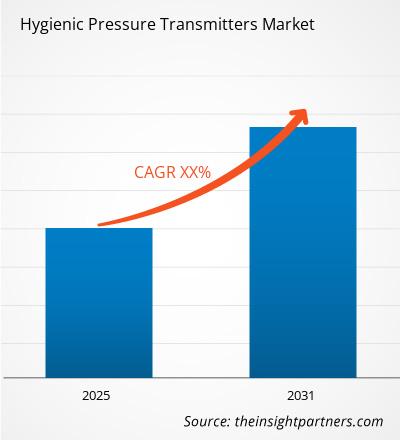
The Hygienic Pressure Transmitters Market is valued at US$ 1.30 Billion in 2025 and is projected to reach US$ 2.08 Billion by 2034, expanding at a CAGR of 5.36% from 2026 to 2034. This segment includes pressure measuring products that have been designed to cater to sanitary processing systems, where cleanliness, compatibility, integrity of processes, and pressure regulation are essential in the manufacture of foods, medicines, biotech products, cosmetics, and other similar products.
North America’s Hygienic Pressure Transmitters Market Size growth is driven by modernization of the food and pharmaceutical manufacturing industry, stringent process validation processes, and adoption of digital devices. The region is expected to register a CAGR of 5.7–6.2% during 2026-2034 owing to the need for upgrading the existing transmitter technology and automation of processes.
Hygienic Pressure Transmitters Market Assessment and Insights
- North America: North America is expected to hold a 27–29% share in 2025 and grow at a CAGR of 5.7–6.2% between 2026 and 2034, supported by pharmaceutical modernization, food safety controls, and automated process measurement.
- US: The US is estimated to represent 70–74% of North American demand in 2025 and expand at a CAGR of 5.8–6.3% through 2034, led by pharmaceutical and food processing installations.
- Europe: Europe is projected to account for 25–27% share in 2025 and grow at a CAGR of 5.1–5.6% through 2034, with Germany, the UK, France, Italy, and Spain providing substantial hygienic instrumentation demand.
- Asia Pacific: Asia Pacific is estimated at 36–38% share in 2025 and is projected to grow at a CAGR of 6.1–6.7% through 2034, led by China, Japan, South Korea, India, and Australia.
- Largest Segment: Flange Type is assessed at a 44–48% market share in 2025, expanding at a CAGR of 5.4–5.9% as standardized sanitary connections support broad process integration.
- High Growth Segment: Pharmaceuticals is estimated at a 17–21% market share in 2025 and is projected to grow at a CAGR of 6.2–6.8%, reflecting stringent contamination controls.
- Key companies analyzed in detail: Dwyer Instruments, Inc.; Emerson Electric Co.; ESI Technology Ltd.; Hitachi High-Tech Corporation; Honeywell International Inc.; NAGANO KEIKI CO., LTD.; OMEGA Engineering, Inc.; Siemens AG; Viatran Corporation; WIKA Group.
Source: The Insight Partners' analysis based on proprietary research, government publications, company annual reports, investor presentations, industry databases, and expert interviews.
From simple analog pressure sensors, technology has grown into sophisticated pressure transmitters that feature diagnostic abilities, configurable communication, enhanced temperature compensation, and sanitary connection technology. Manufacturers are employing stainless steel material, flush diaphragm, and minimization of dead space to allow for frequent cleaning of their products. Compatibility with Clean-In-Place (CIP) and Steam-In-Place (SIP) processes has been incorporated by manufacturers as a realistic design consideration.
Future markets will increasingly involve the production of biopharmaceutical products, pure foods, specialty chemicals, and new manufacturing sites in Asia. The increasing emphasis in the regulatory world on traceability, contamination prevention, validation, and cleanability will generate replacement demand. Future capital expenditures for modular manufacturing facilities will increasingly favor standardized pressure transmitters.
Hygienic Pressure Transmitters Market Report Scope
| Report Attribute | Details |
|---|---|
| Market size in 2025 | US$ 1.30 Billion |
| Market Size by 2034 | US$ 2.08 Billion |
| Global CAGR (2026 - 2034) | 5.36% |
| Historical Data | 2021-2024 |
| Forecast period | 2026-2034 |
Hygienic Pressure Transmitters Market Analysis
Demand is heavily influenced by production processes where pressure sensing needs to coexist with hygiene control requirements. Consequently, the Hygienic Pressure Transmitters Market growth is affected by the expansion of pharmaceutical capacity, automation in food & beverage industries, and closed process systems. The value chain includes sensing components, wetted materials, diaphragm, sanitary process connections, electronics, calibration, certification, integration, and after-sales support.
Supply depends on precision machining capability, stainless steel machining, sensors, electronics procurement, and qualification capabilities. Suppliers who can ensure surface finish and dimensions repeatability are well placed to serve applications which require frequent cleaning and sterilization. Instrument selection today is based on lifecycle costs and not just on initial cost because calibration stability, cleanability, down time, and replacement intervals all impact plant profitability.
The competition comprises multinationals that automate instrument companies and pressure instrument companies. According to the Hygienic Pressure Transmitters Market Report, key points of differentiation include hygienic certification, process connections by applications, diagnostics, digital communication, and stringent pharmaceutical process applications. Competition from Emerson Electric Co., Siemens AG, Honeywell International Inc., and WIKA Group is in a wide range of instruments whereas Dwyer Instruments, Inc., ESI Technology Ltd., NAGANO KEIKI CO., LTD., OMEGA Engineering, Inc., and Viatran Corporation manufacture pressure instrument products.
Key investment points are digital connectivity, diagnostics, application engineering, and regional technical support. Hygienic design from WIKA Group allows for clean in place (CIP) and sterile in place (SIP) functions. Emerson Electric Co. manufactures pressure measurement instrumentation in its product range of automation solutions whereas Siemens AG markets hygienic transmitters in process control architecture. Specialists compete on configurability whereas Hitachi High-Tech Corporation comes into play when precise measurements are in manufacturing and analysis processes.
● REPORT CUSTOMIZATION
Tailor This Report To Align With Your Specific Business Requirements
This report can be customized to align precisely with your business objectives, scope, and target markets. Customization options include tailored segmentation, geography, competitive analysis, and strategic insights to support informed decision-making.
Customize This Report →WHAT YOU CAN ADJUST
- ● Segmentations
- ● Geography
- ● Competitive Analysis
- ● Language Preferences
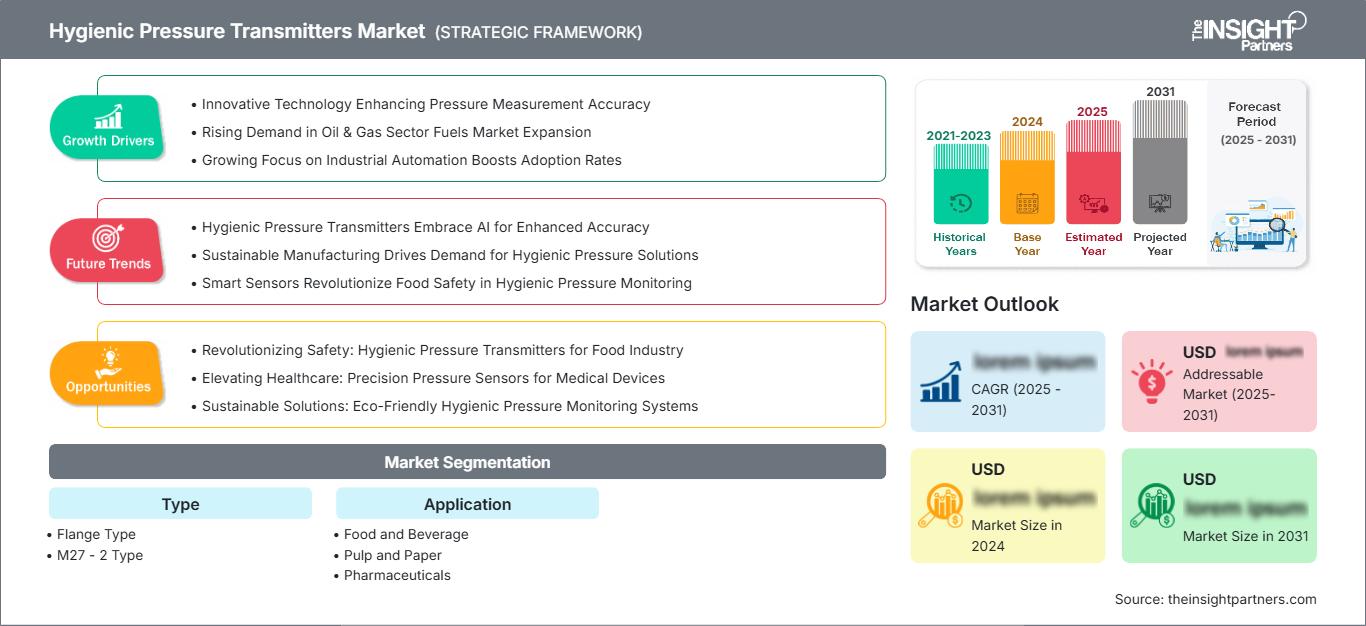
Hygienic Pressure Transmitters Market: Strategic Insights
Regional Insights
North America Hygienic Pressure Transmitters Market
North America is expected to account for a 27-29% of the Hygienic Pressure Transmitters Market share in 2025, registering a CAGR of 5.7-6.2% from 2025 through 2034. The US leads regional demand, whereas Canada provides its contribution in terms of food processing, beverages, pharmaceuticals, and specialty chemicals production. Drivers include replacements of old equipment and investments in automation of sanitary production facilities.
Flush diaphragms, stainless steel wetted parts, and hygienic process connections are becoming more and more demanded due to higher rates of cleaning required. Measurement accuracy and documentation in the case of pharmaceutical production facilities and wash down capabilities in case of food production facilities drive the regional growth.
U.S. Hygienic Pressure Transmitters Market
According to estimates, the USA will contribute to around 70-74% of the North America demand by 2025 and is anticipated to grow at a CAGR of 5.8-6.3% till 2034. This is due to its well-developed pharmaceutical industry, biotech sector, dairy production industry, beverages industry and also its industrial automation segment.
Companies like Emerson Electric Co., Honeywell International Inc., Dwyer Instruments, Inc., OMEGA Engineering, Inc., Viatran Corporation, and WIKA Group offer their products and services in this segment. For food and beverage industry, clamp connection of the pressure sensors is favored. Pharmaceutical industry is focused on validated pressure sensors.
Europe Hygienic Pressure Transmitters Market
Europe is forecasted to have a 25–27% share in 2025 and exhibit 5.1–5.6% CAGR up to 2034, with Germany being the market leader. Factors driving demand include tight hygiene engineering, developed pharmaceutical manufacturing facilities, developed food processing industry, and advanced adoption of automation.
The United Kingdom sustains demand via pharmaceuticals, dairy products, beverages, and biotech manufacturing, which makes use of the hygienic instruments to conduct validated processes and cleaning cycles. The advantage that Germany has over other nations is in having the largest automation sector in Europe and also process equipment industry, which enables it to produce and replace original equipment. France, Italy, and Spain contribute via food processing, beverages, cosmetics, chemicals, and pharmaceuticals.
APAC Hygienic Pressure Transmitters Market
The Asia Pacific region is projected to be worth 36-38% in 2025 and will experience growth at a CAGR of 6.1-6.7%. The key countries within the region are China, Japan, South Korea, India, and Australia, in order of importance. This region can be driven by the capacity for pharmaceuticals, improvements in food processing, and automation within industry.
China gets its advantages from the large-scale manufacturing and investment in process equipment while Japan and South Korea stress precision and reliability. India gets its strength from the development of pharmaceuticals and food-processing activities, whereas Australia gets its strength from food/beverage processing.
Middle East & Africa Hygienic Pressure Transmitters Market
The Middle East and Africa demand is driven by investments in food security, pharmaceutical localization, beverages, and process industry modernization. Saudi Arabia and the UAE are at the forefront of regional adoption, and South Africa continues to be a significant industrial market. The regional CAGR is projected to be 4.8–5.4% until 2034.
In Saudi Arabia, there are food manufacturing and industrial diversification projects underway. For the UAE, it is advanced processing and pharmaceutical applications. In South Africa, the focus is on food, beverage, chemicals, and mining process industry applications. Other countries of the region remain relatively small but provide select opportunities with the use of automation equipment.
Segmentation Analysis
Type
The Type segment in the Hygienic Pressure Transmitters Market is divided into Flange Type and M27 - 2 Type. Flange Type is expected to remain the larger configuration because standardized sanitary connections simplify installation, cleaning, and equipment replacement. The segment is projected to grow at a 5.4–5.9% CAGR through 2034. M27 - 2 Type retains relevance where compact connection geometry and equipment-specific integration requirements influence specification.
- Flange Type: Flange Type remains the principal configuration for process lines requiring accessible sanitary connections, straightforward maintenance, and compatibility with established food, beverage, and pharmaceutical equipment architectures.
- M27 - 2 Type: M27 - 2 Type addresses installations where compact mechanical interfaces and equipment-specific mounting requirements influence selection, particularly in specialized process skids and constrained instrumentation layouts.
Application
Application demand spans food and beverage, pulp and paper, pharmaceuticals, cosmetics and bio-related, chemical and metals, and oil and gas. Pharmaceuticals represents the fastest-growing major application, supported by contamination-control requirements and increasing process validation. The application segment is projected to expand at a 5.7–6.3% CAGR through 2034, while food and beverage remains a major installed-base contributor.
- Food and Beverage: Food and beverage facilities prioritize cleanable pressure measurement for tanks, pipelines, pumps, filtration, and filling systems, making hygienic transmitters important for reliable process control and sanitation.
- Pulp and Paper: Pulp and paper applications use hygienic-capable measurement selectively where process cleanliness, corrosion resistance, and reliable pressure monitoring intersect with specialized production requirements.
- Pharmaceuticals: Pharmaceutical manufacturing requires stringent contamination control, validated measurement, and repeatable CIP or SIP processes, creating strong demand for sanitary transmitters with traceable calibration and reliable diagnostics.
- Cosmetics and Bio-related: Cosmetics and bio-related production increasingly requires cleanable instrumentation for formulation, transfer, and vessel monitoring, particularly where product consistency and contamination prevention influence equipment selection.
- Chemical and Metals: Chemical and metals facilities use specialized hygienic configurations in selected processes requiring corrosion-resistant materials, dependable pressure monitoring, and controlled interfaces with automated process equipment.
- Oil and Gas: Oil and gas applications remain selective, with demand concentrated where sanitary construction, process cleanliness, or specialized fluid handling conditions justify hygienic pressure measurement.
Opportunity Snapshot
| Application | Revenue Contribution (High/Medium/Low) | Trend Tag | Adoption Stage |
|---|---|---|---|
| Food and Beverage | High | CIP Control | Mature |
| Pulp and Paper | Low | Process Monitoring | Mature |
| Pharmaceuticals | High | Sterile Processing | Scaling |
| Cosmetics and Bio-related | Medium | Clean Processing | Scaling |
| Chemical and Metals | Medium | Corrosion Control | Scaling |
| Oil and Gas | Low | Process Safety | Mature |
Hygienic Pressure Transmitters Market Growth Drivers and Impact Analysis
Expansion of Pharmaceutical and Bioprocess Manufacturing
Pharmaceutical and bioprocess facilities require precise pressure monitoring across filtration, chromatography, sterile transfer, vessel operations, and clean utility systems. Increasing production complexity raises the number of measurement points that require sanitary construction and validation-ready documentation. The market impact extends beyond new equipment because existing plants periodically replace transmitters to maintain calibration performance and qualification status. Suppliers offering flush diaphragms, hygienic connections, diagnostics, and CIP or SIP compatibility can address multiple process stages with fewer instrument variants. This standardization can reduce engineering effort and spare-parts complexity. The strongest commercial effect is likely in regions adding biopharmaceutical capacity, where instrument selection is increasingly linked to contamination-control strategies and lifecycle qualification requirements.
Rising Automation in Food and Beverage Processing
Food and beverage manufacturers are increasing automation to improve consistency, throughput, energy efficiency, and traceability. Pressure transmitters are integral to automated control of pumps, filtration systems, tanks, homogenization equipment, and process pipelines. Hygienic construction becomes particularly important where instruments encounter repeated washdown, CIP, or temperature cycling. Greater automation creates demand for stable digital signals and diagnostics that can be incorporated into distributed control and supervisory systems. The commercial effect is a gradual shift from basic pressure sensing toward configurable transmitters capable of supporting standardized plant architectures. Equipment suppliers can benefit by offering multiple sanitary connection options, robust stainless-steel designs, and application-specific calibration. Replacement programs in established plants provide an additional demand layer alongside new production-line installations.
Stricter Requirements for Cleanability and Process Integrity
Process owners increasingly evaluate measurement devices as part of the complete hygienic design rather than as isolated components. Dead spaces, surface condition, wetted materials, diaphragm integrity, and cleaning compatibility can influence contamination risk and validation outcomes. Standards and engineering practices associated with 3-A, EHEDG, ASME BPE, and pharmaceutical manufacturing encourage equipment designs that simplify cleaning and reduce process risk. This environment increases the value of transmitters specifically engineered for sanitary service. Hygienic Pressure Transmitters Market impact is strongest where product contamination carries substantial financial or regulatory consequences. Suppliers with documented materials, certifications, repeatable calibration, and application engineering can command greater consideration during equipment qualification. Over time, these requirements should encourage replacement of conventional industrial transmitters in applications where hygiene performance is becoming a formal procurement criterion.
Hygienic Pressure Transmitters Market Future Trends
Digital Diagnostics Embedded in Hygienic Instrumentation
Future hygienic transmitters are likely to combine pressure measurement with richer diagnostic information, enabling operators to detect sensor drift, abnormal process conditions, diaphragm problems, and maintenance requirements earlier. HART, IO-Link, and related communication architectures can make these data available to plant asset-management platforms without changing the core measurement principle. Manufacturers may increasingly emphasize condition monitoring, remote configuration, event logging, and automated calibration workflows. In pharmaceutical production, digital records can support process documentation and maintenance planning. Food processors can use diagnostics to identify pressure deviations before they affect product quality. The resulting technology direction favors instruments that function as connected measurement nodes rather than isolated sensors. This Hygienic Pressure Transmitters Market trend should gradually influence specification criteria, particularly in newly automated sanitary facilities.
Low-Dead-Space and Resource-Efficient Sensor Designs
Pressure transmitter development is likely to increasingly prioritize designs that minimize dead space and reduce the resources required for cleaning and sterilization. Inline sensing architectures, optimized diaphragm geometry, and improved process connections can help maintain flow characteristics while simplifying CIP and SIP operations. Reduced cleaning-agent and water consumption can become a meaningful equipment-selection factor as manufacturers address operating costs and sustainability targets. Dry sensor concepts may also receive greater attention where eliminating fill-fluid exposure improves contamination protection. Suppliers that demonstrate measurable cleaning, energy, or maintenance benefits can differentiate beyond accuracy alone. Over the longer term, hygienic instrumentation may increasingly be evaluated according to total process impact, including installation geometry, cleaning time, maintenance requirements, and compatibility with digital production systems.
Hygienic Pressure Transmitters Market Opportunities
Localized Manufacturing and Service Networks in Asia
The expanding installed base across Asia creates opportunities for suppliers to establish localized calibration, configuration, repair, and application-engineering capabilities. China and India offer particularly relevant manufacturing ecosystems, while Japan, South Korea, and Australia provide sophisticated process industries with demanding quality requirements. A regional service model can shorten instrument replacement cycles, improve commissioning support, and reduce qualification delays. Suppliers can also develop standardized product families adapted to local sanitary connection preferences and regulatory requirements. The Hygienic Pressure Transmitters Market Forecasts indicate that investment should prioritize regions where pharmaceutical, food, beverage, and biotechnology production is expanding faster than instrumentation service infrastructure. Partnerships with system integrators and equipment builders can provide access to multiple projects while reducing dependence on direct plant-by-plant sales.
Integrated Measurement Packages for Pharmaceutical Skids
Pharmaceutical and biotechnology skids provide an attractive opportunity for integrated pressure measurement packages that combine hygienic transmitters, sanitary connections, calibration documentation, communication interfaces, and application-specific configuration. Buyers increasingly value reduced commissioning complexity because validated systems require consistent documentation and repeatable performance. Suppliers can therefore move beyond individual instrument sales by working with skid builders and engineering contractors during the equipment-design stage. Standardized packages can improve compatibility across filtration, chromatography, sterile transfer, and buffer preparation systems. The opportunity is particularly relevant for suppliers with established sanitary product portfolios and digital communication capabilities. Investment in preconfigured assemblies, documentation workflows, and validation support could increase specification influence while creating recurring demand for replacement instruments and service contracts.
Recent Developments
- February 2026: Yokogawa Electric Corporation (TOKYO: 6841) announces the release of the OpreX Pressure Transmitter EJX S Series as the successor to its core EJX A lineup of plant field instruments. Building on the proven silicon resonant sensor technology that Yokogawa has been refining for the past 30 plus years, the EJX S Series offers enhancements in accuracy, long-term stability, and durability that ensure stable plant operations and improve maintenance efficiency. Sales of the EJX S Series will commence on March 9 in Southeast Asia, China, North and South America, Europe, Oceania, the Middle East, Africa, and India. In Japan, sales are scheduled to start in September. To meet market needs, Yokogawa will continue to add new models with enhanced capabilities to the EJX S lineup.
- October 2025: STS Sensors is proud of the latest release of its new pressure sensor - The PS350 Hermetic Analog Pressure Transmitter - A high-performance and accurate sensor for industrial needs. The PS350 is engineered to provide next-level pressure measurement with a combination of high capabilities, unmatched durability, and ease of integration.
- September 2025: ABB’s new P-300 versatile pressure transmitter series is now available in the United States, ensuring high accuracy and ease of use over a broad range of applications in the petrochemical, chemical, power, pulp and paper, and other industrial sectors. The P-300 measures pressure from 0.05 kPa (0.2 in H₂O) on differential pressure application up to 105 MPa (15000 psi) on high gauge pressure application, with 0.055 percent accuracy levels.
Frequently Asked Questions

- Comprehensive Market Sizing and Forecast Analysis
- Detailed Segmentation Analysis
- In-Depth Market Dynamics Assessment
- Regional and Country-Level Insights
- Competitive Landscape and Company Benchmarking
- Strategic Business Intelligence
Recent Reports
Testimonials

The Insight Partners provided valuable market intelligence that supported our global go-to-market strategy. Their team was professional, responsive, and attentive to our feedback, providing thoughtful analysis and helpful methodological clarifications throughout the project.
Junmo Kim Chief Financial Officer (CFO), Enertech Co., Ltd.
The Insight Partners' SCADA System Market report is comprehensive, with valuable insights on current trends and future forecasts. The team was highly professional, responsive, and supportive throughout. We are very satisfied and highly recommend their services.
RAN KEDEM Partner, Reali Technologies LTDs
I requested a report on a very specific software market and the team produced the report in a few days. The information was very relevant and well presented. I then requested some changes and additions to the report. The team was again very responsive and I got the final report in less than a week.
JEAN-HERVE JENN Chairman, Future Analytica
We worked with The Insight Partners for an important market study and forecast. They gave us clear insights into opportunities and risks, which helped shape our plans. Their research was easy to use and based on solid data. It helped us make smart, confident decisions. We highly recommend them.
PIYUSH NAGPAL Sr. Vice President, High Beam Global
The Insight Partners delivered insightful, well-structured market research with strong domain expertise. Their team was professional and responsive throughout. The user-friendly website made accessing industry reports seamless. We highly recommend them for reliable, high-quality research services
YUKIHIKO ADACHI CEO, Deep Blue, LLC.
This is the first time I have purchased a market report from The Insight Partners.While I was unsure at first, I visited their web site and felt more comfortable to take the risk and purchase a market report.I am completely satisfied with the quality of the report and customer service. I had several questions and comments with the initial report, but after a couple of dialogs over email with their analyst I believe I have a report that I can use as input to our strategic planning process.Thank you so much for taking the extra time and making this a positive experience.I will definitely recommend your service to others and you will be my first call when we need further market data.
JOHN SUZUKI President and Chief Executive Officer, Board Director, BK Technologies
I wish to appreciate your support and the professionalism you displayed in the course of attending to my request for information regarding to infectious disease IVD market in Nigeria. I appreciate your patience, your guidance, and the fact that you were willing to offer a discount, which eventually made it possible for us to close a deal. I look forward to engaging The Insight Partners in the future, all thanks to the impression you have created in me as a result of this first encounter.
DR CHIJIOKE ONYIA MANAGING DIRECTOR, PineCrest Healthcare Ltd.Reason to Buy
- Informed Decision-Making
- Understanding Market Dynamics
- Competitive Analysis
- Identifying Emerging Markets
- Customer Insights
- Market Forecasts
- Risk Mitigation
- Boosting Operational Efficiency
- Strategic Planning
- Investment Justification
- Tracking Industry Innovations
- Aligning with Regulatory Trends





 Get Free Sample for