
Image Intensifier Units Market Trends, Size & Forecast by 2034
Coverage: By Diameter (18 mm, 25 mm, 40 mm, 75 mm, 150 mm); Application (Bioluminescence, Combustion, LIBS, PIV, LIF, Other); End User (Military, Healthcare, Industrial, Consumer Electronics, Other) , and Geography (North America, Europe, Asia Pacific, and South and Central America)
- Status : Data Released
- Report Code : TIPRE00022012
- Category : Electronics and Semiconductor
- No. of Pages : 150
- Available Report Formats :


- Last update date : September 28, 2026


2025 Market Size
US$ 497.68 Mn
Base year value
2034 Forecast
US$ 890.56 Mn
Projected by 2034
CAGR 2026-2034
6.68 %
Growth rate
Addressable Market
US$ 6,275.43 Mn
(2026-2034)
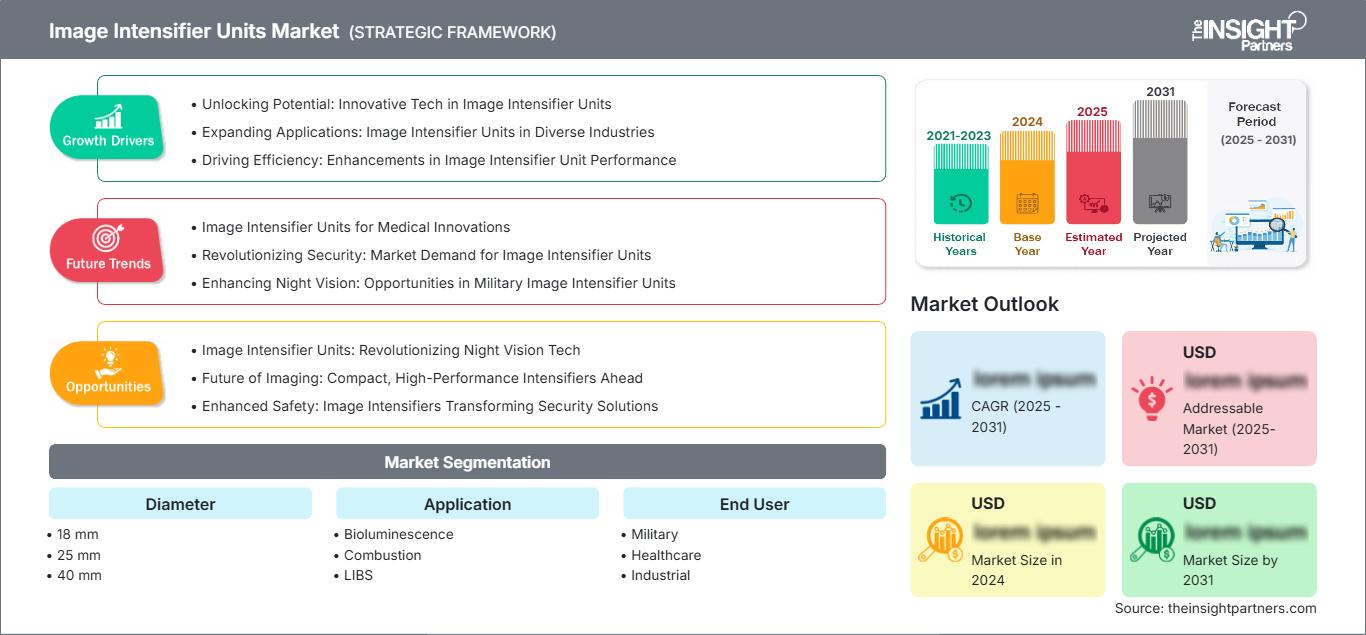
The Image Intensifier Units market is valued at US$ 497.68 Million in 2025 and is projected to reach US$ 890.56 Million by 2034, expanding at a CAGR of 6.68% from 2026 to 2034. Demand is backed by scientific imaging, high-end night vision, combustion analysis, spectroscopy, and growing integration into intensified camera systems. Market refers to a niche imaging technology category which is used in low light, high speed, and time resolved imaging.
North America is an important market region due to defense upgrades, research in photonics technology, and requirement for high speed optical diagnostics. The Image Intensifier Units market size is expected to witness a CAGR of 5.9–6.8% between 2026 and 2034. High investments in aerospace research, military imaging, and optical imaging in semiconductors are expected to drive the purchase of intensifier technology.
Image Intensifier Units Market Assessment and Insights
- North America: North America is estimated to account for a 31–35% Image Intensifier Units market share in 2025 and expand at a 5.9–6.8% CAGR between 2026–2034, supported by defense modernization, scientific research, aerospace programs, and high-speed industrial imaging requirements.
- US: The US represents approximately 78–82% of North America's 2025 share and is expected to grow at 5.8–6.7% CAGR between 2026–2034, led by defense and scientific instrumentation.
- Europe: Europe holds an estimated 25–29% share in 2025 and is projected to grow at 5.8–6.7% CAGR between 2026–2034, with the UK, Germany, France, Italy, and Spain supporting photonics, aerospace, and research demand.
- Asia Pacific: Asia Pacific accounts for approximately 23–27% share in 2025 and is expected to register 7.0–7.9% CAGR between 2026–2034, led by China, Japan, South Korea, and India through industrial imaging and research investment.
- Largest Segment: The Military segment is estimated at a 35–39% market share in 2025, with a 6.1–7.0% CAGR between 2026–2034, reflecting sustained night-vision procurement.
- High Growth Segment: 40 mm diameter units represent an estimated 18–22% market share in 2025 and are projected to grow at 6.9–7.8% CAGR between 2026–2034, supported by demanding scientific imaging applications.
- Key companies analyzed in detail: Argus Imaging BV, Dantec Dynamics, DEP Technologies, L3Harris Technologies, Inc., Inframet, Photek Limited, Exosens, Teledyne Princeton Instruments, Thales Group, and Yukon Advanced Optics.
Source: The Insight Partners' analysis based on proprietary research, government publications, company annual reports, investor presentations, industry databases, and expert interviews.
The technology has progressed beyond conventional low-light enhancement technology toward high gain microchannel plate configurations, electronic fast gating, custom photocathodes, and fiber-optic interfaces. Contemporary models have become increasingly compatible with CCD, CMOS and sCMOS sensors, providing greater temporal resolution and simplifying the overall system configuration. Large format detectors, such as 75 mm and 150 mm models, can satisfy special needs in scientific and industrial applications.
Increasing demands will come from new markets, where there will be growing interest in defense modernization, space science, spectroscopy and industrial diagnostics. The expansion of photonics manufacturing capabilities and research infrastructures has increased the addressable customer segment. On the other hand, demands for greater quantum efficiency, reduced gate time, noise levels, and ruggedness make it profitable for suppliers to differentiate in their technologies.
Image Intensifier Units Market Report Scope
| Report Attribute | Details |
|---|---|
| Market size in 2025 | US$ 497.68 Million |
| Market Size by 2034 | US$ 890.56 Million |
| Global CAGR (2026 - 2034) | 6.68% |
| Historical Data | 2021-2024 |
| Forecast period | 2026-2034 |
Image Intensifier Units Market Analysis
Demand is emerging in the context of the need for capturing very faint or fast-changing optical signals that cannot be captured independently by regular digital detectors. The market for Image Intensifier Units is hence directly tied to applications like defense night vision, laser-induced fluorescence, combustion study, plasma diagnostics, bioluminescence, and particle image study. The ecosystem includes suppliers of photocathodes, microchannel plates, tubes, cameras, optics, and scientific instruments. Users are increasingly focusing on the overall imaging performance of products rather than just tube performance.
The supply structure will continue to be technologically specialized due to the nature of the manufacturing process that involves vacuum technology, photocathode coating, microchannel plate design, phosphor design, and electronic gating. Competing suppliers can specialize in customization, reliability, spectral sensitivity, active area selection, and integration. The demand for laboratory-based research applications tends to favor flexibility, whereas defense applications tend to require ruggedness, life-cycle, repeatable and procurement specifications.
In competitive analysis of the Image Intensifier Units market report, the supply side is highly fragmented yet characterized by technological intensive suppliers. Photek Limited and Teledyne Princeton Instruments cater for scientific and high speed imaging applications whereas L3Harris Technologies, Inc. and Thales Group have significant presence in military vision systems. The presence of tube technology alongside other types of technologies in the products of Exosens can be attributed to the legacy of Photonis in Exosens.
Strategic investments are increasingly targeted towards high resolution photocathode development, fast gating capability, small form factors, and intensified CMOS technologies. The other key trend in the image intensifier unit market is diversification of applications beyond tube units. Photek Limited has shown how intensifiers can be incorporated in space and scientific imaging applications. Teledyne Princeton Instruments specializes in developing ultrafast intensified cameras. There are other niche optical equipment specialists that include Argus Imaging BV, DEP Technologies, Inframet, and Yukon Advanced Optics.
● REPORT CUSTOMIZATION
Tailor This Report To Align With Your Specific Business Requirements
This report can be customized to align precisely with your business objectives, scope, and target markets. Customization options include tailored segmentation, geography, competitive analysis, and strategic insights to support informed decision-making.
Customize This Report →WHAT YOU CAN ADJUST
- ● Segmentations
- ● Geography
- ● Competitive Analysis
- ● Language Preferences
Image Intensifier Units Market: Strategic Insights
Regional Insights
North America Image Intensifier Units Market
The North American region contributed with an estimated Image Intensifier Units market share of 31–35% in 2025, and is expected to register a growth rate of 5.9–6.8% CAGR through 2034. This region accounts for a significant contribution of market growth owing to the large share of defense-related agencies, aerospace industry, universities, national laboratories, and industries that need such products for high performance in low-light and high-speed imaging capabilities. Military procurement helps in maintaining demand, whereas the commercial demand comes from fields of combustion diagnostics, plasma research, spectroscopy, and bioluminescence. L3Harris Technologies, Inc. offers significant exposure of products with high image intensifier tubes and night vision systems.
Canada is one of the countries that contributes in the region with academic photonics, aerospace research, and industrial measurements applications, however, with less share compared to the US market. Regional buyers prefer fast gating, white phosphor, enhanced shock resistance, and sensor capability. Defense modernization is the main structural driver of the market; whereas research and manufacturing are other opportunities available.
U.S. Image Intensifier Units Market
The United States is projected to be about 78%-82% of North America’s 2025 share and will grow at a CAGR of 5.8%-6.7% until 2034. Defense is the major application market with night vision goggles, surveillance, targeting, and low-light tactical devices. Scientific organizations need advanced imaging for combustion, plasma, fluorescence, and fast-optics measurements.
Image intensifier technology has a considerable presence at L3Harris Technologies, Inc., while Teledyne Princeton Instruments caters to the requirements for scientific and industrial imaging. The demand in the US has a growing reliance on sensor fusion, size reduction, modularity, and digital gating. An increasing focus is being placed on longevity, environmental aspects, and optical compatibility.
Europe Image Intensifier Units Market
Europe was estimated at 25% – 29% share in 2025 and will be growing at a 5.8% - 6.7% CAGR until 2034. The UK, Germany, France, Italy, and Spain represent a diversified customer base that includes such industries as defense, scientific research, aerospace industry, automotive tests, and advanced industrial measurements. France is a leading country in the region due to the existence of an ecosystem including defense and photonics industries provided by Exosens and Thales Group.
In terms of scientific imaging equipment, the UK can rely on Photek Limited that provides image intensifiers and detection systems tailored for scientific and industrial applications and aerospace sector. Germany relies on automotive combustion research, industrial measurements, and photonics engineering. France is a combination of defense procurement and scientific instrumentation. Italy and Spain have their contribution into the market in aerospace, research in universities and industries, and defense sector.
APAC Image Intensifier Units Market
The APAC market segment accounts for roughly 23–27% share in 2025 and is expected to grow at a CAGR of 7.0–7.9% from 2025 to 2034. Leading regional players are China, Japan, South Korea, India, and Australia. Industrial automation, defense upgrades, semiconductor industry, aerospace developments, and university research labs boost usage of enhanced imaging technologies.
China is experiencing growth in its indigenous photonics capabilities, while Japan and South Korea are focused on high precision instrumentation and manufacturing. India is investing more into aerospace, defense and scientific research, while Australia promotes astronomy, defense, and research applications. Initiatives in the region for enhancing indigenous semiconductor, electronics, and photonics capabilities could positively impact demand for imaging solutions.
Middle East & Africa Image Intensifier Units Market
Demand in MEA and Africa is relatively small but diverse, driven by military upgrading, border monitoring, aerospace projects, and industrial inspection systems. The market in the region is estimated to register a CAGR of approximately 5.0%-6.0% up to 2034. In particular, Saudi Arabia and the UAE constitute the main buyers from Middle East. South Africa represents an important center of research and industry.
Saudi Arabia and the UAE are working on development of more advanced military and aerospace projects which necessitate low light imaging capabilities. South Africa helps with scientific research, mining, astronomy and industrial testing needs. Other regions of MEA will see mainly demand for defense and security solutions as well as specialized scientific research projects. Modernizing infrastructure and localization projects can help in the future to develop demand.
Segmentation Analysis
Diameter
Diameter selection determines field of view, spatial resolution, coupling requirements, and overall system architecture. The Diameter segment is projected to grow at 6.4–7.3% CAGR between 2026–2034. Smaller formats remain suitable for compact systems, while larger diameters address high-speed scientific imaging and specialized research. The Image Intensifier Units Market scope increasingly includes customized active areas for application-specific camera integration.
- 18 mm: Compact 18 mm units serve portable systems and applications requiring small optical footprints. Their established integration with digital sensors supports demand where weight, power consumption, and system size are important.
- 25 mm: 25 mm units provide a balanced combination of active area and resolution. They are widely suited to scientific imaging, spectroscopy, fluorescence, and compact intensified camera architectures.
- 40 mm: 40 mm units address demanding scientific applications requiring larger imaging areas while retaining useful spatial resolution. Their adoption benefits combustion diagnostics, plasma studies, and advanced laboratory imaging.
- 75 mm: 75 mm formats support larger fields of view and specialized imaging systems. They are strategically relevant for neutron imaging, high-speed diagnostics, and applications requiring broader optical coverage.
- 150 mm: 150 mm units serve highly specialized large-area imaging requirements. Their strategic importance comes from maximizing field coverage for research and experimental systems where conventional sensor dimensions are insufficient.
Application
Application demand is driven by the need for nanosecond-scale temporal resolution and high sensitivity under weak optical conditions. The segment is expected to grow at 6.5–7.4% CAGR between 2026–2034, with scientific and industrial applications benefiting from integrated gating and digital camera technologies.
- Bioluminescence: Bioluminescence imaging requires high sensitivity for extremely weak photon emissions. Intensifiers enable researchers to capture low-light biological signals while preserving temporal information for experimental analysis.
- Combustion: Combustion imaging uses intensified systems to observe transient flame structures, ignition events, and chemical reactions. Fast gating enables researchers to isolate short-duration phenomena with improved contrast.
- LIBS: LIBS applications depend on capturing weak emission spectra generated during laser ablation. Intensifiers provide sensitive, gated detection that improves measurement capability for time-resolved elemental analysis.
- PIV: Particle Image Velocimetry benefits from synchronized intensified imaging when tracer particles or flow conditions produce insufficient optical intensity. Fast gating supports accurate visualization of rapidly changing flow structures.
- LIF: Laser-Induced Fluorescence requires selective detection of weak fluorescence signals against optical backgrounds. Intensifiers improve sensitivity and temporal control, supporting combustion, plasma, chemical, and biological research.
End User
End-user requirements differ substantially according to performance, reliability, regulatory, and operating-environment requirements. The segment is projected to grow at 6.3–7.2% CAGR between 2026–2034. Military applications remain important, while healthcare, industrial, and consumer-oriented opportunities broaden the demand base.
- Military: Military users prioritize ruggedness, low-light sensitivity, reliability, and integration with night-vision and surveillance systems. Procurement is influenced by modernization programs, battlefield requirements, and lifecycle performance.
- Healthcare: Healthcare applications require sensitive imaging for specialized diagnostics, research, fluorescence analysis, and low-light microscopy. Adoption is concentrated in advanced institutions where temporal and photon sensitivity justify specialized systems.
- Industrial: Industrial customers use intensified imaging for combustion, semiconductor-related inspection, spectroscopy, quality analysis, and high-speed process diagnostics. Integration with existing digital cameras is a major purchasing consideration.
- Consumer Electronics: Consumer electronics represents an emerging application area where compact imaging architectures and sensor integration could support specialized low-light devices, although price sensitivity remains a significant adoption constraint.
Opportunity Snapshot
| End User | Revenue Contribution | Trend Tag | Adoption Stage |
|---|---|---|---|
| Military | High | Night Vision | Mature |
| Healthcare | Medium | Fluorescence Imaging | Scaling |
| Industrial | High | Fast Diagnostics | Scaling |
| Consumer Electronics | Low | Low-Light Imaging | Emerging |
Image Intensifier Units Market Growth Drivers and Impact Analysis
Defense modernization and demand for advanced low-light vision
Modernization of defense has increased the need for performance-enhanced low-light sensing capabilities through night vision goggles, surveillance systems, target acquisition devices, and soldiers' gear. Today, modern defense users are more interested in integrating image intensification into thermal imaging and digital imaging technologies rather than using it as a standalone technology. In addition, there is a need for high-performing tubes, white phosphorus structures, ruggedization, and removable modules. Procurement programs create incentives for suppliers to increase their product lifecycle reliability since tube replacement and maintenance determine the readiness of operations. Defense contracts offer manufacturers long-term production of products and investments in engineering while integrators get a chance to manufacture fused vision products.
Expansion of high-speed scientific and industrial diagnostics
Scientific and industrial research increasingly requires imaging systems capable of capturing transient optical events that occur faster than conventional digital cameras can reliably resolve. Combustion, plasma physics, laser diagnostics, fluorescence, spectroscopy, and particle-flow measurements therefore remain important demand generators. Intensifiers provide adjustable gain and extremely short gating, allowing researchers to isolate events while suppressing background illumination. This capability is particularly valuable when experiments combine pulsed lasers with weak optical emissions. Industrial laboratories also use intensified systems to investigate ignition, spray formation, material behavior, and high-speed processes. As research equipment becomes more automated, demand is shifting toward complete camera assemblies with integrated electronics and software rather than standalone tubes. This transition expands the value opportunity for suppliers able to provide both hardware and application engineering.
Photonics integration with digital camera architectures
The increasing integration of intensifier tubes with CMOS and sCMOS cameras is changing the purchasing model for advanced imaging equipment. Users can obtain high sensitivity and rapid gating without replacing their entire digital imaging infrastructure. This reduces integration barriers and encourages adoption among laboratories that already operate standardized camera platforms. Integrated power supplies, programmable gate controllers, fibre-optic coupling, and software-based synchronization further simplify deployment. The commercial effect is significant because suppliers can address broader customer groups through modular configurations. System designers can also tailor photocathodes, phosphors, active areas, and gating characteristics according to wavelength and experiment requirements. As a result, the market is moving toward configurable platforms that combine specialized intensification with increasingly common digital interfaces, improving interoperability and reducing the technical complexity associated with high-speed optical measurement.
Image Intensifier Units Market Future Trends
Integration of intelligent digital control with intensifier hardware
Future Image Intensifier Units Market trends are expected to emphasize deeper integration between tube electronics, digital sensors, triggering systems, and software. Programmable gain, automated gating, synchronized acquisition, and real-time signal processing can reduce operator intervention while improving experimental repeatability. Advanced camera platforms may increasingly combine intensifier control with automated exposure selection and application-specific acquisition algorithms. Such architectures can help researchers manage complex experiments involving pulsed lasers, fluorescence, combustion, and plasma events. Defense applications may similarly incorporate digital diagnostics for monitoring tube performance and system health. The resulting products are likely to be sold as configurable imaging platforms rather than individual components. Suppliers that combine vacuum-tube expertise with electronics, software, and camera integration should therefore be positioned to capture higher-value system opportunities.
Development of larger-area and application-specific intensifiers
Another emerging direction is greater customization of active area, photocathode response, gating speed, and optical coupling. Scientific customers increasingly require imaging configurations designed around specific wavelengths, fields of view, and experimental geometries rather than standardized tube specifications. Larger formats can address wide-area measurements, while compact tubes remain important for portable and high-resolution systems. Specialized photocathodes can improve response across ultraviolet, visible, and near-infrared ranges. Meanwhile, advanced microchannel plate designs are being developed to improve resolution and gain without compromising reliability. These developments should encourage suppliers to build modular product families that share manufacturing platforms while supporting application-specific configurations. Such flexibility can reduce development time for customers and strengthen supplier relationships with research institutions, defense contractors, and specialized instrumentation manufacturers.
Image Intensifier Units Market Opportunities
Expansion of intensified imaging in emerging scientific ecosystems
Emerging research ecosystems across Asia Pacific and the Middle East present opportunities for suppliers with application engineering and local technical support. Universities, national laboratories, aerospace institutions, and industrial research centers are expanding capabilities in photonics, combustion, spectroscopy, and advanced materials. The Image Intensifier Units Market Forecasts should therefore be assessed alongside investments in research infrastructure rather than only equipment replacement cycles. Suppliers can target these markets through distributor partnerships, laboratory demonstrations, training programs, and modular camera configurations. Localization of application support can shorten sales cycles because customers often require assistance with gating, photocathode selection, optical coupling, and synchronization. Companies that establish regional technical capabilities can capture early demand while building long-term relationships with institutions that are upgrading from conventional high-speed cameras.
Development of integrated tube-camera platforms for industrial users
Industrial customers represent an opportunity to move beyond specialized research laboratories toward broader process diagnostics. Manufacturers can develop integrated tube-camera platforms combining intensifiers, sensors, optics, power supplies, synchronization electronics, and application software. Such systems could simplify deployment in combustion testing, materials research, semiconductor-related inspection, and advanced manufacturing environments. The opportunity is particularly attractive where users already possess digital imaging infrastructure but require additional sensitivity or temporal resolution. Suppliers can also create application-specific packages that reduce engineering requirements for customers and improve repeatability between installations. The Image Intensifier Units Market Forecasts indicate that value creation should increasingly come from system integration, software, and application support rather than tube sales alone. This approach can diversify revenue and improve customer retention across industrial laboratories.
Recent Developments
- May 2026: Photek Limited announced that its image intensifier technology was integrated into the Ultraviolet Imager aboard the ESA–Chinese Academy of Sciences SMILE mission. The MCP118 intensifier was designed for high sensitivity in the far-ultraviolet range, enabling observation of auroral activity and solar-wind interactions. The development demonstrates the company’s continued positioning in specialized space-science and scientific imaging applications.
- January 2026: Exosens introduced an ultra-high-resolution image intensifier technology achieving up to 80 lp/mm resolution, combined with ultra-fast gating and active areas up to 25 mm. The technology is based on Photonis Hi-QE photocathode and microchannel plate technologies and was positioned for scientific imaging applications. The development highlights continuing improvements in resolution and temporal performance.
- January 2025: L3Harris Technologies, Inc. highlighted advances in unfilmed Gen III image-intensifier tube technology, emphasizing sensitivity, ruggedness, reduced halo effects, and extended operational life. The company also described continued engineering investment in tube technology for tactical night-vision applications. The development reflects the defense sector’s continuing focus on improving low-light performance and reliability under demanding field conditions.
Frequently Asked Questions

- Comprehensive Market Sizing and Forecast Analysis
- Detailed Segmentation Analysis
- In-Depth Market Dynamics Assessment
- Regional and Country-Level Insights
- Competitive Landscape and Company Benchmarking
- Strategic Business Intelligence
Recent Reports
Testimonials

The Insight Partners' SCADA System Market report is comprehensive, with valuable insights on current trends and future forecasts. The team was highly professional, responsive, and supportive throughout. We are very satisfied and highly recommend their services.
RAN KEDEM Partner, Reali Technologies LTDs
I requested a report on a very specific software market and the team produced the report in a few days. The information was very relevant and well presented. I then requested some changes and additions to the report. The team was again very responsive and I got the final report in less than a week.
JEAN-HERVE JENN Chairman, Future Analytica
We worked with The Insight Partners for an important market study and forecast. They gave us clear insights into opportunities and risks, which helped shape our plans. Their research was easy to use and based on solid data. It helped us make smart, confident decisions. We highly recommend them.
PIYUSH NAGPAL Sr. Vice President, High Beam Global
The Insight Partners delivered insightful, well-structured market research with strong domain expertise. Their team was professional and responsive throughout. The user-friendly website made accessing industry reports seamless. We highly recommend them for reliable, high-quality research services
YUKIHIKO ADACHI CEO, Deep Blue, LLC.
This is the first time I have purchased a market report from The Insight Partners.While I was unsure at first, I visited their web site and felt more comfortable to take the risk and purchase a market report.I am completely satisfied with the quality of the report and customer service. I had several questions and comments with the initial report, but after a couple of dialogs over email with their analyst I believe I have a report that I can use as input to our strategic planning process.Thank you so much for taking the extra time and making this a positive experience.I will definitely recommend your service to others and you will be my first call when we need further market data.
JOHN SUZUKI President and Chief Executive Officer, Board Director, BK Technologies
I wish to appreciate your support and the professionalism you displayed in the course of attending to my request for information regarding to infectious disease IVD market in Nigeria. I appreciate your patience, your guidance, and the fact that you were willing to offer a discount, which eventually made it possible for us to close a deal. I look forward to engaging The Insight Partners in the future, all thanks to the impression you have created in me as a result of this first encounter.
DR CHIJIOKE ONYIA MANAGING DIRECTOR, PineCrest Healthcare Ltd.Reason to Buy
- Informed Decision-Making
- Understanding Market Dynamics
- Competitive Analysis
- Identifying Emerging Markets
- Customer Insights
- Market Forecasts
- Risk Mitigation
- Boosting Operational Efficiency
- Strategic Planning
- Investment Justification
- Tracking Industry Innovations
- Aligning with Regulatory Trends





 Get Free Sample for