
Immersion Cooling Market Share, Growth & Forecast by 2034
Coverage: by Type (Single-Phase Immersion Cooling, Two-Phase Immersion Cooling); Cooling Fluid Type (Mineral Oil, Fluorocarbon-Based Fluid, Synthetic Oil, Others); Application (High Performance Computing, Edge Computing, Artificial Intelligence, Cryptocurrency Mining, Others) , and Geography (North America, Europe, Asia Pacific, and South and Central America)
- Status : Data Released
- Report Code : TIPRE00006625
- Category : Electronics and Semiconductor
- No. of Pages : 150
- Available Report Formats :


- Last update date : September 28, 2026


2025 Market Size
US$ 361.57 Mn
Base year value
2034 Forecast
US$ 2,310.05 Mn
Projected by 2034
CAGR 2026-2034
22.88 %
Growth rate
Addressable Market
US$ 10,461.76 Mn
(2026-2034)
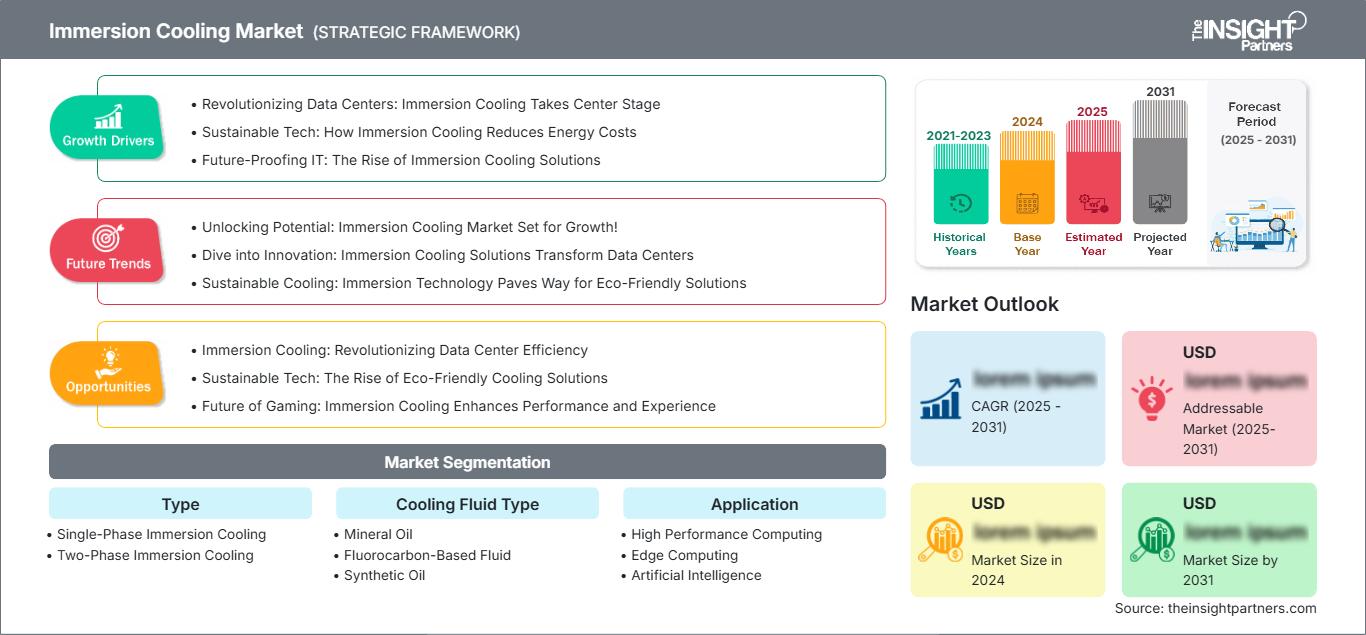
The immersion cooling market size was valued at US$ 361.57 Million in 2025 and is projected to reach US$ 2,310.05 Million by 2034, registering a CAGR of 22.88% during 2026–2034. Expansion reflects rising thermal-management requirements for high-density computing, artificial intelligence infrastructure, edge deployments, and other workloads whose power densities increasingly challenge conventional air-cooling architectures.
North America is positioned for sustained adoption, with an estimated 21.0–22.5% CAGR during 2026–2034. Hyperscale data-center expansion and accelerated AI computing are key structural drivers, while increasing pressure on electricity and water efficiency is encouraging operators to evaluate immersion-based thermal architectures for new facilities and selected retrofits.
Immersion Cooling Market Assessment and Insights
- North America: North America held a 34–38% immersion cooling market share in 2025 and is projected to grow at a 21.0–22.5% CAGR between 2026–2034, supported by hyperscale construction, AI clusters, and advanced data-center infrastructure.
- US: The US represented 84–88% of North American demand in 2025 and is expected to expand at a 20.8–22.3% CAGR during 2026–2034, led by AI infrastructure investment.
- Europe: Europe accounted for a 24–28% share in 2025 and is forecast to grow at a 21.5–23.0% CAGR, with Germany, the UK, France, and the Netherlands supporting sustainable data-center deployment.
- Asia Pacific: Asia Pacific represented a 25–29% share in 2025 and is expected to register a 24.0–25.5% CAGR through 2034, led by China, Japan, South Korea, Singapore, and India.
- Largest Segment: Single-Phase Immersion Cooling held a 61–65% market share in 2025 and is projected to grow at a 22.0–23.5% CAGR during 2026–2034.
- High Growth Segment: Artificial Intelligence represented a 22–26% market share in 2025 and is anticipated to expand at a 25.0–26.5% CAGR as accelerated computing raises thermal density.
- Key companies analyzed in detail: Allied-Control, Asperitas B.V., DCX The Liquid Cooling Company, DownUnder GeoSolutions, Fujitsu Limited, Green Revolution Cooling Inc., Iceotope, LiquidCool Solutions LLC, Midas Green Technologies LLC, Submer Technologies.
Source: The Insight Partners' analysis based on proprietary research, government publications, company annual reports, investor presentations, industry databases, and expert interviews.
The technology is shifting from dedicated coolants to thermal solutions for high density computing. Single phase systems have emerged popular owing to easy fluid handling and compatibility with denser servers, whereas two phase solutions remain under development for more challenging applications. The engineering of tanks, fluid delivery, heat exchangers, monitoring devices and server compatibility are thus emerging as integral components of solution.
Going forward, demand in the immersion cooling market may extend beyond the known hyperscale markets due to increasing adoption of AI infrastructure in regional data centers and at the edge. The region of Southeast Asia, India, the Middle East and certain European markets present new market chances where power availability, water limitations and elevated temperatures affect data center design. There is also progress in the direction of standardization with OCP and ASHRAE working together to formulate standards for liquid cooling.
Immersion Cooling Market Report Scope
| Report Attribute | Details |
|---|---|
| Market size in 2025 | US$ 361.57 Million |
| Market Size by 2034 | US$ 2,310.05 Million |
| Global CAGR (2026 - 2034) | 22.88% |
| Historical Data | 2021-2024 |
| Forecast period | 2026-2034 |
Immersion Cooling Market Analysis
Growth in the immersion cooling market is becoming ever more dependent on faster computing, higher rack power densities, and a push to increase energy efficiency at the facility level. There is an ecosystem of tank makers, dielectric fluids, servers/components, heat transfer, cooling fluid distribution, controls, data center integrators and operators. The market is most active when thermal issues could become a constraint on compute density and/or would otherwise require mechanical cooling facilities.
The supply side in the immersion cooling market will be driven by tank construction, pumps, heat transfer equipment, fluids, and compatibility tests. Mineral oils have the benefit of offering a relatively mature one phase solution, while fluorochemicals can offer solutions for specialized applications and need to pay more attention to environmental and supply considerations. There is a third option for synthetic oils which have a certain value proposition when it comes to thermal properties, material compatibility and lifecycles.
Competitive differentiation in the industry is leaning towards application-specific thermal capability, compatibility with fluids, modularity, and integration into next generation computing platforms. Immersion cooling market analysis reveals a market characterized by specialists alongside existing tech giants. Companies like Asperitas B.V., Green Revolution Cooling Inc., Submer Technologies, and Iceotope have a strong emphasis on advanced liquid cooling systems. Fujitsu Limited on the other hand adds computing and infrastructure know-how for high performance applications.
Funding in this market is also increasingly shifting towards full infrastructure solutions as opposed to components. The two companies leading in this area include DCX The Liquid Cooling Company and LiquidCool Solutions LLC. Midas Green Technologies LLC focuses on the provision of infrastructure solutions that address the needs of immersion cooling. Allied-Control and DownUnder GeoSolutions offer specialists skills for high density computing environments.
● REPORT CUSTOMIZATION
Tailor This Report To Align With Your Specific Business Requirements
This report can be customized to align precisely with your business objectives, scope, and target markets. Customization options include tailored segmentation, geography, competitive analysis, and strategic insights to support informed decision-making.
Customize This Report →WHAT YOU CAN ADJUST
- ● Segmentations
- ● Geography
- ● Competitive Analysis
- ● Language Preferences
Immersion Cooling Market: Strategic Insights
Regional Insights
North America Immersion Cooling Market
North America accounted for a 34–38% share in 2025 and is forecast to expand at a 21.0–22.5% CAGR through 2034. The region is characterized by high concentration of hyperscale and colocation sites, robust investments in AI-related infrastructure, and a matured ecosystem of suppliers for servers, semiconductors, cloud technologies, and data centers. The US is a major demand driver, whereas Canada can offer additional opportunities through data center construction and access to cleaner electricity.
The region’s strength lies in the volume and concentration of accelerated computing installations. AI training and inference require greater heat performance as the processor density grows, driving the consideration of immersion in addition to direct-liquid cooling and air-cooled solutions. Water conservation, electrical supply, and limited grid capacity become new factors. OCP standardization and ASHRAE collaboration contribute to the technical clarity regarding equipment specifications and installation process.
U.S. Immersion Cooling Market
According to the immersion cooling market report, the US represented 84–88% of North American demand in 2025 and is expected to grow at a 20.8–22.3% CAGR during 2026–2034. Demand is centered on hyperscale data centers, AI infrastructure, cloud computing, high-performance computing, and certain applications for cryptocurrencies. Large technology providers and specialized coolant manufacturers have active engagements with operators, server vendors, and infrastructure integrators across the country.
Applications are shifting towards dense GPU clusters, AI fabrication plants, and compute-intensive enterprises. Operators are considering immersion cooling in cases where existing cooling methods pose limitations related to rack density, cooling efficiency, or water consumption. Texas, Virginia, and other large markets for data centers are strategically valuable due to existing infrastructure investments and power requirements. The USA is advantageous in terms of participation in open technical standards, which helps define the requirements for equipment and fluid compatibility.
Europe Immersion Cooling Market
Europe held a 24–28% share in 2025 and is projected to grow at a 21.5–23.0% CAGR. Germany is the leading country, followed by the UK, France, the Netherlands, Italy, and Spain. These priorities create favorable ground for the application of more sophisticated cooling solutions. Europeans evaluate their thermal systems according to the parameters of power consumption, water consumption, energy reuse and lifecycle rather than cooling capacity only.
The UK enjoys a good combination of AI investments along with investments into data centers along with increasing attention to water and energy efficiency. Germany profits from its industrial computing, research and enterprise technology background. France and the Netherlands are beneficial for the development of hyperscale and colocation data centers. Italy and Spain provide chances owing to digital infrastructure build-up and warm environment conditions.
APAC Immersion Cooling Market
APAC held a 25–29% share in 2025 and is expected to register a 24.0–25.5% CAGR, making it the fastest-growing major region. China leads demand, followed by Japan, South Korea, Singapore, India, and Australia. Manufacturing scale, AI investment, hyperscale expansion, and government-backed digital infrastructure are strengthening adoption.
China combines AI and high-performance computing investment with large-scale data-center development. Japan and South Korea emphasize advanced semiconductor and computing infrastructure, while India and Singapore are expanding digital capacity. Australia offers additional demand from cloud and enterprise computing. Regional policies emphasizing energy efficiency, digital sovereignty, and infrastructure modernization should support adoption.
Middle East & Africa Immersion Cooling Market
Middle East and Africa demand is projected to grow at a 21.0–22.5% CAGR through 2034, with Saudi Arabia leading regional development. The UAE supports data-center and cloud investment, while South Africa remains the principal African market. Rest of MEA demand is smaller but increasingly linked to digital infrastructure programs and enterprise computing.
High ambient temperatures and water considerations strengthen the case for efficient thermal architectures in selected facilities. Saudi Arabia and the UAE are developing large digital infrastructure ecosystems, while South Africa supports regional cloud and connectivity requirements. Investment in AI-ready infrastructure, energy diversification, and sustainable data centers should broaden the addressable opportunity across the region.
Segmentation Analysis
Type
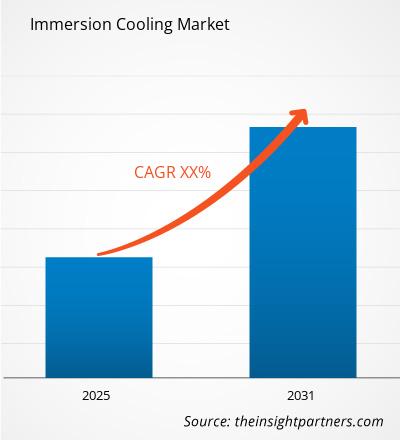
Type is projected to expand at a 22.0–23.5% CAGR during 2026–2034. Single-phase architecture currently has broader commercial adoption because of relatively straightforward operation and fluid management, while two-phase systems remain relevant where high heat-transfer performance and specialized thermal requirements justify greater system complexity. The Immersion Cooling Market scope therefore encompasses distinct engineering choices rather than a single cooling architecture.
- Single-Phase Immersion Cooling: Single-Phase Immersion Cooling remains the principal architecture for many deployments because dielectric fluid stays liquid during operation. Its relatively straightforward tank, pumping, and heat-exchange configuration supports scalable adoption.
- Two-Phase Immersion Cooling: Two-Phase Immersion Cooling uses phase change to remove heat and can support highly concentrated thermal loads. Its strategic importance is strongest where performance requirements justify specialized fluid and condenser infrastructure.
Cooling Fluid Type
Cooling Fluid Type is expected to grow at a 21.5–23.0% CAGR from 2026 to 2034. Fluid selection increasingly considers thermal performance, dielectric properties, material compatibility, environmental characteristics, supply continuity, maintenance, and total lifecycle economics. Standardized qualification practices are becoming important as server manufacturers and operators seek predictable long-term compatibility.
- Mineral Oil: Mineral Oil has a strong position in single-phase deployments because of established availability and practical handling characteristics. Demand is concentrated where operators prioritize proven fluid behavior and manageable system economics.
- Fluorocarbon-Based Fluid: Fluorocarbon-Based Fluid supports specialized two-phase applications requiring strong heat-transfer characteristics. Its strategic position depends on supply security, environmental considerations, fluid lifecycle management, and application-specific thermal requirements.
- Synthetic Oil: Synthetic Oil offers an alternative where engineered thermal properties and material compatibility justify higher specification requirements. It can support specialized computing environments requiring controlled fluid characteristics and long operating lifecycles.
Application
Application demand is forecast to grow at a 23.5–24.5% CAGR during 2026–2034. High-performance computing remains a major installed use case, while AI is gaining strategic importance as accelerated processors increase rack power density. Edge deployments and cryptocurrency mining provide additional applications with different requirements for modularity, operating environment, and deployment economics.
- High Performance Computing: High Performance Computing remains a core application because scientific, engineering, and research workloads require sustained processor utilization. Immersion enables higher compute density and thermal stability in specialized environments.
- Edge Computing: Edge Computing creates demand for compact, resilient thermal systems where space, ambient conditions, and remote operation can constrain conventional cooling. Modular immersion architectures can support distributed high-density deployments.
- Artificial Intelligence: Artificial Intelligence is becoming a central application because GPU-intensive training and inference generate concentrated heat loads. Cooling technology directly influences rack density, performance consistency, and infrastructure design.
- Cryptocurrency Mining: Cryptocurrency Mining uses immersion to manage continuously operating high-density computing hardware. The application remains sensitive to electricity prices, cryptocurrency economics, equipment utilization, and operator requirements for deployment efficiency.
Opportunity Snapshot
| Application | Revenue Contribution | Trend Tag | Adoption Stage |
|---|---|---|---|
| High Performance Computing | High | Dense Compute | Mature |
| Edge Computing | Medium | Modular Edge | Scaling |
| Artificial Intelligence | High | GPU Density | Scaling |
| Cryptocurrency Mining | Medium | ASIC Cooling | Mature |
Immersion Cooling Market Growth Drivers and Impact Analysis
Rapid expansion of AI and accelerated computing
The main factor contributing to structural pressure is the adoption of increased accelerated computing. According to the IEA report, global data-center electricity use may amount to about 945 TWh in 2030, nearly twice the figure for 2024, while electricity use of accelerated servers is expected to grow much more rapidly than the demand for conventional servers. Increased processor utilization and higher GPU power densities increase the thermal load within racks. This prompts consideration of cooling solutions which can support dense computing without proportional growth in mechanical cooling systems. This makes immersion especially significant when there are thermal restrictions on rack design, facility size, or costs associated with implementation.
Water and energy efficiency becoming facility design priorities
Cooling considerations are now more associated with resource availability than temperature regulation alone. Managers of data centers are under increasing pressure to manage their electricity usage as well as reduce their reliance on cooling water in some places. Immersion technology enables harvesting of heat right from the IT equipment and may minimize dependence on conventional air-cooling facilities. This will largely depend on system designs, facility designs, operational factors, and heat reuse. European energy-efficiency policies and sustainability reports are driving the need for consideration of performance measurement in data centers. For locations where water availability is a challenge, the capacity to design data center facilities with minimum water needs could also have an impact on location and expansion considerations.
Rising rack power density is changing thermal architecture
Rising processing capabilities have altered the physical connection between computing hardware and cooling equipment. Air systems are becoming increasingly challenging to optimize as heat becomes localized in smaller regions while requiring higher airflows. Immersion technology facilitates contact between the computing hardware and dielectric liquid, ensuring that heat can be removed closer to its source. This may facilitate higher density designs while relying less on huge amounts of air conditioning. Such an effect will be most applicable to AI cluster setups, HPC operations, and custom-built enterprise applications that generate a constant thermal load through sustained computing processes. With server blueprints moving towards more powerful processors, the selection of a cooling technology needs to occur early on in the planning process of the facility.
Immersion Cooling Market Future Trends
AI-oriented modular cooling architectures will gain importance
The Immersion Cooling Market trends are likely to move toward modular thermal architectures designed specifically around AI clusters rather than generalized data-center cooling. Modularity is important for future solutions since there will have to be a combination of tanks, heat exchangers, monitoring tools, controls, and server compatibility as a kind of template for future use as computing power is added. Modularity may help decrease time spent on engineering and make capacity planning easier for companies which do not know how much AI they will need. In addition, modularity may allow companies to increase their cooling capacity as they develop their GPU clusters without having the whole facility being designed for the maximum thermal load at the beginning.
Thermal management will converge with heat reuse and energy strategy
Any future deployments will be expected to view cooling as a subsystem of an overall energy system rather than mechanical infrastructure alone. Heat transfer through immersion results in an opportunity to harness the thermal energy that can then be reused where local conditions allow for this. Sustainability goals within Europe and commitment by operators will make this a consideration. The next step in designing a system will thus involve linking the immersion system with some kind of heat exchanger or district heating, industrial processes, or building heating systems. In addition, monitoring will become more advanced to include fluid condition monitoring, temperature monitoring, and heat recovery output. Vendors who have the ability to incorporate thermal management with the energy system of the facility become increasingly important.
Immersion Cooling Market Opportunities
Retrofitting high-density computing facilities
The immersion cooling market forecasts indicate an expanding opportunity for retrofit solutions that address thermal constraints without requiring complete data-center reconstruction. Existing facilities may contain valuable power, connectivity, and real-estate infrastructure that operators want to preserve while deploying higher-density computing. Suppliers can target this need through modular tanks, compatible server platforms, heat-rejection equipment, and installation services designed around existing electrical and network architectures. Retrofit projects can also provide a controlled pathway for customers to validate immersion before broader deployment. Commercial opportunities extend to fluid management, monitoring, maintenance, component qualification, and lifecycle services. Vendors that can demonstrate predictable integration with installed infrastructure may reduce customer adoption barriers and capture demand from enterprises that cannot justify constructing dedicated immersion-ready facilities.
Regional AI infrastructure and sustainable data-center development
Emerging data-center markets provide opportunities for cooling suppliers to participate in infrastructure development from the initial design stage. India, Southeast Asia, the Middle East, and selected European locations are expanding digital capacity while considering electricity availability, water use, and climate conditions. Immersion suppliers can work with developers, utilities, server OEMs, and engineering firms to design thermal architectures around local constraints rather than adapting conventional cooling afterward. Partnerships can create opportunities for standardized modular facilities, localized manufacturing, service networks, and fluid-management programs. Investment strategies should prioritize markets where AI capacity is expanding faster than existing thermal infrastructure can comfortably support. Early technical engagement can also improve specification influence and establish compatibility requirements before major equipment procurement decisions are finalized.
Recent Developments
- March 2026: GRC (Green Revolution Cooling) expanded its collaboration with UNICOM Engineering to deliver fully integrated, turnkey immersion-cooled solutions for AI, high-performance computing, GPU-as-a-Service and high-density compute deployments. The solutions combine UNICOM’s system design and lifecycle deployment expertise with GRC’s immersion cooling technology, targeting applications across industrial data centers, factory production lines, remote depots and distributed warehouse environments.
- August 2026: Unisys partnered with Refroid Technologies to accelerate the deployment and lifecycle management of high-performance AI infrastructure by combining Refroid’s direct-to-chip and immersion liquid-cooling technologies with Unisys’ global field services and delivery capabilities. The partnership will support AI-ready infrastructure through deployment, commissioning, validation, technician training, maintenance and AI-powered service management, helping organizations improve efficiency, reliability and scalability as AI workloads drive demand for increasingly energy-intensive, high-density computing environments.
- July 2026: Ekovolt partnered with U.S.-based Midas Immersion Cooling to deploy advanced single-phase immersion cooling for AI- and high-performance computing data centers, combining Ekovolt’s AI-optimized infrastructure expertise with Midas’ high-density cooling technology. The partners will evaluate integrating immersion cooling into Ekovolt’s future European data center developments, including its 100MW Voltekko pipeline, while Midas’ technology can also retrofit existing air-cooled colocation facilities for higher compute densities, improved PUE, and lower energy, water and operating costs without changing the colocation model.
Frequently Asked Questions

- Comprehensive Market Sizing and Forecast Analysis
- Detailed Segmentation Analysis
- In-Depth Market Dynamics Assessment
- Regional and Country-Level Insights
- Competitive Landscape and Company Benchmarking
- Strategic Business Intelligence
Recent Reports
Testimonials

The Insight Partners provided valuable market intelligence that supported our global go-to-market strategy. Their team was professional, responsive, and attentive to our feedback, providing thoughtful analysis and helpful methodological clarifications throughout the project.
Junmo Kim Chief Financial Officer (CFO), Enertech Co., Ltd.
The Insight Partners' SCADA System Market report is comprehensive, with valuable insights on current trends and future forecasts. The team was highly professional, responsive, and supportive throughout. We are very satisfied and highly recommend their services.
RAN KEDEM Partner, Reali Technologies LTDs
I requested a report on a very specific software market and the team produced the report in a few days. The information was very relevant and well presented. I then requested some changes and additions to the report. The team was again very responsive and I got the final report in less than a week.
JEAN-HERVE JENN Chairman, Future Analytica
We worked with The Insight Partners for an important market study and forecast. They gave us clear insights into opportunities and risks, which helped shape our plans. Their research was easy to use and based on solid data. It helped us make smart, confident decisions. We highly recommend them.
PIYUSH NAGPAL Sr. Vice President, High Beam Global
The Insight Partners delivered insightful, well-structured market research with strong domain expertise. Their team was professional and responsive throughout. The user-friendly website made accessing industry reports seamless. We highly recommend them for reliable, high-quality research services
YUKIHIKO ADACHI CEO, Deep Blue, LLC.
This is the first time I have purchased a market report from The Insight Partners.While I was unsure at first, I visited their web site and felt more comfortable to take the risk and purchase a market report.I am completely satisfied with the quality of the report and customer service. I had several questions and comments with the initial report, but after a couple of dialogs over email with their analyst I believe I have a report that I can use as input to our strategic planning process.Thank you so much for taking the extra time and making this a positive experience.I will definitely recommend your service to others and you will be my first call when we need further market data.
JOHN SUZUKI President and Chief Executive Officer, Board Director, BK Technologies
I wish to appreciate your support and the professionalism you displayed in the course of attending to my request for information regarding to infectious disease IVD market in Nigeria. I appreciate your patience, your guidance, and the fact that you were willing to offer a discount, which eventually made it possible for us to close a deal. I look forward to engaging The Insight Partners in the future, all thanks to the impression you have created in me as a result of this first encounter.
DR CHIJIOKE ONYIA MANAGING DIRECTOR, PineCrest Healthcare Ltd.Reason to Buy
- Informed Decision-Making
- Understanding Market Dynamics
- Competitive Analysis
- Identifying Emerging Markets
- Customer Insights
- Market Forecasts
- Risk Mitigation
- Boosting Operational Efficiency
- Strategic Planning
- Investment Justification
- Tracking Industry Innovations
- Aligning with Regulatory Trends





 Get Free Sample for