
In-Vehicle Networking Market Size, Share & Forecast by 2034
Coverage: By Components (Relays, Sensors, Memory, Microcontroller, Switches, Others); Connectivity Standards (CAN, LIN, FlexRay, RF, Ethernet, MOST); Application (Infotainment, Body Electronics, Powertrain, Navigation, Driver Assistance Systems, Others), and Geography (North America, Europe, Asia Pacific, and South and Central America)
- Status : Data Released
- Report Code : TIPRE00016014
- Category : Electronics and Semiconductor
- No. of Pages : 150
- Available Report Formats :


- Last update date : October 16, 2026


2025 Market Size
US$ 4.86 Bn
Base year value
2034 Forecast
US$ 11.58 Bn
Projected by 2034
CAGR 2026-2034
10.13 %
Growth rate
Addressable Market
US$ 73.08 Bn
(2026-2034)
The In-Vehicle Networking Market was valued at US$ 4.86 Billion in 2025 and is projected to reach US$ 11.58 Billion by 2034, registering a CAGR of 10.13% during 2026–2034. The increase in demand will be driven by the growth in the level of electronic content, driver assist capabilities, connectivity in infotainment systems, electric vehicles, and the growing need for secure and deterministic communications within a network of distributed vehicle systems.
North America is likely to be a major player in terms of technology and manufacturing, growing at a rate of 9.1–9.8% during the period from 2026 to 2034. The In-Vehicle Networking Market Size will be driven by the high presence of advanced driver assistance systems and increasing zonal electrical architecture. There will also be an increased demand for networking solutions driven by OEM investment in centralized computing, Ethernet backbones, and software-defined vehicles.
In-Vehicle Networking Market Assessment and Insights
- North America: North America is expected to account for a 31–35% share in 2025 and expand at a CAGR of 9.1–9.8% between 2026–2034, supported by connected vehicle deployment, ADAS integration, software-defined architectures, and strong semiconductor development capabilities.
- US: The US is estimated to represent 78–82% of North America's 2025 market and grow at a CAGR of 9.2–9.9% during 2026–2034, driven by advanced vehicle electronics and autonomous driving investments.
- Europe: Europe is projected to hold a 25–29% In-Vehicle Networking Market share in 2025 and grow at a CAGR of 8.8–9.5% through 2034, with Germany, France, the UK, Italy, and Spain supported by premium vehicle production, safety regulation, and electrification.
- Asia Pacific: Asia Pacific is estimated at 32–36% share in 2025 and is projected to grow at a CAGR of 11.5–12.3%, led by China, Japan, South Korea, and India as vehicle electronics, EV production, and connected mobility expand.
- Largest Segment: Connectivity Standards is estimated to hold a 38–42% market share in 2025, growing at a CAGR of 10.8–11.6%, reflecting the installed base of CAN and accelerating Ethernet migration.
- High Growth Segment: Ethernet is estimated to represent an 18–22% market share within connectivity standards in 2025, expanding at a CAGR of 16.0–17.5% as zonal and centralized architectures mature.
- Key companies analyzed in detail: Analog Devices, Inc., Broadcom Inc., Melexis NV, Microchip Technology Inc., NXP Semiconductors N.V., Robert Bosch GmbH, Semiconductor Components Industries, LLC, STMicroelectronics N.V., Texas Instruments Incorporated, Xilinx, Inc.
Source: The Insight Partners' analysis based on proprietary research, government publications, company annual reports, investor presentations, industry databases, and expert interviews.
Automotive networking has evolved from distributed controller communications into heterogeneous networks that involve CAN, LIN, FlexRay, and Ethernet. The increase in data generated by cameras, radar, displays, and software-defined functions has changed the demands on automotive networking technology. Semiconductors suppliers are embedding networking interfaces, security, processing and switching functionalities into semiconductors to reduce the number of components and simplify electronic control units' architecture.
The future adoption of such technologies will expand outside the current automotive manufacturing centers due to an increase in the volume of vehicle electronics in China, India, Southeast Asia, and some countries in Eastern Europe. Investments in the areas of EV platforms, automated driving, connected services, and centralized computing can further increase the demands for automotive networking technology. Functional safety and cybersecurity requirements are also becoming more stringent and motivate semiconductor suppliers to incorporate all four functionalities in automotive networking platforms.
In-Vehicle Networking Market Report Scope
| Report Attribute | Details |
|---|---|
| Market size in 2025 | US$ 4.86 Billion |
| Market Size by 2034 | US$ 11.58 Billion |
| Global CAGR (2026 - 2034) | 10.13% |
| Historical Data | 2021-2024 |
| Forecast period | 2026-2034 |
In-Vehicle Networking Market Analysis
Electrification of vehicles and software-based functionality represent the key drivers of the In-Vehicle Networking market. Advanced Driver Assistance Systems (ADAS), digital cockpits, battery control, automated parking systems, and over-the-air software update require reliable communication between the sensors, control modules, actuators, and the computer platform. This environment includes players such as semiconductor suppliers, network interface providers, automotive Tier 1 suppliers, software providers, OEMs, and standard bodies. Hence, there is a shift towards networking that can operate on different protocols.
This value chain is also evolving in order to support the increased use of Ethernet. For lower data-rate applications and those requiring cost optimization, CAN and LIN networks are still very relevant; however, Ethernet is used for higher data-rate applications and the backbone network communication. The semiconductor vendors need to provide solutions that can address bandwidth, EMI, functional safety, security, thermal, and cost constraints.
The competitive positioning for most companies now relies on the overall portfolio, not the individual network components. NXP Semiconductors N.V. brings together CAN, LIN, Ethernet switches, PHYs, processors, and gateway technology, while Robert Bosch GmbH is involved in semiconductor, electronic control, and system integration in vehicles. Analog Devices, Inc. focuses on high performance and connectivity in terms of cabin applications, while Microchip Technology Inc. is broadening its Ethernet and automotive networking portfolio to the realm of zonal architecture. As this In-Vehicle Networking Market report shows, the platforms that offer interoperability may benefit from capturing more system value.
Some of the leading companies offering complementary capabilities include Broadcom Inc., STMicroelectronics N.V., Texas Instruments Incorporated, Melexis NV, and Semiconductor Components Industries, LLC. The importance of Xilinx, Inc., which is currently a subsidiary of AMD, stems from the use of the programmable logic technologies in the applications of automotive computing and networking. Investments are now focused on Ethernet PHYs, switches, security features, determinism, and processing.
● REPORT CUSTOMIZATION
Tailor This Report To Align With Your Specific Business Requirements
This report can be customized to align precisely with your business objectives, scope, and target markets. Customization options include tailored segmentation, geography, competitive analysis, and strategic insights to support informed decision-making.
Customize This Report →WHAT YOU CAN ADJUST
- ● Segmentations
- ● Geography
- ● Competitive Analysis
- ● Language Preferences
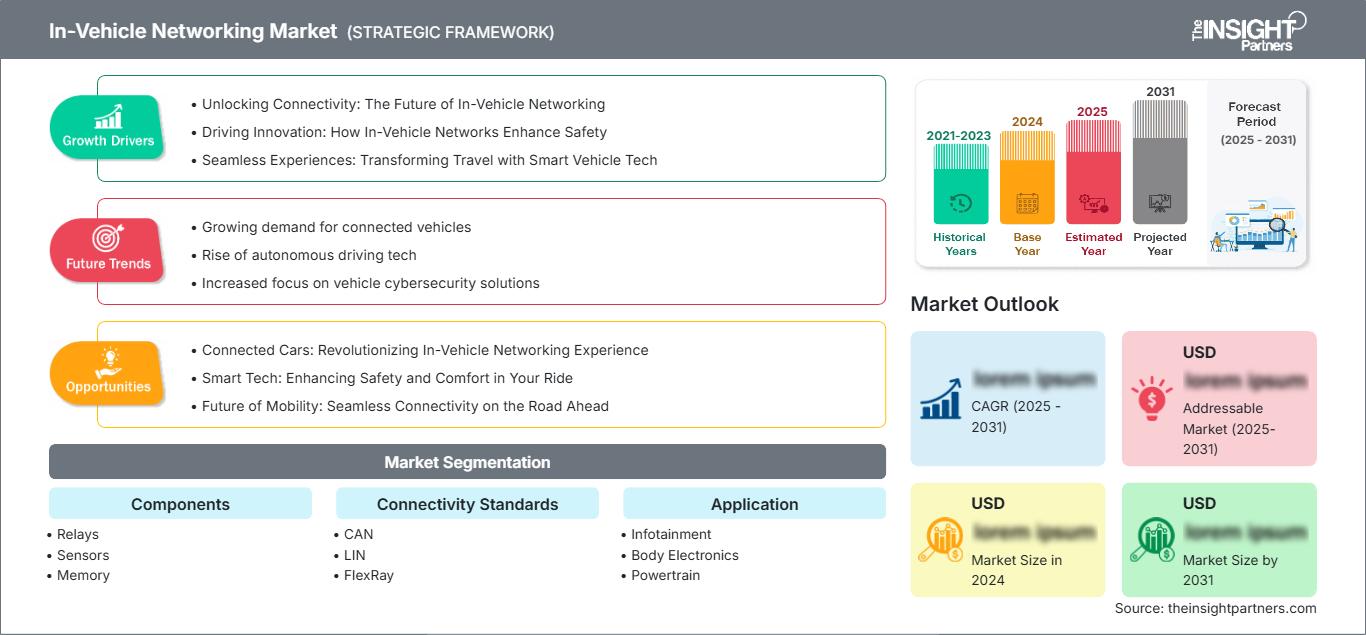
In-Vehicle Networking Market: Strategic Insights
Regional Insights
North America In-Vehicle Networking Market
North America is estimated to account for 31–35% of global demand in 2025 and expand at a CAGR of 9.1–9.8% through 2034. The US dominates regional consumption because major vehicle manufacturers, technology developers, semiconductor companies, and mobility innovators are concentrated there. Increasing deployment of ADAS, connected infotainment, and centralized computing is strengthening demand for higher-bandwidth networks.
There is an additional impact that vehicle software development and cybersecurity standards have on the choice of architecture. In the U.S., OEM programs tend to assess the use of Ethernet backbone, zonal control systems, and gateways instead of very distributed electronic systems. While Canada plays a role in the area of automotive manufacturing and technology, Mexico derives an advantage from joint North American automotive production.
U.S. In-Vehicle Networking Market
North America's United States accounts for an estimated 78-82% of the region’s In-Vehicle Networking Market Share in 2025, registering a CAGR of 9.2%-9.9% during the period up to 2034. This is attributed to wide-scale implementation of vehicle electronics, superior OEM engineering capabilities and early mover advantage in self-driving vehicles, electrification, and connected transportation. Leading suppliers work closely with automakers and Tier 1 companies in the US.
Automotive network usage has progressed beyond traditional body electronics and powertrain electronics communication to ADAS, digital cockpits, telematics, and centralized computing. While CAN plays an important role in mature control functions, Ethernet is becoming critical for camera, displays, gateways, and backbones. Some of the leading suppliers in the region include Analog Devices, Inc., Broadcom Inc., Microchip Technology Inc., and Texas Instruments Incorporated.
Europe In-Vehicle Networking Market
The Europe segment is expected to have a share of 25–29% and experience a CAGR of 8.8–9.5% between 2025 and 2034. Germany represents the largest country in terms of adoption rate due to its strong premium automotive manufacturing and Tier 1 ecosystem. The United Kingdom brings automotive technology and software, while France, Italy, and Spain feature strong volume in terms of vehicle manufacturing and components.
Strong OEM and suppliers ecosystem of Germany promotes Ethernet backbone and computing and advanced driver assistance systems adoption. Regulatory trends towards vehicle safety, cybersecurity, and emissions are driving greater electronics integration in vehicles. France has an advanced platform of connected and electrified vehicles. Italy has maintained its market due to premium, commercial, and high-performance vehicles. Spain is benefiting from vehicle manufacturing and electrification investments.
APAC In-Vehicle Networking Market
It is projected that APAC will hold a share of 32%-36% of the total 2025 market value and grow at a CAGR of 11.5%-12.3%. The main contributor to the growth in APAC is China, due to its strong production of electric vehicles, connected cars, and semiconductor technologies. Japan and Korea add through its advanced OEM and electronics environment, while India builds its capability in producing vehicle electronics.
Australia is still small but promotes the adoption of connected cars and safety systems. APAC’s industrial policy, EV incentives, semiconductor spending, and increasing domestic automobile production accelerate the networking technology adoption process. Chinese OEMs play an important role in adopting centralized electrical architectures, whereas Japanese and Korean companies focus on reliability and safety.
Middle East & Africa In-Vehicle Networking Market
Middle East and Africa accounts for a relatively small share of total global demand; however, it is poised to grow at a CAGR of 8.0–8.7%. Saudi Arabia drives regional growth with its automotive localization policy, mobility projects, and industrial diversification. The UAE drives demand through premium automobiles, smart mobility programs, and smart infrastructure programs.
South Africa is still a major manufacturer, while the Rest of MEA is driven by automobile imports, commercial vehicles, and infrastructure development. Diversification in energy sector and investment in smart cities drive indirect adoption of connected mobility solutions. Current adoption within the region is focused on passenger vehicles, commercial fleets, and premium applications. Higher-value network architecture is becoming increasingly popular with advanced vehicle electronics.
Segmentation Analysis
Components
Components segment in the In-Vehicle Networking Market are expected to grow at a CAGR of 8.9–9.7% during 2026–2034. Rising electronic content requires greater numbers of sensing, processing, switching, memory, and control devices. Suppliers increasingly integrate networking functionality into automotive-grade semiconductors to reduce wiring, improve diagnostics, and simplify system architecture. This segment remains foundational across conventional and software-defined vehicles.
- Relays: Relays remain important for switching power-intensive vehicle functions and electrical loads. Their demand is linked to body electronics, power distribution, lighting, and thermal-management systems requiring dependable switching and isolation.
- Sensors: Sensors support ADAS, powertrain control, cabin monitoring, and vehicle health functions. Increasing sensor density creates greater networking requirements as data must move reliably toward domain controllers and centralized computing platforms.
- Memory: Automotive memory supports software-intensive ECUs, firmware, maps, diagnostics, and data processing. Increasing software complexity strengthens requirements for higher capacity, endurance, reliability, and secure data retention across vehicle architectures.
- Microcontroller: Microcontrollers remain essential for distributed control, body electronics, power management, and networking interfaces. Demand is shifting toward devices combining processing, safety functions, communication peripherals, and security capabilities.
- Switches: Automotive switches are becoming increasingly important as Ethernet backbones expand. Their strategic role is rising in zonal controllers, gateways, centralized architectures, and deterministic communication systems supporting multiple vehicle domains.
Connectivity Standards
Connectivity Standards are projected to expand at a CAGR of 10.8–11.6% during 2026–2034. Legacy protocols remain important because millions of vehicles use established architectures, but Ethernet is gaining strategic importance as data volumes increase. The In-Vehicle Networking Market scope is therefore widening toward multi-protocol platforms that combine deterministic low-speed communication with high-bandwidth networking.
- CAN: CAN remains widely deployed for robust, cost-sensitive communication across body, chassis, powertrain, and safety systems. Its maturity, reliability, diagnostics, and extensive ecosystem maintain strong relevance in new and existing vehicle platforms.
- LIN: LIN addresses lower-cost body and comfort applications where bandwidth requirements are modest. Its simple architecture and low implementation cost sustain adoption for lighting, mirrors, seats, climate controls, and similar functions.
- FlexRay: FlexRay remains relevant in selected deterministic and safety-oriented applications where predictable timing and robustness are required. Its installed base supports continued use, although newer architectures increasingly evaluate Ethernet alternatives.
- RF: RF connectivity supports wireless vehicle functions, keyless access, tire monitoring, connectivity modules, and emerging cabin applications. Integration with broader vehicle networks increases the importance of secure wireless-to-wired communication.
- Ethernet: Ethernet is expanding rapidly because it supports high bandwidth, scalable backbones, zonal architectures, and data-intensive ADAS and infotainment functions. Its ability to integrate with time-sensitive networking strengthens its strategic importance.
- MOST: MOST continues to serve selected multimedia architectures, particularly legacy infotainment systems. However, Ethernet migration is progressively reducing its strategic role where higher bandwidth and unified network architectures are prioritized.
Application
Application demand is expected to increase at a CAGR of 9.6–10.4% during 2026–2034. Networking requirements differ significantly by application because bandwidth, latency, safety, and reliability vary across vehicle functions. ADAS and infotainment are particularly influential in encouraging high-speed architectures, while body and powertrain systems continue supporting established communication protocols.
- Infotainment: Infotainment requires high bandwidth for displays, audio, connectivity, and digital cockpit functions. Increasing screen resolution and software-defined user experiences are encouraging migration toward Ethernet-based communication backbones.
- Body Electronics: Body electronics include lighting, seats, doors, climate systems, and comfort functions. Cost-efficient communication remains important, supporting continued use of LIN and CAN alongside emerging Ethernet-connected zonal controllers.
- Powertrain: Powertrain networks require deterministic, reliable communication among controllers, sensors, actuators, and energy-management systems. Electrification is adding new communication requirements across battery, inverter, motor, charging, and thermal-management functions.
- Navigation: Navigation systems increasingly integrate positioning, mapping, connectivity, displays, and vehicle data. Higher information density strengthens requirements for fast and secure communication between navigation processors, displays, gateways, and central computing platforms.
- Driver Assistance Systems: Driver assistance systems generate substantial data from cameras, radar, and other sensors. Their increasing complexity makes high-bandwidth, low-latency networking essential for sensor fusion, control decisions, and safety functions.
Opportunity Snapshot
| Application | Revenue Contribution | Trend Tag | Adoption Stage |
|---|---|---|---|
| Infotainment | High | Digital Cockpit | Mature |
| Body Electronics | High | Zonal Control | Scaling |
| Powertrain | High | EV Control | Scaling |
| Navigation | Medium | Connected Maps | Scaling |
| Driver Assistance Systems | High | Sensor Fusion | Scaling |
In-Vehicle Networking Market Growth Drivers and Impact Analysis
Expansion of Software-Defined Vehicle Architectures
Software-defined vehicles are changing how automotive functions are organized, updated, and interconnected. Centralized computing and zonal architectures require communication networks that can transport data between sensors, controllers, actuators, and software platforms with predictable performance. This transition increases demand for Ethernet switches, PHYs, gateways, microcontrollers, and security functions while preserving CAN and LIN for cost-sensitive edge applications. The impact extends beyond individual components because OEMs must redesign wiring, diagnostics, software interfaces, and network management. Suppliers capable of offering interoperable hardware and software can participate earlier in vehicle architecture decisions. The shift also creates opportunities for networking companies to move from component sales toward platform-level engagements involving reference designs, development software, security tools, and lifecycle support.
Rising ADAS and Sensor Data Requirements
ADAS is increasing the volume, speed, and criticality of data exchanged within vehicles. Cameras, radar, ultrasonic sensors, displays, and control units must communicate with increasingly centralized processing platforms. This requirement is accelerating adoption of high-bandwidth Ethernet and specialized connectivity technologies while increasing demand for deterministic communication and functional-safety capabilities. The market impact is strongest in premium vehicles and new EV platforms, where advanced assistance features are being integrated alongside digital cockpits and connected services. As sensor counts rise, OEMs also seek lower wiring complexity and improved diagnostics. Networking suppliers therefore benefit from solutions that combine physical-layer performance, switching, security, and safety certification. These requirements are also encouraging stronger collaboration among semiconductor vendors, Tier 1 suppliers, software companies, and automakers.
Electrification and Increasing Electronic Content per Vehicle
Vehicle electrification is creating additional electronic control requirements across batteries, inverters, motors, charging systems, thermal management, and energy optimization. Electric vehicles also support increasingly sophisticated software features, increasing the number of controllers and the volume of data exchanged between them. This raises networking requirements across both high-speed backbone connections and lower-cost edge nodes. The impact is particularly significant where OEMs redesign electrical and electronic architectures rather than simply replacing combustion powertrains with electric drivetrains. Integrated networking components can reduce wiring, simplify gateway structures, and support more flexible software deployment. Semiconductor manufacturers are responding with automotive-qualified microcontrollers, transceivers, Ethernet PHYs, switches, and security functions. Consequently, electrification is expanding the addressable component base while encouraging more standardized communication architectures.
In-Vehicle Networking Market Future Trends
Ethernet Extending Toward the Vehicle Network Edge
The next phase of networking development is expected to extend Ethernet beyond central backbones toward sensors, actuators, and other edge nodes. Low-cost Single Pair Ethernet technologies can reduce gateway requirements while allowing simpler devices to participate in unified network architectures. This trend should encourage development of smaller PHYs, integrated MAC-PHY devices, and endpoint technologies optimized for automotive environments. The In-Vehicle Networking Market trends will increasingly reflect the need to balance Ethernet scalability with CAN-like simplicity at the edge. Functional safety, electromagnetic compatibility, power efficiency, and cybersecurity will remain critical selection criteria. Suppliers that simplify edge deployment through integrated hardware and software are likely to gain influence as OEMs seek standardized architectures that reduce wiring complexity and support centralized software management.
Greater Convergence of Networking, Computing, and Security
Vehicle networking is expected to converge more closely with processing and cybersecurity as centralized architectures mature. Future network controllers and gateways will increasingly combine switching, compute acceleration, hardware security, diagnostics, and time-sensitive networking. This convergence can reduce latency between communication and processing while simplifying system-level integration. It may also shift purchasing decisions from individual networking components toward validated platform solutions. OEMs are likely to evaluate network performance alongside cybersecurity lifecycle support, software update mechanisms, and functional-safety evidence. Semiconductor vendors with broader processing portfolios can therefore use networking products to deepen system-level relationships. Over time, network management software and automated configuration tools should become more important because vehicle architectures will contain larger numbers of interconnected endpoints and dynamically managed communication paths.
In-Vehicle Networking Market Opportunities
Investment in Open and Interoperable Automotive Connectivity
Automotive suppliers can pursue opportunities created by the industry's movement toward open networking standards and interoperable architectures. Technologies associated with Automotive SerDes Alliance initiatives and Ethernet-based communication can reduce dependence on proprietary links and support multi-vendor ecosystems. Investors and suppliers should prioritize products that offer standards compliance, functional-safety readiness, security, and straightforward migration from existing platforms. The opportunity is particularly relevant for ADAS and digital cockpit applications, where high-speed communication requirements are increasing rapidly. Partnerships with OEMs, Tier 1 suppliers, and software developers can accelerate validation and create reference architectures that become reusable across vehicle platforms. The In-Vehicle Networking Market Forecasts should therefore favor companies able to combine standards participation, silicon capabilities, development tools, and long-term automotive qualification support.
Regional Manufacturing and Localization of Networking Components
Localization offers another opportunity as automakers and semiconductor companies seek resilient supply chains for strategically important automotive electronics. India, Southeast Asia, China, Mexico, and selected European locations are expanding manufacturing and engineering capabilities, creating opportunities for suppliers to establish application centers, testing operations, and regional production partnerships. Networking products can benefit from localized design support because automotive qualification and integration often require close interaction with OEM engineering teams. Companies can also differentiate through multi-source manufacturing, long-term supply agreements, and regionally adapted development platforms. Investments should focus on products with broad protocol compatibility and scalable production requirements rather than narrow legacy applications. Regional expansion can improve customer responsiveness while reducing supply-chain concentration and strengthening participation in emerging vehicle production ecosystems.
Recent Developments
- April 2026: Analog Devices, Inc. released A²B 2.0 for production, providing four times the bandwidth of the previous generation and Ethernet tunneling through the Open Alliance SPI interface. The technology targets next-generation vehicle audio and software-defined vehicle architectures while maintaining deterministic low latency and compatibility with existing A²B cabling.
- May 2026: NXP Semiconductors N.V. collaborated with Quanta to develop deterministic zonal networking for software-defined vehicles. The solution combines NXP S32 processing, TSN-enabled networking, CAN and LIN connectivity, and power management to support predictable communication and scalable zonal architectures. Demonstrations were planned through 2026, strengthening the company's positioning around integrated vehicle-network platforms.
- May 2026: Microchip Technology Inc. introduced LAN878x and LAN888x Single Pair Ethernet PHY families supporting 100BASE-T1 and 1000BASE-T1 connectivity. The devices integrate MACsec, TSN, and functional-safety features for automotive systems, targeting ADAS, zonal gateways, and safety-critical networks while supporting scalable network architectures.
Frequently Asked Questions

- Comprehensive Market Sizing and Forecast Analysis
- Detailed Segmentation Analysis
- In-Depth Market Dynamics Assessment
- Regional and Country-Level Insights
- Competitive Landscape and Company Benchmarking
- Strategic Business Intelligence
Recent Reports
Testimonials

The Insight Partners provided valuable market intelligence that supported our global go-to-market strategy. Their team was professional, responsive, and attentive to our feedback, providing thoughtful analysis and helpful methodological clarifications throughout the project.
Junmo Kim Chief Financial Officer (CFO), Enertech Co., Ltd.
The Insight Partners' SCADA System Market report is comprehensive, with valuable insights on current trends and future forecasts. The team was highly professional, responsive, and supportive throughout. We are very satisfied and highly recommend their services.
RAN KEDEM Partner, Reali Technologies LTDs
I requested a report on a very specific software market and the team produced the report in a few days. The information was very relevant and well presented. I then requested some changes and additions to the report. The team was again very responsive and I got the final report in less than a week.
JEAN-HERVE JENN Chairman, Future Analytica
We worked with The Insight Partners for an important market study and forecast. They gave us clear insights into opportunities and risks, which helped shape our plans. Their research was easy to use and based on solid data. It helped us make smart, confident decisions. We highly recommend them.
PIYUSH NAGPAL Sr. Vice President, High Beam Global
The Insight Partners delivered insightful, well-structured market research with strong domain expertise. Their team was professional and responsive throughout. The user-friendly website made accessing industry reports seamless. We highly recommend them for reliable, high-quality research services
YUKIHIKO ADACHI CEO, Deep Blue, LLC.
This is the first time I have purchased a market report from The Insight Partners.While I was unsure at first, I visited their web site and felt more comfortable to take the risk and purchase a market report.I am completely satisfied with the quality of the report and customer service. I had several questions and comments with the initial report, but after a couple of dialogs over email with their analyst I believe I have a report that I can use as input to our strategic planning process.Thank you so much for taking the extra time and making this a positive experience.I will definitely recommend your service to others and you will be my first call when we need further market data.
JOHN SUZUKI President and Chief Executive Officer, Board Director, BK Technologies
I wish to appreciate your support and the professionalism you displayed in the course of attending to my request for information regarding to infectious disease IVD market in Nigeria. I appreciate your patience, your guidance, and the fact that you were willing to offer a discount, which eventually made it possible for us to close a deal. I look forward to engaging The Insight Partners in the future, all thanks to the impression you have created in me as a result of this first encounter.
DR CHIJIOKE ONYIA MANAGING DIRECTOR, PineCrest Healthcare Ltd.Reason to Buy
- Informed Decision-Making
- Understanding Market Dynamics
- Competitive Analysis
- Identifying Emerging Markets
- Customer Insights
- Market Forecasts
- Risk Mitigation
- Boosting Operational Efficiency
- Strategic Planning
- Investment Justification
- Tracking Industry Innovations
- Aligning with Regulatory Trends





 Get Free Sample for