
Indoor Small Pitch LED Display Market Size, Growth & Demand by 2034
Coverage: By Type (P2.1-P2.5 mm, P1.7-P2.0 mm, P1.3-P1.69 mm, Others); Application (Residential, Government, Organizational, Commercial) , and Geography (North America, Europe, Asia Pacific, and South and Central America)
- Status : Data Released
- Report Code : TIPRE00022386
- Category : Electronics and Semiconductor
- No. of Pages : 150
- Available Report Formats :


- Last update date : September 28, 2026


2025 Market Size
US$ 2.70 Bn
Base year value
2034 Forecast
US$ 6.52 Bn
Projected by 2034
CAGR 2026-2034
10.29 %
Growth rate
Addressable Market
US$ 40.93 Bn
(2026-2034)
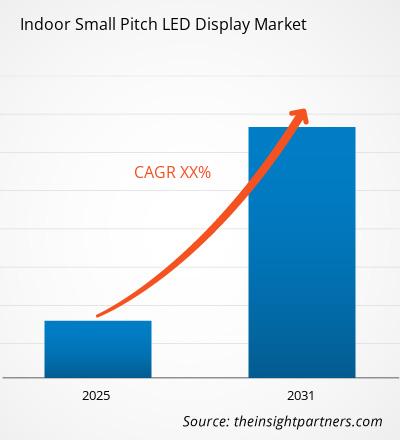
The Indoor Small Pitch LED Display Market is valued at US$ 2.70 Billion in 2025 and is projected to reach US$ 6.52 Billion by 2034, registering a CAGR of 10.29% during 2026–2034. The market encompasses fine-pitch LED systems designed for close-viewing indoor environments, where image continuity, high pixel density, color consistency, and installation flexibility increasingly influence technology selection across commercial, organizational, government, and residential settings.
North America remains an important adoption center as corporate visualization, premium retail, broadcast production, and command environments increasingly prioritize seamless large-format displays. The regional outlook is supported by replacement of tiled LCD walls, demand for higher-resolution visualization, and wider deployment of LED in executive collaboration and immersive environments. The Indoor Small Pitch LED Display size opportunity is also expanding as lifecycle economics become more favorable.
Indoor Small Pitch LED Display Market Assessment and Insights
- North America: North America is expected to represent a 24–28% Indoor Small Pitch LED Display Market share in 2025, growing at a 9.2–10.1% CAGR between 2026–2034. Demand is supported by corporate visualization, broadcast studios, control rooms, premium retail, and replacement of conventional video-wall technologies.
- US: The US accounts for 78–83% of North American demand in 2025, with a 9.4–10.3% CAGR between 2026–2034, supported by enterprise modernization and immersive visualization deployments.
- Europe: Europe is estimated at a 20–24% share in 2025 and is projected to expand at a 9.0–9.9% CAGR between 2026–2034. Germany, the UK, France, Italy, and Spain lead adoption through corporate, government, broadcast, retail, and cultural installations.
- Asia Pacific: Asia Pacific is estimated at a 38–42% share in 2025 and is expected to grow at a 11.0–12.2% CAGR between 2026–2034. China, Japan, South Korea, and India benefit from manufacturing depth, technology development, venue investment, and expanding commercial infrastructure.
- Largest Segment: P2.1-P2.5 mm is estimated to hold a 47–52% market share in 2025, with a 9.0–9.8% CAGR during 2026–2034, reflecting broad cost-performance acceptance.
- High Growth Segment: P1.3-P1.69 mm is estimated at an 18–22% market share in 2025 and is projected to achieve a 13.0–14.5% CAGR during 2026–2034.
- Key companies analyzed in detail: Shenzhen Absen Optoelectronic Co., Ltd., Barco NV, Shenzhen Eastar Electronic Co., Ltd., Leyard Optoelectronic Co., Ltd., Sansi Electronic Engineering Co., Ltd., Shenzhen Liantronics Co., Ltd., SiliconCore Technology, Inc., Triolion Technology Co., Ltd., Unilumin Group Co., Ltd., and VTRON Group Co., Ltd.
Source: The Insight Partners' analysis based on proprietary research, government publications, company annual reports, investor presentations, industry databases, and expert interviews.
From traditional SMD design, production economics are moving towards high-density packing such as COB and MIP solutions. Fine pixel pitches are being integrated with enhanced calibration, reduced power consumption, front maintainability, modular enclosures, and improved refresh rates. Such factors increase the use of LED for close view applications where the uniformity and reliability of images becomes a priority compared to screen size. Vertical integration in the supply chain is increasing.
In the coming years, capital investments in the Indoor Small Pitch LED Display Market will be more inclined to small-pitch solutions, local service networks, and customized setups. New demand for products in India, Southeast Asia, Gulf countries, and certain European regions will help diversify production-driven growth. Regulations on energy efficiency, e-waste, procurement criteria, and sustainability disclosures will encourage vendors to provide long service life and low power consumption.
Indoor Small Pitch LED Display Market Report Scope
| Report Attribute | Details |
|---|---|
| Market size in 2025 | US$ 2.70 Billion |
| Market Size by 2034 | US$ 6.52 Billion |
| Global CAGR (2026 - 2034) | 10.29% |
| Historical Data | 2021-2024 |
| Forecast period | 2026-2034 |
Indoor Small Pitch LED Display Market Analysis
The value chain involves chip providers, packagers, driver and controller companies, cabinet suppliers, software companies, integrators, and end customers. Consequently, the Indoor Small Pitch LED Display success curve is determined by not only by component economics but also by project economics. Cheaper packaging lowers the entry barriers, whereas the need for a seamless image motivates the customer to substitute their tiled LCD display with an LED one.
More often than not, the market demand stems from the need to have a continuous visual surface, such as control rooms, experience centers for corporate clients, retail stores, studios, museums, and upscale hotels. Procurement takes into account the pixel pitch, viewing distance, brightness, calibrations, accessibility for maintenance and cooling, and warranty support. Companies that possess integrated engineering skills can simplify the project process.
Differentiation in competitive positioning in the Indoor Small Pitch LED Display Market can be observed through the combination of hardware development with software, services, and applications. For instance, Shenzhen Absen Optoelectronic Co., Ltd. specializes in the broadest range of LEDs and worldwide services, whereas Barco NV specializes in professional visualization and processing. Similarly, Leyard Optoelectronic Co., Ltd. and Unilumin Group Co., Ltd. specialize in the breadth of technologies and manufacturing volume.
Further investments in the Indoor Small Pitch LED Display Market are being made into the areas of COB, MIP, optical calibration, thermal management, and energy-saving drive design. Shenzhen Liantronics Co., Ltd. and its Esdlumen brand, together with Sansi Electronic Engineering Co., Ltd., SiliconCore Technology, Inc., Triolion Technology Co., Ltd., and VTRON Group Co., Ltd., specialize in various combinations of fine pitch, professional visualization, and installation. It can be concluded that the Indoor Small Pitch LED Display analysis highlights competition in terms of Total Ownership Value rather than only panel price.
● REPORT CUSTOMIZATION
Tailor This Report To Align With Your Specific Business Requirements
This report can be customized to align precisely with your business objectives, scope, and target markets. Customization options include tailored segmentation, geography, competitive analysis, and strategic insights to support informed decision-making.
Customize This Report →WHAT YOU CAN ADJUST
- ● Segmentations
- ● Geography
- ● Competitive Analysis
- ● Language Preferences
Indoor Small Pitch LED Display Market: Strategic Insights

Regional Insights
North America Indoor Small Pitch LED Display Market
According to the Indoor Small Pitch LED Display Market report, North America is estimated to command a 24–28% share in 2025 and is projected to expand at a 9.2–10.1% CAGR through 2034. While the US is the leader in demand for the region, Canada and Mexico represent secondary markets with growing potential. Corporate offices, broadcast centers, government command centers, and high-end retail make up the main sources of demand.
The impact of replacement schedules is becoming more significant for life-cycle cost considerations, aesthetic consistency, and maintainability issues. The direct-view LED product is sought when constant use, custom size, and proximity viewing warrant the cost. Procurement practices incorporating professional AV system specifications and power considerations have an influence on the specification of efficient power and modular designs.
U.S. Indoor Small Pitch LED Display Market
The US represents approximately 78–83% of North American revenue in 2025, equivalent to roughly 19–23% of global demand, and is projected to grow at a 9.4–10.3% CAGR. Applications include enterprise experience centers, command rooms, studios, higher education, retail, and entertainment venues.
The Indoor Small Pitch LED Display Market forecast shows that competitive landscape consists of worldwide competitors and specialized integrators catering to sophisticated setups. Requirements are leaning more towards the range of P1.3-P1.69mm and below, in which viewers will be viewing the screen from up close. Buyers have started assessing aspects like operating power, image uniformity, maintainability, and compatibility with control platforms, in addition to hardware costs. As such, the market share in North America depends on quality specifications.
Europe Indoor Small Pitch LED Display Market
Europe is estimated at a 20–24% share in 2025 and is projected to grow at a 9.0–9.9% CAGR through 2034. Germany is the dominant market, followed by the United Kingdom, France, Italy, and Spain. UK demand includes broadcast applications, business communication, entertainment, and high-end retail, whereas Germany concentrates on industrial visualization, control rooms, and business installations. In France, there is cultural, governmental, and retail use. In Italy and Spain, hospitality, sports, events, and business upgrading form the basis for demand. There is growing consideration of energy efficiency, durability, maintainability, and electronics management in procurement. European buyers are also paying increasing attention to standards conformance and lifecycle performance predictability.
APAC Indoor Small Pitch LED Display Market
APAC holds an estimated 38–42% share in 2025 and is projected to grow at an 11.0–12.2% CAGR. China remains the leading market, supported by manufacturing scale, while Japan and South Korea emphasize advanced visualization. India is expanding through commercial infrastructure and digital modernization, with Australia providing specialized demand.
Industrial investment, smart-city programs, broadcast upgrades, and large venue development support adoption. China’s integrated supply chain accelerates product innovation and cost optimization, while India and Southeast Asia offer expanding installation opportunities. Government digitization and corporate modernization further support regional demand.
Middle East & Africa Indoor Small Pitch LED Display Market
MEA is projected to expand at an 8.8–10.0% CAGR. Saudi Arabia leads regional opportunity, followed by the UAE and South Africa, while the rest of MEA develops through hospitality, government, retail, and entertainment projects. Large infrastructure programs create demand for high-impact indoor visualization.
Saudi Arabia and the UAE benefit from venue development, tourism investment, and smart-infrastructure programs. South Africa remains the principal Southern African market, supported by corporate and broadcast applications. Energy costs encourage efficient systems, while expanding digital infrastructure improves the feasibility of sophisticated indoor display deployments.
Segmentation Analysis
Type
Type segmentation determines the balance between resolution, viewing distance, installation economics, and application sophistication. The Indoor Small Pitch LED Display scope increasingly favors tighter pitches as LED package yields improve and buyers become more comfortable with direct-view technology. The main Type segment is projected to grow at a 9.8–10.7% CAGR during 2026–2034.
- P2.1-P2.5 mm: This range remains strategically important because it provides a practical balance between pixel density and project economics. It is widely suited to meeting rooms, retail environments, institutional spaces, and medium-distance viewing applications.
- P1.7-P2.0 mm: This range serves installations requiring stronger image definition at shorter distances. It is particularly relevant to corporate visualization, studios, control rooms, premium hospitality, and applications where seamless imagery is prioritized.
- P1.3-P1.69 mm: This range addresses premium close-viewing environments requiring higher pixel density. Its strategic importance is increasing in command centers, immersive installations, executive spaces, high-end retail, and applications using detailed graphical content.
Application
Application segmentation reflects differences in procurement criteria, operating schedules, content requirements, and project economics. Commercial and organizational users typically prioritize visual impact and integration, while government installations emphasize reliability and continuity. The main Application segment is projected to expand at a 10.4–11.3% CAGR during 2026–2034.
- Residential: Residential adoption is concentrated in premium homes, private entertainment rooms, luxury developments, and custom media environments. Demand depends heavily on aesthetics, acoustic integration, low operating noise, installation flexibility, and the ability to deliver cinema-scale images.
- Government: Government projects emphasize reliability, security, serviceability, and long operating periods. Applications include command centers, public communication facilities, municipal visualization rooms, and institutional environments requiring dependable display performance.
- Organizational: Organizational deployments include corporate headquarters, conference facilities, training centers, studios, universities, and data visualization environments. Procurement commonly emphasizes collaboration, presentation quality, interoperability, and long-term maintenance support.
- Commercial: Commercial applications include retail, hospitality, entertainment, advertising, and experiential spaces. Buyers increasingly use large seamless surfaces to create differentiated environments, support dynamic content, and improve audience engagement.
Opportunity Snapshot
| Application | Revenue Contribution | Trend Tag | Adoption Stage |
| Residential | Low | Home Cinema | Emerging |
| Government | Medium | Command Centers | Scaling |
| Organizational | High | Hybrid Workspaces | Scaling |
| Commercial | High | Immersive Retail | Mature |
Indoor Small Pitch LED Display Market Growth Drivers and Impact Analysis
Expansion of Immersive and Experiential Indoor Environments
In commercial environments, large-format digital surfaces have become a popular way to deliver a differentiated customer experience as opposed to displaying simple data. There is an increasing possibility of using seamless LED walls in retailers, hospitality, museums, entertainment, and corporate experience centers for content delivery and story-telling through integration into architecture. This trend increases the number of installations due to the possibility of configuring LEDs in non-standard formats without visible seams typical of tiles. Such applications benefit from frequent changes in content and the importance of good image quality to visitor experience. Providers of services combining displays with content management, calibration, and installation engineering can increase their share of project revenue.
Replacement of Conventional Tiled Display Architectures
One significant structural factor in the Indoor Small Pitch LED Display Market includes the replacement of traditional LCD video wall technology and projector technology for uses that require large-format images. LED screens do away with the need for physical bezels and have the capability to offer more flexibility in size, brightness, and usage patterns. When considering lifecycle cost analysis, issues like module replacement, calibration reliability, downtime, and maintenance accessibility play an increasing role in the purchasing decision. In such a scenario, manufacturers who are able to offer durable modules and maintenance capabilities gain a competitive edge. The need for replacement is especially high in environments like command centers, briefing facilities within corporations, broadcasting studios, and high-end commercial facilities where downtime costs money.
Advances in COB, MIP, Calibration, and Power Management
The developments in technology are reducing the practical obstacles to pixel pitches. With the help of COB or MIP technologies, there are possibilities of enhancement in protection, integration, contrast ratio, and pixel density as well as calibration minimizes the distinction between modules. Efficient driver technologies and thermodynamic considerations would enable manufacturers to resolve problems related to energy consumption and endurance at the same time. Such advancements make it possible for the producers to focus on the markets which were depending on LCD or projectors because of issues related to reliability, energy consumption, or quality of images. The competitive advantage is important because differentiation would be based on performance instead of only pixel pitch.
Indoor Small Pitch LED Display Market Future Trends
AI-Assisted Display Management and Content Intelligence
The Indoor Small Pitch LED Display Market trends show that systems of the future will incorporate the use of AI for monitoring, automatic calibration, predictive maintenance, and smart content optimization. Rather than seeing the LED display wall as simply an endpoint, users will see it more and more as a connected visual interface capable of detecting faulty modules and keeping track of consistent brightness levels and optimizing operations. In a commercial setting, analysis can be used to link the performance of screens to viewer habits and scheduling of content. In a command and corporate setting, the use of intelligent monitoring can prioritize availability and maintenance alerts. In either case, such developments will make the hardware less important relative to software and services.
Micro-Scale Pitch Migration and Hybrid Packaging
The next technology cycle will continue pushing toward smaller pixel pitches while balancing yield, thermal performance, manufacturability, and cost. COB and MIP architectures are likely to become more prominent as manufacturers seek smaller emitters, improved surface protection, higher contrast, and more consistent close-viewing performance. Hybrid packaging may allow suppliers to tailor products to different viewing distances without creating completely separate manufacturing platforms. As prices decline, applications previously restricted to premium control rooms or luxury environments can migrate into mainstream corporate, retail, and hospitality projects. This trend will also encourage more standardized cabinet dimensions, simplified maintenance, and improved front-access designs. Smaller pitch will consequently become a broader design choice rather than an exclusively high-end specification.
Indoor Small Pitch LED Display Market Opportunities
Localized Service Networks in Emerging Installation Markets
Manufacturers can capture incremental value by establishing regional service centers, spare-module inventories, certified installers, and technical training programs in India, Southeast Asia, the Gulf, and selected European markets. These markets increasingly require suppliers to provide more than hardware because installation quality and post-sale support directly affect uptime and customer confidence. A localized model can shorten response times, reduce logistics exposure, and improve compliance with local procurement requirements. Vendors can also partner with integrators rather than building every downstream capability internally. The opportunity is especially relevant for fine-pitch installations, where calibration and module replacement require trained technicians. Strategic investment in service infrastructure can therefore create differentiation without relying solely on product pricing.
Premium Application Packages for Corporate and Commercial Buyers
Suppliers can increase project value by packaging LED hardware with processing, content management, acoustic coordination, installation engineering, remote monitoring, and lifecycle service. Corporate headquarters, retail flagships, hospitality venues, and experiential spaces increasingly need integrated outcomes rather than standalone panels. Vendors that develop standardized solutions for meeting rooms, executive briefing centers, immersive retail, and entertainment venues can reduce project design time while preserving customization. Partnerships with AV integrators, architects, interior designers, and software providers can extend reach into specification stages where technology decisions are often made. The Indoor Small Pitch LED Display Forecasts therefore favor suppliers capable of translating technical capabilities into repeatable application packages with predictable deployment and operating costs.
Recent Developments
- July 2026: INFiLED launched its GeminiLED Series, an ultra-thin dual-sided LED display designed for public spaces including airports, rail hubs, retail atriums, and corporate lobbies. The display features two independently operated faces within a 25.5 mm structure, with suspended and freestanding configurations supporting wayfinding, branding, service updates, and visitor communications.
- May 2026: Samsung Electronics America launched its IBF Series indoor LED display for window-facing retail, quick-service restaurant, and live-venue environments. The display offers brightness up to 3,500 nits, flexible landscape and portrait installation, a 1.7-inch depth, and integration with Samsung’s cloud-based VXT platform for content and device management.
- December 2025: Daktronics acquired intellectual property, equipment assets, and technical expertise from X Display Company Technology Limited to expand its MicroLED and MicroIC capabilities. The transaction included proprietary mass-transfer and MicroLED fabrication technologies, specialized development equipment, and the integration of 15 experienced employees.
Frequently Asked Questions

- Comprehensive Market Sizing and Forecast Analysis
- Detailed Segmentation Analysis
- In-Depth Market Dynamics Assessment
- Regional and Country-Level Insights
- Competitive Landscape and Company Benchmarking
- Strategic Business Intelligence
Recent Reports
Testimonials

The Insight Partners provided valuable market intelligence that supported our global go-to-market strategy. Their team was professional, responsive, and attentive to our feedback, providing thoughtful analysis and helpful methodological clarifications throughout the project.
Junmo Kim Chief Financial Officer (CFO), Enertech Co., Ltd.
The Insight Partners' SCADA System Market report is comprehensive, with valuable insights on current trends and future forecasts. The team was highly professional, responsive, and supportive throughout. We are very satisfied and highly recommend their services.
RAN KEDEM Partner, Reali Technologies LTDs
I requested a report on a very specific software market and the team produced the report in a few days. The information was very relevant and well presented. I then requested some changes and additions to the report. The team was again very responsive and I got the final report in less than a week.
JEAN-HERVE JENN Chairman, Future Analytica
We worked with The Insight Partners for an important market study and forecast. They gave us clear insights into opportunities and risks, which helped shape our plans. Their research was easy to use and based on solid data. It helped us make smart, confident decisions. We highly recommend them.
PIYUSH NAGPAL Sr. Vice President, High Beam Global
The Insight Partners delivered insightful, well-structured market research with strong domain expertise. Their team was professional and responsive throughout. The user-friendly website made accessing industry reports seamless. We highly recommend them for reliable, high-quality research services
YUKIHIKO ADACHI CEO, Deep Blue, LLC.
This is the first time I have purchased a market report from The Insight Partners.While I was unsure at first, I visited their web site and felt more comfortable to take the risk and purchase a market report.I am completely satisfied with the quality of the report and customer service. I had several questions and comments with the initial report, but after a couple of dialogs over email with their analyst I believe I have a report that I can use as input to our strategic planning process.Thank you so much for taking the extra time and making this a positive experience.I will definitely recommend your service to others and you will be my first call when we need further market data.
JOHN SUZUKI President and Chief Executive Officer, Board Director, BK Technologies
I wish to appreciate your support and the professionalism you displayed in the course of attending to my request for information regarding to infectious disease IVD market in Nigeria. I appreciate your patience, your guidance, and the fact that you were willing to offer a discount, which eventually made it possible for us to close a deal. I look forward to engaging The Insight Partners in the future, all thanks to the impression you have created in me as a result of this first encounter.
DR CHIJIOKE ONYIA MANAGING DIRECTOR, PineCrest Healthcare Ltd.Reason to Buy
- Informed Decision-Making
- Understanding Market Dynamics
- Competitive Analysis
- Identifying Emerging Markets
- Customer Insights
- Market Forecasts
- Risk Mitigation
- Boosting Operational Efficiency
- Strategic Planning
- Investment Justification
- Tracking Industry Innovations
- Aligning with Regulatory Trends





 Get Free Sample for