
Industrial Bluetooth Market Demand, Share & Growth by 2034
Coverage: By Type (Single-mode module, Dual-mode module); Application (Water and wastewater, Power, Oil and gas, Mining), and Geography (North America, Europe, Asia Pacific, and South and Central America)
- Status : Data Released
- Report Code : TIPRE00016983
- Category : Electronics and Semiconductor
- No. of Pages : 150
- Available Report Formats :


- Last update date : October 16, 2026


2025 Market Size
US$ 4.79 Bn
Base year value
2034 Forecast
US$ 9.50 Bn
Projected by 2034
CAGR 2026-2034
7.91 %
Growth rate
Addressable Market
US$ 64.30 Bn
(2026-2034)
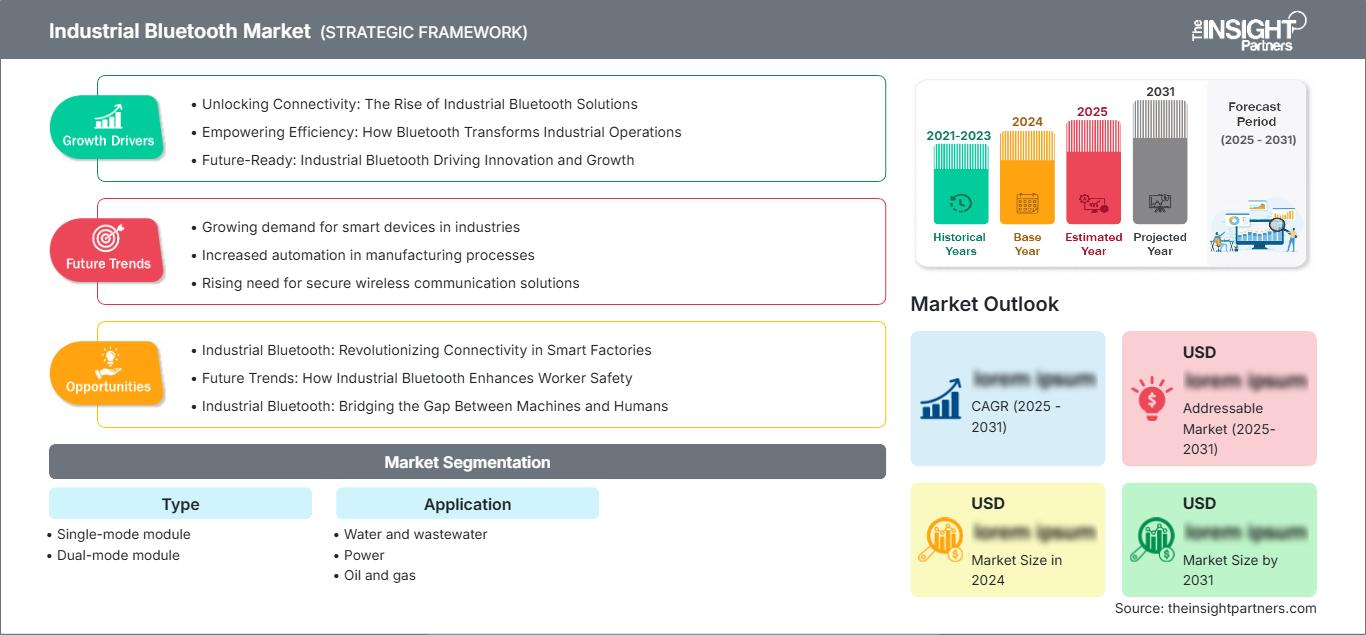
The Industrial Bluetooth Market is positioned for sustained expansion as industrial facilities adopt low-power wireless connectivity for sensing, asset tracking, machine monitoring, and operator mobility. The market is valued at US$ 4.79 Billion in 2025 and is projected to reach US$ 9.50 Billion by 2034, registering a CAGR of 7.91% during 2026–2034. Growth reflects increasing integration of Bluetooth-enabled modules into industrial equipment, gateways, sensors, and connected infrastructure.
North America Industrial Bluetooth Market Size is expected to remain a major industrial deployment center, with an estimated CAGR of 8.1–8.6% through 2034. Mature industrial automation, investment in connected utilities, and demand for low-maintenance wireless sensing are supporting adoption. The region also benefits from established semiconductor ecosystems and strong developer availability, enabling Bluetooth solutions to move from pilot projects toward repeatable deployments across manufacturing, energy, and infrastructure environments.
Industrial Bluetooth Market Assessment and Insights
- North America: North America is projected to command a 31–34% share in 2025 and expand at a CAGR of 8.1–8.6% between 2026–2034, supported by industrial automation, connected utilities, and mature wireless technology ecosystems.
- US: The US represents approximately 25–28% of the global market in 2025 and is expected to grow at a CAGR of 8.2–8.7% through 2034, led by manufacturing modernization and industrial IoT.
- Europe: Europe is estimated to hold a 25–28% share in 2025 and grow at a CAGR of 7.6–8.1% through 2034, with Germany, the UK, France, and Italy benefiting from smart-factory and process-automation investments.
- Asia Pacific: Asia Pacific is estimated at 29–32% share in 2025 and is expected to register a CAGR of 8.6–9.2% through 2034, led by China, Japan, South Korea, and India as connected manufacturing expands.
- Largest Segment: Single-mode module is estimated to hold a 55–60% market share in 2025, with a 7.9–8.5% CAGR during 2026–2034 as low-power industrial sensors proliferate.
- High Growth Segment: Power application is estimated at a 21–25% share in 2025 and is projected to grow at a 8.5–9.1% CAGR as utilities modernize monitoring infrastructure.
- Key companies analyzed in detail: Advantech Co., Ltd.; Cypress Semiconductor Corporation; Dialog Semiconductor plc; Intel Corporation; Microchip Technology Inc.; Nordic Semiconductor ASA; Phoenix Contact GmbH & Co. KG; STMicroelectronics N.V.; Texas Instruments Incorporated; Silicon Laboratories Inc.
Source: The Insight Partners' analysis based on proprietary research, government publications, company annual reports, investor presentations, industry databases, and expert interviews.
The Industrial Bluetooth Market has moved from its roots as a basic wireless connection system to incorporate low-power and multi-protocol connectivity in sensors, gateways, controllers, and industrial terminals. The use of Bluetooth Low Energy has helped enhance its proposition by reducing energy demands, while other developments such as mesh, long-range communication, and advanced positioning applications have increased its applicability. The production of the product will move towards wireless MCUs and pre-certified modules.
In the future, industrial wireless development is expected to evolve beyond conventional manufacturing into other areas such as utility management, mining, water management, and energy systems. Regulations with respect to cyber security, radio certification, interoperability, and digital infrastructure need to support standardization of connectivity choices. The 2025 vision of the Bluetooth Special Interest Group focuses on industry processes, asset tracking, and positioning technology.
Industrial Bluetooth Market Report Scope
| Report Attribute | Details |
|---|---|
| Market size in 2025 | US$ 4.79 Billion |
| Market Size by 2034 | US$ 9.50 Billion |
| Global CAGR (2026 - 2034) | 7.91% |
| Historical Data | 2021-2024 |
| Forecast period | 2026-2034 |
Industrial Bluetooth Market Analysis
The Industrial Bluetooth Market has been influenced by the need for cheap connectivity that requires low amounts of power from distributed industrial equipment. This means that sensors are able to connect with gateways without much need for cabling, thereby making installations easier in brownfield sites. The market consists of semiconductor companies, industrial module makers, automation firms, system integrators, software companies, and users. According to Bluetooth SIG, Bluetooth is still very relevant in factory floor processes, asset tracking, and industrial connectivity; however, the bigger Bluetooth ecosystem is working towards high volume device connectivity.
Supply side factors are leading to a growing demand for integrated products that incorporate radio, MCU, security, protocol stack and software. This makes things easier for equipment makers, but makes it difficult for industrial vendors to distinguish themselves in power requirements, industrial temperature operation, compatibility, and software development. In other words, semiconductor companies have an opportunity to make money from more than just their radios.
Positioning is becoming more and more dependent on multiprotocol functionality, energy consumption, software development frameworks, and high quality reliability. The Advantech Co., Ltd. is developing wireless capabilities for industrial use, and the Microchip Technology Inc. develops Bluetooth LE modules and platforms for industrial automation. The Nordic Semiconductor ASA focuses on low power Bluetooth LE and multiprotocol SoCs, whereas the STMicroelectronics N.V. combines Bluetooth LE with wider STM32-based embedded solutions.
The competition also consists of Cypress Semiconductor Corporation, Dialog Semiconductor plc, Intel Corporation, Phoenix Contact GmbH & Co. KG, Texas Instruments Incorporated, and Silicon Laboratories Inc. The areas of their positioning include chipsets, modules, industrial gateways, automation devices, and wireless development environments. Increasingly, the companies' investments are oriented towards security, edge computing, improved battery life, and compatibility with existing Ethernet, Wi-Fi, cellular, and industrial communications networks.
● REPORT CUSTOMIZATION
Tailor This Report To Align With Your Specific Business Requirements
This report can be customized to align precisely with your business objectives, scope, and target markets. Customization options include tailored segmentation, geography, competitive analysis, and strategic insights to support informed decision-making.
Customize This Report →WHAT YOU CAN ADJUST
- ● Segmentations
- ● Geography
- ● Competitive Analysis
- ● Language Preferences
Industrial Bluetooth Market: Strategic Insights
Regional Insights
North America Industrial Bluetooth Market
North America is expected to represent a Industrial Bluetooth Market share of 31-34% of global sales in 2025, growing at a CAGR of 8.1-8.6% during 2024-2034. Automation of industries, modernization of utilities, and manufacturing plants provide a good environment for wireless sensor networks. North America represents the leading regional market with a strong semiconductor base and high adoption of IoT architecture in industries.
The need for such applications is observed where re-wiring is not needed. Bluetooth sensing is used in oil & gas sites, utilities, warehouses, process plants for monitoring machine health and worker communication. In addition to the availability of technology suppliers and integrators in the region, the importance of cybersecurity also makes the buyers think about device authentication, software updates, and management.
U.S. Industrial Bluetooth Market
In terms of revenue, the US is expected to hold a 25–28% share of the world’s market and 80–83% of North America in 2025. The US' CAGR is anticipated at 8.2–8.7% up to 2034. It is essential for manufacturing modernization, utility digitalization, warehouse automation, and asset management in the industrial sector, especially for wireless sensors that can work in coordination with wired ones with no significant infrastructure upgrades.
Advantech Co., Ltd., Intel Corporation, Microchip Technology Inc., Texas Instruments Incorporated, and Silicon Laboratories Inc. have their part to contribute in terms of computing, semiconductors, modules, and developmental efforts. The field of application is widening from production facilities to substations, pipelines, water management, and logistics centers. The factors that affect the purchasing process are compatibility, longevity, cyber security, endurance, and Bluetooth capabilities in relation to software and edge computing.
Europe Industrial Bluetooth Market
It is estimated that Europe will have 25-28% market share by 2025, and the forecast growth for the region will be in the range of 7.6-8.1%. German companies have been at the forefront of adopting Bluetooth technology. Reasons why Bluetooth technology is being adopted in the region include digitization of industry, energy efficiency, automation initiatives, and engineering competencies.
Countries with substantial usage of Bluetooth technology include the UK and Germany. The UK benefits from the use of Bluetooth because of its digitized industries and infrastructures, and Germany uses the technology due to its industrial base for sensing, prediction of machine failure, and machine networking. Countries such as France, Italy, and Spain also contribute to the demand because of their process, auto, utility, and logistics industries.
APAC Industrial Bluetooth Market
APAC is forecasted to contribute 29-32% of the 2025 market and to experience the fastest growth rate of 8.6-9.2%. China dominates in APAC and is followed by Japan, South Korea, India, and Australia. Manufacturing scale, production of electronics, utilities transformation, and Industry 4.0 investments drive adoption.
China’s smart factory deployment and Japan’s automation expertise give rise to complementing market dynamics. South Korea takes advantage of electronics and industrial manufacturing, India is growing connected manufacturing and infrastructure, while Australia provides potential for mining, energy, and remote assets monitoring applications. Large electronics production chain in the region makes locally available modules and semiconductors possible.
Middle East & Africa Industrial Bluetooth Market
ME Africa is another small but growing segment with estimated CAGR of 7.4-8.2% till 2034. Among regional countries, Saudi Arabia will be driving the market due to diversified infrastructural investments, industrialization, and digital initiatives. UAE will see growth due to smart infrastructures and connected infrastructures, while South Africa will continue its relevance in mining and industrial application.
The energy-intensive infrastructure, water infrastructures, logistics, and remote industrial installations will be some important end-user segments. Bluetooth can help in supplementing the other wireless technology wherever short-range and low-power sensing is required. As far as Rest of MEA is concerned, adoption will mainly depend on project financing, regional systems integration, industrial upgradement, and availability of rugged equipment.
Segmentation Analysis
Type
The Type segment is divided into Single-mode module and Dual-mode module. The segment is projected to expand at a CAGR of 7.8–8.4% during 2026–2034. Single-mode modules benefit from low power requirements, compact designs, and suitability for distributed sensors, while dual-mode modules retain relevance where compatibility with legacy Bluetooth systems and broader device ecosystems remains necessary.
- Single-mode module: Single-mode modules support battery-powered sensors, asset tags, meters, and monitoring devices where low energy consumption and compact form factors are strategically important for long operating cycles.
- Dual-mode module: Dual-mode modules serve equipment requiring Bluetooth Classic and Bluetooth LE compatibility, supporting migration from established industrial devices while preserving interoperability with existing control and service interfaces.
Application
The Application segment includes Water and wastewater, Power, Oil and gas, and Mining and is projected to register a CAGR of 8.1–8.7% during 2026–2034. Demand is supported by geographically dispersed equipment, monitoring requirements, difficult cabling environments, and the need for continuous visibility into operational assets.
- Water and wastewater: Wireless monitoring can connect pumps, valves, meters, and treatment equipment, reducing cabling requirements and improving visibility across distributed infrastructure with difficult physical access.
- Power: Utilities can apply Bluetooth connectivity to equipment monitoring, maintenance workflows, portable diagnostics, and localized sensing, particularly where wireless links complement established grid communication infrastructure.
- Oil and gas: Wireless sensors support equipment inspection, condition monitoring, worker workflows, and localized data collection across facilities where cabling costs and maintenance complexity can constrain conventional deployments.
- Mining: Mining operators can use low-power wireless connectivity for equipment condition, worker location, environmental sensing, and maintenance support across extensive sites with challenging physical infrastructure.
Opportunity Snapshot
| Application | Revenue Contribution (High/Medium/Low) | Trend Tag | Adoption Stage |
|---|---|---|---|
| Water and wastewater | Medium | Smart Monitoring | Scaling |
| Power | High | Grid Sensing | Scaling |
| Oil and gas | High | Asset Tracking | Scaling |
| Mining | Medium | Remote Monitoring | Emerging |
Industrial Bluetooth Market Growth Drivers and Impact Analysis
Expansion of Wireless Industrial Sensing
Industrial operators increasingly require continuous information from assets that were previously monitored manually or through intermittent inspections. Bluetooth Low Energy provides a practical connectivity layer for sensors because devices can operate with limited power while communicating with nearby gateways, handheld terminals, or controllers. This is particularly relevant for rotating equipment, valves, meters, environmental sensors, and mobile tools. Bluetooth SIG identifies asset tracking, factory workflows, and productivity applications among industrial use cases, while 2025 industry commentary indicates that industrial adoption remains an expanding opportunity. The resulting impact is a gradual shift from isolated wireless pilots toward repeatable sensor architectures, increasing demand for modules, embedded software, gateways, antennas, and engineering services across industrial environments.
Need for Lower-Cost Brownfield Connectivity
Brownfield industrial sites often contain equipment from multiple generations, making complete replacement expensive and operationally disruptive. Wireless Bluetooth modules can provide a supplementary connectivity layer without requiring every machine to be redesigned around a new wired network. This supports applications such as equipment diagnostics, maintenance tools, condition monitoring, and localized data acquisition. Integrated development platforms further reduce engineering effort by combining wireless protocols, microcontrollers, security features, and software libraries. The commercial impact extends across both original equipment manufacturers and system integrators because connectivity can be added incrementally. As a result, suppliers that provide flexible interfaces, industrial temperature support, certification assistance, and long-term software maintenance are positioned to benefit from modernization projects that prioritize gradual deployment rather than full facility replacement.
Growth of Connected Utilities and Remote Infrastructure
Utilities and resource industries operate geographically dispersed assets where physical cabling can be expensive, difficult to maintain, or impractical. Bluetooth-enabled devices can provide localized monitoring around pumps, meters, substations, pipelines, processing equipment, and maintenance zones, with gateways aggregating information into wider operational networks. This model is relevant to power, water, oil and gas, and mining applications included in the market segmentation. The impact is not limited to connectivity hardware. Demand can extend to rugged enclosures, battery management, gateway software, analytics, and field-service platforms. As infrastructure owners prioritize asset visibility and maintenance efficiency, wireless sensing becomes a complementary technology alongside Ethernet, Wi-Fi, cellular, and specialized industrial protocols, creating a layered connectivity environment rather than a single-network replacement model.
Industrial Bluetooth Market Future Trends
Bluetooth Channel Sounding and Industrial Positioning
Industrial Bluetooth Market trends are likely to increasingly incorporate positioning capabilities alongside basic data communication. Bluetooth Channel Sounding can support more precise distance estimation between compatible devices, creating opportunities for asset location, worker workflows, tool tracking, and navigation. Bluetooth SIG introduced Channel Sounding as a new secure fine-ranging capability and highlighted its potential to expand connected-device use cases. Over time, industrial developers may combine positioning with sensor telemetry, enabling systems to determine not only equipment status but also location and movement. This can strengthen maintenance workflows and operational visibility without requiring separate positioning infrastructure for every application. The technology's future relevance will depend on interoperability, device availability, power efficiency, and the ability of industrial software platforms to convert location information into actionable operational data.
Multiprotocol Edge Devices for Industrial Networks
A second future direction is the convergence of Bluetooth LE with Wi-Fi, Thread, cellular, and industrial Ethernet within edge devices. Manufacturers increasingly want a single hardware architecture that can serve different deployment environments without creating separate product families. Recent products from STMicroelectronics N.V. and Texas Instruments Incorporated illustrate this direction, combining Bluetooth LE with broader wireless capabilities. Industrial gateways could therefore become protocol translation points, connecting low-power Bluetooth sensors to higher-bandwidth plant networks and cloud services. This architecture may reduce infrastructure fragmentation while allowing operators to choose connectivity according to distance, energy availability, data volume, and application criticality. Software-defined provisioning and remote updates will become increasingly important as fleets of multiprotocol edge devices expand across industrial sites.
Industrial Bluetooth Market Opportunities
Industrial Wireless Retrofit Platforms
The retrofit opportunity is particularly relevant for suppliers targeting factories and process facilities with aging wired equipment. Rather than replacing entire control systems, vendors can develop Bluetooth modules, sensor packages, gateways, and software that attach to existing machinery and expose operational information through standardized interfaces. The Industrial Bluetooth Market scope therefore extends beyond semiconductor components into engineering services, device management, and industrial analytics. Investors and technology providers can prioritize applications where installation downtime is costly and wireless sensing provides a measurable operational benefit. High-value niches include rotating equipment, pumps, compressors, mobile tools, and remote meters. Successful solutions will need robust security, industrial temperature tolerance, predictable radio performance, and clear integration paths into supervisory control, maintenance, and enterprise asset-management platforms.
Connected Utility and Resource Monitoring
Utility and resource operators offer another investment opportunity because infrastructure is geographically distributed and maintenance access can be constrained. Bluetooth-based local sensing can complement existing communications by collecting information from nearby equipment before forwarding it through gateways or higher-range networks. Industrial Bluetooth Market Forecasts can therefore be evaluated alongside capital spending on water treatment, electricity infrastructure, mining modernization, and energy facilities. Vendors can pursue ruggedized sensors, battery-efficient modules, gateway products, and vertical software rather than competing only at the semiconductor level. Strategic partnerships with automation integrators and infrastructure contractors can improve project access, while standardized deployment kits can shorten installation cycles. The strongest opportunities are likely to emerge where wireless monitoring addresses a specific maintenance, safety, energy-efficiency, or asset-visibility requirement with a clearly measurable return.
Recent Developments
- March 2026: Nordic Semiconductor, a global leader in low-power wireless connectivity solutions, unveils its new entry-level, ultra-low-power Bluetooth Low Energy (LE) Systems-on-Chip (SoCs) – the nRF54LS05A and nRF54LS05B. Both can serve as the main wireless SoC in single-chip systems, or operate as Bluetooth LE companion devices in multi-chip systems, benefiting from Nordic’s market-leading Bluetooth LE technology.
- January 2025: Shengrun Technology officially launched the SIP Bluetooth chip using a new packaging process. This chip is not only smaller in size and has simpler peripheral components and circuits, but also achieves a double improvement in overall performance and cost-effectiveness, bringing a new solution to the loT market.
- May 2024: Microchip Technology (Nasdaq: MCHP) has expanded its Bluetooth Low Energy portfolio with 12 new products, aimed at providing designers with an extensive array of choices to tackle their unique challenges, effectively lowering barriers across designs spanning from the simplest to the most advanced. These additions include the RF-ready WBZ350 module and the PIC32CX-BZ3 SoC that offers the lowest entry point available for integrating a Bluetooth Low Energy microcontroller (MCU) into product designs.
Frequently Asked Questions

- Comprehensive Market Sizing and Forecast Analysis
- Detailed Segmentation Analysis
- In-Depth Market Dynamics Assessment
- Regional and Country-Level Insights
- Competitive Landscape and Company Benchmarking
- Strategic Business Intelligence
Recent Reports
Testimonials

The Insight Partners provided valuable market intelligence that supported our global go-to-market strategy. Their team was professional, responsive, and attentive to our feedback, providing thoughtful analysis and helpful methodological clarifications throughout the project.
Junmo Kim Chief Financial Officer (CFO), Enertech Co., Ltd.
The Insight Partners' SCADA System Market report is comprehensive, with valuable insights on current trends and future forecasts. The team was highly professional, responsive, and supportive throughout. We are very satisfied and highly recommend their services.
RAN KEDEM Partner, Reali Technologies LTDs
I requested a report on a very specific software market and the team produced the report in a few days. The information was very relevant and well presented. I then requested some changes and additions to the report. The team was again very responsive and I got the final report in less than a week.
JEAN-HERVE JENN Chairman, Future Analytica
We worked with The Insight Partners for an important market study and forecast. They gave us clear insights into opportunities and risks, which helped shape our plans. Their research was easy to use and based on solid data. It helped us make smart, confident decisions. We highly recommend them.
PIYUSH NAGPAL Sr. Vice President, High Beam Global
The Insight Partners delivered insightful, well-structured market research with strong domain expertise. Their team was professional and responsive throughout. The user-friendly website made accessing industry reports seamless. We highly recommend them for reliable, high-quality research services
YUKIHIKO ADACHI CEO, Deep Blue, LLC.
This is the first time I have purchased a market report from The Insight Partners.While I was unsure at first, I visited their web site and felt more comfortable to take the risk and purchase a market report.I am completely satisfied with the quality of the report and customer service. I had several questions and comments with the initial report, but after a couple of dialogs over email with their analyst I believe I have a report that I can use as input to our strategic planning process.Thank you so much for taking the extra time and making this a positive experience.I will definitely recommend your service to others and you will be my first call when we need further market data.
JOHN SUZUKI President and Chief Executive Officer, Board Director, BK Technologies
I wish to appreciate your support and the professionalism you displayed in the course of attending to my request for information regarding to infectious disease IVD market in Nigeria. I appreciate your patience, your guidance, and the fact that you were willing to offer a discount, which eventually made it possible for us to close a deal. I look forward to engaging The Insight Partners in the future, all thanks to the impression you have created in me as a result of this first encounter.
DR CHIJIOKE ONYIA MANAGING DIRECTOR, PineCrest Healthcare Ltd.Reason to Buy
- Informed Decision-Making
- Understanding Market Dynamics
- Competitive Analysis
- Identifying Emerging Markets
- Customer Insights
- Market Forecasts
- Risk Mitigation
- Boosting Operational Efficiency
- Strategic Planning
- Investment Justification
- Tracking Industry Innovations
- Aligning with Regulatory Trends





 Get Free Sample for