
Industrial Cobot Market Share, Growth & Forecast by 2034
Coverage: by Application (Material Handling, Machine Tending, Test/Inspection, Value Added Processing, Transport); End User (Electronics, Automotive, Industrial, Aerospace and Defense, Healthcare, Others) , and Geography (North America, Europe, Asia Pacific, and South and Central America)
- Status : Data Released
- Report Code : TIPRE00009886
- Category : Electronics and Semiconductor
- No. of Pages : 150
- Available Report Formats :


- Last update date : September 18, 2026


2025 Market Size
US$ 970.03 Mn
Base year value
2034 Forecast
US$ 2,632.07 Mn
Projected by 2034
CAGR 2026-2034
11.73 %
Growth rate
Addressable Market
US$ 15,832.10 Mn
(2026-2034)
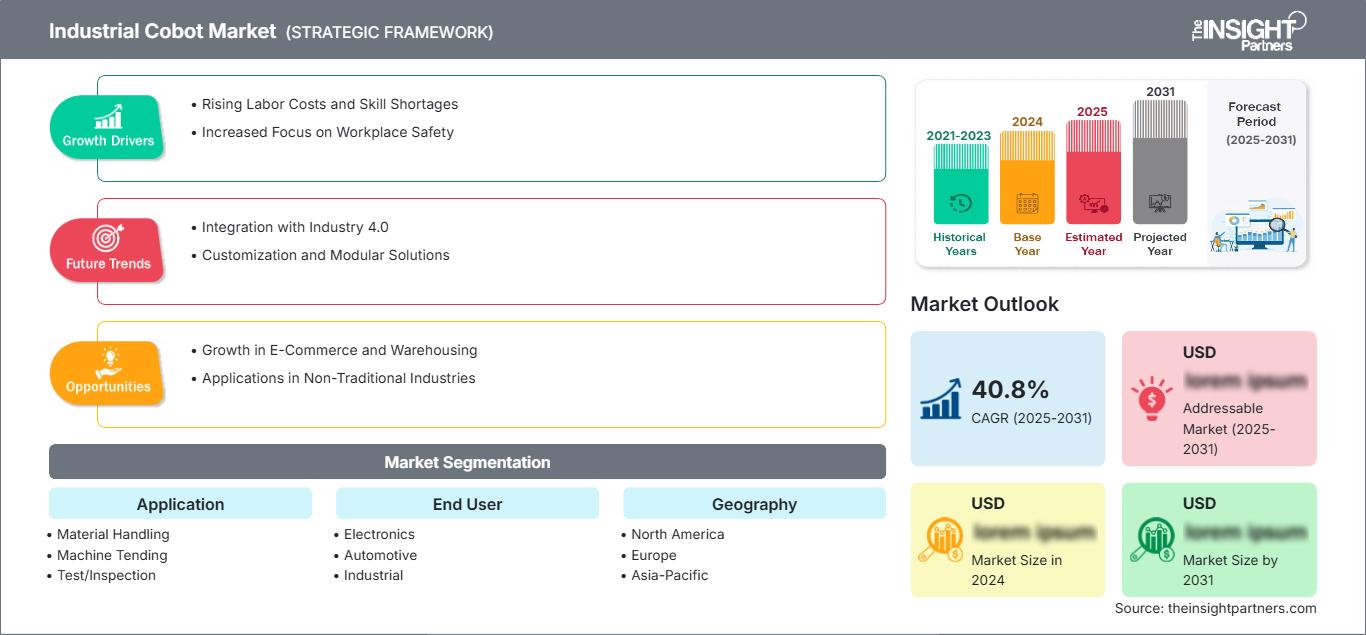
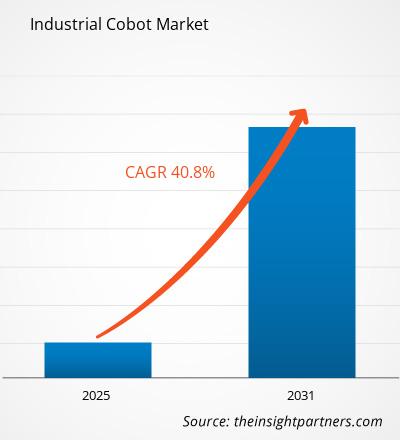
The Industrial Cobot Market is valued at US$ 970.03 Million in 2025 and is projected to reach US$ 2,632.07 Million by 2034, registering a CAGR of 11.73% during 2026–2034. Expansion is being supported by flexible automation requirements, increasing use of human-machine collaboration, and wider deployment across electronics, automotive, logistics, and precision manufacturing environments where conventional fixed automation can be less economical.
North America is positioned for sustained adoption, with an estimated CAGR of 11–13% through 2034. Industrial labor shortages, reshoring initiatives, and demand for rapidly deployable automation are strengthening investment. The region's Industrial Cobot Market size is also being influenced by manufacturers seeking modular systems capable of supporting high-mix production without extensive plant redesign.
Industrial Cobot Market Assessment and Insights
- North America: North America is estimated to hold a 27–31% Industrial Cobot Market share in 2025 and grow at a CAGR of 11–13% between 2026–2034, supported by reshoring, workforce constraints, flexible manufacturing, and rapid deployment requirements.
- US: The US is estimated to represent 78–82% of North America's 2025 share, with a 10–12% CAGR between 2026–2034, led by automotive, electronics, aerospace, and small-batch manufacturing.
- Europe: Europe is estimated at a 25–29% share in 2025 and a 10–12% CAGR between 2026–2034, with Germany, Italy, France, and the UK leading adoption through advanced manufacturing and workforce optimization.
- Asia Pacific: Asia Pacific is estimated at a 36–40% share in 2025 and a 12–14% CAGR between 2026–2034, led by China, Japan, South Korea, India, and expanding electronics production.
- Largest Segment: Material Handling is estimated at a 31–35% market share in 2025, with a 10–12% CAGR between 2026–2034, reflecting broad applicability across factories and warehouses.
- High Growth Segment: Electronics is estimated at an 18–22% market share in 2025, with a 13–15% CAGR between 2026–2034, supported by precision assembly and inspection needs.
- Key companies analyzed in detail: ABB; Epson America, Inc.; FANUC America Corporation; KAWADA Robotics Corporation; KUKA AG; NACHI-FUJIKOSHI CORPORATION; Stäubli International AG; Teradyne Inc.; Universal Robots A/S; YASKAWA ELECTRIC CORPORATION.
Source: The Insight Partners' analysis based on proprietary research, government publications, company annual reports, investor presentations, industry databases, and expert interviews.
The trend towards development of technologies is now moving away from low-load applications to high payloads and extended reach. For instance, ABB's 2026 PoWa series includes payloads up to 7-30 kg and speed reaching 5.8 m/s, which indicates how the industry is now striving for industrial-grade capabilities.
Investments are becoming less directed at hardware but at simulation, software, artificial intelligence, and applications ecosystem. This trend favors manufacturing modernization in Europe and Asia Pacific regions, and in North America – thanks to reshoring and shortage of workers. Moreover, initiatives in physical AI are also expanding the market opportunity as they enable robots to understand varying environments and not just follow pre-defined paths.
Industrial Cobot Market Report Scope
| Report Attribute | Details |
|---|---|
| Market size in 2025 | US$ 970.03 Million |
| Market Size by 2034 | US$ 2,632.07 Million |
| Global CAGR (2026 - 2034) | 11.73% |
| Historical Data | 2021-2024 |
| Forecast period | 2026-2034 |
Industrial Cobot Market Analysis
Market development for Industrial Cobotics is occurring within the context of manufacturers needing to achieve automation that can be added around their existing process, rather than needing to replace their entire production cell. Market conditions will be best where there is a shortage of labor, variability in products and/or high frequency of changeovers that preclude the economics of traditional automation. The ecosystem comprises robot companies, grippers, vision companies, safety, system integrators, software firms and end users. This is what determines how quickly robots get deployed, how reliable they perform and total cost of ownership.
Market dynamics are becoming more influenced by standardization of robot platforms and application packages. Robot hardware is becoming differentiated by weight capacity, arm reach, accuracy, sensors and motion characteristics, whereas software becomes more influential in determining ease of use. According to the International Federation of Robotics, statistics on industrial robots include figures from the national associations within the major manufacturing countries.
Competition positioning has also evolved as existing robot producers are adding simulation, machine vision, AI, and integration services to cobot hardware. In this case, the analysis of Industrial Cobot Market should focus not only on the robot specifications but also on the depth of an ecosystem. The producers like ABB, FANUC America Corporation, KUKA AG, YASKAWA ELECTRIC CORPORATION, and NACHI-FUJIKOSHI CORPORATION already have well-developed industrial automation channels, whereas Universal Robots A/S and Teradyne Inc. prioritize collaboration and flexibility via software.
Epson America, Inc., KAWADA Robotics Corporation, and Stäubli International AG enhance competition due to specific robotic features and manufacturing capabilities. Strategic investments are made into easy programming, digital twins, adaptive control, and application-specific tools. The recent product development shows this trend; for example, Universal Robots has added simulation capabilities via UR Studio, whereas KUKA and ABB are working on platforms which combine robotics, software, AI, and virtual commissioning.
● REPORT CUSTOMIZATION
Tailor This Report To Align With Your Specific Business Requirements
This report can be customized to align precisely with your business objectives, scope, and target markets. Customization options include tailored segmentation, geography, competitive analysis, and strategic insights to support informed decision-making.
Customize This Report →WHAT YOU CAN ADJUST
- ● Segmentations
- ● Geography
- ● Competitive Analysis
- ● Language Preferences
Industrial Cobot Market: Strategic Insights
Regional Insights
North America Industrial Cobot Market
North America is estimated to account for 27–31% of the 2025 market and expand at a CAGR of 11–13%. The region benefits from reshoring, skilled-labor shortages, and demand for compact automation in high-mix manufacturing. Automotive, electronics, aerospace, and metalworking facilities increasingly favor systems that can be redeployed between production tasks.
The USA is the major national market player, with Canada and Mexico contributing to this sector via automotive and manufacturing industries. The statistics of IFR indicate that while there is some short-term policy uncertainty regarding robotics in the USA, in the long term the demand will be driven by reshoring and labor shortages. This will create favorable conditions for collaborative robots.
U.S. Industrial Cobot Market
The US is estimated to represent 78–82% of North America's 2025 market, with a CAGR of 10–12% through 2034. Applications are mainly focused on automotive, electronics, aerospace, machine shops, and general manufacturing. Companies such as ABB, FANUC America Corporation, KUKA AG, Teradyne Inc., and Universal Robots A/S have managed to maintain good market visibility by means of their robotics portfolio and applications.
The importance of the following applications has been increasing: machine tending, materials handling, inspection, welding, and assembly of small parts. The development of portable and pre-engineered robots has become important for smaller manufacturing plants since the use of those does not require much cell installation. The 11 kg 2026 CRX-3iA from FANUC America is an example of this trend.
Europe Industrial Cobot Market
Europe is estimated at a 25–29% share in 2025 and a 10–12% CAGR through 2034, with Germany remaining the leading national market. These countries together make up a diversified manufacturing base, whereas investments in industrial automation facilitate collaboration.
The UK market is driven by manufacturers that look to improve efficiency despite ongoing labor shortages. The applications of demand in this market include automotive parts manufacturing, food processing, logistics, and precision engineering, where flexible automation solutions can work alongside current workers without significant factory redesigns. Germany hosts the most advanced industrial robot ecosystem of the region, with automotive, machinery, electronics, and engineering industries driving demand. France, Italy, and Spain drive demand in automotive, food, packaging, machinery, and metal fabrication applications.
APAC Industrial Cobot Market
APAC is estimated to hold a 36–40% share in 2025 and grow at a CAGR of 12–14%, making it the leading region. China remains the largest national market, followed by Japan and South Korea, while India and Australia provide expanding opportunities.
Electronics production, automotive manufacturing, semiconductor investment, and industrial modernization underpin demand. China benefits from extensive manufacturing capacity, Japan from advanced automation, and South Korea from electronics and automotive production. India is increasing factory automation, while Australia provides opportunities in mining-related manufacturing and general industry. Policy support for smart manufacturing and localization further strengthens regional deployment.
Middle East & Africa Industrial Cobot Market
Middle East and Africa represents an emerging opportunity, with a modeled CAGR of 9–11% through 2034. Saudi Arabia is the leading market, followed by the UAE and South Africa, while the rest of MEA remains comparatively fragmented.
Energy diversification and industrial infrastructure programs are expanding manufacturing requirements beyond hydrocarbons. Saudi Arabia and the UAE are investing in industrial ecosystems, logistics, and advanced production, while South Africa provides demand from automotive, mining equipment, and general manufacturing. The region's adoption is increasingly tied to workforce productivity, process standardization, and efforts to build digitally enabled industrial capacity.
Segmentation Analysis
Application
Application represents the principal route through which collaborative robots generate operational value. The segment is projected to expand at a CAGR of 11–13% during 2026–2034 as manufacturers automate repetitive handling, loading, inspection, and processing tasks. Industrial Cobot Market scope increasingly encompasses applications where rapid changeovers and limited production volumes make fixed automation less attractive.
- Material Handling: Material Handling remains the largest application because cobots can move components, feed workstations, palletize products, and transfer parts while adapting to changing production layouts.
- Machine Tending: Machine Tending addresses loading and unloading of CNC, molding, and machining equipment, improving equipment utilization while allowing workers to supervise multiple processes.
- Test/Inspection: Test/Inspection adoption is supported by integrated vision, force sensing, and repeatable motion, particularly where manufacturers need consistent quality checks across variable product configurations.
- Value Added Processing: Value Added Processing includes finishing, polishing, dispensing, welding, and similar operations where programmable motion can improve consistency and reduce repetitive manual work.
- Transport: Transport applications connect collaborative arms with mobile platforms and production workflows, enabling flexible movement of components between workstations and supporting increasingly connected factories.
End User
End User is projected to grow at a CAGR of 10–12% during 2026–2034. Electronics represents the fastest-growing major end-use category, while automotive and industrial manufacturing remain substantial demand centers. Healthcare and aerospace applications provide specialized opportunities requiring precision, traceability, and controlled operating environments.
- Electronics: Electronics manufacturers use cobots for assembly, screwdriving, component handling, dispensing, and inspection, where precision and frequent product changes make flexible automation valuable.
- Automotive: Automotive plants deploy cobots for component handling, assembly, welding, inspection, and machine tending, particularly for subassemblies and mixed-model production.
- Industrial: Industrial users span machinery, metalworking, plastics, packaging, and general production, creating broad demand for adaptable automation across repetitive processes.
- Aerospace and Defense: Aerospace and defense applications emphasize precision, traceability, and flexible handling, with cobots supporting lower-volume production where traditional automation may require disproportionate investment.
- Healthcare: Healthcare applications include laboratory handling, dispensing, rehabilitation, and controlled material movement, where repeatability and safe human interaction are important.
- Others: Other users include food, education, logistics, and specialized services, where compact automation can address repetitive handling and process-support requirements.
Opportunity Snapshot
| End User | Revenue Contribution (High/Medium/Low) | Trend Tag | Adoption Stage |
|---|---|---|---|
| Electronics | High | Precision Assembly | Scaling |
| Automotive | High | Flexible Welding | Mature |
| Industrial | High | Machine Tending | Mature |
| Aerospace and Defense | Medium | Precision Handling | Scaling |
| Healthcare | Low | Lab Automation | Emerging |
| Others | Medium | Mobile Handling | Scaling |
Industrial Cobot Market Growth Drivers and Impact Analysis
Labor shortages are increasing the value of flexible automation
Workforce shortages that persist are affecting the way automation projects are being looked at by manufacturing companies. Rather than replacing the entire workforce, most factories are now focusing on tasks that are challenging in staffing such as machine loading, inspection, packaging, and moving materials. This is where collaborative robots play a critical role since they can operate in smaller footprints and be relocated in case of any changes in production. In North America and Europe, this factor makes the case for automation more compelling, especially for smaller manufacturers who cannot afford custom systems. In Asia, this driver works hand in hand with increasing complexity of manufacturing and wages. The effect is not limited to sales of robots as the whole value chain gains whenever there is a sale.
High-mix manufacturing is favoring redeployable robotic systems
Manufacturing operations are now characterized by short product life cycles, customization, and frequent process changeovers. Traditional fixed automation may be less suitable where tooling and fixtures as well as programming need to be frequently adjusted, especially in low or medium production volumes. Cobotics help solve the problem at least partly due to teach-by-showcase capabilities, flexible software design, modular end effectors, and easy implementation into manufacturing cells. Economic benefits of cobotics are especially evident where machines have to carry out several processes instead of one process optimized for maximum productivity. Manufacturing of electronics, industrial machines, and specific automotive parts become important markets for robotics products. With a decrease in batch sizes in manufacturing, the possibility to reuse a machine increases the efficiency of equipment usage and reduces process introduction times.
Integrated sensing is expanding cobot use into quality-critical tasks
Enhancements in vision, touch sensing, torque sensing, and safety controls are adding functions to cobots beyond simple pick-and-place tasks. Through these enhancements, the robots are able to sense the location of parts, adjust for inconsistencies, recognize flaws, and react to touches. The use of these capabilities has led to the development of applications that are inspecting, verifying assemblies, surface processing, and inserting, all of which have greater value than simply handling products. With the incorporation of industrial software into the robots, information about the manufacturing process along with the actions of the robot can be collected. This change alters the nature of the competition within the industry because robot makers compete through integrated application stacks and not mechanical capability alone.
Industrial Cobot Market Future Trends
Physical AI will move cobots toward adaptive task execution
Industrial Cobot Market trends are moving from rule-based automation toward systems that can interpret changing physical conditions. Future cobots are likely to combine vision, force feedback, simulation, language interfaces, and learned motion policies so operators can configure tasks with less conventional programming. This development could expand deployment into semi-structured environments where part presentation, object orientation, or workstation conditions vary. AI-enabled systems will also create new requirements for data governance, validation, cybersecurity, and safety certification. Manufacturers are expected to favor platforms that allow models and application software to be updated without replacing mechanical hardware. Partnerships among robot suppliers, cloud providers, semiconductor companies, and specialist AI developers should therefore become more significant as the industry moves toward commercially deployable physical intelligence.
Simulation-first deployment will shorten application engineering cycles
Digital twins and online simulation are expected to become standard components of future cobot procurement. Instead of programming directly on a production floor, users will increasingly validate reach, collision risks, cycle sequences, tooling, and workstation layouts before physical installation. This approach can reduce commissioning delays and improve confidence in expected throughput. It also enables manufacturers to compare alternative robot configurations before committing capital, which is particularly useful for multi-site deployments. Software platforms that combine simulation, virtual commissioning, application libraries, and AI-assisted programming may therefore become important differentiators. The broader effect will be a gradual shift in purchasing decisions from individual robotic arms toward integrated automation environments. Vendors with interoperable software ecosystems are likely to be better positioned as customers seek repeatable deployment methods across factories.
Industrial Cobot Market Opportunities
Expand standardized automation packages for smaller manufacturers
Smaller manufacturers represent a significant opportunity because many have repetitive processes but lack dedicated robotics engineering teams. Vendors can address this gap by developing standardized packages combining a cobot, gripper, vision system, safety equipment, software, and application templates. Industrial Cobot Market Forecasts can benefit from wider availability of these pre-engineered configurations because they reduce integration complexity and shorten purchasing decisions. Channel partnerships with regional integrators can further extend coverage into specialized manufacturing clusters. Priority applications should include machine tending, welding, palletizing, inspection, and material transfer because these processes have clear operating boundaries and measurable productivity outcomes. Commercial models based on leasing, robotics-as-a-service, or staged deployment could additionally lower upfront capital barriers, especially where manufacturers are testing automation before committing to larger production programs.
Target electronics and precision manufacturing ecosystems
Electronics manufacturing provides an attractive investment area because production requires precision, repeatability, traceability, and frequent product transitions. Suppliers can create differentiated solutions by combining cobots with high-resolution vision, precision end effectors, inspection software, and clean production capabilities. Asian manufacturing clusters provide scale, while North American and European facilities offer opportunities linked to supply-chain diversification and localized production. Investors and suppliers should prioritize ecosystems rather than individual machine sales, establishing relationships with contract manufacturers, component producers, system integrators, and automation distributors. Product roadmaps should emphasize compact footprints, repeatable deployment, rapid changeovers, and software portability. These capabilities can increase the number of tasks handled by each installed robot and improve recurring revenue potential through software, service, tooling, and application upgrades.
Recent Developments
- April 2026: ABB Robotics launched its high-speed PoWa collaborative robot family, combining the flexibility and compact footprint of cobots with industrial-grade speed and payload capabilities. The six-model range supports payloads from 7 kg to 30 kg, with top speeds of up to 5.8 m/s, and is designed for applications including high-speed machine tending, palletizing, screwdriving and arc welding. Powered by ABB’s OmniCore controller and integrated with AI-powered software such as RobotStudio and Wizard Easy Programming, PoWa cobots offer no-code programming, plug-and-play tool compatibility and can be operational within an hour, helping manufacturers automate heavier and faster processes with reduced deployment complexity.
- March 2025: Rollon launched a new Cobot Transfer Unit (CTU) designed to extend the operating range of collaborative robots while simplifying integration and improving performance. The updated CTU supports the full range of Universal Robots cobots, including the UR20 and UR30, and uses a 220V power supply compatible with Universal Robots to reduce electrical complexity. The turnkey, plug-and-play system integrates the actuator, gearbox, motor, electrical cabinet and URCap software, with strokes up to 5,500 mm, enabling applications such as material handling, assembly, pick-and-place and packaging.
- July 2026: Grid Dynamics entered a strategic partnership with Doosan Robotics to accelerate adoption of physical AI across manufacturing and logistics by combining Doosan’s collaborative robots with Grid Dynamics’ GAIN Platform for Physical AI and integration services. The partnership will provide turnkey solutions for advanced applications such as processing and inspecting complex-geometry objects, variable assembly, and packaging of unseen or deformable items, while enabling rapid deployment of physical AI models, robotic manipulation workflows, and digital-twin-based optimization and monitoring.
Frequently Asked Questions

- Comprehensive Market Sizing and Forecast Analysis
- Detailed Segmentation Analysis
- In-Depth Market Dynamics Assessment
- Regional and Country-Level Insights
- Competitive Landscape and Company Benchmarking
- Strategic Business Intelligence
Recent Reports
Testimonials

The Insight Partners provided valuable market intelligence that supported our global go-to-market strategy. Their team was professional, responsive, and attentive to our feedback, providing thoughtful analysis and helpful methodological clarifications throughout the project.
Junmo Kim Chief Financial Officer (CFO), Enertech Co., Ltd.
The Insight Partners' SCADA System Market report is comprehensive, with valuable insights on current trends and future forecasts. The team was highly professional, responsive, and supportive throughout. We are very satisfied and highly recommend their services.
RAN KEDEM Partner, Reali Technologies LTDs
I requested a report on a very specific software market and the team produced the report in a few days. The information was very relevant and well presented. I then requested some changes and additions to the report. The team was again very responsive and I got the final report in less than a week.
JEAN-HERVE JENN Chairman, Future Analytica
We worked with The Insight Partners for an important market study and forecast. They gave us clear insights into opportunities and risks, which helped shape our plans. Their research was easy to use and based on solid data. It helped us make smart, confident decisions. We highly recommend them.
PIYUSH NAGPAL Sr. Vice President, High Beam Global
The Insight Partners delivered insightful, well-structured market research with strong domain expertise. Their team was professional and responsive throughout. The user-friendly website made accessing industry reports seamless. We highly recommend them for reliable, high-quality research services
YUKIHIKO ADACHI CEO, Deep Blue, LLC.
This is the first time I have purchased a market report from The Insight Partners.While I was unsure at first, I visited their web site and felt more comfortable to take the risk and purchase a market report.I am completely satisfied with the quality of the report and customer service. I had several questions and comments with the initial report, but after a couple of dialogs over email with their analyst I believe I have a report that I can use as input to our strategic planning process.Thank you so much for taking the extra time and making this a positive experience.I will definitely recommend your service to others and you will be my first call when we need further market data.
JOHN SUZUKI President and Chief Executive Officer, Board Director, BK Technologies
I wish to appreciate your support and the professionalism you displayed in the course of attending to my request for information regarding to infectious disease IVD market in Nigeria. I appreciate your patience, your guidance, and the fact that you were willing to offer a discount, which eventually made it possible for us to close a deal. I look forward to engaging The Insight Partners in the future, all thanks to the impression you have created in me as a result of this first encounter.
DR CHIJIOKE ONYIA MANAGING DIRECTOR, PineCrest Healthcare Ltd.Reason to Buy
- Informed Decision-Making
- Understanding Market Dynamics
- Competitive Analysis
- Identifying Emerging Markets
- Customer Insights
- Market Forecasts
- Risk Mitigation
- Boosting Operational Efficiency
- Strategic Planning
- Investment Justification
- Tracking Industry Innovations
- Aligning with Regulatory Trends





 Get Free Sample for