
Industrial Ethernet Cables Market Size, Growth & Trends by 2034
Coverage: By Type (Consumption Bulk Cable, Cordsets); Application (Classical Ethernet, Fast Ethernet, Gigabit Ethernet, 10 Gigabit Ethernet) , and Geography (North America, Europe, Asia Pacific, and South and Central America)
- Status : Data Released
- Report Code : TIPRE00026366
- Category : Electronics and Semiconductor
- No. of Pages : 150
- Available Report Formats :


- Last update date : September 18, 2026


2025 Market Size
US$ 1.25 Bn
Base year value
2034 Forecast
US$ 4.05 Bn
Projected by 2034
CAGR 2026-2034
13.95 %
Growth rate
Addressable Market
US$ 22.86 Bn
(2026-2034)
The Industrial Ethernet Cables market was valued at US$ 1.25 billion in 2025 and is expected to reach US$ 4.05 billion by 2034; it is estimated to record a CAGR of 13.95% during 2026-2034.
Industrial Ethernet Cables Market Assessment and Insights
- North America: North America is estimated to hold a 29–33% Industrial Ethernet Cables Market share in 2025 and expand at a CAGR of 14.2–15.4% during 2026–2034, supported by factory modernization, automation retrofits, and resilient OT networking requirements.
- US: The US is estimated to represent 68–72% of North American demand in 2025 and grow at a CAGR of 14.5–15.7% during 2026–2034, led by automation-intensive manufacturing and infrastructure upgrades.
- Europe: Europe is estimated to account for a 24–28% share in 2025 and grow at a CAGR of 13.6–14.8% through 2034. Germany, the UK, France, Italy, and Spain remain important markets because of established automation ecosystems.
- Asia Pacific: Asia Pacific is estimated to hold a 31–35% share in 2025 and register a CAGR of 17.0–18.4% during 2026–2034, with China, Japan, South Korea, and India providing strong industrial automation demand.
- Largest Segment: Consumption Bulk Cable is estimated to command a 58–62% market share in 2025 and expand at a CAGR of 15.0–16.2%, benefiting from large-scale fixed installations and customized termination requirements.
- High Growth Segment: 10 Gigabit Ethernet is estimated to hold a 14–18% market share in 2025 and grow at a CAGR of 18.4–20.0%, driven by bandwidth-intensive automation and backbone applications.
- Key companies analyzed in detail: Belden Inc., General Cable Technologies Corporation, Nexans S.A., SAB Bröckskes GmbH & Co. KG, Alpha Wire Company, B&B Electronics Manufacturing Company, Panduit Corp., Siemens AG, Proterial, Ltd., L-com Global Connectivity.
Source: The Insight Partners' analysis based on proprietary research, government publications, company annual reports, investor presentations, industry databases, and expert interviews.
Industrial Ethernet Cables Market has progressed from simple point-to-point plant communications towards hardwired networks capable of integrating sensors, programmable controls, drives, cameras, distributed input/output systems, and edge computers. With greater bandwidth needs, the significance of Gigabit and 10 Gigabit Ethernet technologies is rising, along with cable design changes to include better shielding, flexible jackets, oil resistance, thermal stability, and designs suited for motion and high electromagnetic interference.
In the future, growth in Industrial Ethernet Cables Market will be driven by an expansion into new manufacturing sites as capacity, digitalization, and investment in smart factories expand beyond the current base of automation facilities. With regulatory priorities on electrical safety, electromagnetic compatibility, environmental performance, and energy efficiency, vendors will benefit from an ability to integrate application-specific design features with standard compliance and reliable manufacturing/distribution in their region.
Industrial Ethernet Cables Market Report Scope
| Report Attribute | Details |
|---|---|
| Market size in 2025 | US$ 1.25 Billion |
| Market Size by 2034 | US$ 4.05 Billion |
| Global CAGR (2026 - 2034) | 13.95% |
| Historical Data | 2021-2024 |
| Forecast period | 2026-2034 |
Industrial Ethernet Cables Market Analysis
The market growth is related to factory automation spending, since cables represent the physical layer for controller, switch, sensor, actuator, drive, and supervisory devices. The demand flows along the value chain from copper wire, polymers, shield material, extrusion, cabling, jacketing, testing, connectorization, distribution, system integration, to industrial equipment manufacturing. Cable specifications differ dramatically depending on motion, temperature, chemical resistance, installation, and electrical noise environment.
On the one hand, cable construction firms possessing extrusion and jacketing technologies may use construction capabilities for differentiation, whereas cordset companies compete in terms of connectivity, assembly time, and application engineering. Copper cost remains an important element for consideration, but purchasing is increasingly driven by life-cycle reliability instead of conductor cost only. That is why industrial plants prefer qualified cable constructions in order to minimize risks associated with production process.
Industrial Ethernet Cables Market competitive positioning is based not only on the breadth of product portfolio but also on certification, regional availability, and capacity for providing automation system architecture. Belden Inc. unites industrial networking and cable manufacturing competence, Nexans S.A. and General Cable Technologies Corporation specialize in wider cable manufacturing. Siemens AG benefits from its industrial automation systems and Panduit Corp. highlights its industrial and electrical connectivity.
According to the Industrial Ethernet Cables Market forecast, the specialized vendors take the key market positions as well. Application-specific cable engineering competence belongs to SAB Bröckskes GmbH & Co. KG, while Alpha Wire Company is specialized in demanding wire and cable products and Proterial, Ltd. preserves its industrial Ethernet competencies after Hitachi Cable divestment. Connectivity and network accessories competencies are represented by B&B Electronics Manufacturing Company and L-com Global Connectivity correspondingly. Key areas of investments are now related to small-size designs, high-speed transmission, environmental durability, digital selection, and logistics stability.
● REPORT CUSTOMIZATION
Tailor This Report To Align With Your Specific Business Requirements
This report can be customized to align precisely with your business objectives, scope, and target markets. Customization options include tailored segmentation, geography, competitive analysis, and strategic insights to support informed decision-making.
Customize This Report →WHAT YOU CAN ADJUST
- ● Segmentations
- ● Geography
- ● Competitive Analysis
- ● Language Preferences
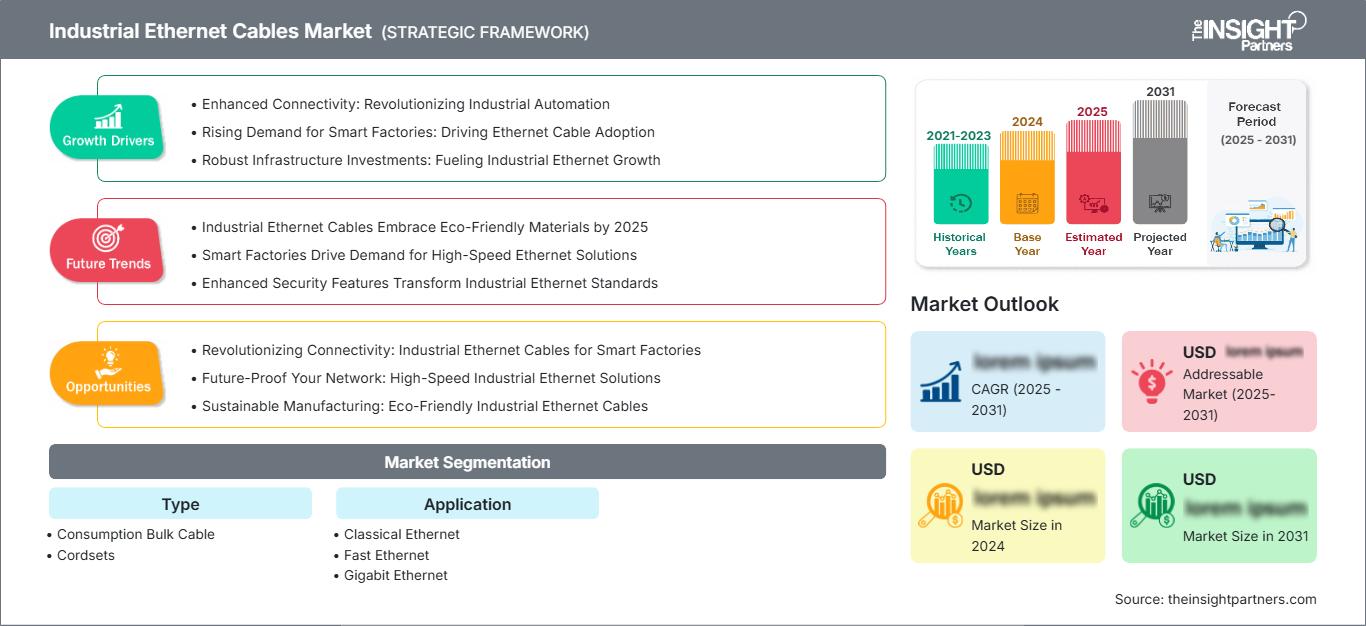
Industrial Ethernet Cables Market: Strategic Insights
Regional Insights
North America Industrial Ethernet Cables Market
North America is estimated to represent 29–33% of global Industrial Ethernet Cables Market revenue in 2025 and expand at a CAGR of 14.2–15.4% through 2034. United States dominates the regional demand owing to the investments made in the areas of automotive, food processing, pharmaceuticals, logistics, and discrete manufacturing. Retrofit installations are especially crucial since the legacy plants need improvements in their physical infrastructure without a full replacement of the line.
The country’s contribution comes from mining, energy, transportation, and advanced manufacturing segments where ruggedized communication infrastructure is essential. In terms of regional procurement, emphasis is now being laid on fire performance, electromagnetic compatibility, oil resistance, temperature resistance, and flexible construction. Having a network of distributors as well as technical support locally would be beneficial for suppliers since the specifications often demand fast replacement and applications support.
U.S. Industrial Ethernet Cables Market
The U.S. represents an estimated 68–72% share of North American Industrial Ethernet Cables Market revenue in 2025 and is projected to grow at a CAGR of 14.5–15.7% through 2034. Demand is supported by manufacturing reshoring, warehouse automation, semiconductor investment, and modernization of production equipment.
The companies that have product distribution within the United States’ industrial connectivity market include Belden Inc., Panduit Corp., Alpha Wire Company, Proterial, Ltd., and L-com Global Connectivity. There is increasing demand for industrial applications of Gigabit Ethernet and 10 Gigabit Ethernet with the advent of machine vision, edge computing, and connected instrumentation, which add to the data load. There is an increasing need for shielded and chemical resistance within industrial facilities, where normal enterprise cables would not hold up on plant floors.
Europe Industrial Ethernet Cables Market
Europe is estimated to hold a 24–28% share of Industrial Ethernet Cables Market revenue in 2025 and expand at a CAGR of 13.6–14.8% through 2034. Germany remains the leading country, supported by machinery, automotive, process industries, and mature automation ecosystems. Demand is also shaped by European requirements for safety, environmental compliance, and energy-efficient production.
The UK, having a strong foundation in food processing, pharmaceuticals, logistics, and industrial automation, still favors dependable network infrastructure for its advanced facilities. Germany boasts of the region's most sophisticated industrial automation sector, where dense machine connectivity and deterministic communications create demand for sophisticated Ethernet cables.
France, Italy, and Spain make further contribution to demand through automotive, machinery, food processing, energy, and logistics investments. Adoption of Industrial Ethernet Cables Market in these nations increasingly includes replacement of existing fieldbus infrastructure with more sophisticated Ethernet network systems. Germany is the market leader among the nations, while competition among regional providers and multinational manufacturers is based on application engineering, certification, and delivery.
APAC Industrial Ethernet Cables Market
APAC is estimated to account for 31–35% of Industrial Ethernet Cables Market revenue in 2025 and register a CAGR of 17.0–18.4% through 2034. China remains the leading country, followed by Japan, South Korea, India, and Australia. Manufacturing automation, electronics production, automotive investment, and industrial digitization provide the principal demand base.
China and Japan combine mature automation capabilities with large installed manufacturing footprints, while South Korea emphasizes electronics and advanced manufacturing. India is expanding automation across automotive, pharmaceuticals, logistics, and general manufacturing, while Australia adds mining and infrastructure applications. Policy support for domestic manufacturing, digitalization, and industrial modernization reinforces regional demand. APAC is consequently expected to remain the fastest-growing major geography within the market.
Middle East & Africa Industrial Ethernet Cables Market
Middle East and Africa demand is supported by energy infrastructure, utilities, transport projects, industrial diversification, and automated facilities. Saudi Arabia is the leading national market, followed by the UAE and South Africa. The region is estimated to expand at a CAGR of 12.0–13.5% through 2034 as industrial projects require resilient plant communication networks.
Saudi Arabia and the UAE are investing in manufacturing, logistics, energy, and smart infrastructure, while South Africa contributes through mining, utilities, and industrial automation. Rest of MEA demand remains project-driven and sensitive to capital expenditure cycles. Industrial Ethernet Cables Market opportunities are strongest where new industrial assets require hardened connectivity from field devices through control networks, particularly in environments exposed to heat, dust, vibration, and electromagnetic interference.
Segmentation Analysis
Type
Type segmentation is led by Consumption Bulk Cable, which is estimated to expand at a CAGR of 15.0–16.2% during 2026–2034. Bulk formats remain important where installers require project-specific lengths, termination flexibility, and optimized routing. Cordsets address applications requiring standardized connectors, rapid installation, repeatable assembly, and reduced field termination, creating a complementary growth path.
- Consumption Bulk Cable: Bulk cable maintains the dominant position because large factory installations require customized routing, field termination, and application-specific jacket constructions across extensive machine and control-network pathways.
- Cordsets: Cordsets gain adoption where standardized connectorization, installation speed, and repeatability matter. Their strategic importance increases in modular machinery, distributed I/O, robotics, and maintenance-intensive production environments.
Application
Application segmentation is led by Gigabit Ethernet, while 10 Gigabit Ethernet is the fastest-growing application and is estimated to expand at a CAGR of 18.4–20.0% during 2026–2034. Higher bandwidth requirements from machine vision, industrial edge computing, and dense device architectures are shifting new installations toward faster Ethernet standards.
- Classical Ethernet: Classical Ethernet remains relevant in legacy industrial networks and lower-bandwidth equipment, particularly where replacement cycles are long and existing controllers can meet production requirements.
- Fast Ethernet: Fast Ethernet continues to serve installed automation systems requiring reliable 100 Mbps communication, with demand concentrated in cost-sensitive upgrades and equipment where higher throughput is not operationally necessary.
- Gigabit Ethernet: Gigabit Ethernet occupies a broad application base because it balances bandwidth, equipment availability, and installation economics for modern control, monitoring, machine vision, and plant-floor communications.
- 10 Gigabit Ethernet: 10 Gigabit Ethernet is increasingly important for network backbones, high-volume data aggregation, advanced vision systems, and edge architectures requiring substantially greater throughput and lower congestion.
Opportunity Snapshot
| Application | Revenue Contribution (High/Medium/Low) | Trend Tag (MAX 2 words) | Adoption Stage (Emerging/Scaling/Mature) |
| Classical Ethernet | Medium | Legacy Retrofit | Mature |
| Fast Ethernet | Medium | Cost Optimization | Mature |
| Gigabit Ethernet | High | Machine Vision | Scaling |
| 10 Gigabit Ethernet | Medium | Edge Backbone | Scaling |
Industrial Ethernet Cables Market Growth Drivers and Impact Analysis
Expansion of automated and connected production assets
The expansion of automated production increases the number of connected endpoints within factories, raising the requirement for dependable physical communication paths. Sensors, programmable controllers, drives, industrial cameras, robots, and distributed I/O create more network connections per production cell than conventional automation architectures. This increases cable density and favors designs that tolerate vibration, repeated flexing, electrical noise, oil, and temperature variation. The impact extends beyond greenfield factories because brownfield facilities increasingly integrate Ethernet-based communication into existing equipment. As more production information moves toward edge systems and centralized analytics, cable performance becomes directly relevant to data availability. This driver therefore supports both higher cable volumes and greater specification complexity, improving the value of engineered products relative to basic office-grade Ethernet alternatives.
Migration from legacy fieldbus networks to Ethernet architectures
Migration from proprietary or legacy fieldbus architectures toward Ethernet-based industrial communication creates replacement demand alongside new-installation demand. Ethernet supports broader integration between operational technology systems, supervisory applications, edge computing, and enterprise platforms, reducing the isolation between production data and business systems. However, industrial deployment requires more than protocol compatibility because physical infrastructure must address electromagnetic interference, mechanical stress, grounding, environmental exposure, and installation constraints. Cable suppliers therefore benefit when customers undertake modernization projects that replace older communication pathways rather than simply adding isolated Ethernet devices. The resulting demand is particularly relevant in mature manufacturing regions where production assets remain operational for long periods. Such retrofit cycles can extend purchasing opportunities across maintenance, engineering, system integration, and plant modernization budgets.
Higher data intensity from machine vision and edge processing
Machine vision, real-time monitoring, digital twins, and edge analytics are increasing the volume of information generated near production equipment. These applications can place greater bandwidth requirements on connections between cameras, controllers, switches, and edge-processing hardware. As a result, network planners increasingly evaluate Gigabit and 10 Gigabit Ethernet for selected high-throughput links rather than applying one speed standard across an entire plant. This segmentation of network architecture benefits cable suppliers that can offer multiple performance categories with compatible environmental constructions. Higher data rates also increase sensitivity to installation quality, shielding, bend radius, connector integrity, and electromagnetic interference. The market impact is therefore twofold: increased demand for faster cable systems and stronger emphasis on application-specific engineering during network design, installation, commissioning, and maintenance.
Industrial Ethernet Cables Market Future Trends
Convergence of wired Ethernet with private industrial 5G
Industrial connectivity architectures are likely to become increasingly hybrid, combining wired Ethernet for deterministic and fixed connections with private 5G for mobile assets, difficult-to-cable areas, and flexible production layouts. This does not eliminate cable demand; instead, it changes where wired infrastructure is concentrated. High-performance Ethernet will remain important for switches, controllers, servers, access points, and backbone connections that anchor wireless zones. Cable specifications may increasingly emphasize high bandwidth and compatibility with compact edge equipment positioned between wired and wireless domains. Suppliers that understand both physical connectivity and network architecture should be better positioned to support mixed deployments. The trend could also encourage more modular factory designs, where cable pathways are engineered as scalable infrastructure capable of supporting changing machine configurations and future communication technologies.
Smaller, lighter and more application-specific cable constructions
The Industrial Ethernet Cables Market trends show that future product development is expected to prioritize smaller diameters, reduced material intensity, improved flexibility, and more targeted environmental protection. Dense industrial pathways create practical constraints because large cable bundles increase routing complexity, installation effort, thermal considerations, and cabinet congestion. Materials engineering can address these issues by improving shielding performance and signal integrity without proportionally increasing cable dimensions. Product families are also likely to become more application-specific, separating stationary, continuous-flex, outdoor, tray-rated, high-temperature, and chemically resistant requirements rather than relying on generalized constructions. This trend creates opportunities for suppliers to differentiate through engineering tolerances, testing, certification, and lifecycle performance. Purchasing decisions may increasingly consider total installed footprint and handling efficiency alongside electrical specifications, particularly in compact automated machinery and high-density control environments.
Industrial Ethernet Cables Market Opportunities
Localized manufacturing and regional supply-chain resilience
Manufacturers can capture opportunity by establishing regional production, stocking, or finishing capabilities close to major industrial automation clusters. Long lead times can disrupt commissioning schedules because cable delivery is often linked directly to installation sequencing, machine integration, and plant acceptance milestones. Localized supply can therefore provide value even when production costs are higher than distant commodity sourcing. Suppliers should prioritize regions combining new manufacturing investment with significant installed automation bases, including selected Asian, North American, and European industrial corridors. Strategic inventory should focus on frequently specified constructions while flexible production can address customized jackets, shielding, lengths, and connector combinations. A regional approach can also reduce exposure to transportation disruptions and enable faster technical support, strengthening supplier relationships with system integrators, machine builders, and large industrial end users.
Engineering services around high-speed and harsh-environment networks
A second opportunity lies in combining cable products with engineering support for network design, specification, testing, and maintenance. Customers deploying high-speed Ethernet in industrial environments often need to reconcile bandwidth requirements with mechanical routing, electromagnetic conditions, environmental exposure, grounding, connector selection, and installation practices. Suppliers can develop application matrices and digital selection tools that translate operating conditions into suitable cable constructions, reducing specification errors. Training for installers and system integrators can further strengthen adoption of advanced products by improving termination quality and commissioning reliability. This approach shifts competition away from cable price alone toward measurable lifecycle outcomes. It is particularly relevant for 10 Gigabit Ethernet deployments, continuous-motion machinery, outdoor industrial systems, and retrofit projects where physical constraints make standardized office-network practices unsuitable.
Recent Developments
- April 2026: KINSUN announced a new M12 X-Coded Female Ethernet Cable, planned for Q3 2026. It supports CAT6A 10 Gbit/s, IP68 protection, and strong EMI shielding, making it suitable for high-speed industrial networking in harsh environments.
- May 2022: PROSCEND launched Long Reach Power over Ethernet (PoE) solutions that can extend Ethernet and power over existing twisted-pair or coaxial cables for distances beyond 500 m. The technology is aimed at applications such as IP cameras, transportation, tunnels, bridges, elevators, and smart cities.
- August 2025: Belden introduced several new connectivity and cybersecurity products for industrial and critical infrastructure applications. Highlights include gel-free fiber cables, Ethernet extension up to 215 m, an industrial firewall, improved network-planning software, and IEC 62443-4-2 Security Level 2 certification for BOBCAT switches.
Frequently Asked Questions

- Comprehensive Market Sizing and Forecast Analysis
- Detailed Segmentation Analysis
- In-Depth Market Dynamics Assessment
- Regional and Country-Level Insights
- Competitive Landscape and Company Benchmarking
- Strategic Business Intelligence
Recent Reports
Testimonials

The Insight Partners provided valuable market intelligence that supported our global go-to-market strategy. Their team was professional, responsive, and attentive to our feedback, providing thoughtful analysis and helpful methodological clarifications throughout the project.
Junmo Kim Chief Financial Officer (CFO), Enertech Co., Ltd.
The Insight Partners' SCADA System Market report is comprehensive, with valuable insights on current trends and future forecasts. The team was highly professional, responsive, and supportive throughout. We are very satisfied and highly recommend their services.
RAN KEDEM Partner, Reali Technologies LTDs
I requested a report on a very specific software market and the team produced the report in a few days. The information was very relevant and well presented. I then requested some changes and additions to the report. The team was again very responsive and I got the final report in less than a week.
JEAN-HERVE JENN Chairman, Future Analytica
We worked with The Insight Partners for an important market study and forecast. They gave us clear insights into opportunities and risks, which helped shape our plans. Their research was easy to use and based on solid data. It helped us make smart, confident decisions. We highly recommend them.
PIYUSH NAGPAL Sr. Vice President, High Beam Global
The Insight Partners delivered insightful, well-structured market research with strong domain expertise. Their team was professional and responsive throughout. The user-friendly website made accessing industry reports seamless. We highly recommend them for reliable, high-quality research services
YUKIHIKO ADACHI CEO, Deep Blue, LLC.
This is the first time I have purchased a market report from The Insight Partners.While I was unsure at first, I visited their web site and felt more comfortable to take the risk and purchase a market report.I am completely satisfied with the quality of the report and customer service. I had several questions and comments with the initial report, but after a couple of dialogs over email with their analyst I believe I have a report that I can use as input to our strategic planning process.Thank you so much for taking the extra time and making this a positive experience.I will definitely recommend your service to others and you will be my first call when we need further market data.
JOHN SUZUKI President and Chief Executive Officer, Board Director, BK Technologies
I wish to appreciate your support and the professionalism you displayed in the course of attending to my request for information regarding to infectious disease IVD market in Nigeria. I appreciate your patience, your guidance, and the fact that you were willing to offer a discount, which eventually made it possible for us to close a deal. I look forward to engaging The Insight Partners in the future, all thanks to the impression you have created in me as a result of this first encounter.
DR CHIJIOKE ONYIA MANAGING DIRECTOR, PineCrest Healthcare Ltd.Reason to Buy
- Informed Decision-Making
- Understanding Market Dynamics
- Competitive Analysis
- Identifying Emerging Markets
- Customer Insights
- Market Forecasts
- Risk Mitigation
- Boosting Operational Efficiency
- Strategic Planning
- Investment Justification
- Tracking Industry Innovations
- Aligning with Regulatory Trends





 Get Free Sample for