
Industrial I/O Modules Market Size, Share & Trends by 2034
Coverage: by Product (Programmable Logic Controller I/O (PLC I/O), Distributed Control System I/O (DCS I/O), Industrial PC I/O); End-user (Process Industry, Discrete Industry) , and Geography (North America, Europe, Asia Pacific, and South and Central America)
- Status : Data Released
- Report Code : TIPRE00010544
- Category : Electronics and Semiconductor
- No. of Pages : 150
- Available Report Formats :


- Last update date : September 18, 2026


2025 Market Size
US$ 8.35 Bn
Base year value
2034 Forecast
US$ 12.19 Bn
Projected by 2034
CAGR 2026-2034
4.29 %
Growth rate
Addressable Market
US$ 93.26 Bn
(2026-2034)
The Industrial I/O Modules Market was valued at US$ 8.35 Billion in 2025 and is projected to reach US$ 12.19 Billion by 2034, expanding at a CAGR of 4.29% from 2026 to 2034. The market is undergoing steady transformation as manufacturers modernize control architectures, expand distributed automation, and connect more field devices.Growth reflects replacement of legacy control infrastructure and increasing demand for scalable signal acquisition.
North America is expected to maintain a strong position, supported by manufacturing modernization, process automation, and investments in resilient production infrastructure. The region is estimated to expand at a 6.0–7.0% CAGR between 2026 and 2034. The Industrial I/O Modules Market size is also being supported by increasing adoption of distributed architectures, remote monitoring, and higher-density control platforms across discrete and process applications.
Industrial I/O Modules Market Assessment and Insights
- North America: North America is estimated to hold a 26–29% Industrial I/O Modules Market share in 2025 and grow at a 6.0–7.0% CAGR between 2026–2034, supported by factory modernization, automation investment, and replacement of aging control infrastructure.
- US: The US is estimated to represent 68–72% of North America's 2025 share and expand at a 6.2–7.1% CAGR between 2026–2034, driven by manufacturing reshoring and process digitization.
- Europe: Europe is estimated to account for 22–25% share in 2025 and grow at a 5.5–6.5% CAGR between 2026–2034, with Germany, France, Italy, and the UK supporting automation upgrades.
- Asia Pacific: Asia Pacific is estimated to command 34–38% share in 2025 and register a 6.5–7.5% CAGR between 2026–2034, led by China, Japan, South Korea, and India.
- Largest Segment: Programmable Logic Controller I/O is estimated at a 46–50% market share in 2025, with a 4.5–5.5% CAGR from 2026–2034, reflecting its broad installed base.
- High Growth Segment: Industrial PC I/O is estimated at a 15–19% market share in 2025, expanding at a 5.5–6.5% CAGR from 2026–2034, supported by edge-oriented architectures.
- Key companies analyzed in detail: ABB Ltd., Emerson Electric Co., General Electric Company, Mitsubishi Electric Corporation, Moxa Inc., OMRON Corporation, Red Lion Controls, Rockwell Automation, Inc., Siemens AG, TE Connectivity Ltd.
Source: The Insight Partners' analysis based on proprietary research, government publications, company annual reports, investor presentations, industry databases, and expert interviews.
There has been a transition of control architecture from centralized racks to modular networking systems where I/Os are located near machines and production equipment. Channel density, diagnostic features, remote programming, safety, and Industrial Ethernet capability are among the key drivers behind the design of these modules. Compactness, interoperability, and easy replaceability are now more valued in production schemes.
During the forecast period, spending in the Industrial I/O Modules Market will be expected to flow to flexible I/O solutions enabling modernization and automation projects in brownfield facilities. Manufacturing centers in India and Southeast Asia create new application possibilities, while increasing focus on cybersecurity and machinery safety leads to the greater value of modules. Price is no longer the main factor when selecting modules, and the decision process is now driven by lifecycle support, controller compatibility, diagnostic capability, and engineering software.
Industrial I/O Modules Market Report Scope
| Report Attribute | Details |
|---|---|
| Market size in 2025 | US$ 8.35 Billion |
| Market Size by 2034 | US$ 12.19 Billion |
| Global CAGR (2026 - 2034) | 4.29% |
| Historical Data | 2021-2024 |
| Forecast period | 2026-2034 |
Industrial I/O Modules Market Analysis
Demand for the growth of Industrial I/O Modules Market is related to investment on factory automation, control system replacements, and growing numbers of sensors and actuators used in manufacturing assets. The providers of I/O modules act as an interface between field devices, controllers, communications and software, making the interoperability of key for them. The manufacturers tend to use modular systems which will allow them adding capacity step by step without designing whole control cabinets.
Industrial I/O Modules Market Report indicates that supply dynamics is affected by the availability of semiconductors, quality of industrial components and regional manufacturing strategy. I/O module vendors are distinguished by the channel density, speed, robustness, safety compliance, protocols and diagnostics. Transition to the distributed I/O market adds to the demand of robust and machine mounted modules, which operate outside cabinets, especially in packaging, material handling, automotive manufacturing, water treatment and energy facilities.
Positioning within the Industrial I/O Modules Market will be more about the ecosystem rather than about hardware specifications in the upcoming years. Companies like ABB Ltd., Rockwell Automation, Inc., Siemens AG, Mitsubishi Electric Corporation, Emerson Electric Co., and OMRON Corporation use controller and automation system integration to establish connections through their installed bases. Experts, such as Moxa Inc. and Red Lion Controls, offer connectivity options to complement I/O systems.
At the same time, strategic investments in the Industrial I/O Modules Market become directed at smaller remote solutions, software integration, and conversion tools for older systems. Rockwell Automation, Inc. presented PointMax I/O in 2025 as a modular remote I/O system aimed at enhancing flexibility and simplifying the system architecture. Siemens AG keeps developing its automation engineering and controller solutions, while Emerson Electric Co. is improving its software-defined automation and industrial data infrastructure.
● REPORT CUSTOMIZATION
Tailor This Report To Align With Your Specific Business Requirements
This report can be customized to align precisely with your business objectives, scope, and target markets. Customization options include tailored segmentation, geography, competitive analysis, and strategic insights to support informed decision-making.
Customize This Report →WHAT YOU CAN ADJUST
- ● Segmentations
- ● Geography
- ● Competitive Analysis
- ● Language Preferences
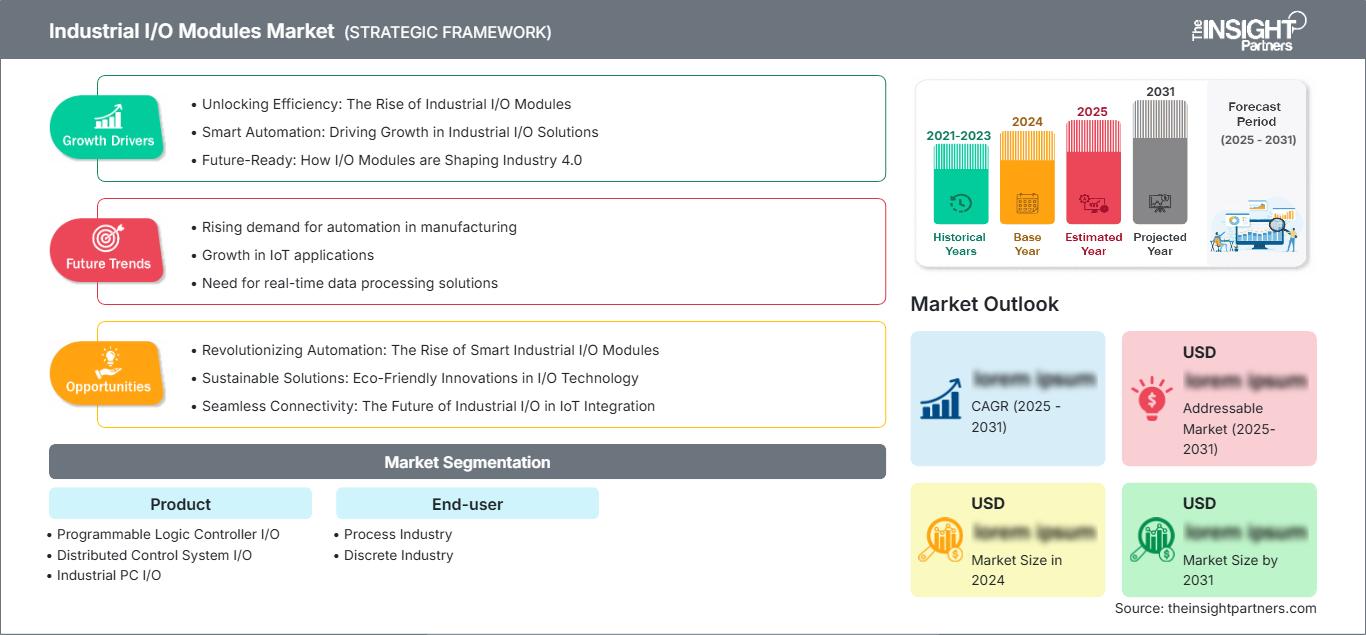
Industrial I/O Modules Market: Strategic Insights
Regional Insights
North America Industrial I/O Modules Market
According to the Industrial I/O Modules Market forecast, North America is estimated to represent a 26–29% share in 2025, with a regional CAGR of 6.0–7.0% from 2026–2034. The US continues to be the main contributor, which is backed up by improvements in factory equipment, investments in semiconductor production, logistics automation, and upgrading of the old programmable control systems in industrial facilities.
Contributors from Canada include applications in the field of energy, mining, food processing, and advanced manufacturing, whereas Mexico profits from the implementation of nearshoring and production growth in the automobile industry. The demand will be more directed at the remote and distributed I/O since such designs cut down on wiring and make machines easier to expand.
U.S. Industrial I/O Modules Market
The US is estimated to represent 68–72% of North America's 2025 market share and is projected to expand at a 6.2–7.1% CAGR from 2026–2034. Manufacturing reshoring, warehouse automation, and modernization of process plants support continued replacement demand for intelligent I/O architectures.
Uses range from automotive, electronic, pharmaceuticals, food processing, energy, to water infrastructure industries. Rockwell Automation, Inc. has expanded its product line through PointMax I/O, but Emerson Electric Co. still commands respect in process automation industry. Requirements have been influenced by need for smaller machinery, remote diagnostics, cybersecurity, and compatibility with existing control systems. The industry also gets a boost from investment intended to make production more resilient and less dependent on outdated automation components.
Europe Industrial I/O Modules Market
Europe is estimated to hold a 22–25% share in 2025 and grow at a 5.5–6.5% CAGR through 2034, with Germany leading regional demand. Industrial digitalization, energy-efficiency requirements, machinery modernization, and established automation ecosystems support sustained adoption across manufacturing and process industries.
The UK emphasizes flexible factory automation, process modernization, and distributed control architectures, while Germany benefits from a large machinery, automotive, chemicals, and industrial equipment base. France combines aerospace, automotive, food processing, and energy applications. Italy and Spain support demand through machinery manufacturing, packaging, food production, and industrial modernization. Siemens AG, ABB Ltd., and Mitsubishi Electric Corporation remain important technology suppliers across European industrial ecosystems.
APAC Industrial I/O Modules Market
APAC is estimated to account for a 34–38% share in 2025 and expand at a 6.5–7.5% CAGR through 2034, making it the leading regional market. China is the leader, aided by manufacturing scale, and Japan, South Korea, India, and Australia assist through automation and investment in infrastructures.
Industrial policy, electronics manufacturing, car making, and digitization of factories are behind the regional demand for devices. China and Japan continue to be important deployment regions, and India grows through the use of automation through manufacturing localization. South Korea assists semiconductors and electronics uses, while Australia helps through mining and process industries.
Middle East & Africa Industrial I/O Modules Market
Middle East and Africa demand is supported by energy infrastructure, water treatment, mining, logistics, and industrial diversification. Saudi Arabia and the UAE represent important investment centers, while South Africa remains significant for mining, utilities, manufacturing, and process automation.
The region is estimated to grow at a 5.0–6.0% CAGR through 2034, with Saudi Arabia positioned as a leading growth market. UAE projects emphasize smart infrastructure and industrial digitization, while South Africa supports automation in mining and utilities. Rest of MEA demand remains linked to energy projects, industrial facilities, and infrastructure modernization, creating opportunities for ruggedized and remotely managed I/O systems.
Segmentation Analysis
Product
Product demand varies according to controller architecture, installed-base compatibility, signal complexity, and plant modernization requirements. The segment is expected to expand at a 4.2–5.0% CAGR from 2026–2034. PLC-connected solutions remain foundational, while distributed and PC-based architectures gain relevance where flexibility, edge processing, and modular expansion are priorities. The Industrial I/O Modules Market scope therefore increasingly encompasses both centralized and decentralized control environments.
- Programmable Logic Controller I/O: PLC I/O remains the principal deployment category because of its extensive installed base, straightforward engineering workflows, and compatibility with machine-control applications. Demand is supported by modernization and incremental capacity expansion.
- Distributed Control System I/O: DCS I/O is strategically important in continuous and batch processes requiring high availability, redundancy, extensive diagnostics, and large numbers of analog signals. Refining, chemicals, power, and utilities remain important applications.
- Industrial PC I/O: Industrial PC I/O supports flexible computing-oriented architectures where data processing, machine vision, edge analytics, and software-defined control are increasingly integrated. Adoption is strongest in advanced manufacturing and specialized machine applications.
End-user
End-user demand reflects differences in process complexity, automation maturity, operating conditions, and equipment lifecycles. The segment is projected to grow at a 4.0–4.8% CAGR from 2026–2034. Process industries prioritize reliability and signal integrity, whereas discrete industries emphasize machine flexibility, rapid commissioning, and high-speed communication.
- Process Industry: Process industries require robust I/O for continuous monitoring, analog signal acquisition, safety functions, and distributed control. Long asset lifecycles encourage retrofit-compatible modules that minimize shutdowns and preserve existing engineering investments.
- Discrete Industry: Discrete industries increasingly adopt modular I/O for machine automation, robotics, packaging, automotive production, and electronics assembly. Compact footprints and decentralized architectures help manufacturers simplify wiring while supporting rapid line reconfiguration.
Opportunity Snapshot
| End-user | Revenue Contribution | Trend Tag | Adoption Stage |
|---|---|---|---|
| Process Industry | High | Process Safety | Mature |
| Discrete Industry | High | Smart Machines | Scaling |
Industrial I/O Modules Market Growth Drivers and Impact Analysis
Factory modernization and brownfield automation investment
One key structural trend includes the modernization of production equipment which still utilizes old-fashioned controllers, wiring in the center, and legacy I/O. Nowadays, many manufacturers prefer to update old modules during periodic maintenance procedures rather than to wait for a total rebuild of their plants. Consequently, there appears ongoing demand for compatible solutions, compact modules, remote I/O, diagnostics and other products. There are also advantages associated with brownfield projects which prefer providers who could keep the current control logic while enhancing connectivity in the process. From a business perspective, the revenue from such trends goes far beyond the mere sale of modules since engineering, configuration, commissioning and updating services often go hand-in-hand with hardware. In addition, plants with limited downtime periods appreciate the hot-swappable and modular approach enabling them to scale up production with minimum rewiring.
Expansion of distributed and remote control architectures
The proliferation of distributed automation is transforming both the location of I/O modules and their communication with the controller. Instead of putting all signals in the central cabinet, the companies place some of the I/O modules near the machine, process unit, and cell. In addition, such a solution can save on the cabling, cabinets, engineering, and installation efforts. The robust remote I/O is especially useful in applications related to material handling, automotive, packaging, water, mining, and outdoor industries. Thus, the vendors have started to compete in terms of enclosure ratings, protocols, diagnostic abilities, and installation options. The new design also allows integrating the safety I/O and intelligent device communication. The connection of additional equipment within the plant will enable the use of distributed I/O modules to increase signal capacity in a scalable manner.
Rising requirements for diagnostics, safety, and operational visibility
Today’s industry looks for I/O modules that offer more intelligence than merely signal processing. Diagnostics, including channel status, fault detection, time stamping, device diagnostics, and communication diagnostics can shorten the troubleshooting period and help make maintenance easier. The safety-certified I/O makes it possible for machine manufacturers and process operators to design protection mechanisms without developing separate hardware architectures. It thus facilitates more expensive I/O configurations and the transition from simple signal interfaces to smart interfaces. This is particularly important when unexpected downtime leads to considerable losses in production. Moreover, integration with industrial Ethernet, engineering software, and supervisory applications allows I/O data to be included in operation-related analysis. As a result, vendors with advanced diagnostic tools and good software integration will derive more value from each system installed.
Industrial I/O Modules Market Future Trends
Software-configurable and edge-aware I/O architectures
Future I/O platforms are likely to incorporate greater software configurability, enabling engineers to modify signal behavior, diagnostics, and device mappings without extensive hardware changes. This direction aligns with the broader adoption of edge computing and software-defined automation, where control functions increasingly interact with local analytics and higher-level applications. Industrial PC I/O is positioned to benefit because computing resources can support preprocessing before information reaches supervisory systems. Vendors may increasingly differentiate through engineering environments, reusable configurations, cybersecurity controls, and lifecycle management rather than hardware alone. Another likely development is tighter integration between I/O diagnostics and asset-management platforms. These capabilities can shorten commissioning, improve troubleshooting, and support predictive maintenance while allowing manufacturers to standardize architectures across multiple plants.
Higher-density I/O with integrated communications and safety
The Industrial I/O Modules Market trends show that module development is likely to focus on combining more functions within smaller physical footprints. High-density digital and analog channels, integrated communication interfaces, safety functions, and diagnostics can reduce cabinet requirements and simplify machine architecture. Such integration is particularly valuable for manufacturers facing space constraints or increasingly complex equipment designs. The next generation of modules is also expected to support broader protocol interoperability, enabling equipment from different suppliers to coexist within standardized industrial networks. This trend can reduce engineering barriers during brownfield projects, where complete replacement of existing automation systems is rarely practical. As regulatory expectations for machinery safety and cybersecurity become more stringent, module vendors will increasingly embed protective functions and secure configuration mechanisms. The result should be greater functionality per installed channel without proportionally increasing panel complexity.
Industrial I/O Modules Market Opportunities
Brownfield migration platforms for legacy control systems
A significant opportunity exists in developing migration platforms that connect modern I/O modules with legacy controllers and field wiring. Many industrial facilities cannot justify complete automation replacement because shutdown costs, engineering risks, and validation requirements are substantial. Vendors can address this constraint through adapter modules, conversion interfaces, reusable configuration tools, and staged migration architectures. Such solutions can preserve valuable installed infrastructure while gradually introducing modern diagnostics, remote connectivity, and higher-density signal handling. The strongest opportunities are likely in process plants, utilities, chemicals, food production, and mature discrete manufacturing facilities. Vendors that combine migration hardware with engineering services can establish longer customer relationships and increase recurring revenue. The Industrial I/O Modules Forecasts therefore point toward a substantial role for modernization-led demand alongside new greenfield installations.
Localized manufacturing and application-specific module development
Regional manufacturing expansion creates opportunities for suppliers to establish localized production, engineering, and service capabilities. India, Southeast Asia, Mexico, and selected Middle Eastern economies are developing industrial capacity that requires automation hardware adapted to local operating conditions and procurement requirements. Application-specific modules can address needs in water, mining, energy, automotive, packaging, and electronics manufacturing. Localization can reduce delivery times, simplify customization, and improve resilience against global supply disruptions. Companies can also strengthen competitiveness by partnering with system integrators and machine builders that influence component selection early in project design. Product portfolios tailored to regional voltage standards, environmental conditions, communication protocols, and maintenance practices can create differentiated positions without requiring entirely new automation platforms. This strategy can be particularly effective where local content policies influence capital-project procurement.
Recent Developments
- July 2026: Siemens AG launched SIMATIC AX WinCC Unified Elements, an IT-style engineering application designed to accelerate automation application development through modern software workflows, version control, and deployment practices. The launch illustrates the industry's movement toward software-centric engineering environments that increasingly complement hardware automation platforms and simplify industrial application development.
- May 2026: Emerson Electric Co. introduced major enhancements to its AspenTech Inmation OT Data Fabric, positioning it as an enterprise-scale industrial data backbone for contextualized, AI-ready operational information. The development strengthens the connection between plant-level automation data and enterprise applications, reinforcing the industry's transition toward integrated OT and IT architectures.
- June 2025: Rockwell Automation, Inc. introduced PointMax I/O, a modular remote I/O system designed to provide scalable architectures, smaller footprints, and greater design flexibility for modern industrial operations. The platform supports both new machine development and modernization, reflecting growing demand for distributed I/O and simplified control-system integration.
Frequently Asked Questions

- Comprehensive Market Sizing and Forecast Analysis
- Detailed Segmentation Analysis
- In-Depth Market Dynamics Assessment
- Regional and Country-Level Insights
- Competitive Landscape and Company Benchmarking
- Strategic Business Intelligence
Recent Reports
Testimonials

The Insight Partners provided valuable market intelligence that supported our global go-to-market strategy. Their team was professional, responsive, and attentive to our feedback, providing thoughtful analysis and helpful methodological clarifications throughout the project.
Junmo Kim Chief Financial Officer (CFO), Enertech Co., Ltd.
The Insight Partners' SCADA System Market report is comprehensive, with valuable insights on current trends and future forecasts. The team was highly professional, responsive, and supportive throughout. We are very satisfied and highly recommend their services.
RAN KEDEM Partner, Reali Technologies LTDs
I requested a report on a very specific software market and the team produced the report in a few days. The information was very relevant and well presented. I then requested some changes and additions to the report. The team was again very responsive and I got the final report in less than a week.
JEAN-HERVE JENN Chairman, Future Analytica
We worked with The Insight Partners for an important market study and forecast. They gave us clear insights into opportunities and risks, which helped shape our plans. Their research was easy to use and based on solid data. It helped us make smart, confident decisions. We highly recommend them.
PIYUSH NAGPAL Sr. Vice President, High Beam Global
The Insight Partners delivered insightful, well-structured market research with strong domain expertise. Their team was professional and responsive throughout. The user-friendly website made accessing industry reports seamless. We highly recommend them for reliable, high-quality research services
YUKIHIKO ADACHI CEO, Deep Blue, LLC.
This is the first time I have purchased a market report from The Insight Partners.While I was unsure at first, I visited their web site and felt more comfortable to take the risk and purchase a market report.I am completely satisfied with the quality of the report and customer service. I had several questions and comments with the initial report, but after a couple of dialogs over email with their analyst I believe I have a report that I can use as input to our strategic planning process.Thank you so much for taking the extra time and making this a positive experience.I will definitely recommend your service to others and you will be my first call when we need further market data.
JOHN SUZUKI President and Chief Executive Officer, Board Director, BK Technologies
I wish to appreciate your support and the professionalism you displayed in the course of attending to my request for information regarding to infectious disease IVD market in Nigeria. I appreciate your patience, your guidance, and the fact that you were willing to offer a discount, which eventually made it possible for us to close a deal. I look forward to engaging The Insight Partners in the future, all thanks to the impression you have created in me as a result of this first encounter.
DR CHIJIOKE ONYIA MANAGING DIRECTOR, PineCrest Healthcare Ltd.Reason to Buy
- Informed Decision-Making
- Understanding Market Dynamics
- Competitive Analysis
- Identifying Emerging Markets
- Customer Insights
- Market Forecasts
- Risk Mitigation
- Boosting Operational Efficiency
- Strategic Planning
- Investment Justification
- Tracking Industry Innovations
- Aligning with Regulatory Trends





 Get Free Sample for